Showing posts with label Greg Cochran. Show all posts

Wednesday, March 05, 2025

'Empathising and Systematising' - a short story by Adam Carlton


Antoinette and myself at my agent's office

She walked across while I was waiting to see my agent.

Antoinette: I remembered just in time. One of the readers of the slush pile. Bottom of the food chain in the business.

But Antoinette stood out, I thought: she had sparkle.

"Hi Adam," she said, showing me a printout, "I came across this and I'm puzzled. My first thought was, well, it's not for us; but something about it - the argument - it piqued a bit of interest..."

She gave me a charming smile, with only the slightest flicker of irony, and handed me the document.

"I thought of you."

Like I said, smart girl.


The Evolution of Elite Cognition: Systematizers vs. Empaths in the March of Civilization

By Dr Henry Lutending

Human society was once small, tribal, and violently xenophobic. Hunter-gatherers operated in tight-knit bands well below the Dunbar limit, where social trust was personal, reciprocity was direct, and there was little requirement for abstract reasoning or large-scale cooperation. The only selection pressures at play were for basic survival skills—strength, cunning, a capacity for immediate social bonding, and a deep suspicion of outsiders, who, given resource limitations, were almost certain to be hostile.

Then came agriculture, surplus, cities, and suddenly, a new game. Societies grew beyond the size where direct reciprocity was possible. Elites—those who could manage complex societies—emerged. And to do that, they needed two things: (1) systematizing intelligence, to plan taxes and economies, develop legal codes, and run administrative structures; and (2) high-level prosociality, to negotiate, defuse conflict, and create the ideological glue that held populations together. In short, enhanced intelligence and empathy became adaptive in a way they simply hadn’t been before.

Selection responded accordingly. Over the last ten thousand years, elite classes across civilizations—from the Middle-East to China—developed traits that were alien to their peasant underclasses. Elites had to think long-term, manage abstract systems, and suppress impulsivity in favor of diplomacy and reputation-building. These traits, culturally vital, were biologically selected. The best networkers and system-builders left the most descendants, shaping gene frequencies over time. (Peasants also adapted away from their hunter-gatherer forebears, to a life of sedentary drudgery and endemic disease - a different set of adaptations).

Selection was fast, messy, and polygenic. Just as rapid selection for intelligence in Ashkenazi Jews produced both extraordinary cognitive abilities and a cluster of neurological disorders [1], so too did the selection for high-trust, high-intelligence elites produce its own variety of pathological byproducts—over-systematization, over-empathizing, and the various maladaptations we now call autism, anxiety disorders, and elite neurosis.

Fast forward to today, and we see the consequences all around us. The class structure of modern Western societies forms a cognitive and temperamental cline.

At one extreme, the criminal underclass: impulsive, aggressive, low-future-orientation, thriving on immediate dominance rather than delayed reciprocity.

At the other extreme, the hyper-refined elites: measured, strategic, highly networked, masters of abstract thought but often physically timid, conflict-averse, and tempted toward comforting illusions at the expense of harsh realities they are often insulated from.

Within those elites there has always been a schism: between the systematizers, who think in hierarchies, structures, and long-range planning; and the hyper-empaths, who seek to create moral consensus, enforce ideological norms, and suppress overt aggression in favor of soft power.

This schism is the backbone of our present culture wars. The progressive elites—the hyper-empaths—dominate institutions that rely on moral framing: academia, media, HR bureaucracies. They create narratives, enforce taboos, and attempt to neutralize dissent through social pressure rather than direct confrontation - repressive tolerance, in Marcuse's words [2]. 

Their failure mode? Paralysis in the face of real conflict, an inability to handle reality when brute force is required, and the consequential destruction of high-trust norms when predatory actors exploit them. As the phrase goes: when the bullets start flying, the liberals leave the room, in tears, wringing their hands.

Meanwhile, the systematizing elites—the pragmatic, hierarchical, and meritocratic—lean toward finance, tech, the military, and entrepreneurial domains. Their failure mode? Brutal, zero-sum thinking, a tendency to ignore social legitimacy, and, in the extreme, a return to old-fashioned coercion when persuasion fails.

Every current civilization oscillates between these poles. When the systematizers dominate too completely, society hardens, becomes rigid, loses social legitimacy, and collapses under its own brutal hierarchies. When the hyper-empaths dominate, society feminizes, unmoors itself from reality, loses its ability to defend itself, and becomes prey to external or internal predators.

The pendulum swings. And right now, after decades of progressive dominance, it’s swinging back. The liberal consensus, built on high-trust norms and an almost pathological aversion to direct power, is fracturing under the weight of its own contradictions. The coming era will be more masculine, more systematizing, and, inevitably, more coercive.

AI adds a new factor to the mix.

If elite cognition has been honed by centuries of intense selection for specific traits—systematizing, empathizing, problem-solving, and navigating complex social structures—what happens when you begin to outsource those very traits to machines? Artificial intelligence, for example, could decouple cognitive labor from biology entirely, allowing for a kind of disembodied, almost immortal competence that doesn't have the same evolutionary pressures we do. The very nature of "elite" ability could shift radically, and potentially in a direction that doesn’t favor the long-standing human social fabric.

This has been explored in a fictional setting by the author S. M. Stirling in his sequence [3], The Domination of the Draka. The books explore an alternate history where the Draka, a brutal and highly militarized society, dominate much of the world.

Draka society is not simply a dystopia in the sense of a broken system, but rather an alternative hyper-competent, brutal, and authoritarian regime that has achieved a form of success. The Draka operate on the mastery of domination through genetic servitude to create an order that is efficient, stable, and terrifying.

It's not the only future we can envisage. Once technology has improved on mere human labour, it may occur to elites to simply let the working classes fade away to extinction. With the total fertility rates we see in modern economies, that's probably the default option, anyway.

The abilities of elite populations to genetically optimise their own systematizing and empathizing traits has never been greater. Paradoxically as genome engineering makes that imminent prospect enticing, the arrival of superhuman embodied AI may render it unnecessary. 

The elites will transition to something new, to be sure: it may even be their own extinction.

References

[1] "The Ten Thousand Year Explosion". Cochran and Harpending, 2009.

[2] "Repressive Tolerance". Herbert Marcuse, 1965.

[3] "The Domination". S. M. Stirling, 1988-96.


I looked back at Antoinette in disbelief.

“Where to begin? References to genetics in social science, fascistic regimes cited without obligatory moral condemnation?

"Does this guy even have a job?”

Antoinette shrugged, her tight, translucent blouse shimmering in the sun, “There's no affiliation on his manuscript - maybe he's an independent researcher. So what do you think? The circular file?"

I thought about it. Normally yes, of course. But perhaps the times were changing; perhaps a smart agent could get ahead of the curve...

"I think you should go for it, it's kind of interesting, after all. But to be on the safe side, make sure you frame it as satirical fiction...”


Thursday, March 19, 2020

COVID-19 Notes: March 19th 2020

 
Amazon link

Sun Tzu's 'Art of War' is quite a short text dating from the Late Spring and Autumn Period (roughly 5th century BC). It mostly describes how to fight guerrilla wars of deception against a numerically-stronger enemy in various terrains. The advice is functional and callous, describing for example the great utility of 'disposable spies' for feeding false information to the enemy (they will of course be killed once their treachery is unmasked) and noting the improved resolve of armies manoeuvered onto 'fatal terrain' deep in enemy territory, where they will fight or die.

The reason I read the book was more for the copious introduction and scene-setting - Chinese history prior to and during the Warring States period (475 BC). Also the subsequent understanding of The Art of War in the empires which followed. What I learned was that the Emperor, the Son of Heaven, had a Mandate of Heaven. As Wikipedia explains:
"According to this belief, Heaven (天, Tian) — which embodies the natural order and will of the universe — bestows the mandate on a just ruler of China, the "Son of Heaven" of the "Celestial Empire". If a ruler was overthrown, this was interpreted as an indication that the ruler was unworthy, and had lost the mandate. It was also a common belief that natural disasters such as famine and flood were divine retributions bearing signs of Heaven's displeasure with the ruler, so there would often be revolts following major disasters as the people saw these calamities as signs that the Mandate of Heaven had been withdrawn."
In this light it is not hard to see why the Chinese Communist Party and State used such severe methods to drop R0 to around 0.3 and squelch the epidemic. It wasn't humanitarian concerns - it was their response to an existential test of their right to rule.

Amazon link

I'm currently reading this: an analysis of recent Chinese history (humiliation and shame at the hands of Western and Japanese imperialists - only reversed in the last few decades). The story is told through the biographies of key Chinese intellectuals and leaders. Basically China had to make a major cultural shift from the dead-weight of an agrarian-Confucianism (rigid, static and statist) to a form and ideology of governance which would permit the development of a dominant capitalism. It's ironic that only a Stalinist version of Marxist-Leninism could prove strong enough to force open those doors. The Chinese now feel sufficiently secure to readmit a new, legitimising neo-Confucianism.

The chapters itemise a chronicle of defeat as all obvious strategies of modernisation were attempted only to fail, leading to further predations by China's vulure-enemies. You can see why they hate the Japanese and despise the West: they have every reason to based on recent history.

---

I remain sceptical about European attempts to push R0 below 1. Despite Greg Cochran's advocacy (which I linked to in a previous post). I think people have no idea just how very drastic, very police-stateish, were the methods employed in East Asia.

In Italy, by contrast, the lockdown measures sound suitably draconian. However, mobile phone records shows widespread non-compliance (45% of Italians are wandering around outside their homes), the case-numbers keep rising and in the anarchic south the infection has barely begun. All this talk of Italy soon reaching a peak is so much hot air.

In the UK - more compliant but more densely populated - they will certainly get R0 reduced but I'm doubtful if the epidemic can be put into reverse. I'm not even sure that's the real intention. As people have pointed out, the Imperial paper which everyone was citing assumed that treatment resources would stay flatlined. But of course they will quickly ramp up over the next two months or so, compensating for our inability to actually lock down enough people.

Playing with exponentials is a risky business, like trying to hold a slippery fish. This could still all go pear-shaped (if the pears are >1 exponential).

---

We ourselves are hunkered down and will pop out to Waitrose this evening when numbers are predicted by Google to be low. Grab some milk to freeze. Don't think there are many infected in Wells yet so it's still the phony war. As Covid-19 is a disease of the elite, I suggested we might shop at Morrisons instead, but Clare noticed their toilets were pretty unhygienic a while ago, so that's ruled out.

Meanwhile, life goes on...
---

Sunday, March 15, 2020

COVID-19 notes: mid-March 2020

We were walking around Wells marketplace yesterday. Everything normal: the market stalls were all in place, crowded with people; the high street was full of passers-by.

No masks of course.

My estimate is that there will just be a handful of people with the infection at the moment: no-one here will know anybody who has a real problem (above the noise level of normal winter illness).

---

The criticisms of the Government's policy are largely idiotic. They remind me of the apocryphal Star Trek quote: "We gotta slow down, Cap'n, the crew cannae take any more!"

Despite the robust pronouncements of an excitable Greg Cochran, Europe and the States can't get R0 below 1 - the political institutions and popular mandate don't permit it (nor is it desirable given the risks of further outbreaks). So the infection will run its course at a rate which is subject to only marginal re-engineering.

Despite the polemics, UK policy is essentially the same as that being applied in Europe, factoring in the time-lags. I'm expecting the UK peak to be mid-May (if delays don't really work) to mid-June (if they do). The earlier date is 60 days from today: eight and a half weeks.

We will soon find out what 400,000 dead looks like: [67 million * 60% * 1%]. 

Note that the background death rate in the UK is around 100,000 per month.

[70 million population divided by 70 years of life = 1 million dead/year; 100,000/month].

"Fifty percent of cases would be within two thirds of a standard deviation from the central point, which gives 2 * (2/3) * (2.25) = 3 weeks."

So during the peak three weeks, the death rate will be 275,000/ 75,000 = 3.7 over normal.

We will notice when every 'normal' dead body is accompanied by three additional ones..

---

I read a couple of books where the first half - analysis - was excellent while the second half, conclusions and recommendations, was rubbish. It's what happens when somewhat-bright people review the work of people who are really smart - but then expose their own lack of insight.

Amazon link

Great analysis of Marx's sociological and economic thinking. Best summary if you are already familiar with the economic concepts (c + v + s etc). But his conclusions, where he indicates why he is no longer a Marxist, are just ... terrible. Not wrong: just superficial, lacking insight.

Example thought: 'Marx's economics work is not used by modern economists: it's like it never existed at all'.

Right.

---

Amazon link

Kagan has a good, clear-eyed analysis of the basis of the post-WW2 order. American hegemonic power created a global Hobbesian state in which lesser (but historically dangerous) powers - Germany, Japan - were disarmed and prevented from rising again. A somewhat demilitarised non-American capitalist world gained the benefits of trade: Les Trente Glorieuses.

The unravelling of neoliberalism, dominated as it was by globalisation, financialisation and a growing separation between the elites and the masses, has refracted itself into political crisis everywhere together with the fraying of the 'American mission to the world'.

Kagan is broadly correct in this analysis and his writing is historically-informed: 'the jungle always grows back'.

At this point his intelligence fails him. He confuses the epiphenomenal role of elite institutions (EU, IMF, UN) with those real global, historical forces which are transforming class and inter-state relationships. His tail wags his dog - a paradigm which the first half of his book has already decisively refuted.

---

What I'm reading now

Amazon link
Ten volumes (out of twenty) so far published (Wikipedia article). I'm on volume three.

This is good old-fashioned SF on the grandest scale with a cast of thousands - most of whom end up horribly dead.

A frightening view of a future dominated by China with its traditional Confucian culture of Han superiority, disdain for 'Barbarians' and a preference for a life of regimented stasis.

Nope. Will never happen.

Wednesday, November 21, 2018

"Blueprint" - Robert Plomin (a review)

Amazon link

Plomin's book is written in a practical, down to earth style. It's not at all academic. The big ideas (relentlessly hammered home) are these.

  • All traits (physical and psychological) have a substantial genetic component. Heritability is around 50% as a rule of thumb. Higher for traits like height, weight and intelligence.

  • Shared environments such as the family and school do not significantly affect traits. Schools don't make you smarter and parents don't make you nicer.

  • Schools will educate you to your potential aptitude if they're any good (and may socialise you into an elite). Bad parenting can damage a child. But absent active damage, it's the child's inherited genetics which determine performance and personal outcomes.

  • Non-genetic influences on traits are the generally random effects of life events and short lasting (these include test imprecision).

  • Apparent environmental differences (eg parents who read to their children in a house full of books as against ...) have a substantial genetic component (studious parents have studious children). Plomin describes this as nature in nurture.

Strong claims, but based on vast experiments with hundreds of thousands of participants. The results strongly replicate. Problem is, they're quite counterintuitive and few people believe them.

Toby Young writes in Quillette about a recent debate in London:
"On Monday in London’s Emmanuel Centre a debate took place that pitted two Quillette contributors - Robert Plomin and Stuart Ritchie - against two “experts” on child psychology - Susan Pawlby and Ann Pleshette Murphy. The motion was “Parenting doesn’t matter (or not as much as you think)” ...

The ushers asked people to vote for or against the motion on their way in and then again at the end, the idea being that the “winners” would be the side that persuaded the most people to change their minds rather than the side that got the most votes. Which was just as well for Plomin and Ritchie since only 17 percent agreed with them at the beginning of the evening, with 66 percent against and 17 percent saying “Don’t Know.”
Young describes the debate in detail and then describes the results:
"The debate was well-chaired by Xand van Tulleken, a doctor and broadcaster who has an identical twin brother named Chris, and, after he’d taken plenty of questions and done his best to sum up, the audience was asked to vote again.

As expected, a majority still disagreed with the motion, but Plomin and Ritchie had succeeded in persuading some people to change their minds. The number against the motion declined from 66 percent to 51 percent, while those in favor increased from 17 percent to 29 percent, with 20 percent saying “Don’t Know.”

That made Plomin and Ritchie the winners."
Few people truly believe scientific abstractions until the engineering stares them in the face. But that could happen, given the falling cost of whole genome sequencing together with ever larger scale Genome-Wide Association Studies (GWAS) for every trait imaginable.

Soon anyone's genome will be cheaply sequenced and their polygenic scores read off (at any age including infancy, in utero or for IVF selection) to deliver personalised results for a palette of physical, psychological and aptitude life-traits.

Already there are the early signs that the liberal media, the op-ed writers and professional pundits are beginning to warm to the idea. Plomin seems to have avoided the public evisceration he was undoubtedly fearing.

The book is interesting, important and enlightening. One of the books of the year.

---

Eric Turkheimer on his blog is complaining that Plomin has used his ideas without attribution. This may be true but he should get over it: this is popularisation, not academia. If the reception had been super-hostile, Turkheimer might now be experiencing relief rather than angst.

Turkheimer is not alone, by the way. Few of Plomin's peers get namechecked. There could be a few more bruised egos out there.

---

James Thompson of UCL has an excellent and detailed chapter-by-chapter review and Greg Cochran wrote a review at Quillette, "Forget Nature Versus Nurture. Nature Has Won".

Worth checking both out.

Wednesday, November 14, 2018

"Blueprint: How DNA Makes Us Who We Are" - Robert Plomin

Amazon link

Robert Plomin is one of the good guys, and this book is apparently a summing up, for a general audience, of his life work. It has just arrived and is on the stack.

Meanwhile Dr James Thompson of UCL has an excellent and detailed chapter-by-chapter review, from which this short excerpt.
"Chapter 11 is about the development of genome-wide association studies. Chapter 12 is a very substantial one about genetic prediction. Chapter 12 is Plomin’s real coming out: he reveals his polygenic scores for all to see. Naturally, this is a teaching opportunity, explaining the insights and the limitations of such measures. Figs 6 and 7 are worth showing again and again, if only to explain polygenic scores and their overlaps, and the fact that they provide probabilistic estimates, not certainties."
Greg Cochran has written a review at Quillette, "Forget Nature Versus Nurture. Nature Has Won".

And Toby Young, also at Quillette: "Is Sociogenomics Racist?".  No, he argues.

I'm looking forward to reading and learning. Update: here's my review.

Monday, October 22, 2018

The evolutionary genetics of homosexuality (GWAS)


Tom Whipple, science editor at The Times, has this piece today.
Sexuality genes linked to sex appeal

The genes that make some people gay could also help straight people to have more sex, according to a study that may help to explain the evolutionary paradox of homosexuality.

Although there is no “gay gene”, scientists have long known that there is a strong genetic component to homosexuality. This leads to a conundrum: given that gay people have fewer children, the genes linked to homosexuality might be expected to be less likely to survive.

A leading theory of why this does not happen has now received its clearest validation. US scientists scoured the genomes of 400,000 people and compared their DNA to surveys about their sex lives. They identified a whole suite of genetic variants associated with people having had a same-sex partner.

They also looked at the sex lives of those who had those genes but who had never slept with someone of the same sex — and found an intriguing result.

According to the results, presented by an international team of researchers to the Human Behaviour and Evolution Society, straight people with the gay genetic variants had more sexual partners and were seen as more attractive. This fits with the “gay genes hypothesis”: that the genes that make some people gay persist in the population because they have reproductively beneficial effects in others.
It's been clear for a while (see lead author Brendan Zietsch's paper from 2008) that female relatives of gay men (such as their sisters) tended to have more children than the female relatives of men with fewer gay characteristics, and that heterosexual men with more alleles for feminised traits were also more reproductively successful. This has been called the Johnny Depp effect. The novelty here is the size of the sample, 400,000, and the use of genomic data.

Whipple did not give a reference and it took me a little while to track down the actual paper, from here.

HUMAN BEHAVIOR AND EVOLUTION SOCIETY
30th Annual Meeting
July 4th – July 7th, 2018

The evolutionary genetics of homosexuality

Brendan Zietsch, Andrea Ganna, Karin Verweij, Felix Day, Michel Nivard, Robert Maier, Robbee Wedow, Abdel Abdellaoui, Benjamin Neale, John Perry

Homosexual behaviour in humans is genetically influenced and is associated with having fewer offspring. This presents a Darwinian paradox: why have genes that predispose to homosexual behaviour been maintained in the population despite apparent selection against them?

Here we show that genes associated with homosexual behaviour are, in heterosexuals, associated with greater mating success. In in a genotyped sample of more than 400,000 individuals from the UK and USA, we for the first time found genome wide-significant association of specific variants with ever having had a same-sex partner, and hundreds of additional variants were significantly associated in aggregate.

Among men and women who had never had a same-sex partner, these same aggregate genetic effects were significantly associated with having more lifetime sexual partners and, in an independent sample, with being judged more physically attractive. Our results suggest that genes that predispose to homosexual behaviour may have been evolutionarily maintained in the population because they confer a mating advantage to heterosexual carriers.
The paper is gated of course, and I haven't been able to find an open-access version. But you get the idea. I suspect we're well down the road to putting Gregory Cochran's 'gay germ' theory to rest.

Monday, March 26, 2018

Russia and America should be friends?

At West Hunter, Greg Cochran writes:
"the true strategic threat to both Russia and the United States is China (not the casbah, for God’s sake): the cowboys and the Cossacks should be friends."
This makes sense from an American nationalist viewpoint: superpower politics. It also makes long-term strategic sense for Russia, looking at their Siberian border with China.

---

If super-intelligent, incredibly-prosocial and pleasantly-attractive aliens landed in, say, Australia with a view to world colonisation - should we be in favour? They sound nicer than us. Or should we be with Juan Rico: on the bounce and looking out for the interests of the human race, come what may. My species, right or wrong.

Amazon link

Frank Salter had a flawed and controversial book, "On Genetic Interests: Family, Ethnicity and Humanity in an Age of Mass Migration", out in 2006 arguing that:
"In modern Darwinian theory, bearing children is only one way to reproduce. Since we share genes with our families, ethnic groups, and the species as a whole, ethnocentrism and humanism can be adaptive."
But the average level of relatedness between random members of a genetically-homogeneous nation is about 1/128 (discussion here). This doesn't seem nearly enough to trigger any emotional feelings of kin solidarity, see here.

Nevertheless, there's plainly a measure of emotional solidarity underlying nationalism. It seems to work through shared cultural signifiers (appearance, dress, behaviour, speech patterns, interpersonal style, social conventions and ritual) rather than that you know your co-ethnics at an individual level and feel some nationalistic kin-warmth towards them. That emotional propensity seems also to have been selected for - you don't see it in other animals. It does, however, facilitate the building of empires, which are astonishingly good for your genes.

Tuesday, February 06, 2018

Hobbit devolution

Marginal Revolution resurrected this ancient article from Greg Cochran - a moral tale with a punchline.


Brief summary:
  • Brains can go down as well as up because: evolution.
  • Small populations accumulate rising mutational load - brains are a prime target.
  • If there's a devolved ecological niche waiting in the wings, watch out!

Tuesday, January 02, 2018

Another year ...

So I measured my weight this morning. After two weeks of unrestrained gluttony I'm three pounds up (68.5 from target 67 kg) and showing all the signs of advanced sugar poisoning on my increasingly-blotchy skin.

Dr Michelle Braude - "eat carbs and lose weight (but ditch the red meat)"

The Times this morning has another brain-dead diet article from the latest pretty-young-waif with a book-to-sell (cut out red meat!) - but I'm on the Matthew Parris diet. I may even run this afternoon. If the rain stops.*

---

It's my birthday - soooo welcome as the years advance! - and a special commemorative photo shows off my birthday card!

Clare admires the skill of the photographer

---

In those few moments whilst not engaged in eating I was engrossed in books over the Christmas period. From Greg Cochran's list I chose:

Amazon link

Sajer's account of his years on the Eastern Front as a very young soldier takes the reader to new depths of human suffering. How did any of those guys survive? And as soldiers of a demonised regime who ended up on the losing side, their experiences have been erased from history - can't be spoken of in polite company.

So the clue is in the title.

Amazon link

I can see why Dr Cochran liked this pulp classic. The focus is on biology and directed evolution, and the plot is interesting .. and very fifties in style although dating from the late eighties. Chase's books have been described as clever, rather intellectual but a little flat. I found it so and would not recommend it.

---

I'm much more energised by the uneven but exciting Merchant Princes omnibus trilogy.

Amazon link

Amazon link

Amazon link

Don't want to go into the details of this vast sprawling saga - here's the Amazon summary.
"Miriam Beckstein is a successful reporter for a hi-tech magazine. So when she discovers a huge money-laundering scam, she thinks she's hit the big time. But when she takes it to her editor, not only is she fired, but she starts to receive death threats. And that's just the beginning.

"To distract her furious daughter, Miriam's adoptive mother unearths mementos from her real mother, murdered when she was an infant. But these reveal a secret that will ultimately throw entire governments into disarray. For what Miriam thinks is a simple locket has the power to fling her into an alternate timeline. In this less-developed world, knights on horseback wield automatic weapons, and world-skipping assassins lurk - all on the other side of our reality. Here, her true family runs a criminal empire - and they want her back. But Miriam has other plans.

Following The Bloodline Feud are two further omnibus volumes, The Traders' War and The Revolution Trade."
There is a follow-on trilogy: Empire Games and Dark State (with the third volume due in 2019). Charles Stross has 'crib notes' - beware spoilers.

Charles Stross is very bright and well-read across a number of disciplines, from physics to genomics to economics and contemporary politics. Some people have read this series as 'Economics Science Fiction' while for others it's a liberal-minded allegorical critique of US policy over the decades.

Stross is a good enough writer to leave his personal agenda largely to one side. All the factions have understandable motives. In a rather patchy way, it's an increasingly compelling read: recommended.

I particularly liked his Accelerando too.

---

* Update (1.45 pm): I last exercised back in September: the winter recess. I am amazed at how fast - and how completely - fitness rolls off you. Five minutes on the exercise bike left me gasping and wobbly - literally weak at the knees. Then a run around the block: 1.23 km = 0.76 miles.

(The full run up the hill and back is 3.22 km = 2 miles - and 55 metres vertical. Took me 18 minutes, back in the day).

Last time I did round the block (in September) it took me 6 minutes and 45 seconds. Today 7 50.

Upon this sorry baseline, fitness will be rebuilt in 2018.

Tuesday, August 08, 2017

James Damore gets fired

The rainbow colours of diversity

The ex-Google employee was terminated for observing (in an internal memo) that genders differ in their aptitude for, and interest in, computer science.
Steve Hsu has this to say, while Scott Aaronson has written an elegant and oblique post.

---

Blank-slate ideology asserts that all humans - of whatever gender and/or race - are cognitively biologically-identical, and that therefore all detrimental differences of outcome are solely due to oppression. When elites defend plainly-wrong ideas with the utmost ferocity, I am reminded of Marx's point, "The ideas of the ruling class are in every epoch the ruling ideas."

Why would the ruling elite want to believe it? Because it would be so dangerously divisive to look at any human subgroup and affirm that group's lower average cognitive performance or competence. Even identifying plainly outperforming groups - such as the Ashkenazim - risks opening the door to the concept of differences. So extreme is this impetus to faux-egalitarianism that many people deny even physical performance differences between genders or races. Social cohesion is the game.

I keep reminding myself (I already wrote about this) that globalisation is the economic driver for blank-slate ideology. Its young, educated beneficiaries are eager converts (arguably against their own longer-term interests) to causes so apparently egalitarian, culturally left-wing .. and economically convenient for globalised capital.

At least we haven't reintroduced the auto-de-fé yet or I wouldn't be writing this.

---

The Google CEO's sophistry was particularly disingenuous: see "If Google did heavy lifting ...".

Tuesday, July 04, 2017

The Tao of Immortality

Amazon link

If "A Wizard of Earthsea" is a boy's coming-of-age and "The Tombs of Atuan" is a girl's coming-of-age, then "The Farthest Shore" is a mature reflection on power, its limits and the deeper purposes of life.

The storyline concerns the disintegration of magic - a side effect of a maverick sorcerer, Cob, who develops a great spell to ensure his own immortality. Le Guin portrays this as the ultimate destabiliser of the balance of life, the harmony of all existence. Death-removed is stasis; death is the prerequisite for the renewal of life.

Very Taoist and emotionally satisfying, even a little convincing; but my inner skeptic has qualms.

---

The modern theory of aging is that of senescence although controversies rage. But as Greg Cochran observes, in theory it should be fixable. In surveys, people seem to be split as to whether they would take up an offer of personal immortality.

If I was offered a course of treatment which rendered me immortal, I wouldn't be interested. I'm too stupid and slow at age 66: I see only voyeuristic tedium in millennia to come. But perhaps the salesman has an upgraded deal?

Perhaps my ageing, error-strewn DNA could be debugged and re-implanted somehow to make a quasi-clone. A new, vibrant baby-me, ready to start a new life without all those burdensome memories and bodily breakdowns. When I was such an infant, I'm sure that I was up for life .. so that would have to be a yes, then.

But why stop at cloning? Why not introduce some extra variety, explore new regions of the corporeal and psychological state-space? Sounds like an even better plan.

Oh, wait. You say we do that already?

---

I think it's an open question as to whether a society which had genetically-engineered extremely-long life would have strategically greater reproductive success than current-lifespan societies. That is the issue at stake here.

One day some society will try it - and evolution will have another sub-species to test..

Wednesday, April 12, 2017

Diary: today's chronicle of failures

Jerry Pournelle's blog (on the sidebar to the right if you're in a PC browser, otherwise here) has a recurring theme where he details his struggles with recalcitrant Microsoft products and sundry other applications.

I felt his pain today. The laptop refused to connect to the scanner (Epson BX630FW). I tried all the usual stuff: restarted everything, reconnected all devices to the router, reinstalled the printer software, switched from WiFi to an Ethernet connection, ... .

Result: stuff prints but the scanner remains unrecognised. My best guess is that something in the printer/scanner has broken. The workaround is just to take pictures via the pretty good camera on my Nexus 6 phone - I'm in no hurry to replace the five year old Epson device.

---

Work on the 'famous' chatbot has paused. Reason: I know how to do it and consequently I'm already bored.

The interesting hurdle was my bucket-list objective of getting a proper, FOL resolution theorem prover to work. Now that it does (gratifyingly high in Google searches), moving on to a planner has lost much of its appeal.

I suspect much of the power of a chatbot anyway is in the data (ie the data-fill), not the sophistication of the underlying architecture or algorithms. This makes me even less excited.

A deeper problem. A chatbot needs to interact with conversationalists and to learn. Minimally, this needs Internet access and engagement with a messaging platform such as Skype, Twitter or Facebook. But if you start from Common Lisp the integration problems look rather daunting and even expensive. I'm not enthused about shifting to Javascript or Python, where such integration would probably be easier.

So I'm awaiting some conceptual innovation sufficiently exciting to remotivate me. Something like cracking consciousness perhaps 😎 ...?

---

My favourite article today: this meditation from Greg Cochran disinterred from 2013 and still completely relevant.
"... Syria was born for trouble. Although we all know that ethnic diversity is our strength, better than ice cream or unicorn poop, it appears that Syria (like much of the Middle East) has managed to acquire too much of a good thing. Paradoxical as it may seem, Syria is actually overly diverse.

There are very ancient Christian communities, as well as Kurds (who aim for an independent Kurdish state, an idea that horrifies Turkey), but the real fight is between the Sunni Arabs (about 60 percent of the country) and the Alawites, who run the show and make up about 12 percent of the population. I’m sure that most of my readers are fully conversant with every detail of the history and practices of the various Muslim denominations,—just as our lawmakers are—but let me talk about the Alawites for a moment.

The Alawites have an esoteric religion, one in which their most important beliefs are kept secret from outsiders. Since those beliefs are only revealed through a long process of initiation, even most Alawites don’t know what they are.

We know some things, most of which don’t sound at all like Islam. Alawites drink wine: they celebrate Christmas and Easter. They reject to the call to prayer and the pilgrimage to Mecca. They have no places of worship. Women among the Alawites are not veiled, and enjoy greater freedom than among Sunnis or Shi’ites, but it seems that this is the case because they are believed to be soulless—they are never initiated into the mysteries. Alawites also seem to believe in reincarnation.

Traditionally, Alawites were considered non-Muslim and treated like dirt—worse than Christians or Jews. You can see how the Sunni majority might resent being ruled by them—indeed, it’s hard to imagine how that ever came to pass.

The roots of Alawite dominance go back to the French colonial era. Most Syrian Muslims opposed French rule and refused to serve in the local gendarmerie—but the Alawites did. After independence, the Alawites continued to enter the armed forces in large numbers, partly because they were poor as heretical church mice. At first, the highest ranks in the army were filled by Sunnis, but each coup led to the expulsion of Sunni generals on the wrong side, and there were many coups. The political struggles bred mutual suspicion among the Sunnis, but the Alawites stuck together. The Alawites were also overrepresented in the Baath party.

So, while the Baath party took over in 1963, the Alawites took over in 1966—and they haven’t let go yet.

The thing is, when you ride the tiger, you can’t let go. Although they have made efforts to build support outside their sect, through nationalist and redistributionist policies, the Alawite government has always faced violent opposition. They’ve put down full-scale revolts, most notably in Hama, 1982, where they leveled the city with artillery, killing tens of thousands. All that official violence means that they can’t afford to lose. Once the Alawites were despised, but now they’re hated. At this point, Peter W. Galbraith, former ambassador to Croatia, says “The next genocide in the world will likely be against the Alawites in Syria.” ...
The tone of the whole article is ironic and satirical. The comments - worth a look - confirm that Americans don't do irony.
"Reinhold says:

September 10, 2013 at 5:48 pm

Is this some kind of a troll? If not: proof that scientists are often brain-dead regarding politics."
A little later another commentator sadly remarks:
"Anonymous says:

September 11, 2013 at 8:49 pm

So far one out of seven people realized that the proposal is satire. That ratio is probably above average."
The standard procedure for Sunni Jihadis with Alawite captives is to behead them. If I hear the neocon-signposting phrase, "bombing his own people", one more time ... .

Tuesday, February 14, 2017

The Outstanding Leader is unwell ..


The BBC website reports:
"The half-brother of North Korean leader Kim Jong-un has been killed in Malaysia, South Korean and Malaysian sources say.

Kim Jong-nam, 45, is said to have been targeted at the airport in Kuala Lumpur, the capital. A source close to the Malaysian PM's office told the BBC that Mr Kim was killed in the city, saying his body was now undergoing an autopsy. Kim Jong-nam is the eldest son of former North Korean leader Kim Jong-il."
---

The US President Mr Trump says 'something will be done' about North Korea's somewhat provocative ballistic missile tests. Perhaps one imagines a pre-emptive strike on military facilities?

Easily done, but it's hard not to see the Chinese reacting badly.

Something a little more subtle is needed. Some virus, engineered to attach to cells expressing a certain genotype. Thanks to CRISPR, that kind of virus-editing seems quite practicable. A weaponised flu variant should do it.

How to get a copy of the Dear Leader's genome? You can go a long way with a half brother.

The other half of the mission is transportation. The US authorities should not be relying on a pandemic. A long range stealth-drone delivering a miniature RPV close to the OL should do it: something disposable and wasp-like.

Send a swarm: only way to be sure.

What are the chances the CIA has this mission design in front of the President as we speak?

---

Greg Cochran was writing about jihadis, but the principle seems to apply.

Wednesday, November 09, 2016

President Trump

This morning's result confirms the overwhelming exasperation of ordinary folk with the liberal elite which has run the world so successfully over the last decades, and which continues to colonise the hectoring mainstream media (MSM).

Rod Liddle commented,
"If Trump wins, I wonder if the BBC will be as exultant as it was in 2008, when Obama won? Here’s a small bet – it won’t be. There will be wailing and gnashing of teeth. It’s almost worth him winning for that alone. Oh, and for the Guardian’s tears."
The Brexit dynamic now looks more assured. Rod Liddle again:
"Take Brexit. Whether you were for Remain or Leave, we are leaving and need to secure the best possible future for our country, no? The Democrats have made it absolutely clear that in trade deals we are ‘at the back of the queue’. They were vehemently opposed to Brexit, a position made clear by Hillary Clinton herself, who also opposed any independent trade deal with the UK, worried that it might have an impact upon US jobs.

"There is no such problem with Trump – who not only cheered the Brexit result but has said that a trade deal with Britain would be near the top of his agenda. Whether a Remainer or a Leaver, then, it’s clear that Trump is better for Britain."
Greg Cochran put his finger on why the polls - as for Brexit - were so consistently and spectacularly wrong (here).
"Social Desirability Bias

Posted on November 8, 2016 by gcochran9

"It must be strong today, something like 5 points.

"If so, you’ll be hearing calls for the end of the secret ballot."

Thursday, August 04, 2016

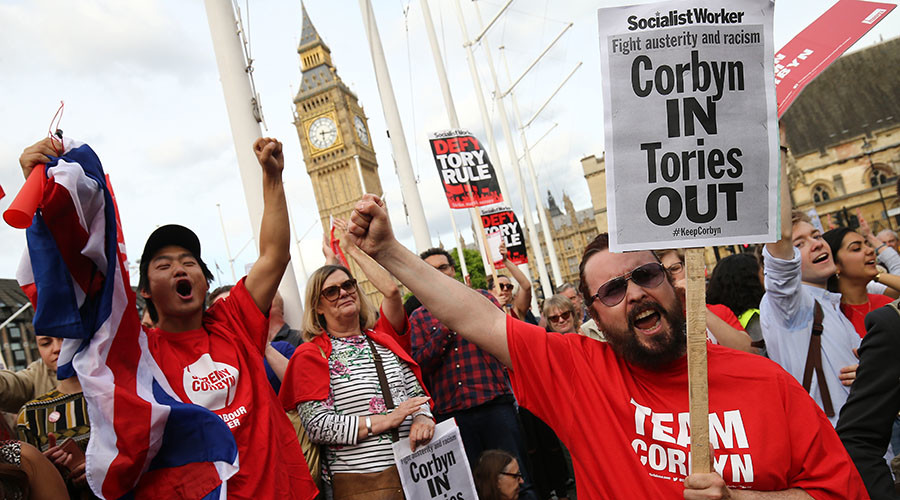
On the Corbyn New Left


Matt Bolton (PhD student) explains (July 14th 2016) that:
"... the mainstream ‘socialist’ or ‘green-liberal’ left who are the main constituency of Corbynism ... are much closer in form to moral or religious crusades, or perhaps a charity appeal, than marxism or anarcho-syndicalism. They are defined by a complete lack of strategic thinking, and are utterly devoid of cunning."
Bolton thinks that the 200,000 who have paid their £25 and joined/supported Labour as Corbyn supporters are very low-quality material to build the movement:
"My own CLP doubled its membership during Corbyn’s leadership campaign, with 300 people signing up. In the past year, I would generously estimate that perhaps 10 of those 300 has had any concrete involvement with the party (going to meetings, canvassing, delivering leaflets, taking up positions in the local party, running for council).

"The local Momentum group has had a little more success in turnout, though the majority of people attending were already involved in other campaigns, and the most that has been organised has been a few fundraising socials and the odd pro-Corbyn demo.

"This indicates that Momentum will be most effective in areas which already have a wide range of activist groups and networks (ie places with a high density of population due to a strong local economy) but far less so in places further away from the urban centres of capital accumulation, where existing political activism is thin on the ground, if not non-existent.

"The point here is not to bash people for lack of activity — there are all sorts of reasons why participation might be difficult, from lack of time to the labyrinthine structure of the party rulebook, to the deeply, deeply dull nature of most political work. It is merely to say that simply pointing to the numbers of new members says nothing about the existence or quality of a ‘social movement’.

"For the vast majority of ‘new members’, joining the party was not a promise of future activity, but a gesture of general support — perhaps similar to signing a Change.org petition — for whatever they thought Corbyn as Labour leader symbolised."
Such pessimism. And all Bolton can advocate is that the left should
"... campaign for Proportional Representation. It is only by getting rid of the farcical imbalance of FPTP that a Corbynist-style party has any chance of power (even if only as a minor partner in a coalition), and it would be far more effective in concrete terms than the membership reaching a million.

"Corbyn himself has had little to say about this issue, but McDonnell and Clive Lewis have intimated that a deal with the SNP, Greens, Lib Dems, Plaid Cymru — and perhaps even UKIP — could be a possibility."
Trotsky and Lenin are spinning in their graves.

---

Two days ago, Phil Burton-Cartledge took him to task for underestimating the potential dynamics of initially-naive popular movements.
"He argues that Corbynism is a simulacra of a social movement. It isn't a real one because the adherents Matt has encountered in his CLP and online do not match up to what activists in a proper movement looks like, such as the (relatively) politically sophisticated and hyper active supporters of Militant back in the day.

"In reality, how movements emerge are a process. Social movements are the purposeful, sustained mobilisation of large groups of people organising toward a series of political and/or social objectives. They never emerge fully formed and can in their early phases look like the remotest of primitive ancestors.

"Within days, St Petersburg peasants and workers went from clutching portraits of their beloved Tsar as they petitioned him to calling for his head as Russia almost tipped into revolution in 1905. The civil rights movement and its morphing into violent insurrection in parts of the northern US had its roots in the gospel, in pacifism, and a faith in American constitutionalism.

"How many activists have come into politics via beliefs in fairness, spirituality, conspiracy theory, and other ideas that at best partially reveal, and it worst obscure the realities of social life? The world over, millions have. And they always will.

"The movement of people coming into Labour are a work in progress, because we're all works in progress. The shouting on social media, the lack of sophistication with which some new comrades express themselves, the lapsing into semi-conspiratorial modes of thought, all are symptomatic of masses of new people getting drawn to politics.

"But among them there are future Labour ministers and perhaps even a Prime Minister who has got involved because of Jeremy Corbyn. "
Good Marxist points .. up to that last sentence. Lenin and Trotsky etc ...

---

And finally, why is Corbyn so very popular?

Yesterday, Helen Lewis at the New Statesman published this insightful essay, "Explaining the love for Jeremy Corbyn", expressed in 11 succinct bullet points.

My short summary: he's a blankish canvas on which the disaffected middle-class project their own sense of entitlement and self-worth - powered by their alienation from the power and influence wielded by remote denizens of the inner bubble, which they naturally resent.

Perhaps I'm a little too harsh on her theses.

---

There's a lot to like about the ethics, idealism and even the worldview of Marxism, as I tried to convey in my two previous posts:
  1. Revolution back on the agenda?
  2. Communism would be like - what?
Who wouldn't want to be a freedom fighter for the oppressed against distant and selfish elites who patronise from on high?

It's really unfortunate that the Marxist solution (the abolition of market mechanisms and total socialisation of politics and economics) flies in the face of real human nature, in all its evolved and genetically-endowed complexity.

The present generation of movement-activists may not be wholly aware that there was once a time when revolutionaries actually won, smashed the capitalist state and instituted the dictatorship of the proletariat. Putting in place a post-capitalist society was not easy (admittedly the communists at that time were faced with economic collapse and civil war).

Still, in 1922, five years after the proletarian revolution, the committed Bolshevik Leon Trotsky made this summing up to the Fourth World Congress of the Comintern, describing why 'War Communism' (extreme central planning) had to be replaced by the 'New Economic Policy', re-introducing market mechanisms.
"Failing a free market, the peasant would be unable to find his place in economic life, losing the incentive to improve and expand his crops. Only a mighty upsurge of state industry, enabling it to provide the peasant and agriculture with all its requirements, will prepare the soil for integrating the peasant into the general system of socialist economy.

"Technically this task will be solved with the aid of electrification, which will deal a mortal blow to the backwardness of rural life, the muzhik’s barbaric isolation, and the idiocy of village life. But the road to all this is through improving the economic life of our peasant-proprietor as he is today.

"The workers’ state can achieve this only through the market, which stimulates the personal and selfish interests of the petty proprietor. The initial gains are already at hand. This year the village will supply the workers’ state with more bread-grains as taxes in kind than were received by the state in the period of War Communism through confiscation of the grain surpluses.

"At the same time, agriculture is undoubtedly on its way up. The peasant is satisfied – and in the absence of normal relations between the proletariat and the peasantry, socialist development is impossible in our country."

The further history of the Soviet Union (and the other 'communist' states) confirmed that 'socialist man' was psychologically an impossibility both for peasants and, unfortunately, for workers, except in the heads of the most gullible and deluded Party cadres who were duly mocked by their contemporaries.*

---

* The Trotskyists think it was Stalinism which killed their leader and marginalised their movement. Proximately they are right, but ultimately it was human nature itself which fatally undermined the revolutionary Marxist movement.

Wednesday, December 02, 2015

Hive Mind: to buy or not to buy?


I've mentioned this before. Here's an extract from the blurb at the book's Amazon page.
"... Over the last few decades, economists and psychologists have quietly documented the many ways in which a person's IQ matters. But, research suggests that a nation's IQ matters so much more.

"As Garett Jones argues in "Hive Mind," modest differences in national IQ can explain most cross-country inequalities. Whereas IQ scores do a moderately good job of predicting individual wages, information processing power, and brain size, a country's average score is a much stronger bellwether of its overall prosperity.

"... Jones argues that intelligence and cognitive skill are significantly more important on a national level than on an individual one because they have "positive spillovers." On average, people who do better on standardized tests are more patient, more cooperative, and have better memories. As a result, these qualities and others necessary to take on the complexity of a modern economy become more prevalent in a society as national test scores rise.

"What's more, when we are surrounded by slightly more patient, informed, and cooperative neighbors we take on these qualities a bit more ourselves. ... "
According to the Wikipedia article, the average IQ for sub-Saharan Africa is 82. For ethnic Europeans the average IQ is 100 and for East Asians (Chinese, Japanese, Koreans) the figure is 105. It's not hard to get significant correlations between such disparate national IQ figures and levels of economic development.

The validity of IQ as a predictor of achievement in very diverse milieux has been empirically verified time and time again so in a sense, what Hive Mind is talking about is hardly very new. This could be a reason not to buy it.

Greg Cochran reviewed it and said some nice things - quite rare from curmudgeon-central! Apparently Jones is quite a good writer too. So why not buy it?

The Hive Mind reviews on Amazon are quite amusing. Most of them are from Garett Jones's colleagues at GMU - as befits academics, they can't just summarise the book and say they like it, they have to write not-so-mini essays! Consider this review from colleague Timothy J. Groseclose, from which I quote this excerpt:
"Jones constructs an example, which I call “the parable of the vases.” In a moment I’ll explain the details of the example, but first let me briefly discuss its importance. The example has significantly affected my thinking, and it is one of the highlights of the book. I do not think it is an exaggeration to say that the parable ranks as one of the all-time great examples in economics. Although it is not quite as insightful and important as Ronald Coase’s crops-near-the-train-track example (which illustrates the efficiency of property rights), I believe it is approximately as insightful and important as: (i) Adam Smith’s pin-factory example (which illustrates the benefits of division of labor) and (ii) Friedrich Hayek’s example of an entrepreneur knowing about an unused ship (which illustrates the value of particular, versus general, knowledge).

"The parable begins with a simplifying assumption. This is that it takes exactly two workers to make a vase: one to blow it from molten glass and another to pack it for delivery. Now suppose that two workers, A1 and A2, are highly skilled - specifically no matter which task to which they are assigned they are guaranteed not to break the vase. Suppose two other workers, B1 and B2, are less skilled - specifically, for either task each has a 50% probability of breaking the vase.

"Now suppose you are worker A1. If you team up with A2, you produce a vase every attempt. However, if you team up with B1 or B2, then only 50% of your attempts will produce a vase. Thus, your productivity is higher when you team up with A2 than with one of the B workers. Something similar happens with the B workers. They are more productive when they are paired with an A worker than with a fellow B worker.

"So far, everything I’ve said is probably pretty intuitive. But here’s what’s not so intuitive. Suppose you’re the manager of the vase company and you want to produce as many vases as possible. Are you better off by (i) pairing A1 with A2 and B1 with B2, or (ii) pairing A1 with one of the B workers and A2 with the other B worker?

"If you do the math, it’s clear that the first strategy works best. Here, the team with two A workers produces a vase with 100% probability, and the team with the two B workers produces a vase with 25% probability. Thus, in expectation, the company produces 1.25 vases per time period. With the second strategy, both teams produce a vase with 50% probability. Thus, in expectation, the company produces only one vase per time period.

"The example illustrates how workers’ productivity is often interdependent—specifically, how your own productivity increases when your co-workers are skilled.

"The example generates an even more remarkable implication. It says that, if you are a manager of a company (or the central planner of an entire economy), then your optimal strategy is to clump your best workers together on the same project rather than spreading them out amongst your less-able workers.

"The parable has some interesting implications for immigration policy. Namely, it suggests that Ann Coulter and Donald Trump may be more correct than they realize. Coulter and Trump, when arguing for more restrictions on immigration, most often invoke political and cultural reasons - e.g. they note that more immigrants will cause crime to increase or cause the U.S. to adopt more left-wing policies. The parable of the vases, however, provides an economic reason: Specifically, when the U.S. allows more low-skilled immigrants into the country, it can lower the productivity of native workers.

"Perhaps more profound is the following implication. Immigration opponents usually make their argument from an own-country perspective. E.g. Trump and Coulter usually focus on the fact that a more open-borders policy hurts American natives. They rarely discuss the fact that such a policy helps potential immigrants. Related, they do not consider the net effect - that is, whether the costs to American natives are greater than the benefits to potential immigrants. The parable-of-the-vases example, however, takes a worldly perspective, not U.S.-centric perspective, and it suggests that the net benefits are negative.

"For example, it suggests the following: Suppose you were the secretary general of the U.N. - someone who is interested in the total economic output of the entire world, not just the output of the U.S. If so, then the parable-of-the-vases example implies that you would want the world’s smartest people to clump in only one or a few countries. You’d want the U.S. to restrict immigration from low-IQ countries because it increases the world’s economic output, not just the U.S.’s. As far as I’m aware, the people who favor more restrictive immigration policies - including Coulter and Trump - have never made this argument."
His rather gushing review is exactly how you write as an academic for whom the scales have just fallen from the eyes!

On balance, I think I ought to buy it, if only to provide a review not from George Mason University.

---

Update: here is my review.


Sunday, November 22, 2015

Castle Hill/Maesbury Castle on a cold Sunday afternoon

We first visited Maesbury Castle (Castle Hill) - just outside Wells on the Old Frome Road - in October, (I wrote about it here). On a cold, sunny Sunday afternoon Alex, Clare and myself visited again.

Clare and Alex on the Neolithic camp ramparts

The author in a chill wind

Glastonbury Tor in the far distance

Afterwards in the Crown, Wells market square

I was waiting for someone to review "Hive Mind" by Garett Jones, and finally Greg Cochran has done so here (comments are worth reading, too).


I don't think I will be buying it.


Friday, January 10, 2014

"Ancestral Journeys" by Jean Manco

"Amusing review you wrote on your blog about Ancestors."

"What?"

"That great tome you've been reading for days now. I read your review. It made me laugh."

"I haven't written a review yet."  (Baffled).

"Well, it was on the screen."

(Enlightenment).

 "It was Greg Cochran's review you read, on his blog 'West Hunter'. I was reviewing it before writing my own thoughts."

I am of course immensely flattered that my wife might believe that a review by such an eminent population geneticist, polymath and all-round smart person could possibly have been written by myself. In her defence, she's not fantastically up on genetics or the deep history of Europe. She's right about the quality of the writing though: here's what Gregory Cochran had to say.
"Jean Manco has a new book out on the peopling of Europe, Ancestral Journeys.  The general picture is that Europeans arise from three main groups: the Mesolithic hunters (Hyperboreans),  Levantine farmers, and Indo-Europeans off the steppe.   It’s a decent synthesis of archaeological, linguistic, and genetic evidence. I suspect that her general thesis is in the right ball park:  surely not correct in every detail, but right about the double population replacement.

"It is a refreshing  antidote to previous accounts based on the pots-not-people fad that originated back in the 1960s, like so many other bad things.  Once upon a time, when the world was young, archaeologists would find a significant transition in artifact types, see a simultaneous change in skeletons,  and deduce that new tenants had arrived, for example with advent of the Bell Beaker culture.  This became unfashionable: archaeologists were taught to think that invasions  and Völkerwanderungs were never the explanation, even though history records many events of this kind.

"I suppose the work Franz Boas  published back in 1912, falsely claiming that environment controlled skull shape rather than genetics, had something to do with it.  And surely some archaeologists  went overboard with migration, suggesting that New Coke cans were a sign of barbarian takeover.  The usual explanation though, is that archaeologists began to find the idea of prehistoric population replacement [of course you know that means war - war means fighting, and fighting means killing] distasteful and concluded that therefore it must not have happened.  Which meant that they were total loons, but that seems to happen a lot.

"But the book could be better. Jean Manco relies fairly heavily on mtDNA and Y-chromosome studies, and they are not the most reliable evidence.  Not because the molecular geneticists are screwing up the sequencing, although there must sometimes be undetected contamination, but because mtDNA and Y-chromosomes are each single loci with an effective population size four times smaller than autosomal genes.  They are more affected by drift, and drift can deceive you.  Moreover, in some cases selection might affect the historical trajectory of mtDNA and Y-chromosomes,  which would add to the confusion. Now to be fair, we have more ancient mtDNA results than autosomal DNA,  and there is more published data on mtDNA and Y-chromosome than autosomal DNA in existing populations.  This situation is rapidly improving.

"Autosomal DNA has zillions of loci and a larger effective population size.  Most of it is neutral.  That’s what you want, for investigating past mixing and movement  – and autosomal DNA yields interesting hints using publicly available data and software.  For example, using the program ADMIXTURE, you find a West Asian-like component in almost all Europeans (from Spain to Russia, and at about the same level) – but not in Sardinians or Basques. Which must be telling us something.

"In addition, she’s not bloody-minded enough. She thinks that a fair fraction of the big population turnovers involved migrants moving into areas that had been abandoned by the previous owners. I can imagine that happening in a few cases.  Maybe the Greenlanders, living in an extremely marginal country for their kind of dairy farming, mostly left and/or died out  before the Eskimos showed up.  That is, in my dreams, because we know that the two groups fought. The Greenlanders may have been in trouble, but they didn’t just fall -  Eskimos pushed. The European colonization of the New World is closer, since there was a dramatic population collapse from the newly introduced Eurasian and African diseases, but even then there was a fair amount of fighting. I’m sure that there were serious epidemics in European prehistory, but  it seems unlikely they compared with the impact of the simultaneous arrival of  bubonic plague, diphtheria, leprosy, malaria, measles,  typhoid, and whooping cough on the Amerindians (with yellow fever and cholera for dessert).

"I mean, when the first farmers were settling Britain, about 4000 BC, they built ditched and palisaded enclosures.   Some of these camps are littered with human bones – so, naturally, Brian Fagan, in a popular prehistory textbook, suggests that ”perhaps these camps were places where the dead were exposed for months before their bones were deposited in nearby communal burials”!  We also find thousands of flint arrowheads in extensive investigations of some of these enclosures, concentrated along the palisade and especially at the gates.  Sounds a lot like Fort Apache, to me.

"There are some new and fascinating results about European prehistory that beg to be incorporated in a revised version of this book, for example the stuff about how the Hyperboreans contributed to the ancestry of modern European and Amerindians, but that info is so new that she could not possibly have incorporated it. Not her fault at all.

"Read it."
I'd classify "Ancestral Journeys" as a semi-popular book. Jean Manco's mastery of the details of populations and their movements across Europe, North Africa and the Near East across a time period stretching from 46,000 years ago to the early mediaeval is truly staggering - she seems to have absorbed and synthesised hundreds of sources. Somehow the clarity of her thinking and the organisation of her material saves the reader from being totally lost in the details.

The study of deep history is a fusion of archaeology, linguistics and genetics with the genetics becoming more important as more DNA samples - ancient and modern - are sequenced. What does this genetic information actually mean? The reader will need to internalise the historical evolution and mutation of mitochondrial and Y-chromosome DNA to understand the resulting haplogroup trees which drive historical analysis.

Evolutionary Tree of Y-DNA haplogroups (from Wikipedia)

If you've not had a course in population genetics then you will be hitting Wikipedia hard (you could do worse than start here and follow the links to grasp the genetic concepts underpinning this book).

Trivia point: Jean Marco is based just up the road from where we live, in Bristol.