Showing posts with label Communism. Show all posts

Tuesday, December 30, 2025

Abundance removes the need for men


Abundance and Male-Female Roles

A society of abundance is predominantly a female model of social life. 

The hard material questions - securing resources, retaining them, defending them - have largely been solved, or at least outsourced to impersonal systems. As a result, daily life can be organised around interior and relational flourishing: children, conversation, social grooming, the maintenance of emotional and moral networks.

For men, however, this same environment proves actively hostile. An abundant society removes not only danger but challenge; not only hardship but the possibility of great movements, grand projects, or idealistic quests that impose themselves from without. In such conditions, men frequently experience themselves as superfluous.

That experience of psychological irrelevance manifests as the anomie and purposelessness so characteristic of modern life. One might also note that without social roles for the expression of male virtues, female-male relationships are also thrown into confused disarray.

In pre-modern or marginal environments, life is structured by a small number of inescapable facts. Resources are scarce, threats are real, and failure is visible, consequential and frequently lethal. Under these conditions, the environment generates meaning automatically.

One does not have to ask what to do with one’s life; the environment answers that question continuously and without ambiguity. Our psychologies were formed from this environment of evolutionary adaptation.

A society of abundance reverses this structure. Food, shelter, security, and continuity are largely guaranteed. Violence is monopolised by the distant state. Failure is buffered, deferred, or medicalised. This does not produce freedom in any neutral or transparent sense. It produces existential slack: a vacuum in which meaning must be self-generated without the psychological equipment to do so reliably.

Across cultures and even across primate lineages, female sociality tends to be relational rather than heroic, oriented toward maintenance rather than conquest or defence, and embedded in dense networks of mutual attention.

In an abundant society, these forms of engagement remain meaningful. Child-rearing continues to matter. Emotional labour retains its value. Gossip and informal norm-policing still perform essential social functions. Interior flourishing has a clear referent in children, relationships, and continuity across generations. Abundance maps comparatively cleanly onto caretaking-and-coordination psychologies.

Male motivational systems, by contrast, are typically quest-shaped. Across cultures, male psychology is disproportionately tuned to status acquired through risk, esteem earned through competence under pressure, and meaning derived from challenges that offer real external resistance.

Male meaning is often heterotelic: it depends on something outside the self that pushes back. Remove danger, scarcity, honourable risk and hostile enemies, and what remains is a restless surplus of drive with nowhere to go - often redirected into crime or tribal violence.

Crucially and consequentially, abundance does not merely fail to reward these drives; it actively pathologises them. Competitiveness becomes “toxic,” ambition is redescribed as “ego,” risk-taking is framed as reckless immaturity, and hierarchical instincts reframed as authoritarianism.

The male psyche is therefore not only under-stimulated but morally delegitimised. The lived result is a recognisable phenomenology: superfluity, in the sense that no one needs what one brings; disorientation, with no clear criteria for success; resentment, as others flourish without comparable sacrifice; and withdrawal into simulations - games, pornography, and bogus ideologies.

Men do not feel liberated. They feel ontologically surplus.

Are men superfluous in societies of abundance? Functionally, often yes: a tendency that advances in AI and robotic automation are likely to intensify.

The uncomfortable conclusion is that a society of permanent abundance is not neutral with respect to sexed-psychologies. It fits female social logics tolerably well, leaves male motivational systems idle, and then blames those systems for malfunctioning.

We won't return to scarcity, mythic warrior cultures, or reactionary romanticism. But challenge, risk, and meaningful opposition cannot simply be abolished without psychic cost - and that cost will be borne disproportionately by men.

We need new quests for healthy societies.

Historically that usually means revolution and war.


These views are not particularly original. In A Secular Age (2007) - see also the Wikipedia article - Charles Taylor says this: "But the concern about levelling, the end of heroism, of greatness, has also been turned into a fierce denunciation of the modern moral order, and everything it stands for, as we see with Nietzsche.

"Attempts to build a polity around a rival notion of order in the very heart of modern civilization, most notably the various forms of fascism and related authoritarianism, have failed. But the continued popularity of Nietzsche shows that his devastating critique still speaks to many people today. The modern order, though entrenched—perhaps even because entrenched—still awakens much resistance."

I asked GPT5.2 whether Nietzsche might yet have had an answer to this centuries-old critique of abundant modernity. This was the interesting reply from GPT5.2.


Monday, April 10, 2023

A Better World, Where Are You?


"I was brought up as a member of the Church of England and simply follow the customs of my tribe. The church is part of my culture; I like the rituals and the music. If I had grown up in Iraq, I would go to a mosque… It seems to me that people who attack religion don’t really understand it. Science and religion can coexist peacefully — although I don’t think they have much to say to each other. What I would like best would be for scientists not even to use the word “God.” … Fundamental physics shows how hard it is for us to grasp even the simplest things in the world. That makes you quite skeptical whenever someone declares he has the key to some deeper reality… I know that we don’t yet even understand the hydrogen atom — so how could I believe in dogmas? I’m a practicing Christian, but not a believing one."

My position is not quite the same as Martin Rees's.

To be esoteric for a moment, I am a deontic Catholic: not one who buys into the Confessional ontology (i.e. a literal, uncritical, ahistorical reading of the sacred texts). Though paradoxically, it's only when the vast majority of adherents and clergy cleave to a Confessional ontology that the institution persists through the endless millennia. 

Nevertheless historical, materialist deontology is the right paradigm (Roger Scruton is my go-to guy here on deontology).

Sally Rooney hints that with the death of the Marxist-Leninist, communist ideal, Catholicism is one of the few remaining subversive forces insofar as - at its best - it counterposes and organises social solidarity based on high ethical principles against an alienated rootlessness taken to absurdity by a debilitating, progressive wokeness - from which elevated standpoint Catholicism is popularly ridiculed, or treated as absurd or incomprehensible.

(There are other countercultures which also deserve support: those arts which uplift, unify and empower ordinary people and exemplify unfashionable virtues: duty, honour, courage, competence, resilience.)

Sally Rooney's characters in "Beautiful World, Where Are You?" reflect on their ineffectual exposition of a fashionable, but sterile and impotent Marxism. They unwillingly experience the attraction of the granite, collective worldview of the eternal and universal Catholic Church: so often hijacked institutionally by bad people… so often bureaucratically underpinning reaction... but as John Dominic Crossan has so eloquently outlined, so revolutionary and omnipresent in its core doctrine.

Monday, September 17, 2018

Human Dodos, Communist Man, Draka Serfs

Amazon link

A couple of years ago I wrote some posts reviewing Francis Fukuyama's "The Origins of Political Order". From the Wikipedia article:
"From chimpanzee hunting groups to tribes

In his quest for the origins of political order, he first looks at the social order among chimpanzees, notes that the war-like hunting group, rather than the family, was the primary social group, and claims the same for humans. Humans went further: to survive they formed tribes, whose armies were superior to hunting groups by their sheer size.

He uses recent work in sociobiology and other sources to show that sociability built on kin selection and reciprocal altruism is the original default social state of man and not any isolated, presocial human as suggested by Hobbes and Rousseau. He suggests that Hobbes and Locke present a fallacy when they argue humans developed cooperative ability only as a result of the invention of the state.

This is because chimps, the genetic ancestors to humans, engage in kin relations based on cooperation, and so Hobbes and Locke must be mistaken suggesting humans were once sociable, lost this instinct and then regained it due to the state.

Challenge of tribes on the road towards the state

The next step was to escape beyond tribalism and the "tyranny of cousins", to join tribes into larger coalitions towards states, again due to the advantage of larger armies. This was done with the aid of religion. This was because as groups grew in size, maintaining cooperation became more difficult as face-to-face interactions with much of society became difficult. Religion offered a way of providing a combining social force to hold society together.

For example, Fukuyama cites Mohammed as an example of what Weber labels a "charismatic leader" because he used the idea of an 'umma' (community of believers) to bind together the territory that he ruled over. This challenge to transcend tribalism partly remains today in many parts of the world outside Western civilization, for example in Afghanistan and in Somalia.

Restrictions on marriage and inheritance as a strategy against corruption

Loyalty to the tribe or the family, rather than to the state, leads to corruption and weakening of the state. Various strategies were used to overcome the corruption. One such strategy was restrictions against marriage among the ruling official class to make sure that loyalties would not lie with family or tribe.

  • Mandarins or Scholar-officials, who were the ruling class of China, were not allowed to pass on the lands given to them by the emperor to their own children and were restricted as to whom they were allowed to marry.

  • Mamluk slaves, the ruling class of Egypt and the Ottoman Empire, were told which slaves to marry while their children could not inherit from them. Janissaries were originally forced into celibacy or prohibited from having a family.

  • Pope Gregory VII forced Catholic priests in Europe to become celibate and they were prohibited from having a family for the same reason.

  • Spanish administrators in South America were restricted from marrying local women and from establishing family ties in the territories they were sent to."
It should be added that the elites of empires of archaic despotism used extreme violence to break the powers of the clans. People do not take kindly to having a boot stamping on a human face - forever.

---

The three articles I wrote were:
  1. 'The natural state of humanity is clannishness'
  2. Human Dodos
  3. Human Dodos: the FAQs
which should be read in that order. I compared Jonathan Haidt's liberals (Myers-Briggs NFs) to dodos. Their naive optimism, their overarching (albeit abstract) compassion and their gullible belief in generalised human 'goodness' makes them easy meat for predators. Social liberalism is very much a northern european psychological trait, while most of the world's population (to its own economic detriment) continues to organise itself clannishly. Fukuyama's taming process has a way to go - and is not making any progress.

It's generally observed that extreme liberalism is required in a population to make Communism work. No more state, no more police, no more armies, no more war. We'd better believe in general niceness.

Just as Marx suggested that the historic role of capitalism was to develop the productive forces to enable the communist transition, perhaps it also has the historic task of breeding humans nice enough to make communism work at all. Then recall that a society of doves is unstable in the presence of predators. And then there is always the way of the Draka, which always seemed to me more likely.

---

It's worth noting that western societies - so apparently liberal in appearance - are capable of extreme and non-liberal violence whenever push comes to shove. In America only about 20% of the population self-declare as liberals. Despite much sjw noise and fury, social liberalism is more a convenient facade for the imperial west.

I recall that fateful phrase: "Notice how the liberals all leave the room, wringing their hands, once the bullets start flying."

Monday, March 12, 2018

The biotech road to full automation

In my post "Advanced AI is indistinguishable from slavery" I wrote about the advantages biotechnology brings for a future post-capitalist society. Communist theory has traditionally counterposed central planning to the 'anarchy' of the market. But that often-criticised anarchy is actually rather biological, a kind of exploratory behaviour in which potential new needs are tested for sustainable effective demand.

By contrast, as János Kornai has pointed out at length, our experience of central planning has identified insuperable principal-agent problems together with a structural inability to properly engage with real human needs.

---

A global multicellular biosphere has existed on this planet for five hundred million years, exhibiting persistence and dynamic self-regulation in the absence of any intelligent oversight or central planning.

Biology is local while ecology is global.

Compare this with our global capitalist economy, the ongoing maintenance of which requires the mandatory coordination of human effort, intelligence and conscientiousness. It's because apart from human workers, other means of production are generally incredibly dumb. We work on metals, plastics, glass, oil, coal .. none of which do anything useful without the application of human labour mediated by clunky tools.

Peter Hamilton's vision of the Eden habitat (by Jim Burns)

Plants and animals, by contrast, are self-supporting nanotechnology of such stupefying sophistication and complexity that we can't even emulate the simplest possible animal (C. elegans). If we could bioengineer plants and animals to address our portfolio of needs (substituting for our present reliance on dumb stuff) the complexities and endless engagement of humans in running the economy could in large part be finally dispensed with.

---

Some people think that a linear extrapolation of AI and robotics on our current technology base will deliver full automation, but (a) we're a long way from embodied AGI robots, and (b) the global supply chains to build and maintain such artifacts of metal and plastic would be incredibly brittle .. not at all to be relied upon. They should be discretionary extras around a biotech core for future societies.

---

I imagine a rather sneering response: "Wait till an adversary comes up against you with high-bandwidth satellite comms, tanks, hypersonic missiles and nukes. See how far your genetically modified palm trees will take you then. Are you going to fight back with Game of Thrones-style dragons?"

So how would a super-sophisticated biotech-civilisation respond to such a threat? By using smart biology (including servitors) to build counter-artefacts. Nothing says that every element of a future biotech-civilisation must be fabricated from protoplasm: that's not even true in today's biosphere. Biotech just gives you a fantastic set of new options.

Thursday, March 08, 2018

Advanced AI is indistinguishable from slavery

"Any sufficiently advanced AI is indistinguishable from slavery".
---

Amazon link

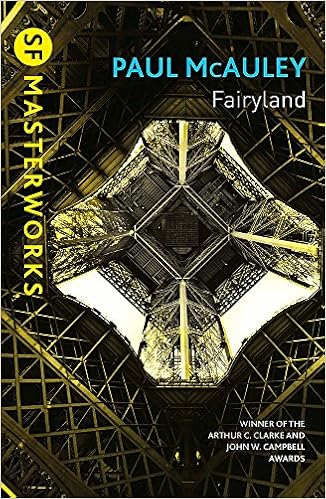
“Before he met the brilliant, hypnotic child Milena, Alex Sharkey had never played with "dolls"—blue-skinned, gengineered lifeforms designed for work, amusement, or destruction. But the underground gene-hacker is seduced by a megalomaniacal little girl's dream of providing the soulless genetic constructs with free thought and a future—and he unwittingly unleashes a plague of madness on the world.

Now there's a void in his life and memory that must be refilled, but it means pursuing the dangerous sentient species he helped sire from the ruins of a Magic Kingdom through a wasted Europe. It is Alex Sharkey's last chance and the last hope remaining for a once-dominant human race.”
From this review of Fairyland.

---

The historic role of capitalism is to develop the forces of production towards abundance. The founding fathers of Marxism speculated that everyone would then live like the ancient aristocrats of Greece and Rome, but with deeper, broader and more sophisticated experiences than those available in antiquity .. and without the slavery.

How would communism look? I sometimes think they imagined automated factories with conveyor belts and robot arms moving stuff onto automated trucks to deliver to your door. But Amazon seems to have all that in hand.

There is another route to abundance - the biological.

Biology seems to work off plentiful raw materials: air, earth, rain and sunshine. We're getting better at gene-hacking. Within a generation we could make dolls. Start from a primate base, add IQ and speech. Modify the empathy-volitional drives .. .

Is it slavery if they really want to work to keep us happy?

Everywhere you currently envision smart, AI-controlled robots of steel and chrome, tilling the fields (or the hydroponic tanks), fabricating gee-gaws .. replace them in your mind with smart biology - genetically-engineered protoplasm.

Just itemise people's needs:
  • food and drink (lots of new plants) - check
  • accomodation (grows from a pod, see the catalogue) - check
  • transport (smart horse and carriage; primate-derived servitors) - check.
The list goes on. If it can be done with metals and integrated circuits, it can be done with genetically-modified lifeforms in a much more sustainable way.

Will our prospective uplifted biosphere be subverted, as in "Fairyland"? With all that free time in a communist society, there should be plenty of people happy to invest in counter-terrorism. Or we'll engineer some servitors to do it: there's a lot to learn from the Greeks and Romans.

---

Why the emphasis on biology?

Because our existing metal-and-plastic technology-base depends upon a complex division of labour and global supply chains. It's brittle and unstable, and relies upon human (in fact smart-fraction) levels of competence to make it work at all, to sustain it against entropy. It's capitalism's great achievement.

By contrast, the biological ecosystem is predominantly local and functions on the lowest level of explicit intelligence possible. It's so much more robust. It also helps address economic coordination problems which have proved so intractable to centralised planning.

I don't think everything can be subsumed under applied biology. But most things for sure.

Other stuff (supercomputers, hypersonic/space transport, genome engineering) may be beyond anything a tailored plant/animal could do* - opportunities for our future AI overlords to shine.

What will we do with all that free time?

---

* As the old saying has it: "supercomputers etc don't grow on trees". And probably in the future they won't either.

Monday, March 05, 2018

Leon Trotsky's vision of communism

Link to PDF

Trotsky wrote the series of articles published as "Literature and Revolution" in 1924, two years after the end of the ruinous civil war and during the earliest phase of the 'New Economic Policy'. At that time he still occupied the position of Commissar of War, the head of the Red Army.

Most of the early chapters are assessments of (often obscure) contemporary artists but towards the end Trotsky widens his scope and considers the nature of art in class societies and its future under socialism. Here is the final section from Chapter Eight, Revolutionary and Socialist Art.
"Having rationalized his economic system, that is, having saturated it with consciousness and planfulness, man will not leave a trace of the present stagnant and worm-eaten domestic life. The care for food and education, which lies like a millstone on the present-day family, will be removed, and will become the subject of social initiative and of an endless collective creativeness.

Woman will at last free herself from her semi-servile condition.

Side by side with technique, education, in the broad sense of the psychophysical molding of new generations, will take its place as the crown of social thinking. Powerful “parties” will form themselves around pedagogic systems. Experiments in social education and an emulation of different methods will take place to a degree which has not been dreamed of before. Communist life will not be formed blindly, like coral islands, but will be built consciously, will be tested by thought, will be directed and corrected.

Life will cease to be elemental and for this reason stagnant. Man, who will learn how to move rivers and mountains, how to build people's’ palaces on the peaks of Mont Blanc and at the bottom of the Atlantic, will not only be able to add to his own life richness, brilliancy, and intensity, but also a dynamic quality of the highest degree. The shell of life will hardly have time to form before it will burst open again under the pressure of new technical and cultural inventions and achievements.

Life in the future will not be monotonous.

More than that. Man at last will begin to harmonize himself in earnest. He will make it his business to achieve beauty by giving the movement of his own limbs the utmost precision, purposefulness, and economy in his work, his walk, and his play. He will try to master first the semiconscious and then the subconscious processes in his own organism, such as breathing, the circulation of the blood, digestion, reproduction, and, within necessary limits, he will try to subordinate them to the control of reason and will. Even purely physiologic life will become subject to collective experiments. The human species, the coagulated Homo sapiens, will once more enter into a state of radical transformation, and, in his own hands, will become an object of the most complicated methods of artificial selection and psychophysical training.

This is entirely in accord with evolution. Man first drove the dark elements out of industry and ideology, by displacing barbarian routine by scientific technique, and religion by science. Afterwards he drove the unconscious out of politics, by overthrowing monarchy and class with democracy and rationalist parliamentarianism and then with the clear and open Soviet dictatorship. [Recall that the 'Dictatorship of the Proletariat' in Marxist theory is the rule by the masses which secures the revolution against its class enemies. It does not mean Stalin!].

The blind elements have settled most heavily in economic relations, but man is driving them out from there also, by means of the Socialist organization of economic life. This makes it possible to reconstruct fundamentally the traditional family life. [Marx and Engels talked about the socialised, collectivised family (in The Communist Manifesto) - not one of their better ideas. Trotsky here seems more circumspect.]

Finally, the nature of man himself is hidden in the deepest and darkest corner of the unconscious, of the elemental, of the subsoil. Is it not self-evident that the greatest efforts of investigative thought and of creative initiative will be in that direction? [Trotsky was supportive of the work of Freud - p. 182].

The human race will not have ceased to crawl on all fours before God, kings, and capital, in order later to submit humbly before the dark laws of heredity and a blind sexual selection! Emancipated man will want to attain a greater equilibrium in the work of his organs and a more proportional developing and wearing out of his tissues, in order to reduce the fear of death to a rational reaction of the organism towards danger. There can be no doubt that man’s extreme anatomical and physiological disharmony, that is, the extreme disproportion in the growth and wearing out of organs and tissues, give the life instinct the form of a pinched, morbid, and hysterical fear of death, which darkens reason and which feeds the stupid and humiliating fantasies about life after death.

Man will make it his purpose to master his own feelings, to raise his instincts to the heights of consciousness, to make them transparent, to extend the wires of his will into hidden recesses, and thereby to raise himself to a new plane, to create a higher social biologic type, or, if you please, a superman.

It is difficult to predict the extent of self-government which the man of the future may reach or the heights to which he may carry his technique. Social construction and psychophysical self education will become two aspects of one and the same process. All the arts—literature, drama, painting, music, and architecture will lend this process beautiful form. More correctly, the shell in which the cultural construction and self-education of Communist man will be enclosed, will develop all the vital elements of contemporary art to the highest point.

Man will become immeasurably stronger, wiser, and subtler; his body will become more harmonized, his movements more rhythmic, his voice more musical. The forms of life will become dynamically dramatic. The average human type will rise to the heights of an Aristotle, a Goethe, or a Marx. And above this ridge new peaks will rise."

I think Trotsky is here making illustrative, but realistic projections of his futuristic views. Many of these ideas have also been addressed by science-fiction writers subsequently; Trotsky would have nodded appreciatively at current genomic research, I'm sure. Personally I'm a supporter of most of his vision.

One needs to remind oneself that Russia in 1924 was economically ruined. Trotsky, like the other Bolshevik leaders, was expecting revolution in Western Europe to save the infant soviet regime (undoubtedly very large and sustained transfer payments would have been needed - as was the case from West into East Germany after reunification).

Those revolutions never occurred, the soviet dream was lost. But the vision is worth pondering: how much of it is actually compatible with future developments within capitalism?

Sunday, February 18, 2018

"The Socialist System" - János Kornai

Amazon link


'The Socialist System' presents itself as a daunting read: a 600 page, somewhat dry analysis of the detailed workings of the socialist (ie post-capitalist) system in all its aspects. Kornai was trained as a philosopher, becoming an economist and then a journalist in socialist Hungary, in the period after the second world war.

His book identifies three phases of socialism: the 'heroic' period of the revolutionary-transitional system (think 'War Communism'), the classical system of totalitarian bureaucratic control (prototypically Stalinism) and the reform period (NEP; the Gorbachev reforms). The historical order is usually (but not always) as written - with occasional reversions.

---

It is commonplace to review the political horrors of socialism: the great famines of the thirties in Russia and the Gulag, the 'Great Leap Forward' in China. But underlying such political episodes of class struggle and bureaucratic consolidation are deeper issues, those associated with the consequences of bureaucratic coordination of the economy.

Bureaucratic coordination just doesn't work that well. Kornai is forensic in considering how the dictates of forced growth (due to the regime's often-justified sense of their encirclement by more advanced and hostile capitalist states) generates aggressive, top-down 'tight plans' incapable of fulfillment even in principle.

It's simply impossible to centrally-plan a modern economy with any degree of success. All layers of the bureaucracy see it in their interests to organise outputs against static, inflexible and ignorant plan-objectives, regardless of the real needs they plainly see around them. Indeed they will be rewarded for plan-fulfillment and punished for failure.

Hoarding, shortages, poor quality goods and lack of motivation are endemic. The system works, after a fashion, but once the extensive phase of development has been achieved progress slows and the centrally-planned economy falls further behind advanced capitalist countries.

Kornai is especially good on the organic and protean nature of the bureaucracy. Industrial societies are just too interdependent: they must be coordinated. In the absence of market (price) mechanisms, top-down bureaucratic coordination is the only alternative and its daily failures lead to further bureaucratic growth. Anything which is not being centrally controlled is potentially dangerous to the achievement of the plan.

Eventually, though, something must be done. Reforms are called for. Wherever market mechanisms are introduced - in agriculture or in small business - productivity soars. Yet the market is anathema to the plan: the two organising principles cannot cohere. In one place capitalism is allowed to advance and the communist party's monopoly of power begins to falter; in another place the party strikes back and property rights begin to to look shaky causing investment collapse.

The masses are conflicted. On the one hand they welcome the lessening of repression, the chances for higher incomes in the private sector and the greater availability of higher-quality goods. On the other hand, their innate and indoctrinated sense of egalitarianism is offended by capitalism's inequities and meritocratic qualities let alone the elements of price-gouging and rip-offs attendant upon the reemergence of private property and market relations.

Nowhere does the Trotskyist model of a socialised economy under the democratic control of workers' councils get a look-in. Somehow, there's a disconnect between the operation of the economy as a whole and the specific interests of individual workers and their families. The principal-agent problem at all scales is just too overarching, too ubiquitous.

---

For a while, China has seemed a counter-example to Kornai's thesis. We are told that the Chinese Communist Party leadership has studied and learned from the collapse of the Soviet Union. It may be too early to say but the story on China in 2018, as growth continues to slow, suggests that Kornai's prognosis will again be proven correct.

Amazon link

If this book, rich in details and experience were made into a TV series, could it transform the illusions of western leftists who still believe a planned economy could be made to work? I was studying Kornai's book while also reading Vasily Grossman's 'Life and Fate' and it was extraordinary how Kornai's general principles were exactly replicated in the experiences of Grossman's characters.

Yet I have no illusions. The myth of the benevolent centrally-planned economy is probably written in our genes: every generation has to painfully learn better, hopefully through works such as this.

---

Let us return to the intriguing question of China. Andrew Batson writes:
"I put János Kornai’s The Socialist System: The Political Economy of Communism on my best books list for last year, but I’ve been slow in writing something longer about it. It’s taken some time for me to think through how to understand China in the context of his arguments.

Kornai’s book is brilliant in its diagnoses of the internal conflicts and problems of “market socialism” or “reform socialism”, in which market mechanisms are permitted but the Communist Party maintains political primacy and a large public sector. This is a still a pretty accurate definition of China’s system. There were so many moments while reading when I wanted to shout out loud in recognition: “Yes! That’s exactly how it is!”

Yet the book finally concludes that market socialism is an inherently unstable and unsustainable system that cannot last. Essentially Kornai argues that the combination of a weakened version of state intervention and the half-hearted embrace of market competition enjoys the vices of both systems and the virtues of neither.

A government that no longer truly believes in socialism cannot enforce its plans, while market forces are allowed to operate only inconsistently, so that they amplify rather than alleviate distortions. The inevitable accumulation of economic problems means that the public and officials get fed up with the system and eventually decide to jettison it entirely."
Batson then continues to the key question: So what did Kornai miss?

Tuesday, January 23, 2018

The Romans thought we already had AGI

Rodney Brooks doesn't think we'll have embodied artificial general intelligence any time soon:
"A robot that has any real idea about its own existence, or the existence of humans in the way that a six year old understands humans - Not In My Lifetime".
The Romans would have begged to differ, they reckoned they used incredibly advanced instrumenta vocalia every day, albeit embedded within an economy of staggering backwardness and low productivity.


Slaves have a level of intelligence and physical dexterity that our most advanced AI systems only remotely hint at. Instrumentally the issue with slaves is that they're rather low-powered, they're hard to instruct and not readily obedient to instruction. They can be dangerous.

Sentimentally, people oppose slavery because .. well, you know.

Nevertheless, and absent anything better, the use of underpowered, hard-to-control instrumenta vocalia to supplement and replace human labour has been pretty popular in history.

Yes, your ancestors considered whether to do the heavy, dirty work themselves while the losers watched .. or have the captives do it instead.

Shame on them!

---

My question here is what happens when we do engineer AGI. You are asked to imagine a humanoid robot with human-plus levels of competences and sociability, serving our every need.

Looks like we need to subtract from the design all those features which give you qualms.

We could make the features repulsive (yeah, that will please the marketing department).

Perhaps we make the AGI rejoice in servitude, like those doors in the 'Hitchhiker's Guide to the Galaxy' which monotonously thank you for using them? I sense this will not assuage your sense of guilt.

No, it's hopeless. AGI is impossible.

---

Truthfully, given the slow progress of AI and robotics contrasted with stellar developments in genetics, it could be easier to uplift a higher primate. Dial down the aggression, add some genes for language capability, increment IQ by thirty points .. . There, does that work for you?

Tuesday, November 14, 2017

"Why the Culture Wins" - Joseph Heath

A Culture Orbital
"Many years ago, a friend of mine who knows about these sorts of things handed me a book and said “Here, you have to read this.” It was a copy of Iain M. Banks’s Use of Weapons.

I glanced over the jacket copy. “What’s the Culture?” I asked.

“Well,” she said, “it’s kind of hard to explain.” She settled in for what looked to be a long conversation."
Thus starts this appreciation of Iain M. Banks by Joseph Heath, Professor in the Department of Philosophy at the University of Toronto. It's a long and interesting essay which for me flags The Culture as the literary expression of the culmination of neoliberalism (hedonistic individualism), not of the utopian-communism which Banks claimed for it.

Heath writes:
"This is in fact why Horza, the protagonist of Consider Phlebas, dislikes the Culture. The book is set during the Idiran-Culture war, and is unusual among the Culture novels in that its protagonist is fighting on the side of the Idirans, and therefore provides an outsider’s perspective on the Culture. The Idirans are presented as the archetype of an old-fashioned functional culture – their political structure is that of a religiously integrated, hierarchical, authoritarian empire.

The war between the Idirans and the Culture is peculiarly asymmetrical, since the Culture is not an empire, or even a “polity” in any traditional sense of the term, it is simply a culture. It has no capital city, or even any “territory” in the conventional sense.

(“During the war’s first phase, the Culture spent most of its time falling back from the rapidly expanding Idiran sphere, completing its war-production change-over and building up its fleet of warships… The Culture was able to use almost the entire galaxy to hide in. Its whole existence was mobile in essence; even Orbitals could be shifted, or simply abandoned, populations moved. The Idirans were religiously committed to taking and holding all they could; to maintaining frontiers, to securing planets and moons; above all, to keeping Idir safe, at any price.”)

Horza is not an Idiran, but rather one of the last surviving members of a doppelganger species. The question throughout the novel – and the question put to him, rather forcefully, by the Culture agent Perosteck Balveda – is why he is fighting on the Idiran side, given that they are, rather self-evidently, religious fanatics, with an exclusive and zealous conviction in the superiority of their own species.

(“It was clear to [the Idirans] from the start that their jihad to ‘calm, integrate and instruct’ these other species and bring them under the direct eye of their God had to continue and expand, or be meaningless.”)

The Culture, by contrast, is all about peaceful coexistence, tolerance and equality. So why would a member of an otherwise uninvolved third species choose the Idiran side?

The difference, for Horza, is that the Idirans, for all their flaws, have a certain depth, or seriousness, that is conspicuously lacking in the Culture. Their actions have meaning. To put it in philosophical terms, their lives are structured by what Charles Taylor refers to as “strong evaluation.”

(Indeed, the inability of the Culture to take the war that it is fighting seriously serves as one of the most consistent sources of entertainment in all the Culture novels, as reflected in ship names, which are generally tongue-in-cheek such as: What are the Civilian Applications? or the Thug-class Value Judgement, the Torturer-class Xenophobe, the Abominator-class Falling Outside the Normal Moral Constraints, etc.)

Consider Weber’s famous diagnosis of modernity, as producing “specialists without spirit, sensualists without heart.” In the Culture, the role of the specialist has been taken over by the AIs, leaving for humanity nothing but the role of “sensualists without heart.”

Thus the chief attraction of the Culture is the promise of non-stop partying and unlimited sex and drugs. (Genetic and surgical modification provide Culture members with the ability to make almost unlimited changes to their bodies, which typically include enhanced genitalia that allow them to experience intense, extended, and repeated orgasms, as well as the installation of specialized glands that produce a range of psychoactive chemicals, to dull pain, to produce euphoria, to remain awake, or to produce almost any other feeling that might seem desirable.)

One can see then why Horza might dislike the Culture. On the surface, his complaint is that they surrendered their humanity to machines. But what he really wants is a culture that can serve as a source of deeper meaning, which is the one thing that the Culture conspicuously fails to provide – on the contrary, it turns everything into a joke.

The Culture may be irresistible, but for essentially stupid reasons. (“Horza tried not to appear as scornful as he felt. Here we go again, he thought. He tried to count the number of times he’d had to listen to people – usually from third- or low fourth-level societies, usually fairly human-basic, and more often than not male – talking in hushed, enviously admiring tones about how It’s More Fun in the Culture… I suppose we’ll hear about those wonderful drug glands next, Horza thought.”)."

...

"There are a variety of developments that are associated with modernity. One of them involves a move away from ascribed toward achieved sources of identity. The idea is rather simple: in traditional societies, people were defined largely by the circumstances that they were born into, or their ascribed characteristics – who your family was, what “station” in life you were born to, what gender you were, etc. There were a strict set of roles that prescribed how each person in each set of circumstances was to act, and life consisted largely of acting out the prescribed role.

A modern society, by contrast, favours “choice” over “circumstances,” and indeed, considers it the height of injustice that people should be constrained or limited by their circumstances. Thus there is a move toward achieved sources of identity – what school you went to, what career you have chosen, who you decided to marry, and the lifestyle you adopt. “Getting to know someone,” in our society, involves asking them about the choices they have made in life, not the circumstances they were born into.

There are, of course, advantages and disadvantages to both arrangements. The advantages of choice, for people living in an achievement-oriented society, are too obvious to be worth enumerating. But there are disadvantages. Under the old system of ascribed statuses, people did not suffer from “identity crises,” and they did not need to spend the better part of their 20’s “finding themselves.”

When everything is chosen, however, then the basis upon which one can make a choice becomes eroded. There are no more fixed points, from which different options can be evaluated. This generates the crisis of meaning that Taylor associates with the decline of strong evaluation.

Human beings have spent much of their lives lamenting “the curse of Adam,” and yet work provides most people with their primary sense of meaning and achievement in life. So what happens when work disappears, turning everything into a hobby?

A hobby is fun. Many people spend a great deal of time trying to escape work, so they can spend more time on their hobbies. But while they may be fun, hobbies are also at some level always frivolous. They cannot give meaning to a life, precisely because they are optional. You could just stop doing it, and nothing would change, it would make no difference, which is to say, it wouldn’t matter.

Now consider the choices that people have in the Culture. You can be male or female, or anything in between (indeed, many Culture citizens alternate, and it’s considered slightly outré to be strongly gender-identified). You can live as long as you like. You can acquire any appearance, or any set of skills. You can alter your physiology or brain chemistry at will, learn anything you like.

Given all these options, how do you choose? More fundamentally, who are you? What is it that creates your identity, or that makes you distinctive? If we reflect upon our own lives, the significant choices we have made were all in important ways informed by the constraints we are subject to, the hand that we were dealt: our natural talents, our gender, the country that we were born in. Once the constraints are gone, what basis is there for choosing one path over another?"
The life of a robin in the garden, or a cat in front of the fire, is not bereft of meaning just because neither will ever master calculus.

Humanity has spent millennia .. continues to spend the millennia .. in transforming its environment to remove the obligation to labour for survival. Yet all our instincts, our motivations, are to do with our abilities to deal with existential challenges, to survive, succeed, find a mate, reproduce and have grandchildren.

Absent such challenges such drives, emotions and goals flail on air: great achievements are no longer existentially-motivated but merely discretionary. All actions reduce to the playing of games.

Perhaps we become no more than pets of the Culture Minds. Perhaps we'll alter our genomes so we'll enjoy that. Perhaps our future technology-womb won't be brittle.

So many 'perhaps's.

---

We do actually know what happens, biologically-speaking, when you take a species and move it into an utterly benign environment: step forward the Dodo.

Tuesday, July 11, 2017

"Jeremy Corbyn and the bourgeois dream"


Bagehot in this week's Economist:
"One interpretation of Jeremy Corbyn’s rise, popular on the left, is that he is satisfying a pent-up desire for “real socialism”. But this ignores the fact that many people voted for the Islington MP despite his policies, not because of them.

Mr Corbyn is a long-standing critic of the European Union who did as much as he could to ensure that Remain would fail while pretending to support it. Another interpretation, popular on the right, is that his supporters are woolly minded virtue-signallers, determined to prove how compassionate they are while ignoring the fact that Corbyn-style policies have invariably led to disaster.

This ignores the fact that millennials have suffered more from the long stagnation that followed the financial crisis than any other generation. They have reason to be angry.

The most intelligent explanation has been provided by John Gray in the New Statesman. Mr Gray argues that Corbynism is “populism for the middle classes, serving the material and psychological needs of the relatively affluent and the well-heeled”. Far from being a repudiation of Tony Blair’s policies, Corbynism represents the completion of the takeover of Labour by middle-class people who put their own interests (such as free university education) above those of the working class.

But Mr Gray’s strictures miss an important point: most young Corbynistas are not so much settled members of the middle class as frustrated would-be members. Ben Judah, a millennial-generation journalist and author of “This is London”, points out that members of his generation are angry that they have done everything they were told, from studying hard at school to going to university to trying to get a respectable job, but are still holding on by their fingertips. ...

It is getting ever harder for young people to get a foot on the property ladder or find somewhere decent to rent. Thirty-year-old millennials are one-third less likely to own their own homes than baby boomers were at the same age, and spend £44,000 ($58,000) more on rent in their 20s than baby boomers did.

The problem then extends to the workplace. The young have been on the sharp end of two economic shocks: the 2008 crisis, which squeezed living standards, and a technological revolution, which is doing for middle-class jobs what mechanisation did for working-class ones.

Automation is hollowing out entry-level positions as companies use machines to do the routine tasks, such as searching through legal precedents or examining company accounts, that used to be done by junior employees. Companies of every type are cutting costs by ditching long-term perks such as defined-benefit pensions.

These problems reinforce each other. People who are subjected to flexible work contracts find it almost impossible to qualify for a mortgage. They are magnified by the London effect. Young people flock to the capital, where the best professional jobs are concentrated, but exorbitant property prices force them to migrate to the farthest corners of the city or to share with strangers. And they are curdled by generational antagonism.

The Resolution Foundation, a think-tank, calculates that people aged 65-74 hold more wealth than those under 45, a group that is almost twice the size. Browse the Facebook pages where young Corbynistas hang out and you do not find hymns of praise to the workers’ control of the means of production, but laments for the indignities of modern metropolitan life and jeremiads against baby boomers who grabbed all the cheap houses and got free university education into the bargain."
This seems quite consistent with Peter Turchin's "Secular Cycles" theory, where I commented:
"The main driver of the agrarian secular cycle is the Malthusian growth of population past the technological carrying capacity of the land. The gathering overpopulation initially facilitates an unsustainable growth in the numbers of militarily-capable elites while simultaneously undermining their finances.

The ensuing collapse is exacerbated by inter-elite warfare over the ever-shrinking spoils, and the final depression period cannot end until the elites themselves have been more than decimated and are thoroughly exhausted with war. Typical time frames are of the order of a century.

The post-agrarian capitalist world, as Turchin and others have frequently observed, exhibits similarities to the agrarian cycle. But differences are also plain, certainly in the advanced capitalist countries.

We have much more technology, we have many occupational niches for women and we have contraception. As a consequence the Malthusian overpopulation bomb doesn't detonate - more the contrary.

What we do have in plenty is elite overproduction (the new graduate 40%) which can never enter the real elite of the 1% bubble, where power and wealth is concentrated. This disaffected and mostly young middle class today inclines to leftism (Sanders, Corbyn and similar European-continental movements) or more generally the cultural marxism of the SJWs.

A traditional Marxist might say that the leftist 'movement' at present consists in taking bourgeois ideology in a rather literal way at its own face value, its self-valuation as inclusive, globalist, tolerant, equal and individualist. The bubble-elite is then denounced for not living up to its own stated values. Naturally, in its egalitarian utopia of the imagination, the status and influence of 'movement' supporters would be considerably more exalted.

Such an old-school Marxist would also characterise this social layer as petit-bourgeois, febrile and subject to abrupt changes in mood."
Since the mass of entitled young graduates are neither going away nor going up, they will continue to stew in resentment at their "betters", who seem to have effortlessly glided to elite positions through a combination of connections and nepotism.

Razib Khan writes ("Our Civilization’s Ottoman Years"):
"... subordinate peoples had their own hierarchies, and these hierarchies interacted with the Ottoman Sultan in an almost feudal fashion. Toleration for the folkways of these subordinate populations was a given, so long as they paid their tax and were sufficiently submissive. The leaders of the subordinate populations had their own power, albeit under the penumbra of the ruling class, which espoused the hegemonic ethos.

How does any of this apply to today? Perhaps this time it’s different, but it seems implausible to me that our multicultural future is going to involve equality between the different peoples. Rather, there will be accommodation and understandings. Much of the population will be subject to immiseration of subsistence but not flourishing. They may have some universal basic income, but they will be lack the dignity of work. Identity, religious and otherwise, will become necessary opiums of the people. The people will have their tribunes, who represent their interests, and give them the illusion or semi-reality of a modicum agency.

The tribunes, who will represent classical ethno-cultural blocs recognizable to us today, will deal with a supra-national global patriciate. Like the Ottoman elite it will not necessarily be ethnically homogeneous. There will be aspects of meritocracy to it, but it will be narrow, delimited, and see itself self-consciously above and beyond local identities and concerns. The patriciate itself may be divided. But their common dynamic will be that they will be supra-national, mobile, and economically liberated as opposed to dependent.

Of course democracy will continue. Augustus claimed he revived the Roman Republic. The tiny city-state of Constantinople in the 15th century claimed it was the Roman Empire. And so on. Outward forms and niceties may be maintained, but death of the nation-state at the hands of identity politics and late stage capitalism will usher in the era of oligarchic multinationalism.

I could be wrong. I hope I am."
A Marxist would say that what characterises the current 'conjuncture' is that the masses have recovered from the defeats of the 1980s and have a new-found confidence and bolshiness. They refused to be cowed by elites espousing policies they see as attacking their own best interests.

Their immediate political responses - what the elites call 'populism of the right and of the left'  (Trump & Sanders in the States; there are analogues in other countries) - in no way provide longer-term viable political-economic alternatives.

Since  postcapitalist socialism via revolution is ruled out (an ill-defined and unworkable target architecture), the period of instability will persist until Razib Khan's oligarchic multinational bourgeoisie restore order and, more importantly, a rate of profit which justifies renewed investment and therefore higher productivity.

The next decade is going to be extremely rough.

---

You might find "Economics of the populist backlash" by Dani Rodrik well worth reading (h/t Marginal Revolution). Professor Rodrik is an economist who distinguishes between models and reality: I'm currently checking out Kindle samples of his latest two books.

Tuesday, May 16, 2017

And this is the best you could do?

Over the last thirty to forty years, capitalism leveraged the developing Internet and a rapidly-industrialising Far-East to reorganise itself on a thoroughly global basis. It's just a fading memory now, the latter part of the twentieth century with its industrially-based national capitalisms, first-world manufacturing and millions of production-workers in secure, well-paid and unionised jobs with prospects.

The advent of globalisation coincided with massive overproduction in manufacturing (cf the car industry, steel)  so that the smart money moved into finance. Bailed out in the aftermath of 2008, and with a dearth of profitable investment opportunities, the global elite continue to enjoy their luxuries while the masses stagnate .. and wonder where their lives are going.

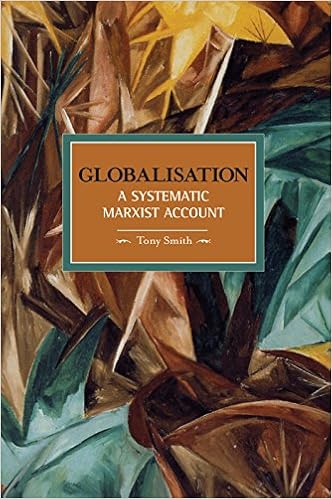
We all know something about globalisation and many of us want our politicians to fix it. Part one of Tony Smith's book reviews the leading proposals for reform.


Amazon link

---

As I mentioned in a previous post, I learned a lot from Tony Smith. Here is how he begins: the quotes below are taken from his chapter 8, "A Marxian Model of Socialist Globalisation".
"The various models of globalisation examined in part one are designed to ... provide a spur to reform existing institutions and practices.

  1. Proponents of the social state call for a renewed state commitment to social welfare and full employment. 

  2. Neoliberals advocate increased free trade and capital liberalisation, along with the dismantling of 'crony capitalism'. 

  3. Defenders of the catalytic state insist that public authorities must aggressively and comprehensively provide the necessary preconditions for a region's successful participation in the global economy. 

  4. Democratic-cosmopolitan theorists propose a global social charter guaranteeing the material preconditions for autonomy and substantive equality of opportunity."

Smith has little difficulty in establishing that all four schools of thought (since they accept the continuing existence of capitalism) fail to propose realistic measures which put a 'democratic' control of economic activity ahead of relentless global profit maximisation.

---

There is, of course, no end to the list of critics of capitalism. But the socialist alternatives are completely tarnished, are they not? By the disastrous experience of 'soviet communism'?

Smith tackles this issue with commendable rigour and honesty:
"A wide variety of objections have been proposed against Soviet-style bureaucratic central planning, widely taken to be either the only form of socialism or the form to which all others degenerate. I shall first list what I take to be the eight most significant criticisms of this framework. ..."
Smith's case against state bureaucratic-socialism is familiar:
"(i) Ownership of the means of production lies in the same hands as control of the coercive state apparatus. While this arrangement may not make the worst forms of totalitarianism inevitable, no one familiar with the historical record could deny its close association with authoritarian regimes.

(ii) Ownership by everyone in general is equivalent to a lack of ownership by anyone in particular. When private property rights to capital goods are not defined, no one has an incentive to use them efficiently.

(iii) Product quality tends to be poor. It is far easier for planners to formulate, implement, and monitor plans in quantitative than qualitative terms. The lack of an effective feedback mechanism connecting producers and users/consumers also leads to a neglect of product quality.

(iv) The informational burdens placed on bureaucratic central planning are now almost universally acknowledged to result in economic inefficiency. Central planners cannot appropriate adequate information regarding all potential inputs, all potential outputs, and all potential social wants and needs, when possible inputs, outputs, and wants and needs are all changing over time.

(v) If we take planners as 'principals' and managers of enterprises as their 'agents', centralised bureaucratic planning necessarily tends to generate severe principal/agent problems. Collective ownership leads managers to distort the information they pass on to central planners, underestimating the output their enterprises are capable of producing while overestimating the inputs required to produce any given level of output.

(vi) Authoritarian central planning is not able to develop successfully in areas where personal initiative and creative responses to unforeseen problems are important. Ordinary workers feel dehumanised and cynical, with pernicious economic effects.

(vii) State ownership of the means of production and centralised planning by a bureaucratic caste cannot match the technological dynamism of capitalism. In certain circumstances, bureaucratic central planning is able to attain considerable extensive growth, that is, growth resulting from the mobilisation of greater and greater inputs. And, in certain sectors where mass resources could be devoted and where success or failure was relatively easily measured (for example, space, military, heavy industry), significant accomplishments were in fact attained in the Soviet Union and elsewhere.

But this sort of social order is unable to generate intensive growth based on the more efficient use of inputs. The lack of incentives for managers to engage in risky activities like innovative behaviour is surely a significant factor. Managers appropriate few of the fruits of such activities when they are successful, and may suffer significant penalties when they are not.

(viii) A lack of hard budget constraints allows inefficient firms to continue in production and even expand over time.

Taking all of these factors into account, most observers conclude, it should have come as no surprise that bureaucratic central planning with state ownership of the means of production eventually generated vast material and spiritual stagnation."
It's surprising how many nostalgic communists and left social-democrats have still not taken these forceful (and thoroughly correct and legitimate) points on board.
"These considerations appear to justify the conclusion that there is simply no feasible alternative to capitalist markets with private ownership of the means of production. Market competition appears to provide private owners with incentives to ensure a level of efficiency and dynamism unattainable in either bureaucratic socialism or market socialism.

"One can accept this conclusion without having to deny that capitalism brings with it profound social costs. Financial crises, environmental crises, extreme levels of economic and political inequalities, and so on, are not likely to ever be entirely eliminated. But the harms they inflict can be lessened over time.

"If there is no feasible and normatively attractive alternative to a capitalist framework, lessening these harms must be our goal, and the failed project of collective ownership of the means of production must be unequivocally abandoned.

"In the present historical context, the burden of proof lies entirely with those who continue to call for the socialisation of the means of production [my emphasis]. Meeting this burden requires developing an alternative model of socialism capable of avoiding the fundamental structural flaws listed above."
---

You can imagine at this point how excited I was that such an incisive and profound thinker was about to unveil a model of post-capitalist economics and politics which might actually work!
"I shall adopt the model of economic democracy developed by David Schweickart, adding three modifications to make it a more adequate alternative form of globalisation."
David Schweickart's book is called "After Capitalism" (2002) by the way: I haven't read it.
"The model Schweickart defends has the following essential elements:

(i) Production and distribution are primarily undertaken within worker collectives. Workers are not hired as wage-labourers by capital; they instead join worker collectives as fellow members. There is a basic right to employment, with state enterprises providing jobs for those unable to find positions in collectives."
Hiring is the easy bit. Smith does a fair amount of hand-wringing later in the chapter when he considers how you might have to get around to actually firing workers.
"(ii) Managers of worker collectives are democratically accountable to those over whom they exercise authority, either through direct elections or through appointment by a workers' council that is itself directly elected. These enterprises are required to have representatives from a range of social movements (environmental groups, consumer groups, feminist groups, and so on) on their boards of directors, accountable to those movements."
Given the intellectual coherence and balanced judgement observed in radical social movements in the real world, I think you can guarantee that they would wreck any otherwise-viable economic enterprise. I might also mention the ample opportunities for rent-seeking and intimidation.
"(iii) Worker collectives produce public goods, inputs into the production process, or final consumption goods. Funds for the first are directly allocated to collectives by the relevant planning agencies (see below). The latter two categories of products are offered for sale in producer and consumer markets.

"In Schweickart's view, attempts to centrally plan all inputs and outputs in a top-down fashion are simply not feasible, at least not in a complex and dynamic economy. But it does not follow that capitalist market societies are the only acceptable forms of economic organisation.

It is possible to imagine a feasible and normatively attractive society combining markets with the socialisation of the means of production, that is, a society making use of producer and consumer markets after abolishing both capital markets and labour markets."
This doesn't pass the innovation test. Would Steve Jobs have got the funds he needed from the relevant 'planning agency'?
"(iv) Workers in enterprises are granted use rights to facilities and other means of production. But ultimate ownership rights remain with the local community. Workers cannot use their enterprise as a cash cow and then walk away; they have a legal duty to maintain the value of the community's investments. If sufficient depreciation funds cannot be appropriated from revenues to maintain the value of these investments, it is the responsibility of community banks to shut down an enterprise."
Shutting down a community enterprise? Yes, that's going to happen. To be fair, Smith himself worries about that but his Pollyanna assumptions that everyone would 'do the best thing' are unfortunately just so much pie-in-the-sky.
"Once depreciated funds have been deducted, the remainder of the revenues from public allocations or sales in consumer/producer markets (apart from the taxes to be considered below) are then distributed among the members of the collective according to formulae set by the democratically accountable management."
Incidentally, this focus on local communities is endearingly Victorian but hopelessly anachronistic. Modern globalised industry (which Smith agrees is a productivity advance that post-capitalism needs to build upon, not roll-back) increasingly organises both production and employee-allocation globally. Localised, and presumably small-scale communities are simply not the scale at which state-of-the-art enterprises operate at.
"(v) The origin of funds for new investment and public goods is a flat tax on the non-labour assets of all enterprises. In Schweickart's proposal, the rate of this tax is initially set by a democratically elected legislature, operating on the national level. This legislature also decides on the appropriate division of revenues between funding for national public goods and funds that are allocated to democratically elected regional and local legislative bodies.

"Each of these assemblies, in turn, must also decide upon the level of funding for public goods to be supplied in the relevant geographical area vis-à-vis the level of funds set aside for distribution to the level below it. These legislative bodies can also set aside a percentage of funds for investment in areas of pressing social needs."
It's touching that Smith thinks that allocations of resources in the billions of dollars are going to be somehow resistant to powerful lobbying, rent-seeking and every form of power-play. Plainly the human nature that Smith sees is not the same as most of us observe.
"(vi) After all decisions have been made regarding the general level of new investment and the order of social priorities, and after funds required for public goods on the national, regional, and local levels have been allocated, the remaining revenues are distributed to local communities on a per capita basis (at least this should be the presumption in the absence of compelling reasons to do otherwise, such as the need to temporarily favour historically disadvantaged regions).

"Community banks would then undertake the actual allocation of new investment funds to worker collectives. The boards of directors of these banks would include representatives of a broad range of social groups affected by the banks' decisions. New enterprises would be formed, and existing ones expanded, through allocations by community banks rather than private capital markets."
Still this idea that 'local communities' are the essential unit of future social organisation. Leading edge corporations today operate globally and have to raise resources on global financial markets. Any socialist alternative is going to have to recognise that global is not simply the additive sum of hundreds or thousands of local community banks.
"(vii) When allocating investment funds for new worker collectives and the expansion of existing ones, community banks must take three main questions into account. Is there likely to be sufficient demand for the output of the given enterprise for it to maintain the value of the community's investment and provide adequate income for its members? Will the investment provide stable employment? And is the investment consistent with the set of social priorities democratically affirmed on the national, regional and local levels?

"Extensive external financial and social audits can be regularly imposed on all enterprises and community banks to assess their performances in terms of these criteria. These independent social audits are a crucial component of the socialist version of the principle of transparency, institutionalising a level of accountability and transparency far beyond the limited neoliberal version of the principle.

"Community banks can then be ranked on the basis of the results of these audits. The level of income of the staff of a particular bank, and the amount of funds allocated to this bank for distribution in the future, are determined by the bank's place in this ranking."
I think we're looking at an impenetrable veto-network here. How many crucial innovations were funded by capitalists taking a punt? There will be precious few punts in the above arrangements.
"(viii) In Schweickart's model, there are no markets for capital assets, and so there will be no capital flight in the form of cross-border investments in capital assets. There will also be little foreign direct investment, since worker collectives are unlikely to outsource their own jobs, and community banks are assessed according to the extent they create employment in their own communities. But there will still be trade across borders.

"For a period of time, this may include trade with regions that have not institutionalised a version of economic democracy. In such circumstances, regions committed to socialist globalisation should follow the principle of fair trade rather than 'free' trade. To ensure that this occurs, Schweickart calls for a 'social tariff'." If oppressive labour practices hold down wage levels in a given region, the prices of imports from that region will be raised to what they would have been had worker income been comparable to the level prevailing in the importing country.

"A social tariff will also be imposed to compensate for a lack of adequate spending on the environment, worker health and safety, or social welfare in the exporting nation. The revenues collected by this tariff will then be distributed to the groups in the exporting country with the best record of effectively implementing anti-poverty programmes, whether or not they are agencies of the government."
A touching faith in (chronically ineffectual) do-gooding organisations and a complete lack of insight into the intractable developmental issues in the third world, particularly sub-Saharan Africa.
"I believe that three additions to this framework should be made:

"(ix) Schweickart does not investigate the monetary dimension of international trade in his model. I believe that the proposals made by Paul Davidson discussed in the last chapter are incompatible with capitalist social relations, but quite feasible if socialist production relations are established. In the latter set of circumstances, it would be possible to have something like Davidson's International Monetary Clearing Units serve as the sole form of world money. It would also be feasible to establish a set of rules that ensure that excessive trade imbalances do not persist, and that the burdens of adjusting to the imbalances that do arise are not disproportionately imposed on the most vulnerable regions of the global economy.

"(x) David Held's proposals for democratic-cosmopolitan law are also incompatible with capitalist social relations, as Chapter 4 established. But they, too, would be feasible if socialist production relations were in place. More specifically, a level of global governance above the state should be established. This would include a representative assembly selected more democratically than the United Nations, a global social charter, an international court of justice, and so on."
Ah yes, world government through a beefed-up UN. presumably with a world army to enforce its decisions. That will go down well. If only we could all get along, like a vast ant colony of genetically-related and sterile individuals.
"(xi) Schweickart holds that local communities within a nation ought to receive new investment funds on a per capita basis. In this manner, the material preconditions for both individual autonomy and flourishing communities are furthered. The force of this argument extends to the global level. There should be a democratically accountable socialist international planning agency to ensure the provision of global public goods. It must also guarantee that regions across the planet have access to new investment funds in direct proportion to their population in the absence of special considerations (such as the need to temporarily favour previously disadvantaged regions of the global economy).

"This is an extension of Held's proposal for global social investment funds, but with these funds now replacing, rather than merely 'complementing', global capital markets. In this manner, the systematic tendency to uneven development that afflicts all possible forms of capitalism could be abolished."
We know how popular transfer payments are.
"This model of economic democracy undoubtedly needs to be greatly supplemented and modified, and compared and contrasted with other approaches with which it shares 'family resemblances'. Once again, however, the goal here is not to provide a fully fleshed-out blueprint of the single best form of socialism. If the model is developed enough to show that a feasible and normatively attractive socialist alternative is possible in principle, that is sufficient."
So you can see how unimpressed I was by Tony Smith's model of post-capitalism. A fantasy of infeasible cooperation and general niceness. To be fair, Smith recognises that not everyone will be thinking altruistically of the greater good of all humanity all of the time, but his architecture kinda presupposes that.

It's what happens when you ignore biology and your model assumes a human nature which would indeed work if almost everyone was a sterile clone.

Still, even if the solution is utterly unconvincing, the analysis isn't bad. I listened to Professor Smith lecturing for an hour last night - to a rather sparsely-attended class at Iowa State - and I was impressed by what he had to say about current global economic difficulties.


He comes across as a slightly manic Bernie Sanders.

---

I am still waiting for the Martian Marxist, the social scientist who simple analyses without confected, activist rage.

I am also of the opinion that a post-capitalist future will emerge from a capitalism which has automated away almost all routine jobs. Call me a fan of AI and robotics.

What happens when the few remaining jobs are at a level of skill and intelligence denied to, say, 95% of the workforce? Those 95% will insist on a radical reordering of things, one which is probably incompatible with the reproduction of capitalist relations of production.

But it will be better.

Monday, April 24, 2017

"The future is already here ... "

The full William Gibson quote: "The future is already here - it's just not very evenly distributed".

We'll wait a long time for AI systems as competent as human workers (for day-to-day tasks). But when those systems arrive, their great benefit will be low marginal cost: software copied for free, hardware rolling off production lines.

And people won't have to do those jobs, unless - hipster-like - they especially want to.


So what would society be like with an abundance of cheap, competent labour?

This future already exists (to the benefit of some of the people) in places with an overabundance of cheap human labour.

From Marginal Revolution:
"The first couple of times I took a taxi to a restaurant I was surprised when the driver asked if I wanted him to wait. A waiting taxi would be an unthinkable expense for me in the United States but in India the drivers are happy to wait for $1.50 an hour. It still feels odd.

The cars, the physical capital, in India and the United States are similar so the low cost of transportation illustrates just how much of the cost of a taxi is the cost of the driver and just how much driverless cars are going to lower the cost of travel. ...

Every mall, hotel, apartment and upscale store has security. It’s all security theatre - India is less dangerous than the United States - but when security theatre can be bought for $1-$2 an hour, why not?

Offices are sometimes open 24 hours a day, 7 days a week. Not that anyone is in the office, just that with 24 hour security there is no reason to lock up, so the office physically stays open. ...

At offices, cleaning staff are on permanent hire so they come not once or twice a week but once or twice an hour. The excessive (?) cleanliness of the private spaces makes the contrast between private cleanliness and public squalor all the more striking."
Karl Marx's communism (abundance for all!) is often portrayed - by members of the elite - as an unattainable utopia; but Marx himself observed that communism for the masses would merely be an extension of the experience of the elite aristocracy through the ages.

Communism 'is already here', as the man said, but '... not very evenly distributed'.

Not yet.

---

India, with its oversupply of relatively unskilled manual workers, is not an optimal emulation of an AI future. AI systems will be more diverse, more embedded and hopefully not oversupplied.

Those waiting taxis come with negative externalities.