One can think of one or two contemporary leaders that the US administration might also wish to terminate but in addition to competence, the problem has always been that of deniability.
Dropping something lethal on the target from a great height is rarely a problem.
As the recent assault on Sergei Skripal in Salisbury indicates, covert administration of a lethal agent is not a problem if you have access; but wary leaders take precautions. The idea of 'slaughterbots' comes to mind, but these are high-tech. Inevitably some will crash and only partially burn - and then the adversary's weapons lab will point the finger.
The answer is to use a biological vector - an insect such as a wasp or bee comes to mind. Surely with American leadership in deep learning and artificial neural nets this must be a trivial engineering problem? But not so. Virtually nothing is known of how the insect brain controls the insect body, in terms of flight control, visual processing and goal attainment.
---
The simplest possible organism with a nervous system may be C. elegans.

"Nervous systems are complex, highly parallel information processing architectures made of seemingly imperfect and slow, yet highly adaptive and power-efficient components to carry out sophisticated information processing functions.I'm not sure I completely believe that final sentence, although the complete operation of neuron-neuron communication is far from understood.
However, despite the rapidly growing body of knowledge on almost every aspect of neural function, currently no computational model or hardware emulation exists that is able to describe or even reproduce the complete behavioural repertoire of the nematode Caenorhabditis elegans, an organism with one of the simplest known nervous systems.
This is particularly surprising because C. elegans, a soil-dwelling worm with a life span of a few days, 1 mm long and 80 µm in diameter, is one of the five best characterized organisms. It is multicellular and develops from a fertilized egg to an adult worm just as a human being does. Despite its small genome (~ 10 M base pairs), there is about 40% homology to the human genome (3.2 G base pairs).
The adult hermaphrodite is comprised of exactly 959 cells, including 95 muscle cells and 302 neurons. The morphology, arrangement and connectivity of each cell including neurons have been completely described and are found to be almost invariant across different individuals. There are approximately 7000 chemical synaptic connections, 2000 of which occur at neuromuscular junctions, and approximately 600 gap junctions (White et al., 1986).
All of this data including the connectome, the detailed interconnectivity map of the 302 neurons through synapses, is publicly available through the Worm Atlas (Achacoso & Yamamoto, 1992; Oshio et al., 2003; Varshney et al., 2011).
Despite its simplicity, the nervous system of C. elegans does not only sustain vital body function, but generates a rich variety of behavioural patterns in response to internal and external stimuli. These include associative and several forms of nonassociative learning that persist over several hours (Hobert, 2003). Interestingly, many processes of learning and memory in C. elegans are highly conserved across evolution, which demonstrates that there are universal mechanisms underlying learning and memory throughout the animal kingdom (Lin & Rankin, 2010).
With all of this data, information and modern computer technology at hand, it is surprising that there is yet no comprehensive artificial C. elegans emulation system from which the principles of neural information processing underlying behaviour can be derived. The Si elegans project aims to fill this gap.
Research into neural networks (NN) and artificial or computational intelligence (AI/CI) has tried for more than 30 years and not succeeded in understanding the signal processing in a simple network made of only 302 neurons.
The main reason is: nervous systems work in different ways than current computers and any simulation running on them. In nature, information is processed in a highly parallel and "plastic" fashion, which cannot be sufficiently reproduced or simulated in hard-wired, serial multi-tasking or even parallel-linked von Neumann architectures."
---
 |
| Amazon link |
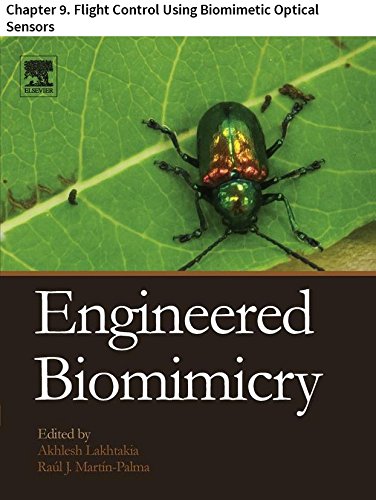
This (2013) ebook, " Engineered Biomimicry: Chapter 9. Flight Control Using Biomimetic Optical Sensors" comes with the following summary:
"Insects are dependent on the spatial, spectral, and temporal distributions of light in the environment for flight control and navigation. This chapter reports on flight trials of implementations of insect-inspired behaviors on unmanned aerial vehicles. Optical-flow methods for maintaining a constant height above ground and a constant course have been demonstrated to provide navigational capabilities that are impossible using conventional avionics sensors.
Precision control of height above ground and ground course were achieved over long distances. Other demonstrated vision-based techniques include a biomimetic stabilization sensor that uses the ultraviolet and green bands of the spectrum and a sky polarization compass. Both of these sensors were tested over long trajectories in different directions, in each case showing performance similar to low-cost inertial heading and attitude systems."
If we could replicate the insect's brain on hardware and remotely couple it to an insect body, a possible mission architecture sees a stealthed RPV deliver a cache of insects to within a couple of kilometres of the target.
The swarm is released and remotely flown to the target - where some kind of lethal toxin is delivered. The insects then disperse to receive a 'destruct' command. If any bodies are found, there will be little left to show that they have been engineered.
---
See also: Openworm. All these 'worm simulation' projects seem to be moribund, if not dead. I wonder why?