Showing posts with label COVID-19. Show all posts

Sunday, July 14, 2024

COVID: Day 4


 So Wednesday night was the unexplained coughing; Thursday was the feeling cold-ish - yes, it's a cold! - followed by a night of spouse-awakening coughing.

Friday morning (I know now how COVID feels) I asked Clare to pop down to Boots and buy a flow test. It's a bit complicated, following the instructions; something like fourteen steps? I had no confidence that the test would work. Twenty minutes later I was looking at the image you see above. And only five weeks since I had an identical bout! That can happen, apparently.

I'm lucky so far: nothing in the lungs, no serious muscle pains, manageable lethargy. I have no appetite but even that can be spun positive - it's been months since I was below eleven stone (70 kg) and yet... here I am at 69 kg and a bit. 

I think it will be next Sunday, a week today, before I can freely meet with any old and infirm people. Meanwhile I am self-exiled to the back bedroom, where I feel psychologically sedated but prone to bedding-changing night time sweats. Yes, yeuk!

In other news today, ex-President Trump was shot at and slightly wounded. I found out this morning because, naturally, I was early to bed last night. All the usual stereotypes and narratives are to-hand and I have nothing remotely original to contribute.

Now for some more rehydration...

Friday, May 10, 2024

Notebook: Higgs, Gym, Beta-level Simulation

Amazon

Higgs field/boson popular science book

I recently read Matt Strassler's book, "Waves in an Impossible Sea" which aims to explain the Higgs field and Higgs boson to non-physicists. It's probably as good as you can expect for such a book. Strassler is a clear writer and doesn't shy away from difficult questions.

For example, he tackles the question of whether light, which travels through a vacuum, needs a (very strange, 'impossible') medium to carry the electromagnetic field. He makes a clear distinction between a medium and a field which is crucial here.

The explanation of the Higgs field "stiffening" quantum fields for particles with mass isn't perfect, but it's perhaps the best analogy available. It encouraged me to revisit the maths - I have some books which are gentler than this.

Exercise Routine

This morning at the gym I continued my aerobic workout: five minutes on the exercise bike, then the stepper, and finally, the treadmill. My goal is to improve my fitness, especially after a bad case of what was likely COVID last June. The breathlessness lingers, but I believe exercise can help. The idea is to use the gym for 15-20 minutes of high-intensity aerobic exercise, complementing my Tai Chi sword form, Tai Chi form and Heian kata (shotokan karate) practice.

With summer approaching I can move some of the latter exercises outdoors, freeing up gym time for equipment-based aerobic work.

Your very own beta-level simulation

An article in The Times recently discussed the use of large language models to create "Grief-Bots" or "Dead-bots" – terms that could use some marketing work! The concept involves feeding a large language model with information about a deceased person, including appearance, voice recordings, conversation samples, and even their style of communication. The system then essentially "reincarnates" the departed, allowing a simulated interaction with a spouse, parent, or other loved one.

One suggestion was to leave such a "beta-level simulation" (as Alastair Reynolds termed it) for your descendants. This could be an alternative to traditional ‘letters cast into the future’, which naturally lack context and specificity.

However, the question arises: what's the purpose of such a simulation? It wouldn't be an information source, as better systems exist and will continue to develop. It wouldn't be the first choice for advice either.

Perhaps it's for emotional support – someone who responds in a way that resembles a spouse, grandparent, or ancestor, acting more like a friend than a resource. Science fiction often explores this theme, sometimes with a Far-Eastern cultural context: ancestor-worship.

While I understand the concept, I suspect most people wouldn't be interested in frequent interaction with such an "archaic entity" when daily life offers so much.

Practically, leaving an operational large language model to your descendants is impossible. Technology advances rapidly, rendering the software outdated and unusable within a year.

A better solution might be to leave training data – biographies, transcripts, and other relevant information. This way, future generations could train a model using the latest software, essentially "reincarnating" you or anyone else.

Forward-thinking individuals might consider this approach for the future. Or perhaps they’ll wonder why on earth they should bother: one’s sprawling digital estate will have all the data any future AI system could ever require, whether you like it or not.

Sunday, April 05, 2020

COVID-19 Notes: Politics vs Epidemiology

This whole COVID-19 thing has been a laboratory experiment in human behavior. The virus is invisible and for many people there has been no direct experience of the pandemic. So people's reactions are based on what they are being told and instructed to do via the media.

On the foreign TV stations today (CNN, EuroNews) there were video sequences of UK people enjoying the parks in the sunshine over this sunny weekend - in violation of the lockdown. In our own news channels (BBC, ITV) not so much. No copying, please!

The media find themselves in a difficult position: the government fears the fundamental irrationality of the masses and therefore declines to present the models from which they're working ... and the options they're considering.

The culture wars, in all their social momentum, aptly demonstrate how much political force can be assembled in support of nonsense. Who'd risk it?

The media could call them on this, but they also understand how dangerous it is: they hold themselves on a leash, ask seemingly-tough (but rather general) questions on secondary issues and don't challenge the inevitable obfuscatory replies they get from the politicians and health bureaucrats.

I agree this is both sensible and necessary: I merely draw attention to the fact that it's theatre. It also makes everyone involved look kinda stupid as they walk on eggshells.

---

It's possible (while mixing a few metaphors) to read between the lines and figure out the small print of government strategy. Right now it's all about suppressing the early exponential phase of infections and building NHS capacity plus testing; in a month they will probably let the 'young' out - festooned with tracing apps - and keep the 'old-retired' cocooned. Not a hard sale. There will be much official wriggling around on 'intrusive' mobile phone apps to lubricate buy-in.

Come the summer the economy will reboot, in fits and starts, with some fumbling since the data on infections/immunity will still be too sparse and underdetermined.

Then as we wheel into the autumn the recession will bite in earnest. I expect 2020/2021 to be the lost years as the zombie-sector of the economy caves in with mass unemployment and bankruptcies.

The economic green shoots are postponed till late 2021.

---

What are we doing? We have the exercise bike parked in the hall and we both do 5 or 10 minutes a day at a pant-inducing rate. I jogged the 1.2 km 'round the block' yesterday in a preliminary 7 minutes and 10 seconds; my target is a minute quicker.

Important to prep the respiratory and cardiovascular systems.

"Adam Bede" by George Elliot
Clare has discovered audio books on Kindle - now heavily discounted - and is pictured listening to "Adam Bede".

Amazon link

I am on book six of Chung Kuo and still engaged with the agents of progressive change being uniformly unpleasant and/or psychopathic while the T'ang leadership representing the status quo (= cultural death) are elegant, intelligent and refined. SF opera on the grand scale.

Saturday, March 21, 2020

COVID-19 Notes: R0 > 1 still: March 21st 2020


Wells Market today (the Spring Equinox) - this counts as deserted

Other things being approximately equal, while reported cases rise (day on day) each day, R0 > 1.

This means the pandemic is not under control, is not being suppressed, is only being managed.

The revealed preference of UK Government policy is pretty much the status quo ante:
  • to accept that this infection is going to run, albeit at a slower rate - reduced R0 >1
  • to try to "shield" (cocoon) the elderly, pregnant and 'at risk'
  • to ramp up resources (testing and contact-tracing, beds, ventilators, partial-treatments, eventually vaccination) as fast as possible.
Minimising the virus overspill over NHS resources seems an acceptable compromise, carried out under the acceptable political banner of 'suppression'.

---

Sunday, March 15, 2020

COVID-19 notes: mid-March 2020

We were walking around Wells marketplace yesterday. Everything normal: the market stalls were all in place, crowded with people; the high street was full of passers-by.

No masks of course.

My estimate is that there will just be a handful of people with the infection at the moment: no-one here will know anybody who has a real problem (above the noise level of normal winter illness).

---

The criticisms of the Government's policy are largely idiotic. They remind me of the apocryphal Star Trek quote: "We gotta slow down, Cap'n, the crew cannae take any more!"

Despite the robust pronouncements of an excitable Greg Cochran, Europe and the States can't get R0 below 1 - the political institutions and popular mandate don't permit it (nor is it desirable given the risks of further outbreaks). So the infection will run its course at a rate which is subject to only marginal re-engineering.

Despite the polemics, UK policy is essentially the same as that being applied in Europe, factoring in the time-lags. I'm expecting the UK peak to be mid-May (if delays don't really work) to mid-June (if they do). The earlier date is 60 days from today: eight and a half weeks.

We will soon find out what 400,000 dead looks like: [67 million * 60% * 1%]. 

Note that the background death rate in the UK is around 100,000 per month.

[70 million population divided by 70 years of life = 1 million dead/year; 100,000/month].

"Fifty percent of cases would be within two thirds of a standard deviation from the central point, which gives 2 * (2/3) * (2.25) = 3 weeks."

So during the peak three weeks, the death rate will be 275,000/ 75,000 = 3.7 over normal.

We will notice when every 'normal' dead body is accompanied by three additional ones..

---

I read a couple of books where the first half - analysis - was excellent while the second half, conclusions and recommendations, was rubbish. It's what happens when somewhat-bright people review the work of people who are really smart - but then expose their own lack of insight.

Amazon link

Great analysis of Marx's sociological and economic thinking. Best summary if you are already familiar with the economic concepts (c + v + s etc). But his conclusions, where he indicates why he is no longer a Marxist, are just ... terrible. Not wrong: just superficial, lacking insight.

Example thought: 'Marx's economics work is not used by modern economists: it's like it never existed at all'.

Right.

---

Amazon link

Kagan has a good, clear-eyed analysis of the basis of the post-WW2 order. American hegemonic power created a global Hobbesian state in which lesser (but historically dangerous) powers - Germany, Japan - were disarmed and prevented from rising again. A somewhat demilitarised non-American capitalist world gained the benefits of trade: Les Trente Glorieuses.

The unravelling of neoliberalism, dominated as it was by globalisation, financialisation and a growing separation between the elites and the masses, has refracted itself into political crisis everywhere together with the fraying of the 'American mission to the world'.

Kagan is broadly correct in this analysis and his writing is historically-informed: 'the jungle always grows back'.

At this point his intelligence fails him. He confuses the epiphenomenal role of elite institutions (EU, IMF, UN) with those real global, historical forces which are transforming class and inter-state relationships. His tail wags his dog - a paradigm which the first half of his book has already decisively refuted.

---

What I'm reading now

Amazon link
Ten volumes (out of twenty) so far published (Wikipedia article). I'm on volume three.

This is good old-fashioned SF on the grandest scale with a cast of thousands - most of whom end up horribly dead.

A frightening view of a future dominated by China with its traditional Confucian culture of Han superiority, disdain for 'Barbarians' and a preference for a life of regimented stasis.

Nope. Will never happen.

Friday, March 06, 2020

COVID-19: UK predictions: now-June 2020

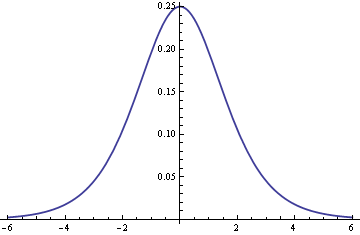
The logistic distribution from John Cook's excellent overview

The derivative of the logistics curve (the cumulative number of cases in an epidemic) is the logistic distribution, which looks very much like a scaled normal distribution as John Cook explains.

His graph above shows you the number of active cases as time advances: starting low, rising to an epidemic peak and then dying away. [As I write we are at -3.5σ = -5.6].

The standard deviation to use σ = 1.6 according to John Cook's article.

The Times today carries a report which allows a prediction of the course of the epidemic in the UK. This is what the Chief Medical Officer had to say:

"Professor Whitty said that the peak of an outbreak was expected in about two months, with 50 per cent of cases over a three-week period and 95 per cent over a nine-week period."

Mapping this on to the normal distribution gives us a standard deviation of two and a quarter weeks (σ =2.29, call it 2.25).

Fifty percent of cases would be within two thirds of a standard deviation from the central point, which gives 2 * (2/3) * (2.25) =  3 weeks. 

So the peak of cases would be two months time, early May: we are currently about three and a half standard deviations out (7.9 weeks).

Five weeks after the peak the epidemic should have burned itself out in the UK: mid-June.

So to summarise for the UK:
  1. Crisis (50%):  end-April to first half of May (3 weeks)
  2. Peak:               first week of May
  3. Burn-out:        mid-June.
 The power of stats.
---

Thursday, March 05, 2020

COVID-19 notes: plague month four


1. "This solves so many problems!"

Humour saying the unsayable. We have too many old people. We have too many old people clogging our health systems and care homes. We can't afford decent support while no-one will countenance those helpful little pills for the elderly infirm. And now nature has come along to solve our problem.

As regards the political and economic conditions of the poor, the Black Death was a real public good.

Subsequently.

2. Follow the Money

I was doing calculations (parameter estimations for logistics curves) to try to figure out when the epidemic will finally burn itself out. But the James Bond people have helpfully solved the problem (was ever a film better named!). "No Time To Die" has been postponed to November.

3. There are two mutations, 'L' and 'S' in the world (so far)

The more aggressive 'L strain' appears to be less prevalent, possibly due to increased suppression due to it being more apparent to surveillance (and quarantine). However, we are in the earliest stages of the pandemic globally and the number of mutations correlates with the number of viruses in replication.

It is unlikely that the virus is at its peak of fitness in current incarnations. And RNA viruses have a hundredfold greater mutation rate than DNA viruses.

---

Rhetorical question: how many people are currently envisioning themselves a few months from now lying pallid and dizzy in their beds while slowly drowning from fluid build-up in their lungs?

Tuesday, February 25, 2020

COVID-19 dynamics: simple coronavirus models


1. From deaths to current number of infections

The deaths reported in a country are usually the cumulative deaths so far. By the time someone has died though (they caught the infection a while ago) the infection has since increased. Here's a model which takes both these facts into account.

Assumptions

(1) lethality rate is 2%;
(2) average time to die after infection is one week (conservative assumption);
(3) numbers doubling time is 7 days (during the early, exponential phase of the infection).

Note that in a sequence which doubles, the latest figure is half the total so far. Thus 1, 2, 4, 8, 16. The current figure, sixteen, is approximately half the total of thirty one.

Example:a country which reports 16 deaths so far - also [n deaths].
1. Deaths (overall) = 16  [n]

2. Deaths in the latest iteration = 8  [n/2]
   - assume the 8 people caught it 7 days ago=1 iteration.

3. Infected cases 7 days ago = 50 * number now dead @ 2% lethality
    infected = 50 * 8 = 400   [25n]

5. Number infected now (twice as many) = 800  [50n].

So when you hear on the news that so many people are reported dead in some country, multiply by 50 to get the current number of cases.
---

2. The pattern of number of cases

If the infection was spreading in a closely-coupled population with no obvious barriers then the number of cases would increase as the logistics curve at the top of the page above. But countries are engaged in lockdown. This means that the logistics curve will apply inside the quarantine area - perhaps with a smaller R0 if people self-quarantine at home - but that spread outside will be impeded.

However, this is a hard virus to lockdown completely given asymptomatic transmission. So it's quite likely that - with a delay - new cities and regions will be infected ... and then locked down.

This gives a waviness modulating the global logistics curve. The global curve is a series of mini-logistics-curves glued together. It makes the overall pandemic a more protracted affair, which obviously helps in terms of public health logistics, but it's unlikely to stop the virus in its tracks.

It also creates periodic illusions that 'the infection is levelling off'.

---

3. The case of Iran

Iran's Shia theocracy is culturally not like the West, or indeed China. I wonder whether their current policy is not so much incompetence as a simple resignation to letting the virus just run to completion.

The reactionary theocrats running Iran may believe that their middle-class opponents are more likely to suffer as a consequences of the pandemic (the conservative rural multitudes will just soak it up) plus they are mostly surrounded by enemies: Israel, Arabs and Sunnis. What's not to like about being a country-level superspreader?

This would be interesting if true: Covid-19 as implicit biological warfare.

Tuesday, February 11, 2020

COVID-19: should we be worried? Yes

Dr Neil Ferguson of Imperial college seems the go-to guy:
"Our estimates – while subject to much uncertainty due to the limited data currently available – suggest that the impact of the unfolding epidemic may be comparable to the major influenza pandemics of the 20th century,” he said. [Daily Telegraph].
I heard him on PM yesterday evening. He reckons 60-70% of the UK population will eventually get it, of whom 1% will die; big error bars for the next three weeks. Given asymptomatic transmission with R0 2-3 it can't be kept out or contained within the UK over any extended period. Especially when it goes exponential in countries outside of China.

From Le Monde: (Practise your French) :
"selon une modélisation, un groupe de trois Etats se situe dans le trio de tête des pays les plus menacés par une arrivée du virus : l’Egypte, l’Algérie et l’Afrique du Sud. Ils sont suivis d’un second groupe constitué, lui, du Nigeria et de l’Ethiopie."
Lots of links between China and Africa. Public health screening and treatment not brilliant in the latter.

UK risks: (i) breakdowns in the supply chain May/June when the pandemic really takes hold here; (ii) personal incapacity and/or need to self-quarantine.

What can you do? 

- Shop now for cans of soup, long-life milk, dried fruits and cereals, sanitary items; face-masks (they won't look so ridiculous soon).

- Check out your camping cooker.

- Petrol in the car - don't forget the car can charge mobile phones.

Buy stuff you'll be able to consume after the pandemic so you're not wasting money.

---

The Mormons famously have a survivalist level of supplies, c. six months. But 2-4 weeks should do it - you can always go half-rations.

I always think the best time to panic-buy is before other people realise they have to.

Note

Best estimate of case doubling time at present seems to be 7 days. If, by the end of February, there were 16 invisible cases in the UK, time to one million is (sixteen doublings) = 16 weeks = four months.

It won't seem a major problem here before Easter is my prediction (note big error bars!).

---

Update (13/2/20): I today cancelled our June holiday in Crete. The call-centre operative seemed unsurprised when I mentioned COVID-19. We have, however, been hit by a stinging cancellation fee, the entire deposit, 20% of the overall cost.

I'm thinking this summer is going to be disastrous for the holiday companies and for travel insurers.

---

Update: If you have a VPN into the UK it is educational to watch this:
"Hannah Fry leads a nationwide experiment to help plan for the next deadly flu pandemic, which could happen at any time. How many will it kill? What can we do about it?"
The BBC/Cambridge model parameters are basically spot-on for Covid-19 (R0=1.8; lethality=2%).

---

Update (14/2/20): My brother wrote to me and observed:
"I would take issue with one of your precautions: Don’t waste time and (increasingly large amounts of) money on surgical (or most other types of) masks. Even the better ones have an interweave gap some three times larger than the virus and invariably get damp, increasing the stickability.

Leave your eyes, nose and mouth open to the world, just don’t touch them without washing/gelling hands (as frequently as possible)."
---