Showing posts with label Immortality. Show all posts

Wednesday, November 06, 2024

Some of those alive today will never truly pass...


Some of those alive today will never truly pass...

I live in the moment. I don’t experience yesterday’s me, or the me of ten seconds ago. Those people are only memories in the here-and-now: partial and selective.

The me of tomorrow is speculative.

I feel myself a sliver of consciousness in this moment, surrounded by a sterile past and future; a present-spark in the wasteland of non-being in the rest of eternity.

I don’t worry about it.

Let me paraphrase: that intellectual truth carries no affective overtones.


You tell me I will be shot to death tomorrow. That prospect, truly believed, updates my present internal state and induces fear. How uncomfortable! 

But will I really be shot tomorrow? Who knows? Nobody.

I die and am resurrected in a very advanced AI system, a distant descendant of the Chatbots and Replikas of today. It’s loaded with my personality model, with my personal history (reconstructed from documents, posts, pictures, videos, memoirs) used to create detailed ‘memories’.

Perhaps it has a body much like mine so it’s an embodied avatar of myself.

How is it different in kind from my present anticipation of tomorrow-me?

It’s hard to say. I think it would come down to whether it had an inner life, just as what constitutes the me that worries about such things seems necessarily to have an inner life.

Hat tip René Descartes.


Why do we have an inner life at all? Where did that come from, evolutionarily speaking?

Because we struggle to understand ourselves. A single level architecture, whether a merely reactive robot like an insect - or a zombie powered by a purely rational theorem-prover - would either have nothing capable of self-understanding (the insect) or nothing to understand (the zombie).

But humans have a triune architecture, with our cortex-powered superego/ego a late addition to our selfish, instinctual id - a cortex doing the work of situating us in an extended, non-immediate world, a world with a past, a future, a web of objectives, means, ends, social relationships, friends, enemies, neutrals and endless politics. No wonder we are conflicted over what we should be doing: the bit that negotiates lives in endless, fraught dialogue with the bit that selfishly wants and doesn’t want.

Our mental world is populated with intentional prediction models of others (goals, beliefs, plans, perceptions, actions) and of course, models of ourselves: “Learning to be Me” in Greg Egan’s phrase.

Our chatbots don’t currently have an internal life: it is not ‘something that it is like to be’ if you’re ChatGPT. But that’s a feature of the current architecture. There's not much current demand for emotional, conflicted, somewhat edgy AI agents. But when that moment comes…

When it comes, I should contemplate my biological death as no longer final on this Earth, provided that at some point my descendants choose to reincarnate a personality much like my own.

How convinced are you? And did you reflect on this deeply enough?

Thursday, July 06, 2017

What would amaze Newton? Not much

"I've seen things you people wouldn't believe: attack ships on fire off the shoulder of Orion. I've watched C-beams glitter in the dark near the Tannhauser Gate. All those... moments... will be lost... in time, like... tears... in rain." (ref).
Did I mention that I am already bored with the future?


As an experiment, I mentally bring Sir Isaac Newton (1642-1727) back to life as a fully-formed adult, and ask what surprises him about three hundred and fifty years of progress. I don't mean surprised in any obvious sense, I mean stuff he'd discover that he genuinely could not have anticipated.

Our present-day culture and technology? I think that was all imaginable in the 17th century. I hesitated a bit at computers - the whole concept of hardware-software seems to depend on a post-Newton paradigm - but then I remembered Leibnitz.

So I think the only things which would truly amaze the brought-forward Newton are:
  1. Relativity
  2. Quantum Theory
  3. The neurobiological basis of mind.
The first two violate his Galilean worldview; the third his strong religious beliefs.

---

Today we know the universe - spatially and temporally - pretty well: from 10-32 seconds at startup out to about 100 billion years ahead.

We also know what the universe is macroscopically made of: galaxies, black holes, stars, planets, space-boulders, dust & gas clouds. The known laws of physics apply to virtually all of the phenomenology of these objects - we can predict with high accuracy what it would be like to visit.

No real surprises there.

---

Life is bounded by physics, chemistry and thermodynamics. We have a reasonable theory of biogenesis ('The Vital Question') and the transition to eukaryotic and multicellular life.

I wouldn't be surprised to find we are the only technological society in this galaxy (evidence) and I think we have a reasonable idea about the kinds of aliens that might exist - once we peel off those rose-coloured spectacles.

If I were to achieve an unwanted immortality, I just don't see where future history could differ much surprise-wise from that space which science-fiction has already massively, redundantly charted.

I would be interested - but I don't see myself massively amazed.

---

Note: there really isn't that much room for reality to out-weird our imagination when a leading paradigm to understand the spacetime in which we live is described thus:
"The zeroth order phenomena [in quantum gravity] is locality itself. This must be the case if, as is sometimes hypothesized, locality is emergent in the classical or continuum limit of a fundamental quantum theory of gravity, whose states are networks living in no space, perhaps spin networks or records of entanglement.

The first order departures from locality are quantum phenomena, especially entanglement. Indeed one version of this proposal is that spatial relations are emergent from entanglement. ... "
From Lee Smolin's paper, "What are we missing in our search for quantum gravity?".

Tuesday, July 04, 2017

The Tao of Immortality

Amazon link

If "A Wizard of Earthsea" is a boy's coming-of-age and "The Tombs of Atuan" is a girl's coming-of-age, then "The Farthest Shore" is a mature reflection on power, its limits and the deeper purposes of life.

The storyline concerns the disintegration of magic - a side effect of a maverick sorcerer, Cob, who develops a great spell to ensure his own immortality. Le Guin portrays this as the ultimate destabiliser of the balance of life, the harmony of all existence. Death-removed is stasis; death is the prerequisite for the renewal of life.

Very Taoist and emotionally satisfying, even a little convincing; but my inner skeptic has qualms.

---

The modern theory of aging is that of senescence although controversies rage. But as Greg Cochran observes, in theory it should be fixable. In surveys, people seem to be split as to whether they would take up an offer of personal immortality.

If I was offered a course of treatment which rendered me immortal, I wouldn't be interested. I'm too stupid and slow at age 66: I see only voyeuristic tedium in millennia to come. But perhaps the salesman has an upgraded deal?

Perhaps my ageing, error-strewn DNA could be debugged and re-implanted somehow to make a quasi-clone. A new, vibrant baby-me, ready to start a new life without all those burdensome memories and bodily breakdowns. When I was such an infant, I'm sure that I was up for life .. so that would have to be a yes, then.

But why stop at cloning? Why not introduce some extra variety, explore new regions of the corporeal and psychological state-space? Sounds like an even better plan.

Oh, wait. You say we do that already?

---

I think it's an open question as to whether a society which had genetically-engineered extremely-long life would have strategically greater reproductive success than current-lifespan societies. That is the issue at stake here.

One day some society will try it - and evolution will have another sub-species to test..

Friday, November 18, 2016

Cryogenically frozen for years: then what?

From the BBC - the story is carried by many outlets.
"A 14-year-old girl who wanted her body to be preserved, in case she could be cured in the future, won a historic legal fight shortly before her death.

The girl, who was terminally ill with a rare cancer, was supported by her mother in her wish to be cryogenically preserved - but not by her father.

She wrote to the judge explaining that she wanted "to live longer" and did not want "to be buried underground".

The girl, who died in October, has been taken to the US and preserved there."
Her letter is quite poignant.
"I have been asked to explain why I want this unusual thing done.

"I am only 14 years old and I don't want to die but I know I am going to die.

"I think being cryopreserved gives me a chance to be cured and woken up - even in hundreds of years' time.

"I don't want to be buried underground.

"I want to live and live longer and I think that in the future they may find a cure for my cancer and wake me up.

"I want to have this chance.

"This is my wish."
---

In order of likelihood, most likely first.

  1. Civil disturbances result in loss of cooling sometime over the coming centuries.
  2. The best they can do is clone her from her DNA - so no memories.
  3. They scan her brain and recreate her mind in a total VR simulation.
  4. She is resurrected as a physical android with brain emulation.
  5. They scan her brain, run her mind as an emulation controlling a biological clone body.

The most unlikely option? She gets thawed out, they fix freezing damage and her cancer, and she resumes life in the future.

---

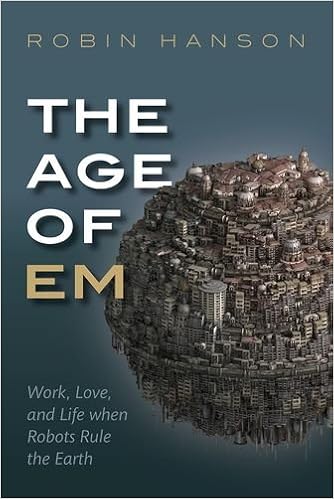
Brain scanning was discussed in Robin Hanson's book. Em stands for 'brain emulation' via scanning.


In this scenario, the girl (like other cryonauts) becomes a human time capsule, a resource for future historians.

No-one seems to dispute that both neurological and other organic damage will result from the cryogenic process. Presumably a sufficiently robust scanning procedure could review, edit and fix errors - mostly.

We don't have the faintest glimmerings today of such technology.

Wednesday, December 30, 2015

Immortality Ltd

My new business venture.


"Good morning, sir.

"Once you have signed up we take your DNA sample - saliva or a cheek swab will do the trick. We'll hold off on the full genome sequencing as long as possible - you know, costs are coming down and accuracy's getting better all the time.

"Now let me explain the basic service.

"Our trained interviewers will help put together a detailed biography of your life. Any of your photos and videos plus supporting documentation will be invaluable here. Going forwards, it would be helpful if, from now on, you could keep a detailed diary - even better would be a blog. My own would be an example - oh yes, we do eat our own dog food here.

"Now when the time comes, we will need to see a death certificate, for legal reasons. Then we can take your stored cells and started the cloning process. We choose the foster parents to replicate the kind of idealised childhood you would wish to have had. We can reassure you that given basic standards of care, the correlation between parental environment and life outcome is essentially zero. So it's not too critical.

"As you grow and develop, our company will use the biographical material I mentioned to systematically brief you on your previous life."

"?"

"Yes, sir, that's the life you're living at this moment. As your future self grows up, he will absorb your biography as part of his education. You have heard about so-called false-memory syndrome? Well, consider this a benign case. Your future self will gradually remember being you in this life.

"And in the much more remote future? Well, we can do it all over again. And again."

...

"You ask about the special services? As you know, we all have a couple of recessive lethal mutations. These can be snipped out. We can remove genetic disease traits if sequencing shows you to have them. And we can tweak the quantitative traits. Sir might wish to be a little more intelligent, a little taller or stronger, perhaps a shade more attractive? And if you find certain aspects of your personality slightly irksome, well, something can be done about that."

...

"You ask, will you still be you? As you know, we all change a bit over our lifetimes, and provided we keep your genome edits within the normal range we're talking about a better you, not a different person. As I said, these are optional services and we do charge a fee, but nevertheless we find them popular. Our customers seem to want that extra edge for their future selves.

"And now sir, if I could draw your attention to the contract we have here, ready for your signature?"

---

What do you think? Angel investors or crowdfunding? Should I offer a discount for a husband-and-wife family plan?

---

Steve Hsu had a not-dissimilar post for Christmas.