Showing posts with label Charles Stross. Show all posts

Monday, February 24, 2025

My Favourite Science-Fiction Authors

---

ChatGPT:
In your teens you were a fan of Isaac Asimov's Foundation series, Robert Heinlein's adventure SF novels, and Arthur C. Clarke's technical near-future fiction. None of these authors now feature on your favorite list—why is that?

Nigel:
When I returned to these authors, as an adult, I found Asimov's characterisation shallow and his style pedestrian—tedious, in fact.

Heinlein’s Starship Troopers stands out as a kind of masterclass in civics and moral coming-of-age, but most of his other stories are drowned in hedonistic self-indulgence.

As for Clarke, his engineering bias hasn’t aged well, and once again his characterisations are virtually non-existent.

These days, I want more from my fiction.


ChatGPT:
Your critique clearly shows that you demand more depth—both in characterisation and in thematic exploration—than what you found in those earlier works. Shifting focus to your current favorites: Which among them best fills that gap? Take Iain M. Banks’ Culture series, for instance. What resonates with you about it, and can you pinpoint a moment or aspect in Banks’ writing that you find transformative compared to the cold technicality or self-indulgent hedonism you disliked before?

Nigel:
After his death, I genuinely thought for some years that Banks would quickly be forgotten and be unread. His plot development is dense, complex, and often unmemorable; the quality of his Culture novels is quite uneven.

Over the last couple of years, however, I’ve reconsidered. I now see more clearly how many deep issues his thinking encompassed, and how the vast canvas of space opera allowed him to explore profound philosophical and moral dilemmas through vast splurges of baroque text.

Banks was very smart and expected the same of his readers—you never come to believe, as you read, that you're out-thinking him. On the downside, I don’t think there are many sharply, deeply delineated characters in his work. Even Diziet Sma only takes you so far.


ChatGPT:
Interesting. Moving on to Greg Bear, you’ve admired his work as well. Do you think he strikes a better balance between scientific rigor and emotional engagement? Are there particular works—say, Eon or Queen of Angels—that exemplify his strengths? How do you feel his narrative style has evolved over time?

Nigel:
I don’t think that’s the spectrum by which Bear’s work should be judged.

Like most ideas-based SF, his writing is rather matter-of-fact. It doesn’t elevate the heart-rate or engage the emotions much—except for the intellectual sense of awe it inspires. Bear tells an awe-inspiring story, and he’s one of the best at expanding that vast canvas of futurity which simply blows the mind away, whatever topic he’s dealing with.

I always felt he was working through a standard list of subjects—the General Relativity novel, the Quantum Mechanics novel, the Bio-Engineering novel, and so on. He generally made superlative tech-thrillers out of nearly all of them: his work is brimming with ideas, worked out in exquisite detail, which holds your attention.

But once again, memorable characters and inner lives are not his strong suit.


ChatGPT:
That’s a clear-eyed assessment. Let’s talk about Richard K. Morgan next. His work is known for a gritty, uncompromising vision of the future, filled with realpolitik, double-crosses, and a jolt of raw sex and violence. What aspects of his style or thematic focus do you think best capture the contemporary zeitgeist? How do his narratives, especially in the development of his antihero Takeshi Kovacs, address or subvert traditional dystopian tropes?

Nigel:
Morgan’s worldview is fairly standard: evil corporations, corrupt institutions and governments, and oppressive religions. His schtick is realpolitik—cynical about motives and fully aware that superior physical force generally wins the day. His plots are packed with double-crosses, deception, and betrayal—ingredients that make for an engrossing thriller.

Additionally, Morgan is a disinhibited writer. His sex and violence are described in prose that leaves little to the imagination and knows few boundaries—the reader is invariably jolted.

What I appreciate most about Morgan’s writing, though, is the way he handles the personal development of his antihero, Takeshi Kovacs. For a long time, we’re led to believe this super-warrior, this Envoy, is criminally-minded, brutal, self-serving, and utterly nihilistic. And yet, we eventually discover (spoiler alert!) that this is really just a carefully constructed facade.


ChatGPT:
Now let’s move on to Charles Stross. You’ve highlighted him as presenting a curious paradox. Can you explain what distinguishes his approach for you? Specifically, does his handling of political intrigue and economic themes offer a satisfying contrast to the baroque expansiveness of Banks or the gritty realism of Morgan? What is it about his narrative pace or style that makes his work stand out?

Nigel:
Charles Stross presents a curious paradox. As an individual, he comes across—much like Peter Watts—as an extremely militant, bleeding-heart liberal. In his published talks at conventions, his every utterance is steeped in moral outrage and preachy, self-righteous vitriol.

And yet, when he sits down in the quiet of his study and applies his economic, political, and technical knowledge to develop speculative scenarios with plausible issues and plots, he is simply superlative. He can write sympathetic, rounded characters, and his very artistic, emotional temperament imbues his writing with the necessary literary fire.

He writes what he cares about, and you know it—it isn’t just an intellectual exercise, which would be utterly boring.

Wednesday, February 14, 2018

Über-surveillance

Amazon link

I'm reading Charles Stross's "Empire Games", the first volume of the second Merchant Princes trilogy. We're in a 2020 New York, a world where Homeland Security has transformed America into a total surveillance state.

Hulius is a 'worldwalker', a terrorist to the American authorities, who is returning from a rendezvous with a NY agent-in-place.
"Entering the station, Hulius passed under the lenses of cameras on the staircase, of cameras fronting the ticket machines, of cameras watching the faces of everybody passing through the barriers, and, finally, of the cameras on the platform and on the subway train itself.

These cameras had just enough onboard intelligence to match faces against a database of persons of interest, and to call for help if they scored a hit. And, all unbeknownst to him, Hulius had become a person of interest. ...

Hulius was a person of interest because he'd been observed on numerous previous occasions and never identified. His face was known, his biometrics logged; but he was never associated with the same cell phone ID, or with RFID tags in an ID card (or the washing instruction labels in his clothing), or even with the same bicycle.

Hulius was a blind spot in the surveillance network's purview, like the 600-mile-per-hour moving hole in the radar reflection of a rain cloud that betrays the passage of a stealth bomber.

And as he walked toward the back of the platform for a train to Forest Hills, phones began to buzz."
This is the ultimate feature of total surveillance. If the system knows everybody, then the intruding agent need do nothing wrong, need not show any behavioural abnormalities. The systems shriek: 'there's a stranger in town!' .. and the forces of law and order begin to gather.

We're entering the age of human-level AI capabilities: competent cognitive functions which are obedient, don't get tired and are on duty 24/7. And replicable without limit, at low marginal cost. Cities, whole countries, become small villages which never sleep.

Exercise for the reader: how do you defeat a surveillance system this ubiquitous?

---

1. Get a fake Id?

But the system is tracking you minute by minute. Any anomalies or unexplained gaps flag an alert. How do you ever leave your cover and get any useful agent-work done? It would be like cheating on God.

2. Subvert the System?

Like those thriller genius-kids who can break any password in seconds on a jury-rigged Ono-Sendai deck?

3. Your answer.

Yes, that's the one I'm interested in. Here's mine.

Friday, January 26, 2018

Reading to Clare: "The Bloodline Feud"

Amazon link

I've just finished reading this novel to Clare over forty seven evenings, at 30-40 minutes per session.

Miriam is a pretty good ENFJ heroine and Clare was sufficiently engaged to have requested we move on to volume two (The Traders' War)  at some point in the future.

You can listen to my audio recordings here.

Reading a book aloud is not the same as reading to yourself. Everything's slower and the author's longueurs, if present, are more obvious. The Bloodline Feud is not quite a thriller - the pace varies too erratically. Sometimes there's genuine excitement, a lot of the time it's a fairly routine narrative pushing events along, and then there are info dumps explaining points of economics or some other distinctive background element.

Stross gets an A+ for ideas and general intelligence, and a B- for his comic-book characters, most of whom are not that fleshed out or even interesting.

However, the plotting is usually sufficient to keep reading.

Anyway, we're now going to up the pace and the adrenalin with this (which I've just read to myself).

Amazon link

Ignatius reaches Jack Reacher levels of excitement with more conceptual sophistication. As usual, you'll find the recordings on the resource sidebar to the right (once I get started).

Saturday, January 06, 2018

Why liberals hate Trump (cont.)

Note: if you're unfamiliar with Myers-Briggs Type Theory or Keirsey Temperament Theory you might want to review this.

---

While researching yesterday's post on Donald Trump, I came across "Donald Trump ESTJ Personality?" by Ross Reinhold. Apparently quite a few students of personality type have been assessing Trump as an ESTJ.

It's quite an easy mistake to make: Trump can do a very good authoritative CEO impression when he feels like it. But there is more to it than that: his core (ST) authoritarianism hits a deeper nerve with the psychotherapeutic community, who are extremely liberal.


I equate liberal (in the Jonathan Haidt sense) with the Myers-Briggs/Keirsey category of Idealist.

Ross Reinhold writes:
"While we are supposed to respect and celebrate the values of all 16 personality types, deep in the hearts of many fans of personality typing ESTJ and ENTJ types are the bad guys in the type world.

The “types” of people most often reacting negatively to ESTJ/ENTJ (and to the kind of behavior Trump frequently exhibits) are what David Keirsey has labeled as having an Idealist temperament (see his seminal book “Please Understand Me”).

Keirsey also studied Myers work and identified four personality types who share the Idealist temperament: INFP, INFJ, ENFP, and ENFJ. All Intuitive Feeling types.

Since both ESTJ and ENTJ extravert their Thinking and are by nature “command and control” folks, by their very nature [they] are easily off-putting to all Feeling types.

Feeling types who also favor Intuition can be particularly sensitive. When they see some evidence of what they consider as improper behavior or attitudes they will tend to “intuit” there is more of the same, that what they observe is only the tip of the iceberg.

In a 1996 landmark study of Personality Type in the general population, researchers Allan Hammer and Wayne Mitchell found that 15.7% of the adult population fit into the four Idealist personality types. In a 2004 compilation of the type distribution of the membership of the Association for Psychological Type (at the time the largest worldwide association of type professionals) showed that these four Idealist personality types comprised 46.3 % of the membership.

While a minority in the general population, Idealists are easily the dominant temperament among professional users of and teachers of personality type. So when you understand that there is natural conflict between Extraverted Thinking types and Feeling-Intuitive types you can see how even among professional “experts,” the negatives associated with ESTJ and ENTJ can loom large.

Because Trump does exhibit some characteristics associated with ESTJ and he also offends a number of people (and a large number of Idealists I suspect) it is easy to conclude he must be an ESTJ because it is perceived as one of the two most offensive personality types.

... continue reading.
The author (who wrote the piece I linked to yesterday) suggests Trump is actually an ESTP.

---

Dick Cheney is an ENTJ - a classical hate figure for liberals. Incidentally Cheney is the main villain in super-liberal Charles Stross's "Merchant Princes" trilogy I was reading over Christmas.

Wednesday, January 03, 2018

Two essays ..

For those of you with time on your hands (I know that's a set with measure zero, but so?), I have a couple of interesting essays for you to ponder.

---

1. The Global Elite Is The Only Elite Now

Razib Khan is dipping into the same zeitgeist as I did with my post, "A Christmas message from the Bubble". He writes:
"First, the neoliberal order of infinite plentitude and a universal middle class collapsed in the financial crisis of 2008. Though the global order continues on neoliberal precepts, it is more a matter of not knowing what the alternative could be, rather than genuine enthusiasm.

Second, nationalism and localist movements which cut against the grain of global democratic liberalism have become vigorous. China shows no signs of embracing democratic liberalism, India is home to a Hindu nationalist movement that has the reins of power, and right-wing political movements are on the march in Europe.

Third, a genuine international global elite has taken on greater solidity since the financial crisis, because they understand that their interests are more important in concert than the nation-states which they are notionally citizens of.

Consider Rupert Murdoch. Born an Australian, but now an American citizen. He has media properties of note across many nations. He has daughters who are half ethnically Chinese, granddaughters who are part Ghanaian, and other grandchildren who are being raised British (and are descendants of Sigmund Freud!).

Murdoch may be an extreme case, but his life and ties are not atypical for the global oligarchic class. Below them is the global professional caste which moves between nations as needed, and views themselves citizens of the world. They are foot-soldiers in keeping the machinery of internationalism chugging along.

The banker in New York arguably has more in common in terms of public and private interests with the banker in London or Shanghai than they do with the citizens who reside in the hinterlands of the nation-states in which they live. ...

Over the next few years, we will start to see how the nation-state, and the resurgent nationalisms, deal with the reality of a supra-nation without a state, the cosmopolitan global overclass. At the pinnacle of the global overclass are the oligarchs. This group has always been of internationalist bent due to their reliance or positions in finance and trade.

But in the past few centuries, national patriotism was a feature present even among oligarchs. To some extent, the national and personal interest were commingled. ... And it is also true that during the great age of globalization before 1914 this class was still characterized by a powerful robust nationalist ethos which would be unthinkable today."

Razib is right to identify the ever-increasing domination of the globalist bourgeois elite (he doesn't use the language of Marxism although it's by far the best analytic framework). The neoliberals arrived with an economic ideology of weak government, low taxes and few immigration controls, buttressed by a social/political agenda of individualistic autonomy, a commitment to civic equality which was then taken to infer biological equality and thence extended to a demand for equality of outcome.

This faux-progressive manifesto for maximally-frictionless capitalism has been uncritically swallowed by the left.

 And so we segue to Charles Stross.

---

2. Dude, you broke the future!

I wrote about Charles Stross in my last post. He's an interesting guy, a combination of penetrating and incisive intellectual with ranting SJW. We Keirsey Rationalists always have a problem arguing with the INFJs of this world because their emotional values are always deployed to derail dispassionate rational analysis.

His essay is the transcript of a talk given to the 34th Chaos Communication Congress in Leipzig, December 2017. It covers a range of topics including the Singularity, the alleged dangers of uncontrolled 'AI-runaway' (he is as skeptical as I am) and an interesting analogy between autonomous AI systems and profit-maximising corporations.

So far, so interesting. But his inner SJW keeps popping up, leading him into - dare I say it? - politically-correct dogmas which encapsulate scientific error.

I leave him be .. challenging his core assumptions would be as rewarding as debating a creationist.

Still, the emotionalism and factional tribalism which make his politics so tedious and tendentious are just what makes him a great novelist. Fiction is about emotion and conflict, not sterile ideas!

You can read his thoughts - they are unfailingly interesting even when infuriating - or you can watch his video.


It's an hour, though.

Tuesday, January 02, 2018

Another year ...

So I measured my weight this morning. After two weeks of unrestrained gluttony I'm three pounds up (68.5 from target 67 kg) and showing all the signs of advanced sugar poisoning on my increasingly-blotchy skin.

Dr Michelle Braude - "eat carbs and lose weight (but ditch the red meat)"

The Times this morning has another brain-dead diet article from the latest pretty-young-waif with a book-to-sell (cut out red meat!) - but I'm on the Matthew Parris diet. I may even run this afternoon. If the rain stops.*

---

It's my birthday - soooo welcome as the years advance! - and a special commemorative photo shows off my birthday card!

Clare admires the skill of the photographer

---

In those few moments whilst not engaged in eating I was engrossed in books over the Christmas period. From Greg Cochran's list I chose:

Amazon link

Sajer's account of his years on the Eastern Front as a very young soldier takes the reader to new depths of human suffering. How did any of those guys survive? And as soldiers of a demonised regime who ended up on the losing side, their experiences have been erased from history - can't be spoken of in polite company.

So the clue is in the title.

Amazon link

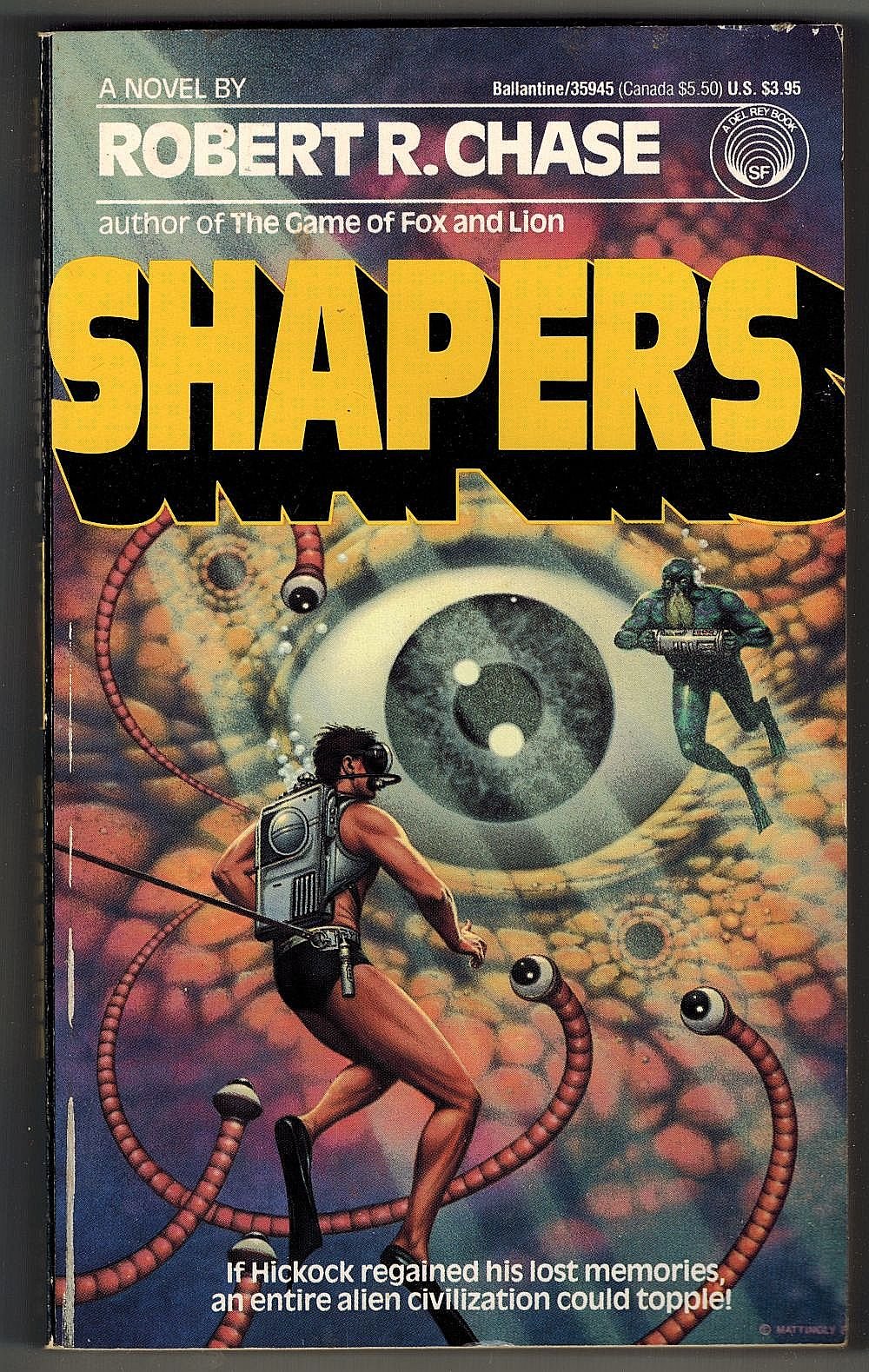
I can see why Dr Cochran liked this pulp classic. The focus is on biology and directed evolution, and the plot is interesting .. and very fifties in style although dating from the late eighties. Chase's books have been described as clever, rather intellectual but a little flat. I found it so and would not recommend it.

---

I'm much more energised by the uneven but exciting Merchant Princes omnibus trilogy.

Amazon link

Amazon link

Amazon link

Don't want to go into the details of this vast sprawling saga - here's the Amazon summary.
"Miriam Beckstein is a successful reporter for a hi-tech magazine. So when she discovers a huge money-laundering scam, she thinks she's hit the big time. But when she takes it to her editor, not only is she fired, but she starts to receive death threats. And that's just the beginning.

"To distract her furious daughter, Miriam's adoptive mother unearths mementos from her real mother, murdered when she was an infant. But these reveal a secret that will ultimately throw entire governments into disarray. For what Miriam thinks is a simple locket has the power to fling her into an alternate timeline. In this less-developed world, knights on horseback wield automatic weapons, and world-skipping assassins lurk - all on the other side of our reality. Here, her true family runs a criminal empire - and they want her back. But Miriam has other plans.

Following The Bloodline Feud are two further omnibus volumes, The Traders' War and The Revolution Trade."
There is a follow-on trilogy: Empire Games and Dark State (with the third volume due in 2019). Charles Stross has 'crib notes' - beware spoilers.

Charles Stross is very bright and well-read across a number of disciplines, from physics to genomics to economics and contemporary politics. Some people have read this series as 'Economics Science Fiction' while for others it's a liberal-minded allegorical critique of US policy over the decades.

Stross is a good enough writer to leave his personal agenda largely to one side. All the factions have understandable motives. In a rather patchy way, it's an increasingly compelling read: recommended.

I particularly liked his Accelerando too.

---

* Update (1.45 pm): I last exercised back in September: the winter recess. I am amazed at how fast - and how completely - fitness rolls off you. Five minutes on the exercise bike left me gasping and wobbly - literally weak at the knees. Then a run around the block: 1.23 km = 0.76 miles.

(The full run up the hill and back is 3.22 km = 2 miles - and 55 metres vertical. Took me 18 minutes, back in the day).

Last time I did round the block (in September) it took me 6 minutes and 45 seconds. Today 7 50.

Upon this sorry baseline, fitness will be rebuilt in 2018.

Tuesday, November 28, 2017

Selling capitalism to the feudal nobility

Steve Hsu is pessimistic about the terminal age of decadence in which we live:
"The empires Glubb studied had a lifespan of about ten human generations, or two hundred and fifty years, despite changing factors such as technology. Glubb describes a pattern of growth and decline, with six stages: the Ages of Pioneers, Conquest, Commerce, Affluence, Intellect and Decadence. He pointedly avoided writing about India or China, focusing rather on middle and western Eurasia, stating that his knowledge was inadequate to the task.

Note that six stages in 10 generations means that significant change can occur over one or two generations -- a nation can pass from one age to the next, as I believe we have in America during my lifetime.
... There does not appear to be any doubt that money is the agent which causes the decline of this strong, brave and self-confident people. The decline in courage, enterprise and a sense of duty is, however, gradual. The first direction in which wealth injures the nation is a moral one. Money replaces honour and adventure as the objective of the best young men. Moreover, men do not normally seek to make money for their country or their community, but for themselves.

Gradually, and almost imperceptibly, the Age of Affluence silences the voice of duty. The object of the young and the ambitious is no longer fame, honour or service, but cash. Education undergoes the same gradual transformation. No longer do schools aim at producing brave patriots ready to serve their country. [ Or to discover great things for all mankind! ] Parents and students alike seek the educational qualifications which will command the highest salaries. ...
Duty, Honor, Country:

The unbelievers will say they are but words, but a slogan, but a flamboyant phrase. Every pedant, every demagogue, every cynic, every hypocrite, every troublemaker, and I am sorry to say, some others of an entirely different character, will try to downgrade them even to the extent of mockery and ridicule.

The 21st century American reality (the Age of Decadence):

"Yeah, I calculated the NPV, and, you know, it's just not worth it for me. I really believe in your project, though. And, I share your passion. Good luck."
The description is of the decline of asabiyyah, as complacency and selfish individualism possess the elites. Yet there is still something superficial about this account.

---

It seems plausible that Duty, Honor, Country are the paramount virtues of a vigorous and rising polity. They are communitarian traits as in Jonathan Haidt's MFT, almost the opposite of the value set of liberalism. Undoubtedly they base themselves on evolutionarily-ancient components of the human psyche, selected for group cohesion.

Pre-capitalist formations, such as the empires of antiquity and those of feudalism, codified and celebrated duty, honour and country/empire. The elites knew they had to hang together or they'd hang separately, given their explicit social position as oppressors. When social solidarity failed, rebellions soon followed. Peter Turchin has written books about this.

In capitalism it's somewhat different. Economic exploitation is hidden behind the veil of equal formal rights for all. Most people sign up to the elite idea that capitalism is not a class society. The elites do not generally rely upon the threat of explicit oppression, but on the atomisation of labour, free to flow where fluid capital requires it (in terms of geography, roles and skills).*

Liberal individualism is the soul of modern capitalism but it doesn't really stir the heart .. and it doesn't glue society together.

---

I'm reading Charles Stross's The Bloodline Feud: The Family Trade and The Hidden Family (Merchant Princes Omnibus Book 1) where the heroine (a feisty tech journalist who is also feudal royalty) attempts to kickstart capitalism in a parallel feudal world. Stross is the pre-eminent writer of economics science-fiction and his book has received plaudits from leading economists such as Paul Krugman.

Amazon link


From a feudal point of view, capitalism as an overarching system looks incredibly weird. The world is run by merchants, who have no interests apart from enlarging their capital again and again?

'What then is life for?' they would ask**.

---

* This is at the root of the 'somewheres' vs. 'anywheres' distinction we saw with Brexit. The Remainers cannot conceive how anyone could be opposed to their vision of a uniform transnational community of right-thinkers embracing an enlightened globalised capitalism; Leavers conversely can't understand why our hard-built and largely pleasant British island community should be subordinated to more powerful European nation-states with their own somewhat inimical interests.


** A quote I once heard: "No-one ever gave their life for IBM."

Tuesday, August 08, 2017

'Accelerando' and the architecture of superintelligence


After four years I've just re-read Charles Stross's Accelerando and was again blown away. Here are my summer of 2013 thoughts. But in a nutshell, as the solar system transitions through the Singularity, posthumans of superintelligence transcend even augmented versions of ourselves.

Can we say more?

---

Intelligence is a reified concept. It presents as a trait of performance but is frequently conceived of as a mechanistic 'thing'. It's as if we took athletes such as Usain Bolt and Mo Farah and claimed they had a high 'quickness-quotient'. We would discuss the heritability of QQ and perhaps derive a scale. We would discuss biological correlates - is there a QQ module somewhere in the body?

IQ is clearly telling us something about performance, but to a greater extent than admitted it's collapsing several different things into one measure.
  • Reaction time (where we're defeated by houseflies).
  • Logical inference - where we're easily beaten by simple AI systems.
  • Pattern induction (eg Raven's Progressive Matrices):  AI programs do well.
But perhaps the best definition of intelligence is the 'ability to learn or understand or to deal with new or trying situations'.

---

Back in March I wrote a piece about the architecture of intelligence, 'Roger Atkins: Mind Design notebook'.  I proposed that we should think of the intelligent mind as operating over a semantic network defined by nodes, links and overall processing speed.

-- Each node is a minitheory: some facts, rules and cached deductions + relevant inference rules. For example, you have a small minitheory about your pet and a much larger one about yourself.

-- Each link represents a kind of relation between theories (there are many). The classic 'ISA' relation familiar from object-oriented languages and ontologies would be an example. Also similarity relations for analogical reasoning.

-- Processing operations over a semantic net include:
  • Take a node (minitheory) and deepen it with new facts, deductions or rules. Or create a new node on encountering or constructing some new entity.

  • Create a new connection or relationship between nodes via an insight as to how they relate. A more richly-connected semantic net is potentially more powerful.

  • Given a problem, navigate around the semantic net to form a solution (then add it).
---

With this architecture, a more intelligent entity has:
  • a larger and more densely-connected link-set
  • more and more-elaborated nodes
  • faster link-traversal, new-link-creation and node-processing.
Links between different, and perhaps remote nodes will likely be rather abstract and removed from direct experience. For example, a notion of symmetry underlies both natural beauty and artificial design. A sophisticated semantic net requires the handling of complex abstraction.

---

This architectural model gives us a handle both on superior human intelligence and on posthuman superintelligence.

Firstly, why can't we just go and build an AGI today? Because the root set of competences in every human's semantic net are nodes and links which encode the experienced physical and social world, a net which requires a degree of innervated embodiment we have as yet no clue as to how we might build. Only when 'they walk amongst us' will designers be in with a chance.

Secondly, how would a superintelligence differ from today's humanity? A superintelligence would possess a semantic net with improved performance along all three dimensions. Observe however that no matter how complex a network of abstract nodes, at the base is the set of nodes which must connect to the complexity of the world. Even the brightest genius condemned to a sensory-deprivation cell wouldn't be that performative. Nothing there to work on.

I suspect that the sum total of new social experiences is parameterised by the possibilities of new physical environments, whether occasioned by exploration and/or technologies. And even these are ultimately bounded by the free energy available, as Accelerando reminded us with such gusto.

I think the take-home message is broadly as Stross imagined it. A superintelligence which walked amongst us (Hi Aineko!) would be bounded by the limitations of purely human technology + culture. But a society of superintelligences able to drive forward  their own physical, technological and cultural environment?

Well, let's just say there would be plenty of headroom.

---

Note: in this view, artificial neural nets are an engineering implementation of the semantic net architecture described above. We know from human neural nets (aka 'brains') that a 'compiled' semantic network runs real fast in the subconscious (maybe it is the subconscious) while trying to 'consciously' work on your own semantic network to address novel, complex problems is really hard work and a real test of IQ.

Friday, July 28, 2017

Smart pets? An *obvious* spinoff ...

From Steve Hsu today at Information Processing:
"Work on cognitive enhancement will probably be done first in monkeys, proving Planet of the Apes prophetic within the next decade or so :-)"
Many (most?) of the alleles implicated in superior cognitive functioning will doubtless have other physiological effects. This 'multiple and diverse impact' of genes is called Pleiotropy.

For this reason - when we have a list of the relevant IQ alleles - we would be ill-advised to shift into genome-editing mode and just flip all those genes to their 'enhancement' variants.

Naturally, there'll be loads of research first on mice, monkeys (expensive) and .. cats.


Link

Contra Wittgenstein, I may yet share my life with a truly biologica Aineko before I die.

---

(Nothing worse than being incessantly nagged by an entitled creature which believes itself master or mistress of the universe and which additionally possesses claws).

Friday, February 24, 2017

Something to conjure with

This post serves as an ideal introduction for my review of "The Last Days of New Paris" by China Miéville.

The Ritual's first outing is today, by the way. If you're keen you'd better rush to hit the shops for that orange candle stub. I somehow feel the baby carrot just won't cut it.

From here via Charles Stross.


A Spell to Bind Donald Trump and All Those Who Abet Him (version 2.0)

To be performed at midnight on every waning crescent moon until he is removed from office. The first ritual takes place Friday evening, February 24th, at the stroke of midnight. This binding spell is open source, and may be modified to fit your preferred spiritual practice or magical system — the critical elements are the simultaneity of the working (midnight, EST—DC, Mar-a-Lago, and Trump Tower NYC time) and the mass energy of participants. ...

Some lodges/covens are doing a variation of this as a group working, while a number of solitary practitioners are planning to connect and live-stream via Facebook, Twitter, and other social media.

Components
  • Unflattering photo of Trump (small)
  • Tower tarot card (from any deck)
  • Tiny stub of an orange candle (cheap via Amazon)
  • Pin or small nail (to inscribe candle)
  • White candle (any size), representing the element of Fire
  • Small bowl of water, representing elemental Water
  • Small bowl of salt, representing elemental Earth
  • Feather (any), representing the element of Air
  • Matches or lighter
  • Ashtray or dish of sand

Optional
  • Piece of pyrite (fool’s gold)
  • Sulfur
  • Black thread (for traditional binding variant)
  • Baby carrot (as substitute for orange candle stub)

Preparation
  • Write “Donald J. Trump” on the orange candle stub with a pin or nail
  • Arrange other items in a pleasing circle in front of you
  • Lean the Tower card against something so that it’s standing up (vertically)
  • Say a prayer for protection and invoke blessing from your preferred spirit or deity. Reading the 23rd Psalm aloud is common in Hoodoo/Conjure/Rootwork traditions. Experienced magicians may perform an appropriate banishing ritual.

RITUAL (v. 2.1)

(Light white candle)

Hear me, oh spirits
Of Water, Earth, Fire, and Air
Heavenly hosts
Demons of the infernal realms
And spirits of the ancestors

(Light inscribed orange candle stub)

I call upon you
To bind
Donald J. Trump
So that he may fail utterly
That he may do no harm
To any human soul
Nor any tree
Animal
Rock
Stream
or Sea

Bind him so that he shall not break our polity
Usurp our liberty
Or fill our minds with hate, confusion, fear, or despair
And bind, too,
All those who enable his wickedness
And those whose mouths speak his poisonous lies

I beseech thee, spirits, bind all of them
As with chains of iron
Bind their malicious tongues
Strike down their towers of vanity

(Invert Tower tarot card)

I beseech thee in my name

(Say your full name)

In the name of all who walk
Crawl, swim, or fly
Of all the trees, the forests,
Streams, deserts,
Rivers and seas
In the name of Justice
And Liberty
And Love
And Equality
And Peace

Bind them in chains
Bind their tongues
Bind their works
Bind their wickedness

(Light the small photo of Trump from the flame of the orange candle stub and hold carefully above the ashtray)

(Speak the following loudly and with increasing passion as the photo burns to ashes)

So mote it be!
So mote it be!
So mote it be!

(Blow out orange candle, visualizing Trump blowing apart into dust or ash)

(Pinch or snuff out the white candle, ending the ritual)

In a spirit of ecumenicalism or something, I imagine that you could replace Trump in this ritual with any other celebrity you have a problem with. Bono, .. or Shami Chakrabarti, for example.

Tuesday, September 01, 2015

Women writing hard SF: Linda Nagata


Linda Nagata writes:
"... After a ten-year hiatus, I finally returned to writing. I was shocked to learn that, a decade into the 21st century, women were still using pseudonymous names to sell SF. One writer related how an editor had told her bluntly that hard SF would not sell under a woman's name. And social media is full of negative statements and stories--enough to convince any sensible woman to be wary of science fiction, and of hard SF in particular. This is my field, and I was wary of it!

The climate had gotten so bad that by the time I got around to writing a new hard SF novel--more precisely, a near-future, high-tech military novel written in first person from a male point of view, because why not max out the degree of difficulty?--I had no doubt I was making an illogical choice. I knew this was not what I should be writing if the goal was to further my career and grow my audience.

I wrote the novel anyway, because I needed to write it. And then I self-published it, because I didn't want to deal with what I perceived as the negative environment of traditional publishing. Two years ago I was here on Charlie's blog with a guest post about that decision. Since then, The Red: First Light was nominated for both the Nebula and John W. Campbell Memorial awards, and went on to sell to Simon & Schuster's new SFF imprint, Saga Press, with the sequel, The Trials, just out. It would be easy to say my fears were baseless and it all turned out okay--but how many of you have actually heard of these books, or read them?"
I bought The Red and enjoyed it; I have ordered the sequel, The Trials. I was particularly intrigued to see how well a woman could get inside the head of an elite male special forces trooper who fights in an exoskeleton.

Here's what The Red is all about (Tor review):
"The tone of the novel is set right from the very first paragraph:

There needs to be a war going on somewhere, Sergeant Vasquez. It’s a fact of life. Without a conflict of decent size, too many international defense contractors will find themselves out of business. So if no natural war is looming, you can count on the DCs to get together to invent one.

The speaker is Lt. James Shelley, a highly cynical but competent officer who leads a high-tech squad of exoskeleton-enhanced, cyber-linked soldiers in the latest manufactured international incident, deep in the Sahel. (The location illustrates another one of Shelley’s axioms: “Rule One: Don’t kill off your taxpayers. War is what you inflict on other people.”)

The start of The Red: First Light is simply flawless. Shelley introduces a new member to the squad, and in just a few scenes, you know everything you need to know: the tight bond between the soldiers, their faith in the highly cynical but reliable Shelley, the Linked Combat Squad technology, the general situation. The exposition is perfectly delivered, and before you know it you’re in the thick of it.

“The thick of it” in this case means a series of intense, well-written scenes describing life and combat in a remote military outpost somewhere in Sub-Saharan Africa: patrols, combat incidents, friendly interactions with the locals who are, in most cases, as war-weary as the soldiers. There’s an inexorable pull to this part of the novel: the soldiers live in a round-the-clock state of combat readiness, interrupted by brief chunks of drug-induced sleep. They’re monitored 24/7. There are no breaks. Once you’re into this book, it’s hard to put it down until you reach the shocking end of the first section.

It’s also full of examples of the plight of the common soldier, created by the faceless, immensely rich defense contractors who manipulate world politics to keep conflicts (and sales) going. High-tech combat equipment is recovered after a soldier’s death because it’s cheaper to train another grunt than build another robot. Lt. Shelley has his dad send medications for the squad’s dogs, and buys their food from the locals on his own dime. It reminded me of the saddening reality of teachers having to spend their own money on basic school supplies.

There are many more powerful illustrations of this “only a pawn in their game” theme (although a more appropriate Dylan tune to refer to here would probably be “Masters of War”). Drones relay the commands of faceless, codenamed Guidance officers down to the field. Most disturbingly, skullcaps worn by soldiers like Shelley allow their emotional and mental state to be monitored and altered as needed. Shelley is frequently aware that his true feelings are suppressed, and have been suppressed for such a long time that he’s become dependent. At one point, he notes drily:

The handbook says the brain stimulation [the skullcap] provides is non-addictive, but I think the handbook needs to be revised.

This emo-monitoring ends up highlighting the real issues: identity and awareness. Shelley occasionally has inexplicable, but always accurate premonitions. Where do they come from? Is it the voice of God, as one of his squadmates insist? Or is there something else going on? And regardless, how much of a person’s original identity remains if they are monitored and controlled 24/7?

Somewhere deep down in my mind I’m aware of a tremor of panic, but the skullnet bricks it up. I watch its glowing icon while imagining my real self down at the bottom of a black pit, trapped in a little, lightless room, and screaming like any other soul confined in Hell.

If my real self is locked away, what does that make me?

I know the answer. I’m a body-snatching emo-junkie so well-managed by my skullnet that the screams of my own damned soul are easy to ignore. But there is someone out there who can get inside my head. Am I haunted by a hacker? Or is it God?

Once the first “episode” of the novel is over, these become central questions. While that opening section is one long, intense, adrenaline-fueled rush, it focuses on what’s ultimately just a small part of the conflict. In section two, the novel takes a sharp turn when it starts exploring the broader issues. That also means things slow down considerably, for a while at least. Not that this is a bad thing—there’s a depiction of wounded soldiers’ rehabilitation that’s incredibly poignant, for one—but the change in pace is noticeably abrupt. Eventually, all of the pieces of the puzzle come together in a spectacular conflict that also sets up future installments."
The hero, Lt Shelley, is a middle-class antiwar activist who joined the US Army (as he appears to believe) to avoid a jail sentence for 'subversive' protests. In fact, he seems made for war: perhaps the covert AI which seems to be directing things behind the scenes made him that way?

Linda Nagata is a talented writer who can make the pages turn, summon up immersive scenes, write engrossing action sequences, all with an enviable turn of phrase. The Tor review I quote above goes on to highlight some weaknesses in plotting and pace: criticisms with which I agree.

I would add that I don't think she quite gets the male psychology right. Almost right, but our hero is just a tiny bit too empathic* - there's a casual psychological callousness which we expect to see in our SF (special forces!) action heroes, which we get in writers as diverse as Heinlein and Morgan, but not here.

My other criticism is her tediously Manichaean view of the world: evil defence contractors vs the ethically-righteous guardians of the common people. Post adolescence, the world is not quite like that and the best novels leverage Nagata-levels of moral indignation at more compelling and credible targets. I include both Heinlein and Morgan, by the way, as on the right side of their respective barricades on this particular issue.

Still, The Red is a more entertaining read than 90% of what's out there so give it a go.

---

* The dynamic of inter-personal relationships in this novel (especially with the insipid g/f Lissa) makes a lot more sense if we entertain the thought that Lt Shelley might in fact be the thinly-veiled depiction of a gay woman.

Saturday, September 13, 2014

Can martial artists actually fight?

Tricia Sullivan - SF author and fighter

Tricia Sullivan thinks not.
"Most people think of martial arts and fighting as being more or less synonymous. I see them as a Venn diagram of two sets that overlap by a tiny margin. This is because most martial artists don't fight and their training isn't directly based on what happens in a fight.

There are reasons for this. The problem of training for a fight is a tricky one. If an instructor puts students in an actual fight (as opposed to highly controlled drills with restricted moves), they might get seriously hurt. But if instructors can't create an accurate representation of a fight in the gym, trainees will never really be tested. To make up for the lack of fighting, martial arts typically focus on displays of fake combat that illustrate the combative moves that have been passed down through history. They may have non-contact or light contact fighting, but this only tests your ability to touch the other person with the techniques you have been taught--not your ability to hurt them for real much less take a beating yourself.

Most people who study martial arts study a system. Whether the system is historical (like kung fu and karate) or modern (like Systema and Krav Maga) the techniques are taught formally, with ranks, with semi-compliant drilling between members of the same school, and with a heavy dose of hierarchy that keeps everybody in their place. With a few exceptions (Gracie Barra jiu-jitsu is one system that grades predominantly through hard competition) the idea of all-out fighting is a theoretical one, kept well in the background.

But fighting is chaotic. It's often unpredictable. It doesn't systemize well and it's difficult to pass on as a body of knowledge. What people don't realize is that no matter how effective the founder of a discipline may have been in his (or in the case of Wing Chun, her) day, unless the practices of that system involve rigorous testing in realistic fighting conditions against non-compliant opponents from outside your system, you can never really know whether you can make their moves work for you.

..."      (continue reading)
The many comments are pretty insightful too.

Tricia is a prolific science-fiction writer as well as martial artist, the reason she's writing this post on Charles Stross's blog. I haven't read any of her stuff and I guess her reviews are mixed although her novel "Dreaming in Smoke" won the 1999 Arthur C. Clarke award.

She has follow-up posts here and here.

Sadly for those who devote their lives to the perfection of Karate, Aikido or Taekwondo, skilled practitioners often come off very badly in fights with drunken idiots. Despite lack of formal training, being large, aggressive and fearless takes you a long way in a fight as does the use of improvised weapons such as bottles, drinking glasses and ash-trays. The sensei complains that his or her victorious opponent wasn't following the rules.

Tricia has most time for Judo and Wrestling - at least you really get to grapple with opponents - but even MMA has to outlaw those injurious or  lethal moves which are decisive in real fights.

One of the videos Tricia embedded in her second post was this one, of a real street fight in Turkey where a gang set upon a guy who happens to be a boxer ...


... looks like boxing really works.

Thursday, December 05, 2013

"Singularity Sky" - Charles Stross

Charles Stross is comically left-wing in his private writing (his blog). His novels, however, are imaginative, sophisticated deconstructions of received wisdom on both left and right .. and so to 'Singularity Sky'.

 I had a notion that this was going to be a black hole story - some orbital plot. But that's just my physics prejudice: the singularity here is that of AI and information transcendence - specifically what happens when post-singularity culture meets a rather nasty stalinist police state head-on.

 Leon Trotsky makes a lightly-disguised appearance as the domestic revolutionary leader but the heroes (Martin and Rachel) are Culture-like representatives of future-modernity. As in "Halting State", love soon blooms - I'm beginning to see a pattern here.

Saturday, November 30, 2013

23andMe forced out of business?

The personal genetics company 23andMe has been issued with a 'cease trading' notice by the American FDA. The issue is not the right of people to get a printout of their own genome (or the subset 23andMe analyse) but the advice which is needed to make sense out of it.

The FDA is concerned that without regulation, unscrupulous or incompetent companies will inform lay members of the public that they have this or that harmful allele (gene variant) leading to dangerous lifestyle or surgical decisions. Clearly some kind of 'quality' oversight is necessary but no-one seems to have a good answer as to how to do it. In the meantime, 23andMe has been told to stop sending out its 'spit kits'. More from Michael Eisen and Razib Khan.

The Economist has a good link to this report on the infamous Stuxnet cyber-weapon used to sabotage Iranian uranium hexafluoride centrifuges. Apparently the weapon was even more subtle than we thought.

Recently Read

1. "Proxima" by Stephen Baxter

From this review.
"Protagonist Yuri is an out-of-time remnant of “The Heroic Generation”, whose energy-intensive geo-engineering efforts to sort out global warming caused more problems than they solved. Popped into cryo-stasis by parents hoping for a better future, he wakes up into a world that resents him for his association with the disastrous past. He’s not treated well, and that includes being shipped off on the dodgy, bare-bones colony effort to the Alpha Centauri star system.

His struggle to remain alive, and the mysteries he uncovers on the way, form one of the novel’s two major strands. The other strand takes place in the Solar System, where the cold war between the expansionist Chinese Empire and the constituent countries of the United Nations is hotting up. Alien artefacts have been discovered on Mercury, and the UN isn’t sharing.

It’s not often you can agree with the hyperbole on the back of a book, but calling Baxter “Arthur C Clarke’s natural successor” is bang on the money. Clarkeian tropes such as mysterious extra-terrestrial leavings, deep time and the sinister majesty of the cosmos are greatly in evidence here. Baxter takes a worthwhile chunk of time detailing a fascinating planetary ecology for “Per Ardua” (as the colonists end up calling their world). This is ingeniously alien, and includes a banded series of biospheres. Rather than possessing cells, like Earth life, the creatures of Per Ardua are made of much larger, interchangeable “stems”, with the result that they behave somewhat like predatory LEGO, brutally disassembling one another and using the parts to create their own young.

The depth and ingenuity of this part of the tale has one thinking of Clarke’s efforts in Rendezvous With Rama. Similarly well set out are Baxter’s various modes of space travel, which include a multi-year colony mission, a one man cosmic dash, and a fascinating take on interstellar sailing, where the vessel contains tens of thousands of disposable sails, each invested with its own consciousness."
"Proxima" to me had rather the feel of "Flood", a similarly densely-textured, languid immersion in another time and place - this this case about 160 years into the future. Although not quite a page-turner, the details are sufficiently involving to keep you reading. Baxter specialises in writing about unpleasant characters who do nasty things, worse actually than you had imagined, and this keeps the plotting interesting. I was left shaking my head at the end - what was all that about? - before becoming reconciled to the fact that the novel doesn't really end, just sets things up for the final volume "Ultima" (to come in May 2015).

2. "Halting State" - Charles Stross

A hi-tech crime-caper set in a near-future independent Scotland. Chinese secret agents, black nets, augmented reality, TCP/IP covertly tunnelled over a 'Dungeons and Dragons'-style online game, quantum computers .. this breathless thriller has a page-turning energy notably absent from Baxter's work. And the heroes are a games-programmer (Jack) and a forensic accountant (Elaine): how could love not bloom?

Wednesday, June 19, 2013

Accelerando; Stour Head

I have been a long-time Accelerando rejectionist. I guess I bought into all the reviews like this.
I describe a book that I admired immensely but didn't enjoy, a book that's impressive but not very entertaining. Accelerando is an exemplar. The imagination that concocted this future comes from the percolating skull of one of SF's most striking talents. But this is a classic case of idea fiction in which the ideas overwhelm the sense of wonder. While intellectually stimulating, there's no emotional connection. And the combination of reams of tech-talk and a dearth of relatable characters makes this a book whose appeal will be limited to a particular phylum of SF geek.
OK, so who wants to read very clever but soulless writing by a bright guy who's familiar with programming, AI, economics, quantum physics, cosmology, relativity, molecular biology, ...?

A lot of critics don't want to, that's clear. But on impulse I grabbed the novel from the library last week and eventually got round to it: and it's amazing! Here is the plot outline (from the same hostile review) - but it surely doesn't do the book justice.
The story presents us with three generations of the Macx family, throughout the full run of the 21st century, at the end of which nothing recognizably human exists any longer, and the solar system itself is home to thousands of space-borne processors in which billions of posthumans live in a uploaded state. Bodies are merely meat machines, obsolete at the best of times. In the first three chapters, Manfred Macx, working in the early part of this century as a "venture altruist," has come up with a way to liberate himself from what he terms scarcity-based economies. He comes up with one brilliant idea after another, and just gives them away to companies to do with what they will. This enables him to live anywhere free, off the goodwill of those whom he's enriched. While Stross makes a number of dire economic predictions that are entirely valid (even uncomfortably relevant in this day and age of two-dollar-plus gasoline), what I found interesting was an undercurrent of naivety in Manfred's ethos: to wit, that nothing he gets is actually free, though it's free to him. Somebody must still be paying for it.

Manfred's goal is to free the entire human race from outmoded economies and make everyone filthy rich so they can enjoy the Singularity when it hits. He also wants new laws in place to protect uploaded humans, which can only exist if old ideas about ownership, copyright, and intellectual property go the way of the dodo. When a group of lobsters (!) serving as test subjects for uploading somehow achieve sentience via the process, Manfred helps them to escape the Earth by beaming them in the direction of a signal emanating from deep space, thought to be of intelligent extraterrestrial origin.

This segues us into the middle third of the novel, in which Manfred's daughter Amber, fleeing from a nasty custody battle between Manfred and her neo-Luddite mother (via the clever use of new pre-Singularity corporate paradigms initiated by Manfred) ends up in Jovian orbit amongst a group of orphans working to decode and respond to the alien signal. This section of the book is where some structural problems blemish the plot, possibly related to its compiled-novellas nature. When Amber's mother tries a tricky legal maneuver to get her back, Amber — within about the space of a page — sets herself up as empress of something called the Ring Imperium, and promptly sends uploads of herself and the rest of her crew in the direction of the alien signal.

Amber should have been a fantastic character, but I could never warm up to her. And her section of the book, despite being no less suffused with spectacular ideas than anything else from Stross's pen, was one I simply couldn't get into — suprising, as it contains an amusing riff on first contact tropes and one or two pointed spoofs of 2001. (Not to mention its last chapter, "Nightfall," was a Hugo nominee.) The final section, involving Amber's son Sirhan, is interestingly the most engaging of the book, considering that it takes place in the twilight years of the century, when only a few "meatbody" humans remain in the solar system. In some of the story's most trenchant observations, we see that posthumans have much the same petty problems as their flesh-and-blood precursors. A dysfunctional family is pretty much the same, whether living today or in the accelerated future.
Actually the characters are interesting and their plot-relationships draw you in: it is a page turner. What I was truly impressed by though was the care with which Stross has really thought about the Singularity. Suppose the process of runaway intelligence was via the conversion of more and more of the 'dumb matter' of the solar system into "computronium" (i.e. dust-sized distributed processors). Why wouldn't a new Darwinian paradigm emerge? Why wouldn't the post-human intelligences cluster near the sun for power and to minimise speed of light delay. Why wouldn't it all go terribly wrong? So like everyone else, I'm blown away by the torrent of worked-out ideas, and swept along by the story. It's time to read some more stuff by Charlie Stross.

---

We spent the afternoon today at Stourhead. Clare was determined to give her mitochondria a thorough airing and set off relentlessly from the "Spread Eagle" complex of shops and cafes, through the gardens and woods to the far end of the estate near King Alfred's Tower (four and a half miles uphill and back).

I marvelled.

Here are some pix of the lake and gardens.

Clare appreciating the honeysuckle

The ducks - that's grass they're eating?

The author occluding the Rhododendrons