Showing posts with label Rod Liddle. Show all posts

Thursday, June 13, 2024

Quo modo Deus exstat?


Michelangelo -The Creation  of Adam (Wikipedia)

Major is the family dog, recently taken to sheep-worrying/killing. The father will have to put it down. Owen, the godless younger brother, petitions his religious-curious older sister.

“'If you prayed for Major not to get shot would he not get shot?' said Owen in a demanding voice.

The thought of praying had never crossed my mind.

'You prayed you wouldn't have to thread the sewing machine any more and you didn't.'

I saw with dismay the unavoidable collision coming, of religion and life.

He got up and stood in front of me and said tensely, 'Pray. How do you do it? Start now!'

'You can't pray,' I said, 'about a thing like that.'

'Why not?'

Why not? Because, I could have said to him, we do not pray for things to happen or not happen, but for the strength and grace to bear what does. A fine way out, that smells abominably of defeat. But I did not think of it. I simply thought, and knew, that praying was not going to stop my father going out and getting his gun and calling, 'Major! Here, Major -' Praying would not alter that.”

---

‘Age of Faith’, in ‘Lives of Girls and Women’, Alice Munro (p. 145).


Aged ten, I ask my father if he believes in God. “No I don't,” he says, “There is no way heaven could be big enough for all the people it would need to contain.”

A parish meeting in Andover, a Q&A. Hesitantly, a parishioner asks the priest, “Father, where is heaven?” The priest, equally hesitant, talks about quantum theory and the strange spaces within the atom. I cringe with embarrassment.

Rod Liddle writes in his Sunday Times column about asking a CofE bishop whether he believes in God. “Blessed if I know, Rod,” comes the reply, confirming Liddle’s sardonic take on England's institutional religion.

A liberal states their deepest attachment and loyalty: to democracy and the rule of law. But in what sense do those things actually exist? I ask. They don't understand the question.

Buddhists believe that the self is an illusion.

Freighted, that term ‘illusion’.

It appears that Buddhists believe the self is a process, an epiphenomenon of more basic physical and mental state transitions. Is that what ‘illusion' means?

It's natural to think naively that existence is a simple, obvious notion. Stones exist, your body exists. If something exists, you can poke or paint it. But most ‘things’ we deal with in life are not like this: contracts, democracy, numbers, freedom, oppression, patriotism, any -ism. Welcome to the social construction of reality and the ubiquity of reification.

Catholicism is more a framework than a set of definite precepts. It's not reducible to biblical literalism. Orthodoxy will tell you that the true nature of God is mysterious. Most Catholics opt for some manner of ontological realism but I'm more deontological…

Sunday, February 24, 2019

TIG of the dump

This is a post about The Independent Group.

My reading about the (now ancient - 1998) dispute between Ellen Meiksins Wood and Nicos Poulantzas as to the status of white-collar ‘new professionals’ has been educational.

Poulantzas argued that these gentrified yuppies: hipsters, lawyers, journalists, media people, architects, lecturers - bubble people par excellence - were not part of the working class at all, they were the new petty-bourgeoisie. They had a distinctive class interest (they were unproductive workers in Marxist terms) and exhibited a contingent relationship with the proletarian class struggle.

Woods observed acidly that in every case we're talking about people who have been dispossessed of means of production, people who need to sell their labour power to survive. Look, they're workers!

---

So how come they look so different to the traditional blue-collar manual working class? Our middle-class workers are educated, articulate, individualistic and, where active, fervent on identity issues. Class thoughts never enter their heads. They are post-class.

As always we have to look at the specific evolution of capitalism, particularly over the last decade or so, to understand the real situation here.

The traditional surplus-value-producing working class is, to our surprise, still with us: in car plants, mines, docks, transport, construction and a thousand subcontractors. They have no voice in the media and are rarely seen there, but they haven’t gone away. Instead, a decade of steady but anaemic growth has rendered them apathetically, resentfully quiescent.

The great four-decade expansion of automation, financialisation and globalisation has dramatically expanded the number of jobs in the circulation of capital (sales, marketing, advertising, PR, media), in financial services and for the state. Most of these workers are not directly involved in the production of surplus value per se; they skim the value produced by other workers as Woods reminds us. Yet workers they are, nonetheless. Their jobs are less obviously ‘working for the Man’ - in fact they can offer significant opportunities for autonomy and creativity -  and they are sometimes quite well paid (although by no means always - a source of anger).

It is easy to see why Poulantzas saw this working class fraction as petty-bourgeois. They tend to see themselves as floating free of the production processes of the economy, part of the general cultural superstructure. They internalise the dominant ideology of bourgeois liberalism (not an pejorative term at all here; descriptive) and push it to its pure extremes.

The result is the cult of social-justice, its contours carefully, albeit subconsciously, edited for consistency with the reproduction of capitalist social relations. Everyone talks about material inequality (those huge ratios) yet no-one seriously agitates to do anything about it - it's an abstraction; transgender equality, however, is a cause to die for

No-one talks about class. Even the existence of classes in the context of economic dominance is denied; class is conceded to be at most a cultural signifier, subordinate to intersectional identity.

This sociological fractioning is prevalent across the advanced capitalist countries. All that has changed in recent years is that continuing anaemic growth - which does not offer advancement prospects to either the blue- or white-collar fractions of the working class - has led to mounting (though inchoate) discontent and new mobilisations on the streets.

The traditional blue-collar working class is resentful and votes for Brexit or Trump - the conservative, anti-elite populists. The white-collar working class votes for Sanders or Corbyn - the progressive (in cultural terms) populists. The real political expression of the über-elites, the Osborne-Obama-Macron-Merkel axis, has hit the buffers and is failing to attract support outside those closest to the coat-tails of the international elites, Davos Man and assorted wannabes.

It's a problem.

In UK terms, we see the Tory’s Theresa May defiantly holding a course designed to appeal to the domestic, anti-globalist fraction of the UK national bourgeoisie plus a fraction of the English blue-collar working class abandoned by Labour; we see Labour’s Corbyn and Momentum hoovering up the embittered white-collar workers (together with some petty-bourgeois forces, for sure, students and the artisan self-employed) who want to complete the bourgeois revolution to the max and advance their own prospects.

And then there is The Independent Group, that remnant from the Blairite-Cameron glory days, wondering if there is a social base for its nostalgic brand of neoliberal 'revival'.

I suspect not.

---

Rod Liddle in The Sunday Times this morning was talking-up a party representing his own preferences: Blue Labour (and Red Tory). That would be the current Social-Democratic Party.

In common with most people, I had thought the SDP had finally died back in 1990.

I can see why Rod kind of likes this ghost of times past, but the SDP (now) is destined to be even more ineffectual than TIG. It presents a brand of one-nation Labourism/Toryism which articulated the narrative of 1950s ascendant national capitalism, but which is completely inapplicable to the current period of neoliberal decay.

It's a dated answer to a question which has not yet been put.

Sunday, January 13, 2019

A British Coup?


Over-the-top, copy-selling headline from The Sunday Times today.

It's always interesting watching the elite wrestling with the imperfect levers of governance to bring about the result they really want. The referendum result would have been reversed in a second if not for their inchoate, pervasive fear of the 52%.
Who are these people? We never meet them. No sign of them within the boundaries of the M25.
We know that the left petty-bourgeoisie, the metropolitan bubble-people, lined up for Remain. If the great reversal project progresses during the next weeks through a vote of confidence in May's government (to be lost) and then a general election, what will the Leave-voting working class do? No respectable party speaks to their concerns (Blue Labour, as championed by Rod Liddle, is dead in the water).

A general election with the Tory party in chaos and the Labour Party obfuscating and trying to change the subject - that would be a sight to behold. My tentative projection is that the Tory vote would collapse, the Labour vote would hold up and we would finally get to see what a Corbyn government would do.

No wonder they're cautious.

---

It's ironic really. The Theresa May strategy was always to retain the economic benefits of EU membership while continuing to maintain social cohesion by implementing the strict letter of Leave. It was always  'BREXIT in name only'.

The British elite, in its arrogance and short-term greed, has run roughshod over this mildly-intelligent plan. Do they really think a Corbyn government has their neoliberal interests at heart? That rather widespread popular expectations of a new socialist way forward will be so easy to endlessly subvert? They have learned nothing from M. Macron's experiences.

Such hubris: they can be very stupid at times.

Monday, August 13, 2018

Rod Liddle on the BBC (The Spectator)

Yesterday I noted that "Those outside the bubble are ceaselessly lectured, indeed have no other language of norms and morality." At that time I hadn't read the piece below.

Must be the zeitgeist.


Rod Liddle

Rod Liddle (The Spectator) writes:
"It is hard to keep up, isn’t it? The British Register of Victimhood lengthens almost daily, in defiance of science, common sense and reality. I think that the only way to avoid giving offence is for the BBC to lecture us on a daily basis about how we must see the world, according to its own implacable and berserk liberal agenda. Maybe a 15-minute slot after the early evening news, where Kirsty Wark or Huw Edwards could simply spell out to us where we’re going wrong and what we should do about it. That would be a genuine public service, no?

The corporation recently made a video aimed at GCSE students about multiculturalism — and it was, as you can imagine, a carefully balanced piece of work, giving equal weight to both sides of the story. ‘Multiculturalism is a powerful tool for survival and possibly the only way to survive, so let’s embrace it,’ the children were informed. Elsewhere a smug little Geordie narrator (the dialect of choice these days) said that Great Britain had ‘always’ been a nation of immigrants, there was no such thing as British people, and yet you could always hear malevolent idiots ‘banging on’ about the need to control immigration.

No mention was made of the overwhelming opposition to uncontrolled immigration, nor the weight of numbers that have arrived here recently, nor the relationship with crime figures. Still less the views of the majority of the population that immigration has actually not been a good thing, overall, for the country. In other words, they wish it hadn’t happened.

The film was eventually pulled by the BBC because, as viewers on YouTube pointed out, it was vacuous, tendentious, biased tripe. This must have come as a shock to the producers of the film, who will surely have believed that they were simply promulgating the usual BBC line on immigration — and that this isn’t remotely a case of bias but simply decency and civility, and that those who disagree are uneducated untermenschen who need to be taught a lesson or two, preferably by some Geordie halfwit so that it sounds authentic and not too metrocentric.

The problem is that this is indeed precisely the BBC’s view, without caveat: it is the mindset which informs every single report the BBC has ever done on the subject of immigration, be it on the news programmes or the dramas or even the bloody Food Programme. And as I say, they do not think that it is bias at all. It is simply right, and there’s an end to it. And if they pull this video, I assume they’ll be pulling Newsnight, The News at Ten, Today, World at One and every local news programme across the country."
The pervasiveness of bubble-think - and not just on immigration.

Sunday, January 08, 2017

Did we just pass peak Rod Liddle?

Rod Liddle - Sunday Times scourge of bien-pensant liberals

What a delight, week-on-week, to read Rod Liddle in the Sunday Times skewering snowflake students, wittering luvvies and the ludicrous - often malevolent - antics of politically-correct officialdom.

But this week the Liddle howitzer is badly misfiring:
"Meanwhile some academic at Connecticut University has predicted that political instability will engulf the world and civilisation will be destroyed before the zombies have even had time to set their alarm clocks. Peter Turchin suggested that world mayhem, violence and misery will peak in the 2020s. “The presidential election which we have experienced, unfortunately, confirms this forecast,” the smug idiot added."
Peter Turchin is not some crazed liberal. He's one of the good guys, a mathematician who has been working for years on historical cycles of civilization expansion and collapse.

His approach, Cliodynamics, identifies the signs of civilizations going to seed: widening inequality, indebted states and most importantly, an overproduction of elites vying for power. All this leads to instability and political conflict.

Turchin's work has been validated for Antiquity (the Roman Empire) and the Mediaeval period. Recently he has applied his database and mathematical models to contemporary America in his recent book, 'Ages of Discord'.

Here's more.

There are arguments to be had with Turchin's approach. Capitalism has different dynamics to those of ancient slave-owning or feudal societies, not least in the differentiation between economic and political power (there appear to be few problems of elite overproduction in the economic sphere, at least until AI really starts taking over). A flavour of those debates can be seen here.

So, Rod, Peter Turchin is not a 'smug idiot'.

---

If only this was all that was wrong with Mr Liddle's column today, but the whole thing is tired and lacklustre. Same old same old. Time for some new ideas, some originality.

Wednesday, November 09, 2016

President Trump

This morning's result confirms the overwhelming exasperation of ordinary folk with the liberal elite which has run the world so successfully over the last decades, and which continues to colonise the hectoring mainstream media (MSM).

Rod Liddle commented,
"If Trump wins, I wonder if the BBC will be as exultant as it was in 2008, when Obama won? Here’s a small bet – it won’t be. There will be wailing and gnashing of teeth. It’s almost worth him winning for that alone. Oh, and for the Guardian’s tears."
The Brexit dynamic now looks more assured. Rod Liddle again:
"Take Brexit. Whether you were for Remain or Leave, we are leaving and need to secure the best possible future for our country, no? The Democrats have made it absolutely clear that in trade deals we are ‘at the back of the queue’. They were vehemently opposed to Brexit, a position made clear by Hillary Clinton herself, who also opposed any independent trade deal with the UK, worried that it might have an impact upon US jobs.

"There is no such problem with Trump – who not only cheered the Brexit result but has said that a trade deal with Britain would be near the top of his agenda. Whether a Remainer or a Leaver, then, it’s clear that Trump is better for Britain."
Greg Cochran put his finger on why the polls - as for Brexit - were so consistently and spectacularly wrong (here).
"Social Desirability Bias

Posted on November 8, 2016 by gcochran9

"It must be strong today, something like 5 points.

"If so, you’ll be hearing calls for the end of the secret ballot."

Tuesday, July 19, 2016

Human Dodos: the FAQs

If you read "Human Dodos", here are the Frequently Asked Questions.

---

1. Do liberals and libertarians really not feel four of the six moral dimensions?

The moral dimensions are quantitative traits. Plainly it's possible to elicit patriotism in a liberal, or disgust in a libertarian. We're talking about settings dialled up or down, not binary switches.

2. How do the moral dimensions fit with personality?

It's hard to find papers comparing psychology's five-factor model with MFT's six moral dimensions. I can only refer you to papers comparing liberals and conservatives (but not libertarians) which find:
"Evidence showing that the Big Five personality traits (conscientiousness, agreeableness, openness to new experiences, extraversion and emotional stability) are correlated with political orientation. Specifically, liberals tend to score higher on experiential openness while conservatives tend to be strongly conscientious. Other evidence links politeness with conservatism and empathy with liberalism."
3. Did liberalism evolve?

Like most psychological traits, the moral dimensions are probably around 50% heritable - that is, around 50% of differences between people can be mapped down to (additive) genetic factors. The other half is labelled 'environmental' but that covers a multitude of factors including imprecision in testing as well as differential life experiences.

Most likely there have always been people who were more trusting and generally empathic to strangers. The Bible says "Blessed are the peacemakers", as if they were a scarce and unpopular resource, as doubtless they were in a clannish, herding honour culture.

4. Why is liberalism useful?

Liberalism is not that useful in a clannish environment - it marks you down as a victim and would tend to get selected against. However, with the birth of multi-ethnic countries/empires it becomes important to replace intergroup antagonisms with a generalised empathy underwritten by the uniformly and impartially applied rule of law.

This requires a fictive equality between citizens, which has to override negative responses to subgroup 'alien customs' and 'repulsive practices'.

Religion (with all its ingroup-outgroup faults) has historically provided the necessary all-encompassing ideology, but today in the west we have something even better - liberalism.

Cultivating selective blindness to individual and group differences is critical for elites to succeed in their unifying mission (they additionally require the intelligence to develop and apply laws, and to rule successfully). Liberals really are both nicer and smarter.

Henry Harpending observes.
"Gregory Clark, an economist at UC Davis, posted an essay several years ago titled Genetically Capitalist? in which he proposed that the stable social environment and institutions of Medieval England selected for a new kind of human who was less prone to violence, had an affinity for work, had low time preference, and was individualistic in several ways."
Greg Clark's work suggested that differential fertility amongst the ruling elite in England (and by extension Europe) resulted in the 'trickle down' of elite allele-frequencies, resulting in the gradual 'domestication' of the European population. This is just another way of capturing the increased prevalence of liberal, empathic values in the west.

So don't expect to see western norms in other world populations with different historical trajectories. The jury is still out as to whether the 'western genotype' actually improves long-term population fitness or not. As usual, look around and observe.

5. Is there something better than liberalism?

Many things are worse.
  • Inter-group pogroms; 
  • identifying groups with the excesses of their worst members; 
  • discrimination by ethnic group membership rather than individual performance.
Some things would be better.
  • Recognising that as a matter of fact, ethnic groups differ significantly on many psychological as well as physical traits and adjusting priors accordingly; 
  • not wasting time, money and invective on trying to attain impossible equal outcomes; 
  • public policy based on reality rather than wishful thinking.

Don't hold your breath. We live in a society composed of many different groups differentially ranked by wealth, intelligence, obesity, propensity to violence and so on. All these traits have some genetic component.

Any group publicly identified by policymakers as low on one of these morally-charged ranking scales is going to vociferously object, and the defence "It's true, here's the evidence" won't be worth a can of beans (as Scott Adams points out).

It's interesting that, as far as I can see, the only way to successfully run a modern capitalist democracy is on the basis of liberal self-deception. Seems the glue of 'religious' authority can't, in the end, be avoided.

And that's why Rod Liddle will stay in his box and not rule the world.


Friday, January 22, 2016

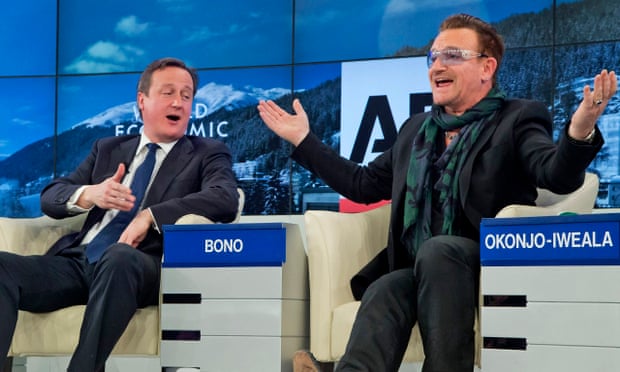
Those loveable pop veterans

Bono (and some politician) at Davos

Rod Liddle writes:
"I was desperately worried that you hadn’t read or heard enough platitudinous drivel about David Bowie — and therefore felt compelled to weigh in with my own observations. In all honesty I haven’t heard so much repetitive, imbecilic guff since Mandela shuffled off this mortal coil. It was even worse than the confected sobfest that greeted the passing of the charming and likeable Lou Reed."
Yes, if ever there was a man who made a career out of being a nasty piece of work, it was Lou Reed.

Liddle then correctly observes that the key thing was that Bowie wrote and performed some memorable songs, but let's move on to his views on some other musicians.
"Paul McCartney. The rock press always adored John Lennon and rather despised McCartney. But favourite Beatles songs are almost all by McCartney. Lennon was loved for his supposed ‘edge’, for his fatuous political convictions (the attendant hypocrisy forgotten). McCartney just carried on writing tunes which had about them a sophistication and vast melodic range.

"Compare the melodies of two songs which, initially, have a similar chord sequence: ‘Here, There and Everywhere’, by McCartney and ‘Woman’, by Lennon. McCartney’s soars all over the place and then, just for fun, changes key — twice. Lennon’s sticks doggedly to the base note of every chord."
I was never a fan of Lennon, whose persona seemed to be mostly juvenile bully, leavened by a large sprig of self-righteousness, But McCartney is equally hard to love, with his platitudinous petit-bourgeois sensibilities. You don't have to be Sigmund Freud to figure out that calling your 2013 album 'Kisses on the Bottom'* underscores your toe-curling 'down-with-the-kids' insecurities.

Yeah, yeah, yeah; it's hard to love these ageing, narcissistic, preening pop veterans.

Luckily, we have their music.

---

* Yes, I know the reference and no, it's no excuse.

Sunday, April 26, 2015

Rod Liddle

Rod Liddle

"What were his parents thinking of, calling him Rodney?"

"Maybe they hated him, it's pretty much a revenge for life."

"There are so many Biblical names they could have chosen: Matthew, Mark, David. They're all classy."

"No-one ever seems to be called Goliath: 'Hey there, Goliath, stop hitting little Pamela!'"

Friday, July 11, 2014

"Selfish Whining Monkeys: How we Ended Up Greedy, Narcissistic and Unhappy" by Rod Liddle

Hard to find anyone with a good word to say about Rod Liddle's latest. Here's Rob Killick's review, which tries to explain why.
Selfish Whining Monkeys by journalist Rod Liddle has had a good duffing-up by reviewers and commentators. Some of his harshest critics are, unsurprisingly, the sort of people Liddle blames in his book for many of the ills of modern life. David Aaronovitch, Will Self and Julie Burchill are among those who have lined up to put the boot in.

Why has Selfish Whining Monkeys, which, in style and content, is very much like Liddle’s popular column in The Sunday Times, had such a hostile response? Liddle could see this as proof that he has hit his target, as most of the hostile reviewers are part of what he characterises as the ‘faux left’, the metropolitan elite who ‘consider themselves left, or leftish, but whose views are either wholly irrelevant to the poorest indigenous sections of our society, or positively hostile towards them’.

And there you have the nub of why Self et al have attacked this book so viciously. The claim against Liddle is that his championing of the white working class, his opposition to immigration and his nostalgia for an overwhelmingly white, prelapsarian 1950s Britain (Liddle cites the decline of organised religion as one of the reasons for our current social malaise) automatically make him a racist. The critics do not prove this claim, preferring, as Aaronovitch does, to notice ‘the sly references to racial characteristics’. Self is subtle enough to suggest that Liddle may be suffering from a kind of false consciousness, that Liddle ‘thinks he believes’ he is not a racist but really he is, as evidenced by his use of words such as ‘tribe’ to describe the Muslim community.

If this sounds familiar it is because it is the same charge that has been made against the UK Independence Party (UKIP) and its supporters over the past year. In many ways, Selfish Whining Monkeys could be a manifesto for UKIP. Each chapter is its own furious polemic against an aspect of modern life – schools, the class system, the aforementioned faux left, the EU, the free market, London. Like UKIP, Liddle professes to give a voice to those who have been disenfranchised by the congelation of political life into a ‘New Establishment’. In his column for The Times, Hugo Rifkind helpfully summed up what this New Establishment stands for:

‘I find myself perhaps belatedly realising, I am a man of strong establishment views. I am broadly Europhile and certainly unionist. That’s only half of it, though. I am also politically correct, feminist, environmentalist and avowedly multiculturalist. It’s a bit of a shock to realise these are all now establishment views; they certainly never used to be.’

Liddle’s crime, in the eyes of the New Establishment, is to claim to speak for those who feel they have been left behind by modern life. These days, as we saw with the media’s relentless campaign against UKIP leader Nigel Farage, this is enough to turn him into a pariah.

But his book is more than a simple Farage-style saloon-bar rant. Like his columns, it is also often very funny, self-deprecating and quick to notice the absurdities of modern life. He reflects on the aftermath of his Spectator column, ‘Dr Liddle’s Casebook’, in which he panned the claims that ME is a physical disease. Among those who wanted him prosecuted for hate crimes against ME sufferers was a woman who, Liddle recounts, was told by police ‘that the man [Liddle] was a well-known arsehole and it was best to ignore him’. ‘So common sense still exists in at least one constabulary, then’, is Liddle’s witty aside.

Liddle’s crime, in the eyes of the New Establishment, is to claim to speak for those who feel they have been left behind by modern life

He also picks up on other, less populist aspects of modern life which he finds distressing, such as the intrusion of the judiciary into political life, the rise of censorship and intolerance (he defends Muslims who burn Remembrance Day poppies in public), and the false ‘choices’ we are offered in public services. In defending democratic rights, especially free speech, he is firmly on the side of the democrats (with the egregious exception of his opposition to freedom of movement).

Liddle’s instinct is that of a satirist. Part of the cause of the vitriol hurled at him is that nobody likes being mocked. But I think what has really infuriated reviewers is that, in the process of mocking, Liddle often transgresses the New Establishment’s most stringent rule: You Can’t Say That.
I can't say that the book is really good. It's repetitive, some parts are frankly rather tedious and it's not funny enough. The observation that modern capitalism systematically undermines traditional social relationships was not even original in Marx's theory of alienation. And like all rants from the heart, it's one-sided and short on both analysis and remedy.

However, truths need restating every generation and Rod is saying some stuff which - as he is careful to point out - you don't get to hear either from The Economist-style 'let capitalism be free' right-wing or the smug, bien-pensant, faux-left monkeys who dominate our media (.. channelling Rod there for a moment).

His Sunday Times pieces, though, are better.