Showing posts with label Phil Burton-Cartledge. Show all posts

Wednesday, August 23, 2017

A theorisation of Corbynism (Hardt and Negri)

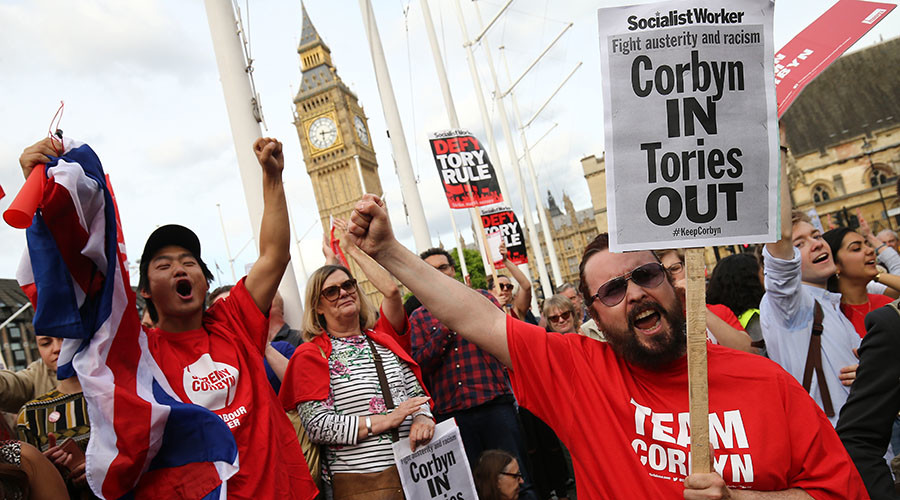
An orthodox Marxist would be extremely interested in Momentum, the radicalisation of predominantly young, middle-class professional types organised around Jeremy Corbyn's Labour Party. It would seem highly reminiscent of the 'New Left' student movements of the sixties and seventies (full disclosure: I was there).

Said Marxist would, however, be far less impressed by the level of consciousness of the movement's thinking: its faddish diversities, its self-indulgent identity politics, its horizons delimited by left-wing social-democracy.

Traditionally we would call such proto-ideologies petit-bourgeois and see their proponents as candidates for a deeper education. But ancien-Marxism seems falsified by history - no lessons there to learn. The result - inevitably - is the theorisation of left-populism by itself as the new anti-capitalism.

Parenthetically, this rather ignores just how popular Corbynism and its American and Continental cousins are with the left bourgeoisie!

---

The poster-children for this way of thinking - after Paul Mason's efforts - are the theorists Michael Hardt and Antonio Negri, boosted by left-academics such as Phil Burton-Cartledge.

Phil has written a series of posts explaining the new ideas - I'll just quote a summary.
"What is clear for Hardt and Negri is the revolutionary party is out. As the properties of fixed capital are distributed among our growing legions of cognitive and socialised workers, the 'functions' of the revolutionary party are diffused among the politicising networks.

"Rather than the received conception of a vanguard of class conscious cadres providing leadership for the rest to follow, cadre building applies to the class as a whole. The power of the multitude lies in its being the living substance of the common, and increasingly their common lines of flight are putting them on a collision course with capital.

"Biopolitical production wrapped up in dense webs of communication brings people together, educates them, politicises them. For example, the incessant identity-related debates are no longer the concern of radical elites beavering away in academies but are now the property of millions of people, as the fall out from Charlottesville demonstrates.

"The aim then is to build up the capacity for self-organisation, forge new institutions that bring out the common interests of socialised workers without denying their difference. The image is of a self-activating, self-coordinating swarm that can simply overwhelm capital and the state in a process of creative destruction, of replacing one form of organising society with another."
None of this is well-defined. None of this has the ring of truth. Seems more like opportunistic pandering to a set of inchoate longings which have nothing to do with undermining capitalism and everything to do with its further development. Notice how the critiques of capitalism - how very bad it is - have a ritualistic and anaemic quality.

Those middle-to-upper-class Momentum supporters, those SJWs in the States, those French supporters of Jean-Luc Mélenchon in La France Insoumise, are having the time of their lives under capitalism.

---

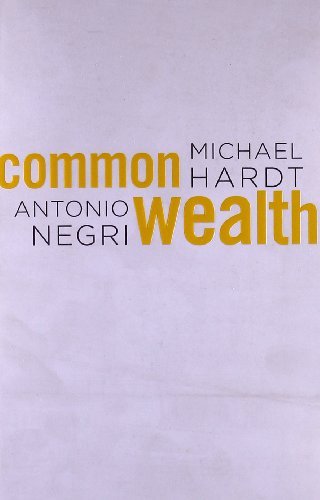
I feel, nonetheless, slightly motivated to read the final book of Hardt and Negri's trilogy, Commonwealth, if only to understand their thinking more fully.

I have to say though, that I do rather prefer my own vision as to the future destiny and supersession of capitalism - it's a lot more grounded in reality.
Amazon link

"Together Hardt and Negri's work is considered to be responsible for a resurgence of interest in non-orthodox Marxism and its political manifestations.

"Commonwealth is the final part of a trilogy that began with "Empire" in 2000, a book that was published during the emergence of the alter-globalization movement. "Multitude" followed in 2004, developing the ideas that had been introduced in "Empire," in particular the concept of the multitude as a new revolutionary subject. "Commonwealth" is a worthy addition to the trilogy, expanding and clarifying on the understandings in the previous books, but perhaps more significantly grounding their analysis within an extended discussion of "the common...".

"Commonwealth" is a book that challenges presuppositions about the utility of Marx, and introduces the possibility of combining his insights with the ideas of other significant authors such as Nietzsche, Foucault, Deleuze and Guattari, who are not traditionally associated with the radical communist project."
From the Amazon page.

---

Following on from John Gray's insightfully scathing review of Commonwealth, I should perhaps turn to Slavoj Žižek, a writer who prefers to épater les bourgeois rather than flatter them.

In Gray's words,
"A Slovenian philosopher, psychoanalytical theorist and film critic, Žižek has become a gadfly of the left establishment, a prolific provocateur whose principal aim seems to be to confound his tender-minded readers. His target throughout this book is not the right but the soft, democratic, meliorist left, which imagines that the egalitarian goals of communism can be realised by non-repressive, liberal means.

"Žižek is savagely scornful of this view, writing sharply that "One of the mantras of the postmodern left has been that we should finally leave behind the 'Jacobin-Leninist paradigm' of centralised dictatorial power. But perhaps the time has now come to turn this mantra around... Now, more than ever, one should insist on the 'eternal Idea of Communism' - strict egalitarian justice, disciplinary terror, political voluntarism, and trust in the people."

"In other words, dictatorship is indispensable to the communist project. Mass coercion and terror are not departures from a humane vision, brought about by tyrannical leaders acting in backward conditions. Lenin and Stalin were genuine masters of revolutionary strategy, who knew that without organised terror their goals would never be achieved."
Amazon link

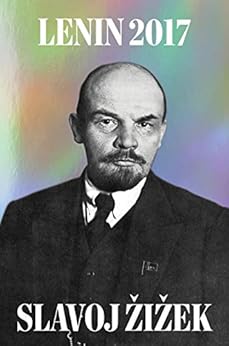
Gray is reviewing Zizek's First as Tragedy, Then as Farce,  but perhaps it's worth waiting a couple of weeks for the prolific Comrade Žižek's latest opus: Lenin 2017: Remembering, Repeating, and Working Through?

But perhaps it's time to lose patience with showmen who really haven't a clue as to what is to be done?

---

Next: What the Owl said to Lenin and Trotsky.

Thursday, April 27, 2017

Ode to Joy


There is a special character to Europhilia. The hushed, reverential tone of voice, those shining eyes. You see it with the apostles of Globalism: Tony Blair, Nick Clegg .. and Emmanuel Macron.

If only I had the literary technique to characterise such foolishness. I bow instead to the superior writing skills of  Phil Burton-Cartledge.
"The problem is for these folks, remainiacs if you will, the European Union is more than a trading bloc with an opaque bureaucracy. It's their Soviet Union, their City on the Hill, their Jerusalem.

"In their minds, the EU condenses Enlightenment values and liberal internationalism. It's an achievement standing above the nationalisms and tribalisms of old, that proves we can all get along on the basis of common humanity.

"And they have the nerve to look down their noses at Leave voters and call them deluded. It's stop-the-world-we-want-to-get-off, liberal-style. "
I rather wish I'd said that.

Thursday, March 23, 2017

Terror: can AI help?

My go-to guy on the Labour Left, Phil Burton-Cartledge, had this to say about yesterday's terror attack in central London.
"And, in a very rare instance, I'm going to defend the intelligence services. There is a very good chance the assailant was on a terror watch list. It's quite possible he had been or was presently under surveillance.

"Inevitably, the questions will be asked why he wasn't detected and/or picked up before now and prevented from undertaking this afternoon's attack. Again, while it's right such issues should be explored, lessons drawn and, if there is a case of egregious carelessness that those responsible be held to account, what really has to be asked is what could have been done differently?

Thankfully, we don't have indefinite detention without trial of suspects, but unless there are teams on standby covering the move of every single suspect then the answer has to be very little.

"Watching someone getting into their car and driving into central London is not immediately suggestive of suspicious activity. There is no way his intent to kill could be inferred before the car mounted the pavement and started accelerating towards passers by.

"This kind of attack is next to impossible to prevent if someone is so minded to carry it out."
These are very good points. But could AI have helped prevent the attack?

There are two issues to separate:
  • recognising that an attack is in progress
  • dealing with it.
Both are difficult.

Modern naval vessels are subject to attack from hypervelocity sea-skimming missiles. The time between detection and impact is short - too short to allow humans in the defence loop. The ship's AI monitors sensor systems such as radar, and has direct control over its terminal defence systems. An example would be the Phalanx.

If the AI gets it wrong and is too aggressive .. well, stuff happens in the military.

---

Deep Learning systems are typically trained on vast datasets, essential to extract the relevant classificatory features from the enormous space of relevant variations.
  • I doubt we have large datasets of events as rare and varied as 'Islamic terrorist attacks'.

  • I therefore doubt we could extract a definitive feature set which would reliably partition attacks from the myriad of events which define normal life.

Still, in more constrained situation such as an entranceway, you could create plenty of simulation data of intruders armed with knives or guns and I suspect a recogniser could be made to work. The police or guards would call in an attack anyway, so the AI system might buy you only a few seconds (and I'd be worried about all those false positives and false negatives).

But it would really come into its own if it could be linked to a fast response system.

I rather admire those security guys who take-down armed assailants. Almost all of the time on their watch, nothing bad is happening. Then comes an exceedingly rare event which they have to classify within seconds as requiring lethal force - and get it right. The natural human reaction would be to hold off for fear of making a catastrophic error. It's a hard call.

In Richard K. Morgan's SF pulp noir "Altered Carbon", the AI system at the 'Hendrix Hotel' takes out hero Takeshi Kovacs's attackers (once he has thumb-printed his contract!):
"I straightened again and snapped my hand out to the keypad beside the screen. Traces of fresh spittle smeared over the matt black receiver. A split second later a calloused palm edge cracked into the left side of my skull and I collapsed to my hands and knees on the floor. A boot lashed into my face and I went the rest of the way down.

'Thank you sir.' I heard the voice of the hotel through a roaring in my head. 'Your account is being processed.'

I tried to get up and got a second boot in the ribs for the trouble. Blood dripped from my nose onto the carpet. The barrel of the gun ground into my neck.

'That wasn't smart, Kovacs.' The voice was marginally less calm. 'If you think the cops are going to trace us where you're going, then the stack must have fucked your brain. Now get up! '

He was pulling me to my feet when the thunder cut loose.

Why someone had seen fit to equip the Hendrix's security systems with twenty-millimetre automatic cannon was beyond me, but they did the job with devastating totality. Out of the corner of one eye I glimpsed the twin-mounted auto-turret come snaking down from the ceiling just a moment before it channelled a three-second burst of fire through my primary assailant. Enough fire-power to bring down a small aircraft. The noise was deafening. "
Decisions which seem difficult when you're thinking at human speeds seem a lot more tractable when time is slowed by a factor of ten or one hundred .. or when thinking speed is cranked up by a similar amount.

Something tells me the Hendrix Hotel is the way of the future.

Thursday, August 04, 2016

On the Corbyn New Left


Matt Bolton (PhD student) explains (July 14th 2016) that:
"... the mainstream ‘socialist’ or ‘green-liberal’ left who are the main constituency of Corbynism ... are much closer in form to moral or religious crusades, or perhaps a charity appeal, than marxism or anarcho-syndicalism. They are defined by a complete lack of strategic thinking, and are utterly devoid of cunning."
Bolton thinks that the 200,000 who have paid their £25 and joined/supported Labour as Corbyn supporters are very low-quality material to build the movement:
"My own CLP doubled its membership during Corbyn’s leadership campaign, with 300 people signing up. In the past year, I would generously estimate that perhaps 10 of those 300 has had any concrete involvement with the party (going to meetings, canvassing, delivering leaflets, taking up positions in the local party, running for council).

"The local Momentum group has had a little more success in turnout, though the majority of people attending were already involved in other campaigns, and the most that has been organised has been a few fundraising socials and the odd pro-Corbyn demo.

"This indicates that Momentum will be most effective in areas which already have a wide range of activist groups and networks (ie places with a high density of population due to a strong local economy) but far less so in places further away from the urban centres of capital accumulation, where existing political activism is thin on the ground, if not non-existent.

"The point here is not to bash people for lack of activity — there are all sorts of reasons why participation might be difficult, from lack of time to the labyrinthine structure of the party rulebook, to the deeply, deeply dull nature of most political work. It is merely to say that simply pointing to the numbers of new members says nothing about the existence or quality of a ‘social movement’.

"For the vast majority of ‘new members’, joining the party was not a promise of future activity, but a gesture of general support — perhaps similar to signing a Change.org petition — for whatever they thought Corbyn as Labour leader symbolised."
Such pessimism. And all Bolton can advocate is that the left should
"... campaign for Proportional Representation. It is only by getting rid of the farcical imbalance of FPTP that a Corbynist-style party has any chance of power (even if only as a minor partner in a coalition), and it would be far more effective in concrete terms than the membership reaching a million.

"Corbyn himself has had little to say about this issue, but McDonnell and Clive Lewis have intimated that a deal with the SNP, Greens, Lib Dems, Plaid Cymru — and perhaps even UKIP — could be a possibility."
Trotsky and Lenin are spinning in their graves.

---

Two days ago, Phil Burton-Cartledge took him to task for underestimating the potential dynamics of initially-naive popular movements.
"He argues that Corbynism is a simulacra of a social movement. It isn't a real one because the adherents Matt has encountered in his CLP and online do not match up to what activists in a proper movement looks like, such as the (relatively) politically sophisticated and hyper active supporters of Militant back in the day.

"In reality, how movements emerge are a process. Social movements are the purposeful, sustained mobilisation of large groups of people organising toward a series of political and/or social objectives. They never emerge fully formed and can in their early phases look like the remotest of primitive ancestors.

"Within days, St Petersburg peasants and workers went from clutching portraits of their beloved Tsar as they petitioned him to calling for his head as Russia almost tipped into revolution in 1905. The civil rights movement and its morphing into violent insurrection in parts of the northern US had its roots in the gospel, in pacifism, and a faith in American constitutionalism.

"How many activists have come into politics via beliefs in fairness, spirituality, conspiracy theory, and other ideas that at best partially reveal, and it worst obscure the realities of social life? The world over, millions have. And they always will.

"The movement of people coming into Labour are a work in progress, because we're all works in progress. The shouting on social media, the lack of sophistication with which some new comrades express themselves, the lapsing into semi-conspiratorial modes of thought, all are symptomatic of masses of new people getting drawn to politics.

"But among them there are future Labour ministers and perhaps even a Prime Minister who has got involved because of Jeremy Corbyn. "
Good Marxist points .. up to that last sentence. Lenin and Trotsky etc ...

---

And finally, why is Corbyn so very popular?

Yesterday, Helen Lewis at the New Statesman published this insightful essay, "Explaining the love for Jeremy Corbyn", expressed in 11 succinct bullet points.

My short summary: he's a blankish canvas on which the disaffected middle-class project their own sense of entitlement and self-worth - powered by their alienation from the power and influence wielded by remote denizens of the inner bubble, which they naturally resent.

Perhaps I'm a little too harsh on her theses.

---

There's a lot to like about the ethics, idealism and even the worldview of Marxism, as I tried to convey in my two previous posts:
  1. Revolution back on the agenda?
  2. Communism would be like - what?
Who wouldn't want to be a freedom fighter for the oppressed against distant and selfish elites who patronise from on high?

It's really unfortunate that the Marxist solution (the abolition of market mechanisms and total socialisation of politics and economics) flies in the face of real human nature, in all its evolved and genetically-endowed complexity.

The present generation of movement-activists may not be wholly aware that there was once a time when revolutionaries actually won, smashed the capitalist state and instituted the dictatorship of the proletariat. Putting in place a post-capitalist society was not easy (admittedly the communists at that time were faced with economic collapse and civil war).

Still, in 1922, five years after the proletarian revolution, the committed Bolshevik Leon Trotsky made this summing up to the Fourth World Congress of the Comintern, describing why 'War Communism' (extreme central planning) had to be replaced by the 'New Economic Policy', re-introducing market mechanisms.
"Failing a free market, the peasant would be unable to find his place in economic life, losing the incentive to improve and expand his crops. Only a mighty upsurge of state industry, enabling it to provide the peasant and agriculture with all its requirements, will prepare the soil for integrating the peasant into the general system of socialist economy.

"Technically this task will be solved with the aid of electrification, which will deal a mortal blow to the backwardness of rural life, the muzhik’s barbaric isolation, and the idiocy of village life. But the road to all this is through improving the economic life of our peasant-proprietor as he is today.

"The workers’ state can achieve this only through the market, which stimulates the personal and selfish interests of the petty proprietor. The initial gains are already at hand. This year the village will supply the workers’ state with more bread-grains as taxes in kind than were received by the state in the period of War Communism through confiscation of the grain surpluses.

"At the same time, agriculture is undoubtedly on its way up. The peasant is satisfied – and in the absence of normal relations between the proletariat and the peasantry, socialist development is impossible in our country."

The further history of the Soviet Union (and the other 'communist' states) confirmed that 'socialist man' was psychologically an impossibility both for peasants and, unfortunately, for workers, except in the heads of the most gullible and deluded Party cadres who were duly mocked by their contemporaries.*

---

* The Trotskyists think it was Stalinism which killed their leader and marginalised their movement. Proximately they are right, but ultimately it was human nature itself which fatally undermined the revolutionary Marxist movement.