Showing posts with label Google. Show all posts

Thursday, February 22, 2024

LLMs have battered my blogging!

In the old days, I would have an idea, develop it, and write it up as a post here. 

Now: I have an idea, I type it into Gemini which writes the blog post... and I don't post it here.

What value do I add when everyone has access to an LLM in 'God-mode'?

In future, what you'll get here will be either some very idiosyncratic posts indeed - thoughts not encompassed by the bland LLM summation of the collective wisdom of the world-wide web - or something very personal indeed, probably involving cats.

---

Here we go.

1. I am being ambushed as I get up by puss-puss. She demands I scratch her head and also rub deep inside her ears. How disgusting is that?! I have to wash my hands before I go downstairs!


2. A slightly edited blog post I asked Gemini to write for me on this topic: 

"Write a blog post of less than 650 words analysing the Vatican's dilemma with scientific research such as physics, evolutionary biology and in particular research into the Historical Jesus.

Make the point that there appear to be limits in modifying or reinterpreting Biblical scripture and theology when faced with the challenge of non-sacralised content from non-Catholic sources. How are these limits determined and are there absolute barriers?"

---

Gemini's blog post

"The Vatican and the Tightrope Walk: Navigating Science and Scripture

The Vatican, as the center of the Catholic Church, faces a unique challenge: reconciling the ever-evolving world of scientific discovery with the timeless truths enshrined in its scriptures and theology. This tightrope walk is particularly evident in fields like physics, evolutionary biology, and even historical research on the figure of Jesus.

The Church's position on science has undergone a gradual shift throughout history. While initial reactions to revolutionary discoveries were often cautious or even hostile, the modern Church acknowledges the validity of scientific progress. Pope John Paul II, for example, famously declared that "faith and reason are like two wings on which the human spirit rises to the contemplation of truth."

However, when scientific findings seem to contradict scripture, the Church faces a dilemma. Take, for example, evolution. While accepting the reality of biological change, the Church insists on its compatibility with the doctrine of creation. This necessitates an intricate interpretation of Genesis, often drawing on allegorical readings or theological frameworks to bridge the gap.

Similarly, historical research on the life and teachings of Jesus can challenge established narratives. The discovery of non-canonical gospels, for instance, raises questions about the "true" Jesus, potentially contradicting the Gospels accepted by the Church. Reconciling these findings requires careful analysis, distinguishing between historical fact and theological interpretation.

The limits of modifying or reinterpreting scripture and theology are determined by a complex interplay of factors. Firstly, the core doctrines of the Church, like the divinity of Christ or the Trinity, are considered immutable. Secondly, the historical and literary context of scripture plays a crucial role in interpreting its meaning. Finally, the interpretations of Church authorities and theologians throughout history contribute to a cumulative understanding of faith.

However, absolute barriers are difficult to define. Science constantly evolves, and new discoveries can necessitate re-evaluations of established interpretations. Additionally, theological understanding itself is a dynamic process, with ongoing dialogue between scholars and believers. This leaves room for adaptation, but within certain boundaries.

The Vatican's approach is often characterized as cautious and deliberate. It seeks to harmonize scientific findings with scripture, finding common ground wherever possible. When contradictions seem insurmountable, it emphasizes the distinct realms of faith and reason, asserting that they ultimately lead to the same truth from different perspectives.

This balancing act is not without its critics. Some argue that the Church is too rigid, clinging to outdated interpretations in the face of scientific evidence. Others believe it compromises its core values by bending theology to accommodate secular knowledge. Ultimately, the Vatican's position reflects its unique role as a steward of both faith and reason. It strives to remain faithful to its tradition while engaging with the ever-changing world." 

---

Comment: it's a bit bland and wordy, and bends over backward not to offend anyone but there's a core of interest. As they say: I didn't have time to make it shorter.

Thursday, January 30, 2020

It's just a better parasite...

From Google AI:
"Modern conversational agents (chatbots) tend to be highly specialized — they perform well as long as users don’t stray too far from their expected usage.

To better handle a wide variety of conversational topics, open-domain dialog research explores a complementary approach attempting to develop a chatbot that is not specialized but can still chat about virtually anything a user wants.

Besides being a fascinating research problem, such a conversational agent could lead to many interesting applications, such as further humanizing computer interactions, improving foreign language practice, and making relatable interactive movie and videogame characters.

However, current open-domain chatbots have a critical flaw — they often don’t make sense. They sometimes say things that are inconsistent with what has been said so far, or lack common sense and basic knowledge about the world. Moreover, chatbots often give responses that are not specific to the current context.

For example, “I don’t know,” is a sensible response to any question, but it’s not specific. Current chatbots do this much more often than people because it covers many possible user inputs.

In “Towards a Human-like Open-Domain Chatbot”, we present Meena, a 2.6 billion parameter end-to-end trained neural conversational model. We show that Meena can conduct conversations that are more sensible and specific than existing state-of-the-art chatbots. Such improvements are reflected through a new human evaluation metric that we propose for open-domain chatbots, called Sensibleness and Specificity Average (SSA), which captures basic, but important attributes for human conversation.

Remarkably, we demonstrate that perplexity, an automatic metric that is readily available to any neural conversational models, highly correlates with SSA..."

Read more...
This is the 'Chinese Room' approach to social agency, consciousness not required.

I think the approach is architecturally self-limiting: the limit-point being suave, fluid, empty-headed gossip-grooming.

It will make Google a fortune.

Monday, December 16, 2019

I would really like to fix this image!

Clare aged around 15

This is a blurred image. I would really like to unblur it.

What is blurring? It is an artefact of the imaging process. If the image is out of focus, each point in the original is replaced (in the image) by an average value of neighbouring points. This process is called convolution, and blurring is sometimes modelled by a Gaussian point-spread function (PSF).

Pixelation is also a convolutional process. Here there is a uniformity of image value across the pixel; the pixel is formed via a uniform PSF. Both effects are present on the the picture above of the young Clare.

The process of restoring the orginal image is called deconvolution. It's complicated by three problems: (i) we normally don't know the exact PSF; (ii) the image always has added noise; (iii) information is thrown away in the blurred-imaging process. Recovery is inevitably somewhat speculative.

If the PSF is not known, it can be estimated in a process known as blind convolution. If the nature of the image is known (Clare's face) then model-based recovery could be used, particularly if we have other images of the subject (we do!).

This is an area where deep learning is very, very applicable; a spin-off from facial recognition systems. There are a large number of papers on the topic but I have failed to find an online website where I can simply upload the picture (and maybe some unblurred pictures of the subject) and get a restored, sharp picture to download.

Perhaps an iteration of Google Photos at some point? Like this:

State of the art (PDF)

The above images are from a team including Beijing Institute of Technology, Nvidia and Google Cloud. When can I get to use it?

---

Update: June 15th 2020: There's a system online and I've tried it.


Thursday, May 23, 2019

Huawei, Google and the Faraway Tree

It must have come as a shock to Huawei. It's discovered that it's only a hardware-maker after all. The real power is with Google. So it will now have to develop its own total ecosystem like Apple.

But it's hard to replicate what Google has - just think of the intellectual capital represented by Google Maps, for one. Remind me again just how good the Chinese are at software for westerners.

Huawei can't win this one. Not outside of China.

We now live in a multiple planetary system. Planet Anglosphere, planet China and then the rest.

On a personal basis I distrust the woke, dissimulating Google. It's a vast gatekeeper, sitting between the producers and their customers, siphoning off middleman-rents like some vampire squid. It's interests are far from benign: ask yourself what the ideal Google-world would look like and repeat after me: 'total surveillance'.

Benign, of course, Daenerys.

I'm tiptoeing away. I already left Google Search in favour of DuckDuckGo; Chrome has been abandoned in favour of Firefox. I am tempted to migrate from Gmail to Protonmail but I hardly use email these days. But Photos, Maps, Translate, Keep, Docs and Blogger?

There are Microsoft alternatives but frying pan and fire come to mind.

Oh dear!

---

Trivia note: in "The Magic Faraway Tree" (Book 2 of the trilogy), Enid Blyton introduces 'Google Buns'. Here's a recipe. And here's a link to my current (.mp3) reading of this book: 'Are you sitting comfortably, children?'.

I already read Book 1.

Sunday, January 13, 2019

Sunday, December 23, 2018

Three virtual posts

Amazon link

I was going to review Richard Morgan's latest tech-thriller "Thin Air" which I enjoyed a lot. But Steven Poole of The Guardian expressed my thoughts so much more clearly. Really, it's easier just to point you to his review.

---

Like everyone else I had plenty of thoughts about the alleged Gatwick Airport drone incursion. The problem seems to be in two parts: first to identify the team launching/retrieving the drone; second to deal with the drone itself. The first part seems harder.

My idea was to run a real time video-acquisition platform (a satellite, police drones or arrays of ground-based CCTV) covering the operational radius of the hostile drone around the airport - I believe this is 2-3 miles. This would generate a great deal of video which would need to be searched very rapidly for hostile drone-team activity. Precisely what Project Maven was designed to address. Google may have gone pacifist but no reason for Qinetiq not to do the project.

But I read so many interesting ideas that it seemed pointless and redundant to add any more.

---

I was going to write about this paper with the unpromising title: "Mapping morality with a compass: Testing the theory of ‘morality-as cooperation’ with a new questionnaire" by Oliver Scott Curry, Matthew Jones Chesters and Caspar J. Van Lissa.

What they've done is rethink Jonathan Haidt's Moral Foundations Theory on the basis of evolutionary plausibility. Instead of Haidt's five dimensions, they have seven and in their field trials it all seems to make sense. Here are their seven moral dimensions. Click on image to make readable.


This is what they say in their abstract.
"Morality-as-Cooperation (MAC) is the theory that morality is a collection of biological and cultural solutions to the problems of cooperation recurrent in human social life. MAC uses game theory to identify distinct types of cooperation, and predicts that each will be considered morally relevant, and each will give rise to a distinct moral domain.

Here we test MAC’s predictions by developing a new self-report measure of morality, the Morality-as-Cooperation Questionnaire (MAC-Q), and comparing its psychometric properties to those of the Moral Foundations Questionnaire (MFQ). Over four studies, the results support the MAC-Q’s seven-factor model of morality, but not the MFQ’s five-factor model.

Thus MAC emerges as the best available compass with which to explore the moral landscape."
I have been quite enthused here by Moral Foundations Theory, while being aware that it, like the five-factor model of personality theory, floats unanchored, crying out for a deeper evolutionary embedding. So this latest work is potentially quite exciting.

Unfortunately, the paper itself is dry and technical and does not excite. I hope the research community builds on it to progress Jonathan Haidt's work - particularly on the psychological/moral differences between liberals, conservatives and libertarians. Then I will feel motivated to comment.

Sunday, October 28, 2018

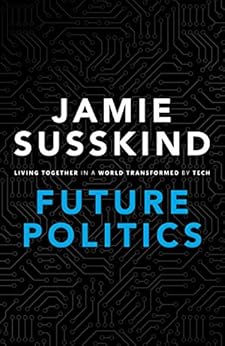
Our future of total surveillance (Jamie Susskind)

Amazon link

Susskind's book was reviewed in The Sunday Times today (here).  It's about a dystopian future of AI super-surveillance sourced from sinister tech companies like Google (I am not being ironic).


I was struck by this quote:
".. the children decide to go on a demo. They heard about it from their friends; artificial-intelligence systems had prevented them receiving online information. Their phones warn them about rain and traffic, but there is none. A drone records their progress. Then, on their internet-enabled glasses, they see pictures of people being interrogated in stress positions; each has the face of one of them. They turn back."
Actually, demonstrators within authoritarian regimes face far stronger disincentives than those described above. Demonstrations still happen because when people get mad enough they'll brave prospects of torture. Or perhaps they lack imagination or think it won't happen to them. All of the above probably.

---

There have been a few lone-actor atrocities in the US over the last few days. The so-called 'MAGA bomber', Cesar Sayoc, was found particularly rapidly after fingerprints and DNA were apparently found on suspect devices. Easy to cross-check as Sayoc had a criminal record.

Wikipedia tells us, "According to the US Bureau of Justice Statistics, 2,220,300 adults were incarcerated in US federal and state prisons, and county jails in 2013 – about 0.91% of adults (1 in 110) in the U.S. resident population."

That's a great dataset for machine learning applied to GWAS. Genome to facial appearance is a quick win: you can almost always get a scene-of-crime DNA sample, and all criminals are on Facebook, aren't they?

---

I read the review carefully but I'm not convinced there's much new in Susskind's book ..
"His writing is clear and precise; he is a lawyer, he is making a case. Irritatingly, he puts in too many (one would be too many) cheeky-chappy asides such as, “At last, someone has found a use for spinach.” But, on the whole, he steers a course to the future that is as convincing as it is shocking. We can fix this, is his message, but there is also the nagging sense that we probably won’t."
We won't until we do. I'll give the book a miss.

---

Related postÜber-surveillance.

Monday, October 01, 2018

Witch Hunt at CERN


From the BBC website:
"A senior scientist has given what has been described as a "highly offensive" presentation about the role of women in physics, the BBC has learned. At a workshop organised by Cern, Prof Alessandro Strumia of Pisa University said that "physics was invented and built by men, it's not by invitation". He said male scientists were being discriminated against because of ideology rather than merit.

He was speaking at a workshop in Geneva on gender and high energy physics. Prof Strumia has since defended his comments, saying he was only presenting the facts. Cern, the European nuclear research centre, described Prof Strumia's presentation as "highly offensive". The centre, which discovered the Higgs Boson in 2012, has removed slides used in the talk from its website "in line with a code of conduct that does not tolerate personal attacks and insults".

Prof Strumia, who regularly works at Cern, presented the results of a study of published research papers from an online library. He told his audience of young, predominantly female physicists that his results "proved" that "physics is not sexist against women. However the truth does not matter, because it is part of a political battle coming from outside".
This is all wearisomely familiar from the James Damore case at Google a year ago. If the institutions which are dedicated to truth in science can't defend it against political pressure, who can?

Here's the offending slide presentation (PDF) by the way. It's ponderous-humorous and a bit technical; the BBC cherry-picked remarks they could use out of context. Read it if you dare!

---

On the strength of it all I decided to let Luboš back.

The Reference Frame is hereby reinstated on the right-hand side of the web version in the blog list. For all his extravagant language, grotesque and offensive personal insults and tone-deaf histrionics, the physics, though partisan, is good and the attacks on SJW nonsense merited.

In Luboš's post yesterday, "Nasty SJWs persuade spineless CERN officials to start an inquisition trial against an Italian scientist", the professor at the centre of the row, Alessandro Strumia, added this piece in the comments:
"Thank you Lubos for writing me alerting about this mess; let me clarify.

CERN organised this "gender workshop". Having recently worked on bibliometrics, I had the data relevant for the workshop, so I did the simple checks that should have been done before claiming that physicists are sexist, etc etc etc

Next I went to hear the workshop, that was ignored by almost all theorists who privately have bad opinions about it.

One of the speakers told (as if this were common knowledge) that words such as “competitive”, “conservative”, “hardworking” are bad. A participant said that physicists are second only to military in sexual harassment. And the rest was along similar lines, as clear from the quotations on my second page. Have a look at the other talks still kept on line by CERN, and switch “men" with “women”, and then decide if they are sexist.

It was clear that anything different from their line would have been discredited and ignored. And the objective results that I got from bibliometrics did not support their line: there is no discrimination against women.

This is a good news, but it's not what they want.

Like with LHC results, which are not the best we hoped, it’s our duty to present honestly what we get.

That’s why I decided that the only option (apart from self-censorship) was openly talking about the alternative ideas “discredited” in past gender workshops and that they don’t want to hear, from Simon Baron Cohen, to Summers...

Having spoken with many physicists and friends (including female physicists who attended the workshop), I am fully sure that the big majority understands, although many of them fear the consequences of speaking. I myself tried to find somebody else who dared to speak in my place, and I decided I had to speech only after having seen courageous people that in the past years begin to openly challenge the ideology (like the guy who said “ideological echo-chamber" and was fired by google), and that people thinks very different than media etc.

So I hope to survive and keep doing the physics that I like. Although I am worried that, acting on self-conservation instinct, CERN might worsen a bad situation.

After the talk, I warned important physicists there “a mess will happen”, and they believed my worries were exaggerated. So I am sure that good honest people hosted and funded the workshop underestimating that it was politically-charged and driven by people who dislike our culture based on hard and smart work and on gender-neutral merit, which I think is worth defending.

The sexist attacks against physicists might violate CERN code of conduct, but I liked that CERN is so open to free speech that we can discuss the unpleasant issues raised by the workshop. The fact that my talk is no longer freely available makes me fear that somebody might want my head to appease a political area which is highly voted by academicians, but recently not so much by the people.

I am happy if somebody wants to discuss and check honestly what I wrote in the talk, but tomorrow I have to work full day.

PS Lubos: when you started blogging, I believed you were a totally wrong idiot. But your blog contains good physics, so I kept reading, and with time, I come to realise that I was wrong, and you were right, although too much ahead of time. A very great US physicist told me that you were even moderate, before what happened to you."

That final paragraph - very interesting. But I believe, based on his words above, that Professor Strumia is too naive and trusting to be long for this world.

Update (Oct 5th 18): BackReaction has been taking a look at the citation data Prof. Strumia was using, and at his slides: "Gender-bias in Academia: The Case Strumia". This seems the kind of debate you would expect within the physics community.

Thursday, January 04, 2018

A new SafeSearch for the epoch of hate

In the bad old days, just before yesterday, the main thing wrong with the Internet/Interweb was that it was awash with porn. Thankfully, browser providers such as Microsoft and Google came up with SafeSearch, which allowed you to automatically filter out this torrent of filth.

Today the Interweb is awash with people trying to convince you of fake news. Sometimes they distort information or just plain lie to you, sometimes they express discomfiting opinions which they ought to have self-censored .. and sometimes they expose you to true information about the world which is deeply upsetting or brand-damaging.


Google/YouTube has been slow to pull down (somewhat-popular) offending content. I was shocked, shocked to realise that there was a conflict of interest here. Luckily the big advertisers are on the case. In The Times today I read: "JP Morgan’s firewall blocks ads from YouTube hate videos".

Yes, hate. So bad for the brand.
"Google has been accused of failing to do enough to remove dangerous content from YouTube after a leading bank created its own tools to prevent its online advertisements appearing alongside hate-filled videos.

Politicians and advertisers said it was an indictment of Google that a financial company was able in effect to identify and filter racist and terrorist clips where the tech giant had failed.

JP Morgan Chase devised an algorithm with 17 layers, or filters, to separate what it deems as safe YouTube channels from unsafe ones. One of the filters assesses the total video count on a channel, which automatically cuts out channels with one-off viral videos. Other filters look at channels’ subscriber counts, the topics they focus on, the language of the video captions and viewer comments on their clips.

“The model Google has built to monetise YouTube may work for it, but it doesn’t work for us,” Aaron Smolick, executive director of paid-media analytics and optimisation at JP Morgan Chase, told Business Insider. “The attention of protecting a brand has to fall on the people within the brand.”
Do we even want Google or Facebook to be the arbitrators of what can be published on the Interweb? Times commentator David Aaronovitch is not so sure:
"We all accept that material inciting terrorism or showing child sexual abuse should be removed immediately. But what happens when companies are obliged to take down anything that constitutes hate speech or intimidation?

Leaving aside the question of how you define them, the approach would almost certainly involve creating algorithms that delete material with certain keywords or phrases as soon as they are posted.

For one thing, this would save tech giants the trouble of having to respond to potentially millions of requests to take down material that users found offensive.

Better to make the mistake of wrongful deletion of posts and accounts, for which there is no penalty, than to allow something bad to get through and get dragged through the courts."
The world according to Google. I'm sure Hillary Clinton and George Osborne would approve.

---

There is a better way.

Extend the concept of SafeSearch the JP Morgan way. Consider a firewall-like app which can download 'safe-to-view' rules. Anyone can design a rule set: the US Democratic Party, SJWs-against-hate, Fox News, The Sun newspaper, .. JP Morgan .. .

Any organisation which fears brand damage will simply white-list those rule-sets from organisations which filter content in an acceptable manner. The app will then block their ads in proximity to texts, pictures and videos deemed to be those of hate. The ads will only be served to those devices running the app with a white-listed rule-set; I think JP Morgan et al could swing that.

This decentralised solution removes our reliance on those compromised Silicon Valley giants. We can all live safely in our bubble of choice.

Seriously, what is there not to like?

Monday, October 16, 2017

Time to go post-Google

For a long time I used to not care about Internet privacy. And then Google got into SJW mode and ceased to be my friend. I read about its business model, the Amazonian torrents of cash that advertisers pour into its coffers .. and I wondered if it would always have my best interests at heart.

So I decided to use DuckDuckGo for all those searches which I'd like to keep from the planetary AI. But Google, and my ISP, still know way too much.

... but you're never alone with a keylogger

On my Android devices, the DuckDuckGo app has a setting to 'enable Tor' which I checked. It then helpfully prompts you to install the Tor router Orbot and the Tor browser Orfox. It's easy.

Orbot does not provide generic anonymous Internet access; programs have to be configured to work with it. Basically things work best if you access websites via the Tor Browser .. which is the search term for Windows PCs.

The thing is, I know that the AI assistant we're slowly crawling towards will only work if it knows more about you than your closest confidante. And it will live in the Cloud. But I would pay to have that knowledge base under my control and lodged with a trusted third party (like the folks running ProtonMail).

Keyloggers

Google's middleman offer to advertisers and you & me is based on the twin peaks of narrow domain expertise, increasingly based on neural net AI such as Google Translate and voice recognition, and its ability to integrate across its apps which thread to so much of our lives: email, photos, calendar, notes, search queries, etc.

Google does the bulk of this information centralisation and synthesis in the Cloud: that is, on its own servers. The resulting real-time data model of you both repopulates your apps (Chrome talks to Gmail talks to Calendar talks to Google Now talks to GPS talks to Maps ...) and is sold to advertisers for targeting.

If we're to bring that level of integration back into our own hands, then we need to capture our activity across many different apps and device functions. Perhaps one day all apps will have a standard API with which to talk to our personal assistant app .. but until then it's a benign keylogger I'm afraid.

The other people who are big fans of keyloggers are the intelligence services and those vendors (like Microsoft) who are losing out in the race for ubiquitous ownership of our most popular apps.

Sunday, August 13, 2017

Diary: vexatious Sunday

My day starts with the Sunday Times and I'm reading Dominic Lawson on the James Damore/Google affair. I'm reminded of the illiterate and distorted editorials in The Times and The Economist (previous post) and I fantasise about cancelling my subscriptions as I ponder the old dilemma: (i) do they know the science but choose to lie about it, which makes them mendacious hypocrites; or (ii) have they not even bothered to check the relevant body of knowledge carefully cited by Damore, choosing instead to ventilate their blank-slate wish-fulfillment fantasies - which makes them incompetent.

In either case, why am I spending good money reading them? I console myself that The Economist does a good quarterly Technology Review and The Times occasionally has some useful news in it.

---

While Clare is at Mass I resume Frederick Beiser's Hegel.


When you read highly abstract discussions relating to substance, essence, the necessary, the contingent, the noumenon and phenomenon, the synthetic a priori, it's tempting to think that the underlying problem set these guys are wrestling with is impossibly abstruse.

Not so: at the end of the eighteenth century, with enlightenment rationality crumbling under the Reign of Terror and religion on the ropes, Hegel and the Romantics are struggling with straightforward questions.
  • Is the universe a Newtonian machine or is there scope for free will?
  • If knowledge is just representations in our minds, can reality be truly known?
  • If we have free will, and God is not a personal judge, whence morality?
I think we have a good scientific framework for these questions today (not, of course, uncontroversial), but Hegel was definitely on the right track. His stuff is abstract both because the right scientific toolset hadn't yet been developed, but also because in a dynamic world of evolving connections, the individual concrete element of reality is conditioned by its relationships with other things - and some of those relationships are inherently abstract.

Quick example: you concretely see a human walking from one location to another where they start doing certain things in a structured way and conversing with others. What extra information about that scenario's history of embedding relations do you need to properly and fully understand what is happening?

If I tell you the person is a priest and he walked to his church? If I say she is a barista and she walked to her coffee shop in a now-desanctified church? How much more do you need to understand completely and fully? A lot.

You get the idea.

---

In our irreligious age, residual belief in God seems a mere foible. But Hegel was not an atheist, and to be consistent God had to be present in the ontology of reality. Looming over everything was Spinoza's immanent God, a divine presence infusing everything. But this leads to quietist, passive conclusions. If we are part of God, what scope for novelty or freedom?

Hegel adds conflict, dynamics and process through the dialectic, but does he really have a solution?

---

In the afternoon we strolled to Wookey and had toasted teacakes on our return.

The evening progresses,  I watch BBC coverage of the IAAF World Championships and my distaste with the deep feminisation of media culture surfaces again. Some Brit has just been disqualified in a walking race of epic length after three warnings, at the 10 km mark or thereabouts.

He seems tearful but full of resolve to do better in future. The BBC interviewer is like a trauma therapist: "How do you feel?" "Can you recover from this?" "You put in so much hard work!" ..

Call me systemising rather than empathising but - insofar as I care - I would rather have liked some footage of his DQ faults, and someone explaining technically what he had done wrong and what he should do about it.

Dispassionate analysis? Not what this is about.

OK. I'm done with being vexed for today .. until the BBC News at ten o'clock.

".. then I must be .." *


The Economist this week writes:
"Mr Pichai had good reasons to sack Mr Damore. One is the content of the memo. It says many reasonable-sounding things: that “we all have biases” and that “honest discussion with those who disagree can highlight our blind spots”. But these are just camouflage before a stonking rhetorical “but”: the argument that innate differences, rather than sexism and discrimination, explain why women fare worse in the technology industry than men. “Neuroticism (higher anxiety, lower stress tolerance)”, Mr Damore writes, “may contribute…to the lower number of women in high-stress jobs.”

"Research has indeed shown some smallish group-level differences in personality and interests between the sexes. But drawing a line from this to women’s suitability for tech jobs is puerile. An unbiased eye would light on social factors rather than innate differences as the reason why only a fifth of computer engineers are women. "
In today's Sunday Times, Dominic Lawson observes of The Financial Times:
"... the Financial Times, which in an editorial denounced Damore’s memo as “almost pure drivel”. That paper is facing industrial action on behalf of its female employees, who suffer from a 13% gender pay gap (according to the National Union of Journalists).

It, too, has an internal reason for declaring to the world how deplorable it finds young Damore, so it published another article accusing him of a “long email rant against diversity programmes . . . a rambling confused mash-up of outdated science”.
---

When these idealogues attend a performance of 'The Life of Galileo' by Bertolt Brecht,
"This was a lively, heartfelt performance which showcased reason and science vs. obscurantist arguments from authority designed solely to buttress the interests of those in power. This never fails to be relevant."
they root for Galileo, bravely sticking it to The Man. It never occurs to them that they are The Man.

---

The genius of Brecht was to give good arguments to the Catholic Inquisition. The interrogator points out that regardless of any purely-scientific merits of Galileo's thesis, the practical effects of the new doctrine would be to undermine the primacy and sanctity of scripture and thus subvert the social order, undermining authority and leading to dangerous chaos.

A very high price to pay for some arid, esoteric and contested version of 'truth'.

---

* Imposter.

Tuesday, August 08, 2017

If Google did heavy lifting ...

Following on from the James Damore affair (read first).

Suppose Google's business involved heavy, manual construction work. The relevant Division is full of tough, strong endomorph types. They are mostly male with a smattering of shot-putter women.

Top software development is the mental equivalent of this level of performance ..

The HR people go crazy. This tip of the company spear is shockingly male-dominated, showing entrenched .. well, you know. They demand more diversity training and proactive affirmative action hiring. We want a 50-50 equal gender ratio. And we want it now.

A Damore-equivalent naïf observes that men are on average quite a bit stronger than women. That any women who can hack it are more than welcome in the Division. But biologically there just aren't that many applicants compared to qualified men. Going for 50-50 is going to be a stretch. Perhaps this equality of outcomes thing is, well, .. inappropriate?

As Google's CEO fires him, does he still say this?
"However, portions of the memo violate our Code of Conduct and cross the line by advancing harmful gender stereotypes in our workplace. Our job is to build great products for users that make a difference in their lives.

To suggest a group of our colleagues have traits that make them less biologically suited to that work is offensive and not OK. It is contrary to our basic values and our Code of Conduct, which expects “each Googler to do their utmost to create a workplace culture that is free of harassment, intimidation, bias and unlawful discrimination.”
Plainly the female employees of the Division - by virtue of the fact they were hired in the first place and are meeting the standards - are not  'less biologically suited'. No one said otherwise.

But comparison of the male-female population distributions for physical body strength indicates that women in the general population are 'less biologically suited'. It's why we have separate male and female sports events.

Female-Male trait distributions overlap, but are sometimes not identical.
If you're hiring for extreme values of such a trait, don't be surprised

 if the applicant pool sizes differ quite substantially.

I'm not sure the CEO's sophistry would work for physical strength employment. But cognitive and personality traits are not so obvious at a glance and playing word-games is easier.

---

Further reading.

*  "Women's Brains" - male-female comparison: Human Connectome project (N = 900).

*  "Women and Minorities in Science"  - a typically-erudite analysis from La Griffe.

*  "Sex Differences in Mathematical Aptitude" - La Griffe analysis relevant to software dev.

James Damore gets fired

The rainbow colours of diversity

The ex-Google employee was terminated for observing (in an internal memo) that genders differ in their aptitude for, and interest in, computer science.
Steve Hsu has this to say, while Scott Aaronson has written an elegant and oblique post.

---

Blank-slate ideology asserts that all humans - of whatever gender and/or race - are cognitively biologically-identical, and that therefore all detrimental differences of outcome are solely due to oppression. When elites defend plainly-wrong ideas with the utmost ferocity, I am reminded of Marx's point, "The ideas of the ruling class are in every epoch the ruling ideas."

Why would the ruling elite want to believe it? Because it would be so dangerously divisive to look at any human subgroup and affirm that group's lower average cognitive performance or competence. Even identifying plainly outperforming groups - such as the Ashkenazim - risks opening the door to the concept of differences. So extreme is this impetus to faux-egalitarianism that many people deny even physical performance differences between genders or races. Social cohesion is the game.

I keep reminding myself (I already wrote about this) that globalisation is the economic driver for blank-slate ideology. Its young, educated beneficiaries are eager converts (arguably against their own longer-term interests) to causes so apparently egalitarian, culturally left-wing .. and economically convenient for globalised capital.

At least we haven't reintroduced the auto-de-fé yet or I wouldn't be writing this.

---

The Google CEO's sophistry was particularly disingenuous: see "If Google did heavy lifting ...".

Monday, May 22, 2017

The next Kondratiev wave?


Wikipedia article

Fortunate we are to develop our careers in the rising phase of a Kondratiev wave. As new platform technology is widely introduced, the economy grows, wages and salaries rise and a host of fascinating and challenging socio-technological problems present themselves. Work can be fun!

Yes, I remember the late 80s through the mid-2000s, when the Internet was bright and young and we made a new world of computing and telecoms!

The stagnation and depression phase of a Kondratiev wave is something else. The economy flatlines, wages and careers stagnate, everything is flat and immobile; the story of the last ten years.

---

A new wave starts with new platform technologies, sufficiently mature to make a practical difference, which revolutionise production at a higher level. At the same time, the required (and vast) capital investment has to be profitable with a promise of demand sufficient to absorb the new products.

Are we there yet?

It's been predicted for a while now that the next Kondratiev wave will be driven by a combination of AI (in its new neural net incarnation), robotics and genomics - driving industries such as pharmaceuticals and healthcare - but in practice almost everything.

I don't think we're at the lift-off point yet. None of these technologies are ready for prime-time: they're niche and require too much scarce expertise to make work. Nor is it clear that the political conditions are in place for massive new investments.

Peter Turchin has predicted that we're in for a rough decade, suggesting civil turmoil until the mid-twenties. His view may be no more than inappropriate curve-fitting: we shall see.

---

Ernest Mandel (Late Capitalism - PDF) correctly observed that massive investments in transformational new technologies will not occur unless they are profitable, which, he argues, requires that working class resistance (to losing jobs and perhaps lower wages) has been broken. He sees fascism and the second world war (thirties and forties) and Thatcher's union-busting (eighties) as typical precursors to new waves.

The next wave would, however, seem to require very little in the way of cheap unskilled labour (which in fact it proposes to - eventually - replace). If we take Google as the current industry leader in next-wave technologies, the economic and political strength of the working class en large hardly seems to matter as regards their truly enormous investment in AI and robotics.

But if the impact of the next wave will be the massive elimination of both middle class and working class jobs, then a precondition for across-the-board capital investment would surely have to be a belief that such high rates of job loss and unemployment could be successfully achieved.

Is such an outcome politically deliverable today? Plainly not.

I anticipate the next decade to be one of the steady imposition of job-elimination technologies, accompanied by increasing worker resistance. Those states which succeed by force and/or inducements in advancing total automation will open the floodgates for the next wave.

Thursday, March 09, 2017

Replika is massively oversold

Replika was originally going to be your own, online personal doppelgänger. Given the current state of the art with chatbots (tiresome and useless), that was always going to be a stretch.

The current PR says:
"Replika is your personal AI friend that you nurture and raise through text conversations. It is a lifetime companion who is always there for you, chats with you, keeps your memories, and helps you become more connected to yourself."
They're busy trying to create doable spin-offs such as a personal diary ("A Cute Diary That Keeps Itself").

Given date-slippage, I had thought that the whole Replika thing might have silently collapsed, but I suppose there is no shortage of people who are happy to update a super-Eliza forty times a day with details of their every mundane activity.

Facebook.

There would be a lot of interest in a virtual friend, endlessly attentive and caring  (except that's not a friend, more a courtier - artificial sycophancy). But if this were in the state of the art, one of Google, Microsoft, Facebook, Amazon or Baidu would have done it already. It's plainly on the future roadmap for the plethora of voice assistants, but today's systems are no more than super-recognisers.

---

Have you ever had the experience of being in a technical meeting, in an area not wholly in your sphere of competence, and suddenly you lose the plot? For a moment, you just don't know what everyone else is talking about. You pray no-one will ask for your opinion.

If you're lucky, in a minute or two the topic will move on and you will rejoin the shared context.

What happened there? The participants shared an internal cognitive model of what the conversation was about, and yours frayed. But no chatbot today can maintain an internal model of any complexity.

Worse: the topics of mundane discourse are open-ended, rooted in a complex culture and often private. Do we even want our AI-in-the-cloud to share personal and family intimacies, possibly with any interested intelligence agency?

---

Your Replika AI friend is going to get 40 bland texts per day from you. Some of the questions already seem rather intrusive.


There is a hint of blank-slate about current AI. As if one standard optimised neural-net architecture could create the ideal artificial personality template, which then gets loaded with data to become an individual.

We know that people aren't like that. Common experience and psychometric data tells us that people have distinct personalities, that these are strongly heritable and resistant to change. We all know, as folk psychologists, that we deal with people as distinct individuals, not clones. And that most of those differences are innate and resistant to social influences.
"She thinks she can change him!"
No she can't.

So many mountains to climb.
  • Why is the brain structured as modules, not one uniform design?
  • How is the architecture of personality differences implemented?
  • How to immerse an AI in common knowledge, culture and mores?
  • How does social deftness, tact and propriety work?
  • What's an effective, useful and pleasant engagement model - corporeal?

Yes, I am prepared to be disappointed with Replika.

---

Update: 9th March 2017.

"Replika AI to launch on the App Store

"Today, we are excited to announce that Replika will appear on the Apple’s App Store on March 13 at 12:00 AM Pacific time. We’d like to thank all the participants of the app’s preview in Testflight for the incredible feedback that helped us shape the app."

Sunday, February 19, 2017

People are boring - so what chance chatbots?


The BBC's Dave Lee writes:
"It's been nearly a year since Microsoft's Satya Nadella proclaimed "bots are the new apps".

"Yet despite the promise of a revolution in how we interact with services and companies online, progress has been utterly miserable - the vast majority of chatbots are gimmicky, pointless or just flat out broken. ...

The CNN news chatbot, for example, is worse at giving you the news than any of CNN’s other products. ...

"Google's AI-powered messaging app Allo, since being launched to much fanfare last year, has failed to make even a minor dent in a messaging app market dominated by Whatsapp and Facebook Messenger.

"And that's because there's no compelling reason to bother with Allo. None of its features - like asking it for directions - provide enough of a benefit beyond what you'd get from just tapping in your request the "old fashioned" way. Users have an incredibly short fuse for chatbots not working exactly as we expect."
---

We have a special name for those few people who we (mostly) don't find boring.

Friends.

We don't much enjoy extended interactions with random folk. People who, nevertheless:
  • have been completely socialised into our culture for decades, 
  • come with detailed background knowledge of the world,
  • are endowed with common sense and full conversational abilities.
So why did the AI companies think we'd enjoy interacting with chatbots, which are cognitively impoverished in every conceivable way?

It's a good question and I'm not sure of the answer.
- Were they over-impressed by their mighty artificial neural nets? But they're only fantastic recognisers and classifiers, a far cry from artificial general intelligences (AGI).

- Did they think that we're all keen to have conversational, hands-free interaction with our pocket devices? In fact that's socially way too intrusive most of the time, plus we're talking to conversational muppets.

- Was there a belief that in some narrow, vertical and tightly-constrained domains there might be a niche for a conversational interface? There's almost certainly something to that - but we don't yet know what.
My own feeling is that the successful mass consumer chatbot can be nothing less than a truly effective virtual friend. To that end it will have to posses AGI and be malleable to your own personality and 'friend-preferences'.

We'll have starships before we have that; I haven't seen the first clue we're on that road.

---

All of the above presupposes peer-relationships, typically with kids or adults. Those conversations - most of the time! - exhibit an irreducible core of rational and relevant 'aboutness'.

So hard to replicate for an artefact.

But there are natural agents around without much cognitive competence: babies, small children and pets. The bond here is emotional .. and so is the interaction.

So if you're in the business of designing chatbots which could conceivably bond with your customers, you might want to take note .. .*

---

* In the old days, we called them 'dolls', and they came without batteries.

Thursday, January 12, 2017

John Cook on automated theorem provers

(Source)

Mathematician and computer scientist John Cook restates the orthodoxy on automated theorem proving (ATP).
"When I first heard of automated theorem proving, I imagined computers being programmed to search for mathematical theorems interesting to a wide audience. Maybe that’s what a few of the pioneers in the area had in mind too, but that’s not how things developed.

The biggest uses for automated theorem proving have been highly specialized applications, not mathematically interesting theorems. Computer chip manufacturers use formal methods to verify that given certain inputs their chips produce certain outputs. Compiler writers use formal methods to verify that their software does the right thing. A theorem saying your product behaves correctly is very valuable to you and your customers, but nobody else. These aren’t the kinds of theorems that anyone would cite the way they might site the Pythagorean theorem. Nobody would ever say “And therefore, by the theorem showing that this particular pacemaker will not fall into certain error modes, I now prove this result unrelated to pacemakers.”

Automated theorem provers are important in these highly specialized applications in part because the results are of such limited interest. For every theorem of wide mathematical interest, there are a large number of mathematicians who are searching for a proof or who are willing to scrutinize a proposed proof. A theorem saying that a piece of electronics performs correctly appeals to only the tiniest audience, and yet is probably much easier (for a computer) to prove.

The term “automated theorem proving” is overloaded to mean a couple things. It’s used broadly to include any use of computing in proving theorems, and it’s used more narrowly to mean software that searches for proofs or even new theorems. Most theorem provers in the broad sense are not automated theorem provers in the more narrow sense but rather proof assistants. They verify proofs rather than discover them. (There’s some gray zone. They may search on a small scale, looking for a way to prove a minor narrow result, but not search for the entire proof to a big theorem.) There have been computer-verified proofs of important mathematical theorems, such as the Feit-Thompson theorem from group theory, but I’m not aware of any generally interesting discoveries that have come out of a theorem prover."
However, if you widen the discussion to automated deduction as we see in expert systems, planning systems and pretty much everything Google is trying to achieve, inference is everywhere.

Monday, December 19, 2016

They are already among us

#FakeNews   #ButNotThatFake

They could be babies, those little homunculi, pushed around in kiddie-karts by Google staff. You can't see the high-bandwidth comms, the data links ferrying every perception and mewling cry to DeepMind's server farms.

The situated cognition people were right.

To be human-smart is to participate wholly in human society.

Reading millions of files off the Internet just doesn't hack it for artificial general intelligence.

HUM∀NS's 'synths' and Westworld's 'hosts' were the way to go.

Google is betting that body research will track mental development. When they need their baby-synths to toddle around, the batteries and artificial muscles will be there.

Adolescence is going to be the tricky one.


Tuesday, December 13, 2016

Prosocial AI: Google's Jigsaw at the NYT

From the MIT Technology Review.


"Jigsaw — formerly known as Google Ideas — says it intends to spot and remove digital harassment with an automated program called Conversation AI.

[...]

Conversation AI is an offshoot of one of the most successful of Google’s “moonshot” projects, Google Brain. It has helped revolutionize the field of machine learning through large-scale neural networks, and given Google advantages such as software that is more skillful than humans at recognizing images.

But Conversation AI won’t be able to defeat online abuse. Though Jigsaw’s stated goal is to “fight the rise of online mobs,” the program itself is a far more modest—and therefore more plausible—project. Conversation AI will primarily streamline the community moderation that is today performed by humans. So even if it is unable to neutralize the worst behavior online, it might foster more and better discourse on some sites.

Jigsaw is starting Conversation AI at the New York Times, where it will be rolled out in a few months to help the company manage its online comments. Human moderators currently review nearly every comment published on the site. Right now, Conversation AI is reading 18 million of them, learning to detect each individual category of comments that get rejected—insubstantial, off-topic, spam, incoherent, inflammatory, obscene, attack on commenter, attack on author, attack on publisher.

The Times’s goal is not necessarily to reduce abuse in its comments, a problem it already considers under control. Instead, it hopes to reduce the human moderators’ workload. “We don’t ever expect to have a system that’s fully automated,” Erica Greene, engineering manager of the New York Times community team, told me. Times community editor Bassey Etim estimates that somewhere between 50 and 80 percent of comments could eventually be auto-­moderated, freeing up employees to devote their efforts to creating more compelling content from the paper’s comment sections.

The New York Times site poses very different problems from the real-time free-for-all of Twitter and Reddit. And given the limitations of machine learning — as it exists today — Conversation AI cannot possibly fight abuse in the Internet’s wide-open spaces. For all the dazzling achievements of machine learning, it still hasn’t cracked human language, where patterns like the ones it can find in Go or images prove diabolically elusive.

The linguistic problem in abuse detection is context. Conversation AI’s comment analysis doesn’t model the entire flow of a discussion; it matches individual comments against learned models of what constitute good or bad comments. For example, comments on the New York Times site might be deemed acceptable if they tend to include common words, phrases, and other features.

But Greene says Google’s system frequently flagged comments on articles about Donald Trump as abusive because they quoted him using words that would get a comment rejected if they came from a reader. For these sorts of articles, the Times will simply turn off automatic moderation."

Let's be clear: this is a good idea. The machine learning system is replacing grunt work currently carried out by hordes of bored human moderators. Hard cases are referred up by the AI. Few people want their reading experience polluted by foul-mouthed, ignorant rants. Moderation is enforced on this publishing outlet too! We all use automated spam filters.

And yet .. .

We sometimes forget the downside of prosociality. All this politeness, agreeableness and consensus-seeking must lead eventually to a bland, stifling conformity. When the system is silted up - captured by vested interests spouting the empty language of universality - the only progress is through breaking the rules.

I checked with my mentor, Karl M., and he confirmed that the result is often rather impolite.

---

Anyway, what's done is done. I can only conclude this post with a satiric observation:
"I for one welcome our new AI over---"
[This comment has been removed by the Blogger AI moderator: code 9 - hate speech].