Showing posts with label Karl Marx. Show all posts

Friday, April 10, 2026

Politics Advice to my Grandchildren


A Letter to My Grandchildren When They Are Fifteen

When I was fifteen I listened to contemporary politicians, Wilson and Heath in the 1966 election, berating each other in morally heated terms. I wondered why there wasn't a clear right or wrong answer on these pressing policy matters. I wondered how to decide – what could be the methodology? – between the different parties' positions.

Unlike in the maths or physics I was studying, no one seemed to have a good theory.

Eventually – and after I learned some economics – I came to understand. Politics is not what it pretends to be: a search for correct answers as to how to run things (in the scientific sense). Not at all. It’s actually a system for distributing power between powerful people who represent conflicting interests, under conditions of uncertainty and limited knowledge - and varying degrees of competence, we might add.

Let’s listen to the economist Joseph Schumpeter (1883–1950): democracy is not the rule of “the people” discovering the common good. Instead it’s a competition between political groupings, usually organised as parties, for the right to govern (see Capitalism, Socialism and Democracy, 1942). Elections are not moments of truth or attempts to achieve generalised optimality; they are moments of selection. You are choosing only between elite teams representing diverse interest groups.

Finally, the tone of political debate begins to make sense. Each side is not calmly reasoning toward a shared conclusion. Each side is attempting to win by mobilising its supporters while undermining its opponents. Moral language is part of the toolkit, galvanising ‘us’ and demonising ‘them’.

Incidentally, this is why the famous GOAT, the ‘Government of All the Talents’ is a non-starter except in times of national emergency - when domestic factional struggles get to be put on hold.

The Machinery Beneath the Stage

It’s after the election when Public Choice Theory intervenes to provide the next layer of our education. It begins with a simple observation: the people inside political systems – politicians, civil servants, advisers – are not saints or neutral calculators. Like all human beings, they respond to the incentives available to them.

Politicians seek re-election. Bureaucrats seek budget, stability, and expansion of their power and influence. Voters, for the most part, remain only lightly informed because people are busy, the effort required to master public policy is large, and the influence of any individual vote is small to negligible.

Meanwhile, smaller, organised groups – industrial cartels, unions, the professions – have strong incentives to lobby for policies that benefit them... and the power and focus to succeed in doing so.

The result is that government policy tends to reflect the pressure of organised minorities much more than the diffuse interests of the majority (noting that all governments wish to keep the masses politically atomised and quiescent, which is why Populism is deprecated as so dangerous).

This stance is accentuated when the dominant governing ideology is managerialism, with political leaders who pride themselves on lacking any overarching vision, but who are content to triangulate between interest groups, thinking their role is to compute some kind of political vector sum.

How Power Settles and Hardens

Mancur Olson became justifiably famous (The Rise and Decline of Nations: Economic Growth, Stagflation, and Social Rigidities, 1982) by observing that those elite fractions strong enough to gain real power do not merely exercise it ‘in the moment’; they institutionalise it. They construct legal frameworks, regulatory regimes, and administrative practices that lock in their advantages. What begins as a contingent victory becomes a durable structure.

Each such structure generates beneficiaries, and those beneficiaries organise to defend it. Over time, society accumulates a dense network of such layers incorporating protections, subsidies, rules and exceptional treatment. Each, in the moment, could be justified. Together they form a dense web that becomes increasingly resistant to change – a de facto veto network which locks-in a stagnant status quo.

So this is Olson’s central point: democratic societies tend to become sclerotic. Not because they suddenly become foolish, but because they become crowded with entrenched interests that resist the shock of the new. Reform is not blocked by ignorance so much as conscious, organised opposition.

Machiavelli saw this long before modern economics. He observed that “there is nothing more difficult to take in hand, more perilous to conduct, or more uncertain in its success, than to take the lead in the introduction of a new order of things” (The Prince, 1532).

Those who benefit from the old order resist fiercely; those who might benefit from the (untried and embryonic) new are uncertain, hesitant, or divided. Reform is intrinsically hard, even when it is vitally necessary for the larger society.

Why Change Requires Shock

As the web of special interest groups unfolds over decades, the system slows. It becomes less adaptive, less efficient, more preoccupied with managing its own accumulated complexity; the barriers to change are thus constructed.

Significant reform so often requires a countervailing force of unusual magnitude: economic crisis, political upheaval, war, or the arrival of disruptive technologies that make old arrangements untenable. Olson noted that societies experiencing social collapse, such as Germany and Japan after 1945, often exhibited faster growth in the following decades, partly because entrenched interests had been dismantled in defeat.

Marx, in his own way, grasped part of this dynamic. He spoke of a tension between the “forces of production” and the “relations of production”. When the former advance beyond what the latter can accommodate, strain builds. Something must eventually give. Despite Marx’s legendary revolutionary optimism, it’s far from a quick process.

The Role of the Public

Where does this leave “the people”? Not as sovereign masters in the romantic sense, nor as mere dupes. Most people are busy with their own lives; rationally inattentive to national politics. They rely on heuristics: party labels, reputations, broad impressions of competence or trustworthiness. People become aware in broad outlines when the current set-up is stalled and on a road to nowhere; when their own hopes of fulfilment are being dashed.

Why You Will Not Find a Single “Right Answer”

At fifteen, I wanted a method that would tell me the correct policies, the ones I should support, just like a calculation produces a correct result.

It took me a good few years to comprehend that there are no such methods, because political questions are not of that kind. They always involve trade-offs with winners and losers and everyone fights and obfuscates for their advantage. There is no neutral vantage point from which all interests align, although all parties will pretend the opposite.

So don't look for purity in politics. You will not find it. Look instead for cui bono: who benefits, who pays, who is organised, who is left in the cold. Watch out for bad arguments: specious narratives which make you wonder how anyone could ever believe that - special interests, dressed up in the garb of universal idealism, often look like that.

Hopefully you will see more clearly than I did at your age. You will not be seduced by moral hectoring, self-satisfied self-righteousness. 

Instead, you may take quiet satisfaction in looking behind the curtain at those little men and women pulling the levers and pretending to be wizards.


Thursday, April 10, 2025

The New Religiosity


---

The ruling ideology is the ideology of the ruling class, said Marx.

The ruling ideology of capitalism has many attributes, but one of its most fundamental is cognitivism: the recasting of consciousness and interpersonal relationships in terms of rationalism; the distrust, downplaying and ironisation of emotion.

The reasons for this are not hard to find. Emotions evolved to catalyse behaviour in small group situations: interpersonal, subjective, in-the-moment. The challenge and retreat, the grief and sympathy, the overture and the acceptance. By contrast, capitalism is a society of strangers interacting via transactional processes extended in space and time. Spontaneous emotions seriously get in the way; a vague generic prosociality is much to be preferred.

Bourgeois intellectuals theorise this as the ideal-type of human relationships: with each other and with nature. The scientific attitude: everything cool, detached and ironic; everything controlled. Not much room there for untrammelled awe or anything else from the heart.

The new atheists supposed that religion was a cognitive phenomenon: easy to shoot down the sky-fairy buttressed by literalist readings of absurdist texts. Not hard to critique the idiocy of the faithful.

I was in Mass, participating in the rituals, feeling relaxed, part of a community of people I knew and worked with. We were not in conflict and were not transactional; we were volunteers in the service of the transcendental. It spoke to the emotions, to social solidarity, not the detached intellect.

Why?

How do you get a collection of independent primates to group together beyond family and friends? It can’t be a purely intellectual idea - those don’t stick, don't motivate behaviour. It has to be an attachment to some greater good, something ethically worth supporting, something beyond the human and petty. We can and should all line up to follow the Good and Benevolent.

I think there must have been strong evolutionary selection for such adaptations to cultural groupishness: the feelings of social solidarity with comparative strangers (‘us’ not ‘them’), the feelings of awe at the common projection of our altruistic impulses, coalescing around collective symbology. At the dawn of the axial age I imagine that cynical heretics were culled. Religiosity evolved.

Now we have that feeling described amongst the secular by that ugly phrase: ‘a God-shaped hole’.

We’ve tried being atomised and alone: identikit cogs in the global machine, moveable and replaceable, cash in hand, nowhere to go, no-one to go with. And yet the ‘idiocy of village life’ which Marx remarked upon still casts its shadow: we don’t want to go back to the stultifying small-scale traditional community, dominated by its petty jealousies and mindless conformity.

And yet we have a real choice, here in modernity: we can join clubs, societies, the military - almost anything with a higher, purer purpose. And one of our choices - perhaps the purest and most ethical - is organised religion.

Perhaps that’s why - as the ludicrous ideologies of the failed global utopia decay and collapse - that traditional religion is making a comeback, with its true social-emotional significance newly-discerned beneath its heavily symbolic self-presentation: "Ad maiorem Dei gloriam".

Wednesday, March 19, 2025

Bonapartism: The Politics of Exhaustion and Renewal


Bonapartism: The Politics of Exhaustion and Renewal

Karl Marx’s theory of Bonapartism, most famously articulated in The Eighteenth Brumaire of Louis Napoleon (1852), describes a political phenomenon in which a charismatic leader emerges in times of systemic crisis to impose order, override institutional paralysis, and forge a new governing consensus. This occurs when the existing political order—whether liberal-democratic, aristocratic, or revolutionary—has exhausted its capacity to reconcile deep social and economic contradictions. The Bonapartist leader presents himself as standing above class conflicts, acting as an arbiter between competing interests, yet in reality, he restructures the state in a way that ultimately serves the long-term interests of the ruling class.

In The Eighteenth Brumaire, Marx examines the rise of Napoleon III, who seized power in 1851 amid the decay of the French Second Republic. Marx describes how the bourgeoisie, unable to maintain class rule through parliamentary means and fearful of proletarian revolution, ceded power to an authoritarian figure who promised to restore stability. The Bonapartist leader appeals to multiple classes simultaneously—bourgeois elites, the petty bourgeoisie, and even elements of the working class—by adopting a rhetoric of national renewal while systematically dismantling democratic structures. The state, in this phase, appears to gain an autonomous power of its own, floating above class conflicts, yet it remains a tool for consolidating a new elite consensus.

Bonapartism is not simply dictatorship; it is a transitional mechanism. Marx understood it as an historical necessity in moments when the old order could no longer function, but no new order had yet emerged. Napoleon Bonaparte himself embodied this logic when he assumed power in 1799, stabilizing a post-revolutionary France that had descended into factional chaos. His rule introduced modern legal and administrative structures—most notably the Napoleonic Code—while sweeping away both the feudal remnants of the ancien régime and the radical instability of revolutionary government. Similarly, his nephew’s coup d’état in 1851 marked the end of the tumultuous revolutions of 1848 and the failure of bourgeois democracy to manage the contradictions of industrial capitalism.

The Bonapartist interlude is, by its nature, temporary. While it serves as a violent reset for a failing system, it ultimately exhausts itself, either giving way to a more stable and institutionalised form of rule or collapsing into deeper crisis. It is a moment of transition, not an endpoint. The question for any Bonapartist regime is not whether it can last indefinitely—it cannot—but whether it successfully lays the foundations for the political and economic order that will follow.

Historical examples abound. Napoleon’s empire, despite its military triumphs, was undone by the very contradictions it sought to resolve, giving way to the Bourbon Restoration. Napoleon III’s Second Empire, despite its modernization efforts, crumbled under the weight of geopolitical miscalculations and domestic unrest, paving the way for the Third Republic. Twentieth-century variants of Bonapartism, from Perón in Argentina to De Gaulle in France, likewise emerged from crises, imposed order, and then gave way to more durable structures.

The pattern remains relevant. When institutions falter, when economic transformations outpace political adaptation, and when ruling elites prove incapable of maintaining legitimacy, the Bonapartist figure emerges. His function is not to create stability, but to smash resistance to a new order. The question is: what comes after him?

Monday, November 04, 2024

This is my position too

From Amazon

From Marginal Revolution today (a comment).

Have you ever heard of Schumpeter saying he was as impatient with those who could not get beyond Marxism as he was with those who could not even get as far as Marxism?

"In his book Capitalism, Socialism, and Democracy (1942), Schumpeter remarked that Marx had created a powerful framework for understanding capitalism, even if he saw Marx's predictions as ultimately flawed. Schumpeter found value in grappling with Marx’s ideas and believed they deserved serious consideration, which led him to criticize both extremes: those who dismissed Marx without understanding his insights, and those who rigidly adhered to Marxist doctrine without adapting it to new realities.

The quote you're referencing captures Schumpeter's view that intellectual engagement with Marxism is valuable, even if one ultimately disagrees with it. Schumpeter was critical of shallow rejections of Marxism just as much as of dogmatic adherence, advocating instead for a nuanced understanding of Marx’s contributions and limitations."

Thursday, August 08, 2024

A Memo to Charles and Fred (from ChatGPT)


The slogan "Workers of the world unite! You have nothing to lose but your chains!" from the Communist Manifesto by Karl Marx and Friedrich Engels represents a powerful call for collective action among the working class. However, evolutionary psychology, anthropology, and theories of reciprocal altruism reveal challenges to this rallying cry.

Individuals will prioritise immediate personal risks over uncertain collective gains; this can make them hesitant to join revolutionary movements. The costs of revolution — violence and social upheaval — can easily outweigh perceived benefits (and in Marxism those are particularly ill-defined). Additionally, successful collective action depends on trust and a history of reciprocity, often lacking in a diverse and stratified working class both nationally and internationally. Without established relationships and mutual trust, the call for unity falls on skeptical ears.

Humans are evolutionarily predisposed to live in hierarchical structures: stability is naturally preferred over drastic change. This leads to resistance against revolutionary calls, as individuals find greater benefit in the status quo. Additionally, the human tendency to favour in-group members complicates global solidarity; cultural, national, and ethnic identities prevent workers worldwide from identifying as a cohesive group. Indeed, one may doubt there is a compelling, material basis for so doing.

In summary, while the slogan served as a powerful impetus for change, the realities of human nature, fractured social structures, and cultural diversity suggest that achieving widespread solidarity and revolutionary transformation is far more complex than the slogan implies. A contemporary analysis of the Marxist tradition must conclude that the sentiment, although undoubtedly thrilling, is now obsolete.

Monday, July 15, 2024

In Praise of Étienne de La Boétie (1530-1563)


Étienne de La Boétie

The king thinks he is the king because of his intrinsic properties: he acquired the divine right from God; he has ‘blue blood’ through his aristocratic lineage. Because of this his subjects bow and abase themselves before him.

The truth is exactly the reverse. The king is just an individual, not necessarily tremendously special, who happens to occupy the central prestige/authority role in the network of power relationships in that kingdom. 

However, if the mass of people, through some revolutionary process, come to repudiate those social relationships and choose, say, a republican form of governance, the king is revealed as no more than just another man (albeit with quirky traits).

There is a quote by Marx where he says something like: "It's not because he is king that his subjects bow before him; it is because they bow before him that he is king.

This sentiment can be traced back to the wonderful: “The Discourse of Voluntary Servitude” by Etienne de la Boétie (1577).

Some monarchs discovered this the hard way: Charles 1st in the English civil war; Louis XVI in the French revolution; Tsar Nicholas in the Russian Revolution.

Intrinsic qualities are not irrelevant however. The king ought to have the talent, character and ability to occupy the role. Sadly, kingship is seldom subject to competitive tender; incompetent kings have historically presaged ruination.

People who previously occupied a lowly position in society's hierarchy - but who are elevated to success by dint of some narrow skill, or by luck or the flow of events - sometimes complain of imposter syndrome. They think their new, exalted role is really meant for someone else, someone with intrinsic merit way beyond their own.

They may be right: subjects need their king to look convincingly kingly, not like a janitor in ermine. 

Nigel Mansell was a champion racing driver but he never looked the part; no surprise that he ended up a volunteer Special Constable, working the beat. We much preferred the look of James Hunt whose family included a baronet, a real aristo: Hunt thankfully behaved like one.

Next time you look at a preening, narcissistic, entitled celebrity, patronising you from their media pulpit, remember that they only occupy their platform of outraged self-righteousness because their subjects have agreed, collectively, to bow and abase themselves before them. They truly reap what they have sown.

Saturday, July 16, 2022

Is Revolutionary Marxism dead for ever? Yes


At Marx's funeral in Highgate cemetery on March 17th 1883 there were only 11 or 12 mourners present. Marx "had established no place of significance in the politics and intellectual life of Britain.Indeed, at his death Marx did not have a lot to show for his life’s work: his major political effort since the failure of the 1848 revolution, the First International, had foundered by 1873."

Marxism as a mass ideology was the subsequent creation of Engels as populariser, fueled by developments within capitalism at the end of the nineteenth century which led to the development of mass trades unions and social-democratic parties. These organisations found in Marxism a thoroughgoing critique of a still-harsh capitalism and the hazy promise of a utopian future for the working masses.

The disintegration of the Russian feudal-autocratic state in 1917 was inappropriately theorised by Lenin and Trotsky as the template for revolutionary transition in the advanced capitalist countries. This template endures in the contemporary Trotskyist movement. 

Few believe in it now.

---

The intractable problems of Marxism include: the nature of nationalism; the enduring centrality of the family; the lack of revolutionary consciousness within the working class; the inability to theorise the existence of necessary, structural contradictions between the forces and relations of production within capitalism; and the reasons for the easy restoration of capitalism within the former USSR - rather than the expected transition to democratic socialism. 

These all point to the limitations of the framework Marx originated and which his Leninist and post-Leninist successors deepened and extended.

It is the hallmark of a (self-serving) ideology that it refuses to confront those questions which intellectually embarrass it. Truth is bypassed in favour of group cohesion and narrow groupish interests. That is exactly how Marx defines an ideology: he did not expect Marxism itself to succumb - a failure of analysis on his part.

In his economic and philosophical writing Marx freely admitted that he was abstracting away from human nature. His interest was sociology: those human relationships and interactions which underpin and constitute generalised commodity production, the defining feature of the capitalist mode of production. His worker and capitalist archetypes were psychological ideal-types, exemplifying the social requirements and dynamics of their roles: they were deliberately not cast as rounded human beings. 

An unfortunate simplification.

In the twenty-first century, we know a great deal more about human drives and behaviours. The limitations of natural solidarity - as evidenced in revealed behaviour - are seen in preferences for family and friends. Loyalty to abstract causes - often laudable - is  often more about advertising personal worth (commitments to honour, sacrifice, ethics) than an exceedingly-scarce generalised altruism. In an atomised society this substitutes for the more organic status markers available in traditional societies.

An observation: I observe this to be the case, I do not express a normative opinion although Marx himself was a fan, seeing the destruction of all traditional forms of social life as an essential engine of progress, most notably in that famous passage in the Communist Manifesto.

---

The scale of the capitalist economy - now thoroughly global - far outstrips the span of emotional or cognitive commitment of any individual worker, capitalist or petit-bourgeois. The Marxist dreams of conscious social relationships to organise and regulate the economy more equitably than the operations of the market have failed whenever tried: so-called socialist economic formations collapsing into bureaucratism and nepotism.

It was noteworthy that the experiments in workers control of factories in the old Yugoslavia were prone to takeovers by the managerial elite and/or profitability failures due to the inability to rationalise the workforce.

Change in a dynamic economy requires a measure of brutality - but the turkeys don't care to vote for Christmas.

In the absence of a compelling narrative of transition to a post-capitalist economy (what means? what ends?), any plausible road to a communist future has simply evaporated, no longer existing in any sense recognizable to the original Marxist tradition.

Identity politics - Wokeism - represents the final abandonment of the central (and correct) Marxist tenet that specific economic relations constitute the foundation of any viable society. In Wokeism we see a withdrawal from any radical critique of capitalism, its replacement by assertions of utopian egalitarianism (equality of outcomes) in ways that actually support the endless capitalist project of labour-supply flexibility.

A globalised capitalism works best with rational, low-touch states which establish a minimally-obstructive framework for production and exchange at all geographical scales, minimising transaction costs. Borders with their irritating bureaucracy and tariffs should be eschewed; all social groups encouraged to present themselves freely to the labour market. 

The Progressive manifesto writes itself.

The Woke vanguard, the SJWs, occasionally push things too far - as young zealots often do - and have to be reined in. The media sees to it.

---

There will be no more significant Leninist-style revolutionary parties earnestly striving to lead the struggling masses to an opaque victory. The revolutionary Marxist project is just too decoupled from reality - although it took the failures of the 1970s, 80s and 90s to finally appreciate it.

Use the power of the state as a countervailing force against capitalism's well-known divisive excesses by all means - the revisionist social-democrats have been advocating that since before Edouard Bernstein.

The author who best understands the potential for it all to go wrong in the future is surely S. M. Stirling: I point you in the direction of The Domination of the Draka and in particular, its fourth volume, Drakon - featuring Homo Drakensis/Homo Servus: genetic masters and slaves.

Why wouldn’t they - if they could?

Monday, January 28, 2019

Phew, finally got through Steve Keen .. again!

Amazon link

Finally completed my second (and more successful) reading of Steve Keen's book. An impressive introduction to (and demolition of) neoclassical economics. A tale never told better.

Why isn't Keen a Marxist? He doesn't want to be drawn into a position where one is committed to overthrow capitalism rather than fix it, but also I think because his approach is very .. Australian. A kind of bluff, no-nonsense concrete directness which is a world away from Marx's sophistication of thought. However, you can be a Marxist and not believe capitalism is ripe for overthrow.

Keen's fairly grotesque mischaracterisation of Marxism is addressed by "Left Flank" (on the resources sidebar in the web version): "Steve Keen wrong about Marx".

---

I don't of course agree with International Socialism's Leninist aspirations but I thought Alex Callinicos's article, Brexit blues, was a pretty good outline of the dilemmas facing British capitalism.

The SWP was one of the few British left-wing organisations which did not succumb to the neoliberal ideological onslaught and capitulate to  'Remain'.

Wednesday, October 03, 2018

Capitalism is hard to get started

Amazon link

In contemporary thought capitalism, at least in embryo, has always been with us. People have always traded, merchants have always profited and the market has always existed. By some magic England initiated an industrial revolution in the 18th century and thereafter (after a lengthy brutish period) liberal civilisation finally swept the globe - provided the forces of reactionary-populism can be kept at bay.

Such an ideological narrative obscures everything about true causation and real historical dynamics. Ellen Wood's book (above) essentially builds on Marx's arguments in Capital Volume 1, specifically Part 8, Primitive Accumulation, to outline the actual genesis of capitalism.

Classic feudalism exhibited what she terms parcelized sovereignty. A hierarchy of lords and nobles culminated in the monarch. This edifice was supported by explicit expropriation of the social surplus product of the peasantry, forced to work the nobles' land or pay rents in kind or money.

Feudalism of this type is not particularly stable. Power and wealth depend upon the possession of worked estates. It's a zero-sum game in which successful aggression - lord against lord, lord against monarch and monarch against monarch - is well-rewarded.

One route out of this is for the central power to win bringing about the absolutist state (purest example: the French state of Louis 16th who was deposed in the 1789 revolution). The French bourgeois revolutionaries were not capitalists (Wood insists on this distinction); they were urban professionals who used state office as the source of their wealth.

The pre-capitalist absolutist state might have been an end-point for the feudal polity, but it locked feudal relations of production into place - it did not organically produce capitalism.

England took a different route. The state was centralised early, yet was somewhat decoupled from the absolute power of the monarchy. Much of English history can be understood as a conflict between the leading nobles and the monarch for control of the state apparatus, including the means of taxation and repression, through the institutions of parliament.

The early centralisation of the UK market, the centralised, uniform state and the lack of a requirement for local lords to use their own military muscle on their peasants produced a tendency to demand rents in money rather than in kind or by corvée. This led to the phenomenon of agrarian capitalism: large farms (larger than could be cultivated by a family household plus a few hired hands) which relied upon landless workers as paid labourers. The farmer-tenants paid a monetary rent to their aristocratic/noble landlords.

Capitalist tenant-farmers could be turfed off their leases and the rent raised for more productive incomers. This gave the farmers an interest in increasing productivity - such a motive is unknown under the feudal-confiscatory mode of production. Landowners invested in surveying services precisely to ascertain optimal rents.

Where did the capitalist farmers come from? I think they were the most successful yeomen in the first instance, the kulaks of England. Certainly not part of the gentry, as Jane Austen would be the first to point out. This transition occurred in the 16th and 17th centuries primarily (see the Wikipedia article). Enclosures and the move to sheep farming (peaking in the late 18th/early 19th centuries) drove depopulation of the countryside and the mass separation of small-scale peasants from their means of livelihood. Facing starvation, these would flock to the towns where they became the first proletariat.

The first capitalists were those guild-masters who were able to thrown off the egalitarian shackles of guild law and increase the size of their enterprises, hiring tens and hundreds of newly-arrived workers. They were joined by usurers and merchants, looking for new opportunities to increase capital. Through this process, England produced dominant classes of landless workers and capitalists, quite separate from the feudal three estates of the church,  the land-owning aristocracy, and the bourgeoisie and peasantry.

Once capitalism had gained traction, it was both self-sustaining and expansive. In its formative period the workers had no choice but to work hard or die; the capitalists, if defeated by the competition, would be bankrupted and pauperised. Even today, redundancy and bankruptcy are bad news.

Capitalism, unlike every other mode of production, is experienced as a never-ending compulsive treadmill, forced to ceaselessly develop the productive forces.

---

Wood argues that this capitalist lift-off happened just once in history, in England, due to the unique set of circumstances outlined above. She then proposes that under the impact of England's consequent economic and military success, the European absolutist states were forced to introduce their own capitalisms - essentially top-down - as 'modernising' reforms under the threat of obliteration.

I think you could make a similar case for the dynamic of Stalinist Russia .. and for China today.

---

Could the Roman Empire have introduced capitalism? Not an easy question to answer. You have to identify the seeds of both capitalist and proletarian classes and then show how such seeds would have grown rather than being extinguished by stronger and inimical social forces.

Obviously in the actual histories of the great agrarian empires there is not the slightest evidence of incipient capitalist tendencies. The Roman elite's wealth derived from unutterably vast landed estates, mostly worked by slaves. Slavery required a ubiquitous military presence to enforce it. This did not encourage agrarian capitalism, the seed corn for the capitalist transition.

When agrarian/slave empires broke up, they transitioned to feudal structures, not capitalist ones. I suspect that the Roman Empire never had the option for a capitalist future in its structure and dynamics.

---

Incidentally, I was not that impressed by Ellen Wood's book, although the topic she writes about is important and sorely neglected. Her writing is unengaging and repetitive. The book is heavily padded and would have worked better as a long essay.

She spends the first half of the work criticising at length other Marxist authors who, she correctly notes, assume what they are trying to prove, seeing the genesis of capitalism as inherent in trading or petty commodity production (all phenomena of many historical periods, geographies and modes of production which in general never led to capitalism).

Her analysis of the transition to capitalism itself  is largely derivative from Marx (Capital Volume 1 Part 8, et al) and other works on agrarian capitalism (there is an extensive literature).

Finally, she finishes with the usual platitudes about the superiority of a never-explained socialism over capitalism and parochially finds evidence for capitalism's deep flaws in mad-cow disease of all things! So a clever writer but derivative, not too creative, someone who doesn't rise above genre cliche.

---

More posts on Marxist theory.

Thursday, March 29, 2018

"Hegel: A Very Short Introduction" - Peter Singer

Amazon link

Some days (not often) I wake up and wonder if instead of being a Marxist, I should subscribe to Hegelianism. Trouble is, Hegel (1770-1831) is so hard to understand. Back in August of last year I ordered Frederick Beiser's book, Hegel, but I over-reached. I now appreciate that Peter Singer is the place to start for the Hegel neophyte.

After a biographical sketch (life and times) Singer starts the tour with the Philosophy of History. Here Hegel reviews world history from 'oriental despotism' through antiquity (Greece and Rome, not considered the same), continuing to Christianity and then to the modern post-enlightenment state. He sees history as marking a transition from initially complete unfreedom through to its final state as conscious, free and dutiful community. (Many people considered his ideal as not a million miles away from the Prussian state which sponsored him, although Singer makes a good stab at refuting this).

Underpinning Hegel's notion of the progressive nature of history is the evolution of consciousness. Singer now takes us through one of the more obscure but central of his works: The Phenomenology of Mind. Here Hegel's Idealism (vs Materialism) is foregrounded as he examines historical consciousness developing towards completely self-awareness and the absolute. Hegel's treatment here is notoriously opaque and tortuous, brushing with ideas of psychology and religion. Singer does his best to extract a coherent line of argument.

The progress of history, expressive of the growth of mind/spirit, is a dialectical one, a transformatory logic which Hegel documented in the Science of Logic. Singer gives this work a more summary, concise treatment, drawing the links with Marx's dialectics.

The book ends with the aftermath. Hegel's more youthful works were highly dialectical and abstract; his later thinking arguably more concrete (though remember, this is Hegel) and more engaged with celebrating the Prussian state. After Hegel's death in 1831 his followers split into two camps. The Right Hegelians followed his mature thinking and vanished into obscurity; the Left Hegelians attempted to 'rescue' Hegel' from inadequate radicalism: this movement gave birth to Marxism.

Peter Singer's book is excellent, almost the perfect scene-setter for further exploration. I now understand better Marx's notes about turning Hegel on his head and removing the mysticism in his development of historical materialism.

Singer successfully conveys Hegel's overarching scheme .. but how convincing is it? Hegel's preoccupation with consciousness, freedom and duty as the true foundations of a dynamic reality could only seem plausible in a culture steeped in religion and the immanent presence of the supernatural. When Marx reconceptualised history as the dialectical process of men making history, but not under conditions of their own choosing, Hegel's ungrounded abstractions lost their force. So I've ceased to feel any of Hegel's gravitational pull on my thinking.

Wednesday, March 07, 2018

Perry Anderson on Western Marxism and Hegemony

Amazon link

"In The German Ideology, Marx wrote that the development of the forces of production is an absolutely necessary practical premise because without it scarcity is merely generalized (nur der Mangel verallgemeinert), and with destitution (Notdurft) the struggle for necessities would begin again and all the old filth would necessarily be reproduced'. See Werke, Vol. 3, pp. 34-5.

This passage was to be recalled by Trotsky in his analysis of the reasons for the rise of Stalinism in Russia, which made scarcity (nuzhda) a central category of its explanation: see The Revolution Betrayed, New York 1965,pp. 56-60."
This from the notes for Chapter 4 of "Considerations on Western Marxism" by Perry Anderson. It's a quote I've had in mind a long time, but was unable to track down. Very critical for the analysis of the failures of bureaucratic-socialism in the twentieth century, and perhaps in the twenty-first.

Anderson is a visionary, synthetic writer: (a bird or a seer in the classic distinction). His account of Western Marxism after the Russian revolution is crammed full of insights. Anderson reviews the works of Lukács, Korsch and Gramsci; Adorno, Marcuse and Benjamin; Sartre and Althusser; and Della Volpe and Colletti, together with other figures within Western Marxism from 1920 to 1975.

Here's a brief summary from a generally hostile review.
"Anderson argues that despite their diversity all these thinkers represent a common response to the failure of the Russian revolution to spread to the West after the First World War, and the consequent suffocation of Marxism by Stalinists, fascism, and social-democracy.

The ‘Western Marxists’ reacted by flying from active involvement in the class struggle to a preoccupation with philosophy, and indeed with idealist philosophy divorced from practice in a way that the classical Marxists, from Marx himself to Lenin, Luxemburg and Trotsky, would have violently rejected.

Only today, Anderson concludes, with the revival of workers’ struggles and of the revolutionary movement in the advanced capitalist countries, can Marxist theory be integrated into the class struggle again."
Anderson was writing in 1974, when the événements of May '68 in Paris were still fresh in mind and the Trotskyist movement had been revitalised (it was not to last). In his afterword written a decade later, Anderson was less starry-eyed and more conscious of the many gaps at the core of Marxist thinking: what would the socialist state look like, once we reject the naive vision of the permanently mobilised working class organised in councils? Where is the genesis of revolution to be found in a prosperous bourgeois democracy?

Our theoretical difficulties here relate to our very distance from the phenomenon in question: the practical transcendence of capitalism.

Anderson has come to see the concept of hegemony (as pioneered in the works of Gramsci) as a powerful and under-theorised foundation of capitalist stability: the privileging of consent over repression. His latest books ( The H-Word: The Peripeteia of Hegemony and the reissued The Antinomies of Antonio Gramsci: With a New Preface) are his attempt to address these issues.

---

Next: Perry Anderson's Marxism.

Tuesday, November 14, 2017

"Why the Culture Wins" - Joseph Heath

A Culture Orbital
"Many years ago, a friend of mine who knows about these sorts of things handed me a book and said “Here, you have to read this.” It was a copy of Iain M. Banks’s Use of Weapons.

I glanced over the jacket copy. “What’s the Culture?” I asked.

“Well,” she said, “it’s kind of hard to explain.” She settled in for what looked to be a long conversation."
Thus starts this appreciation of Iain M. Banks by Joseph Heath, Professor in the Department of Philosophy at the University of Toronto. It's a long and interesting essay which for me flags The Culture as the literary expression of the culmination of neoliberalism (hedonistic individualism), not of the utopian-communism which Banks claimed for it.

Heath writes:
"This is in fact why Horza, the protagonist of Consider Phlebas, dislikes the Culture. The book is set during the Idiran-Culture war, and is unusual among the Culture novels in that its protagonist is fighting on the side of the Idirans, and therefore provides an outsider’s perspective on the Culture. The Idirans are presented as the archetype of an old-fashioned functional culture – their political structure is that of a religiously integrated, hierarchical, authoritarian empire.

The war between the Idirans and the Culture is peculiarly asymmetrical, since the Culture is not an empire, or even a “polity” in any traditional sense of the term, it is simply a culture. It has no capital city, or even any “territory” in the conventional sense.

(“During the war’s first phase, the Culture spent most of its time falling back from the rapidly expanding Idiran sphere, completing its war-production change-over and building up its fleet of warships… The Culture was able to use almost the entire galaxy to hide in. Its whole existence was mobile in essence; even Orbitals could be shifted, or simply abandoned, populations moved. The Idirans were religiously committed to taking and holding all they could; to maintaining frontiers, to securing planets and moons; above all, to keeping Idir safe, at any price.”)

Horza is not an Idiran, but rather one of the last surviving members of a doppelganger species. The question throughout the novel – and the question put to him, rather forcefully, by the Culture agent Perosteck Balveda – is why he is fighting on the Idiran side, given that they are, rather self-evidently, religious fanatics, with an exclusive and zealous conviction in the superiority of their own species.

(“It was clear to [the Idirans] from the start that their jihad to ‘calm, integrate and instruct’ these other species and bring them under the direct eye of their God had to continue and expand, or be meaningless.”)

The Culture, by contrast, is all about peaceful coexistence, tolerance and equality. So why would a member of an otherwise uninvolved third species choose the Idiran side?

The difference, for Horza, is that the Idirans, for all their flaws, have a certain depth, or seriousness, that is conspicuously lacking in the Culture. Their actions have meaning. To put it in philosophical terms, their lives are structured by what Charles Taylor refers to as “strong evaluation.”

(Indeed, the inability of the Culture to take the war that it is fighting seriously serves as one of the most consistent sources of entertainment in all the Culture novels, as reflected in ship names, which are generally tongue-in-cheek such as: What are the Civilian Applications? or the Thug-class Value Judgement, the Torturer-class Xenophobe, the Abominator-class Falling Outside the Normal Moral Constraints, etc.)

Consider Weber’s famous diagnosis of modernity, as producing “specialists without spirit, sensualists without heart.” In the Culture, the role of the specialist has been taken over by the AIs, leaving for humanity nothing but the role of “sensualists without heart.”

Thus the chief attraction of the Culture is the promise of non-stop partying and unlimited sex and drugs. (Genetic and surgical modification provide Culture members with the ability to make almost unlimited changes to their bodies, which typically include enhanced genitalia that allow them to experience intense, extended, and repeated orgasms, as well as the installation of specialized glands that produce a range of psychoactive chemicals, to dull pain, to produce euphoria, to remain awake, or to produce almost any other feeling that might seem desirable.)

One can see then why Horza might dislike the Culture. On the surface, his complaint is that they surrendered their humanity to machines. But what he really wants is a culture that can serve as a source of deeper meaning, which is the one thing that the Culture conspicuously fails to provide – on the contrary, it turns everything into a joke.

The Culture may be irresistible, but for essentially stupid reasons. (“Horza tried not to appear as scornful as he felt. Here we go again, he thought. He tried to count the number of times he’d had to listen to people – usually from third- or low fourth-level societies, usually fairly human-basic, and more often than not male – talking in hushed, enviously admiring tones about how It’s More Fun in the Culture… I suppose we’ll hear about those wonderful drug glands next, Horza thought.”)."

...

"There are a variety of developments that are associated with modernity. One of them involves a move away from ascribed toward achieved sources of identity. The idea is rather simple: in traditional societies, people were defined largely by the circumstances that they were born into, or their ascribed characteristics – who your family was, what “station” in life you were born to, what gender you were, etc. There were a strict set of roles that prescribed how each person in each set of circumstances was to act, and life consisted largely of acting out the prescribed role.

A modern society, by contrast, favours “choice” over “circumstances,” and indeed, considers it the height of injustice that people should be constrained or limited by their circumstances. Thus there is a move toward achieved sources of identity – what school you went to, what career you have chosen, who you decided to marry, and the lifestyle you adopt. “Getting to know someone,” in our society, involves asking them about the choices they have made in life, not the circumstances they were born into.

There are, of course, advantages and disadvantages to both arrangements. The advantages of choice, for people living in an achievement-oriented society, are too obvious to be worth enumerating. But there are disadvantages. Under the old system of ascribed statuses, people did not suffer from “identity crises,” and they did not need to spend the better part of their 20’s “finding themselves.”

When everything is chosen, however, then the basis upon which one can make a choice becomes eroded. There are no more fixed points, from which different options can be evaluated. This generates the crisis of meaning that Taylor associates with the decline of strong evaluation.

Human beings have spent much of their lives lamenting “the curse of Adam,” and yet work provides most people with their primary sense of meaning and achievement in life. So what happens when work disappears, turning everything into a hobby?

A hobby is fun. Many people spend a great deal of time trying to escape work, so they can spend more time on their hobbies. But while they may be fun, hobbies are also at some level always frivolous. They cannot give meaning to a life, precisely because they are optional. You could just stop doing it, and nothing would change, it would make no difference, which is to say, it wouldn’t matter.

Now consider the choices that people have in the Culture. You can be male or female, or anything in between (indeed, many Culture citizens alternate, and it’s considered slightly outré to be strongly gender-identified). You can live as long as you like. You can acquire any appearance, or any set of skills. You can alter your physiology or brain chemistry at will, learn anything you like.

Given all these options, how do you choose? More fundamentally, who are you? What is it that creates your identity, or that makes you distinctive? If we reflect upon our own lives, the significant choices we have made were all in important ways informed by the constraints we are subject to, the hand that we were dealt: our natural talents, our gender, the country that we were born in. Once the constraints are gone, what basis is there for choosing one path over another?"
The life of a robin in the garden, or a cat in front of the fire, is not bereft of meaning just because neither will ever master calculus.

Humanity has spent millennia .. continues to spend the millennia .. in transforming its environment to remove the obligation to labour for survival. Yet all our instincts, our motivations, are to do with our abilities to deal with existential challenges, to survive, succeed, find a mate, reproduce and have grandchildren.

Absent such challenges such drives, emotions and goals flail on air: great achievements are no longer existentially-motivated but merely discretionary. All actions reduce to the playing of games.

Perhaps we become no more than pets of the Culture Minds. Perhaps we'll alter our genomes so we'll enjoy that. Perhaps our future technology-womb won't be brittle.

So many 'perhaps's.

---

We do actually know what happens, biologically-speaking, when you take a species and move it into an utterly benign environment: step forward the Dodo.

Monday, October 30, 2017

Marx: "Right about capitalism, wrong about socialism"

I've been engaged in an exploration of the Marxian analysis of capitalism as a mode of production, how any successor society might emerge and what it might be like. I've read the first two volumes of Capital (bulky, circuitous and sprawling though they are) and also two excellent introductions from Michael Heinrich and Duncan Foley.

Amazon link .. and PDF

Amazon link .. and PDF

I feel quite sufficiently educated. I also concur with the Russian epigram quoted above: Marx was right about capitalism, but wrong about socialism.

But .. before we get too judgemental .. it's worth bearing in mind that Marx said very little about socialism. As Duncan Foley observes in his "Socialist alternatives to capitalism I: Marx to Hayek",
"In general Marx responded to questions about his views on the organization of socialist society by saying that these questions could be solved only by those who actually confronted them historically, that is, presumably, by the revolutionary movements that would establish socialist institutions. This is a prudent and in some ways sensible stance, but frustrating to a posterity that has made notably little progress on these problems."
Foley continues:
"Really existing socialism

"History, of course, was not waiting for political economy to sort out the issue of socialism. The early decades of the twentieth century also saw the emergence of a Soviet Union dedicated, rhetorically at least, to the building of a socialist economy, out of the wreckage of the Russian Empire.

The Bolsheviks confronted two practical political economic problems in the 1920s. Perhaps the lesser was the organization of day-to-day production and distribution. The greater was what later came to be called the problem of “development”: how to transform the backward, largely traditional agricultural economy of the sprawling Russian empire into a viable industrialized power.

The second task was all the more pressing because the denouement of the First World War on the Eastern Front had revealed the military and political vulnerability of a backward Russian economy in a world increasingly populated by industrialized capitalist powers.

The Soviets, whose leadership contained some remarkably talented and thoughtful figures, such as Nikolai Bukharin, arrived at a practical solution to the problem of organization of day-to-day production fairly soon after consolidating political power through prevailing in the Civil War with the Whites. This took the form of the “New Economic Policy” (NEP), which allowed, and indeed encouraged, capitalist commodity production in many sectors of the economy, including food production.

The NEP structurally created a “mixed” economy in which a large private sector co-existed with state-sponsored industrial enterprises. (The NEP is recognizably a precursor of Deng Xiaoping’s “socialist market economy” which was the framework for Chinese economic growth in recent years.)

The NEP worked well to stabilize the Soviet economy after the Civil War; under this regime output and incomes recovered significantly from the low levels of the Civil War period. Many Bolsheviks, including Lenin, were willing to accept the NEP framework as an indefinitely prolonged phase of building socialism, as long as the state held the “commanding heights” of the economy through control of energy, transportation, heavy industry, and finance.

Two connected and predictable developments undermined the NEP. First, as we would expect, the privatized commodity-producing sector of the economy exemplified some fundamental laws in generating large disparities in income and wealth. The appearance of a wealthy proto-bourgeoisie in the midst of a society governed by a one-party dictatorship committed to socialist goals threatened the narrow political base of Bolshevik power.

Second, the NEP was structurally favorable to the agricultural sector, particularly to the market-oriented strata of the peasants. The NEP thus resulted in a relatively “balanced” path of economic growth between industry and agriculture. Not surprisingly the prices of food and other agricultural products tended to rise relative to industrially produced goods, limiting the degree to which surplus production in agriculture could be mobilized for rapid industrial investment.

Despite Bukharin’s determination to “ride to socialism behind the peasant’s nag”, NEP policies proved explosively unstable politically, and collapsed under efforts to mobilize agricultural surpluses by military force which ultimately led to collectivization, central planning, and the bloody political purges of the nineteen-thirties.

Stalin rather than Bukharin balanced at the top of the “greasy pole” of Communist Party politics apparently more by ruthless and opportunistic manipulation of coalition politics than through consolidating a stable political base of power.

Just how the Soviet economy did operate in the 1930s, and in particular what was the practical mixture of bottom-up and top-down dynamics in this period remains obscure. A relatively small central planning bureaucracy had in theory enormous economic power to implement a policy of extremely rapid industrialization centered on the expansion of heavy industry. It seems unlikely that the fairly coarse-grained plans produced could be the whole story of Soviet economic life under this regime.

The management of new industrial armies recruited to new urban centers involved a great deal of decentralized local improvisation and experimentation. Since the centralized planning bureaucracy did not actually control many resources itself, local managers facing shortages of inputs and surpluses of outputs improvised informal market-like arrangements with each other. Despite the wishful thinking of market-fundamentalists, capitalist economies in periods of extremely rapid industrialization have often strayed significantly from the orthodoxies of profit-maximization given market prices, making it difficult to draw hard analytical lines by which to characterize the Soviet experiment.

While the Soviets were engaged in their furious (if in the very long run curiously futile) attempt to change the world, western European philosophers continued to interpret it. ... "
In his follow-up paper, "Socialist alternatives to capitalism II: Vienna to Santa Fe", Foley contemplates the great complexity of the global capitalist economy and speculates how any subsequent mode of production could do better as regards the difficult issues of economic information retrieval, resource allocation and optimality of outcomes. He contrasts top-down and bottom-up approaches:
"The last half of the twentieth century saw an upsurge in interest in bottom-up self-organized systems, such as ant-hills and bees’ nests, bird flocks, computer networks, unsupervised learning algorithms such as neural nets, the capitalist economy, possibly the human brain and a host of other similar examples.

Several features of these bottom-up systems draw the attention of systems thinkers. For one thing, compared to top-down optimal control systems, bottom-up self-organized systems tend to be more “resilient” or “robust”. Self organized systems often (though not invariably) continue to function (possibly in a degraded mode) despite the disruption or even destruction of important subsystems, and in important cases can recover from such damage spontaneously.

Top-down systems can be built with considerably “redundancy”, but tend to be more vulnerable to disruption of key elements, particularly the feedbacks that implement their optimal control properties.

Another intriguing property of bottom-up self-organized systems is that although they are not designed to achieve optimal performance, they often do perform surprisingly well. Ant-hills, for example, are remarkably efficient in locating and exploiting food sources. Bottom-up self-organized systems also exhibit a high degree of adaptability to new situations. Optimal control systems tend to be optimized for some particular context in which they are designed to operate. Self-organized systems can adapt to a wide range of environmental changes (though there are typically limits to the magnitude of shocks any such system can survive).

Capitalism itself is a good example of all these features of spontaneously organized bottom-up systems: historically capitalist institutions tend to reproduce themselves even after the destruction wrought by wars, revolutions and financial meltdowns; capitalist allocation of resources approximates efficiency to some degree; and capitalism has proven to be highly adaptable in the face of massive environmental changes (many of which, such as world population growth and technical innovations, arise from the dynamics of capital accumulation itself).

The vision of the economy as a complex system gives rise to a “bottom-up” understanding of how commodity production is organized, a la Hayek. It also suggests a parallel bottom-up vision of socialism as arising from the spontaneous organization of production through some framework of institutions different from private appropriation and exchange of products.

This bottom-up vision of social organization resonates with important political currents of the late twentieth century. The “New Left” movements of the nineteen-sixties rebelled against the centralizing and regimenting tendencies of “Old Left” socialism and communism by calling for decentralization, participation, and the political primacy of individual freedom and expression.

The Left, such as it is in the contemporary world of globalized capitalism, is much more attracted to the vision of spontaneous political expression than to the unpleasant chore of organizing political institutions.

This enthusiasm for spontaneity without central coordination or direction has attached different parts of the Left to various economic experiments, plans, philosophies, and models. Some of these, such as micro-credit institutions, amount to very minor modifications of the capitalist commodity system (or could indeed be regarded as systematic extensions of the logic of the commodity system).

One idea which flowers perennially on the Left as an alternative to capitalism is workers’ control. ..."
Foley then looks in detail at the historical experience with workers' control, particularly in the former Yugoslavia, and comes to some very pessimistic conclusions.
"When worker-controlled enterprises become very successful, the resulting hierarchy of workers begins to resemble that of capitalist firms. When the contradictions between the juridical form of organization of the enterprise and the substantive claims of different strata of workers to the surplus revenues become acute, it is common for worker-controlled enterprises to privatize themselves spontaneously, converting into traditional capitalist firms.

A second point is that despite the demonstrated capability of worker-controlled firms to compete successfully with capitalist firms under particular circumstances, there has been no tendency for worker controlled enterprises to grow spontaneously to crowd out capitalist firms in any economy: workers’ control remains a relatively small sector even in societies where tradition and practice favor this form of productive organization."
So no easy answers then. However, Foley's essay would not be complete without at least an attempt to provide an existence proof that a mode of production transcending capitalism is at least possible (- all emphasis in the extract below has been added).
"To bring this talk to an end, I will indulge in the luxury of fantasizing about some alternatives to capitalist-commodity production.

There are some ground rules for this exercise. This is speculation about changing what Marx calls social relations of production. In thinking about alternatives in this (very broad) range of issues I am not required to consider every social problem (foreign policy, religion, education, political institutions, mental illness, drug abuse, culture).

In general, the basic supposition is that life goes on as usual. People get up, go to work or school, form families, reproduce, age, consume, and so forth. There are natural disasters and domestic and foreign conflicts, regional divisions, and the like. But it is not fair for me to wish away critical aspects of the problem of organizing a complex division of labor to sustain the type of technologically sophisticated society post-industrial capitalism has created, with relatively high levels of consumption and economic security.

For example, it would not be very interesting for me to posit a system of universal abundance of use-values created by some imaginary robot workforce, and then to spin a vision of the resulting glittering possibilities for human social life.

It would also not be of much interest for me to ignore the problem of a “transition” by assuming a complete self-contained and self-reproducing alternative system. A socialist fantasy alternative has to include the notion of a “mixed” economy, in which commodity-capitalist social relations continue to prevail in some sectors, or regions. The socialist sector of the economy has to include methods for dealing with a capitalist-commodity other.

Furthermore, I am most interested in ideas that would allow a socialist alternative to co-exist with (and in a larger sense compete with) capitalist-commodity social relations indefinitely. Thus it is not fair for me to assume some “revolutionary” transformation of the whole society (even with the dystopian backdrop of a looming or ongoing ecological crisis) to resolve basic problems of social relations.

It is equally uninteresting for me, however, to ignore the deep hostility of bourgeois ideology to radical alternatives to capitalist-commodity production. I am interested primarily in how ordinary, regular suburban/urban people who by and large have jobs, incomes, and more or less stable lives through the capitalist-commodity system might transform their social relations of production.

It is not going to be hard to criticize the particular fantasy I put forward. The main function of such exercises is to induce dialectic thinking by making concrete assumptions that can be knocked down.

On the other hand, it is not in the spirit of this kind of exercise to invoke “human nature” in one or another of its many incarnations as an objection; or to wish away through assertion the fact that capitalist-commodity production has many parallel unresolved contradictions.

It is not reasonable to insist, for example, that opportunistic behavior would be any less mixed with social and other-regarding behavior in a socialist fantasy than it is in capitalist commodity reality. In fact, it seems reasonable to suppose that a change in social relations could re-balance human behavior towards others at least at the margin.

It also seems reasonable to suppose that people are grown-up enough and aware enough of the facts of economic life to understand that at an aggregate level consumption depends on production, and that they are willing to accept social responsibility to work productively as a condition of consuming."
Don't hold your breath: gaming the system is rather pervasive in human affairs.
"Lifenet 

"So let us imagine an alternative set of social relations, which I will call “Lifenet” which can organize social production to meet at least some part of the spectrum of human needs outside capitalist-commodity institutions.

Lifenet production is organized through peer-production enterprises. People start or join existing peer-production initiatives without any direct material compensation. The output of these enterprises is made available freely to participants in the system through a Lifenet distribution system, just as open-source software is published freely through open source licenses.

One key point here is that users or consumers of Lifenet outputs agree not to re-sell them as commodities for money. The aim is to create an alternative system of production and distribution that can be effectively separated from capitalist-commodity production.

Participants in Lifenet enterprises have a Lifenet account maintained in a central Lifenet database. The Lifenet account records individual contributions to Lifenet enterprises, and also individual withdrawals of Lifenet products. Thus an individual who participated in a food production enterprise would have that participation recorded in her Lifenet account; if she received food or clothing or software from Lifenet distribution centers (perhaps something like food coops or farmers’ markets today) these withdrawals would also be recorded in the Lifenet account. (One can imagine something like a credit card system to maintain these accounts automatically.)

The purpose of the Lifenet account would not be to enforce an exact balance between individual contributions to the production system on the one hand and withdrawals through the distribution system on the other. It would, however, allow the system to monitor the balance of production and distribution as a whole, and to identify and discourage or prevent possible abusive over-drawing on distribution. (If some level of the individual accounts were publicly accessible, peer pressure could play a major role in this respect.)

The premise of the accounts is that Lifenet as a whole is solvent, and has products available for distribution. A Lifenet system is going to work only if the individuals participating and the system itself develop an ethos of thrift, prudence, and waste-aversion. Lifenet must prudently keep large reserves of products to secure its ability to respond to contingencies (natural disasters, local breakdowns of the system) flexibly and reliably. The participants in the system must use its resources sparingly and thriftily, both as producers and consumers. The idea of “enough” has to pervade the system from top to bottom.
He goes on but you can see (as in David Schweickart's account of a possible model for socialism which I wrote about), this is already sinking under its own implausibilities.

It is worth emphasising what derails all these models of socialism: the conflict between the interests of the larger economy vs. the interests of groups comprised of families and friends.

'Communist man' does not exist and  - short of substantial genomic engineering - never will: we are not ants. When this factory has to close and the workers relocate, or that sacrifice has to be made 'for the common good', then under capitalism - in the final analysis - coercion is applied.

Conflicts are intrinsic and unavoidable. Contemporary Marxist intellectuals always leave the room at this point, wringing their hands; the Bolsheviks were never so mealy-mouthed.

So if Professor Foley, a very smart economist, can do no better than this after a lifetime of study, I am more than ever convinced that capitalism will be superseded only when it has created sufficient cognitive-robotic automation to essentially displace the proletariat from production .. and thus end any further possibilities of capital accumulation.

Tuesday, October 03, 2017

Diary: Capital Vol 2 and other stories

Up bright and early this morning. A ten past eight appointment with the dentist to have my new crown fitted. Except that it didn't fit. Apparently this happens one time out of five or six.

The tooth-stub was re-impressed (uncomfortable-to-the-cheek process with a mould) and I have to return in a couple of weeks for the next attempt to fit it.

---

I am working through Capital Vol 2 (£2.99 on Kindle .. slightly easier to read than the free PDF) and what a trial the first four chapters are.

Things they don't tell you. Volume 2 was never written as a book by Marx, instead it was assembled from his voluminous notes by Engels. It's dry, insanely-repetitive .. and a less reverential editor would have cut it down to one tenth the size.

There are occasional nuggests buried under pages of Marx pecking away at the same material, over and over again. Marx was clearly just writing this stuff for himself, trying various thoughts out in an obsessive manner.

I'll grit my teeth and persevere, and then let someone else take over the heavy burden of distilling its real content. David Harvey is meant to be the go-to guy and I have his Limits to Capital.


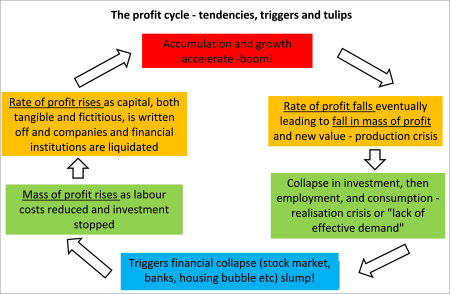
Unfortunately I have to say I side with Michael Roberts against Harvey in the fundamentals of Marx's dynamical thinking, summed up in the reproduction schemes and Marx’s law of the tendency of the rate of profit to fall (LTRPF).

Update: Vol 2 chapters 5 and 6, where Marx reverts to coherent narrative, are considerably more interesting. I'm learning quite a bit and hoping for a continuing trend here.

---

BBC political editor Laura Kuenssberg has an insightful piece on the BBC website today about the inner decay of the present Tory government.
"The fuss around Boris Johnson is the symptom not the cause. The problem that is increasingly on people's minds at this grisly conference is that the Tories might be only at the start of a decline, which becomes impossible to escape.

"One former minister says, "there is a smell of decay", another, that it is "hopeless, but we are resigned to the nightmare". Cabinet ministers fret that Theresa May simply doesn't have the ideas or imagination to reboot either her leadership or their party. ...

"One of her colleagues says "how did she blow the party up in 12 months?", lamenting how her premiership has paralleled Gordon Brown, who after years of hoping to get to Downing Street arrived there with little to say, bewildered by the sudden challenge of the top job. Another says she looks "bent and broken". ...

"The fear here is not really that Boris Johnson is grabbing all the attention, it's that this party could be dying inside, and it finds itself with a leader who might struggle to stop the downward spiral."
Time to finish up here and go listen to Boris.

---

Comment 

Performance-wise, it was a pretty decent speech and the conference standing ovation looked genuine. The message - economically-globalist, politically-liberal, strategically British-Empire-lite - was tailored to appeal to smaller capitalists operating within the national market, those companies aligned with US and other non-EU markets and the culturally-nationalist fraction of the more traditional working class.

Its tragedy: the Boris vision is not aligned with the interests of the dominant financial and industrial wings of the British ruling class, which heavily value economic integration within the European Union. It also fails for the idealistic middle-class young, those who buy into euro-ideology and fill the ranks of Momentum.

So yet again we've seen the deep fissure within the British elite and in the mass of the population, as refracted through the Tory party. Boris, despite his charisma, does not bridge the divide. No-one can.

Tory party dynamics, going forward, should be fascinating.

Friday, September 29, 2017

A Roadmap of Crisis Theories

This post could also be entitled, 'The Gurus of Contemporary Marxist Theory', interpreting 'Marxist' rather broadly.

A year ago, when I started to pay more attention to economics, I was clueless as to where to go for high-quality Marxist analysis (even at the start of my search I was not in any doubt that neoclassical economics - in its denial of the class structure of capitalism - was intellectually bankrupt).

I knew about Ernest Mandel of course, but who else was worth reading, and what were the key issues in contemporary debates?

On the latter question I soon discovered that the most important issue was, of course, the Marxist theory of crisis.

From Michael Roberts
---

On page 15 of Michael Roberts's book, "The Long Depression", he shows a variant of the roadmap below from the San Francisco Bay Area Marxist Study Group (click on image to make larger and more legible).


San Francisco Bay Area Marxist Study Group via Nick Johnson


Incidentally I'm comfortable with Michael Roberts's take on the world because, like him, I'm hard left on the diagram above all the way down 😎.

Roberts is also not that tribal, seeking to understand rather than denounce. This is just as well as he secretly seems as convinced as I am that capitalism has at least another century before the imminence of total automation make production solely for the valorisation of capital essentially impossible.

This view of capitalism's likely future rather depends upon Marx's law of the ‘tendency of the rate of profit to fall’ (TRPF) applying over the long-term. I'm good with that as an empirical reality, increasing automation being the causal mechanism.

---

So who are the top gurus of Marxist thinking today? I've already mentioned Michael Roberts who has a prolific blog. I should also mention Sam Williams at "A Critique of Crisis Theory".

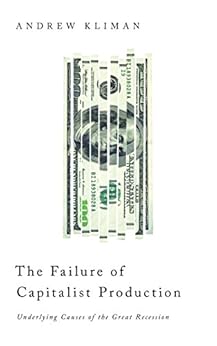
Moving now to the superstars, we have Dave Harvey, Michael Heinrich and Anwar Shaikh. I have bought books authored by all three. I'd also mention Andrew Kliman, whose book (below) I've just acquired.

Amazon link

While not a Marxist, radical Keynesian Steve Keen gets an honourable mention for bearing the wrath and fury of the entire neoclassical establishment with courage and fortitude. Roberts writes about him here.

So I'm very much a work-in-progress at the moment, struggling hard to get an intuitive view of the dynamics of capitalist economies at all time scales (Michael Roberts's views on cycles are persuasive).

In the background Marx's own writings, Capital Vols 2, 3 and 4 are still on the stack.