Showing posts with label coronavirus. Show all posts

Thursday, March 19, 2020

COVID-19 Notes: March 19th 2020

 
Amazon link

Sun Tzu's 'Art of War' is quite a short text dating from the Late Spring and Autumn Period (roughly 5th century BC). It mostly describes how to fight guerrilla wars of deception against a numerically-stronger enemy in various terrains. The advice is functional and callous, describing for example the great utility of 'disposable spies' for feeding false information to the enemy (they will of course be killed once their treachery is unmasked) and noting the improved resolve of armies manoeuvered onto 'fatal terrain' deep in enemy territory, where they will fight or die.

The reason I read the book was more for the copious introduction and scene-setting - Chinese history prior to and during the Warring States period (475 BC). Also the subsequent understanding of The Art of War in the empires which followed. What I learned was that the Emperor, the Son of Heaven, had a Mandate of Heaven. As Wikipedia explains:
"According to this belief, Heaven (天, Tian) — which embodies the natural order and will of the universe — bestows the mandate on a just ruler of China, the "Son of Heaven" of the "Celestial Empire". If a ruler was overthrown, this was interpreted as an indication that the ruler was unworthy, and had lost the mandate. It was also a common belief that natural disasters such as famine and flood were divine retributions bearing signs of Heaven's displeasure with the ruler, so there would often be revolts following major disasters as the people saw these calamities as signs that the Mandate of Heaven had been withdrawn."
In this light it is not hard to see why the Chinese Communist Party and State used such severe methods to drop R0 to around 0.3 and squelch the epidemic. It wasn't humanitarian concerns - it was their response to an existential test of their right to rule.
Amazon link

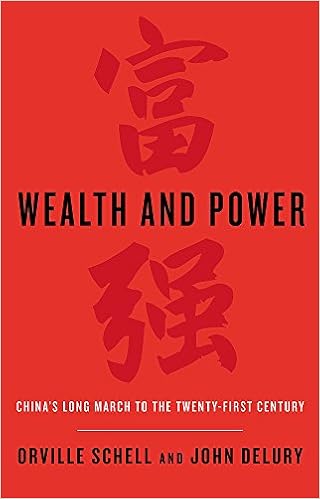
I'm currently reading this: an analysis of recent Chinese history (humiliation and shame at the hands of Western and Japanese imperialists - only reversed in the last few decades). The story is told through the biographies of key Chinese intellectuals and leaders. Basically China had to make a major cultural shift from the dead-weight of an agrarian-Confucianism (rigid, static and statist) to a form and ideology of governance which would permit the development of a dominant capitalism. It's ironic that only a Stalinist version of Marxist-Leninism could prove strong enough to force open those doors. The Chinese now feel sufficiently secure to readmit a new, legitimising neo-Confucianism.

The chapters itemise a chronicle of defeat as all obvious strategies of modernisation were attempted only to fail, leading to further predations by China's vulure-enemies. You can see why they hate the Japanese and despise the West: they have every reason to based on recent history.

---

I remain sceptical about European attempts to push R0 below 1. Despite Greg Cochran's advocacy (which I linked to in a previous post). I think people have no idea just how very drastic, very police-stateish, were the methods employed in East Asia.

In Italy, by contrast, the lockdown measures sound suitably draconian. However, mobile phone records shows widespread non-compliance (45% of Italians are wandering around outside their homes), the case-numbers keep rising and in the anarchic south the infection has barely begun. All this talk of Italy soon reaching a peak is so much hot air.

In the UK - more compliant but more densely populated - they will certainly get R0 reduced but I'm doubtful if the epidemic can be put into reverse. I'm not even sure that's the real intention. As people have pointed out, the Imperial paper which everyone was citing assumed that treatment resources would stay flatlined. But of course they will quickly ramp up over the next two months or so, compensating for our inability to actually lock down enough people.

Playing with exponentials is a risky business, like trying to hold a slippery fish. This could still all go pear-shaped (if the pears are >1 exponential).

---

We ourselves are hunkered down and will pop out to Waitrose this evening when numbers are predicted by Google to be low. Grab some milk to freeze. Don't think there are many infected in Wells yet so it's still the phony war. As Covid-19 is a disease of the elite, I suggested we might shop at Morrisons instead, but Clare noticed their toilets were pretty unhygienic a while ago, so that's ruled out.

Meanwhile, life goes on...
---

Friday, March 06, 2020

COVID-19: UK predictions: now-June 2020

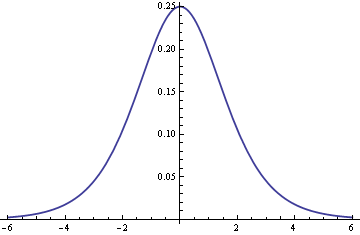
The logistic distribution from John Cook's excellent overview

The derivative of the logistics curve (the cumulative number of cases in an epidemic) is the logistic distribution, which looks very much like a scaled normal distribution as John Cook explains.

His graph above shows you the number of active cases as time advances: starting low, rising to an epidemic peak and then dying away. [As I write we are at -3.5σ = -5.6].

The standard deviation to use σ = 1.6 according to John Cook's article.

The Times today carries a report which allows a prediction of the course of the epidemic in the UK. This is what the Chief Medical Officer had to say:

"Professor Whitty said that the peak of an outbreak was expected in about two months, with 50 per cent of cases over a three-week period and 95 per cent over a nine-week period."

Mapping this on to the normal distribution gives us a standard deviation of two and a quarter weeks (σ =2.29, call it 2.25).

Fifty percent of cases would be within two thirds of a standard deviation from the central point, which gives 2 * (2/3) * (2.25) =  3 weeks. 

So the peak of cases would be two months time, early May: we are currently about three and a half standard deviations out (7.9 weeks).

Five weeks after the peak the epidemic should have burned itself out in the UK: mid-June.

So to summarise for the UK:
  1. Crisis (50%):  end-April to first half of May (3 weeks)
  2. Peak:               first week of May
  3. Burn-out:        mid-June.
 The power of stats.
---

Tuesday, February 25, 2020

COVID-19 dynamics: simple coronavirus models


1. From deaths to current number of infections

The deaths reported in a country are usually the cumulative deaths so far. By the time someone has died though (they caught the infection a while ago) the infection has since increased. Here's a model which takes both these facts into account.

Assumptions

(1) lethality rate is 2%;
(2) average time to die after infection is one week (conservative assumption);
(3) numbers doubling time is 7 days (during the early, exponential phase of the infection).

Note that in a sequence which doubles, the latest figure is half the total so far. Thus 1, 2, 4, 8, 16. The current figure, sixteen, is approximately half the total of thirty one.

Example:a country which reports 16 deaths so far - also [n deaths].
1. Deaths (overall) = 16  [n]

2. Deaths in the latest iteration = 8  [n/2]
   - assume the 8 people caught it 7 days ago=1 iteration.

3. Infected cases 7 days ago = 50 * number now dead @ 2% lethality
    infected = 50 * 8 = 400   [25n]

5. Number infected now (twice as many) = 800  [50n].

So when you hear on the news that so many people are reported dead in some country, multiply by 50 to get the current number of cases.
---

2. The pattern of number of cases

If the infection was spreading in a closely-coupled population with no obvious barriers then the number of cases would increase as the logistics curve at the top of the page above. But countries are engaged in lockdown. This means that the logistics curve will apply inside the quarantine area - perhaps with a smaller R0 if people self-quarantine at home - but that spread outside will be impeded.

However, this is a hard virus to lockdown completely given asymptomatic transmission. So it's quite likely that - with a delay - new cities and regions will be infected ... and then locked down.

This gives a waviness modulating the global logistics curve. The global curve is a series of mini-logistics-curves glued together. It makes the overall pandemic a more protracted affair, which obviously helps in terms of public health logistics, but it's unlikely to stop the virus in its tracks.

It also creates periodic illusions that 'the infection is levelling off'.

---

3. The case of Iran

Iran's Shia theocracy is culturally not like the West, or indeed China. I wonder whether their current policy is not so much incompetence as a simple resignation to letting the virus just run to completion.

The reactionary theocrats running Iran may believe that their middle-class opponents are more likely to suffer as a consequences of the pandemic (the conservative rural multitudes will just soak it up) plus they are mostly surrounded by enemies: Israel, Arabs and Sunnis. What's not to like about being a country-level superspreader?

This would be interesting if true: Covid-19 as implicit biological warfare.

Tuesday, February 11, 2020

COVID-19: should we be worried? Yes

Dr Neil Ferguson of Imperial college seems the go-to guy:
"Our estimates – while subject to much uncertainty due to the limited data currently available – suggest that the impact of the unfolding epidemic may be comparable to the major influenza pandemics of the 20th century,” he said. [Daily Telegraph].
I heard him on PM yesterday evening. He reckons 60-70% of the UK population will eventually get it, of whom 1% will die; big error bars for the next three weeks. Given asymptomatic transmission with R0 2-3 it can't be kept out or contained within the UK over any extended period. Especially when it goes exponential in countries outside of China.

From Le Monde: (Practise your French) :
"selon une modélisation, un groupe de trois Etats se situe dans le trio de tête des pays les plus menacés par une arrivée du virus : l’Egypte, l’Algérie et l’Afrique du Sud. Ils sont suivis d’un second groupe constitué, lui, du Nigeria et de l’Ethiopie."
Lots of links between China and Africa. Public health screening and treatment not brilliant in the latter.

UK risks: (i) breakdowns in the supply chain May/June when the pandemic really takes hold here; (ii) personal incapacity and/or need to self-quarantine.

What can you do? 

- Shop now for cans of soup, long-life milk, dried fruits and cereals, sanitary items; face-masks (they won't look so ridiculous soon).

- Check out your camping cooker.

- Petrol in the car - don't forget the car can charge mobile phones.

Buy stuff you'll be able to consume after the pandemic so you're not wasting money.

---

The Mormons famously have a survivalist level of supplies, c. six months. But 2-4 weeks should do it - you can always go half-rations.

I always think the best time to panic-buy is before other people realise they have to.

Note

Best estimate of case doubling time at present seems to be 7 days. If, by the end of February, there were 16 invisible cases in the UK, time to one million is (sixteen doublings) = 16 weeks = four months.

It won't seem a major problem here before Easter is my prediction (note big error bars!).

---

Update (13/2/20): I today cancelled our June holiday in Crete. The call-centre operative seemed unsurprised when I mentioned COVID-19. We have, however, been hit by a stinging cancellation fee, the entire deposit, 20% of the overall cost.

I'm thinking this summer is going to be disastrous for the holiday companies and for travel insurers.

---

Update: If you have a VPN into the UK it is educational to watch this:
"Hannah Fry leads a nationwide experiment to help plan for the next deadly flu pandemic, which could happen at any time. How many will it kill? What can we do about it?"
The BBC/Cambridge model parameters are basically spot-on for Covid-19 (R0=1.8; lethality=2%).

---

Update (14/2/20): My brother wrote to me and observed:
"I would take issue with one of your precautions: Don’t waste time and (increasingly large amounts of) money on surgical (or most other types of) masks. Even the better ones have an interweave gap some three times larger than the virus and invariably get damp, increasing the stickability.

Leave your eyes, nose and mouth open to the world, just don’t touch them without washing/gelling hands (as frequently as possible)."
---

Thursday, January 23, 2020

Modelling China's new coronavirus

From the BBC.
"Lockdown measures are increasing across China's Hubei province to try to control the spread of a new virus that has left 17 people dead. Wuhan, Hubei's capital of 11 million people where the virus first emerged, has no trains or planes in or out. At least four other provincial cities are seeing clampdowns on transport.

"There are more than 500 confirmed cases of the virus, which has spread abroad, with Singapore, Saudi Arabia and Vietnam the latest affected."
Imagine a two-by-two matrix: one dimension is R0, the basic reproduction number; the other dimension is the survival function showing lethality. Only the square with R0 >> 1 and high lethality is a source of real concern. In that case the epidemic spreads fast and kills most of the victims.

One day we'll be able to model viruses and their mutation trees to determine whether there is an adjacent genotype to the day-zero virus which is much more dangerous. Today we have no idea - projections are just a matter of luck.

The current outbreak is rather benign so far.
"Most of the 17 victims were elderly and suffered from other chronic diseases including Parkinson's disease and diabetes."
However, there is clearly a selective advantage to any viral-mutation which more aggressively hijacks the host's body to make more virus copies - provided it doesn't kill the host too quickly. This virus currently has a long asymptomatic period, so it seems there is space for it to transition to a more lethal variant while maintaining transmission potency. We shall see.

Wash your hands - the face-masks are far from a panacea!