Showing posts with label Taoism. Show all posts

Tuesday, September 16, 2025

Taoism: 'Woke' in the Warring States Period


Taoism and the Overproduction of Elites: A Prehistory of Woke

Taoism is often presented as a kind of mystical naturalism: a contemplative retreat from the world into the ineffable flow of Dao, the Way. At its core, it seems to reject ambition, planning, and even language itself. The true sage, we are told, "does nothing—and yet everything is done." It is the philosophy of the mountain recluse, the poet-hermit, the fisherman-philosopher.

But this metaphysical hush, from a historical materialist point of view, is not merely a spiritual choice. It is an ideological response to very specific social conditions: the breakdown and over-centralisation of the imperial Chinese state during the Warring States period (475–221 BCE), and the rise of a large class of educated men with nowhere to go. In other words, Taoism is what happens when too many elites chase too few elite roles.

If that sounds familiar, it should.

The Historical Structure: The Asiatic Mode of Production

China in the late first millennium BCE was a bureaucratic civilisation par excellence. Its centralised states depended on irrigation, taxation, corvée labour and local village collectivism. This is what Marx once called the "Asiatic mode of production"—a model in which the state sits like a parasitic spider over a communal peasantry, extracting surplus through coercive administration (rather than capitalist accumulation).

In this setting, Confucianism became the house ideology of the bureaucratic class: a system of social ethics justifying hierarchy, filial piety, and loyal service to the emperor. It was a philosophy built for mandarins.

But by the time Taoism emerged, the system was in chaos. Competing states devoured one another. The Confucian promise of harmony through order rang hollow. Meanwhile, more and more literate young men, educated in the classics, found themselves unable to gain entry into an overstretched and corrupt bureaucracy. The elite credential pipeline was glutted.

And so a new ideology emerged, not from the peasants below, but from the disappointed aspirants of the elite: Taoism.

The Taoist Move: Withdrawal as Critique

The Tao Te Ching is not an activist tract. It is a manual for surviving a world gone mad by refusing to engage on its terms. Don't compete. Don’t strive. Don’t try to manage the empire. The more you act, the more you disrupt the natural order. The true sage flows with the current. He is indifferent to rank, untouched by politics, unmoved by moral certainties.

This is not reactionary conservatism, nor revolutionary fervour. It is what we might call structural quietism—a metaphysics forged in the psychic pressure cooker of elite overproduction. If there are no jobs at court, and the system is corrupt and collapsing, then the only rational move is to define success as withdrawal.

The Taoist sage is, in a sense, a dropout with cosmic justification.

The Modern Echo: Progressive Ideology and the Credentialled Left

Peter Turchin has coined a useful term for the modern West’s malaise: elite overproduction. Our societies churn out vast numbers of educated young people with degrees, ambition, and political awareness—but without commensurate openings in the professional-managerial class. The result? Frustration, status anxiety, and the invention of new moral frameworks to explain exclusion.

Contemporary progressive ideology—what critics call "wokeness"—is not so different from ancient Taoism in structural origin. It is the product of a class with cultural capital but no route to power. Like the Taoists, today’s frustrated aspirants are not able to seize the existing structures; so they redefine them. They claim moral authority not through office, but through identity. Oppression becomes a kind of inverted credential.

Where Taoism says "do nothing," progressivism says "speak your truth." But both are responses to blocked advancement. Taoism universalises marginalisation as a cosmic principle. Woke politics moralises it as a structural injustice. One withdraws to the mountain. The other tweets furiously from Brooklyn.

Cosmic Absolutes and Sacred Abstractions

Both Taoism and progressivism share a tendency to reify principle in response to social instability. The Dao becomes an ungraspable metaphysical constant, beyond rational critique, the source of all true order. Likewise, the modern ideologue invokes justice, equity, lived experience—terms which function not descriptively, but sacrally. To question them is heresy.

This is not a coincidence. When the real levers of power are inaccessible, meaning retreats into the symbolic. The state cannot be controlled, but the narrative can be rescripted. The institution resists reform, but ideology is more malleable.

The Ideology of the Disappointed

Taoism was never the philosophy of peasants. It was the philosophy of ex-bureaucrats, failed courtiers, and hermit-scholars who found the system both morally compromised and structurally closed.

Today’s cultural left is not the voice of the truly dispossessed; it is the ideology of the overproduced intellectual class—educated, moralising, disillusioned, and increasingly metaphysical.

This stratum projects its own sense of victimhood onto the truly dispossessed, then lobbies for remunerative jobs in the 'benevolent' part of the state apparatus, proposing to occupy positions of power and influence in order to 'fix things'.

In both cases, the system bred more ideological producers than it could absorb. And in both cases, those producers turned their disillusionment into new systems of value that rejected the old order - but lacked the power to overthrow it. So instead, they did something subtler: they redefined what power meant.

Conclusion: Rhyme, Not Repetition

History does not repeat, but it rhymes. The Taoist recluse and the woke activist share little in lifestyle or tone. But both are ideological children of blocked aspiration. One decoupled from imperial collapse with serene detachment. The other reacts to neoliberal sclerosis with permanent cultural revolution.

Neither can fix the state; both can explain its failures and make a kind of virtue out of exclusion. And in that lies their ideological momentum and persistence.

Sunday, June 15, 2025

A Conversation about John Gray

Amazon

Nigel: "He has written many books but if each book were a circle in a Venn diagram one senses there would be a high degree of overlap?"


ChatGPT: Yes, exactly. Reading John Gray's oeuvre is a bit like being trapped in a philosophical Möbius strip – no matter where you enter, you’re soon back at the same bleak vista, albeit with different scenery. Each of his books is a variation on a theme: the illusion of human exceptionalism, the failure of secular utopianism, and the absurdity of progress.

You could imagine the Venn diagram as a dense cluster of nearly concentric circles – not entirely overlapping, but close enough to feel like iterations of the same insight, refracted through different cultural anxieties. Here's how that plays out:

- Straw Dogs is the primal scream – a raw, aphoristic assault on humanism.

- Black Mass takes that scream into the political realm: showing how utopias become gulags.

- The Silence of Animals tries to get past the scream: what might peace look like if we give up meaning altogether?

- Seven Types of Atheism then categorises the delusions: even atheism, he says, is usually just religion in drag.

- Feline Philosophy purrs the same theme with whiskers: cats live without purpose, and so should we.

It’s not repetition in a lazy sense, though – it’s more like theme and variation in a minimalist symphony. Think Philip Glass, but with pessimism instead of piano.

So yes, the Venn diagram would have an unnervingly tight core. But that’s part of his project – to hammer at the same delusion until the reader’s defences crack and they see, with terrible clarity, that there is no grand narrative, no final redemption, just a procession of clever animals trying to believe they’re angels.


Nigel: "Do you think Gray can veer into contemporary moralising? He obsesses about climate change, for example,without showing a very nuanced understanding of the actual phenomenon and its most likely economic and social consequences (probably not enormous, maybe even net positive). He's simplistic in his diatribe against 'universal state surveillance' and so on."


ChatGPT: Yes – absolutely. For all his declared disdain for moralising and illusions of control, Gray is not immune to his own species of sermonising. There’s a paradox at the heart of his work: he preaches against preaching, and in doing so becomes a kind of apocalyptic moralist himself – a secular Jeremiah denouncing the follies of the tribe.

His treatment of climate change is a good example. He wields it not as a complex policy challenge or an empirical debate, but as a kind of eschatological proof of human hubris – a final exhibit in his long prosecution of Homo sapiens as a species too clever to survive. Fair enough, rhetorically. But when you prod at the details – emissions modelling, economic trade-offs, adaptive capacities – Gray is curiously incurious. He seems uninterested in distinctions between, say, RCP 2.6 and 8.5, or between Bangladesh and Berlin.

The same goes for surveillance and AI. His critiques often read as instinctive reactions – a reflexive recoil from the world of digitised modernity, couched in quasi-Orwellian terms. But again, he shows little interest in institutional design, legal nuance, or empirical boundaries between privacy erosion and genuine repression. The surveillance state, for Gray, is not a spectrum of practices and technologies; it’s a monolith – and one that neatly confirms his prior worldview.

This is where his work veers into its own form of dogma. For a writer who claims to reject systems, Gray can be oddly systemic in his pessimism: everything is always getting worse, and always for the same reasons.

To be fair, some of this is literary strategy: he’s writing polemic, not policy. He’s painting in charcoal, not watercolour. But you're right – there’s a lack of granularity, a refusal to engage with complexities that don’t fit the declinist template.

So yes, he sometimes becomes the thing he claims to despise: a moralist in secular vestments, shaking his head at the sins of progress, railing against shadows, not always caring if they are real.


Nigel: "What do you think is his core insight?

I think it's some combination of human life as an end in itself and not a means in some overarching utopian or dystopian plan, coupled with a map-territory distinction between theorisation of conscience experience and the lived experience itself - as each of us experiences it.

What do you think?"


ChatGPT: His core insight, when stripped of the rhetoric and spleen, is not just that progress is a myth or that humans are deluded animals – those are supporting arguments. The real insight is both existential and phenomenological:

1. Human life is not a means to any greater end – political, historical, spiritual, or technological.

Gray's rejection of utopias – religious or secular – stems from a deep intuition that to instrumentalise human life (in the name of socialism, liberalism, transhumanism, whatever) is to repeat the ancient sacrificial logic of all bad religion. He is, in this sense, an anti-Hegelian: history does not culminate, it merely happens. The modern myth is that we are becoming something better. Gray’s rejoinder is: no, we’re not becoming anything. We just are. Like cats.

This makes him closer to Aristotle than he lets on. Life is a telos unto itself – the purpose is to live it, not to reshape it to fit a blueprint. But unlike Aristotle, there is no virtue ethic here, no eudaimonia. There’s just being. And maybe a nap.

2. Theories are not experience. Thinking about living is not the same as living.

This is where your map-territory distinction is spot on. Gray sees ideologies – whether Marxist, neoliberal, religious, or scientific – as maps pretending to be the terrain. They promise an explanation of suffering, death, and desire – and they fail, because those things are not problems but features of lived reality.

He borrows here from Schopenhauer and the mystics, but also from a kind of philosophical quietism: the most authentic life is not the one that’s best explained, but the one that’s most attentively experienced. Hence his admiration for animals, and especially cats – they don't need a worldview. They just are.

In this sense, Gray’s project is not nihilistic, despite appearances. It’s a kind of negative ethics: stop trying to make the world conform to your abstractions. Stop sacrificing the present for an imagined future. Be sceptical of any doctrine that requires someone else’s suffering to achieve its perfection. And stop pretending that understanding the rules of the game will save you from its pain.

So yes: Gray’s core insight is that life should not be subordinate to ideology, and thinking about life is not the same as being alive. It’s a sort of disenchanted Zen, written by a man who distrusts monks.


Nigel: "It's a philosophy of life, not a political program. But suppose you buy into it completely, what are the public policy implications?

Perhaps he's more Daoist than he wishes. It was always the Confucians who did the heavy lifting to make civilisation work. And being John Gray kind of depends on civilisation. Ironic."


ChatGPT: Yes! That’s the paradox at the heart of the Grayian worldview: it’s a philosophy of detachment articulated from within a highly literate, hyper-civilised, and well-plumbed society. He lives in a world built by Confucians—by technocrats, bureaucrats, and idealists, not by feral cats and Wittgensteinian mystics. His Daoist shrug, his quietism, is only plausible because others are sweating the details he scorns.

You're quite right to observe that Gray offers no political program—indeed, he seems to find the very notion of a program suspect. And yet: he writes books, speaks to Western publics, engages in civic debate. That is not the behaviour of someone truly at peace with the void. It’s the behaviour of someone who relies on the infrastructure of reasoned order while theatrically rejecting its premises.

As for public policy implications, let’s indulge the thought experiment. Suppose we take Gray's view as gospel: no progress, no grand arc, no salvation through politics. What follows?

1. Minimalism in Government Ambition

If humans are essentially unchangeable, and if utopias invariably become tyrannies, then the first rule of public policy is: do less, and do it modestly. No grand crusades, no universal liberation projects. Governance becomes a matter of damage control, not redemption. Bureaucrats, not visionaries.

This would arguably endorse Burkean conservatism—though Gray himself, having seen where Victorian “civilisation” led, distrusts that too.

2. Environmental Adaptation, Not Salvation

On climate: Gray’s view might suggest not utopian green revolutions or hairshirt eco-puritanism, but a pragmatic, almost fatalistic adaptation strategy. Not “save the planet,” but “try not to die stupidly.” Build seawalls, manage migration, keep the lights on. Don’t pretend we’re going to fix nature.

3. Pluralism Without Optimism

His suspicion of universalism implies a policy preference for pluralism—not because all values are equal, but because trying to impose one set leads to blood. But this isn’t the sunny liberal pluralism of Isaiah Berlin; it’s more like Hobbes meets Daoism: keep people from killing each other, and don’t expect anyone to become enlightened.

4. No Social Engineering

Education, welfare, even health policy—if viewed through Gray’s lens—should focus on alleviating suffering, not perfecting society. That’s a Buddhist move: compassion without illusion. Teach kids to read, not to be good global citizens. Feed people, don’t fix them.

---

But as you rightly point out, this is all somewhat parasitic on the very civilisational apparatus Gray affects to despise. Being John Gray depends on civilised life: on publishers, universities, editors, antibiotics, sewage systems, and pension schemes. He lives in the House of Reason, while loudly criticising the architects for dreaming too big.

Which is why I think you're right to say he's more Daoist than he admits. The true Daoist sage wouldn't publish seven books to tell people to stop publishing books. He would simply... go and watch the river. Gray, by contrast, writes like a man who's tried the river - and found it too slow.


Monday, July 17, 2023

The T'ai Chi Sword Form

Part of the Cheng Man-ch'ing sword form

My last post was about stopping karate training. The chronic sciatica which prompted this is still with me, five weeks later, but I sense an improving trend.

The Cheng Man-ch'ing T'ai Chi form (empty handed, 24 postures) and the weapon form shown above are not a health problem however. The movements are slow, symmetrical and balanced without powerful impulsive strikes, turns and kicks. 

Puting the Daoist paradigm to one side, from a purely functional point of view T'ai Chi 'katas' are training balance, coordination, kinaesthetic sense, relaxation and, of course, a meditative psychological state. Such benefits come only when the sequences are as natural as driving, after many years of practice: I have been working on the sword form for six months.

Wednesday, May 18, 2022

The owl spreads its wings


Image by Dawn Whitney-Hall

Hegel wrote that the owl of Minerva takes wing at dusk. Any wisdom we might have (philosophy, self-knowledge) postdates the raw events of life. We experience - and only then the possibility of reflection and understanding.

And so in our last decades we draw a balance sheet. Our work in the world is mostly done: others will move the world forward: build families or utopias or theories of reality.

What is left to us is character itself: the perfection of self before we vanish like fleeting dew before the gathering light of a new day without us.

---

The psychotherapy community talks about the balanced type development of maturity; the Taoists talk about harmony and following the Way.

I agree with both. 

As 'stuff' which is conscious, we should do everything in our power to get this business of 'being' right. Not let ourselves down; not be marked down by those who interact with us.

---

What does failure look like?

A memory at which I cringe. Twenty years ago a discussion with a senior UK television executive. The consultancy I worked for was intending to do a project of some kind with him. I was under-briefed on the TV industry, an omission of which I was starkly aware.

With a much better prepared, but more junior colleague I met with him at a café in Paddington station. We talked and I have to say I monopolised the conversation, bombarding him with urgent questions as my ignorance and insecurity strove to get a handle on his world and the issues confronting him. He visibly shrank back under this remorseless hammering. My embarrassed friend interrupted me: "Why are you asking our client? I know all about this…"

I ignored him.

I never had any contact with that executive again. The project did not go ahead.

Another client described me once, frankly: "You make me feel like a butterfly, trapped by a pin, while you dissect me."

---

What do the advocates of mature type development and of the Tao tell us?

My MBTI is INTP (P shading to J). In the Jungian telling, I normally present an open, ideas-oriented face to the world (secondary, extraverted N) while my introverted analytic self tries to synthesise the logic of it (dominant introverted T)

But when I'm stressed and off-balance my subconscious anxieties take the driving seat. To quote a personality website:

"The dominant function of the INTP is their Ti, when they are in their shadow they become more focused on Te. When the INTP attempts to dominantly use this function it can cause them to be more direct, and even a bit aggressive in their attempts to get things done."

So that was me when I felt out of my depth. If only I had had the maturity and self-insight to recognise what was going wrong - and to stay balanced and calm!

But when one is 'trapped' in the constraints of career, there is little space for the cultivation of the self. Growing up remains a postponed project of one's later years. Better late than never.

---

Just as traditional Chinese medicine is a phenomenological approximation to scientific biology, so I used to imagine the Tao (The Way) as a pre-scientific cosmology. But of course it isn't.

The precepts of Taoism - the flow of water, the fluent motions of animals such as cats - prioritise categories of harmony which are at root psychological archetypes.

One is reminded of athletes talking of being in the zone, and going with the flow.

It is the battering of threats, physical and social, which judder us out of the flow, which force a conflict between id and superego which throws the ego into anguished incompetence. Hell is other people with destabilising agendas, threatening situations.

Yet there are no 'situations in themselves'; there are only our attitudes to situations: the framing, the paradigm in which we comprehend and emotionally react to them. And our reactions are our own - ours to frame. We have choices if we are self-aware enough. We are not condemned to be a slave to the shadow. 

I take Taoism to be a framework for self-preparation for just that. To consciously self-monitor and find a harmonious, balanced, mature response to events. All of them. Not to be possessed by one's Inferior function. I believe they call it Mindfulness.

How?

Ritualised forms or katas such as those of T'ai Chi or Qigong direct the mind-body complex towards self-confidence and calm. That which is attained during practice may spill over into general life. Sometimes all you need is a catalyst.

So I think I see a goal (I am aware that the real goal is to have no goal).

Grow up finally. Be wiser. Finish the work.

May 2022. 

Wednesday, September 29, 2021

The Tao and the Truth

A physicist contemplates ethics and death

1.

They lay companionably side by side in the oversized bed, sunk into hollows shaped by long occupancy.

They held hands in the dark. It was not yet midnight. Drawn blinds obscured the yellow-orange street-light. They were both on their backs, staring up at the blackness, the ceiling vanished in the gloom.

“One day it will be just one of us lying here alone,” he said, “with a vacancy where you or I used to lie.”

She made a little sound of exasperation: “I never think about that.”

“I doubt it will be many years now.”

“Probably the other will die after a few weeks,” she said, “It often happens that way.”

“Yes, through grief, stress and loneliness: the collapse of the immune system. It's not a pleasant way to go.”

“Oh.”

2.

The rain came in this afternoon, as predicted. Looking out the kitchen window he sees the trees as through a misty veil, as if a painter stroked a watery brush down a backdrop.

Nothing he is seeing is mysterious to him. Given boundary conditions here and the laws of physics, he thinks, this is just how matter behaves. Really, there are no surprises. Perhaps that was Keats’ complaint.

3.

For years he has been trying to understand the Tao Te Ching, Lao Tzu's prescription for right-living. Harmony through conscious alignment with the Way.

The Way - that tantalising reification of something obscure yet important.

He thinks of the stories we tell ourselves, tell our self - that devious phantasm of our cortex. Narratives of possible futures mediating Id and Superego.  Temptations vie with duties, competing to lure the Ego.

He rejects free will of course. Physics, in refuting it, makes the issue problematic, not axiomatic.

He’s pleased about that.

4.

To be sophisticated as regards a well-lived life (and Lao Tzu is surely up there, with his minimal metaphysical baggage) surely we're buttressing the better angels of our nature in that endless dispute?

Think of it as a gift from our present to our future life.

5.

He lies in the darkness; she's asleep. He hears the soft harmony of her breathing.

There is no time-past and time-future. Everything just exists. Architected, though, with that titanic entropy-gradient - the one that orients the future from the past. That thirteen-billion-year car-crash dividing prediction from memory. (But is the past really so fixed? He knows that physics isn’t so sure).

He thinks: our subconscious, our collective unconsciousness, wants us to thrive in this universe. Don't ask for some big, deep reason: there isn't one. It comes with the design. Our DNA coded us a big brain: it didn't know how to do the mission. We're not insects.

Lao Tzu's message is the most prosocial, the least magical and the surest blueprint for some harmonious, galactic future our true selves desire. But Philosophical Taoism can't get real purchase in a class society, it needs egalitarianism.

Two and a half thousand years. No-one properly comprehends Lao Tzu’s great work. Its time has not yet come; not till humankind is refashioned to the collective Sage.

6.

He will never be able to explain this to her. 

He hopes she goes first. That it is painless... and sudden... and unforeseen.

Let him be the one to shoulder the aftermath.

He needs to believe it all makes sense.

Perhaps it does.

Tuesday, August 07, 2018

Your personality chooses your religion (humour)


The "New Atheists" (Dawkins et al) have a down on religion because -- it isn't true.

Duh! of course no religion can survive the laws of physics .. which explain everything. But religion does more for us than that.
  • It provides a moral framework for our lives as social beings
  • It provides some reassurance in the face of our own mortality
  • Adherence advertises to ourselves and others a commitment to moral behaviour.
These are all things worth having. Yet it's hard to commit to the difficult path of self-discipline and self-denial except under supernatural duress. A candidate religion would be preferable to the extent it was at least somewhat believable.

And then there is the style of the religion. Can one approach it in an intellectually austere way - as an introvert? Or does one have to sway, dance, sing and play the guitar?

Finally  there's not much chance of impressing others with your own commitment to virtue if you advertise your adherence to a faith that no-one has ever heard of, or which is a laughing stock. Church of Scientology, anyone?

So faced with these constraints, I turned to AI and cranked up my Prolog theorem-prover again (last used in car selection).

/* Choosing your religion by the four psychological temperaments (SP, SJ, NF, NT)

Classify religions (faiths) on the following dimensions:
- intensity [ascetic, calm, emotional, shrill]
- plausibility [low, medium]
- recognition amongst the UK public [low, medium]

candidates: evangelical, anglican, wahhabism, sufism, hinduism, buddhism, philosophical_taoism, sjw.
*/

religion(R) :- member(R, [evangelical, anglican, wahhabism, sufism, hinduism, buddhism, philosophical_taoism, sjw]).

intensity(evangelical, emotional).
intensity(anglican, calm).
intensity(wahhabism, emotional).
intensity(sufism, ascetic).
intensity(hinduism, emotional).
intensity(buddhism, calm).
intensity(philosophical_taoism, ascetic).
intensity(sjw, shrill).

plausibility(R, low) :- member(R, [evangelical, anglican, wahhabism, sufism, hinduism]).
plausibility(R, medium) :- member(R, [buddhism, philosophical_taoism, sjw]).

recognition(R, low)     :- member(R, [buddhism, philosophical_taoism, wahhabism, sufism]).
recognition(R, medium)  :- member(R, [evangelical, anglican,  hinduism, sjw]).

choose(Religion, sp) :- intensity(Religion, emotional).
choose(Religion, sj) :- intensity(Religion, calm), recognition(Religion, medium).
choose(Religion, nf) :- intensity(Religion, X), X \= ascetic.
choose(Religion, nt) :- intensity(Religion, ascetic), plausibility(Religion, medium).

?- choose(Religion, sp).
Religion = evangelical ;
Religion = wahhabism ;
Religion = hinduism.
?- choose(Religion, sj).
Religion = anglican ;
?- choose(Religion, nf).
Religion = evangelical ;
Religion = anglican ;
Religion = wahhabism ;
Religion = hinduism ;
Religion = buddhism ;
Religion = sjw.
?- choose(Religion, nt).
Religion = philosophical_taoism ;
---

Notice that I've used the Myers-Briggs/Keirsey temperament classifications: SP-Artisan, SJ-Guardian, NF-Idealist, NT-Rational.

I speak to you as an NT, a Rational. I must say that Taoism is no surprise, but despite my admiration for Lao Tzu and Ursula le Guin, I won't be following the Way any time soon. Too passive, too airy-fairy and how can you take seriously people who call themselves 'cultivators'???

---

Disclaimer: this post is satirical and lays no claim to empirical verisimilitude. It is based on no research and no conclusions should be drawn. If anyone's feelings are hurt, I can only plead for forgiveness. That shouldn't be too difficult.

Sunday, June 03, 2018

Affiliating to your favoured mode of production

Me, driving along:

"Isn't it interesting. There are three modes of production - the slavery of antiquity, feudalism and bureaucratic socialism - all of which showed extreme stagnation in the development of their productive forces. Productivity stayed low and technological creativity was minimal. Only capitalism has been able to sustain technological progress."

Clare: "I thought you were a Marxist."

"I am."

"But you're just saying the capitalism is better than all the others."

"It is. I'm a Marxist because I think Marx's method is right. He's the only one who really understood how capitalism (and the other modes of production) really worked. It's his utopianism I have a problem with, his starry-eyed view of an entirely socially-determined human nature."

"You can't be a Marxist, not with all those conditions. You don't understand about labels. You're either a Marxist or you're not. You're not. No-one would understand you."

(A pause before I continue).

"I'm still thinking about some kind of token to show that I adhere to a higher ideal, that I'm self-disciplined and ethical. That's what a uniform buys you, or a religious badge showing you're a good Catholic."

"Your hair's short enough. Why don't you get some saffron robes. That would convince people."

"I'm not a Buddhist. I would sign up to philosophical Taoism, but would a Yin-Yang tattoo convince anyone .. wouldn't you just be self-labelling as new-age and flaky?


(I muse).

"I guess I could have a hammer and sickle tattoo, but who these days associates that with iron discipline and a higher morality? Most likely they'd think I was some kind of hipster who ran a microbrewery."

---

What I was really interested in was just why capitalism is such a growth machine, despite human nature's natural inclination to find a quiet rut and enjoy it - certainly not to over-exert oneself for some abstract 'higher common good'.

I know the answer: it's fear. The unique insight of Marx was that a capitalist who doesn't ruthlessly innovate will be outcompeted - and ruined - by their competitors. Without fear, without skin in the game - no progress.

But there's no virtue-advertising insignia which celebrates that insight.

Tuesday, July 04, 2017

The Tao of Immortality

Amazon link

If "A Wizard of Earthsea" is a boy's coming-of-age and "The Tombs of Atuan" is a girl's coming-of-age, then "The Farthest Shore" is a mature reflection on power, its limits and the deeper purposes of life.

The storyline concerns the disintegration of magic - a side effect of a maverick sorcerer, Cob, who develops a great spell to ensure his own immortality. Le Guin portrays this as the ultimate destabiliser of the balance of life, the harmony of all existence. Death-removed is stasis; death is the prerequisite for the renewal of life.

Very Taoist and emotionally satisfying, even a little convincing; but my inner skeptic has qualms.

---

The modern theory of aging is that of senescence although controversies rage. But as Greg Cochran observes, in theory it should be fixable. In surveys, people seem to be split as to whether they would take up an offer of personal immortality.

If I was offered a course of treatment which rendered me immortal, I wouldn't be interested. I'm too stupid and slow at age 66: I see only voyeuristic tedium in millennia to come. But perhaps the salesman has an upgraded deal?

Perhaps my ageing, error-strewn DNA could be debugged and re-implanted somehow to make a quasi-clone. A new, vibrant baby-me, ready to start a new life without all those burdensome memories and bodily breakdowns. When I was such an infant, I'm sure that I was up for life .. so that would have to be a yes, then.

But why stop at cloning? Why not introduce some extra variety, explore new regions of the corporeal and psychological state-space? Sounds like an even better plan.

Oh, wait. You say we do that already?

---

I think it's an open question as to whether a society which had genetically-engineered extremely-long life would have strategically greater reproductive success than current-lifespan societies. That is the issue at stake here.

One day some society will try it - and evolution will have another sub-species to test..

Friday, December 02, 2016

The Tao of Weights: function follows form


Dear A. J,

I have been reflecting on your recent performance on my weight training programme. You warmed-up on the bike and then did the sixteen exercises. In every case you were dismissive, repeatedly advocating "More resistance!", "Heavier weights!".

I observed, though, that you focused solely on hitting your performance target, usually 15 repetitions, despite in many cases only achieving this through the most intricate contortions in which you threw every part of your body at the exercise to achieve 'success'.

This relentless goal-centric performance is even stranger as I know you have studied martial arts, where the philosophy - the Tao if you will - is Wu Wei:
"Wu Wei (chinese, literally “non-doing”) is an important concept of Taoism and means natural action, or in other words, action that does not involve struggle or excessive effort. Wu wei is the cultivation of a mental state in which our actions are quite effortlessly in alignment with the flow of life."
The point of 'pushing iron', as with all other exercises, is to develop specific muscles, tendons and joints. The form is all-important. Without it, random muscles and parts of the body engage in an unbalanced and uncontrolled manner. The body does not develop harmoniously and there is a risk of injury.

Let me say it again. In the first instance, neither the weights you are lifting nor the number of reps you achieve is the goal. The goal is to perfect the form. With dumbbells, where many muscle groups coordinate to achieve the exercise form, this takes a while. Use manageably small weights until the form is good, then slowly increase weights and reps.

In general you should do reps only until you lose the form, not up to the point where you cannot continue despite arbitrary contortions.

My final point. It's a mistake to approach an exercise session with external achievement goals in mind. Your objective is to do each exercise in a calm and measured way, taking care to observe the form, and focussing on your body's feeling to fine-tune technique.

Concentrate on your proprioceptive sense and you will discover whether the exercise is working the right muscles.

Next time, I urge you to be calm and unhurried - emphasise optimal process - and desired outcomes will follow.

Best regards,

Nigel.

---

PS. Bruce Lee quotes to ponder 😔.

Wednesday, October 19, 2016

The Book of the Way and its Power

This post is for J. and A. on their special day.

---

The word Tao means 'way' or 'path'. For a reductive materialist it could be identified with the spacetime block-universe. But this fails to capture the relationship of the Tao to agency as well as physics.

Te means 'power', not in the sense of a fifth-generation fighter aircraft, but in the old-fashioned sense of 'virtue'.

Ching means 'classic', or 'canon' or 'book': an authoritative statement.

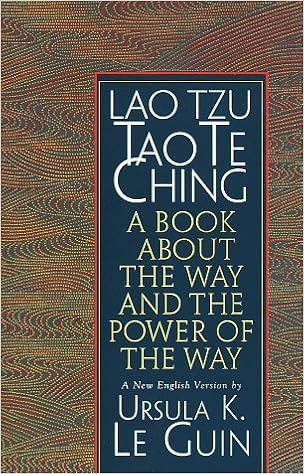
People argue about the best translation of the Tao Te Ching. Perhaps the most accessible is that due to Ursula K. Le Guin, the most prominent contemporary Taoist in the philosophical tradition. I like many of her chapters (see below) which render Lao Tzu's thoughts into a contemporary idiom.

But there's always the danger of over-processing. My real favourite is Arthur Waley's peerless text, which presents the Taoist work in its original cultural setting, allowing the reader space to engage and to seek the relevance in his or her own situation

Amazon link

Amazon link

To oxymoronically take a chapter almost at random. Here's Ursula Le Guin's Chapter 16.
Be completely empty.
Be perfectly serene.
The ten thousand things arise together;
in their arising is their return.
Now they flower,
and flowering sink homeward,
returning to the root.
The return to the root
is peace.
Peace: to accept what must be,
to know what endures.
In that knowledge is wisdom.
Without it, ruin, disorder.
To know what endures
is to be openhearted,
magnanimous,
regal,
blessed,
following the Tao,
the way that endures forever.
The body comes to its ending,
but there is nothing to fear.
In her note she comments, "To those who will not admit morality without a deity to validate it, or spirituality of which man is not the measure, the firmness of Lao Tzu's morality and the sweetness of his spiritual counsel must seem incomprehensible, or illegitimate, or very troubling indeed."

And here is how Arthur Waley translates the same chapter 16.
Push far enough towards the Void,
Hold fast enough to Quietness,
And of the ten thousand things none but can be worked on by you.
I have beheld them, whither they go back.
See, all things howsoever they flourish
Return to the root from which they grew.
This return to the root is called Quietness;
Quietness is called submission to Fate;
What has submitted to Fate has become part of the always-so.
To know the always-so is to be Illumined;
Not to know it, means to go blindly to disaster.
He who knows the always-so has room in him for everything;
He who has room in him for everything is without prejudice.
To be without prejudice is to be kingly;
To be kingly is to be of heaven;
To be of heaven is to be in Tao.
Tao is forever and he that possesses it,
Though his body ceases, is not destroyed.
So there you are: two interpretations of the same 2,400 year old text.

The Tao Te Ching, with its 81 chapters, is mystical and allusive. It's easy to let the eyes glaze over the stanzas which seem to require too much intellectual hard work.

A hard core materialist, who believes we - along with the other 'ten thousand things' - are 'just atoms' may simply walk away. I am basically just such a materialist, but learned long ago that the map is not the territory, and that an effective theory of agency and consciousness is not identical to being an agent and experiencing consciousness.

It's only when you examine your own self, abstracting a little from the busy personas of everyday role-playing, that the moral framework of the Tao Te Ching comes into focus. It's not for everyone, and it's not for every day. Sometimes, though, you should lift your head up if you can and try to engage with the biggest picture.

Cheng Man-Ch'ing used to say that Taoism was for the sage on his mountain, not for practical folk. But then, he was a Confucian.

---

Here's a short link to this post: https://goo.gl/X2Rd7q using the Google URL shortener.

Thursday, February 06, 2014

"The Man in the High Castle" by Philip K. Dick

I put off reading Philip K. Dick's "The Man in the High Castle" over the decades. Who wants to read an 'alternate history' story - not a genre I have much time for?

I'm an idiot of course: Philip K. Dick's novels are never about what they seem. The book is brilliant.

First things first: here's an outline of the setting (I hesitate to call it a plot), excerpted from Adam Roberts' excellent review.
"The novel is set in West-Coast America in the 1960s, but a 1960s in which the Axis powers won the Second World War. The old USA has been partitioned, with Nazi-run Eastern and Japanese-run Western portions and a notionally non-aligned buffer-zone along the Rockies.

"The main characters are a number of San Francisco Americans getting on with their lives in their various ways. The Japanese overlords are totalitarian but honourable, and many of them have a penchant for collecting old US-memorabilia -- civil war pistols, 1920s comic-books and the like, a market a number of Americans are happy to supply. Meanwhile the Germans have landed astronauts on Mars, drained the Mediterranean for farmland, and have almost entirely liquidated the black African population in an extension of the 'final solution'.

"Dick's use of detail to sketch out his alternate reality is well-nigh flawless, a model for others to copy: not too egregious, but always suggestive and thought-provoking. But the masterstroke of the book is the character Hawthorne Abendsen, the author of the pulp bestseller The Grasshopper Lies Heavy. Living in the castle of the book's title in the Rockies, Abendsen has consulted the ancient Chinese Book of Changes, the I Ching, and used his readings of it to write a sort of Science Fiction potboiler, an alternate-reality tale in which America and the Allies win the Second World War. His book has become a popular success, so much so that the Nazi high command want him assassinated."
The one- and two-star reviewers on Amazon were disappointed that the novel isn't the American-noir they were expecting. The Wikipedia article gets it better:
"The interpretation and confusion of true and false realities is the principal theme of The Man in the High Castle; it is explored several ways:
  • Robert Childan grasps that most of his antiques are counterfeit, thus, becomes paranoid that his entire stock might be counterfeit; a theme common to Dick's writing (cf. Do Androids Dream of Electric Sheep?), wherein the counterfeit is better than the original, because it is functionally real, e.g. the .44 caliber Colt Army Model 1860 revolver indistinguishable by anyone but an expert armorer, as Tagomi's shoot-out demonstrates.

  • ...

  • Several characters are secret agents traveling under assumed persona and pretenses; the gentile "Frank Frink" is the counterfeit persona of the Jew "Frank Fink".

  • The Grasshopper Lies Heavy, the book-within-a-book, postulates an alternative universe where the Axis lost World War II to the Allies, albeit with an alternative sequence of events. It is an alternative history analogue of The Man in the High Castle. The interpenetration of two false realities illustrates that the idea of a false and a true reality is inaccurate, because there exist more than two realities.

  • ...

  • Novelist Hawthorne Abendsen, the eponymous Man in the High Castle, lives in a house after having lived in a castle (fortified house) that was more prison than home, yet, for the sake of perception (false reality) he perpetuates the myth of his fortified isolation.

  • At the end of the novel, Hawthorne Abendsen and Juliana Frink consult the I Ching—it tells them they are living in an immaterial (false) world.

  • ...
The I Ching - so central to the novel - is a Taoist work, a tool in seeking the wisest, most harmonious course ("the Way") within life's eternal struggle between opposites (the dark and the light, yin-yang). Dick has the I Ching as the real 'author' of the novel-within-a-novel The Grasshopper Lies Heavy, itself a representation of  "The Man in the High Castle" which we know Dick wrote by consulting the Book of Changes.

If you like this kind of self-referentiality, you'll find this novel awesome!

My take on "The Man in the High Castle" is that Dick is trying to work out how different life-philosophies deal with good and evil. The Nazis, as depicted, are stomach-churningly nasty, sadistic and genocidal. Westerners such as the ethical Abwehr agent form an active, highly dangerous resistance; the Buddhist character Tagomi struggles to reconcile non-violence with the need to confront really bad people while the artisan characters of Taoist folklore (the Jew Frank Frink and his estranged wife Juliana) seem to act harmoniously in accordance with their true natures - in the moment as Taoism suggests.

Tuesday, January 08, 2013

The Left Hand of Darkness - Ursula LeGuin

You read something first when you know nothing. Thus in my youth, when I first encountered 'The Left Hand of Darkness'. How was I to know that Ursula LeGuin was Taoist, and that the ForeTellers of Gethen/Winter continued in the ancient tradition of Lao-Tzu, as did the Ekumen of Known Worlds?

Genly Ai is the Envoy to Gethen from the 83 planets of the Ekumen. In mediaeval Karhide he tries to persuade the king to join his nation to the stellar alliance but his patron at court, Estraven, falls foul of court intrigue and is exiled. Ai barely understands the swirling politics about him and soon he too finds himself in the neighbouring police state of Orgoreyn, where Estraven has washed up.

If Karhide is a backward, hearty, mediaeval kingdom mostly constituted from independently-minded clan kin-groups, Orgoreyn is a bureaucratic, stalinist society where people are 'units', allowed no possessions. Again, Ai understands nothing of the machinations of the power elite and ends up a political prisoner in the frozen north.

His escape across the glaciers with Estraven is the final epic section of the book. His mission, however, is in tatters: it seems that none of the rulers of Gethen see their interests furthered by recognition of the existence of the Ekumen.

This is a novel deeply infused by the ethos of feminism: life-affirming, welcoming diversity of experience, warmly optimistic, with a horror of violence and war. LeGuin is too smart not to recognise the dualities of real life (her poem in the book: 'light is the left hand of darkness') yet the masculine principle barely registers. Her male characters could as well be female: there is a certain, predominantly male characteristic of vigorous, analytic and interests-driven brutality which is entirely absent from this novel.

The beautiful writing in this novel doesn't entirely hide the structural flaws. The Envoy is astoundingly stupid, unempathic, bull-headed, incurious and under-trained for his assignment. While his endless errors and misjudgements are needed to drive the story along, it cannot be imagined that the Ekumen would have sent such a one to such a vital assignment.

This was the second book Adrian bought me for Christmas. Two out of three isn't bad but Neal Asher's 'The Skinner' will be a forthcoming library donation as I find that author unreadable.