Showing posts with label New York Times. Show all posts

Thursday, May 17, 2018

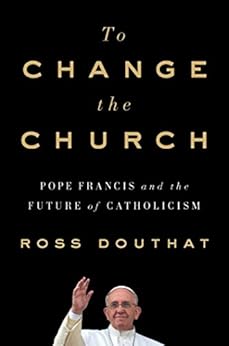
"To Change the Church" - Ross Douthat

Amazon link

Ross Douthat is not very well known here but in the States he has a profile as a conservative commentator on the NYT. He is also a Catholic convert.

Here is what his fellow New York Times writer, Paul Elie, had to say about Douthat's work:
"To Douthat [Pope] Francis is an accommodationist, and decline has reached the apex of the church. “This is a hinge moment in the history of Catholicism,” he declares, “a period of theological crisis that’s larger than just the Francis pontificate but whose particular peak under this pope will be remembered, studied and argued about for as long as the Catholic Church endures.”

What immediately follows is an adroit, perceptive, gripping account of Catholic controversializing. Douthat sets out the liberal and conservative “master narratives” about the Second Vatican Council and then offers a third narrative that deftly blends the two.

He sketches the life and times of the future pope, Jorge Mario Bergoglio, the Argentine Jesuit archbishop of Buenos Aires. There’s commentary on past controversies and a brief history of Catholic teaching on marriage, from Matthew 19 (“What God has joined, let not man put asunder”) to Humanae Vitae, the 1968 encyclical in which Pope Paul VI upheld the ban on artificial birth control. ...

And then, as Douthat reaches what he sees as the heart of the matter — the Vatican synods on marriage and the family in 2014 and 2015 — his culture-warrior tendencies stir fully to life.

He casts the synods as a battle: warring factions, attacks and frontal assaults, purges and collaborators. Francis’ openness to the German cardinal Walter Kasper’s proposal to relax the ban on divorced-and-remarried people in Germany receiving Communion at Mass is framed as a liberal pope’s “crusade to change the church.”

Although Francis has invited free discussion more than any previous pope, his efforts to shape the synod’s outcome (he is the pope, after all) are seen as “stage-managing” and “deck-stacking.” The synod fathers’ disputes are rolled down the slippery slope and deemed a “full-scale theological crisis” in which the hope that Francis would foster unity and renewal is undone by the supposed liberals’ supposed desire to accommodate “the sexual revolution and all its works.”

Douthat’s own position is traditionalist-cum-literalist: Any relaxing of the Catholic teaching on marriage — one man, one woman, one time — means that core teachings can be changed; if core teachings can be changed, the Catholic Church is no longer the Catholic Church; and if the church is not the church, all hope is lost."
I started the book somewhat sympathetic to Douthat's position - Pope Francis has not endeared himself with his vague anti-capitalism, ecological posturing and seeming inability to sort out the Vatican.

Douthat is a smart guy but he has a problem - blind faith. Once he committed to switching his critical intelligence off to accommodate a strangely-invisible super-presence, the fount of moral authority and one which extruded a portion of itself into a low-key itinerant Jewish preacher some two thousand years ago .. well, he felt he had to commit himself to Jesus's reported words as divinely-inspired axioms for life.

No matter the grievous consequences to perfectly respectable people (remarried divorcees - the case in point - enjoined to live as 'sister and brother'), the letter of the law must be served or the heavens shall fall. In the face of such egregious nonsense one can only wish more power to Francis's elbow.

As Elie observes:
"Vatican II was at once the church’s response to a crisis and the perpetuation of it. In less than five years the council fathers made changes whose number and scale dwarf the modest proposals floated in Francis’ pontificate — made them over the objections of Bill Buckley and other pundits who styled themselves as more Catholic than the pope. The biggest change had to do with the church’s relationship to Judaism, other churches and other religions.

In a few strokes, Jesus’ hard saying “No one comes to the Father except through me” and its Catholic expression (“Outside the church there is no salvation”) were softened and qualified. The change was profound and tradition-defying. Ever since, the church has affirmed the integrity of other faiths; ever since, Catholics have had to ask themselves, “Why be Catholic, when other ways are O.K., too?” Ever since, there has been no one clear answer."

Tuesday, December 13, 2016

Prosocial AI: Google's Jigsaw at the NYT

From the MIT Technology Review.


"Jigsaw — formerly known as Google Ideas — says it intends to spot and remove digital harassment with an automated program called Conversation AI.

[...]

Conversation AI is an offshoot of one of the most successful of Google’s “moonshot” projects, Google Brain. It has helped revolutionize the field of machine learning through large-scale neural networks, and given Google advantages such as software that is more skillful than humans at recognizing images.

But Conversation AI won’t be able to defeat online abuse. Though Jigsaw’s stated goal is to “fight the rise of online mobs,” the program itself is a far more modest—and therefore more plausible—project. Conversation AI will primarily streamline the community moderation that is today performed by humans. So even if it is unable to neutralize the worst behavior online, it might foster more and better discourse on some sites.

Jigsaw is starting Conversation AI at the New York Times, where it will be rolled out in a few months to help the company manage its online comments. Human moderators currently review nearly every comment published on the site. Right now, Conversation AI is reading 18 million of them, learning to detect each individual category of comments that get rejected—insubstantial, off-topic, spam, incoherent, inflammatory, obscene, attack on commenter, attack on author, attack on publisher.

The Times’s goal is not necessarily to reduce abuse in its comments, a problem it already considers under control. Instead, it hopes to reduce the human moderators’ workload. “We don’t ever expect to have a system that’s fully automated,” Erica Greene, engineering manager of the New York Times community team, told me. Times community editor Bassey Etim estimates that somewhere between 50 and 80 percent of comments could eventually be auto-­moderated, freeing up employees to devote their efforts to creating more compelling content from the paper’s comment sections.

The New York Times site poses very different problems from the real-time free-for-all of Twitter and Reddit. And given the limitations of machine learning — as it exists today — Conversation AI cannot possibly fight abuse in the Internet’s wide-open spaces. For all the dazzling achievements of machine learning, it still hasn’t cracked human language, where patterns like the ones it can find in Go or images prove diabolically elusive.

The linguistic problem in abuse detection is context. Conversation AI’s comment analysis doesn’t model the entire flow of a discussion; it matches individual comments against learned models of what constitute good or bad comments. For example, comments on the New York Times site might be deemed acceptable if they tend to include common words, phrases, and other features.

But Greene says Google’s system frequently flagged comments on articles about Donald Trump as abusive because they quoted him using words that would get a comment rejected if they came from a reader. For these sorts of articles, the Times will simply turn off automatic moderation."

Let's be clear: this is a good idea. The machine learning system is replacing grunt work currently carried out by hordes of bored human moderators. Hard cases are referred up by the AI. Few people want their reading experience polluted by foul-mouthed, ignorant rants. Moderation is enforced on this publishing outlet too! We all use automated spam filters.

And yet .. .

We sometimes forget the downside of prosociality. All this politeness, agreeableness and consensus-seeking must lead eventually to a bland, stifling conformity. When the system is silted up - captured by vested interests spouting the empty language of universality - the only progress is through breaking the rules.

I checked with my mentor, Karl M., and he confirmed that the result is often rather impolite.

---

Anyway, what's done is done. I can only conclude this post with a satiric observation:
"I for one welcome our new AI over---"
[This comment has been removed by the Blogger AI moderator: code 9 - hate speech].

Sunday, October 16, 2016

Bitcoin: the suits move in

From The New York Times (Oct 11th 2016) via Marginal Revolution: "Central Banks Consider Bitcoin’s Technology, if Not Bitcoin".
"Bitcoin was created by libertarian-minded programmers with a deep suspicion of central banks and the national currencies they issue.

"Yet it is central banks that are doing some of the most ambitious work of late in trying to harness the technology introduced by Bitcoin.

"The central bankers do not want their institutions to own or use Bitcoin itself. Instead, they hope they can use the decentralized method of record-keeping introduced by Bitcoin — known as the blockchain or distributed ledger — to complete and record transactions in the real economy more efficiently, quickly and transparently.

"The most enthusiastic central banks — including the Bank of England and the People’s Bank of China — have discussed issuing their national currencies onto some sort of distributed ledger, a name that comes from the concept of several parties keeping records simultaneously.

"Blockchains allow several players to keep a shared spreadsheet using cryptography and so-called consensus mechanisms that provide a way to agree on which transactions happened at what time.

"For the central banks, the promise of the technology is that it would allow them to track every pound or renminbi on every step of its travels through the financial system in real time — something that is impossible now. The goal would be to make the financial system more transparent, fast, efficient and secure.

"If the central banks succeed, it would be one of the greatest unexpected twists in new technology: An invention aimed at dethroning central banks and making it harder for money to be tracked instead ends up empowering those central banks and making money more easily traceable.

"The Bank of England has produced several research papers on the topic. One suggests that the economic benefits of issuing a digital currency on a distributed ledger could add as much as 3 percent to a country’s economic output, thanks to the efficiency it could offer."
Inter-bank settlements and a means to ensure "a financial system that does not go down even if the central bank’s computer systems are temporarily taken offline," seem to be important drivers.

Friday, May 02, 2014

Bad writing ruins good ideas ("The Cooperative Gene" - Mark Ridley)

After the late heavy (asteroid) bombardment of the Earth 3.9 billion years ago, single-celled life seems to have evolved almost immediately. These were the prokaryotes (simple cells without nuclei). It then took a further 1.6 billion years of prokaryotic stagnation before complex cells evolved (eukaryotes) - the kind of cells which form all animals and plants. The evolution of multicellular life then took a further billion years. These are big gaps.

Here's a time line.

Mark Ridley believes that many of the delays in life's tangled and protracted history are due to the problems of overcoming DNA copying errors. This is what he has to say in the preface to his book "The Cooperative Gene: How Mendel's Demon Explains the Evolution of Complex Beings".
"The DNA in a human being is 6600 million letters long and codes for about thirty thousand genes. In contrast, the DNA of a bacterium is two or three million letters long and codes for two or three thousand genes. Copying mistakes will have become more numerous as the DNA grew longer, for much the same reason as they happen when we are copying written text.
...
"The evolution of complex life required mechanisms to deal with copying mistakes in the DNA. The first mechanisms improved the accuracy of the copying itself. The earliest life forms probably made about one copying mistake in 100 letters, but bacteria had reduced the rate to less than one mistake in 1,000,000,000 letters.

"This huge improvement is due to the use of DNA for the master-copy — it is an impressively error-proof molecule — and a molecular machinery for proofreading and repairing mistakes. But the possibilities for improving the accuracy of copying seem to have been exhausted by the bacterial stage. The basic DNA copying machinery has remained much the same since then, and we make copying mistakes at a similar rate per letter of DNA as bacteria do.

"Our total error rate is much higher, however, because we use so many more letters of DNA code. Between bacteria and us the length of the DNA molecule has increased 1000-fold and the DNA has come to be copied 100 times per generation, against the once per generation of a bacterial cell.

"Our total error rate has gone up 100,000 times, and whereas a bacteria makes a mistake once in every 1000 offspring, we make over 100 mistakes in every offspring. It is something of a paradox how we can persist, while making so many copying mistakes in our DNA. The solution is uncertain, but is probably — sex. Sex can act to concentrate the copying errors in some of a parent's offspring, leaving other offspring relatively error-free. Sexual life forms could evolve to be more complex than clonal life forms."
Ridley's book is a tribute to how much can be explained by starting with one fundamental engineering-type puzzle - how can you faithfully copy DNA, an essential step in evolutionary replication? - and use it to account for many apparently-diverse phenomena:
  • the stretched timeline of evolution itself
  • the reason for sex
  • the strange process of meiosis ( 2 => 4 => 1 chromosome)
  • ageing (we can't accurately clone our own DNA over too many cellular generations)
Perhaps future genetic engineering technology can address this final problem.

The New York Times reviewer had the same problem that I guess all readers experienced with this book: it's really badly written. Professor Silver's thorough review attempted to be diplomatic:
"The title of Ridley's book suggests an alternative perspective on the gene's role in evolution from that presented by Dawkins in ''The Selfish Gene.'' But Ridley's ideas are not that different, and they've been expressed in more lively prose by others. Like the exodus of Israel from Pharaoh's Egypt, the story of evolution must be told anew to each generation. In both cases it is probably best to rely on earlier texts."
Here are some of my own words for Ridley's writing: stodgy, indigestible, use of inappropriate student humour, gratuitous (and adolescent) attacks on the Bible.

It is possible to plough through the dense and indigestible prose, and the persevering reader is rewarded with some truly paradigm-changing insights. Professor Silver is not quite right: Dawkins didn't already write this material - one just wishes he had.

Sunday, September 08, 2013

"Same War, Different Country" by Thomas L. Friedman

Thomas Friedman has the following piece in the New York Times today, which I mention because I agree with most of it.
"SAY, did you see the news from Libya — the last country we bombed because its leader crossed a red line or was about to? Here’s a dispatch from Libya in the Sept. 3 British newspaper, The Independent:

“Libya has plunged unnoticed into its worst political and economic crisis since the defeat of Qaddafi two years ago. Government authority is disintegrating in all parts of the country putting in doubt claims by American, British and French politicians that NATO’s military action in Libya in 2011 was an outstanding example of a successful foreign military intervention, which should be repeated in Syria. ... Output of Libya’s prized high-quality crude oil has plunged from 1.4 million barrels a day earlier this year to just 160,000 barrels a day now.”


I keep reading about how Iraq was the bad war and Libya was the good war and Afghanistan was the necessary war and Bosnia was the moral war and Syria is now another necessary war. Guess what! They are all the same war.


They are all the story of what happens when multisectarian societies, most of them Muslim or Arab, are held together for decades by dictators ruling vertically, from the top down, with iron fists and then have their dictators toppled, either by internal or external forces. And they are all the story of how the people in these countries respond to the fact that with the dictator gone they can only be governed horizontally — by the constituent communities themselves writing their own social contracts for how to live together as equal citizens, without an iron fist from above. And, as I’ve said before, they are all the story of how difficult it is to go from Saddam to Jefferson — from vertical rule to horizontal rule — without falling into Hobbes or Khomeini.


In Bosnia, after much ethnic cleansing between warring communities, NATO came in and stabilized and codified what is in effect a partition. We acted on the ground as “the army of the center.” In Iraq, we toppled the dictator and then, after making every mistake in the book, we got the parties to write a new social contract. To make that possible, we policed the lines between sects and eliminated a lot of the worst jihadists in the Shiite and Sunni ranks. We acted on the ground as the “army of the center.” But then we left before anything could take root. Ditto Afghanistan.


The Obama team wanted to be smarter in Libya: No boots on the ground. So we decapitated that dictator from the air. But then our ambassador got murdered, because, without boots on the ground to referee, and act as the army of the center, Hobbes took hold before Jefferson.


If we were to decapitate the Syrian regime from the air, the same thing would likely happen there. For any chance of a multisectarian democratic outcome in Syria, you need to win two wars on the ground: one against the ruling Assad-Alawite-Iranian-Hezbollah-Shiite alliance; and, once that one is over, you’d have to defeat the Sunni Islamists and pro-Al Qaeda jihadists. Without an army of the center (which no one will provide) to back up the few decent Free Syrian Army units, both will be uphill fights.


The center exists in these countries, but it is weak and unorganized. It’s because these are pluralistic societies — mixtures of tribes and religious sects, namely Shiites, Sunnis, Christians, Kurds, Druze and Turkmen — but they lack any sense of citizenship or deep ethic of pluralism. That is, tolerance, cooperation and compromise. They could hold together as long as there was a dictator to “protect” (and divide) everyone from everyone else. But when the dictator goes, and you are a pluralistic society but lack pluralism, you can’t build anything because there is never enough trust for one community to cede power to another — not without an army of the center to protect everyone from everyone.


In short, the problem now across the Arab East is not just poison gas, but poisoned hearts. Each tribe or sect believes it is in a rule-or-die struggle against the next, and when everyone believes this, it becomes self-fulfilling.


That means Syria and Iraq will both likely devolve into self-governing, largely homogeneous, ethnic and religious units, like Kurdistan. And, if we are lucky, these units will find a modus vivendi, as happened in Lebanon after 14 years of civil war.

And then maybe, over time, these smaller units will voluntarily come together into larger, more functional states.

...
"
Don't hold your breath.

Friedman refers to US and allied military forces as 'the army of the centre' but the role is straight out of Hobbes' Leviathan, the dictatorship which curbs the alleged natural tendency of all men to be beastly to one another.

Hobbes is more accurate if we take the unit of mutual antipathy to be kinship groups rather than individuals: clans and tribes, or the ersatz kin-groups of shared religious fanaticism. And Friedman is effectively arguing that in these fissiparous states, the US must replace the dictator it has overthrown or the whole show goes to hell in a handcart.

Roll on the US legislative vote for bombing Syria, on Wednesday.