Showing posts with label SJW. Show all posts

Wednesday, June 10, 2020

Shame they don't teach history any more

Prior to the nineteenth century, almost all countries were predominantly agrarian with fragile, low-productivity economies. Their elites owed their prosperity to the exploitation of workers, peasants and slaves, whose conditions of existence were uniformly awful.

This should be emphasised: in all societies prior to c. twentieth century capitalism, the masses lived on the edge with income just sufficient to perpetuate themselves. Their misery was compounded by brutal treatment from their 'betters' for whom they were simply potentially rebellious resources.

Most of those elites consumed their wealth 'unproductively' but a few were philanthropists. Some of those in the latter category later had statues put up to them by a grateful (elite) citizenry, for example Edward Colston (1636-1721) of Bristol.

It's an interesting social phenomenon that these statues are now being toppled in the name of an ahistoric moralism - but as we know, it's not really about that.

Nevertheless, I expect slightly conservative professors of history to be pointing out these salient truths in this weekend's papers... while right- and left-wing protesters fight in the streets.

The masses are in motion; history has resumed.

Monday, November 26, 2018

The relative autonomy of the petty bourgeoisie

Nicos Poulantzas

Sociologists Bradley Campbell and Jason Manning came to people's attention in early 2018 with their book, "The Rise of Victimhood Culture: Microaggressions, Safe Spaces, and the New Culture Wars". Seeking to account for an SJW phenomenon increasingly dominant in the western world, they distinguished between three kinds of culture: Honor, Dignity, and Victimhood.

Campbell and Manning over-abstracted these cultural categories, representing them almost as menu choices, or contingent way-points on the arc of history. This was mostly corrected in Tanner Greer's commentary at "The Scholar's Stage" (which features on the sidebar in the web version of this blog).

Rather than having me summarise his impressive analysis, please review it for yourself: "Honor, Dignity, and Victimhood: A Tour Through Three Centuries of American Political Culture"

Greer's analysis was not perfect.
"The transition from honor to dignity reflected a deeper shift in the basic building blocks of society. Had Western Europeans not shifted away from clan based to citizen based communities, there would not have been any Culture of Dignity. The shift from dignity to victimhood reflects a similar change in the societal distribution of power. ...

The federal government assumes powers traditionally reserved to local and state governments. Local businesses have been pushed out of existence by international conglomerates. The businesses, associations, congregations, and clubs that once made up American society are gone. America has been atomized; her citizens live alone, connected but weakly one to another. Arrayed against each is a set of vast, impersonal bureaucracies that cannot be controlled, only appealed to.

A "Culture of Victimhood" is a perfectly natural response to this shift in the distribution of power. Remember that the central purpose of moral cultures is to help resolve or deter disputes. Dignity cultures provide a moral code to regulate disputes among equals from the same community. They also help individuals in a community--citizens--organize to protect their joint interests.

21st century America has lost this ability to organize and solve problems at the local level. The most effective way to resolve disputes is appeal to the powerful third parties: corporations, the federal government, or the great mass of people weakly connected by social media. The easiest way to earn the sympathy of these powers is to be the unambiguous victim in the dispute.

Victim culture is here to stay."
In fact this 'atomisation' has to be interpreted more dynamically, in class terms. After all, not everyone identifies as a 'victim'.

Peter Turchin has correctly linked neoliberal atomisation with the 'overproduction of elites', the mass production of (social science and humanities) graduates with inflated expectations and entitlements, but for whom no place exists within the real elite, the top 1% or 0.1%. They are angry and febrile and in the mass a cause of political instability. It's not a new phenomenon: some of us remember the late sixties and early seventies.

This (now vastly enlarged) intermediate layer between the traditional working class and the high bourgeoisie is termed by Marxists the petty bourgeoisie. This brought to mind the seminal work of theorist Nicos Poulantzas and I reviewed with interest his chapter 13, "The New Petty Bourgeoisie" in "The Poulantzas Reader" (PDF) .

Poulantzas was an interesting guy and I also reviewed his bio, nodding along, until I came to this:
"He killed himself in 1979 by jumping from the window of a friend's flat in Paris."
He was 43.

There was something about the mental stability of continental Marxists in the late twentieth century. His more famous contemporary, Louis Althusser,  killed his wife Hélène Rytmann the following year and was declared unfit to stand trial due to insanity. He was committed to a psychiatric hospital for three years.

Why are the new petty bourgeoisie so restless again? Because a decade of economic stagnation with the increasing gap between their circumstances and those of the top 1% has left them feeling abandoned. They experience a dislocating lack of prospects and purpose.

The old-time (pre-1980s) working class had a historic cultural identity forged through tenement communities, monolithic employers, trade unionism and social-democratic activism. The modern petty bourgeoisie by contrast is a collection of isolates, expressing their angst through faddish identity-issues.

None of these campaigns ever address the real causes of their dissatisfaction. Nevertheless, their heartfelt herd-activism is always destabilising .. and from the bourgeoisie's point of view, always with a risk of triggering wider unrest. Consequently, the elites attempt to manipulate and co-opt them (eg the moralising campaign against plastic pollution which carefully fails to discuss the true sources of said pollution).

The classic Marxist texts (Lenin, Trotsky) recognised the febrile and changeable nature of the radicalised petty bourgeoisie. Their works discuss methods of creating an alliance with the proletariat in the struggle for socialism.

How times have changed now that the tail wags the dog: the era of Momentum and the death of the dream .. .

Thursday, October 11, 2018

When Keynes comes to town

Amazon link

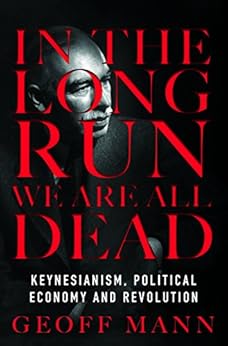
Maddeningly abstract and allusive, Geoff Mann's book situates Keynes within an intellectual arc stretching back to the French Revolution (1789-99) and Hegel's subsequent theorisation of its lessons for modern civilisation. A reminder of the shallowness of contemporary thinking about values, governance and the collapse of the neoliberal project.

Keynes is depicted as taking a stand against delusional neoclassical (and highly mathematicised) theories in which capitalism is assumed to be always at, or returning to equilibrium. Keynes sees the structural instabilities driving boom-bust cycles, highlighting the essential fragility of the 'civilised order'. His vision calls for conscious state action to underpin the conditions of existence of the masses, heading off a revolution of despair after which the deluge.

I have reviewed the book here: "In The Long Run We Are All Dead" - Geoff Mann.

It prompts this analysis of our contemporary predicament in the spirit of Mann's thinking.

---

Social Justice Warriors vs the Populists

There was a time when I did not regularly throw my shoes at the television set, when the TV and print media had not yet morphed into latter-day Pravdas.

It was the time before neoliberalism’s decline, before the great crash of 2008.

First had come the sixties transition from post-war factory-capitalism, familiar from a thousand Stalinist agitprop posters. No more conveyor-belt mass-production 'on the track'. The new middle-class economy was fragmented, individualistic and complicated. It wanted mass university education and greedily consumed its output. Not that those jobs were particularly well paid.

And so were sown the seeds of elite overproduction.

Neoliberalism took recognisable shape in the 1980s, a pivot away from national industrial capitalisms towards a frictionless world with international just-in-time supply chains and global capital flows. The opportunities to seek profitable investment opportunities and attain economies of scale rewarded some industries more than others: high tech and finance to name two.

Naturally there was an inspiring vision to accompany globalisation. It postulated a world without borders, where all impediments to the free availability of factors of production should be removed: no tariffs and no irritating state/legal restrictions.

The vision ordained that outdated prejudices limiting international access to labour should be abolished. Free migration! No cultural barriers! No acknowledgement could be made that any performance differences due to race, gender, sexuality, age etc might have any biological/genetic causation. Differences in outcome were always and everywhere to be understood as socially-constructed pernicious hangovers - to be abolished in the name of an enlightened neoliberalism!

Thus was born the phenomenon of the social justice warrior (SJW), prepped to fight those dinosaurs who hadn't yet got the memo.

Since 2008/9 global economic growth in the advanced capitalist countries has been anaemic. Profitability has been poor and the neoliberalism project has been fraying. Those never signed up in the first place, most specifically the non-graduate industrial working class were getting restive as their communities, workplaces and personal prospects got trashed. And so arose their inchoate political voice: Populism.

Those who were meant to be the foot-soldiers of globalisation (all those idealistic young social science graduates) were increasingly abandoned by a failing project on the defensive. They formed that new class fraction, the precariat. Of course they doubled-down on the SJW vision, feeling betrayed. They are the scarily militant snowflakes of the Labour Party's Momentum organisation .. and similar movements in other countries.

The SJW programme, increasingly absurd, continues to infiltrate the mainstream media and leftist politics. It has nothing whatsoever to do with anti-capitalism, despite its seemingly leftist credentials. It is the anguished shriek of a decaying neoliberalism.*

The Populist-SJW conflicts are global, though taking different forms and tempos in North America, Latin America and the different countries in Europe. In some cases (France) the neoliberal cause is still somewhat in the ascendant (Macron). In most countries though, the neoliberal elites are on the defensive.

Neither side has a programme which can work. Classical neoliberalism is discredited: its globalist-individualism falters while continuing to cause too much collateral damage. The elites fear disruption; they sense the masses stirring. Yet there can be no return to fifties-style nation-state economies.

There will be no proletarian revolution. Capitalism will find a new modus operandi. It will not be the re-establishment of a resurgent neoliberalism. This is a struggle of years as there is no simple solution, no way forward which does not succeed in defeating powerful vested interests.

Most likely is the theme Mann develops in his book, a Keynesian, somewhat covert counter-revolution. The result: a more hands on, activist state creating institutional forms fostering inclusivity for restive groups currently felt irrelevant and disposable by internationalist capital. Theresa May understood this in her much ignored remark that making Brexit work was the only way of saving the neoliberal project.

In the UK, both Corbynism and May-style conservatism are groping towards this solution. It will place constraints on the free disposition of capital and it will be expensive. You can see why powerful (but short-sighted) forces resist this new direction.

But the re-integration of the 60% plus of the population who are not graduates and that larger part of the more educated 40% who have been abandoned by the real elites requires it. The challenge is to develop a programme which addresses both constituencies: in the UK Labour and Conservatives engage from different directions.

But painfully, in fits and starts, with much conflict and perhaps violence, this is where we will end up, maybe a decade out.

---

* Ideologies take on a life of their own. Ideological 'praxis' exhibits a relative autonomy from the material conditions which elicit it.

Put more plainly, even though the SJW agenda derives from and serves the purposes of the neoliberal project, it occasionally bites the hand that nurtures it. Sometimes its logic undermines that project.

Notice the liberal media indulgently rowing back from episodes of overreach. It's usually a humourous demurral and no general conclusions will be drawn.

Monday, October 01, 2018

Witch Hunt at CERN


From the BBC website:
"A senior scientist has given what has been described as a "highly offensive" presentation about the role of women in physics, the BBC has learned. At a workshop organised by Cern, Prof Alessandro Strumia of Pisa University said that "physics was invented and built by men, it's not by invitation". He said male scientists were being discriminated against because of ideology rather than merit.

He was speaking at a workshop in Geneva on gender and high energy physics. Prof Strumia has since defended his comments, saying he was only presenting the facts. Cern, the European nuclear research centre, described Prof Strumia's presentation as "highly offensive". The centre, which discovered the Higgs Boson in 2012, has removed slides used in the talk from its website "in line with a code of conduct that does not tolerate personal attacks and insults".

Prof Strumia, who regularly works at Cern, presented the results of a study of published research papers from an online library. He told his audience of young, predominantly female physicists that his results "proved" that "physics is not sexist against women. However the truth does not matter, because it is part of a political battle coming from outside".
This is all wearisomely familiar from the James Damore case at Google a year ago. If the institutions which are dedicated to truth in science can't defend it against political pressure, who can?

Here's the offending slide presentation (PDF) by the way. It's ponderous-humorous and a bit technical; the BBC cherry-picked remarks they could use out of context. Read it if you dare!

---

On the strength of it all I decided to let Luboš back.

The Reference Frame is hereby reinstated on the right-hand side of the web version in the blog list. For all his extravagant language, grotesque and offensive personal insults and tone-deaf histrionics, the physics, though partisan, is good and the attacks on SJW nonsense merited.

In Luboš's post yesterday, "Nasty SJWs persuade spineless CERN officials to start an inquisition trial against an Italian scientist", the professor at the centre of the row, Alessandro Strumia, added this piece in the comments:
"Thank you Lubos for writing me alerting about this mess; let me clarify.

CERN organised this "gender workshop". Having recently worked on bibliometrics, I had the data relevant for the workshop, so I did the simple checks that should have been done before claiming that physicists are sexist, etc etc etc

Next I went to hear the workshop, that was ignored by almost all theorists who privately have bad opinions about it.

One of the speakers told (as if this were common knowledge) that words such as “competitive”, “conservative”, “hardworking” are bad. A participant said that physicists are second only to military in sexual harassment. And the rest was along similar lines, as clear from the quotations on my second page. Have a look at the other talks still kept on line by CERN, and switch “men" with “women”, and then decide if they are sexist.

It was clear that anything different from their line would have been discredited and ignored. And the objective results that I got from bibliometrics did not support their line: there is no discrimination against women.

This is a good news, but it's not what they want.

Like with LHC results, which are not the best we hoped, it’s our duty to present honestly what we get.

That’s why I decided that the only option (apart from self-censorship) was openly talking about the alternative ideas “discredited” in past gender workshops and that they don’t want to hear, from Simon Baron Cohen, to Summers...

Having spoken with many physicists and friends (including female physicists who attended the workshop), I am fully sure that the big majority understands, although many of them fear the consequences of speaking. I myself tried to find somebody else who dared to speak in my place, and I decided I had to speech only after having seen courageous people that in the past years begin to openly challenge the ideology (like the guy who said “ideological echo-chamber" and was fired by google), and that people thinks very different than media etc.

So I hope to survive and keep doing the physics that I like. Although I am worried that, acting on self-conservation instinct, CERN might worsen a bad situation.

After the talk, I warned important physicists there “a mess will happen”, and they believed my worries were exaggerated. So I am sure that good honest people hosted and funded the workshop underestimating that it was politically-charged and driven by people who dislike our culture based on hard and smart work and on gender-neutral merit, which I think is worth defending.

The sexist attacks against physicists might violate CERN code of conduct, but I liked that CERN is so open to free speech that we can discuss the unpleasant issues raised by the workshop. The fact that my talk is no longer freely available makes me fear that somebody might want my head to appease a political area which is highly voted by academicians, but recently not so much by the people.

I am happy if somebody wants to discuss and check honestly what I wrote in the talk, but tomorrow I have to work full day.

PS Lubos: when you started blogging, I believed you were a totally wrong idiot. But your blog contains good physics, so I kept reading, and with time, I come to realise that I was wrong, and you were right, although too much ahead of time. A very great US physicist told me that you were even moderate, before what happened to you."

That final paragraph - very interesting. But I believe, based on his words above, that Professor Strumia is too naive and trusting to be long for this world.

Update (Oct 5th 18): BackReaction has been taking a look at the citation data Prof. Strumia was using, and at his slides: "Gender-bias in Academia: The Case Strumia". This seems the kind of debate you would expect within the physics community.

Sunday, August 05, 2018

"The Robespierrean social justice terror blowing through Silicon Valley"

La nostalgie de l'Ancien Régime

"The Robespierrean social justice terror blowing through Silicon Valley ...".

Nice phrase (ugly reality). Marginal Revolution has some notes on US tech management.

Here are the top nine (of seventeen).

  1. "Most tech leaders aren’t especially personable. Instead, they’re quirky introverts. Or worse.

  2. Most tech leaders don’t care much about the usual policy issues. They care about AI, self-driving cars, and space travel, none of which translate into positive political influence.

  3. Tech leaders are idealistic and don’t intuitively understand the grubby workings of WDC [Washington DC].

  4. People who could be “managers” in tech policy areas (for instance, they understand tech, are good at coalition building, etc.) will probably be pulled into a more lucrative area of tech. Therefore there is an acute talent shortage in tech policy areas.

  5. The Robespierrean social justice terror blowing through Silicon Valley occupies most of tech leaders’ “political” mental energy. It is hard to find time to focus on more concrete policy issues.

  6. Of the policy issues that people in tech do care about—climate, gay/trans rights, abortion, Trump—they’re misaligned with Republican Party, to say the least. This same Republican party currently rules.

  7. While accusations of deliberate bias against Republicans are overstated, the tech rank-and-file is quite anti-Republican, and increasingly so. This limits the political degrees of freedom of tech leaders. (See the responses to Elon Musk’s Republican donation.)

  8. Several of the big tech companies are de facto monopolies or semi-monopolies. They must spend a lot of their political capital denying this or otherwise minimizing its import.

  9. The media increasingly hates tech. (In part because tech is such a threat, in part because of a deeper C.P. Snow-style cultural mismatch.)
---

There's a scenario in which a perfect storm is brewing. The Googles and Facebooks of the world are economically and ideologically aligned with a declining neoliberal project which only gets the more shrill as it loses out to the inchoate populism of the increasingly disaffected masses.

As popular discontent grows, the tech companies - deploying personal data and means of surveillance undreamt of by former elites - are increasingly available for repression (in a just cause of course). We forget how authoritarian regimes always spin out self-justification.

When social cohesion breaks down (and this is a feature of the political-economic period we're living through) left and right are equally tribal and nasty, each in their own way. In the end it's always human beings and their antagonistic group interests, dressed up in fancy ideologies.

Makes you nostalgic for the mid twentieth century, Les Trente Glorieuses.

---

And here's an antidote to that.


Friday, January 26, 2018

"The Circle" - Dave Eggers

Didn't read "The Circle" first time out (2013). I was put off by the reviews.

Big mistake.

Having just completed this excellent and page-turning satire, I returned to those very reviews. Some were autistic (fatally flawed - he gets details of the technology wrong); some were literary-snobbish (his writing is flawed, the characters are flat and unconvincing); and some were patronising (politically flawed, could never happen, nothing to see here - move on).

Amazon link

But some people called it right, Steven Axelrod being my outstanding favourite.

Here's how he starts:
"Reading Dave Eggers’ new novel The Circle an image slipped into my mind, one not contained in the book but which I’m sure its protagonist would appreciate: a big church wedding with full Catholic ceremony – the priest in his vestments, bathed in the densely colored sunlight from the rose window, holding a massive Bible before a crowd of hundreds of friends and family as the sacred catechism rolls up the nave and echoes from the flying buttresses of the medieval ceiling. “Do you take this woman …” and the man answers “I do.”

Then he turns to the bride. “Do you, Emily Johnson, take this man, Brad Halpern, to be your lawfully wedded husband, to have and to hold …”

When he’s done, she looks up distracted.

“What?”

She’s been texting.

The only problem Mae Holland, the heroine of The Circle would have with this scenario is that Emily hadn’t “gone clear” – she had no portable camera attached to herself which could document every moment of the ceremony to her 239,456 followers.

She wasn’t “zinging” them all (a kind of instant tweet), acknowledging their “smiles” and good wishes as they came in. What was wrong with Emily? Why wasn’t she sharing this beautiful moment? Who made her dress? Where did Brad get his tuxedo? Does the church do charity work?

Couldn’t she link to the designer and the haberdashery and the Catholic aid organization? Think how her Conversion Rate (that’s the number of purchases you stimulate with your comments and zings and links) could be sky-rocketing! Not to mention her Retail Raw – that’s “the total gross purchase price of recommended products” people have purchased because of you. What a waste!

Doesn’t Emily understand that sharing is caring and secrets are lies and most of all – privacy is theft?"
Mae Holland is a 2013 portrait of a type we've become more familiar with, the ingenue social-justice warrior, insistent upon giving us all the benefits of her inexperience.

In Axelrod's words,
"One of the most audacious aspects of Eggers’ book is that the writing sticks rigorously with Mae Holland’s point of view. The narration is as close as “close third person” can get. Why not tell it in first person then? But that’s the whole point: that pesky “first person” is precisely what the Circle is trying to eradicate.

Because Mae doesn’t understand what’s happening to her and her world, the reader is forced to make the arguments that she can’t. The novel becomes interactive in a way that no computer program could ever be. You’re literally shouting at the page. When Mae talks about basic principles with Eamon Bailey, one of the three Wise Men who founded the company, she swallows his specious arguments whole.

All secrets are bad because anything private is suspect – why would we hide something we weren’t ashamed of? Mae doesn’t have the presence of mind or the education to point out that most of the great strides forward in human history – including the basic technical work that created the Circle itself – was done in silence and solitude.

Human beings need isolation and quiet and uninterrupted thought. Physical health and sanity depend on it. The idea that we only hide what we’re ashamed of is simply false. But Mae doesn’t get it. She loves being part of something bigger than herself, having her tastes and opinions influencing the world, seeing her face in the mirror of a million hard drives."
"The Circle" is not a prediction of a Google-Facebook future: real life is way too conflicted for that. Instead it conjures up a certain kind of utopian vision, one where everyone is nice, everyone loves and affirms everyone else all the time, everything works and there is no unpleasantness of any kind.

[There's always an implicit, passive-aggressive 'or else' hanging in the air].

This is the left-liberal dream, an SJW paradise: the final triumph of the superego.

And yet such a cultish community of doves is totally open to manipulation by those less scrupulous. The transparent shark swirls in the sociopathic CEO's aquarium.
"The world of doves is not evolutionarily stable. Power corrupts, and those constrained to become doves are transformed rapidly into victims."
.. as I observed in my review of "Gnomon".

---

So now two juxtaposed discussions of novels critiquing the socially-liberal dream. What gives?

Well, Amazon noticed my interest in "Gnomon" and promptly recommended "The Circle".

Yes, I'm living the dream.

---

Some of the reviews pointed out that in the novel, due to The Circle's technology, crime is reduced and welfare is actually improved. Seems silly to deny it.

Eggers' authorial-viewpoint characters try to locate what is actually bad about The Circle. It's harder than one might imagine. Isn't total surveillance much like vaccination? Necessarily total for the greater good?

The best they can do is to highlight the increasing levels of compulsion to sign into The Circle's total environment. But is the only alternative to The Circle's cult some kind of (ineffectual) off-grid survivalism?

We'll have to improve on that. I can do no better than effective checks and balances.

Wednesday, April 05, 2017

Globalisation, then neoliberalism, finally political correctness


Charles Murray at Middlebury College, March 2017

From the Wikipedia bio:
"William Deresiewicz is an American author, essayist, and literary critic. Born in 1964 in Englewood, New Jersey, Deresiewicz attended Columbia University before teaching English at Yale University from 1998-2008.

"He is the author of A Jane Austen Education, How Six Novels Taught me About Love, Friendship, and the Things that Really Matter (Penguin Press, 2011) and Excellent Sheep: The Miseducation of the American Elite and the Way to a Meaningful Life (Free Press, 2014). ..."
Deresiewicz has a from-the-heart (if overlong) essay on the current wave of 'political correctness' at US colleges. Check it out, or the shorter summary by Steve Sailer here.
"Elite private colleges are ideologically homogenous because they are socially homogeneous, or close to it. Their student populations largely come from the liberal upper and upper-middle classes, multiracial but predominantly white, with an admixture of students from poor communities of color - two demographics with broadly similar political beliefs, as evidenced by the fact that they together constitute a large proportion of the Democratic Party base.

"As for faculty and managerial staff, they are even more homogenous than their students, both in their social origins and in their present milieu, which tends to be composed exclusively of other liberal professionals—if not, indeed, of other liberal academics.

"Unlike the campus protesters of the 1960s, today’s student activists are not expressing countercultural views. They are expressing the exact views of the culture in which they find themselves (a reason that administrators prove so ready to accede to their demands). …

"The term political correctness, which originated in the 1970s as a form of self-mockery among progressive college students, was a deliberately ironic invocation of Stalinism. By now we’ve lost the irony but kept the Stalinism - and it was a feature of Stalinism that you could be convicted for an act that was not a crime at the time you committed it. So you were always already guilty, or could be made to be guilty, and therefore were always controllable.

"You were also always under surveillance by a cadre of what Jane Austen called, in a very different context, “voluntary spies,” and what my students called the PC police. Regimes of virtue produce informants (which really does wonders for social cohesion). …

"There is one category that the religion of the liberal elite does not recognize - that its purpose, one might almost conclude, is to conceal: class. Class at fancy colleges, as throughout American society, has been the unspeakable word, the great forbidden truth. ... It has long struck me in leftist or PC rhetoric how often “white” is conflated with “wealthy,” as if all white people were wealthy and all wealthy people were white.

"In fact, more than 40 percent of poor Americans are white. Roughly 60 percent of working-class Americans are white. Almost two-thirds of white Americans are poor or working-class. Altogether, lower-income whites make up about 40 percent of the country, yet they are almost entirely absent on elite college campuses, where they amount, at most, to a few percent and constitute, by a wide margin, the single most underrepresented group. ...

The exclusion of class also enables the concealment of the role that elite colleges play in perpetuating class, which they do through a system that pretends to accomplish the opposite, our so-called meritocracy. Students have as much merit, in general, as their parents can purchase (which, for example, is the reason SAT scores correlate closely with family income). The college admissions process is, as Mitchell L. Stevens writes in Creating a Class, a way of “laundering privilege.”
Because political correctness is presented by its advocates in moral terms, it's sometimes difficult to understand it as the optimised ideology of globalisation - a form of capitalism which really got going in the 1980s-90s, powered by Internet-mediated supply-chains and the economic rise of China.

More precisely, political correctness provides the moralistic framework, neoliberalism the ideology while globalisation captures the underlying economic dynamics:
"Economic neoliberalism is an economic theory and an ideological conviction that supports maximizing the economic freedom for individuals and thus reducing the amount of state intervention to the bare minimum.

"In this regards, it does advocate the elimination of government-imposed restrictions on transnational movements of goods, capital and people .... However, although these aspects are considered important aspects of globalization, this essay argues firstly that globalization is a much richer and multi-dimensional process that extends beyond transnational economic transactions. ..."
Following Marx, we should understand that causality has worked in the direction indicated by the title of this piece: first the economics, then the political justifications, finally the moral underpinnings. It is ironic that the political left now provides ideological cover for global capital.

Thursday, February 25, 2016

Spatial Awareness


There's a special feeling of relaxed contentment when you're back home from the dentist.

Shards of memory: lying back, staring at fluorescent grills in the ceiling, everything yellow through the goggles; the steel hypodermic syringe, floating above my face, orienting there .. and there; the pressure of fluid building up in the gums.

The pretty, full-faced assistant asks the dentist, "Is there anything you need?"

Sotto voce I hear his reply: "Spatial awareness ... ."

I manage a contorted smile.

Later it seemed to me that he was a dead ringer, sight and sound, for Moriarty in BBC's "Sherlock".

---


I'm reading "Data and Goliath: The Hidden Battles to Collect Your Data and Control Your World" by Bruce Schneier.  It's an easy read and brimful of fascinating information about government and corporate surveillance.

I've been trying to identify the chronic, low-level irritation I'm experiencing as I turn the Kindle pages. And now it's dawned on me:  that moralising tone. It's the same feeling I get when reading The Guardian.

Friday, November 13, 2015

Priddy Mineries; SJWs and SF; AI deep learning

Clare has had a vision these last days of a walk in the autumnal woods surrounded by the glowing colours of the falling leaves. In the last of the year's sun, we would stroll in a kaleidoscope of natural beauty.

And then there is the inevitable collision with the English climate.

In a short weather window, after a stroll in Stockhill Wood

A rain-soaked Priddy Mineries
I've been quite impressed by Ian McDonald's work so have just ordered 'Luna: New Moon' ; apparently a sequel is scheduled for publication next year and yet another volume in 2017. I particularly enjoyed his 'Brasyl', set in an alternate reality of the Latin-American country:
"A story that begins in the favelas, the slums of Rio, and quickly expands to take in drugs, corruption, and a frightening new technology that allows access to all the multiple worlds that have slipped into existence in other planes every time we make a decision."
Good review here.

I remember McDonald being a target of 'social justice warriors' for his temerity in placing his densely-imagined novels in developing countries (India is another favourite of his). This from Abigail Nussbaum's review of his earlier 'River of Gods'.
"It's a positive, vibrant, and persuasive description, but also one that gives rise to a feeling of unease when one recalls that McDonald is, after all, a white man from Belfast. What right does he have to write about India, much less to pretend to have captured its essence, much much less to imagine its future? When Nic Clarke of Eve's Alexandria reviewed River of Gods, a commenter disdainfully replied that the novel sounded to her like yet another cliché-ridden attempt by a Western writer to fetishize a nation that has become synonymous with exoticism.

"This was not long after the genre blogosphere became embroiled in what's become known as The Great Cultural Appropriation Debate of Doom, an offshoot of a WisCon panel discussing the depiction of cultures by authors foreign to them, and specifically non-white cultures by white authors, and the combination of these two discussions got me seriously reconsidering River of Gods and my, at that point, uncomplicated affection for it.

"McDonald's India feels like a real place, but I have no idea whether he's truly captured the country's spirit and described its driving conflicts with fidelity. He may very well have fictionalized a truth more complicated and nuanced than he was interested in depicting. What's kept me feeling positively towards River of Gods in spite of this realization is the fact that, as I noted above, his India is so strong and independent, so clearly its own entity directing its own fate. River of Gods may be a novel about India told by an outsider, but within the novel India is writing its own story."
I am nonetheless a fan of Abigail's generally insightful reviews. Here is Ian McDonald's background.
"Ian McDonald was born in 1960, in Manchester, to a Scottish father and Irish mother. He moved to Belfast when he was five and has lived there ever since." (Wikipedia).
Deep-Learning has swept all before it in AI, with Facebook, Google and Microsoft competing to hire the smartest researchers. I watched a good introductory video (below) yesterday (~ 40 minutes) by Andrew Ng, who heads up things at Baidu. Delved a bit into backpropagation which is intricate but comprehensible with a little application - figuring it out has been on my 'to-do' list for years.

Despite all the successes, this hierarchical neural-net approach is still modelling perception (something which apparently occupies 60% of most animals' brains). The higher-level stuff - meaning, comprehension, conversation, intentionality still seems a mystery both in paradigm and performance. Much as I would like an AI personal assistant who 'really understands me' and 'how to fix things in the world', it really isn't going to happen anytime soon (unfortunately).


I remember nostalgically when I used to travel Europe and the world as a technical consultant for Nortel. I had scarcely a care in the world as my rather large employer could be relied upon to sort out problems with transport, hotels, illness or any of the other mischances of travel in foreign cultures. If you're rich, you can buy a concierge service which provides a similar level of wraparound care. It will take Google or similar to democratise this for the masses - once they get the AI sorted out.

Like I said, don't hold your breath.