Showing posts with label BackReaction. Show all posts

Friday, December 28, 2018

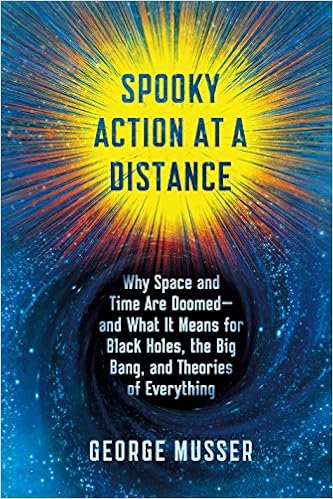
A new book on Loop Quantum Gravity

Amazon link

Some excitement about this book over at Backreaction. This from 'naivetheorist' in the comments.
".. a new book "Quantum Space" (available at Amazon UK now and at Amazon in a few weeks) is a really superb book on LQG. It is a 'pop science' book only in the sense of being equation-free. it traces the history of the development of LGQ (and string theory as well) and provides relevant biographical details on Rovelli and Smolin. it is by far the most impressive book on 'foundational physics' (as it is 'modestly' referred to by those who work on quantum gravity). I hope you will review this book with the usual incisiveness that you use in discussing arXiv manuscripts."
You can read my own thoughts here.

Monday, October 01, 2018

Witch Hunt at CERN


From the BBC website:
"A senior scientist has given what has been described as a "highly offensive" presentation about the role of women in physics, the BBC has learned. At a workshop organised by Cern, Prof Alessandro Strumia of Pisa University said that "physics was invented and built by men, it's not by invitation". He said male scientists were being discriminated against because of ideology rather than merit.

He was speaking at a workshop in Geneva on gender and high energy physics. Prof Strumia has since defended his comments, saying he was only presenting the facts. Cern, the European nuclear research centre, described Prof Strumia's presentation as "highly offensive". The centre, which discovered the Higgs Boson in 2012, has removed slides used in the talk from its website "in line with a code of conduct that does not tolerate personal attacks and insults".

Prof Strumia, who regularly works at Cern, presented the results of a study of published research papers from an online library. He told his audience of young, predominantly female physicists that his results "proved" that "physics is not sexist against women. However the truth does not matter, because it is part of a political battle coming from outside".
This is all wearisomely familiar from the James Damore case at Google a year ago. If the institutions which are dedicated to truth in science can't defend it against political pressure, who can?

Here's the offending slide presentation (PDF) by the way. It's ponderous-humorous and a bit technical; the BBC cherry-picked remarks they could use out of context. Read it if you dare!

---

On the strength of it all I decided to let Luboš back.

The Reference Frame is hereby reinstated on the right-hand side of the web version in the blog list. For all his extravagant language, grotesque and offensive personal insults and tone-deaf histrionics, the physics, though partisan, is good and the attacks on SJW nonsense merited.

In Luboš's post yesterday, "Nasty SJWs persuade spineless CERN officials to start an inquisition trial against an Italian scientist", the professor at the centre of the row, Alessandro Strumia, added this piece in the comments:
"Thank you Lubos for writing me alerting about this mess; let me clarify.

CERN organised this "gender workshop". Having recently worked on bibliometrics, I had the data relevant for the workshop, so I did the simple checks that should have been done before claiming that physicists are sexist, etc etc etc

Next I went to hear the workshop, that was ignored by almost all theorists who privately have bad opinions about it.

One of the speakers told (as if this were common knowledge) that words such as “competitive”, “conservative”, “hardworking” are bad. A participant said that physicists are second only to military in sexual harassment. And the rest was along similar lines, as clear from the quotations on my second page. Have a look at the other talks still kept on line by CERN, and switch “men" with “women”, and then decide if they are sexist.

It was clear that anything different from their line would have been discredited and ignored. And the objective results that I got from bibliometrics did not support their line: there is no discrimination against women.

This is a good news, but it's not what they want.

Like with LHC results, which are not the best we hoped, it’s our duty to present honestly what we get.

That’s why I decided that the only option (apart from self-censorship) was openly talking about the alternative ideas “discredited” in past gender workshops and that they don’t want to hear, from Simon Baron Cohen, to Summers...

Having spoken with many physicists and friends (including female physicists who attended the workshop), I am fully sure that the big majority understands, although many of them fear the consequences of speaking. I myself tried to find somebody else who dared to speak in my place, and I decided I had to speech only after having seen courageous people that in the past years begin to openly challenge the ideology (like the guy who said “ideological echo-chamber" and was fired by google), and that people thinks very different than media etc.

So I hope to survive and keep doing the physics that I like. Although I am worried that, acting on self-conservation instinct, CERN might worsen a bad situation.

After the talk, I warned important physicists there “a mess will happen”, and they believed my worries were exaggerated. So I am sure that good honest people hosted and funded the workshop underestimating that it was politically-charged and driven by people who dislike our culture based on hard and smart work and on gender-neutral merit, which I think is worth defending.

The sexist attacks against physicists might violate CERN code of conduct, but I liked that CERN is so open to free speech that we can discuss the unpleasant issues raised by the workshop. The fact that my talk is no longer freely available makes me fear that somebody might want my head to appease a political area which is highly voted by academicians, but recently not so much by the people.

I am happy if somebody wants to discuss and check honestly what I wrote in the talk, but tomorrow I have to work full day.

PS Lubos: when you started blogging, I believed you were a totally wrong idiot. But your blog contains good physics, so I kept reading, and with time, I come to realise that I was wrong, and you were right, although too much ahead of time. A very great US physicist told me that you were even moderate, before what happened to you."

That final paragraph - very interesting. But I believe, based on his words above, that Professor Strumia is too naive and trusting to be long for this world.

Update (Oct 5th 18): BackReaction has been taking a look at the citation data Prof. Strumia was using, and at his slides: "Gender-bias in Academia: The Case Strumia". This seems the kind of debate you would expect within the physics community.

Sunday, June 17, 2018

"Lost in Math" - Sabine Hossenfelder

Amazon link

Sabine Hossenfelder is a quantum gravity phenomenologist - she links theories to experiments and observations - and she has a popular blog, Backreaction. She is also losing her faith in physics as it is presently conducted.

Here is the problem. The two great foundations of physics, quantum theory and relativity, are completely successful to the precision of existing experiments and observations. Yet they are mutually inconsistent. Attempts at unification (there are many, including string theory) are presently untestable, their verification beyond the limits of colliders and instruments. There are other conundrums too such as the nature of dark energy and dark matter. In the absence of experimental data, ungrounded theories abound - they are cheap, after all! - driven by aesthetics and groupthink.

Hossenfelder is not a superstar physics-populist with a major TV contract and a slew of pop-sci publications. 'Lost in Math' is not intended for that market. It's an extended meditation on the consequences of the absence of meaningful experimental feedback. The author interviews the world's leading physicists (Witten excepted) and is typically unimpressed by what she hears. Her reactions are ironic, sardonic and hilarious. Her text reports back as if talking to peers. How refreshing.

As a bonus you get an insider's view of the hot issues: what's really happening at the LHC, the role of dark matter in cosmology and the evolution of the universe .. as well as the failure of all attempts to characterise it, the problems with the flavours of multiverse, the measurement problem, the black hole firewall controversy.

There's no easy solution to the great stagnation in fundamental physics. The author is keen that the community should be more aware of its cognitive biases, its herd behaviour and groupthink but it seems difficult to identity the incentive to improve.

As for Sabine Hossenfelder herself, she may believe that publication of this book has killed any chance of tenure for ever, but probably it hasn't. One niche closes, another opens.

I had my doubts about buying this book. Would I really learn anything that I hadn't already picked up from many other popular science books and innumerable blog posts? And is the fragility of  beauty, naturalness and elegance as criteria for theory acceptability really enough to sustain a whole volume? Yet Hossenfelder's work is wider and more profound than that. Her tour of the state of the art is a joy to read, discerning and intelligent insights sprinkled throughout. I was engrossed from beginning to end.

Friday, January 20, 2017

Programming is so .. arid

Helena Cronin wrote:
"Women on average have a strong preference for working with people - hence the nurses and teachers; and, compared to men, they care more about family and relationships and have broader interests and priorities—hence little appeal in becoming CEOs. Men have far more interest in "things" - hence the engineers ... "
I'm sitting here looking at a short recursive function which returns a tree whose nodes are themselves a complicated data-type (Atom-list x Nat x Nat) and I'm trying to do minimax on it. The Lispworks 'Listener' has replaced the Atom lists with hash signs (why?) and the arithmetic min function complains it's getting something weird rather than Real - and has thrown me into the debugger.

Why?

The code looks good, although there are so many good-practice projector and constructor functions, cluttering the text.

I sit in frustration, trying to visualise the unwrapping of the computation as the nested mutually-recursive functions execute their combined paths to disaster. Part of me wants to chuck this code away; another part muses that this would mean I was getting even more stupid in my old age.

I review the psychological characteristics required for successful programming.
  • An ability to mentally visualise complex and abstract structures - (heavily g-loaded)
  • A minute attention to detail - the smallest typos kill you
  • Obsessional perseverance when nothing goes right and time-wasting options beckon.
If ever an occupation required what Simon Baron-Cohen calls the 'systemizing brain', this is it.

---

Update: (Twenty minutes later).

OK, so it was a type clash. I forgot to update a previous sub-function. Needed to add some projectors. So now I have a result.

Shame it's not the one I actually need ...

---

Some print-journalism stays with you. I regularly recall a right-on female commentator on The Times using her column to weigh in on gender equality in programming. After some shocking statistics she recounts how she asked her daughter if she had considered becoming a programmer. Her daughter looks at her as if she is mad: "Why would I want to do anything as boring as that?"

The daughter's mother is not of course a programmer. She's an opinion-piece journalist, a job where you get to meet and socialise with important people and then write lots of stuff of interest to your like-minded pals.

*Sigh*.

---

In case it isn't obvious, I know there are good female programmers. I know there are good female physicists (see here). It's just .. we're talking distributions here - you know, bell-shaped curves? - and the male-female means are noticeably different.

Strive for equality of opportunity; do not expect equality of outcome.

Friday, May 27, 2016

A tourist map of physics

This interesting cube-diagram is from Jess Riedels' blog.


The idea of this diagram is that the fundamental theories of physics can be placed in three dimensions as to how they treat gravity, the speed of light and Planck's constant h-bar, ℏ.

Gravity

G is Newton's gravitational constant as in his law F = Gm1m2/r2. When we dial G to zero we're in domains where we ignore the effects of gravity. Most of quantum theory is here, as is special relativity and classical mechanics.

The speed of light

Strictly speaking the important thing about our universe is not the weirdness of the speed of light, it's that in the large the universe's structure is Minkowski spacetime, not our intuitive 3D Euclidean space + time. This is a difference in metric, as well-explained here.

If you dial the speed of light to infinity (so 1/c goes to zero) then the space + time metric tends to that of common sense.

Planck's Constant

This is the weird one. Quantum phenomena such as superposition and entanglement emerge mathematically from the non-zero value of , most clearly seen in the uncertainty principle.

However, the emergence of classical physics from quantum mechanics as you reduce to zero isn't too clear. The state space of quantum mechanics is an abstract structure, a complex high-dimensional vector space called Hilbert space, which is not directly mappable to spacetime.

---

You might say that seven out of the eight nodes on this cube are well-established - the central mystery of contemporary fundamental physics is the eighth, quantum gravity.

Thursday, April 07, 2016

Today's links

Around the Internet today for your amusement and education.

1. 10 Essentials of Quantum Mechanics

As the title suggests, Backreaction lists ten key points. It's a bit subjective as to which is the greatest misconception corrected here, but I'd vote for number 4.
"4. There is no spooky action at a distance

"Nowhere in quantum mechanics is information ever transmitted non-locally, so that it jumps over a stretch of space without having to go through all places in between. Entanglement is itself non-local, but it doesn’t do any action – it is a correlation that is not connected to non-local transfer of information or any other observable.

"It was a great confusion in the early days of quantum mechanics, but we know today that the theory can be made perfectly compatible with Einstein’s theory of Special Relativity in which information cannot be transferred faster than the speed of light."

2. A spat about increasing human IQ

Why did Scott Alexander (Slate Star Codex), Garrett Jones (Hive Mind), and Razib Khan (GNXP) even bother to alert Steve Hsu to this pernicious post, and who is PZ Myers anyway?

Whatever - Professor Hsu gives a reasoned and educational reply.
"Myers is both confused and insulting in his blog post, but I'll refrain from ad hominem attacks, and just focus on the science.

Myers seems to think that humans with much better cognitive abilities than our own can't exist. Sort of like a farmer in 1957 claiming that chickens that are bigger and faster maturing than his own could not exist [...] . I urge Myers to read some books on population genetics before returning to this discussion.

"The argument for why there are probably genomes not very different from our own, but which lead to much better cognitive ability, is very simple, and I went through it in a post called Explain it to me like I'm five years old [...] ."
Worth following the link even if you're older than five.

3. A spat about the KKK on campus (Indiana University)

Via Breitbart (h/t Steve Sailer).
 'Students be careful, there's someone walking around in kkk gear with a whip.'

"Residential hall advisor Ethan Gill quickly wrote an email to his students, warning them of the “threat” on campus: “There has been a person reported walking around campus in a KKK outfit holding a whip. Because the person is protected under first amendment rights, IUPD cannot remove this person from campus unless an act of violence is committed. Please PLEASE PLEASE be careful out there tonight, always be with someone and if you have no dire reason to be out of the building, I would recommend staying indoors if you’re alone.”

"Later in the evening, Gill was forced to retract his warning on his Facebook page, where he clarified that the purported Klansman was actually just an innocent priest dressed in liturgical garments. The “whip” turned out to be the clergyman’s robe-like belt that was tied around his waist."


Are there no safe spaces anywhere any more? Will no-one think of the children?

Thursday, December 10, 2015

Emergent Spacetime


An extract from this book - (publisher, you have no idea how naff that front cover is).
"“Spacetime can’t be fundamental,” says the theorist Nima Arkani-Hamed. “It has to come out of something more basic.”

This thinking completely inverts physics. Nonlocality is no longer the mystery; it’s the way things really are, and locality becomes the puzzle. When we can no longer take space for granted, we have to explain what it is and how it arises, either on its own or in union with time.

Clearly, constructing space isn’t going to be as straightforward as melding molecules into a fluid. What could its building blocks possibly be? Normally we assume that building blocks must be smaller than the things you build out of them. A friend of mine and his daughter once erected a detailed model of the Eiffel Tower out of popsicle sticks; they hardly needed to explain that the sticks were smaller than the tower.

When it comes to space, though, there can be no “smaller,” because size itself is a spatial concept. The building blocks cannot presume space if they are to explain it. They must have neither size nor location; they are everywhere, spanning the entire universe, and nowhere, impossible to point to. What would it mean for things not to have positions? Where would they be? “When we talk about emergent space-time, it must come out of some framework that is very far from what we’re familiar with,” Arkani-Hamed says."
Emergent spacetime is a hot topic. Relativity assumes spacetime as a prior manifold and imposes geometry upon it. Quantum theory knows nothing - ab initio - about spacetime; its setting is a high/infinite dimensional complex vector space known as Hilbert space.

How are the two reconciled? Physical observables such as spatial position (momentum, energy, spin state are others) define coordinate systems (sets of basis vectors) within Hilbert space. It seems that Hilbert space is more fundamental than the spacetime we find ourselves in, but how do we get our perceived universe out of quantum theory? A unified theory needs to tell us but no compelling narrative has yet emerged.

I'm hoping this book can bring me up to date (in a sort of, a bit like, resembling kind of way).

---

A review from Backreaction (which de-risked this purchase for me).

Saturday, April 04, 2015

Confessions of an eternalist

Confession: I am an eternalist.


Eternalist Sean Carroll has a post up commenting on recent books by Lee Smolin and philosopher Roberto Mangabeira Unger who argue to the contrary. Reading the comments there is depressing  - people either don't understand the issue at all, or don't appreciate how to think about the subjective nature of 'now'. Physicists!

One physicist, Sabine Hossenfelder, has written an excellent and definitive analysis: here's an extract.
"The decisive ability that allows us to experience the present moment as being unlike other moments is that we have a memory. We have a memory of events in the past, an imperfect one, and we do not have memory of events in the future. Memory is not in and by itself tied to consciousness, it is tied to the increase of entropy, or the arrow of time if you wish. Many materials show memory; every system with a path dependence like eg hysteresis does. If you get a perm the molecule chains in your hair remember the bonds, not your brain.

"Memory has nothing to do with consciousness in particular which is good because it makes it much easier to find the flaw in the argument leading to the problem of now.

"If we want to describe systems with memory we need at the very least two time parameters: t to parameterize the location of the particle and τ to parameterize the strength of memory of other times depending on its present location. This means there is a function f(t,τ) that encodes how strong is the memory of time τ at moment t. You need, in other words, at the very least a two-point function, a plain particle trajectory will not do.

"That we experience a “now” means that the strength of memory peaks when both time parameters are identical, ie t-τ = 0. That we do not have any memory of the future means that the function vanishes when τ > t. For the past it must decay somehow, but the details don’t matter. This construction is already sufficient to explain why we have the subjective experience of the present moment being special. And it wasn't that difficult, was it?"
I'm not so much into perms as my preferred physical model of subjective temporal experience. If you imagine a robot with an updating model of observed-reality obtained from its internal and external sensors, it's easy to see that examining its own memory store at any instant at all the robot can persuade itself that this instant "now" is special. But all introspective moments are like that. If we saved each database-state where:
"the robot notes that it is aware of itself and its environment now"
to disk, there would be nothing fundamentally distinct about any of them.

That robot is, functionally, me and you and sits easily in the block universe.

Saturday, January 04, 2014

No such thing as free will

Sometimes you know something, but it's stuck in a compartment in your mind: you don't apply it to other stuff you think you know. Many people, for example,  know that our current understanding of fundamental physics - the standard model of quantum mechanics plus relativity - can successfully account for all observed phenomena at the level of molecules and their atomic and subatomic constituents - with no exceptions.

And this has consequences, given that you are constituted from molecules, as theoretical physicist Sabine Hossenfelder writes.
"All known fundamental laws of nature are either deterministic or random. To our best present knowledge, the universe evolves in a mixture of both, but just exactly how that mixture looks like will not be relevant in the following.

Having said that, I need to explain just exactly what I mean by the absence of free will:

a) If your future decisions are determined by the past, you do not have free will.

b) If your future decisions are random, meaning nothing can influence them, you do not have free will.

c) If your decisions are any mixture of a) and b) you do not have free will either."
Read the full piece here.

Evolution has similar implications. Somewhere in "The Selfish Gene" Richard Dawkins wrote that once evolution had been discovered, all previous discussions of philosophy, sociology, psychology and morality pertaining to the human condition were rendered obsolete. E. O. Wilson made similar remarks in his impressive book "Sociobiology".

The impact of these insights on contemporary culture has been largely zero.