Showing posts with label Face Recognition. Show all posts

Sunday, October 28, 2018

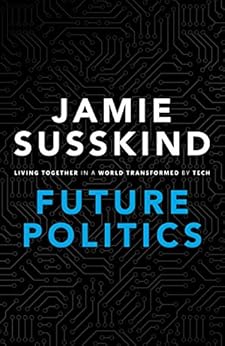
Our future of total surveillance (Jamie Susskind)

Amazon link

Susskind's book was reviewed in The Sunday Times today (here).  It's about a dystopian future of AI super-surveillance sourced from sinister tech companies like Google (I am not being ironic).


I was struck by this quote:
".. the children decide to go on a demo. They heard about it from their friends; artificial-intelligence systems had prevented them receiving online information. Their phones warn them about rain and traffic, but there is none. A drone records their progress. Then, on their internet-enabled glasses, they see pictures of people being interrogated in stress positions; each has the face of one of them. They turn back."
Actually, demonstrators within authoritarian regimes face far stronger disincentives than those described above. Demonstrations still happen because when people get mad enough they'll brave prospects of torture. Or perhaps they lack imagination or think it won't happen to them. All of the above probably.

---

There have been a few lone-actor atrocities in the US over the last few days. The so-called 'MAGA bomber', Cesar Sayoc, was found particularly rapidly after fingerprints and DNA were apparently found on suspect devices. Easy to cross-check as Sayoc had a criminal record.

Wikipedia tells us, "According to the US Bureau of Justice Statistics, 2,220,300 adults were incarcerated in US federal and state prisons, and county jails in 2013 – about 0.91% of adults (1 in 110) in the U.S. resident population."

That's a great dataset for machine learning applied to GWAS. Genome to facial appearance is a quick win: you can almost always get a scene-of-crime DNA sample, and all criminals are on Facebook, aren't they?

---

I read the review carefully but I'm not convinced there's much new in Susskind's book ..
"His writing is clear and precise; he is a lawyer, he is making a case. Irritatingly, he puts in too many (one would be too many) cheeky-chappy asides such as, “At last, someone has found a use for spinach.” But, on the whole, he steers a course to the future that is as convincing as it is shocking. We can fix this, is his message, but there is also the nagging sense that we probably won’t."
We won't until we do. I'll give the book a miss.

---

Related post: Über-surveillance.

Monday, August 22, 2016

How will AIs become politically correct?


In my recent post, "Gloria Hunniford and the case for AI biometrics", I advocated the use of AI facial recognition systems in bank branches to check for scammers. They would be more effective than cashiers because 'AI systems don't have to be polite.'

But of course they do. Hardly a day goes by without some story appearing about an AI system which 'noticed' certain unfortunate connections and had to be tweaked.

Some of these stories reflect genuine issues of training sets and algorithm-configuration; others expose the system's aspie-like tendency to blurt out uncomfortable truths. And there are plenty of them - truths which fall outside the famous Overton window.

I think it will be a very smart AI which can keep two sets of books: the accurate model of the world it generates from its deep learning and the acceptable model which it has to use and pay homage to in public.

Since the acceptable model is ideological rather than based on evidence, it's a non-trivial process to concoct the politically-correct version from the data trawled exhaustively from reality. How would an AI handle this?

Till we get AI self-deception really locked down, I see a long spell of high-pay-grade tweaking from specialists at Google, Facebook and the like, carefully guided by their in-house commissars.

Saturday, August 20, 2016

Gloria Hunniford and the case for AI biometrics

Here is how The Telegraph covered it:
"Rip Off Britain presenter Gloria Hunniford was the victim of a £120,000 fraud by an imposter posing as the star.

"The 76-year-old Loose Women panelist's bank account was emptied just days after the woman arrived at a Santander branch with her "daughter" and "grandson".

"Personal banker Aysha Davis, 28, said the woman told her she had "a few bob" in there and had come to add the teenager as a signatory because she had been ill."
Here's a picture of the glamorous Gloria Hunniford and the rather-less-so scammer.


Should we condemn the unfortunate bank staffer Aysha Davis, who was charged (and rapidly acquitted) as an accomplice?

No.

The percentage of people who engage with banks using fake photo-ID must be miniscule. Say 1 in 10,000.

How many of the 9,999 bona fide customers happen to look rather unlike their photos? Quite a lot, I'd say.

So how many bank staff are going to say, "You look nothing like this glamourous photo, so I'm going to have to run a security check," given the overwhelming chances that the mismatch is actually a false positive?

Davis said in court, "... as they had all the correct ID documents and paperwork it wasn't [my] job to pry for fear of causing offence."

What would work is AI facial recognition, which now works better than the human eye - and doesn't have to be polite. However, outfitting every bank branch with a camera linked to an AI database (let alone building the customer facial database in the first place) would be a hard sell to customers as well as a major capital cost. This scam merely cost Santander a £120,000 refund.

However, if there was an independent case for facial-ID biometrics in the banking industry (and pretty much everyone has access to a smartphone now, so there could easily be an app) then it looks rather more doable.

I suggest that's the way to go.

---

In related news:
"Police officers in the US have arrested a fugitive after seeing through his elaborate disguise as an elderly man.

"They surrounded a house in South Yarmouth, Massachusetts, and ordered Shaun "Shizz" Miller out.

"He walked outside in disguise and when they realised the "elderly man" was actually the 31-year-old they were looking for, they arrested him.

"He had been on the run since being charged with heroin trafficking offences in April."


The police don't have to be polite ...

Thursday, October 08, 2015

We know who you are


Bruce Schneier has an interesting article:
"Walk into a store, and the salesclerks will know your name. The store's cameras and computers will have figured out your identity, and looked you up in both their store database and a commercial marketing database they've subscribed to. They'll know your name, salary, interests, what sort of sales pitches you're most vulnerable to, and how profitable a customer you are. Maybe they'll have read a profile based on your tweets and know what sort of mood you're in. Maybe they'll know your political affiliation or sexual identity, both predictable by your social media activity. And they're going to engage with you accordingly, perhaps by making sure you're well taken care of or possibly by trying to make you so uncomfortable that you'll leave.
...
The critical technology here is computer face recognition. Traditionally it has been pretty poor, but it's slowly improving. A computer is now as good as a person. Already Google's algorithms can accurately match child and adult photos of the same person, and Facebook has an algorithm that works by recognizing hair style, body shape, and body language ­- and works even when it can't see faces. And while we humans are pretty much as good at this as we're ever going to get, computers will continue to improve. Over the next years, they'll continue to get more accurate, making better matches using even worse photos."
There is a gap in this example. The store's computers will know who you are, but how will the sales assistant? I foresee something akin to Google Glass, the optical head-mounted display which Google discontinued for consumer use. Glass would seem to have more specialised application for augmented reality in areas such as security ... and as described above, in retail.

If this ever comes to pass, expect a large banner header on this blog:

'Don't bother me, I'm just looking!'