Showing posts with label Amazon. Show all posts

Thursday, March 09, 2017

Replika is massively oversold

Replika was originally going to be your own, online personal doppelgänger. Given the current state of the art with chatbots (tiresome and useless), that was always going to be a stretch.

The current PR says:
"Replika is your personal AI friend that you nurture and raise through text conversations. It is a lifetime companion who is always there for you, chats with you, keeps your memories, and helps you become more connected to yourself."
They're busy trying to create doable spin-offs such as a personal diary ("A Cute Diary That Keeps Itself").

Given date-slippage, I had thought that the whole Replika thing might have silently collapsed, but I suppose there is no shortage of people who are happy to update a super-Eliza forty times a day with details of their every mundane activity.

Facebook.

There would be a lot of interest in a virtual friend, endlessly attentive and caring  (except that's not a friend, more a courtier - artificial sycophancy). But if this were in the state of the art, one of Google, Microsoft, Facebook, Amazon or Baidu would have done it already. It's plainly on the future roadmap for the plethora of voice assistants, but today's systems are no more than super-recognisers.

---

Have you ever had the experience of being in a technical meeting, in an area not wholly in your sphere of competence, and suddenly you lose the plot? For a moment, you just don't know what everyone else is talking about. You pray no-one will ask for your opinion.

If you're lucky, in a minute or two the topic will move on and you will rejoin the shared context.

What happened there? The participants shared an internal cognitive model of what the conversation was about, and yours frayed. But no chatbot today can maintain an internal model of any complexity.

Worse: the topics of mundane discourse are open-ended, rooted in a complex culture and often private. Do we even want our AI-in-the-cloud to share personal and family intimacies, possibly with any interested intelligence agency?

---

Your Replika AI friend is going to get 40 bland texts per day from you. Some of the questions already seem rather intrusive.


There is a hint of blank-slate about current AI. As if one standard optimised neural-net architecture could create the ideal artificial personality template, which then gets loaded with data to become an individual.

We know that people aren't like that. Common experience and psychometric data tells us that people have distinct personalities, that these are strongly heritable and resistant to change. We all know, as folk psychologists, that we deal with people as distinct individuals, not clones. And that most of those differences are innate and resistant to social influences.
"She thinks she can change him!"
No she can't.

So many mountains to climb.
  • Why is the brain structured as modules, not one uniform design?
  • How is the architecture of personality differences implemented?
  • How to immerse an AI in common knowledge, culture and mores?
  • How does social deftness, tact and propriety work?
  • What's an effective, useful and pleasant engagement model - corporeal?

Yes, I am prepared to be disappointed with Replika.

---

Update: 9th March 2017.

"Replika AI to launch on the App Store

"Today, we are excited to announce that Replika will appear on the Apple’s App Store on March 13 at 12:00 AM Pacific time. We’d like to thank all the participants of the app’s preview in Testflight for the incredible feedback that helped us shape the app."

Wednesday, November 16, 2016

My Exercise Bike Journey

I understand this post is of limited interest, being basically another mundane "I ordered it from Amazon but it didn't work" saga, but I've written it up for my records, and as a basis for an Amazon review once the journey has ended.

---

I bought the Ultrasport F-Bike 200B Exercise Bike from Amazon on September 30th 2016. It arrived about a week later and with some effort I assembled it. At first all went well - it was the ideal warm-up and warm-down machine, bookending weight training. And then it developed an annoying, intermittent jerkiness and thudding noise which, while not preventing use, made it uncomfortable.


I ignored this for a while hoping - idiotically - that it would go away. But yesterday, after reading the Amazon one-star reviews (I was not the only one), I wrote to the German manufacturer (email address: service.uk@ultrasport.net) as follows.
"Dear Sir/Madam,

I bought your exercise bike via Amazon.co.uk. My order was placed on 30th September 2016 and it was dispatched on October 3rd.

However, it has a fault. In use there is an intermittent clunking sound from the cycling assembly - and as it clunks there is a momentary stiffness/resistance, almost as if a bearing is defective. This makes cycling both noisy and uncomfortable.

This is a great disappointment to me - I chose your product as I believed it was of high quality and would 'just work'.

I notice that on the Amazon site there are a number of 1-star reviews which complain of a similar problem.

Is there anything I can do here at home to fix this problem, or can we discuss arrangements to replace the item?

Yours sincerely,

Nigel Seel."
I received this (my emphasis) in reply:
"We’re sorry to learn that your F-Bike seems to have arrived in faulty condition. From what you describe it sounds as if one of the drive belts has slipped out of position. This is not a fault that can easily be repaired. We’ll therefore be glad to replace the bike for you under warranty. In order to arrange this we’ll only need to see your proof of purchase.

Unfortunately, since you bought the product directly from Amazon UK, we don’t have access to any of your purchase details. Would you please come back to us with a copy of your delivery note  or the order confirmation mail you received from Amazon? Also, your telephone number would be great, since UPS likes to have those with the shipping documents.

As soon as we have all the background details complete, we can ship the replacement bike.

Thank you for your patience and cooperation.

Please don’t hesitate to contact us again, should you have any further questions.

For future correspondence please use the Reply button to ensure smooth communication. Thank you.

Kind regards,

Ultrasport Service Team"
After a further email to share Amazon's order confirmation email details, this:
"Hello Nigel,

Thank you for your message with the purchase details.

Now we have everything we need to ship your replacement bike.

It will be handed to UPS and should arrive within a week.

As regards the faulty bike, it doesn’t really make sense to have it shipped back to Germany – the freight costs are simply too high. Would you mind very much disposing of it locally, perhaps in your local recycling yard? That would be very kind.

Thank you for your cooperation.

Please don’t hesitate to contact us again, should you have any further questions.

For future correspondence please use the Reply button to ensure smooth communication. Thank you.

Kind regards,

Ultrasport Service Team"
So good service. Hopefully it will arrive in a week and then it will work properly.

More later.

---

Update; Tuesday, November 22nd 2016

The new bike arrived this morning, and after an hour's work it's assembled and working OK - on a brief trial. We shall see.


Thursday, June 09, 2016

Power starvation

Isle of Wight Music Festival

Ever sat in a tent watching the battery on your phone or tablet die, with no mains power?

Such was my experience in Minehead last weekend. So I bought this:

RAVPower 26800mAh 3-Port 5.5A iSmart Output
Portable Charger Compact Power Bank External Battery Pack

It performed flawlessly, quickly recharging Clare's iPad, my Nexus 6 phone and my Nexus 10 tablet.

It then took around 14 hours overnight to recharge the Power Bank from empty, using the iPad's 5V 2.1A USB mains-charger.

---

Tablets charge at 5V 2.1A from a USB mains-charger while for phones it's 5V 1A.

You can charge a tablet from a 1A phone charger - but it takes twice as long; you can charge a phone from a 2.1A tablet charger - the extra current capacity makes no difference and can't be used by the phone - but it's perfectly safe.

My Nexus 6 phone has a 3220 mAh battery, my Nexus 10 tablet has a 9000 mAh battery while Clare's iPad 2 has a 6,944mAh battery.

At 1 amp you would predict that the phone would take just over three hours to charge, the iPad would take seven hours and the tablet 9 hours.

This is why it makes sense, tablet-wise, to invest in a 2.1 amp charger like this, rather than just reusing old phone chargers, so as to halve these times..


AmazonBasics Wall Charger with USB Outlet (2.1 Amp Output)

---

Due to various inefficiencies, you should multiply the device charging times above by up to an additional 50% (assuming you were charging from empty - but recall you are advised not to let the charge drop below 30% for long-term battery-health reasons).

Thursday, May 19, 2016

Army ready?

"The famous run is a 2.4km (1.5 mile) track in which you must complete the full distance within the given time. The time you have to complete the run will vary depending on the position within The Army that you have applied for.

"Before starting your timed run, you will warm up as a squad with the other people in the selection process. This consists of a slow jog and walk over a distance of 800 metres.  You will then immediately begin your test.

"The required times for the various regiments within The Army are as follows:

"Parachute Regiment - Run Time 09.40"
OK, so we're not going there.
"Royal Signals, Army Air Corps, Royal Logistic Corps, Royal Electrical & Mechanical Engineers, Adjutant Generals Corps, Army Medical Services, Royal Army Veterinary Corps, Intelligence Corps, and Corps of Army Music – Run Time 14.00"
In my school CCF I was in the Signals, so let's take 14 minutes as my target. If you run a km in five minutes (12 km/hour) you will run 2.4 km in 12 minutes. Way to go.

I don't usually use the treadmill in the gym. Too many historical problems with my knees after years of pavement jogging. But this morning I did five hard minutes on the cross-trainer, then did five minutes at a fast-but-comfortable pace on the treadmill.

Distance run in five minutes? 0.88 km.

Time for 2.4 km at this pace = (2.4/0.88) * 5 = 13 minutes 38 seconds.

I'm army-ready.

---

Is the British Army ready? This morning, Amazon delivered General Sir Richard Shirreff's new book, "2017 War With Russia: An urgent warning from senior military command", ordered on the back of my recent reading of Mark Urban's tale of military unpreparedness, "The Edge".


From the blurb:
"Written by the recently retired Deputy Supreme Allied Commander Europe and endorsed by senior military figures, this book shows how war with Russia could erupt with the bloodiest and most appalling consequences if the necessary steps are not taken urgently.

"President Putin said: 'We have all the reasons to believe that the policy of containment of Russia which was happening in the 18th, 19th and 20th century is still going on...' And 'If you press the spring, it will release at some point. Something you should remember.'

"Like any 'strongman', the Russian president's reputation for strength is everything. Lose momentum, fail to give the people what they want and he fails. The President has already demonstrated that he has no intention of failing. He has already started a lethal dynamic which, unless checked right now, could see him invade the Baltic states.

"Russia's invasion and seizure of Georgia in 2008 was our 'Rhineland moment'. We ignored the warning signs - as we did back in the 1930s - and we made it 'business as usual'.

"Crimea in 2014 was the President's 'Sudetenland moment' and again he got away with it. Since 2014 Russia has invaded Ukraine. The Baltics could be next.

"Our political leaders assume that nuclear deterrence will save us. General Sir Richard Shirreff shows us why this will not wash."
I see the Amazon comments are already being filled up with 'warmonger!' sentiments. And naturally one would like to discount books like this in advance, on grounds of special pleading and bureaucratic rent-seeking.

But the job of the armed forces is to defend the country against credible threats. If a senior guy believes it's incapable of doing that, he has a duty to speak out and give chapter and verse.

So I'm going to read this one carefully.

Wednesday, May 04, 2016

"The Secret of our Success" - Joseph Henrich

Luke tells us that "there is rejoicing in the presence of the angels of God over one repentant sinner."

There is similar rejoicing in heaven over anthropologists who embrace gene-culture coevolution. The late Henry Harpending was the paradigmatic example while Joseph Henrich, by contrast, has only made it part of the way.


That being said, the stellar reviews of "The Secret of our Success" correctly identify the good parts of Henrich's new book. We are cultural beings to the core and without the wisdom of our societies our big brains and high IQs are as nothing. Henrich's paradigmatic example is well described in this review from Joe Brewer:
"HMS Erebus and HMS Terror .. left port in June 1845 from the British Isles under the command of Sir John Franklin in search of a Northwest Passage that could energize trade by connecting western Europe to East Asia. They were outfitted with two field tested ice-breaker vessels equipped with state-of-the-art steam engines, retractable screw propellers, and detachable rudders. They also had five years of provisions and were prepared to deal with the harsh winter in the Arctic Ocean. And yet, even with all of these things going for them, the crew was forced to abandon ship in their second year and move onto King Williams Island—where they became fragmented into small groups and forced to the point of cannibalism before all dying eventually.

"The crew was in an area where Inuits had lived for thousands of years, some of whom came into contact with the shipwrecked crew during the time they were stranded there. It was a harsh environment where the locals had amassed a repertoire of knowledge about how to build kayaks and igloos, hunt sea animals for food, and scavenge for plants during the brief warm spells of summer. Unfortunately for the British explorers, this body of cultural knowledge was not available to them and they suffered the consequences."
Henrich has many similar anecdotes about the adaptations which enabled humans - uniquely amongst primates - to develop, share and propagate a collective culture, something we understand in business when we say that 'good processes get excellent performance from average people'.

Still, there are things not to like. The book is too long: after a promising start it becomes a long-winded sprawl, obscuring the big picture.

Henrich has not internalised modern thinking in genetics, particularly population genetics; his underlying mental framework is still at heart blank-slatism. He doesn't understand the genetics of racial differentiation (cf Greg Cochran's post "Such a thing"); he thinks humankind is still evolving into more effective cultural animals (where's the evidence for selection for that?); and many of his assertions - the reasons for the menopause, for example - are far less settled than he suggests.

The book, despite its flaws, is well worth reading as an antidote to Dawkins-style evolutionary individualism. Ironically it's by far the best account of what a theory of memes would actually look like. But its approach to genetics makes one wince.

Monday, April 11, 2016

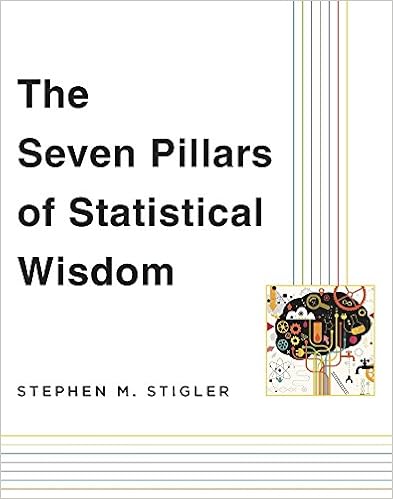
"The Seven Pillars of Statistical Wisdom" by Stephen M. Stigler

A review of: "The Seven Pillars of Statistical Wisdom" by Stephen M. Stigler.


Every student of an abstract subject like maths, physics or even philosophy is familiar with this: you are introduced to a foundational concept yet it seems pretty counterintuitive, and you can think of a number of reasons why the said concept ought to be considered problematic. Yet somehow, the textbooks are less than sympathetic.

My advice is to check the history of the under-motivated concept. The original formulations were often so much more compelling, especially when you realise precisely what problem their authors were trying to solve. Your own misgivings may well be represented in critiques by the innovator’s contemporaries.

It was the very success of later generations which led to the wholesale reconceptualisation of their subject’s foundations.

And so it is with statistics, a subject where deep ideas are often obscured by a focus on technique, and where it sometimes seems that little distinguishes a correct line of argument from an equally plausible, but fallacious, alternative.

Professor Stephen Stigler, in this determinedly historical book, starts with a concept as apparently trivial as the mean, or average, of a sequence of observations. Even this is counterintuitive as it requires discarding information, the individuality of the observations. By what right are ‘bad’ measurements to be treated in the same way as ones we think, or know, to be of higher quality? It took quite a few years for the idea to catch on.

Stigler’s second pillar, information measurement, looks at the processing of large data sets. Opinion polls have made us somewhat aware that the accuracy of the proposed mean is proportional to the square root of the number of observations, not the absolute number.

Sampling was applied to the Royal Mint in Isaac Newton’s time, to ensure that the coins they produced used the right amount of gold. In the absence of a correct theory of standard deviation, the tolerance boundaries were set way too wide. Stigler dryly notes that Newton was warden, then master of the Royal Mint from 1696 to 1727 and that on his death in that year left a sizeable fortune. “But evidently his wealth can be attributed to investments, and there is no reason to cast suspicion that he had seen the flaw in the Mint’s procedures and exploited it for personal gain.”

Later chapters deal with hypothesis testing (pillar 3); statistical processing within the dataset itself, without reference to population norms – as in Student’s t-test (pillar 4); regression to the mean - a concept which proved very hard to pin down (pillar 5); experimental design, particularly when varying multiple qualities at the same time (pillar 6); and finally pillar 7, the notion that a complicated phenomenon may be simplified by subtracting the effect of known causes, leaving a residual phenomenon to which attention may now be focused.

If you are both interested and well-versed in statistics, you will find this book illuminating and witty. The converse also applies.

Monday, April 04, 2016

The Amazon parcel problem

Alice and Bob are both signed up to Amazon Prime and each is expecting a parcel to be delivered to their respective apartment the very next day. The Amazon delivery person will arrive sometime in the ten hours from 9 am to 7 pm, but there's no more definite information. Let's say delivery has a uniform probability distribution.

Both Alice and Bob plan to be at home to collect the parcel, but each also wants to spend an hour in the bath from where, unfortunately, you can't answer the door.

Alice says,
"The chances of the Amazon guy turning up in any of the 10 hour-long slots is exactly the same. It therefore doesn't matter when I take my bath, I always have just a 1 in 10 chance of missing the parcel."
Bob says,
"I'll be taking my bath at 9 am. If I do that I've got a 9 in 10 chance of the Amazon guy coming later than that.

"But suppose I'm stupid enough to delay the bath till, say, 5 pm. Sure if the guy already came, I'm good. But assuming the parcel hasn't yet arrived, there's now a 50% chance I'll be in the bath when it arrives. I'd be insane to bathe then.

"It's always better to take a bath early when an Amazon parcel is due."
Who's right?

---

Update: (Tuesday, 5th April, 2.15 pm).

I'm  more interested in why Bob's argument might ever be considered psychologically plausible.

Let's say we get to 2 pm and the Amazon guy hasn't come. Then the probability per hour of the parcel arriving in the next five hours has doubled from 10% to 20%.

Definitely riskier to take that bath!

This assumes that Bob forgets the (on average) half the days that the parcel did in fact come earlier - he collected it or it arrived between 9am and 10am and he missed it, being in his bath.

But people have a past-future asymmetry; they forget the past but worry about the future. Early deliveries don't give much cause for worry; late deliveries generate increasing anxiety as the day progresses.

People remember things like that - the late days come to predominate in memory. And they have the higher per-hour probability distribution for when the parcel will eventually be delivered.

'Best to bathe earlier'.

Wednesday, March 23, 2016

My automated PA (© Google Next)

Because I review science-fiction books on Amazon, new authors email me asking for a review of their latest work. It's a bit embarrassing knowing how to reply, but luckily I'm a beta-user of Google's next generation personal assistant (Google Next).

Since Google already knows so much about me, it has sensed my disquiet and has learned how to respond on my behalf, like a good PA should. I'm completely hands-off.

Here's an example of a (slightly anonymised) note I received yesterday, and the automated reply.
___


Hi Nigel,

I saw that you offer a lot of great reviews on Amazon. I'm the author of "V NZ FYRRCYRFF: FVZ 811", a newly released YA Science Fiction novel. I would love to send you a free copy of the ebook in exchange for your honest review.

http://www.amazon.co.uk/gp/product/O017NVITZH

If you are interested in reading and reviewing my book, I can send you the ebook as a gift through Amazon, as a mobi or as a pdf file. You can also download it for free through the Kindle Unlimited program.

If you're like me, you have a backlog of books you want to read. I'm okay if it takes you months to get to my book and review it.

Thanks for your consideration,

Wbuna

Author Wbuna Gjvff

----  And here is Napa's reply ---

Dear Wbuna,

Thanks for your recent email. You asked if Nigel Seel would review your science fiction book in exchange for a free copy. Please note that Nigel Seel does not check any books in exchange for free copies because he believes that this puts him under an implicit obligation to be more pleasant than he is normally. If he likes the tone of the book, so he can buy it anyway and review it then. He is unlikely to tell you, but you can see it on Amazon.

Nigel compliments you. On your marketing skills and wishes you every success with your book. It's a crowded market and he knows that a successful author to be very hard work.

Best wishes,

Napa.
Nigel’s automated personal assistant
Powered by Google Next © 2018.

Wednesday, January 01, 2014

Clare and the bath bomb

The video that should never have been posted on the public Internet. Don't know what a bath bomb is? Don't know how it works? View here and Clare will demonstrate her Christmas present.

Three Bath Bombs for Christmas


And here is the author opening his birthday presents.

Wednesday, January 30, 2013

Treats from Amazon!

How the post-person must have staggered up the driveway! Our Amazon delivery this morning included:

1. Nightrider by David Mace. I wrote a few days ago about the strange case of of vanished science-fiction writer David Mace: Nightrider is my second favourite book by this author after Fire Lance.

2. The Hollow Man by Dan Simmons (a T. S. Eliot reference). I'm currently immersed in Endymion, so almost three quarters through the four volume Hyperion sequence (this is my second reading), but The Hollow Man is new to me. Look out for a review in due course.

3. The Way (DVD). This is a film about the legendary Christian pilgrimage in North Spain - to the Cathedral of Santiago de Compostela (el Camino de Santiago de Compostela) - Saint Iago is St. James. The film was made by Martin Sheen's son, Emilio Estevez who was inspired by his own son's experience on 'The Way'.

Estevez's son Taylor (at the time 19 years old) and Martin Sheen (whose The West Wing TV series was in hiatus) took part in the pilgrimage route, driving the length of the Camino. On the way Taylor met his future wife, so that thereafter the Camino held special meaning for him. After the trip a series of discussions started between Sheen and his son for a movie about the Camino de Santiago.

We saw this film at the cinema and it made an impression - so now we get to watch it again.

4. Peppersmith Chewing Gum (12 packets). This is the legendary Xylitol chewing gum which is so good for your teeth, gums and maybe even ears! Another month's supply. We also have xylitol mints and dark chocolate.

And not from Amazon. The NHS wrote to tell me that two years have passed and I'm invited again to the NHS Bowel Cancer Screening Programme. My kit should arrive in two weeks: don't ask.