Showing posts with label Peter Turchin. Show all posts

Saturday, December 13, 2025

A cliodynamic analysis of the SNP in Scotland

---

Cliodynamics and the Scottish Independence Movement


Another example of the power of the Cliodynamics framework of analysis. Peter Turchin’s structural-demographic theory frames political upheaval in terms of deep forces rather than personalities or contingencies. In this analysis, his model highlights three dynamics: mass immiseration, elite overproduction, and state fiscal fragility. The interplay of these trends shapes whether societies remain stable or veer into crisis. It is illuminating to apply this lens to the Scottish independence movement.

For decades, the SNP has functioned as a counter-elite organisation. Its leaders and activists are talented professionals - lawyers, academics, politicians - who, within the framework of the London-centric United Kingdom, are blocked from the very top tier of elite status. Prime ministerships, treasury posts, intelligence leadership, senior ambassadorships, and control over monetary policy are all reserved to Westminster. Scotland’s elites hold positions of influence, but the most prestigious and powerful roles remain off-limits.

Independence promises to change that. A sovereign Scotland would multiply elite slots: cabinet portfolios, a central bank and governorship, top civil-service and military posts, regulators, and ambassadorships abroad. In cliodynamic terms, secession would absorb part of the elite surplus by creating a fresh pyramid of offices. This explains the persistent drive of the SNP and its allies: they have the structural incentive to keep pushing.

The problem lies with the masses. For Turchin, immiseration (stagnant or declining wages and prospects) among ordinary people supplies the fuel for counter-elites. Yet here the calculus is difficult. Scotland benefits from fiscal transfers within the UK, allowing higher public spending than its domestic tax base can sustain. Independence would mean replicating expensive state functions, assuming a higher deficit, and facing uncertainty over currency and borrowing: classic diseconomies of scale. To many Scottish workers and pensioners, the subconscious message is simple: life could get poorer, not better.

This mismatch between elite incentives and mass fears was stark in 2014. The referendum mobilised nearly half the electorate in favour of independence - remarkable given establishment opposition - but economic anxiety kept the “Yes” vote below 50%. The counter-elites could not fully align immiseration with their project.

Since then, Brexit, austerity, and Conservative dominance at Westminster have supplied new grievances. The case for independence is reframed as a chance to escape England’s trajectory, to rejoin Europe, to build a fairer welfare state. The SNP hoped that deteriorating UK politics will tilt the cost–benefit calculation for ordinary Scots.

But cliodynamics suggests that unless the UK itself enters deeper crisis - fiscal breakdown, contested elections, or draconian repression - the Scottish masses remain a brake. Counter-elites cannot carry secession on their own; they require a perception that independence alleviates immiseration rather than worsens it.

In this sense, the independence movement is structurally-driven but contingently-blocked. It will not vanish, because the elite incentive remains. But it will not triumph unless London delivers the kind of trigger event that redefines the economic risks of secession. If that occurs, the Scottish counter-elites will be ready, and the new elite pyramid will rise quickly.


Why the SNP is scandal-ridden and out of ideas—and why Reform is rising in Scotland

Longevity breeds establishment. The SNP’s long incumbency since 2007 has generated fatigue and clientelism. Financial investigations, leadership turmoil, and factional splits have eroded moral authority. A counter-elite that captures regional power without delivering its promised rupture starts to look like the establishment it opposed.

Strategic exhaustion. With London refusing a fresh referendum, Brussels cautious, and the economic case unpersuasive, the SNP’s narrative has stalled. Counter-elites without a credible path to power appear hollow; policy improvisation reads as drift.

Reform’s counterintuitive traction. In Scotland, Reform functions as a protest vehicle rather than a cultural fit. Immiserated voters use it to punish an exhausted political class in Edinburgh as well as London. Some frustrated Scottish aspirants also pivot toward a UK-wide populist ladder that seems to be moving while the SNP’s hierarchy ossifies.

Cliodynamic synthesis. The SNP’s decay is what happens when a counter-elite movement cannot consummate elite circulation. Reform’s gains signal that discontent will find an outlet across national lines when domestic counter-elites are discredited. Unless structural conditions change - or Westminster triggers a crisis that flips mass risk-perception - the Scottish independence project will remain structurally-incentivised yet mass-constrained.

Friday, December 12, 2025

'By Invitation: Peter Turchin' - (as emulated by ChatGPT)

Amazon

---

By Invitation: Peter Turchin

Cliodynamics at end-2025: The Deep Forces Driving Disorder


History does not unfold as a random sequence of surprises. Beneath the noise of daily events, there are slow-moving forces - demographic, economic, political - that rise and fall in patterns. Cliodynamics is the attempt to make these patterns both explicit and predictive.

Two years after End Times was published, we can already see how the mechanisms it described have continued to work themselves out, reshaping politics from Berlin to Brasília.

Take Europe. Germany, long the continent’s stabilising centre, has now suffered three consecutive years of recession. Energy prices remain high, skilled labour is in short supply, and the government has been paralysed by the constitutional straitjacket of the debt brake.

When the coalition collapsed in late 2024 and the country went to the polls again in February 2025, voters did not turn back to centrist stability. Instead, the parties on the far right surged.

The same story is playing out across Europe: Marine Le Pen’s National Rally in France, Nigel Farage’s Reform in Britain, the AfD in Germany. 

Rising populism is not a coincidence. It is the predictable response of societies where ordinary people feel immiserated while elites multiply and compete ever more frantically for scarce positions at the top, positions which are increasingly threatened by automation and AI.

This is what cliodynamics calls elite overproduction. When too many graduates chase too few prestigious roles, when lawyers, journalists and policymakers are produced in excess, a class of disaffected elites emerges.

Denied status, they turn against the system that trained them. They become entrepreneurs of discontent, mobilising the grievances of the masses. The populist wave in Europe is its clearest manifestation in decades; the dynamics point to further escalation.

The economic backdrop intensifies these pressures. Global growth has slowed to around 3% - barely enough to lift living standards. Inflation has eased from its peaks, but the response of governments has been to normalise emergency fiscal measures. Deficits are no longer temporary but structural. Public debt mounts, while citizens perceive that benefits are skewed toward asset-holders and insiders. This “wealth pump” - transferring resources upward - is the second great driver of instability.

Beyond Europe, the same dynamics appear in different forms.

  • In Georgia, hundreds of thousands took to the streets over contested elections and the question of alignment with Russia or the European Union.
  • In Brazil, outrage flared over the shackling of deported migrants and escalated into a full-blown tariff war with the United States.
  • In India, punitive American tariffs on exports have triggered talk in Delhi of closer ties with Moscow and Beijing.

These are not isolated events. They are outward signs of intensifying inter-elite conflict on the world stage, as great powers seek to defend or revise the distribution of wealth and prestige.

Even in the United States, with Trump’s return to office in January 2025, the structural pressures have not eased. Elite overproduction remains acute; the gulf between populist rhetoric and policy delivery continues to widen.

Protectionist tariffs may rally a base and assert American dominance, but they also create new grievances abroad and new inefficiencies at home. America, like Europe, has yet to resolve the contradictions driving its cycle of discord.

The lesson of cliodynamics is that these trends do not cancel each other out; they reinforce one another. Immiseration of the majority breeds anger from below. Overproduction of elites fuels competition at the top. 

When frustrated elites ally with disaffected masses, regimes destabilise. Add geopolitical rivalry and the erosion of democratic norms under intense intra-elite competition, and you have the conditions for systemic crisis.

This is the world of 2025. The “end times” are not an apocalypse but a turbulent passage in the secular cycle. History shows that such passages may lead to reform and renewal, but only if societies find ways to restrain their elites, broaden opportunity, and restore legitimacy to their institutions. Without such measures, the forces driving today’s disorder will continue to build towards more systemic breakdown.

Thursday, December 11, 2025

Cliodynamics on the novel '1984'

Amazon

---

Cliodynamics on the novel '1984'?

George Orwell’s Nineteen Eighty-Four presents us with a closed system. The Inner Party governs in perpetuity, the Outer Party serves, and the proles remain inert. History itself has been abolished. O’Brien tells Winston bluntly: the future is a boot stamping on a human face, forever.

Peter Turchin, founder of Cliodynamics, would raise an eyebrow. His structural-demographic theory insists that states are not timeless mechanisms but unstable equilibria, always subject to recurring cycles of expansion and breakdown. How would his analytic lens interpret Oceania?

Elite overproduction is usually the starting point. In real societies success breeds success; more credentialed aspirants emerge than there are elite slots available. Frustrated competitors form dissident cliques, sharpening factional conflict.

Oceania seeks to prevent this by capping the Inner Party at perhaps two percent of the population and ruthlessly purging any Outer Party member whose ambition rises too far. Yet even here the arithmetic looks shaky. The pipeline of Outer Party functionaries is large; the openings above are tiny. Over decades, the pressure must build. Constant purges offer no stable solution.

Factionalism is the critical marker for impending instability. Orwell insists that the Party has abolished all factional life, that its unanimity is absolute. Turchin would dismiss this as ahistorical.

Wherever elites exist, networks of loyalty and rivalry develop. The Brotherhood, whether real or fictional, is a structural inevitability: a latent factional pole, even if repressed to invisibility. Human nature reasserts itself, as the novel is at pains to point out.

Mass mobilisation is the wild card. Orwell insists the proles are politically inert, incapable of revolutionary initiative. Turchin would agree - until factionalised elites need them.

In most historical collapses, popular upheaval is catalysed from above, as competing elites recruit the masses into their quarrels. Oceania’s proles may not move on their own, but they form the raw material for factional-elite mobilisation - once the cracks appear above.

Finally, war. Oceania, Eurasia, and Eastasia are locked into endless, conflict, inconclusive by design. Turchin has often pointed out that war can stabilise a regime by unifying elites against the outside. But this effect is temporary. War drains resources, accelerates turnover, and exposes weaknesses. A genuine defeat, or a military stalemate that erodes resources, reopens the door to factional conflict at home.

Cliodynamics therefore rejects Orwell’s static dystopia. If Oceania were a real society, not a literary construct, its cycle would look familiar: elite overproduction, hidden factionalism, external pressure, mass mobilisation, systemic crisis.

The iron equilibrium of 1984 is an artefact of Orwell’s world-building, not a sustainable state structure. The real question is not whether Oceania would eventually collapse, but when, and under what stress trigger.

Orwell imagined eternity; Turchin insists on history.

Monday, December 08, 2025

Cliodynamics on Marxism - ChatGPT

Amazon

---

Cliodynamics on Marxism

Karl Marx was not wrong to insist that history has structure. His great contribution was to frame social dynamics as processes, not random events. He grasped that societies generate tensions within themselves and that these tensions can erupt in crises.

That core intuition is sound and aligns with cliodynamic analysis.

What Marx got right:

  • Class structure matters. The divide between those who control resources and those who labour is central. Value-appropriation and inequality are real drivers of conflict.
  • Cycles of boom and bust. He anticipated the periodicity of economic crises, even if he lacked the tools to model them rigorously.
  • The role of ideology. Marx saw clearly that ruling classes produce legitimising narratives to sustain power. This maps closely to modern recognition of how elites manage collective beliefs.

Where Marx went wrong:

  • Teleology. He assumed history has a predetermined end: classless communism. Cliodynamics rejects inevitability. Social evolution follows patterns, but the outcomes vary.
  • Reductionism. Marx reduced everything to economics and class. In cliodynamic models, other variables - demography, elite overproduction, state capacity, external war - are equally decisive. Class conflict is one strand, not the whole fabric.
  • Underestimating elites. Marx thought revolution would be driven from below. History shows mass uprisings succeed when factions of elites fracture and compete. Without that split, the state endures.
  • Static view of the state. For Marx, the state is conceptualised as the executive committee of the ruling class. In practice, states develop their own dynamics: bureaucracies, military establishments, fiscal logics that shape events independently of economic class.

So Marx’s value lies in the framing: history is structured, conflict-driven, and not reducible to individual whim. His error lies in the closure: a belief in inevitability, an overcommitment to class as the single lever, and blindness to the multiple feedback loops - elite competition, demographic stress, fiscal collapse - that make and unmake regimes.

From a cliodynamic standpoint, Marx opened the right door but walked into a cul-de-sac. The task is not to abandon his insight into structure, but to embed it in a fuller systems model.

Nigel: I would agree with this analysis.

Saturday, December 06, 2025

Cliodynamics in a Nutshell - ChatGPT

Amazon

---

Peter Turchin argues that large-scale history is not just chaos but shaped by recurring social forces. His framework, called cliodynamics, draws from ecology, systems theory and public choice theory. It identifies a few key drivers that tend to recur across societies.

One is elite overproduction. As wealth grows, more people rise into the elite class than there are elite positions (political posts, prestige offices, high-status jobs). This surplus of frustrated elites fuels rivalry, factionalism, and instability.

Another is the wealth pump. When institutions are skewed, wealth flows upward into the hands of elites and away from ordinary people. This creates popular immiseration - most people experience stagnating or falling living standards, despite the society as a whole being richer. Discontent spreads, and the system loses legitimacy.

Turchin also highlights the iron law of oligarchy: powerful elites naturally tend to consolidate their power, rigging institutions to preserve privilege and disregarding the interests of other, subordinate, social groups. Over time, this creates heightened social tensions while blocking reform.

These mechanisms interact. Immiseration produces anger from below, while elite overproduction creates competition at the top. Rival elites may mobilise popular discontent against their rivals, driving polarisation and breakdown. Meanwhile, the wealth pump keeps pressure on the system, depleting the buffer of social trust.

Turchin does not claim deterministic prediction. Instead, he offers a probabilistic “engine.” Given certain inputs such as rising inequality, elite overproduction and popular immiseration, the model suggests an increased likelihood of political crisis within a certain time horizon (often a few decades); an Age of Discord. He validates this against cycles in Roman, medieval, and modern states, including the United States.

For a skeptic, the point is not crystal-ball prophecy but the identification of underlying and persistent dynamic regularities. Societies, like ecological systems, move through loops of expansion, inequality, tension, and crisis.

Turchin’s work gives a structured way to think about why instability recurs, and why moments of breakdown are not random.

Thursday, September 18, 2025

Fascism: birth, growth, victory, decay, death

Fascism as Systemic Outcome: An Applied Cliodynamic Analysis

The term “fascism” is often used polemically, as shorthand for repression or violence. Yet if we set aside the rhetoric and instead treat fascism as an institutional form, a different picture emerges.

At its endpoint, a fascist regime is one in which all autonomous structures that could mobilize in opposition to the leadership of the state have been dismantled. Trade unions, media outlets, political parties, voluntary associations: all are homogenized, subordinated, or destroyed. Opponents who resist are violently removed from office or silenced. Civil society ceases to operate as a check. The regime stands as a victorious political–military elite commanding a simplified social field.

Understanding fascism solely as this endpoint, however, obscures the process by which societies arrive there. Fascism is not a sudden eruption of ideology but rather one possible systemic resolution of accumulated blockages within the political economy.

The best analytical framework for grasping this sequence is provided by Mancur Olson’s theory of special interest group sclerosis, Peter Turchin’s cliodynamic accounts of elite overproduction and instability, and Joseph Schumpeter’s insights on creative destruction. Together they show how fascism can emerge as a brutal form of “political–institutional restructuring” when all other mechanisms fail.

1. Institutional sclerosis

Olson argued that as societies mature, entrenched interest groups - whether unions, business lobbies, bureaucratic cliques, or sectors of the state apparatus - accumulate bargaining power. Each group expands and defends its own rents and privileges, blocking reforms that might disadvantage it. Over time, this produces sclerosis: the economy cannot grow, political institutions become rigid and society becomes jammed. Increasingly, the parasitised state bloats, unable to fund itself.

Turchin adds a demographic and elite dimension. As more aspirants compete for limited elite positions, “elite overproduction” heightens competition, polarizes politics, and increases the intensity of factional conflict. Both mechanisms converge: reform stalls, while demands for advancement multiply.

2. Crisis of legitimacy

When sclerosis persists, living standards for the mass of people stagnate or fall. Ordinary citizens lose hope of social mobility. The state, captured by expensive rent-seekers, struggles to finance itself effectively. Public goods deteriorate, and legitimacy drains away. The perception spreads that the normal channels of politics cannot deliver change.

3. Extra-legal contestation

Blocked within institutional frameworks, groups increasingly bypass rules. Strikes, lockouts, militant demonstrations, politicised policing, and paramilitary clashes become normalised. Violence is not yet structural, but it is routinised. The arena of politics moves from parliaments and courts to the streets.

Note that different sections of the elite may back different groups and 'sides': the advent of fascism is always a civil war.

4. Elite convergence on destruction

At some point, fractions of the elite conclude that institutional demolition is the only way forward. They calculate that the destruction of obstructive interests - what they see as “negative institutions” - is a precondition for renewed growth and stability.

They therefore fund or endorse paramilitary movements willing to wield coercion against rivals. It is at this juncture that fascism begins to crystallize: not as an ideological crusade but as a violent simplification of society, clearing away accumulated blockages on the streets.

5. Autonomy of the fascist leadership

If victorious, fascist leadership enjoys a remarkable degree of autonomy. The destruction of free trade unions, independent media, voluntary associations, and opposing political parties leaves bankers, industrialists, and other economic elites with few levers of institutional influence; they are reduced to personal lobbying. 

Scholars of the interwar regimes noted how political–military elites in fascist states exercised radical independence from the remaining fragments of civil society. The fascist state is, in this sense, a spoil of victory for the faction that prevails.

6. Stability without renewal

Where fascist regimes are not ended by military defeat, they may persist for decades. Franco’s Spain and Salazar’s Portugal are cases in point. Yet they preside over a simplified and impoverished civic environment.

The brutal truth is that fascism works: its focused violence destroys those rent-seeking structures which caused the crisis, and may well remove the elite overproduction which fuelled it (by mass-killing of opponents, or by forcing them into lower strata of society).

But the original crisis that sponsored their emergence eventually passes: the specific oppositional forces they smashed no longer exist. A new period of growth now occurs, with the broader elite seeking new avenues of economic and cultural advancement. The absence of a plural civil society, once functional in clearing blockages, becomes an obstacle to modernisation and development. In victory, fascism begins its slide into irrelevance.

7. Slow decay and restoration

In such conditions, civil society begins to regrow covertly. Informal associations, cultural networks, and economic institutions accumulate beneath the surface. Over time, as generational turnover occurs and no-longer-needed repression relaxes, these networks quietly reconstitute a plural field. Eventually the authoritarian façade crumbles, often peacefully. In both Spain and Portugal, democratic structures were restored not by sudden insurrection but by the long, covert reassembly of social complexity.

Conclusion

Fascism is not best seen as an aberrant eruption of ideology or pathology - due to crazed ideologues. It is a systemic trajectory in which accumulated special interests and elite competition render normal politics impossible.

The violent destruction of civil society appears as a brutal and political variant of Schumpeterian creative destruction, clearing away obstructive institutions (at the cost of long-term vitality). Once established, fascism decays slowly, because the very simplification that makes it effective in crisis deprives it of the complexity needed for renewal.

This analysis shifts attention from the moral vocabulary of “evil regimes” to the structural dynamics of political economy. Fascism is one possible resolution of sclerosis, not chosen because it is desired in name but because, in moments of crisis, it can seem the only way out.

Its rise and its withering alike can be understood not as mysteries but as the working out of systemic pressures that Olson, Turchin, and Schumpeter each in their own way help us to map.

Tuesday, September 16, 2025

Taoism: 'Woke' in the Warring States Period


Taoism and the Overproduction of Elites: A Prehistory of Woke

Taoism is often presented as a kind of mystical naturalism: a contemplative retreat from the world into the ineffable flow of Dao, the Way. At its core, it seems to reject ambition, planning, and even language itself. The true sage, we are told, "does nothing—and yet everything is done." It is the philosophy of the mountain recluse, the poet-hermit, the fisherman-philosopher.

But this metaphysical hush, from a historical materialist point of view, is not merely a spiritual choice. It is an ideological response to very specific social conditions: the breakdown and over-centralisation of the imperial Chinese state during the Warring States period (475–221 BCE), and the rise of a large class of educated men with nowhere to go. In other words, Taoism is what happens when too many elites chase too few elite roles.

If that sounds familiar, it should.

The Historical Structure: The Asiatic Mode of Production

China in the late first millennium BCE was a bureaucratic civilisation par excellence. Its centralised states depended on irrigation, taxation, corvée labour and local village collectivism. This is what Marx once called the "Asiatic mode of production"—a model in which the state sits like a parasitic spider over a communal peasantry, extracting surplus through coercive administration (rather than capitalist accumulation).

In this setting, Confucianism became the house ideology of the bureaucratic class: a system of social ethics justifying hierarchy, filial piety, and loyal service to the emperor. It was a philosophy built for mandarins.

But by the time Taoism emerged, the system was in chaos. Competing states devoured one another. The Confucian promise of harmony through order rang hollow. Meanwhile, more and more literate young men, educated in the classics, found themselves unable to gain entry into an overstretched and corrupt bureaucracy. The elite credential pipeline was glutted.

And so a new ideology emerged, not from the peasants below, but from the disappointed aspirants of the elite: Taoism.

The Taoist Move: Withdrawal as Critique

The Tao Te Ching is not an activist tract. It is a manual for surviving a world gone mad by refusing to engage on its terms. Don't compete. Don’t strive. Don’t try to manage the empire. The more you act, the more you disrupt the natural order. The true sage flows with the current. He is indifferent to rank, untouched by politics, unmoved by moral certainties.

This is not reactionary conservatism, nor revolutionary fervour. It is what we might call structural quietism—a metaphysics forged in the psychic pressure cooker of elite overproduction. If there are no jobs at court, and the system is corrupt and collapsing, then the only rational move is to define success as withdrawal.

The Taoist sage is, in a sense, a dropout with cosmic justification.

The Modern Echo: Progressive Ideology and the Credentialled Left

Peter Turchin has coined a useful term for the modern West’s malaise: elite overproduction. Our societies churn out vast numbers of educated young people with degrees, ambition, and political awareness—but without commensurate openings in the professional-managerial class. The result? Frustration, status anxiety, and the invention of new moral frameworks to explain exclusion.

Contemporary progressive ideology—what critics call "wokeness"—is not so different from ancient Taoism in structural origin. It is the product of a class with cultural capital but no route to power. Like the Taoists, today’s frustrated aspirants are not able to seize the existing structures; so they redefine them. They claim moral authority not through office, but through identity. Oppression becomes a kind of inverted credential.

Where Taoism says "do nothing," progressivism says "speak your truth." But both are responses to blocked advancement. Taoism universalises marginalisation as a cosmic principle. Woke politics moralises it as a structural injustice. One withdraws to the mountain. The other tweets furiously from Brooklyn.

Cosmic Absolutes and Sacred Abstractions

Both Taoism and progressivism share a tendency to reify principle in response to social instability. The Dao becomes an ungraspable metaphysical constant, beyond rational critique, the source of all true order. Likewise, the modern ideologue invokes justice, equity, lived experience—terms which function not descriptively, but sacrally. To question them is heresy.

This is not a coincidence. When the real levers of power are inaccessible, meaning retreats into the symbolic. The state cannot be controlled, but the narrative can be rescripted. The institution resists reform, but ideology is more malleable.

The Ideology of the Disappointed

Taoism was never the philosophy of peasants. It was the philosophy of ex-bureaucrats, failed courtiers, and hermit-scholars who found the system both morally compromised and structurally closed.

Today’s cultural left is not the voice of the truly dispossessed; it is the ideology of the overproduced intellectual class—educated, moralising, disillusioned, and increasingly metaphysical.

This stratum projects its own sense of victimhood onto the truly dispossessed, then lobbies for remunerative jobs in the 'benevolent' part of the state apparatus, proposing to occupy positions of power and influence in order to 'fix things'.

In both cases, the system bred more ideological producers than it could absorb. And in both cases, those producers turned their disillusionment into new systems of value that rejected the old order - but lacked the power to overthrow it. So instead, they did something subtler: they redefined what power meant.

Conclusion: Rhyme, Not Repetition

History does not repeat, but it rhymes. The Taoist recluse and the woke activist share little in lifestyle or tone. But both are ideological children of blocked aspiration. One decoupled from imperial collapse with serene detachment. The other reacts to neoliberal sclerosis with permanent cultural revolution.

Neither can fix the state; both can explain its failures and make a kind of virtue out of exclusion. And in that lies their ideological momentum and persistence.

Thursday, April 23, 2020

From Marxism to (methodological) nihilism (via sociobiology)

Amazon link

I was thinking again about Thomas Sowell's book which I mentioned back in March. Then I said:
"Great analysis of Marx's sociological and economic thinking. Best summary if you are already familiar with the economic concepts (c + v + s etc). But his conclusions, where he indicates why he is no longer a Marxist, are just ... terrible. Not wrong: just superficial, lacking insight.

Example thought: 'Marx's economics work is not used by modern economists: it's like it never existed at all'.

Right." [1]
---

This is what I think Thomas Sowell should have said.

So here's the problem, well-rehearsed in the literature. It's not conceptually hard to understand societies in terms of organised and recurrent patterns of human behaviour. Modes of production are not hard either: they reflect different ways of organising viable human life whether by hunting and gathering; nomadic pastoralism (and raiding); agrarian slave-societies; feudalism - another agrarian form; capitalism - based on the separation of the mass of people from their own means of livelihood plus private ownership of the means of production; or state-socialism - where the means of production are (mis-)managed and (dis-)organised by a centralised bureaucratic state.

Marx does a good job of telling it like it is about the actual workings of capitalist economies - and other modes of production although his main interest and focus is capitalism. His is an insightful sociology. It has the ring of truth. Lots of consequences make sense, like the presentational-weakness of the state in advanced (pure) capitalist economies - the state is a servant, a tool of a status-quo, it supports the elites rather than being the elite itself, as it would be in more coercive modes of production.

But conventional Marxists admit that their doctrine does a poor job in explaining the family, nationalism and any form of society superseding capitalism. Again, the reason is familiar: human nature was under-theorised, over-abstracted and rose-coloured in Marx's own writings (species-being). Later in the tradition, blank-slateism, the theory that there is no human nature, it's all 'socially-conditioned' (what is this causal thing called society, I wonder?) became definitive, perhaps as the guarantor that communism could really be both different and even possible.

It's tempting instead to cite the relevant evolutionary biology, to think through what kind of agency biological humanity actually is. And there is a modern, well-attested sociobiological corpus to draw upon. We have a narrative about a rather physically-weak, highly-social but xenophobic primate still driven by primal needs as refracted through a strongly-social organisation.

The interesting sociobiological challenge: how to explain ultrasociality, the creation of mass non-kin societies unique in the animal kingdom? And the answer: people only really care about their kin and close friends, where said emotions mediate inclusive fitness and reciprocal altruism. What is unique about humans is symbolic affiliation: rallying around the flag of some idea (nation, ideology etc).

Mediated by language and signs, enabled by language and abstraction, conducted in terms of fictive kinship (brothers and sisters, mother and father) the scalable results create an environment of superior fitness for those who can make it work. Empires are good for gene propagation, especially the trickle-down genes of elites.

This emergent, sociobiological truth does not bode well for the messianic side of Marxism which, after all, is the driver of its politics. If humans are like that, happy to have their biological needs fulfilled with food, shelter, mates, projects and causes, isn't capitalism sort of getting the job done? And doesn't the unbounded altruism seemingly required of a post-capitalist mode of production seem rather ... infeasible?

As E. O. Wilson famously remarked: wonderful theory, wrong species - he considered Marxism more suited to clone-ants than to humans.

So you can fix Marxism, complete it even, but then you see that all the moralism (evil capitalists, heroic proletarians, oppressed 'minorities') simply expresses the biological imperatives of groups in their different positions within the mode of production. And equally, of course, the biological needs of those articulating Marxist/leftist critiques in their own bids for status and position.

And it ceases to be clear that capitalism can't successfully address the biological (including the psychological) needs of those within its specific form of social organisation. And it becomes very unclear whether there even exists a variant form of social organisation which better leverages human psychology.

Of course, one can always envisage modifying human psychology itself - we could engineer human ants, the ultimate in human-domestication.

So a corrected, improved Marxism rooted in an evolutionary, genomically-informed sociobiology is a superior sociology. It's still subversive of elite status games, economic fractures and self-serving narratives but it crucially lacks a normative directional impulse. Crudely, it tells you how it is but does not suggest anything special to do about it, nor does it speculate teleologically about any predicted or superior future.

It gets worse. Once we conceptualise human beings as just a bundle of sophisticated biological drives, a bunch of self-replicating systems honed by evolution to be rather successful at time-of-writing, we see ourselves reduced (in the technical sense) to just another fascinating phenomenon of physics and chemistry. Who would have thought ...

The collapse of normative discourse into mere description: the ethics and manifest destinies of electrons, protons and neutrons.

Welcome to Nihilism: the derangement of the unanchored intellect.

---

I myself try to resist this slide, despite its utterly compelling logic. I take my, frankly emotional, recourse in this formulation due to Lukács:
"Let us assume for the sake of argument that recent research had disproved once and for all every one of Marx’s individual theses. Even if this were to be proved, every serious ‘orthodox’ Marxist would still be able to accept all such modern findings without reservation and hence dismiss all of Marx’s theses in toto – without having to renounce his orthodoxy for a single moment.

Orthodox Marxism, therefore, does not imply the uncritical acceptance of the results of Marx’s investigations. It is not the ‘belief’ in this or that thesis, nor the exegesis of a ‘sacred’ book. On the contrary, orthodoxy refers exclusively to method. It is the scientific conviction that dialectical materialism is the road to truth and that its methods can be developed, expanded and deepened only along the lines laid down by its founders."
Dialectical materialism: an agent-centric view of situated history, carried through by real, biologically-valid human beings in the ecological circumstances in which they find themselves.
---

Notes

[1] Marx was trying to analyse and understand capitalism as a particular form of human social organisation. This is not interesting to 'modern economists' who are trying to analyse for policy purposes the behaviour of firms, banks and governments within that mode of production. The human-activity substrate is abstracted away in favour of model-attributes represented by differential equations and equilibrium conditions. As a rough analogy consider the difference between a sports psychologist and a referee or umpire.
---

Sunday, March 10, 2019

The misunderstandings of eusociality

"An early 21st century debate focused on whether humans are prosocial or eusocial. Edward O. Wilson called humans eusocial apes, arguing for similarities to ants, and observing that early hominins cooperated to rear their children while other members of the same group hunted and foraged. Wilson argued that through cooperation and teamwork, ants and humans form superorganisms. Wilson's claims were vigorously rejected because they were based on group selection and reproductive division of labour in humans."  -- [Wikipedia].
---

My review

 ---


My review
 ---

People puzzle at how human societies of thousands to millions to billions can form, how they can be stable. Some people fantasise about some mysterious genetic glue which fosters ultra-scalable human bonding, at least among co-ethnics.


My review
---

I am a believer in Robin Dunbar's number:
"By using the average human brain size and extrapolating from the results of primates, he proposed that humans can comfortably maintain only 150 stable relationships."
Pre-capitalist social formations (tribal federations, archaic empires, slave empires, feudal states) were invariably hierarchies based on the elite violence of family-clans. Horizontal kin-preference plus reciprocal-altruism was the glue which held society together, whether at court or in the village-hovels.

Game of Thrones.

When you do political violence to someone, you are not in a social relationship of asabiyyah with them. This is not eusociality.

---

Capitalism removed the means of livelihood from the mass of the population (the 'proletariat') and thereby forced them into the transactional relationship of wage-labour. This is a scalable fact of capitalist economics but does not depend upon some upending of the individual's interpersonal capabilities.

If each human is a node in a graph, the number of personal links per node remains less than or equal to Dunbar's number.

The web of links, however, spans the world.

---

Marxists like to talk about this as commodity fetishism, which socialism will supersede.

The 'workers councils' model is hierarchical and no-one believes in its long-term stability any more. Mass mobilisation is not sustainable, ignoring all the other difficulties such as informed choice and that irritating human lack of global altruism. Yet global coordination is necessary to mobilise the social forces of production, the future socialist global economy.

The need for a global coordination network combines with the human capacity for only a tiny number of reciprocal links. The solution is always hierarchy (at least until we subcontract everything to the AIs). And so the problems start. People are instinctively aware of them, hence the visceral urge for egalitarianism.

As the link-depth grows, relationships become remote, principal-agent problems emerge, the forces at the top of the hierarchy arrange things in their own immediate interests, the bubble re-emerges.

Capitalism addresses this inherent problem by a radical economic decentralisation: private ownership of the means of production at all scales. Coordination occurs via dynamic market-exchange.

The Marxist theory of crises

People occasionally comment on the subsequent problems: the proletariat disproportionality suffers during the inevitable crises.

---

As János Kornai observed however, in centrally planned economies there is no countervailing, decentralising force. The links which constitute the economy are held in place, reproduced - and always for the benefit of the elite - by total surveillance backed by force.

My review


Welcome to the human condition. The maze without an apparent exit.

Monday, November 26, 2018

The relative autonomy of the petty bourgeoisie

Nicos Poulantzas

Sociologists Bradley Campbell and Jason Manning came to people's attention in early 2018 with their book, "The Rise of Victimhood Culture: Microaggressions, Safe Spaces, and the New Culture Wars". Seeking to account for an SJW phenomenon increasingly dominant in the western world, they distinguished between three kinds of culture: Honor, Dignity, and Victimhood.

Campbell and Manning over-abstracted these cultural categories, representing them almost as menu choices, or contingent way-points on the arc of history. This was mostly corrected in Tanner Greer's commentary at "The Scholar's Stage" (which features on the sidebar in the web version of this blog).

Rather than having me summarise his impressive analysis, please review it for yourself: "Honor, Dignity, and Victimhood: A Tour Through Three Centuries of American Political Culture"

Greer's analysis was not perfect.
"The transition from honor to dignity reflected a deeper shift in the basic building blocks of society. Had Western Europeans not shifted away from clan based to citizen based communities, there would not have been any Culture of Dignity. The shift from dignity to victimhood reflects a similar change in the societal distribution of power. ...

The federal government assumes powers traditionally reserved to local and state governments. Local businesses have been pushed out of existence by international conglomerates. The businesses, associations, congregations, and clubs that once made up American society are gone. America has been atomized; her citizens live alone, connected but weakly one to another. Arrayed against each is a set of vast, impersonal bureaucracies that cannot be controlled, only appealed to.

A "Culture of Victimhood" is a perfectly natural response to this shift in the distribution of power. Remember that the central purpose of moral cultures is to help resolve or deter disputes. Dignity cultures provide a moral code to regulate disputes among equals from the same community. They also help individuals in a community--citizens--organize to protect their joint interests.

21st century America has lost this ability to organize and solve problems at the local level. The most effective way to resolve disputes is appeal to the powerful third parties: corporations, the federal government, or the great mass of people weakly connected by social media. The easiest way to earn the sympathy of these powers is to be the unambiguous victim in the dispute.

Victim culture is here to stay."
In fact this 'atomisation' has to be interpreted more dynamically, in class terms. After all, not everyone identifies as a 'victim'.

Peter Turchin has correctly linked neoliberal atomisation with the 'overproduction of elites', the mass production of (social science and humanities) graduates with inflated expectations and entitlements, but for whom no place exists within the real elite, the top 1% or 0.1%. They are angry and febrile and in the mass a cause of political instability. It's not a new phenomenon: some of us remember the late sixties and early seventies.

This (now vastly enlarged) intermediate layer between the traditional working class and the high bourgeoisie is termed by Marxists the petty bourgeoisie. This brought to mind the seminal work of theorist Nicos Poulantzas and I reviewed with interest his chapter 13, "The New Petty Bourgeoisie" in "The Poulantzas Reader" (PDF) .

Poulantzas was an interesting guy and I also reviewed his bio, nodding along, until I came to this:
"He killed himself in 1979 by jumping from the window of a friend's flat in Paris."
He was 43.

There was something about the mental stability of continental Marxists in the late twentieth century. His more famous contemporary, Louis Althusser,  killed his wife Hélène Rytmann the following year and was declared unfit to stand trial due to insanity. He was committed to a psychiatric hospital for three years.

Why are the new petty bourgeoisie so restless again? Because a decade of economic stagnation with the increasing gap between their circumstances and those of the top 1% has left them feeling abandoned. They experience a dislocating lack of prospects and purpose.

The old-time (pre-1980s) working class had a historic cultural identity forged through tenement communities, monolithic employers, trade unionism and social-democratic activism. The modern petty bourgeoisie by contrast is a collection of isolates, expressing their angst through faddish identity-issues.

None of these campaigns ever address the real causes of their dissatisfaction. Nevertheless, their heartfelt herd-activism is always destabilising .. and from the bourgeoisie's point of view, always with a risk of triggering wider unrest. Consequently, the elites attempt to manipulate and co-opt them (eg the moralising campaign against plastic pollution which carefully fails to discuss the true sources of said pollution).

The classic Marxist texts (Lenin, Trotsky) recognised the febrile and changeable nature of the radicalised petty bourgeoisie. Their works discuss methods of creating an alliance with the proletariat in the struggle for socialism.

How times have changed now that the tail wags the dog: the era of Momentum and the death of the dream .. .

Wednesday, May 30, 2018

The ties that bind

Antiquity

In antiquity the social ties which bound society were personal, expressed through patronage.


Commodity items like slaves were atomised and disposable, not part of society.

Feudalism

Feudalism, a non-slave mode of production, was 'a way of structuring society around relationships derived from the holding of land in exchange for service or labour' (Wikipedia).


Reciprocal - and personal - obligations were expressed vertically thus:
"A vassal would swear allegiance and pay homage to his lord in a commendation ceremony. The commendation ceremony was designed to create a lasting bond between a vassal and his lord. Fealty and homage are a key element of feudalism. The ceremony consisted of swearing the Oath of Fealty and the act of homage."
Capitalism

Capitalism, by contrast, needed contractual relationships between free labourers and capitalists as negotiated in the market, and fought against feudalism under the abstract principles of the Rights of Man.

Amazon link

Capitalism is a less organic form of society. As Marx hyperbolically observed in The Communist Manifesto,
"The bourgeoisie, wherever it has got the upper hand, has put an end to all feudal, patriarchal, idyllic relations. It has pitilessly torn asunder the motley feudal ties that bound man to his “natural superiors”, and has left remaining no other nexus between man and man than naked self-interest, than callous “cash payment”.

It has drowned the most heavenly ecstasies of religious fervour, of chivalrous enthusiasm, of philistine sentimentalism, in the icy water of egotistical calculation. It has resolved personal worth into exchange value, and in place of the numberless indefeasible chartered freedoms, has set up that single, unconscionable freedom — Free Trade. In one word, for exploitation, veiled by religious and political illusions, it has substituted naked, shameless, direct, brutal exploitation.

The bourgeoisie has stripped of its halo every occupation hitherto honoured and looked up to with reverent awe. It has converted the physician, the lawyer, the priest, the poet, the man of science, into its paid wage labourers."
Capitalism finds organic communities an obstacle to its own ultra-flexible development. The obduracy of the National Union of Mineworkers was sustained by the extraordinary social cohesion of the pit villages. Yet, as Marx noted, human communities are naturally conservative: capitalism propelled human progress precisely through its hostility to the natural human longing for a warm, supportive, harmonious and stable communitarianism.

Once established, capitalist economies sheltered under nation states and were happy to promote a nationalistic patriotism as the foundation of social stability. But post the sixties, globalisation moved into prominance. Economies now straddled the planet, peoples moved in their millions as migrant labour and sometimes just as migrants. Nationalism as an ideology jarred in this new reality. The narrative became 'multiculturalism' - an imagined, global, borderless and thoroughly-superficial 'community' of free and thoroughly-equal citizens.

All those first and second world war types, spouting their loyalty to King and Country, seemed so very anachronistic now.

---

How useful is this new neoliberal ideology, branded by its enemies as political correctness?

For running a multiethnic, multicultural economic empire it's essential. But when push comes to shove, the shallowness (indeed fraudulence) of its social glue comes to the fore. If neoliberalism celebrates a transient and transactional individualism against communitarian values deemed non-inclusive and reactionary, it's always going to struggle to marshal mass support when confronting a non-compliant adversary.

Why don't we like Russia? Because they're hard on gays??? Saudi Arabia was never so demonised.

---

The ideology of a triumphant capitalism endlessly trumpeted by the Mainstream Media has little to offer the masses outside the bubble .. and ordinary folk, feeling that in their bones, turn elsewhere. The revolutionary bourgeoisie of the eighteenth and nineteenth centuries were the populists of their age, but populism is very suspect today.

The Marxist left believed that just as Marxism had unveiled the mystifications and obfuscations of bourgeois ideology, its vision of socialist freedom, of society working for the many, not the few (to borrow a phrase) would seize the masses, that essential engine of social progress. We know how that worked out.

I have an unappealing prognosis: with economic prospects unpromising, social cohesion unravelling and no easy answers, expect more populism and more crazy politics.

---

As I write, we enter another Italian political and economic crisis.


Tuesday, November 28, 2017

Selling capitalism to the feudal nobility

Steve Hsu is pessimistic about the terminal age of decadence in which we live:
"The empires Glubb studied had a lifespan of about ten human generations, or two hundred and fifty years, despite changing factors such as technology. Glubb describes a pattern of growth and decline, with six stages: the Ages of Pioneers, Conquest, Commerce, Affluence, Intellect and Decadence. He pointedly avoided writing about India or China, focusing rather on middle and western Eurasia, stating that his knowledge was inadequate to the task.

Note that six stages in 10 generations means that significant change can occur over one or two generations -- a nation can pass from one age to the next, as I believe we have in America during my lifetime.
... There does not appear to be any doubt that money is the agent which causes the decline of this strong, brave and self-confident people. The decline in courage, enterprise and a sense of duty is, however, gradual. The first direction in which wealth injures the nation is a moral one. Money replaces honour and adventure as the objective of the best young men. Moreover, men do not normally seek to make money for their country or their community, but for themselves.

Gradually, and almost imperceptibly, the Age of Affluence silences the voice of duty. The object of the young and the ambitious is no longer fame, honour or service, but cash. Education undergoes the same gradual transformation. No longer do schools aim at producing brave patriots ready to serve their country. [ Or to discover great things for all mankind! ] Parents and students alike seek the educational qualifications which will command the highest salaries. ...
Duty, Honor, Country:

The unbelievers will say they are but words, but a slogan, but a flamboyant phrase. Every pedant, every demagogue, every cynic, every hypocrite, every troublemaker, and I am sorry to say, some others of an entirely different character, will try to downgrade them even to the extent of mockery and ridicule.

The 21st century American reality (the Age of Decadence):

"Yeah, I calculated the NPV, and, you know, it's just not worth it for me. I really believe in your project, though. And, I share your passion. Good luck."
The description is of the decline of asabiyyah, as complacency and selfish individualism possess the elites. Yet there is still something superficial about this account.

---

It seems plausible that Duty, Honor, Country are the paramount virtues of a vigorous and rising polity. They are communitarian traits as in Jonathan Haidt's MFT, almost the opposite of the value set of liberalism. Undoubtedly they base themselves on evolutionarily-ancient components of the human psyche, selected for group cohesion.

Pre-capitalist formations, such as the empires of antiquity and those of feudalism, codified and celebrated duty, honour and country/empire. The elites knew they had to hang together or they'd hang separately, given their explicit social position as oppressors. When social solidarity failed, rebellions soon followed. Peter Turchin has written books about this.

In capitalism it's somewhat different. Economic exploitation is hidden behind the veil of equal formal rights for all. Most people sign up to the elite idea that capitalism is not a class society. The elites do not generally rely upon the threat of explicit oppression, but on the atomisation of labour, free to flow where fluid capital requires it (in terms of geography, roles and skills).*

Liberal individualism is the soul of modern capitalism but it doesn't really stir the heart .. and it doesn't glue society together.

---

I'm reading Charles Stross's The Bloodline Feud: The Family Trade and The Hidden Family (Merchant Princes Omnibus Book 1) where the heroine (a feisty tech journalist who is also feudal royalty) attempts to kickstart capitalism in a parallel feudal world. Stross is the pre-eminent writer of economics science-fiction and his book has received plaudits from leading economists such as Paul Krugman.

Amazon link


From a feudal point of view, capitalism as an overarching system looks incredibly weird. The world is run by merchants, who have no interests apart from enlarging their capital again and again?

'What then is life for?' they would ask**.

---

* This is at the root of the 'somewheres' vs. 'anywheres' distinction we saw with Brexit. The Remainers cannot conceive how anyone could be opposed to their vision of a uniform transnational community of right-thinkers embracing an enlightened globalised capitalism; Leavers conversely can't understand why our hard-built and largely pleasant British island community should be subordinated to more powerful European nation-states with their own somewhat inimical interests.


** A quote I once heard: "No-one ever gave their life for IBM."

Tuesday, November 07, 2017

"The End Of The Kingdom Of Saudi Arabia"


By way of Razib Khan, a Peter Turchin paper from 2006:
" The model predicts that the sovereign debt of Saudi Arabia will reach unmanageable proportions some 10−30 years in the future; the fiscal collapse will be followed by a state collapse in short order."
You may wish to skip the methodology sections and go straight to page 8: The test case: Al Saud.

---

I spent a week in Riyadh in the early 1990s supporting Northern Telecom in selling DMS telephone switches to Saudi Telecom. Northern was squeaky-clean Canadian, and the Saudis were .. something else. It was all managed by the country-manager, who functioned as a cut-out and seemed to live the life of a covert operative. At least, he kept vanishing behind the walls of certain villas late at night.

I recall travelling in a taxi once from our hotel to the office of Saudi Telecom. We passed the Ministry of Interior, squatting behind its barbed wire and armed guards.


Its architecture resembled a flying saucer: narrow at the base and expanding as it went up - free fire zones. The taxi driver averted his face and refused to look at it. His 'concern' was palpable. We had all heard the stories.

There is a sense of illusory detachment you get as a westerner, a foreigner in an Islamic police state. We walked through 'chop chop square' en route to the Gold Souk - there were no public executions scheduled that day.

I recall we were unsuccessful. Alcatel and Ericsson had a better class of 'friends'.

Wednesday, September 27, 2017

Why no mathematical models of Marxist economics?

It's been commonplace in recent decades to observe, even decry the extreme mathematization of orthodox micro- and macroeconomics. But Marxist economics - still an active area of research - remains resolutely descriptive and verbal.

Amazon link


If, nevertheless, you search you come across "Mathematical Model of Marxist Economics" (2015) by Wu Yifeng - but that's in Chinese.

Amazon link

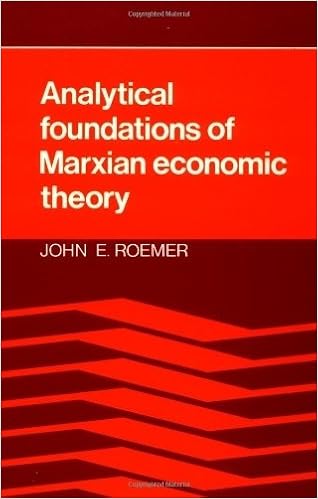
In English we have "Analytical Foundations of Marxian Economic Theory" by John E. Roemer (1989) which is available, partially, as a PDF. Roemer says some sensible things in the introduction about his approach:
"the microfoundations approach consists of deriving the aggregate behavior of an economy as a consequence of the actions of individuals, who are postulated to behave in some specified way. I have taken this approach throughout the book.

For example, in the chapters on the falling rate of profit, it is postulated that a technical innovation is introduced only if it increases profits for a capitalist. This micro approach is different from a macro approach, which might say: We postulate that technical change takes the form of an increasing aggregate organic composition of capital.

From the micro vantage point, one is not allowed to postulate an increasing organic composition of capital unless one can show what individual entrepreneurial mechanism leads to it.

Marxists might question the microfoundations methodology because one of the forceful points of Marx's theory is that the individual is not the relevant unit to examine - it is the class. This might lead one to try and build a model in which classes are the atoms of the system.

I think it should be possible to produce such a model, but I do not believe that model would be contradictory to the ones I have described in this book. The reason is this: that individuals act as members of a class, rather than as individuals, should be a theorem in Marxian economics, not a postulate.

Marx's point is that despite the capitalist's incarnation as a human being, he or she is forced by the system to act as an agent for the self-expansion of capital. Workers, similarly, may have their individual yearnings and habits, but conditions of life force them to acquire a class consciousness and to act, at times, as agents of the working class as a whole and not as their own agent. (This might be the situation, for instance, in a strike, where the striker takes great chances for the good of the strike, which are not personally worthwhile.)

In each case, Marx has claimed that although people exist organically as individuals, we can conclude that they act as members of classes. It is in this sense that class behavior is a theorem and not a postulate of the Marxian theory.

Taking the argument a step further, I would say that it is not only admissible, but important, to take a microfoundations approach in Marxian theory. A common error in Marxian discussions is functionalism: to assume that a mechanism necessarily exists to perform actions that must be performed to reproduce the system.

Put more simply, if the occurrence of X will further the reproduction of capitalist relations, then X occurs. For example, if racist attitudes exist among the working class, then capital will be strong. Therefore, capitalism foments racism.

What is missing here is a description of the mechanism by which this is accomplished. It may be in the interest of capital as a whole to maintain discriminatory wage differentials for black and white workers of equal productivity, but why should the individual, profit-maximizing capitalist respect this differential when he or she can increase profits by unraveling the differential - that is, by hiring only black workers at a slightly higher wage than they are receiving under the racist regime? [For one answer to this question, see Roemer (1979c).]

If we postulate capitalism as a system of anarchic, competitive capitals, each bent on its own expansion, we must face this sort of contradiction from functionalist arguments.

Another example comes from some Marxist-radical theories of education. Capitalism does not require a highly educated working class, so the theory goes, but it does require a well-socialized and docile working class. Schools, then, will serve the role of socializing and channeling people into capitalist society, but not of educating them.

Now, this conclusion may be true, but the functionalist nature of the argument eclipses the mysterious and difficult part of the phenomenon - how does capitalism ensure this role for schools, when teachers try to teach, students try to learn, and so on?

A third example is the role of the state. The capitalist state acts in the interests of the capitalist class - that is the theory. But the theory cannot be convincing unless one can demonstrate the mechanism by which this occurs, especially because capitals do not have a habit of cooperating with each other, as the primary aspect of each capital's existence is self-expansion and competition against other capitals.

What one requires, then, are microfoundations for the role of racism, education, and the state under capitalism. Other examples abound. In the cases when capitalism is guided as if by an invisible hand to coordinate its preservation in the ways mentioned, one requires an explanation of how anarchic capitals produce such a result.

 A second form of functionalism that exists among Marxists is the converse of the first form: If X has occurred, then X must be in the interests of capital. We again can take an example from education:

Because we observe compulsory education, it must be that capital requires such for its reproduction. But this may not be the case: compulsory education may exist because the working class fought for it.

One can find many examples of this form of functionalism in Marxian work: The general consequence of the error is to attribute an omnipotence to the capitalist class that it does not possess in Marxian theory. The capitalist class is pushed along by historical developments: Not everything that happens under capitalism was planned by it, nor is in its best interests. In fact, according to Marx, the general tide of historical development favors the working class. Again, a defense against this form of functionalism is a microfoundations approach.

There is a third form of functionalism among Marxists that, strangely, seems diametrically opposed to the first two forms: If the occurrence of X is necessary for the demise of capitalism, then X will come to pass. We can see the general rule of which these different functionalist forms are special cases if we phrase the general functionalist position this way. We postulate a certain outcome for the social system; functionalism then takes the form of claiming that only events occur which lead to that outcome.

In the first two forms of functionalism discussed, the outcome is the reproduction of capitalist relations; in the third form, the outcome is the transformation of capitalism into socialism. Perhaps the first two forms of functionalism are short-run variants, and the third form is a long-run variant of the general functionalist interpretation of Marxism.

Examples of the third form of functionalism in Marxian economics are prevalent in crisis theory. The system must have crises, because crisis is necessary for capitalist demise. The rate of profit must fall, because only in this way can crisis be brought about. The working class must become impoverished, because otherwise it will never perform its revolutionary task. Bourgeois democracy must transform itself into fascism, because only fascism will heighten the contradictions of capitalism sufficiently to produce revolutionary transformation, which must occur. These arguments are less than convincing; the form of functionalism they involve is similar to that of the utopian socialism of Marx's time, which postulated socialist transformation without a mechanism.

Marx's method was to counter utopian thinking by trying to expose the mechanism that would bring the socialist transformation about. ...

Finally, the equilibrium method has been used in the models in this book. While I have defended the approach of mathematical modeling, and the microfoundations approach, I have less confidence about the equilibrium method. Like many economists of my generation, I am strongly influenced by the power of the equilibrium method: of examining a model when it is at rest, so to speak, in the sense that all the rules that describe how its parts work are simultaneously fulfilled.

What is disturbing about the equilibrium method is that it pictures the typical position of the system as a position the system rarely or never enjoys. Of course, no sophisticated economic model builder would claim that economies are in equilibrium in the sense of a static equilibrium model. A model is only an ideal type.

However, there seems to be a deep contradiction between using models whose main analytical trick is to postulate a position that is precisely at variance with the most interesting and important aspect of capitalist economy as described by Marxian theory - its incessant, contradictory motion.

There is, therefore, the danger that if this intuition is correct, the equilibrium method will prevent one from seeing the most important aspects of the Marxian theory of capital. Knowing no other method, I use the equilibrium method, with the vague thought that, when rereading these pages in twenty years, its obsolescence as a modeling tool for Marxian theory may be clear.

(I might add that there is plenty of precedent in Marx's modeling of his theory for the equilibrium method: Consider, for example, the notion of equalization of profit rates among capitals, or the models of balanced growth designed to show that capitalism was capable of reproducing itself.) ..."
After this thoughtful introduction we encounter chapter 1.
"1 Equilibrium and reproducibility: the linear model

1.1 A brief review

We begin with a discussion of what constitutes an equilibrium, in Marxian terms, of a capitalist economy, and for this chapter we study a linear, Leontief specification of production.

Capitalists all have access to the same Leontief production system {A, L}, where

   A is an n x n input matrix of commodities

   L is a 1 x n vector of direct labor inputs.

If p is a l x n commodity price vector and the wage is normalized at unity so that prices p are interpreted as wage prices, then the usual notion of an equilibrium-price vector in a Marxian system is a vector p for which there exists a nonnegative number π such that

   p = (1 + π)(pA + L)           (1.1)

The vector pA + L is the vector of unit costs of production (assuming that there are no fixed capital costs), and so π may be interpreted as the uniform profit rate for the economy.

There may be, of course, many pairs (p, π) satisfying Equation 1.1.

We add more information to the system by requiring that workers each receive a subsistence vector of commodities b, an n x 1 vector. By subsistence, we mean simply that the wage must be precisely sufficient for b to be affordable, thus

   pb = 1                                 (1.2)

Here, the unit of time that denominates L, which is the same unit of time for which the wage of unity is paid, is to be thought of as one working day.

Combining (1.1) and (1.2), we see immediately that

   p = (1 + π)p(A + bL)         (1.3)

Thus, for a vector p satisfying (1.1) and (1.2) to exist, it is necessary and sufficient that the augmented input coefficient matrix M = A + bL possess an eigenvalue 1/(1 + π) that does not exceed one, to which can be associated a nonnegative eigenvector p.

According to the Frobenius—Perron theorem, if M is an indecomposable matrix, then M has a unique eigenvalue that can qualify; that is, M possesses a unique positive eigenvalue to which can be associated a nonnegative eigenvector. It is, furthermore, the content of Morishima-Okishio's fundamental Marxian theorem (FMT) that if the rate of exploitation e is positive, then the Frobenius eigenvalue of M will be less than one, and so the associated profit rate will be strictly positive. ..."
and so it goes on. One reviewer writes:
"The analytical rigor in treating the subject is among the things that make the book worth buying for anyone interested in mathematical economics: sitting down with paper and pencil for a couple of months in reading the book will be a beautiful intellectual experience, and it will add a whole set of "weapons" to the neoclassically trained economist."
But perhaps we just don't yet have the right (agent-based?) mathematics for Marx.

---

I'm been reading Duncan Foley's excellent primer on Capital.

PDF link

Foley is a clear and creative thinker who is prepared to bring some simple mathematics to the table. He's interested in presenting the conceptual apparatus of Marxism in an orderly manner rather than simply providing a slimmed-down exegesis of the books themselves. His approach is very much rooted in applying Marxism to the present day economy, which informs both his appraisal and his examples.

He reconstructs in mathematical form the circulation of capital and Marx's simple and expanded reproduction equations before moving on to the 'transformation problem', crisis theories and Marx's concept of socialism. Here's the table of contents:
Contents

1 On Reading Marx: Method                            1
2 The Commodity: Labor, Value, Money        12
3 The Theory of Capital and Surplus Value    31
4 Production under Capitalism                       49
5 The Reproduction of Capital                       62
6 The Equalization of the Rate of Profit         91
7 The Division of Surplus Value                   105
8 The Falling Rate of Profit                          125
9 The Theory of Capitalist Crisis                  141
10 Socialism                                                 158
Suggested Readings                                    173
References                                                   177
Index                                                             181
In addition as you can see, this introductory book is quite short.
.
---

When I did my PhD research - the formal theory of intentional agents - I explicitly rejected the framework of differential equations used by the control theorists and the cyberneticists (cf Ross Ashby). For the same reason I am somewhat skeptical about aspects of Peter Turchin's Cliodynamics.

My approach was in the classical AI tradition of modal logics and generalised automata theory where intentional agents (those with perceptions, beliefs, goals, plans, actions) are modelled explicitly. I still think this is the best approach to a twenty-first century formalised Marxist psychohistory where we're interested in history at the simulation level.