Showing posts with label The Sunday Times. Show all posts

Sunday, October 28, 2018

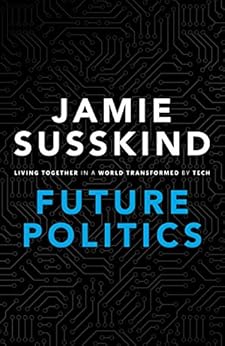
Our future of total surveillance (Jamie Susskind)

Amazon link

Susskind's book was reviewed in The Sunday Times today (here).  It's about a dystopian future of AI super-surveillance sourced from sinister tech companies like Google (I am not being ironic).


I was struck by this quote:
".. the children decide to go on a demo. They heard about it from their friends; artificial-intelligence systems had prevented them receiving online information. Their phones warn them about rain and traffic, but there is none. A drone records their progress. Then, on their internet-enabled glasses, they see pictures of people being interrogated in stress positions; each has the face of one of them. They turn back."
Actually, demonstrators within authoritarian regimes face far stronger disincentives than those described above. Demonstrations still happen because when people get mad enough they'll brave prospects of torture. Or perhaps they lack imagination or think it won't happen to them. All of the above probably.

---

There have been a few lone-actor atrocities in the US over the last few days. The so-called 'MAGA bomber', Cesar Sayoc, was found particularly rapidly after fingerprints and DNA were apparently found on suspect devices. Easy to cross-check as Sayoc had a criminal record.

Wikipedia tells us, "According to the US Bureau of Justice Statistics, 2,220,300 adults were incarcerated in US federal and state prisons, and county jails in 2013 – about 0.91% of adults (1 in 110) in the U.S. resident population."

That's a great dataset for machine learning applied to GWAS. Genome to facial appearance is a quick win: you can almost always get a scene-of-crime DNA sample, and all criminals are on Facebook, aren't they?

---

I read the review carefully but I'm not convinced there's much new in Susskind's book ..
"His writing is clear and precise; he is a lawyer, he is making a case. Irritatingly, he puts in too many (one would be too many) cheeky-chappy asides such as, “At last, someone has found a use for spinach.” But, on the whole, he steers a course to the future that is as convincing as it is shocking. We can fix this, is his message, but there is also the nagging sense that we probably won’t."
We won't until we do. I'll give the book a miss.

---

Related post: Über-surveillance.

Sunday, August 13, 2017

".. then I must be .." *


The Economist this week writes:
"Mr Pichai had good reasons to sack Mr Damore. One is the content of the memo. It says many reasonable-sounding things: that “we all have biases” and that “honest discussion with those who disagree can highlight our blind spots”. But these are just camouflage before a stonking rhetorical “but”: the argument that innate differences, rather than sexism and discrimination, explain why women fare worse in the technology industry than men. “Neuroticism (higher anxiety, lower stress tolerance)”, Mr Damore writes, “may contribute…to the lower number of women in high-stress jobs.”

"Research has indeed shown some smallish group-level differences in personality and interests between the sexes. But drawing a line from this to women’s suitability for tech jobs is puerile. An unbiased eye would light on social factors rather than innate differences as the reason why only a fifth of computer engineers are women. "
In today's Sunday Times, Dominic Lawson observes of The Financial Times:
"... the Financial Times, which in an editorial denounced Damore’s memo as “almost pure drivel”. That paper is facing industrial action on behalf of its female employees, who suffer from a 13% gender pay gap (according to the National Union of Journalists).

It, too, has an internal reason for declaring to the world how deplorable it finds young Damore, so it published another article accusing him of a “long email rant against diversity programmes . . . a rambling confused mash-up of outdated science”.
---

When these idealogues attend a performance of 'The Life of Galileo' by Bertolt Brecht,
"This was a lively, heartfelt performance which showcased reason and science vs. obscurantist arguments from authority designed solely to buttress the interests of those in power. This never fails to be relevant."
they root for Galileo, bravely sticking it to The Man. It never occurs to them that they are The Man.

---

The genius of Brecht was to give good arguments to the Catholic Inquisition. The interrogator points out that regardless of any purely-scientific merits of Galileo's thesis, the practical effects of the new doctrine would be to undermine the primacy and sanctity of scripture and thus subvert the social order, undermining authority and leading to dangerous chaos.

A very high price to pay for some arid, esoteric and contested version of 'truth'.

---

* Imposter.

Sunday, May 14, 2017

Is Theresa May .. Stalin?

Dominic Lawson

Dominic Lawson's op-ed in The Sunday Times today:
"In truth, this secretive, politically friendless and yet virtuous woman has a surprising lack of self-confidence. It accounts for her evident shyness and the lack of spontaneity that so exasperates reporters — not that it matters what journalists think, as long as the voters respect her.

"The lack of intellectual confidence is in some respects a refreshing change from her predecessor’s excess of it: Cameron would make promises he couldn’t keep, in the belief that he could somehow bend the facts to his will — or just busk it.

"But a lack of intellectual confidence in a leader can have the unfortunate consequence that she (or he) finds it impossible to accommodate first-class minds in her top team. May’s replacement of Michael Gove with Liz Truss as lord chancellor is an example. Gove, admittedly, had already fallen out with May when she was home secretary; but Truss has now demonstrated the limitations of craven careerism as head of a judicial system that requires an intellectually rigorous grip at the top. ...

"Theresa May, to her credit, chairs countless cabinet committees and by all accounts does it well, taking account of arguments based on solid evidence and being prepared to change her mind. ...

"... the British public has always liked the idea of a strong leader who says what she’ll do and then does it. Mrs May is gaining enormous electoral traction by appealing to that tradition. Let’s hope such a mandate gives her the confidence not to run a cabinet of fearful mediocrity."
We used to live in Maidenhead, where Theresa May is MP, and once attended a hustings where all the parliamentary candidates made their pitches.

Theresa May - UK prime minister and ISTJ

It was clear that Theresa May was by far the brightest and most competent of those up for election. On the other hand, she did not impress me as scintillatingly bright. She's exactly how you would imagine a high-calibre ISTJ: no surprise that she's patronised by NT intellectuals .. and rather admired by ordinary folk.

It's early days. Too early to determine whether the reaffirmed PM will select a cabinet of the best intellectual talents (those signed up to the mission of course).

Sunday, February 12, 2017

"When I am dead, my dearest"

Poignant poem in The Sunday Times today: by Christina Rossetti, (1830 - 1894).


When I am dead, my dearest,
    Sing no sad songs for me;
Plant thou no roses at my head,
    Nor shady cypress tree:
Be the green grass above me
    With showers and dewdrops wet;
And if thou wilt, remember,
    And if thou wilt, forget.

I shall not see the shadows,
   I shall not feel the rain;
I shall not hear the nightingale
   Sing on, as if in pain:
And dreaming through the twilight
    That doth not rise nor set,
Haply I may remember,
    And haply may forget.

---

I think that's a realistic view of death and its aftermath, beautifully stated.

Sunday, December 14, 2014

Adrian Wooldridge on Torture (Sunday Times)

Adrian Wooldridge is The Economist’s management editor and Schumpeter columnist. Today he wrote an op-ed in The Sunday Times entitled  "Dick Cheney is wrong about torture, but for all the right reasons".
"Since the Senate committee published its torture report last Tuesday, Washington has been engaged in a full-scale civil war, which has pitted Democrats against Republicans and the CIA against liberal institutions such as The New York Times.
...
"But the most interesting battle is not partisan or institutional but philosophical: the battle between soft hearts, who think that torture is an offence against fundamental moral principles, and the hard heads, who think that it is justified if it saves lives. The soft hearts say that good people don’t torture, full stop. The hard heads say that that is self-indulgent pap."
Good to hear someone taking the issue seriously.
"Is this distinction between hard heads and soft hearts correct? The torture report poked some holes in it. On the basis of a detailed study of 20 cases, the report argues that enhanced interrogation played no role in disrupting terrorism plots, capturing terrorist leaders or finding bin Laden.

"But the more I reflected on the report, the more it struck me that conventional wisdom is upside down. Hard heads such as Cheney were motivated by a mixture of outrage over what happened on September 11 and fear of something worse: Cheney’s friends have repeatedly argued that 9/11 changed him fundamentally and transformed a measured figure into a warrior. But there is also a hard-headed case against torture.

"The classic hard-headed argument in favour of torture — the ticking timebomb — is less convincing than it sounds. Imagine that a nuclear bomb has been placed in the heart of London and you have half an hour to extract the necessary information from a jihadist before the device goes off. Will he really give you the right information as you apply the electrodes? Or will he waste your time by giving the wrong leads and then rejoice as you are all blown to smithereens?"
This is sophistry - the specious argument of the inutility of torture. Any interrogation of the nuclear-bomb jihadist is going to be met with initial silence or obfuscation. Suppose torture is the only way to make the jihadist say anything? Suppose you can rapidly check answers and persist until you get the truth? Suppose you have a scanner which can reliably detect the act of lying (so keep applying the current until the subject gives the right leads)?

In other words, suppose torture does in fact work - does that make it OK, Mr Wooldridge?
"Public opinion has been so thoroughly focused on the CIA report that the revelation that last month alone jihadists killed more than 5,000 people passed almost without comment.

"It is precisely because the stakes in this war are so high that we should avoid using torture. The war is fought on the home front: you have to keep the people on your side in a world where patience is limited and the enemy can disappear for long periods of time. Torture divides serious people and gives succour to the frivolous looking for an excuse to argue that “we” are not so wonderful and “they” are merely misunderstood."
"Torture divides serious people ...". Of course it's not alone in that, you could make the same case against drone attacks.
"The most interesting thing about the terrorism report is what it reveals about the internal state of the CIA. Torture took a toll on morale: in August 2002 some officers in a black facility in Thailand found torture so harrowing that they petitioned for a transfer. It created internal divisions: in January 2003 the CIA’s chief of interrogations sent an email to colleagues saying that “enhanced interrogation” was a wreck “waiting to happen and I intend to get the hell off the train before it happens”. It forced the agency to engage in endless lies and cover-ups — not just to Congress but even to the more sympathetic Bush White House."
Again, there are many cases where military exigencies clash with liberal ideals. Pacifism and unilateral disarmament have durable and vocal constituencies. Not a slam-dunk reason to desist from doing what states sometimes have to do, even against their own public opinion.

But Wooldridge has a final argument.
"Democracies that have given in to the use of torture — Britain in the Cyprus emergency in the 1950s, the French in the Algerian War and the Americans in Vietnam — have always come to regret it deeply not just because they lost the moral high ground but also because torture has a peculiarly corrosive effect on democratic institutions.

"It is easy for people who take the war on terror seriously to dismiss the terrorism report as a charade. The Democrats who are baying for the CIA’s blood this week were as one in demanding tough action in the wake of 9/11. They will be as one in condemning the CIA for negligence if jihadists mount another attack on the West.

"But this temptation should be resisted: the West must do what it can to ensure that the dubious decisions taken in the wake of 9/11 are not repeated — for hard-headed reasons rather than soft-hearted ones. Eschewing torture is not just the right thing to do morally. It is the right thing strategically as well."
What it comes down to, I think, is Wooldridge's statement that "torture has a peculiarly corrosive effect on democratic institutions". There is something uniquely unpleasant about torture, not just that it's horribly painful (many battlefield injuries are also agonising), but that the pain is inflicted with intent.

As social and moral creatures we have always made the most profound distinction between bad outcomes which just happen, and those carried through with full forethought and intent. It's the difference between manslaughter and murder. We have a horror of the psychopath, the malevolent person who literally doesn't care about the welfare of others - no conscience and no remorse; pretty much our definition of evil.

I think that for populations with a high degree of empathy, (arguably European populations), there is a profound disinclination to write a blank cheque for the application of unbearable pain by state employees. As a consequence, torture cannot be legitimised in policy or law.

That is not to say (as 'Andy McNab' wrote in The Times last week) that torture isn't (or shouldn't be?) used tactically by troops in battlefield situations (they keep quiet about it). Equally, other cultures which displayed less empathy seem to have had less angst about their states using torture (I recall few protests in the Roman Empire).

So while Adrian Wooldridge's article is full of logical flaws, in the end our inbuilt sense of empathy prevents us from ever legitimising torture, while we should be aware that it's a tool which may never be completely dispensed with in practice due to its sheer utility.

---

I'm sorry if this seems a cop-out, but you've got two principles in contradiction with each other, each with its own domain of compelling applicability. Some degree of hypocrisy is inevitable. Ask the Christian church if it agrees with killing people.