Showing posts with label surveillance. Show all posts

Sunday, January 13, 2019

Sunday, October 28, 2018

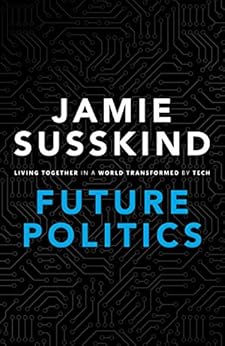
Our future of total surveillance (Jamie Susskind)

Amazon link

Susskind's book was reviewed in The Sunday Times today (here).  It's about a dystopian future of AI super-surveillance sourced from sinister tech companies like Google (I am not being ironic).


I was struck by this quote:
".. the children decide to go on a demo. They heard about it from their friends; artificial-intelligence systems had prevented them receiving online information. Their phones warn them about rain and traffic, but there is none. A drone records their progress. Then, on their internet-enabled glasses, they see pictures of people being interrogated in stress positions; each has the face of one of them. They turn back."
Actually, demonstrators within authoritarian regimes face far stronger disincentives than those described above. Demonstrations still happen because when people get mad enough they'll brave prospects of torture. Or perhaps they lack imagination or think it won't happen to them. All of the above probably.

---

There have been a few lone-actor atrocities in the US over the last few days. The so-called 'MAGA bomber', Cesar Sayoc, was found particularly rapidly after fingerprints and DNA were apparently found on suspect devices. Easy to cross-check as Sayoc had a criminal record.

Wikipedia tells us, "According to the US Bureau of Justice Statistics, 2,220,300 adults were incarcerated in US federal and state prisons, and county jails in 2013 – about 0.91% of adults (1 in 110) in the U.S. resident population."

That's a great dataset for machine learning applied to GWAS. Genome to facial appearance is a quick win: you can almost always get a scene-of-crime DNA sample, and all criminals are on Facebook, aren't they?

---

I read the review carefully but I'm not convinced there's much new in Susskind's book ..
"His writing is clear and precise; he is a lawyer, he is making a case. Irritatingly, he puts in too many (one would be too many) cheeky-chappy asides such as, “At last, someone has found a use for spinach.” But, on the whole, he steers a course to the future that is as convincing as it is shocking. We can fix this, is his message, but there is also the nagging sense that we probably won’t."
We won't until we do. I'll give the book a miss.

---

Related postÜber-surveillance.

Sunday, May 13, 2018

Covert operations under total surveillance


Osama bin Laden used nothing higher-tech than pencil, paper and couriers. Charles Stross suggested that when the NSA is on your case you're back to mediaeval tradecraft, Bruce Schneier frequently points out that against your kid sister almost any security will work, while against a first-world state adversary .. well, you're in trouble.

The main bottleneck facing the modern security state - despite ubiquitous CCTV, backdoor-enhanced routers and traitorous apps - is the shortage of smart oversight. Covert data enters as a firehose but actionable intelligence is vanishingly rare. The more extensive the surveillance, the worse it gets.

You read stuff like:
"You know there are bugs in here, and cameras?"

"Don't worry, they don't have enough staff. They've got AIs doing video review and keyword-tagging .. but if we keep it normal and general, most likely we're OK."
It's an arms race, but it's not linear. Each technology hits a ceiling and while the ongoing deployment of surveillance has a way to go, analysis at scale is much closer to topping out.

A covert agency knows that the best way to thwart security is to operate an innocuous cover-activity with maximal congruence to the mission. How many reporters were spies? How many bird watchers were terrain-mapping?

When activities look legitimate and only intentions might arouse suspicion, the analysing AIs flounder. But what you might call 'action steganography' has a short shelf-life. It gets burned. All reporters are soon viewed with suspicion; bird watchers near sensitive installations find themselves hauled in. Continuing success favours those with imagination and/or the use of activities which are widely popular.

I wonder sometimes at this new fashion for zooming around the countryside on high-tech human-powered machines, festooned with complex multi-function electronic devices.

I really don't recall cycling being that much fun.

Thursday, February 15, 2018

Disrupting über-surveillance: a five point plan

Yesterday I wrote about the potential for new sensor, effector and AI technologies to create a totalitarian surveillance state (after Charles Stross). What could be done to defy such measures?

At the extremes there is, plainly, no solution. If you're thrown naked into a hardened cell, they junk the key and never visit you again .. you're going nowhere.

But real-world security systems are not like that. They're constructed of real, fallible and resource-limited components. Think of the surveillance system as a security agent, as shown below.

A functional diagram of the surveillance-enforcement system - with countermeasures

The surveillance systems are top right: cameras, microphones, pressure pads, .. whatever.

Sensor data is interpreted into symbolic form via low-level primary processing. Interpretation can be informed by feed-forward of higher-level hypotheses - as in the predictive processing model.

In a context of the system's present beliefs and goals, the perceptual world-view is acted upon by a planning system to determine the appropriate response. This is the point where humans are likely in the loop.

Finally, going down to mid-bottom of the diagram, resources are chosen and marshalled and tasked to execute the operational response: "stop and search", "arrest", "kill" .. .

Each of these modules has a possible attack point from the viewpoint of the adversary.

  1. Sensors can be physically attacked - cameras can be painted over or depowered.

  2. Interpretation can be confused: some AI vision classifiers have had problems with patterned spectacles; there are opportunities with disguises and bogus roles.

  3. Planning and resource-assembly can be disrupted by physical attacks and/or resource-intensive diversions. Or directly by an insider.

  4. The beliefs and goals of the system can be subverted: from the outside by subtle misdirection (eg use of an apparently-benign front organisation); or internally by hacking.

  5. The final execution stage can be met with misdirection, attacks or diversions.

As the surveillance and enforcement systems get ever more ubiquitous and sophisticated, the rigidities of AI transform into vulnerabilities. Absent an AGI (and they will be absent), security systems are baffled by human subtleties while human overseers flounder in alert-trivia.

Adversary cleverness, preparation and resources on the ground make for a more even contest than one might imagine.

---

You can usefully think of the security state as a vast, distributed, rather rigid and not-terribly-bright personality. An ESTJ most likely. Then consider how you might fool, or con such a person.

Most of the time this will work, but beware: eventually - if you are successful - they will put someone smart and imaginative on your case.

The security state can change its personality on a sixpence if sufficiently provoked.

Wednesday, February 14, 2018

Über-surveillance

Amazon link

I'm reading Charles Stross's "Empire Games", the first volume of the second Merchant Princes trilogy. We're in a 2020 New York, a world where Homeland Security has transformed America into a total surveillance state.

Hulius is a 'worldwalker', a terrorist to the American authorities, who is returning from a rendezvous with a NY agent-in-place.
"Entering the station, Hulius passed under the lenses of cameras on the staircase, of cameras fronting the ticket machines, of cameras watching the faces of everybody passing through the barriers, and, finally, of the cameras on the platform and on the subway train itself.

These cameras had just enough onboard intelligence to match faces against a database of persons of interest, and to call for help if they scored a hit. And, all unbeknownst to him, Hulius had become a person of interest. ...

Hulius was a person of interest because he'd been observed on numerous previous occasions and never identified. His face was known, his biometrics logged; but he was never associated with the same cell phone ID, or with RFID tags in an ID card (or the washing instruction labels in his clothing), or even with the same bicycle.

Hulius was a blind spot in the surveillance network's purview, like the 600-mile-per-hour moving hole in the radar reflection of a rain cloud that betrays the passage of a stealth bomber.

And as he walked toward the back of the platform for a train to Forest Hills, phones began to buzz."

This is the ultimate feature of total surveillance. If the system knows everybody, then the intruding agent need do nothing wrong, need not show any behavioural abnormalities. The systems shriek: 'there's a stranger in town!' .. and the forces of law and order begin to gather.

We're entering the age of human-level AI capabilities: competent cognitive functions which are obedient, don't get tired and are on duty 24/7. And replicable without limit, at low marginal cost. Cities, whole countries, become small villages which never sleep.

Exercise for the reader: how do you defeat a surveillance system this ubiquitous?

---

1. Get a fake Id?

But the system is tracking you minute by minute. Any anomalies or unexplained gaps flag an alert. How do you ever leave your cover and get any useful agent-work done? It would be like cheating on God.

2. Subvert the System?

Like those thriller genius-kids who can break any password in seconds on a jury-rigged Ono-Sendai deck?

3. Your answer.

Yes, that's the one I'm interested in. Here's mine.

Sunday, January 21, 2018

"Gnomon": the System and the Witness

Amazon link


There are in excess of half a million CCTV cameras in London today. Most are old-fashioned, low-resolution, not networked and operated under disjoint authorities.

Project into the middle-future: many more cameras with microphones and speakers, online and linked to one central authority. Realtime oversight by an AI system - no people involved so no privacy issues - (right, Google?).

This is not just a sensor system, although it has input from the ubiquitous Internet of Things. This AI comes with apps: it can talk to people, warn them, nudge them.

So the AI needs social policies. Naturally they should be prosocial, intolerant of  negative -isms. Something like the BBC or The Guardian made flesh.
"Mielikki Neith is an enthusiastic proponent of both the System and the Witness.

The first is a government of the people, by the people, without intervention or representation beyond what is absolutely necessary: a democracy in the most literal sense, an ongoing plebiscite-society.

The second is the institution for which Britain perhaps above all other nations has always searched, the perfect police force.

Over five hundred million cameras, microphones and other sensors taking information from everywhere, not one instant of it accessed initially by any human being. Instead, the impartial, self-teaching algorithms of the Witness review and classify it and do nothing unless public safety requires it. The Witness is not prurient.

The machine cannot be bribed to hand over images of actresses in their baths to tabloid journalists. It cannot be hacked, cracked, disabled or distorted. It sees, it understands, and very occasionally it acts, but otherwise it is resolutely invisible.

In the gaps where the cameras cannot scan or where the human animal is yet too wild and strange, there are intervention. The majority of the Inspectors' cases concern acts of carefully considered violence, international organised crime and instances of domestic or international terrorism. Some few crimes of passion still occur, but hardly require deep scrutiny, and most are headed off early and preemptively when tremors of dysfunction give them away.

The Witness does not ignore a rising tide, a pattern of behaviour. It does not take refuge behind the lace curtain of non-interference in personal business. No one now shall live in fear of those they also love. Everyone is equally seen. That's how the System works and what it means."
A system like that is going to need state-of-the-art user authentication to access its internals.
"Even so, the protections around it were ferocious, and Annie insisted - in a rare moment of straightforward technical lecturing -that I know them off by heart.

`Authentication on steroids,' Annie said. `Username and password, that's standard. We start there, then we add a dongle.'

`Excuse me,' I asked, 'a what?'

`A physical key. Don't ask why it's called that, no one knows. A physical object that proves your right to access a given resource. These days it's usually your phone. In our case it's a little doodad you wear around your wrist.'  ...

`Yes,' Annie said. 'If you're a total lunatic, you can have the chip encased in plastic and implanted in your arm so that you can Obi-Wan your way around the office. I don't recommend it.'  ...

I slipped the dongle around my wrist, next to the bracelet. ...

All right. Something you know and something you have. Two factors. Okay? But we need more than that. The dongle itself has a biometric scanner. Most people use fingerprints or retinal scan, even aural topology scan, but there are issues with those. Once they're compromised, that's it - you have a finite number. And they lend themselves to rather ugly forms of violence.

We're trialling microbial cloud analysis. The sensor in the dongle is actually patterned after canine nasal cells, which always sounds a little bit weird.'

Yes. To these silicon children, biology is outré.

'Anyway: everyone has a distinct collection of biomass on and around the skin. Recognition is about ninety-six per cent accurate, so not perfect, but it's incredibly hard to fake.

'For full-access login, we have predictive neural modelling and response.'

`What's that?'

Colson shook his head. 'It's the absolute creepiest thing in the world.'

`The machine asks you a string of random questions,' Annie said 'and measures your answers against its analysis of your personality. It's not predicting your answer, it's determining whether it's the sort of answer you'd give. Over time, it also notices if you're changing in significant ways. That's why Colson hates it.'

`It's fucking intrusive,' Colson growled. 'In theory, it could decide you're emotionally unstable and tell your boss. If you vary too much from your previous behaviour, it might lock you out of your own files.

'There's potential for abuse, Annie, and you know it. The alcohol-anklet people could use it to say you're backsliding. And those probation future-crime fuckers, they'd love it: if your connectome gets too much like the one you had when you were a sinner, off to jail you go!

'And sooner or later, someone's going to say it can detect defections and whistleblowers before they can decide what they're going to do themselves. Maybe you see something, I don't know, you're an oil exec and you see the results of a spill. The system might lock you out for insufficient faith in the corporate ethos. Loyalty-based access.'

Annie glanced at me. 'Colson believes the world is on the brink of a collapse into pre-liberal government. The erasure of the twentieth century.'

It is,' Colson said firmly.

`Be that as it may -'

'Loyalty-based access. It's the automation of the merger of a religion of the state with corporate power in the form of information.'

`We'll code it out.'

'Someone'll code it back in.'

`They won't be able to.'

`They'll try.'

`That's why we haven't sold it,' Annie said, a little exasperated, and then to me once more:

'Five requirements. It's like putting ingredients in a cauldron for a magic spell. A significant object, your name, a secret word, your body. Then eventually, connectome: your soul.'

Turns out the last of these is the hardest to hack.

---

In the next post I'll say something about the novel itself.

Friday, January 19, 2018

A winter wonderland

Having been terrorised, terrorised a few nights ago by 70 mph winds (in the morning the bird bath had blown away .. ending up under the car .. imagine!) - this morning saw us whitened by hail.

The back garden

The front drive

Surely we must blame climate change.

We were up at 7.30 am because the local furniture shop, Haskins, had given us a window (8am - 1pm) for the delivery of our new sideboard. Clare was so looking forward to it.

I think it would have been about half past ten when the two burly delivery men drew up in their large van. I didn't envy their porterage of such a heavy piece of furniture up our steep drive (this was thankfully just before the hail storm hit).

We had speculated whether delivery people these days stay for coffee and biscuits, or just do the job and depart on some insane schedule. But that's just Amazon. We tried the experiment and treated the men to Waitrose-sourced coffee bags and shortbreads. They were very grateful and one of them was even somewhat conversational.

---

Clare is delighted with the new sideboard

The cutlery, plates and sundries have now migrated: I find it confusing. Apparently it takes two days to rewire the brain. At least that's what Nick Harkaway claims in the excellent and deeply weird "Gnomon" (of which more shortly).

Amazon link - Quis custodiet ipsos custodes?

I haven't quite finished his novel but I'm meditating on authors who are: off-the-scale Intuitive, who fail to find an editor to complement their insane research-depth and hyper-associative writing, who seem to have uncritically internalised hyper-liberalism, who are plainly very, very smart but still don't delve beneath the linguistic category of 'totalitarian surveillance'.

Mr Harkaway is by turns intriguing and infuriating.

But ultimately quite thought-provoking, this AI-powered panopticon of total automation. There's more to it than who gets to decide the boundary conditions and classification rules.

Here's the Kirkus review (no spoilers).

Thursday, November 16, 2017

I am conflicted about AI-based law enforcement ...

From The Times today (Gang war fear after Romanian sex trafficker Sorin Serbu is killed):

Sorin Serbu - Romanian gangster
"The murder of a powerful Romanian gangster threatens to prompt an underworld war to control a lucrative sex trafficking market.

Sorin Serbu was beaten to death by masked men carrying baseball bats two weeks after he is said to have been involved in a fight with a rival Romanian gangster.

Serbu, 36, was left in a pool of blood outside the Global Bar in Ilford, east London, in the early hours of Sunday after a music gig. Police have confirmed that they are looking for five attackers. He was taken to an east London hospital but died of his injuries. The incident was reported to police by ambulance workers at 2.48am.

The gangster had a history of running drugs and prostitutes into Europe and made millions of euros while based in Italy, according to The Sun, which quoted a Romanian justice source saying: “There may be more bloodshed before this is over. Serbu tried to muscle in and imported around 100 prostitutes. The arrival of competition like that was always going to rock the boat.”

The vice trade in Ilford and neighbouring Redbridge has long been dominated by Romanian and Albanian gangsters. The problem has become so serious that Romanian police officers have been brought in on secondment to help tackle the gangs.

Locals have grown increasingly irate over the street trade and kerb crawling, with complaints about sex in gardens and used condoms strewn along a main road. Officers have seized vans belonging to the gangs and found mattresses in the back.

It is thought that Serbu, from Braila, eastern Romania, had relocated from Rome, his last base for drug and sex trafficking, after coming under pressure from Italian police."

Ilford used to be a relatively respectable area of east London. Not so much now.

Locally-ubiquitous CCTV and AI-based facial-recognition and incident-monitoring would surely help the authorities in dealing with this blight. What could possibly go wrong?

And then I read this (from Marginal Revolution):
"René Carmille  was a punch card computer expert and comptroller general of the French Army, who later would head up the Demographics Department of the French National Statistics Service. As quickly as IBM worked with the Nazis to enable them to use their punch card computer systems to update census data to find and round up Jewish citizens, Rene and his team of double-agents worked just as fast to manipulate their data to undermine their efforts.

The IEEE newspaper, The Institute, describes Carmille as being an early ethical hacker: “Over the course of two years, Carmille and his group purposely delayed the process by mishandling the punch cards. He also hacked his own machines, reprogramming them so that they’d never punch information from Column 11 [which indicated religion] onto any census card.” His work to identify and build in this exploit saved thousands of Jews from being rounded up and deported to death camps.

Rene was arrested in Lyon in 1944. He was interrogated for two days by Klaus Barbie, a cruel and brutal SS and Gestapo officer called “the Butcher of Lyon,” but he still did not break under torture. Rene was caught by the Nazis and sent to the Dachau concentration camp, where he died in 1945."
I remember how the Nazis demanded that Jewish authorities in the ghettos of occupied Europe should render administrative assistance in documenting their Jewish inhabitants. The more efficient the Jewish leadership, the more Jews got deported to the depth camps.

Administrative chaos saved lives, lots of them. The Greeks and Romans understood the dilemma.

Saturday, July 29, 2017

The modern Panopticon

Janice Turner from The Times today interviews Maria Miller, the (Conservative) Chair of the Women and Equalities Select Committee.

The article: "How do you solve a problem like men in women’s changing rooms, Maria?"
"Maria Miller gathers up her handbag and makes to leave: “I don’t think I’m happy about this. I think I’ve finished . . . I didn’t realise this was such a stitch-up.

I’ve been questioning Ms Miller about a report on transgender rights she produced last year as chairwoman of the women and equalities committee. ...

"The heart of the controversy is the view, espoused by Ms Miller’s report, that switching gender should instead merely be a matter of “self-definition”. A man need only “declare” that he is a woman. Your gender is what you feel it to be: there would be no requirement even to take female hormones or have surgery — about 70 per cent of trans women still have intact male genitals — or even “present” as a woman to be legally female. ...

"Furthermore, if the law changes, “gender identity” is likely to become a protected characteristic under equalities legislation: ie if you deny a person is a woman or a man when they claim to be, you are guilty of discrimination or hate crime. ...

"Take this scenario: a man enters a female communal changing area, removes his clothes while women get undressed. Now they have a right to ask him to leave. Under gender self-definition, if he said “I identify as a woman” he would be entitled to stay. This, I stress, is unlikely to be a trans woman — many who use women’s changing rooms every day with discretion and no fuss — but could be a sexual predator exploiting the loophole. (There have been a growing number of cases in the US, including a man in Seattle using women’s pool facilities claiming “the law has changed, I have a right to be here”.) Does Ms Miller not see why women fear a conflict of rights? ...

"I show her a photograph of a bearded, male-born American called Danielle Muscato who dresses in men’s suits and ties, has made no attempt to transition but nonetheless “identifies as female” and insists on living in a women’s homeless shelter. On International Women’s Day he tweeted: “Some women have penises. If you’re bothered by this, you can suck my dick.” ...

"In Toronto, Christopher Hambrook claimed to be a trans woman to access a refuge then raped residents."

These spaces carry out a risk assessment before individuals are allowed to use them and those that pose a risk to safety are not necessarily one gender.

"But 90 per cent of violent crime and 98 per cent of sexual crime is committed by men. Trans women, such as Davina Ayrton, who raped a 15-year-old girl, have been convicted of offences seldom committed by natal females. Would self-identification mean these crimes would be registered as committed by women, skewing the figures? ...

"Sport is another problematic area: self-identification could destroy women’s competitions, allowing former-men with greater musculature and testosterone to dominate. In New Zealand a weightlifter, Laurel Hubbard, has broken national records; in Canada the mountain biker Michelle Dumaresq dominated for years."

Those are already issues that professional bodies have to deal with. And again that is something which needs to be looked at in significant detail.

"I ask her about school sports. In Connecticut Andraya Yearwood, a male-bodied, moustachioed 15-year-old trans girl, has won state championships although she would have finished last in the boys’ competition. Does Ms Miller think this fair to the girl athletes?"

Well, I think it’s a bit of a difficult one to answer because boys are not going through gender reassignment when they’re at school.

"But what would you say to the girls who lost?"

It’s a very difficult one to answer . . .”
---

Walking along a country lane this morning I discussed this with Clare.

"This thing could run a long way. For example, I could claim to be a toddler and demand the right to join an infant play area. If someone objected that I'm a sixty six year old male, could they be open to the accusation of hate crime?"

"Don't worry," she said, "No-one can hear you here."

---

Would you like to know more?

The mediaeval belief that God saw all thoughts & actions was a powerful force for conformity.*

In a more secular age, it's good to know that our technology will soon step into the breach.

---

* Part II .. and related (SSC).

Tuesday, July 26, 2016

A Memo to the Interior Minister


Dear Minister,

Following the latest Islamic-inspired atrocity, you asked for a list of security policy options.

Let us start with the obvious: there are no good security policy options.

Suppose we have twenty million Muslims in Europe with relatively free movement, and suppose only one in a thousand (0.1%) presents a risk of active violence, then that's still twenty thousand very dangerous young men (yes, they do seem to be mostly young men).
  1. In some cases we know who they are, but more often than not, we don't.
  2. Even if we're suspicious, at present we don't have powers to detain them.
  3. The population of 'bad guys' is subject to continual immigration churn.
Here are your options:

1. Deport all the Muslims and reinstate border controls

There are historical precedents: expulsion of the Jews in the Middle-Ages, Stalin's population transfers in the first half of the twentieth century.

Still, so much hardship would be caused to the 99.9% of non-terrorist Muslims that public opinion would never support such a policy. Plus it seems logistically impossible - where would they go?

2. Intern all the bad guys we know about

Illegal at present but perhaps that could be fixed. It would remove some of the potential bad guys but recall we know only a fraction of the potential perpetrators. Plus various Middle-East organisations such as ISIS could always infiltrate clean skins.

There's the injustice factor too. Just because we think someone's potentially bad, doesn't mean we're right. Think Guantanamo Bay.

And remember the old adage: remove one, create one. These guys are big into 'never forgive, never forget'.

3. Guard the schools, churches, synagogues, sports stadiums, ...

Yes, there's the problem. Too many targets, not enough guards, and the bad guys just choose a category we didn't get around to guarding. You can't stop the car driven into a random crowd.

4. Vastly increased spy and surveillance network

The population has been brought up on civil liberties scares but this, at least, has some potential. With considerably more resources poured into informer networks, plus more CCTV and surveillance automation we can massively up our 'prevented in advance' statistics. But some will always get through, and you will not get credit for the potential atrocities we were able to prevent.

5. Stop bombing Middle-East Muslims

It's been a political dogma that terrorist attacks in our country are completely decoupled from our own armed actions in Muslim countries. But you know that's rubbish.

If we stop offensive actions and leave the Middle-East to stew in its own Cauldron of Hell, then arguably we become less visible as a target. However, even if we call it a day, other European countries would need to as well. Whatever our problems in seeing ourselves as a 'United Europe', our Muslim attackers don't really differentiate amongst the 'Crusader nations'.

In any event, if we stopped dropping bombs on them the pace of their attacks on us would undoubtedly slacken but they would hardly cease, since our whole culture is an abomination to them. So this option is by no means a panacea.

The alternative is the old Roman one: go in with overwhelming force and annihilate them. This would work against state-sponsored terrorism, but unfortunately turning the desert sands to glass works less well against religious zealotry.

We would caution against following the Trump line on that one.

5. Just Keep Calm and Carry On

Yes, Minister. We are well aware that this is your de facto policy and that you see no alternative. You were even unwise enough to say so in public.

You have privately stated many times that Islamic terrorism does not pose an existential threat to our country and you are surely correct in this.

It does, however, pose an existential threat to your continuing in office - arguably of equal importance in your thinking.

---

In conclusion, and taking everything in the present conjuncture into account, we would recommend option 4: a massive increase in resources to the security services and a transition to a much more authoritarian role for the state.

If you would be so kind as to take the political flak, Minister, we'll get right on with spending the money.

Yours in confidence.

The Joint Security Committee.

Friday, January 15, 2016

Surveillance Escrow - a new business opportunity


Here's a true story.
We're in the boy's toilets of a primary school. A kid has dropped a toilet roll into the pan and pulled the flush - what a lark! Somehow, the whole bathroom has flooded, causing thousands of pounds worth of damage. The headteacher is incandescent, the miscreant can't be identified and so a new rule is introduced. All toilet rolls are removed: if a child wishes to use the toilet, they have to come first to the headteacher's room where they will be issued with the requisite strips of paper.
What a disaster.

The problem here is that there is no supervision. Cameras can't be put into the toilet facility because of the potential for abuse - you can see the 'paedophile' headlines right now. But there is a solution - surveillance escrow.

Put the cameras in to supervise the toilets and connect them, via a broadband link, to a remote server controlled by a third-party - let's say Surveillance Escrow Services (SES). There the imagery is encrypted and archived, but no-one looks.

If there is a problem, suitably-accredited individuals (not the school staff) decrypt and review footage to determine what actually occurred and execute the agreed procedures vis-a-vis reporting back to the client (this has been discussed in a similar scenario here).

A variant approach, similar to the way Google treats Gmail: AI systems review the sensor feeds (which might be video, image, audio, textual or some other kind of sensor-data) in real-time, looking for anomalies before encrypting and archiving. They deliver alerts and summary reports to SES management who in turn, in conformance with appropriate privacy legislation, report back to the client.

I can imagine a number of possible applications of surveillance escrow (care homes, hospitals, secure workplaces) and offer the idea to any entrepreneur or new product development manager who's interested.