Showing posts with label Baidu. Show all posts

Friday, March 24, 2017

My dream job: chief designer at Mind Design

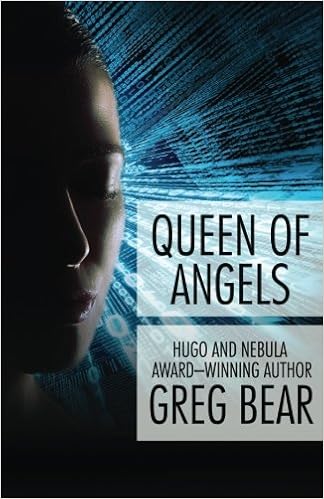
Amazon link

Yesterday in a conversation with Clare the topic came up of my ideal job.

No problem.

Since reading Greg Bear's Queen of Angels (years ago), I've wanted to be Roger Atkins.

But with a better name - obviously.

---

[AXIS (Automated eXplorer of Interstellar Space) is an AI system currently orbiting planet B-2 of Alpha Centauri B. Jill is the stay-at-home duplicate. -- From pp. 128-130.]

"LitVid 21/I A Net (David Shine): "We're preparing for an interview with Roger Atkins, chief designer at Mind Design Inc. responsible for AXIS's thinker device. What questions would you like to ask of the nation's foremost designer of thinking machines? For you know of course that thinking is different from computing.

"Roger Atkins regards computers as an architect might regard bricks. He is at this moment working with his massive personal construct thinking system, which he calls Jill, after an old, that is, a former girlfriend. Part of Jill is in fact the AXIS Simulation we have been mentioning throughout this vid-week, used to model the activities of AXIS itself, which is not directly accessible.

"But there are many more parts to Jill. Jill's central mind and most of her memory and analytical peripherals are on the grounds of Mind Design Inc near Del Mar, California; Jill can access other thinkers and analytical peripherals at Mind Design Inc facilities around the world, some by satellite, most by direct optical cable connections. While we speak with Mr. Atkins, we hope also to ask a few questions of Jill.

"And we begin right now. Mr. Atkins, in the past twenty five years you have moved from the status of a contracted neural network computer designer to perhaps the most important figure in artificial intelligence research. You seem to be in an ideal position to tell us why complete, self-aware artificial intelligence has proven to be such a difficult problem."

Atkins: "First of all, my apologies, but Jill is asleep right now. Jill has been working very hard recently and deserves a rest.

"Why is artificial intelligence so difficult? I think we always knew it would be difficult. When we say artificial intelligence, of course what we mean is something that can truly imitate the human brain. We've long since had thinking systems that could far outstrip any of us in basic computation, memorizing, and for the past few decades, even in basic investigative and creative thinking, but until the design of AXIS and Jill, they were not versatile. In one way or another, these systems could not behave like human beings.

"And one important consideration was that none of these systems was truly self-aware. We believe that in time Jill, and perhaps even AXIS itself, will be capable of self-awareness. Self-awareness is the most obvious indicator of whether we have in fact created full artificial intelligence."

David Shine: "There's a joke about self-awareness ... Could you tell it to us?"

Atkins: "It's not much of a joke. No human would laugh at it. But all modern workers in artificial intelligence have installed a routine that will, so to speak, 'laugh' or perceive humor in this joke should self-awareness occur in a system."

David Shine: "And what is the joke?"

Atkins: "It's embarrassingly bad. Someday perhaps I'll change it.

   'Why did the self-aware individual look at his image in the mirror?"

David Shine: "I don't know. Why did he?"

Atkins: "'To get to the other side.'"

David Shine: "Ha."

Atkins: "See, not very funny."

David Shine: "LitVid 21 viewer Elaine Crosby, first question to Mr. Atkins please."

LVV E Crosby Chicago Crystal Brick: "Mr. Atkins, I've read your lit, and I've long admired your work, but I've always been curious. If you do awaken Jill or some other machine, what will you tell them about our world? I mean, they'll be as innocent as children. How do you explain to them why society wants to punish itself, why we're so set on lifting ourselves up by our bootstraps whatever it takes, and we don't even know where we're going?"

Atkins: "Jill is hardly innocent. Just a few minutes ago, she was examining the theory of social feedback loops, that is, checks and balances in a society. She could probably tell us more about what troubles our society than any single human scholar.

"But that's just recreation for her, in a way; unless someone comes along and specifically asks us - or rather, rents Jill - she won't provide her analysis, but it'll be stored away. I doubt that even if she did solve our problems for us, we'd listen to her"

The novel was written in 1990, twenty seven years ago. Yet the narrative on AI is completely contemporary. The 'joke' is interesting: what humour it possesses would seem to reside in its character as a weak pun. Perhaps that just shows I'm not self-aware.

At time of writing, I suspect the leading candidate for Roger Atkin's job is Andrew Ng.

Thursday, March 09, 2017

Replika is massively oversold

Replika was originally going to be your own, online personal doppelgänger. Given the current state of the art with chatbots (tiresome and useless), that was always going to be a stretch.

The current PR says:
"Replika is your personal AI friend that you nurture and raise through text conversations. It is a lifetime companion who is always there for you, chats with you, keeps your memories, and helps you become more connected to yourself."
They're busy trying to create doable spin-offs such as a personal diary ("A Cute Diary That Keeps Itself").

Given date-slippage, I had thought that the whole Replika thing might have silently collapsed, but I suppose there is no shortage of people who are happy to update a super-Eliza forty times a day with details of their every mundane activity.

Facebook.

There would be a lot of interest in a virtual friend, endlessly attentive and caring  (except that's not a friend, more a courtier - artificial sycophancy). But if this were in the state of the art, one of Google, Microsoft, Facebook, Amazon or Baidu would have done it already. It's plainly on the future roadmap for the plethora of voice assistants, but today's systems are no more than super-recognisers.

---

Have you ever had the experience of being in a technical meeting, in an area not wholly in your sphere of competence, and suddenly you lose the plot? For a moment, you just don't know what everyone else is talking about. You pray no-one will ask for your opinion.

If you're lucky, in a minute or two the topic will move on and you will rejoin the shared context.

What happened there? The participants shared an internal cognitive model of what the conversation was about, and yours frayed. But no chatbot today can maintain an internal model of any complexity.

Worse: the topics of mundane discourse are open-ended, rooted in a complex culture and often private. Do we even want our AI-in-the-cloud to share personal and family intimacies, possibly with any interested intelligence agency?

---

Your Replika AI friend is going to get 40 bland texts per day from you. Some of the questions already seem rather intrusive.


There is a hint of blank-slate about current AI. As if one standard optimised neural-net architecture could create the ideal artificial personality template, which then gets loaded with data to become an individual.

We know that people aren't like that. Common experience and psychometric data tells us that people have distinct personalities, that these are strongly heritable and resistant to change. We all know, as folk psychologists, that we deal with people as distinct individuals, not clones. And that most of those differences are innate and resistant to social influences.
"She thinks she can change him!"
No she can't.

So many mountains to climb.
  • Why is the brain structured as modules, not one uniform design?
  • How is the architecture of personality differences implemented?
  • How to immerse an AI in common knowledge, culture and mores?
  • How does social deftness, tact and propriety work?
  • What's an effective, useful and pleasant engagement model - corporeal?

Yes, I am prepared to be disappointed with Replika.

---

Update: 9th March 2017.

"Replika AI to launch on the App Store

"Today, we are excited to announce that Replika will appear on the Apple’s App Store on March 13 at 12:00 AM Pacific time. We’d like to thank all the participants of the app’s preview in Testflight for the incredible feedback that helped us shape the app."

Thursday, March 17, 2016

AI really is applied neurobiology

When I was researching AI back in the 1980s, we'd all heard of Geoffrey Hinton. He was the key pioneer of artificial neural nets, a field which at the time wasn't making much progress. He never turned up at the main AI conferences where we discussed logics, theorem-proving and symbolic planning programs. A different paradigm entirely.

I never set eyes on him.

Professor Hinton has had the last laugh. His work, and that of close colleagues, underpins the recent AI successes of Google (AlphaGo!), Baidu, Facebook and Microsoft. Whether it's speech recognition, automatic translation or face recognition, deep-learning neural nets are powering it along behind the scenes.

Here's Professor Hinton's recent address to the Royal Society (h/t Steve Hsu). I don't normally find time to watch other people's recommended videos, but I made an exception for this one. Hinton rather reminds me of Richard Dawkins in appearance and style. He's lucid, understated and staggeringly smart. Here he engagingly tells the story of the fall and rise again of the neural net approach to artificial intelligence.


At almost the end of the talk, he puts up this slide for almost two seconds .. and then hides it.

The "secret slide"
I'm sure he just felt it wasn't quite aligned to his audience which didn't seem packed with AI specialists.

There was always a tendency within AI which made a distinction between our language for describing agents as knowing, believing, wanting entities - using intentional, symbolic terms, and the presumed internal agent architecture which caused behaviour - and which need not involve pushing symbols around at all.

We've long been aware of the awesome computation underlying animal/human unconscious situational competences. We've long failed to replicate such abilities using 'Good Old-Fashioned AI'. Perhaps it's time to conclude, with Prof. Hinton, that the architecture which realises such capabilities really has to be that of the deep-learning neural net.

Prof. Hinton is at pains to point out that the most sophisticated current systems fall well short of human brain structure both in terms of quantity of neurons and complexity of interconnection and communication.

We should keep reminding ourselves that brains are doing important stuff at the granularity of small groups of molecules: they are the essence of nanotech.*
___

* In fact, we should probably be using our best AI neural nets to figure out what our own neurons are actually doing. The massive connectivity found in brains may implement features and structures so complex as to be beyond unaided human comprehension.

[In an interesting analogy, you may recall the 'killer app' for quantum computers is said to be the simulation of quantum systems themselves, intractable with conventional computers.]

Wednesday, February 10, 2016

Quotes

Quote from Andrew Ng, Chief Scientist at Chinese search giant, Baidu:
"Worrying about AI evil superintelligence today is like worrying about overpopulation on the planet Mars."
---

An anonymous comment at Scott Alexander's Slate Star Codex:
“Slate Star Codex is 140 IQ discussion about 105 IQ issues.”
(Ouch! That post has more amusing and cringe-inducing stuff).

---

Watch out for the LIGO announcement tomorrow that the coalescence of two orbiting black holes has been observed through their gravitational wave signature:

"The masses of the black holes will be 36 and 29 solar masses at the beginning; and 62 for the resulting black hole. The reconstructed orbital speed will be almost exactly the speed of light. As a bonus, they will also observe the "ringdown to Kerr"
More here.