Showing posts with label Steve Keen. Show all posts

Sunday, October 27, 2019

The Stupidity of Scientism


'Scientism' proposes the methods of the hard sciences - mathematical modelling - as the preferred, or sole approach to studying any topic, no matter how inappropriately (particularly social science).

In psychology this leads to operationalism, in economics to the neoclassical synthesis, in sociology to structuralist accounts of society.

The methodology is ubiquitous in contemporary thinking: listen to any 'expert' on the radio, TV or in the press.

Friedrich A. Hayek in "The Counter-Revolution of Science" characterised Scientism thus (my emphasis):
"The persistent effort of modern Science has been to get down to "objective facts," to cease studying what men thought about nature or regarding the given concepts as true images of the real world, and, above all, to discard all theories which pretended to explain phenomena by imputing to them a directing mind like our own. Instead, its main task became to revise and reconstruct the concepts formed from ordinary experience on the basis of a systematic testing of the phenomena, so as to be better able to recognize the particular as an instance of a general rule. ...

"The social sciences in the narrower sense, i.e., those which used to be described as the moral sciences, are concerned with man's conscious or reflected action, actions where a person can be said to choose between various courses open to him, and here the situation is essentially different. The external stimulus which may be said to cause or occasion such actions can of course also be defined in purely physical terms. But if we tried to do so for the purposes of explaining human action, we would confine ourselves to less than we know about the situation."
In summary, Scientism removes intentionality from the world. It theorises as if people were Newtonian billiard balls, as if populations were classical manifolds - described by (usually linear) differential equations.

It requires severe contortions of mind to wrench-away all the common-sense complexities of the real (agent-populated social) world and to rely exclusively upon some oversimplified, reified model which then predicts counter-intuitive (and false) results.

Truly one has to be extra-smart and very-well-educated to jump through these hoops for Newsnight and Radio 4! It helps to be confident, well-spoken and well-connected too, for some reason.

---

A cynic writes: "If the existing organisation of the world suits these people just fine, why not fix it for ever in some structural straitjacket from which it could never escape except by chaos?"

Tuesday, August 13, 2019

Arnold Kling: the significance of Dunbar's number

Arnold Kling writes:
"Referring of course to the Dunbar number that marks the boundary between small-scale society and large-scale society.

The public operated in the sub-Dunbar sphere. You were concerned with your own family, friends, and co-workers.

The elite managed in the super-Dunbar sphere, running government and large organisations, including mass media. The public knew that the elites were out there, but the public felt no direct connection to the elites. When elites contested with one another, the public were largely bystanders."
There's a lot more at the link.

Kling is a libertarian economist who thinks in terms of models applied to an amorphous social reality. This makes him an over-reductionist. The right way to think about society is:
  1. Social formation - society as it concretely presents itself.
  2. Mode of production - which generates the class structure and social dynamics.
  3. Human nature - which defines the human elements from which behaviour originates.
Orthodox Marxism gets (1) and (2) right and ignores or misunderstands (3), hence its utopian perspectives.

The more enlightened bourgeois intellectuals like Kling think the world is constituted from (1) and (3) and forgo a class analysis - we see ahistoric, universalist categories such as 'public' and 'elites'.

Kling is better than most, though. The orthodox neoclassical economists simply present patently ideological models of (1), with (2) and (3) being replaced by the atomised egoists of homo economicus. Steve Keen is not a Marxist but his critique of this is not inaccurate.

The idea of the Dunbar limit is a powerful one. It allows the concept of nationalism to be approached without misleading ideas that it's either an empty illusion (a logical consequence of neoclassical economics) or that it's some reactionary antithesis to an ideal state of perfect global compassion and universal love. We can safely leave the latter to the overly religious, the social-liberals and SJWs.

In practice people care about their immediate circle, people they know individually and find they like. They care about the concept of their nation insofar as their co-nationals conform to an ideal of behaviour: one which they believe - with substance - buttresses the stability of the institutions and relationships which guarantee their security and their way of life: an ideal-supertribe of generally-amicable 'us'.

There is a lot to be said about a correct theory of nationalism, and how relevant, useful and indeed functional the phenomenon may be in the 21st century.

But without Dunbar's number the analysis doesn't get very far.

Tuesday, April 16, 2019

Clever Sillies

This is a short post with some examples of clever people believing stupid things. And here is the origin of the term: "Clever sillies: why high IQ people tend to be deficient in common sense."

In fact clever sillies are people who have an agenda defined by their social position, which being axiomatically believed, prevents them from understanding reality properly.

1. The Catholic Church cannot understand evolution

From a biological view, the whole of life is a space of genotypes, mutating and complexifying over time via new phenotypes in response to environmental challenges caused by geophysical events and the feedback loops within ecologies themselves.

If you look at primate genomes, the C, G, A, T sequences, nothing jumps out at you about humans. They're pretty indistinguishable from other primates. There's continuity.

Yet in Catholic doctrine, people are in a unique relationship with God, have souls and so forth. Chimpanzees not so much.

Evolution can't support such theological discontinuities, so lip-service only is paid to it.

2. Liberals cannot understand evolution

From a biological standpoint, the presently-existing human race is a marvel of diversity. Over and above the basic XX-XY genomic differences encoding differential male-female reproductive roles, we see regional and historical adaptations to climate and social complexification marking and enabling geographical migration, the neolithic revolution and even the turbulent social history of the last millennium.

New results are being released every day, from teams like that of David Reich through to everyday personal genomics companies such as 23andMe.

None of this is consistent with equal outcomes, an axiom of SJW thought. So human micro-evolutionary plasticity must be denied.

3. Economist can't understand capitalism

As Steve Keen showed, the theoretical structure of neoclassical economics - the current orthodoxy - is laughably stupid. It takes years of education to ram this nonsense firmly into economists' heads. Capitalism is conceptualised as an idealised village market: petty-commodity production.

All this to wish away the obvious truth that investment is conducted for profit, and that profits result from the appropriation by private owners of produced value from propertyless workers. Unthinkable.

Conclusion

We live in a society which denies its own economic nature and for its own replicatory purposes misrepresents the nature of the people who comprise it. No wonder we are drowning in lies.

Where is the truth?

Where is the truth, you ask. Marxists come close with their understanding that capitalism is a kind of game played by people in unequal class relations. The ideologies which makes this seem natural and right are discussed above.

Yet Marxism buys into a naive ideology of the ur-nature of mankind: generalised benevolence waiting for the right social conditions to emerge. This unlikely prospect has been falsified both by history and biology. So there's another agenda subverting the truth. The ever-critical Marx would have been horrified.

I think the people who get closest to truth are the sociobiologists (check out West Hunter some time). They have the kudos of being reviled by everyone.

As the petty-bourgeoisie gets ever more outraged at its lacklustre prospects, its febrile mobilisations, its crazed intellectual frothings get ever more irksome and dangerous.

Hold on tight .. .

Monday, January 28, 2019

Phew, finally got through Steve Keen .. again!

Amazon link

Finally completed my second (and more successful) reading of Steve Keen's book. An impressive introduction to (and demolition of) neoclassical economics. A tale never told better.

Why isn't Keen a Marxist? He doesn't want to be drawn into a position where one is committed to overthrow capitalism rather than fix it, but also I think because his approach is very .. Australian. A kind of bluff, no-nonsense concrete directness which is a world away from Marx's sophistication of thought. However, you can be a Marxist and not believe capitalism is ripe for overthrow.

Keen's fairly grotesque mischaracterisation of Marxism is addressed by "Left Flank" (on the resources sidebar in the web version): "Steve Keen wrong about Marx".

---

I don't of course agree with International Socialism's Leninist aspirations but I thought Alex Callinicos's article, Brexit blues, was a pretty good outline of the dilemmas facing British capitalism.

The SWP was one of the few British left-wing organisations which did not succumb to the neoliberal ideological onslaught and capitulate to  'Remain'.

Thursday, January 10, 2019

The coming recession evokes only Marxist hand-wringing

From Michael Roberts: ASSA 2019 part 2 – the radical: profitability, growth and crises.
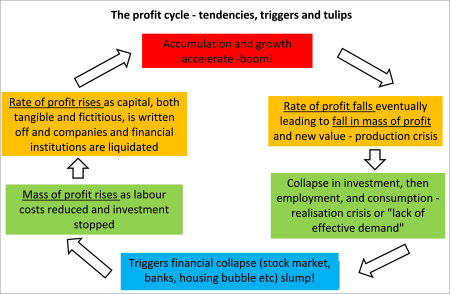
"... Those who read my blog regularly know that I would go further or indeed put it differently.   Capitalist economies go into slumps because of a collapse in profits and investment and this leads to a collapse in “effective demand”, not vice versa as the Keynesians (in whatever species) would have it.  So a restoration of profitability is necessary to restore growth under capitalism- this is what I (and G Carchedi) have called the Marxist multiplier compared to the Keynesian multiplier.

What is wrong with Keynesian theory and thus policy is that it denies this determinant role of profitability.  Indeed, in a way, the neoclassical mainstream has a point – that it is necessary (rational?) to drive down wages, weaken labour through unemployment and reduce the burden of the state on capital to revive profits and the economy. Of course, the mainstream cannot explain crises; often deny they can happen; and have no policy for recovery except to make labour pay."
It's another area orthodox Marxists tip-toe around. The focus on changes in profitability as the driver of the economic cycle together with a superior theory of crises makes Marxist economics far more insightful than the neoclassical tradition which Steve Keen so gleefully debunks, or the left-Keynesianism which he so enthusiastically supports.

Amazon link

But if - absent the socialist revolution - the answer to a capitalist recession is always to restore profitability, what would Michael Roberts advise?

That's the difficulty: the point where the theory transitions from positive to normative.

It gets worse: by pursuing Keynesian policies which tend to further wreck the economy and which confuse and demoralise the working class, the eventual reaction can be catastrophic: (Chile, the NSDAP).

I sense a paralysed coyness here from the Marxist left, impotence due to the very lack of illusions. I guess 'fight in the absolute certainty of defeat' doesn't have much of a ring to it.

Wednesday, April 25, 2018

Michael Roberts on Keynesianism & the modern left

Amazon link

I'm finding Michael Roberts's latest book a lot punchier than "The Long Depression". After a strong and penetratingly-clear review of Marx's 'three laws' (of value, of accumulation and of the tendency of the rate of profit to fall) he moves on to Marx's critics and has this interesting analysis of the continuing popularity of Keynesianism in the ranks of the modern socialist left.
"Marx, Keynes and the labour movement

Keynesian economics dominates on the left in the labour movement. Keynes is the economic hero of those wanting to change the world; to end poverty, inequality and continual losses of incomes and jobs in recurrent crises. In the US, the great gurus of opposition to the neoliberal theories of Chicago school of economics and the policies of Republican politicians are Keynesians.

In the UK, the leftish leaders of the Labour party around Jeremy Corbyn and John McDonnell, self-proclaimed socialists, look to Keynesian economists for their policy ideas and analysis. They bring them onto their advisory councils and seminars.

Those graduate students and lecturers involved in Rethinking Economics, an international attempt to change the teaching and ideas away from neoclassical theory, are led by Keynesian authors like James Kwak or post-Keynesians like Steve Keen, or Victoria Chick or Frances Coppola. Here the idea that inequality is the enemy, not capitalism as such, dominates the media and the labour movement. This is not to deny the ugly importance of rising inequality, but to show that a Marxist view on this does not circulate.

So why do Keynesian ideas continue to dominate? Geoff Mann provides us with an insightful explanation. In a new book, entitled In the Long Run We are all Dead, Mann reckons it is not that Keynesian economics is seen as correct. There have been "powerful Left critiques of Keynesian economics from which to draw; examples include the work of Paul Mattick, Geoff Pilling and Michael Roberts", but Keynesian ideas dominate the labour movement and among those opposed to what Mann calls 'liberal capitalism' for political reasons.

Keynes rules because he offers a third way between socialist revolution, and barbarism, i.e. the end of civilisation as we (actually the bourgeois like Keynes) know it. In the 1920s and 1930s, Keynes feared that the `civilised world' faced Marxist revolution or fascist dictatorship. But socialism as an alternative to the capitalism of the Great Depression could well bring down 'civilisation', delivering instead 'barbarism' - the end of a better world, the collapse of technology and the rule of law, more wars etc. So he aimed to offer the hope that, through some modest fixing of 'liberal capitalism', it would be possible to make capitalism work without the need for socialist revolution. There would be no need to go where the angels of 'civilisation' fear to tread. That was Keynes' narrative.

This appealed (and still appeals) to the leaders of the labour movement and 'liberals' wanting change. Revolution was too risky and we could all go down with it. Mann: "the Left wants democracy without populism, it wants transformational politics without the risks of transformation; wants revolution without revolutionaries". This fear of revolution, Mann reckons, was first exhibited after the French revolution. That great experiment in bourgeois democracy turned into Robespierre and the terror; democracy turned into dictatorship and barbarism — or so the bourgeois myth goes.

Keynesian economics offers a way out of the 1930s depression or the Long Depression now without socialism. It is the third way between the status quo of rapacious markets, austerity, inequality, poverty and crises and the alternative of social revolution that may lead to Stalin, Mao, Castro, Pol Pot and Kim Jong-Un.

It is such an attractive 'third way' that Mann professes that it even appeals to him as an alternative to the risk that revolution will go wrong (see his last chapter, where Marx is portrayed as the Dr Jekyll of Hope and Keynes as the Mr Hyde of Fear).

As Mann puts it, Keynes reckoned that, if civilised experts (like himself) dealt with the short-run problems of economic crisis and slump, then the long-run disaster of the loss of civilisation could be avoided. The famous quote that makes the title of Mann's book, that 'in the long run we are all dead, was about the need to act on the Great Depression with government intervention and not wait for the market to right itself over time, as the neoclassical (`classical' Keynes called it) economists and politicians thought.

For "this long run is a misleading guide to current affairs. In the long run we are all dead. Economists set themselves too easy, too useless a task if in tempestuous seasons they can only tell us that when the storm is long past, the ocean is flat again" (Keynes). You need to act on the short term problem or it will become a long-term disaster. This is the extra meaning of the long run quote: deal with depression and economic crises now or civilisation itself will come under threat from revolution in the long run.

[...]

Like all bourgeois intellectuals, Keynes was an idealist. He knew that ideas only took hold if they conformed to the wishes of the ruling elite. As he put it, "Individualism and laissez-faire could not, in spite of their deep roots in the political and moral philosophies of the late eighteenth and early nineteenth centuries, have secured their lasting hold over the conduct of public affairs, if it had not been for their conformity with the needs and wishes of the business world of the day...These many elements have contributed to the current intellectual bias, the mental make-up, the orthodoxy of the day.". Yet he still really believed that a clever man like him with forceful ideas could change society even it was against the interests of those who controlled it.

The wrongness of that idea was brought home to him in his attempts to get the Roosevelt administration to adopt his ideas on ending the Great Depression and for the political elite to implement his ideas for a new world order after the world war.

He wanted to set up 'civilised' institutions to ensure peace and prosperity globally through international management of economies, currencies and money. But these ideas of a world order to control the excesses of unbridled laissez-faire capitalism were turned into institutions like the IMF, World Bank and the UN Council, used to promote the policies of imperialism, led by America.

Instead of a world of 'civilised' leaders sorting out the problems of the world we got a terrible eagle astride the globe, imposing its will. Material interests decide policies, not clever economists. "
---

Michael Roberts has the strengths and weaknesses of an orthodox Marxist. I lay stress on the word orthodox here. He dismisses Keynes, along with the other critics he considers, because in no case do they propose socialist revolution to deal with the ills of capitalism (as he portrays them).

Roberts's critiques seem wholly compelling: the crises in capitalist reproduction are indeed crises of profitability (and not lack of effective demand, as Keynes claims), yet the brutal methods (devaluation of capital, lowering of wages) required to restore profitability within the framework of capitalism are not at all congenial to well-meaning economists or politicians seeking votes. Yet when executed by the impersonal forces of the crisis itself, they do work.

Roberts would prefer less callous, less cyclical pathways to growth. That's why he's a socialist. Yet he has no model for socialism, no hint as to how the overwhelming motivational and coordination issues of a global economy can be addressed in a manner superior to capitalism. There's just the blind faith that somehow the organised proletariat can do the job.

No political proposition with such a 'manifesto' has a prayer of being taken seriously and in his heart of hearts, Roberts knows it. Hence the ritualistic quality of his denunciations. Yet this selective myopia does neither him nor his book any favours.

And before uncritically lauding the (capitalist-driven) post-1980 successes of China and denouncing the (capitalism-blamed) stagnation of the third world he might try to emulate the bravery of bourgeois economist Garett Jones and absorb this.

But of course I have no serious expectations.

---

I recently wrote about Steve Keen and Corbyn. I plan to work my two posts so far about Marx 200 into an Amazon review over the next few days.

Friday, September 29, 2017

A Roadmap of Crisis Theories

This post could also be entitled, 'The Gurus of Contemporary Marxist Theory', interpreting 'Marxist' rather broadly.

A year ago, when I started to pay more attention to economics, I was clueless as to where to go for high-quality Marxist analysis (even at the start of my search I was not in any doubt that neoclassical economics - in its denial of the class structure of capitalism - was intellectually bankrupt).

I knew about Ernest Mandel of course, but who else was worth reading, and what were the key issues in contemporary debates?

On the latter question I soon discovered that the most important issue was, of course, the Marxist theory of crisis.

From Michael Roberts
---

On page 15 of Michael Roberts's book, "The Long Depression", he shows a variant of the roadmap below from the San Francisco Bay Area Marxist Study Group (click on image to make larger and more legible).


San Francisco Bay Area Marxist Study Group via Nick Johnson


Incidentally I'm comfortable with Michael Roberts's take on the world because, like him, I'm hard left on the diagram above all the way down 😎.

Roberts is also not that tribal, seeking to understand rather than denounce. This is just as well as he secretly seems as convinced as I am that capitalism has at least another century before the imminence of total automation make production solely for the valorisation of capital essentially impossible.

This view of capitalism's likely future rather depends upon Marx's law of the ‘tendency of the rate of profit to fall’ (TRPF) applying over the long-term. I'm good with that as an empirical reality, increasing automation being the causal mechanism.

---

So who are the top gurus of Marxist thinking today? I've already mentioned Michael Roberts who has a prolific blog. I should also mention Sam Williams at "A Critique of Crisis Theory".

Moving now to the superstars, we have Dave Harvey, Michael Heinrich and Anwar Shaikh. I have bought books authored by all three. I'd also mention Andrew Kliman, whose book (below) I've just acquired.

Amazon link

While not a Marxist, radical Keynesian Steve Keen gets an honourable mention for bearing the wrath and fury of the entire neoclassical establishment with courage and fortitude. Roberts writes about him here.

So I'm very much a work-in-progress at the moment, struggling hard to get an intuitive view of the dynamics of capitalist economies at all time scales (Michael Roberts's views on cycles are persuasive).

In the background Marx's own writings, Capital Vols 2, 3 and 4 are still on the stack.

Wednesday, September 27, 2017

A run on Zopa?

There is no evidence for, or imminent possibility of, a run on Zopa.

---

OK, now we've got the scaremongering out of the way, let's examine the substantive issue.

From Wikipedia:
"Zopa enables investors to lend to UK consumers directly through its peer-to-peer lending platform.

"Borrowers can take out loans between £500 and £25,000. Typically individuals use these to funds to help buy a car, consolidate debts, cover home improvements or weddings. All applicants are credit-checked by Zopa.

"Investors’ money enters a queue to be lent in one of three products, which vary according to the risk, returns and accessibility they offer. Once the money reaches the front of the queue, it is split into micro-loans (typically of £10-20 each) that go to multiple borrowers. Investors then receive monthly repayments of interest and capital, which they can relend to compound the interest."
We have funds in Zopa so we have a personal interest in this issue.

---

Both Steve Keen and Michael Roberts have warned about the overhang of corporate and consumer debt in the UK economy .. portending an upcoming recession. As regards consumer debt, according to This is Money,
"We know that it is largely credit cards, personal loans and car finance, but we aren't quite sure who is doing the borrowing and why – beyond the helpful statistics that debt charities can provide.

Some of this pile of credit card and personal loan debt is down to people who can't make ends meet any other way, a considerable amount is down to others who prefer to live beyond their means and borrow a better lifestyle today from their earnings tomorrow.

"The £201 billion debt pile is now within touching distance of its peak of £208 billion in September 2008 when the financial crisis was in full flow. In the crisis, as worried lenders slammed the doors after the horse had bolted - and done an entire lap of the field – consumer credit dried up and borrowing fell, down to about £160 billion in 2013 to 2014.

"Since then it has been on the rise.

"But that in itself and the absolute size of the pile is not necessarily a problem.You would expect consumer credit to rise in an economic recovery and as long as people's ability to pay back that debt is improving through rising wages, then a higher debt pile becomes an economic factor, not an issue.

"There's a problem in Britain though. Our ability to pay back debt hasn't been improving – real wages have fallen.

"Once our earnings are adjusted for inflation, we have less money to pay back our debt today than we did at the financial crisis peak. The other factor that comes into play here, of course, is interest rates. These, as you won't need to be told, are super low. If you can borrow at those low rates then the affordability of your debt is better, yet here there are also some problems. Firstly, rates will one day have to rise. ..."
A rise in interest rates and/or a pullback from QE could both reduce demand in the economy. As a recession bites, unemployment rises as businesses contract or go bust (see "Zombies hold back the recovery"). The unemployed find it hard to repay debts.


Schroders' chart shows how many months the market has expected to wait for a first
rate rise over the past year. One is now expected in about 10 months, sooner than previously.

With interest rates rising and incomes falling, many consumers will be in difficulties. Perhaps they will be unable to service their debts to credit card companies .. and to peer-to-peer lenders such as Zopa.

But events may move faster yet. Given a tired Tory government with a wafer-thin majority, a political crisis could result in a Corbyn electoral victory .. which might then trigger an economic crisis sooner than we might think.

In normal times, Zopa's bad-debt protocol and stringent credit checks mitigate the risks of default. But in a systemic crisis, the number of bad debts could spiral. This could make loan-books unsaleable for savers trying to exit before they lose the preponderance of their investments. And Zopa is not covered by the UK Government's Financial Services Compensation Scheme.

So the conclusion I draw is to keep a prudent eye on the state of the economy. If we seem poised to enter a consumer-debt-fuelled recession of any severity, I'd be thinking of exiting Zopa earlier rather than later. In the meantime we're quietly reducing our exposure.

Friday, September 22, 2017

"The Long Depression" - Michael Roberts

Amazon link

I've been impressed by Michael Roberts's blog posts, on the right sidebar here in the web view. He is insistent that lack of profitability is both the proximate cause of crises and the underlying reason for long depressions, such as the one we're currently experiencing. He is also prepared to make predictions.

So this seemed to be the book to get (published in July 2016) to learn more about his thinking. Here's the Amazon summary.
"Setting out from an unapologetic Marxist perspective, The Long Depression argues that the global economy remains in the throes of a depression. Making the case that the profitability of capital is too low, and the debt built up before the Great Recession too high, leading radical economist Michael Roberts persuasively presents his case that this depression will persist until the profitability of capital is restored through yet another slump."

Here is Michael Roberts talking on "Economic crisis and the long depression" at Marxism 2017:


Roberts talks for 33 minutes - he's interesting, rather tribal, but can perhaps be forgiven in the circumstances. Then there are a number of questions/contributions from the floor until at 54 minutes Roberts again takes the microphone to respond.

His most interesting point is at 1 hour 3 mins when he gives the example of Venezuela as a government which was trying to implement populist measures 'outside the envelope' of what is possible within a capitalist economy. The economy crashes, of course.

Two minutes later he's comparing the situation there with a possible Corbyn government taking office during the predicted next recession. The divergence between what will be promised and what will be possible will be extreme. Roberts is understandably skeptical about 'post-capitalism in one country', seeing the modern economy as inherently global in scale.

But what lesson are we to draw from this? It's a very stupid general who marches the proletarian troops to battle knowing they are to be slaughtered. Yet the idea of global socialist revolution starting via a Corbyn victory in the UK is risible.

So, Michael Roberts, what is to be done?

I suspect that Roberts is well aware that capitalism still has a way to go before immanent contradictions lead to its supersession. The driver for that will not be voluntaristic vanguard parties (hello, SWP?) but the trend to total automation.

---

I'll let you know what I think: it's competing with Steve Keen's book and Capital Vol 2 at the moment. But I think it's a priority.

Friday, September 15, 2017

Steve Keen and Anwar Shaikh

In the 1970s the International Marxist Group (IMG) was known as the most intellectual of the far-left organisations. Theory was taken seriously but as a member in my early twenties I never learned much economics - I was not the only one. An abiding memory was of a conference where a senior comrade gave a speech on economic perspectives: a colleague whispered to me that all he had done was take an editorial from The Economist that week and dress it up in Marxist language - I was appalled.

Amazon link

I'm in two minds about Steve Keen's book. I understand that it's dumbed down, written for students contemplating entering university-level economics. The book describes the vast arc of economics history stretching from the classical era of Adam Smith, David Ricardo and Karl Marx (who arguably terminated that tradition by making it politically explosive) through to the rise of the neoclassical tradition, Keynesianism and the confusion we are in today (Sam Williams' analysis is shorter and more definitive).

On the downside, in areas I know something about (quantum mechanics, special relativity) Keen's writing is confused although blusteringly self-confident. Throughout the book he has eschewed equations and diagrams, which is insane - he is reduced to conveying exactly the same concepts in prose which completely obscures his narrative. I was concentrating closely and his verbal arguments elide important steps and don't really hang together.

So I'm thinking Keen is interesting but intellectually underpowered, the kind of tourist guide who you sense isn't really authoritative.

The guy I'm really meant to read, apparently, is Anwar Shaikh.

Amazon link


Sam Williams writes:
"Shaikh’s book is by a modern university-educated economist written for other modern university-educated economists. Economics blogger Michael Roberts in his review says Shaikh’s “Capitalism” is more difficult than Marx’s “Capital.” I agree with Roberts on this point, and I think it is important to examine why this is so.

One reason is that Shaikh’s book demands a thoroughgoing knowledge of Marx’s work, including all three volumes of “Capital.” But it also requires a thoroughgoing knowledge of modern orthodox bourgeois economics—neoclassical marginalism. While parts of the book use Marxist language, the bulk of it is written in both the language of English and mathematics in a way that will be familiar only to those well grounded in orthodox bourgeois economics.

Shaikh provides some “translation” between the terminology employed by Marx and that used by modern economists, but it is hardly sufficient. In addition, where in the many places Shaikh uses the jargon of neo-classcal marginalism in place of basic Marxist concepts, it renders his language imprecise. Marx’s terminology was designed to describe in precise terms his analysis of capitalism. The terminology of neo-classical marginalism was developed for quite different purposes, to say the least, though it’s always possible to see what Shaikh is getting at provided the reader is sufficiently fluent in both “languages.”

Shaikh does provide a useful appendix listing the meaning of symbols he uses in his mathematical equations. The list is a long one.

Marxist political activists, even if they are highly educated Marxists but lack knowledge in today’s bourgeois economic orthodoxy, will have trouble understanding the book. But professional economists thoroughly grounded in modern bourgeois economics will be if anything in even greater trouble. The reason is that trained as they are in present-day bourgeois economics, they will also have a great deal of difficultly with the book unless they also have a thorough grounding in Marx. Though they will feel “more at home” with much of the terminology than will Marxist political activists, the Marxist foundations of the book will escape them.

The professional economists who will have the least difficulty with “Capitalism” are those familiar with the work of the Italian-British economist Piero Sraffa. For those somewhat familiar with Shaikh’s work, this will be no surprise. Much of Shaikh’s work has revolved around the “transformation problem”—the problem of transforming Marx’s values—or direct prices—into prices of production.

Shaikh has spent a considerable part of his career in refuting the suggestion by various critics of Marx that Sraffa’s work has both refuted Marx’s theory of value and surplus value and rendered it unnecessary. Essentially, these critics—also mostly university-educated economists—hold that the capitalist economy can best be described in terms of prices of production. According to them, analyzing capitalism in terms of “value” merely gets in the way.

But even professional economists familiar with Sraffa, unless well grounded in Marx, will not find “Capitalism” an easy read. I would most certainly not recommend Shaikh’s “Capitalism” as an introduction to modern Marxist economic thought.

None of this detracts from the importance of this work, however. Shaikh is undoubtedly one of the most important economic thinkers of our time. What it does mean is that it may take many years—or decades—for the arguments in this book to be assimilated into the understanding of the workers’ movement. I hope to contribute to this process in this extended review and critique."
So this is exciting and daunting! Although Michael Roberts in his review strikes a cautionary note.

Amazon link

Here is my go-forward plan (I have almost completed Capital Vol 1).
  1. Read Capital Vols 2 and 3 and Theories of Surplus Value (Vol 4)
  2. Read David Harvey's "Limits to Capital"
  3. Engage with Shaikh's book (or watch the video lectures).
I would like to complete this plan within my lifetime.

Thursday, September 07, 2017

Only engineering convinces

Amazon link

I'm only in the earliest stages of Steve Keen's critique of neoclassical economics (above). He's very successful in exposing their logical inconsistencies and utterly implausible assumptions.

From my own amateur reading of the standard texts, I recall authors conceding these points on the excuse that (i) we can learn something from pure models, and (ii) that despite the flawed assumptions the results seem surprisingly accurate.

I know that Dr Keen is underwhelmed by such hand-waving and will address those points in later chapters.

---

Keen is somewhat puzzled by the fact that leading economics journals won't see the force of his (undoubtedly correct) arguments or publish his erudite papers. He has some explanations in terms of cultural inertia, the apparent successes in the past of the neoclassical programme and even the usual lack of real-world consequences of getting the foundations so very wrong. He admits wryly that economics just isn't like physics or engineering.

This seems to me the crux of it:

  • People will believe all kinds of things if doing so underpins their self-interest.

  • If there are no practical consequences (ie nothing that can't be explained away), mere argument will never gain traction.

  • If you believe humans will never fly (“if God wanted man to fly he would have given him wings”) then only an aeroplane will refute you.

I'm waiting for the final chapters where Keen unveils his alternative macroeconomic model which, I believe, successfully outperforms those of the neoliberals.

---

Remember those stories of how racist AI systems were categorising criminals by their mug shots? Plainly, said liberals, crime was a matter of unfortunate circumstances. How could faces (which identical twins suggest are genetically shaped) have anything to do with it?

Yet it was engineering - hard to argue against.

The Economist (liberal susceptibilities very much on hold) reports today: "Advances in AI are used to spot signs of sexuality".
"When shown one photo each of a gay and straight man, both chosen at random, the model distinguished between them correctly 81% of the time.

When shown five photos of each man, it attributed sexuality correctly 91% of the time.

The model performed worse with women, telling gay and straight apart with 71% accuracy after looking at one photo, and 83% accuracy after five. In both cases the level of performance far outstrips human ability to make this distinction.

Using the same images, people could tell gay from straight 61% of the time for men, and 54% of the time for women. This aligns with research which suggests humans can determine sexuality from faces at only just better than chance."
Sexual orientation not so much a lifestyle choice after all.

Friday, September 01, 2017

Corbyn's economist: Steve Keen

In the days before sat-navs, you could find yourself driving around the English countryside trying to find your destination: a village, say, like Royston Vasey.  Signposts would contain the name and direct you down endless byways, but somehow you never got any closer. You may have had similar experiences in seaside towns with signs to public toilets.

My job as a self-employed telecoms network architect required a passing familiarity with microeconomics (traffic modelling, business cases). Sometimes I would delve into macro, my interest being in crises, recessions and the preconditions for a new wave of expansion. People only build big public networks in a time of exuberant growth.

Like Royston Vasey, the search proved elusive. Thanks to Steve Keen, I now know that orthodox macroeconomics simply assumes that crises cannot occur. Those that happen nevertheless cannot be structural, but are due to policy errors or 'outside shocks'.

Keen identifies the bizarre foundations of contemporary macroeconomic models as used by businesses, governments and international agencies: the modelling of all consumers as equivalent atomised individuals (no finance and industrial capitalists, no organised workers); the abstraction away of money, debt and the entire financial sector. A continual return to equilibrium is built in.

Taking these things into account, however, leads to very different models which show strong (and empirically-validated) correlations between excessive private debt and crashes; the economy exhibits chaotic rather than equilibrium-seeking behaviour, something like the weather.

This is all explained rather concisely in his latest book which I've now completed.

Amazon link

I was rather impressed: his arguments seemed plausible and well-corroborated. In the UK he sees an unregulated finance sector (think Margaret Thatcher's 'Big Bang' reforms) as having opened the floodgates of private debt (he has supporting data) and thinks that the chronic UK Government deficit is really a symptom of the long post-crash malaise rather than the prior cause of it.

Reading his Wikipedia bio, I was only slightly surprised to read this:
"In August 2015, Keen endorsed Jeremy Corbyn's campaign in the Labour Party leadership election."
Amazon link

I'll be checking out his main book (above) in the near future. Here's Steve Keen on the BBC's HardTalk.


The interviewer is pretty aggressive and it helps to have read Keen's "Can We Avoid Another Financial Crisis? (The Future of Capitalism)" to understand the logic of his responses.

Tuesday, August 29, 2017

Diary: what I'm reading

Amazon link

Peter Turchin recommends this book in his latest, rather blood-curdling post. He writes,
"It is strange to actually live in a society experiencing a structural-demographic crisis, after studying many examples of such crises in the past. Unfortunately the crisis is developing largely according to the classical pattern. The degree of political polarization is at its highest levels since the (First) American Civil War. Intra-elite infighting is tearing the Republic apart. ...

"Steve is one of the “heterodox economists” (meaning that they are pretty much ignored by the mainstream). His starting point is the theory of Hyman Minsky (another economist who was largely ignored by the profession). Minsky’s theory makes a lot of sense to me, however. Let me try explain it in one paragraph.

"The main dynamical driver is the magnitude of private debt (combining what’s owed by both corporations and households) in relation to GDP. Currently this indicator is at 150% of the US GDP. Why is it bad?

"Actually, for a while, as private debt grows, things are just fine because expanding credit drives economic growth (think of new housing construction during building booms). But eventually the cost of servicing accumulated debt starts to depress consumption (the more you pay for your mortgage, the less money you have to buy things). Falling consumption results in overproduction of goods and declining profits for businesses, which makes investment a losing proposition. Credit collapses, businesses go bankrupt, or downsize their labor, less employment means even less consumption, and (absent large-scale increase in government spending) the economy enters a downward-trending “death spiral” of a prolonged depression.

"The precise timing of the turn-around point is very difficult to predict (it’s another example of earthquake-like dynamics). Yet Steve Keen is one of very few economists who predicted the General Financial Crisis (GFC) of 2007–2008.

"If Steve is right in identifying the main cause of the GFC, then we should listen to what he says in the book about the likelihood of another crisis in the next few years. Unfortunately, the news is bad, because we are still at a very high level of private debt in relation to GDP."
Turchin also sees the world economy in the 'winter' phase of the current Kondratiev cycle (I recently wrote about these here).


In any event, I acquired the book and will read it along with this:


They say the first four chapters are tedious, and that after that, things pick up (most readers have abandoned by then). In these early chapters Marx writes at length and repetitiously about the nature of the commodity, use-value and exchange-value, money and the transformation of money into capital.

He's a lively writer, always good for a venomous quip at the expense of an opponent; his knockabout style is far from politically-correct. It helps to be aware of just how important - how foundational - these concepts are for the whole development of Marxist economics.

Still, I'm glad I've got beyond chapter four.