This is a short post with some examples of clever people believing stupid things. And here is the origin of the term: "Clever sillies: why high IQ people tend to be deficient in common sense."
In fact clever sillies are people who have an agenda defined by their social position, which being axiomatically believed, prevents them from understanding reality properly.
1. The Catholic Church cannot understand evolution
From a biological view, the whole of life is a space of genotypes, mutating and complexifying over time via new phenotypes in response to environmental challenges caused by geophysical events and the feedback loops within ecologies themselves.
If you look at primate genomes, the C, G, A, T sequences, nothing jumps out at you about humans. They're pretty indistinguishable from other primates. There's continuity.
Yet in Catholic doctrine, people are in a unique relationship with God, have souls and so forth. Chimpanzees not so much.
Evolution can't support such theological discontinuities, so lip-service only is paid to it.
2. Liberals cannot understand evolution
From a biological standpoint, the presently-existing human race is a marvel of diversity. Over and above the basic XX-XY genomic differences encoding differential male-female reproductive roles, we see regional and historical adaptations to climate and social complexification marking and enabling geographical migration, the neolithic revolution and even the turbulent social history of the last millennium.
New results are being released every day, from teams like that of David Reich through to everyday personal genomics companies such as 23andMe.
None of this is consistent with equal outcomes, an axiom of SJW thought. So human micro-evolutionary plasticity must be denied.
3. Economist can't understand capitalism
As Steve Keen showed, the theoretical structure of neoclassical economics - the current orthodoxy - is laughably stupid. It takes years of education to ram this nonsense firmly into economists' heads. Capitalism is conceptualised as an idealised village market: petty-commodity production.
All this to wish away the obvious truth that investment is conducted for profit, and that profits result from the appropriation by private owners of produced value from propertyless workers. Unthinkable.
Conclusion
We live in a society which denies its own economic nature and for its own replicatory purposes misrepresents the nature of the people who comprise it. No wonder we are drowning in lies.
Where is the truth?
Where is the truth, you ask. Marxists come close with their understanding that capitalism is a kind of game played by people in unequal class relations. The ideologies which makes this seem natural and right are discussed above.
Yet Marxism buys into a naive ideology of the ur-nature of mankind: generalised benevolence waiting for the right social conditions to emerge. This unlikely prospect has been falsified both by history and biology. So there's another agenda subverting the truth. The ever-critical Marx would have been horrified.
I think the people who get closest to truth are the sociobiologists (check out West Hunter some time). They have the kudos of being reviled by everyone.
As the petty-bourgeoisie gets ever more outraged at its lacklustre prospects, its febrile mobilisations, its crazed intellectual frothings get ever more irksome and dangerous.
Hold on tight .. .
Showing posts with label Michael Roberts. Show all posts
Showing posts with label Michael Roberts. Show all posts
Tuesday, April 16, 2019
Thursday, March 21, 2019
Beyond capitalism: is this the best we can hope for?
It's to easy to reify capitalism. To see it as the capitalist class (hiss!) bearing down upon the downtrodden proletariat.
Expropriate them!
---
1. The inner-truth of capitalism
Let's do the analysis right.
Consider the vast mass of people who cannot live by their own efforts (they have no land, no resources, they are not self-sufficient). The proletariat.
Add a minority who own the land, the factories, the machines, the tools, the raw materials and all the other means of economic production. Ownership guaranteed by law and state. The capitalists.
If the owners hire workers (their capacity to work, actually) at a rate which can reproduce them for work next day, week, year .. while the amount produced by said workers exceeds their wages in value, well the surplus will be owned by the capitalists. They will get consistently richer. We have a technical name for this: it's called profit and it's a good thing. It means social needs are being addressed efficiently.
Note: if you work for the state rather than a private-sector employer, your wages are paid out of taxes: value contributed ultimately by the capitalist sector.
2. What do the capitalists do with their ever-increasing riches?
An insignificant relative proportion goes into luxury apartments and super-yachts (although this conspicuous consumption is a powerful human motivator and source of envy and resentment). The statistics show that most capitalist profits are re-invested to secure another round of expanded reproduction. Or in these stagnating times, financing debt.
M - C - M' in Marx's formula. Money makes money through the intermediary of surplus value production.
Gratuitous consumption is always a missed opportunity under capitalism. An opportunity cost.
In the nutshell, it is the way production is organised which creates the classes .. they are both a precondition and a consequence of the relations of production.
3. Capitalism really pushes the social-surplus product
No moralism. We're none of us going back to living off the land. Noble hunter-gatherers, trapped in the deepest well of unproductive subsistence.
Nor are we going back to the agrarian life, another low-productivity hell-hole where almost everyone is tied to mediocre, hard, tedious life on the land.
We all agree that human affairs are improved when we have a better constructed-environment, one which suits our diverse needs. The way we do that is by a global division of labour where projects of the most ambitious scope can be realised. I like modern medicine.
That's going to take a lot of social-surplus product going forwards. It's going to continue to require people to personally consume only a small fraction of the value they themselves produce.
Any one individual is going to look at projects on all scales up to the fully global and subjectively feel like a small cog in a vast machine.
I wonder though whether they'll really care. Nobody asks me about NASA but I can still get excited.
Who decides what projects should be done, if not individual capitalists who have succeeded in attracting investment capital? I refer you to the pessimistic literature on traditional post-capitalist organisational forms well-documented here.
4. A post-capitalist economic organisation we might expect
Suppose we get the miracle of total automation. Cognitive robots replace workers. But in the end, without wage-labour, profits can't be obtained.
Under capitalism, the capitalist who automates gets a short-term advantage but then overall profits fall. Competition means that in the steady-state the capitalist cannot charge more than will cover his costs. Without wage-labour creating additional value, sale-prices are simply bid down to the costs of robots, overheads and materials. As a consequence, profits tend to zero.
The capitalists don't invest. It's like an economic crisis which never abates.
5. The Roman Empire redux
An economy of petty-commodity production is what still works. Like the Roman Empire of antiquity. The slaves have been switched out for robots. Units of production produce lots of goods which are sold at their value, like in a village marketplace.
The Roman Empire was economically complex and vast in space and time. It was not very productive, not very dynamic - which may have been due to its agrarian character. And slaves are not the ideal robot - far from it. Not biddable at all.
Some people think the answer is for everyone to own personal robots. In antiquity most of the elite fraction of society had at least a few household slaves. But that isn't commensurate with distributing widely the benefits of a sophisticated global economy.
If I had to guess, I would say that the automation-heavy future is essentially robot-powered petty-commodity production combined with a very generous guaranteed income for everyone. Add in genetic enhancement to exploit the possibilities of an improved humanity and we'll not be in a bad place.
At least until the AIs decide we're a waste of their space!
---
Note: the Marxist economist Michael Roberts has written extensively about the consequences of total automation under capitalism. Here's a good place to start.
Expropriate them!
---
1. The inner-truth of capitalism
Let's do the analysis right.
Consider the vast mass of people who cannot live by their own efforts (they have no land, no resources, they are not self-sufficient). The proletariat.
Add a minority who own the land, the factories, the machines, the tools, the raw materials and all the other means of economic production. Ownership guaranteed by law and state. The capitalists.
If the owners hire workers (their capacity to work, actually) at a rate which can reproduce them for work next day, week, year .. while the amount produced by said workers exceeds their wages in value, well the surplus will be owned by the capitalists. They will get consistently richer. We have a technical name for this: it's called profit and it's a good thing. It means social needs are being addressed efficiently.
Note: if you work for the state rather than a private-sector employer, your wages are paid out of taxes: value contributed ultimately by the capitalist sector.
2. What do the capitalists do with their ever-increasing riches?
An insignificant relative proportion goes into luxury apartments and super-yachts (although this conspicuous consumption is a powerful human motivator and source of envy and resentment). The statistics show that most capitalist profits are re-invested to secure another round of expanded reproduction. Or in these stagnating times, financing debt.
M - C - M' in Marx's formula. Money makes money through the intermediary of surplus value production.
Gratuitous consumption is always a missed opportunity under capitalism. An opportunity cost.
In the nutshell, it is the way production is organised which creates the classes .. they are both a precondition and a consequence of the relations of production.
3. Capitalism really pushes the social-surplus product
No moralism. We're none of us going back to living off the land. Noble hunter-gatherers, trapped in the deepest well of unproductive subsistence.
Nor are we going back to the agrarian life, another low-productivity hell-hole where almost everyone is tied to mediocre, hard, tedious life on the land.
We all agree that human affairs are improved when we have a better constructed-environment, one which suits our diverse needs. The way we do that is by a global division of labour where projects of the most ambitious scope can be realised. I like modern medicine.
That's going to take a lot of social-surplus product going forwards. It's going to continue to require people to personally consume only a small fraction of the value they themselves produce.
Any one individual is going to look at projects on all scales up to the fully global and subjectively feel like a small cog in a vast machine.
I wonder though whether they'll really care. Nobody asks me about NASA but I can still get excited.
Who decides what projects should be done, if not individual capitalists who have succeeded in attracting investment capital? I refer you to the pessimistic literature on traditional post-capitalist organisational forms well-documented here.
4. A post-capitalist economic organisation we might expect
Suppose we get the miracle of total automation. Cognitive robots replace workers. But in the end, without wage-labour, profits can't be obtained.
Under capitalism, the capitalist who automates gets a short-term advantage but then overall profits fall. Competition means that in the steady-state the capitalist cannot charge more than will cover his costs. Without wage-labour creating additional value, sale-prices are simply bid down to the costs of robots, overheads and materials. As a consequence, profits tend to zero.
The capitalists don't invest. It's like an economic crisis which never abates.
5. The Roman Empire redux
An economy of petty-commodity production is what still works. Like the Roman Empire of antiquity. The slaves have been switched out for robots. Units of production produce lots of goods which are sold at their value, like in a village marketplace.
The Roman Empire was economically complex and vast in space and time. It was not very productive, not very dynamic - which may have been due to its agrarian character. And slaves are not the ideal robot - far from it. Not biddable at all.
Some people think the answer is for everyone to own personal robots. In antiquity most of the elite fraction of society had at least a few household slaves. But that isn't commensurate with distributing widely the benefits of a sophisticated global economy.
If I had to guess, I would say that the automation-heavy future is essentially robot-powered petty-commodity production combined with a very generous guaranteed income for everyone. Add in genetic enhancement to exploit the possibilities of an improved humanity and we'll not be in a bad place.
At least until the AIs decide we're a waste of their space!
---
Note: the Marxist economist Michael Roberts has written extensively about the consequences of total automation under capitalism. Here's a good place to start.

Sunday, March 10, 2019
The misunderstandings of eusociality
"An early 21st century debate focused on whether humans are prosocial or eusocial. Edward O. Wilson called humans eusocial apes, arguing for similarities to ants, and observing that early hominins cooperated to rear their children while other members of the same group hunted and foraged. Wilson argued that through cooperation and teamwork, ants and humans form superorganisms. Wilson's claims were vigorously rejected because they were based on group selection and reproductive division of labour in humans." -- [Wikipedia].---
 |
| My review |
---
 |
| My review |
People puzzle at how human societies of thousands to millions to billions can form, how they can be stable. Some people fantasise about some mysterious genetic glue which fosters ultra-scalable human bonding, at least among co-ethnics.
 |
| My review |
I am a believer in Robin Dunbar's number:
"By using the average human brain size and extrapolating from the results of primates, he proposed that humans can comfortably maintain only 150 stable relationships."Pre-capitalist social formations (tribal federations, archaic empires, slave empires, feudal states) were invariably hierarchies based on the elite violence of family-clans. Horizontal kin-preference plus reciprocal-altruism was the glue which held society together, whether at court or in the village-hovels.
Game of Thrones.
When you do political violence to someone, you are not in a social relationship of asabiyyah with them. This is not eusociality.
---
Capitalism removed the means of livelihood from the mass of the population (the 'proletariat') and thereby forced them into the transactional relationship of wage-labour. This is a scalable fact of capitalist economics but does not depend upon some upending of the individual's interpersonal capabilities.
If each human is a node in a graph, the number of personal links per node remains less than or equal to Dunbar's number.
The web of links, however, spans the world.
---
Marxists like to talk about this as commodity fetishism, which socialism will supersede.
The 'workers councils' model is hierarchical and no-one believes in its long-term stability any more. Mass mobilisation is not sustainable, ignoring all the other difficulties such as informed choice and that irritating human lack of global altruism. Yet global coordination is necessary to mobilise the social forces of production, the future socialist global economy.
The need for a global coordination network combines with the human capacity for only a tiny number of reciprocal links. The solution is always hierarchy (at least until we subcontract everything to the AIs). And so the problems start. People are instinctively aware of them, hence the visceral urge for egalitarianism.
As the link-depth grows, relationships become remote, principal-agent problems emerge, the forces at the top of the hierarchy arrange things in their own immediate interests, the bubble re-emerges.
Capitalism addresses this inherent problem by a radical economic decentralisation: private ownership of the means of production at all scales. Coordination occurs via dynamic market-exchange.
 |
| The Marxist theory of crises |
People occasionally comment on the subsequent problems: the proletariat disproportionality suffers during the inevitable crises.
---
As János Kornai observed however, in centrally planned economies there is no countervailing, decentralising force. The links which constitute the economy are held in place, reproduced - and always for the benefit of the elite - by total surveillance backed by force.
 |
| My review |
Welcome to the human condition. The maze without an apparent exit.
Thursday, January 10, 2019
The coming recession evokes only Marxist hand-wringing
From Michael Roberts: ASSA 2019 part 2 – the radical: profitability, growth and crises.
But if - absent the socialist revolution - the answer to a capitalist recession is always to restore profitability, what would Michael Roberts advise?
That's the difficulty: the point where the theory transitions from positive to normative.
It gets worse: by pursuing Keynesian policies which tend to further wreck the economy and which confuse and demoralise the working class, the eventual reaction can be catastrophic: (Chile, the NSDAP).
I sense a paralysed coyness here from the Marxist left, impotence due to the very lack of illusions. I guess 'fight in the absolute certainty of defeat' doesn't have much of a ring to it.
"... Those who read my blog regularly know that I would go further or indeed put it differently. Capitalist economies go into slumps because of a collapse in profits and investment and this leads to a collapse in “effective demand”, not vice versa as the Keynesians (in whatever species) would have it. So a restoration of profitability is necessary to restore growth under capitalism- this is what I (and G Carchedi) have called the Marxist multiplier compared to the Keynesian multiplier.It's another area orthodox Marxists tip-toe around. The focus on changes in profitability as the driver of the economic cycle together with a superior theory of crises makes Marxist economics far more insightful than the neoclassical tradition which Steve Keen so gleefully debunks, or the left-Keynesianism which he so enthusiastically supports.
What is wrong with Keynesian theory and thus policy is that it denies this determinant role of profitability. Indeed, in a way, the neoclassical mainstream has a point – that it is necessary (rational?) to drive down wages, weaken labour through unemployment and reduce the burden of the state on capital to revive profits and the economy. Of course, the mainstream cannot explain crises; often deny they can happen; and have no policy for recovery except to make labour pay."
 |
| Amazon link |
But if - absent the socialist revolution - the answer to a capitalist recession is always to restore profitability, what would Michael Roberts advise?
That's the difficulty: the point where the theory transitions from positive to normative.
It gets worse: by pursuing Keynesian policies which tend to further wreck the economy and which confuse and demoralise the working class, the eventual reaction can be catastrophic: (Chile, the NSDAP).
I sense a paralysed coyness here from the Marxist left, impotence due to the very lack of illusions. I guess 'fight in the absolute certainty of defeat' doesn't have much of a ring to it.
Wednesday, December 12, 2018
Reading Poulantzas and McDonnell
Classes in Contemporary Capitalism
From the preface:
---
State, Power, Socialism
This is Poulantzas's great exposition of the anatomy and dynamics of the various forms of the capitalist state, and the implications for the transition to socialism. I already read "The State and the Transition to Socialism" (Chapter 14 "The Poulantzas Reader" - PDF) where Nicos Poulantzas debates with the (at that time) Trotskyist Henri Weber (of the LCR) as to whether the Leninist model of a proletarian revolution/state based on federated soviets is really viable in modern Western Europe.
Poulantzas further questions whether the power of the bourgeois state can really only be overthrown by dual-power soviet structures as in the Bolshevik revolution (that was Trotskyist orthodoxy at the time of the interview, 1977). A kind of head-on assault.
My sympathies align with Poulantzas here, insofar as he at least thought about the nature of the state unlike the FI which had not moved beyond "The State and Revolution".
Weber is right against Poulantzas that the state is too strong and - in extremis - too focused to be subverted/reused from within. But they are both wrong to think that modern capitalism is vulnerable to the revolutionary imposition of a post-capitalist mode of production led by the massed ranks of the industrial proletariat.
That isn't the failure mode.
Update 23rd February 2019:
I've just read Ellen Meiksins Wood's book, "The Retreat From Class", where she devotes a chapter to Poulantzas. She takes him to task for assigning white-collar workers to the 'new petty-bourgeoisie' (rather than the working class) and also for assuming this category is equivalent to the Marxist (technical) distinction between productive and unproductive workers (productive of surplus value, that is).
Poulantzas was undoubtedly wrong about this, and Wood has him nailed.
---
Economics for the Many
I'm expecting this book to be a bunch of left-Keynesians arguing that an incoming Labour government should put more demand into the economy through deficit spending and increased transfer payments in order to stimulate investment and productivity.
I'm completely with Michael Roberts here: good luck with that.
Still, no sense in prejudging. Let's listen to what Mr McDonnell's favourite economists have to say.
 |
| Amazon link |
From the preface:
"The book starts with a general theoretical essay that for the first time seriously explores the distinction between the “agents” and “positions” of capitalist relations of production, and seeks to avoid the typical errors of either functionalism or historicism. It also provides a polemical reconsideration of the problem of the “nation state” as a political unit today, and its relationship to the internationalization of capital.These are really critical issues when trying to understand the kind of class dynamics underlying the recent events in France, the left and right populist movements everywhere and specifically the SJW phenomenon. It's also relevant to any incoming Labour government here in the UK.
Finally, and most originally, Poulantzas develops a long and powerful analysis of the much-abused concept of the “petty-bourgeoisie.” In this, he scrupulously distinguishes between the “traditional” categories of petty-bourgeoisie—shopkeepers, artisans, small peasants—and the “new” categories of clerical workers, supervisors, and salaried personnel in modern industry and commerce. At the same time he demonstrates the reasons why a unitary conceptualization of their class position is possible. The difficult question of the definition of “productive” and “unproductive” labor within Marx’s own account of the capitalist mode of production is subjected to a novel and radical reinterpretation. The political oscillations peculiar to each form of petty-bourgeoisie and especially their characteristic reactions to the industrial proletariat, are cogently assessed.
Poulantzas ends his work with a reminder that the actions and options of the petty-bourgeoisie are critical to any successful struggle by the working class, which must secure the alliance of important sections of the petty-bourgeoisie if the fateful experience of Chile is not to recur elsewhere tomorrow."
---
State, Power, Socialism
 |
| Amazon link |
This is Poulantzas's great exposition of the anatomy and dynamics of the various forms of the capitalist state, and the implications for the transition to socialism. I already read "The State and the Transition to Socialism" (Chapter 14 "The Poulantzas Reader" - PDF) where Nicos Poulantzas debates with the (at that time) Trotskyist Henri Weber (of the LCR) as to whether the Leninist model of a proletarian revolution/state based on federated soviets is really viable in modern Western Europe.
Poulantzas further questions whether the power of the bourgeois state can really only be overthrown by dual-power soviet structures as in the Bolshevik revolution (that was Trotskyist orthodoxy at the time of the interview, 1977). A kind of head-on assault.
My sympathies align with Poulantzas here, insofar as he at least thought about the nature of the state unlike the FI which had not moved beyond "The State and Revolution".
Weber is right against Poulantzas that the state is too strong and - in extremis - too focused to be subverted/reused from within. But they are both wrong to think that modern capitalism is vulnerable to the revolutionary imposition of a post-capitalist mode of production led by the massed ranks of the industrial proletariat.
That isn't the failure mode.
Update 23rd February 2019:
I've just read Ellen Meiksins Wood's book, "The Retreat From Class", where she devotes a chapter to Poulantzas. She takes him to task for assigning white-collar workers to the 'new petty-bourgeoisie' (rather than the working class) and also for assuming this category is equivalent to the Marxist (technical) distinction between productive and unproductive workers (productive of surplus value, that is).
Poulantzas was undoubtedly wrong about this, and Wood has him nailed.
---
Economics for the Many
 |
| Amazon link |
I'm expecting this book to be a bunch of left-Keynesians arguing that an incoming Labour government should put more demand into the economy through deficit spending and increased transfer payments in order to stimulate investment and productivity.
I'm completely with Michael Roberts here: good luck with that.
Still, no sense in prejudging. Let's listen to what Mr McDonnell's favourite economists have to say.
Monday, October 15, 2018
"In the Long Run ..." - Geoff Mann
 |
| Amazon link |
I'm still working my way through this excellent book. Let me quote Michael's Roberts's thoughts from his blog entry, "Best books of 2017".
"Despite the power of Marx’s analysis, it is still the ideas of Keynes that dominate the thinking of heterodox economists in opposing the mainstream. And this is no accident. In an excellent book, Geoff Mann from Simon Fraser University presents a sophisticated explanation of Keynes’ dominance in the labour and leftist movements.Here's my full review: "In The Long Run We Are All Dead" - Geoff Mann.
In his, In the Long Run We Are All Dead, Geoff argues that Keynes rules because he offers a third way between socialist revolution and barbarism, i.e. the end of civilisation as ‘we (actually the bourgeois like Keynes) know it’. This appealed (and still appeals) to the leaders of the labour movement and ‘liberals’ wanting change. Revolution is risky and we could all go down with it. Mann: “the Left wants democracy without populism, it wants transformational politics without the risks of transformation; it wants revolution without revolutionaries.” (p. 21).
What Mann argues is that Keynesian economics dominates the left despite its fallacies and failures because it expresses the fear that many of the leaders of the labour movement have about the masses and revolution. As an example, read leading Keynesian, James Kwak’s latest book, Economism. Kwak quotes Keynes: “For the most part, I think that Capitalism, wisely managed, can probably be made more efficient for attaining economic ends than any alternative system yet in sight, but that in itself it is in many ways extremely objectionable. Our problem is to work out a social organisation which shall be as efficient as possible without offending our notions of a satisfactory way of life.” And Kwak comments: “That remains our challenge today.”
To be fair, it ain’t easy opting for an economic policy that threatens the established order. An inferno will follow from the bourgeois media and institutions. In the autobiographical book of the year, economist Yanis Varoufakis, Greek finance minister during the euro crisis of 2015, outlined the tortuous and labyrinthine encounters that he had with the Euro group in trying to combat the hell that the Troika of the IMF, ECB and EU aimed to impose on Greece.
Adults in the room, my battle with Europe’s deep establishment, is a personalised account, to say the least. Varoufakis’ analysis of the crisis and his justification for what happened (the capitulation of the Syriza government and his resignation from the government) bear all the hallmarks of his ‘erratic Marxism’ (as he calls himself). His battle was lost, but the war continues."
Friday, August 24, 2018
"Crashed" - Adam Tooze
 |
| Amazon link |
From Michael Roberts's blog:
"Tooze’s new book makes a massive contribution to the economic history of the global financial crash of 2008-9. Tooze shows what happened and how it came about that the great credit boom of the early 2000s eventually led to the biggest financial disaster in modern economies and the ensuing deepest slump in capitalist production since the 1930s.Someone in the comments asks for Michael Roberts's opinion on how we get out of this mess.
And he concludes that the way this was dealt with by ‘the powers that be’, namely through bailouts of the banks and the general saving of the wealth of the rich at the expense of the rest of us, has provoked the emergence of a ‘populist’ reaction against ‘capitalism’, whether leftist as in Greece or Spain, or rightist as with Trump, Brexit and the Liga in Italy.
So the legacy of the first ten years of 21st century capitalism is still with us in the second decade. And worse, the underlying problem of rising debt and an uncontrolled financial sector has not been resolved. The financial crisis of 2008-9 could well return.
There have been other intriguing analyses of the great financial crash before Tooze’s. The most popular was The Big Short by Michael Lewis (which was made into a movie). Lewis tells the story of the investment banks who sold ‘toxic’ mortgage backed bonds to their clients (mainly other investment banks and rich individuals, often from Europe), knowing full well that they were rotten. As the property bubble started to burst, these banks then secretly went ‘short’ (betting on a collapse). As Lewis puts in his book, “Goldman Sachs did not leave the house before it began to burn; it was merely the first to dash through the exit – and then it closed the door behind it.”
In my own book on this period, The Great Recession, which is a chronological account, month by month, of the crisis from 2005 to 2010, I describe how the big banks in particular completely escaped the consequences of this scam, thanks to the US government. Indeed, the whole ugly story of the activities of Goldman Sachs and other investment banks before, during and after the credit crunch and the Great Recession beggars belief.
But Tooze’s long book covers the significant financial crises of the previous ten years in much more detail than Lewis or me – and is global in scope. Its length does not mean it is boring at all, as he presents us with vignettes of the major players and their decisions. He shows how they ensured that the stronger and luckier big banks gained at the expense of the weaker and smaller; and how government intervention provided funding for the culprits of the financial disaster at the expense of the victims, working people, tax payers and small businesses.
It was ‘socialism for the rich and capitalism for the poor’: such is the stuff of the capitalist order."
"Do you write anywhere about what a socialist economy might look like and how a transition to such an economy might happen – and here I’m talking about the ‘economics’ rather than the politics of change?I await with interest any response - but we've never had one before. Not from any Marxist economist, not to single Roberts out.
In a world where everyone had agreed that need rather than profit should govern production, and given a political mandate to achieve that, what would you aim for and how would you engineer the change?"
One feels like a literate, educated inhabitant of the Roman Empire or any feudal state during one of their many dislocating crises. There must be a better way, you muse to yourself,.
But the historical preconditions are just not ready.
Truly, you say to yourself, there is no qualitative alternative on offer. Just hunker down and mitigate.
And don't do stupid stuff like the Venezuelans, things which would crash the economy .. and make Adam Tooze's account look like a picnic.
Tuesday, May 01, 2018
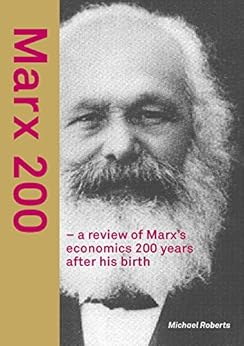
May Day review of "Marx 200" by Michael Roberts
 |
| Amazon link |
Marx 200 is a punchy, readable and succinct review of Marx’s economics at the 200th anniversary of his birth. A renowned Marxist economist, Roberts rapidly takes us to the core of Marx’s great theoretical innovations, his three ‘laws’, addressing the many arguments of his critics. He then assesses how well Marx’s ‘predictions’ have held up. This short book highlights the current resurgence of Marxist economics; it does, however, also exemplify this tradition’s weaknesses.
Roberts starts with a brief biography of Marx. After reviewing the development of Marx’s thinking he introduces his three ‘laws’: (i) the law of value: only labour creates value ; (ii) the law of accumulation: capitalists are forced to accumulate more and more capital through competition ; and (iii) the law of the tendency of the rate of profit to decline. On the latter, Roberts presents his usual trenchant and compelling arguments in support.
Non-Marxists are amazed to discover that Marx left us with no fully developed theory of crisis. Such a theory would require the synthesis of all the dynamical tendencies within capitalism - and contemporary Marxists differ in ascribing central causation. For Roberts, the cycle of crises is fundamentally driven by the cycle of profitability. He assembles an impressive amount of data to show graphical correlations and the superposition of short- and long-term economic cycles. He then turns to Marx’s critics: his main targets are the Keynesians and the relatively new school of post-Keynesian ‘heterodox economists’ (he includes a discussion of the ‘transformation problem’).
In his final chapter he addresses Marx’s predictions: how well have they held up? Marx held that as capitalism developed, inequality would increase (both within and between countries). Roberts has ample data, particular since the inception of neoliberalism in the 1980s, to confirm that. Second is Marx’s point that capitalism is focused exclusively on capital valorisation and cares not a jot for environmental and ecological issues. Roberts see climate change as contemporary evidence for that too, although he underestimates the extent to which capitalist states can successfully cooperate to deal with global ecological issues they find proximately threatening. Finally he addresses the rise of AI and robotics, presenting the orthodox view that machines cannot create value so that total automation is incompatible with capitalist relations of production. Here his presentation is marred by failing to discuss the proximate economic and political effects of overwhelming automation: simply appealing to lack of surplus value leaves the discussion at too high a level of abstraction.
Let us now turn to the weaknesses and lacunae which Roberts’ book shares with other Marxist accounts.
1. Capitalism is consistently criticised as historically obsolete, irrational and destructive. A socialist replacement is demanded. It’s clear that capitalism’s contradictions drive its dynamics and that its cyclical behaviour creates negative human consequences. Yet where is the credible alternative? How would a socialist state handle the motivational and coordination problems which capitalism, in its tough-minded way, routinely deals with effectively? János Kornai in ‘The Socialist System’ presents a chilling account of the failures of ‘rational planning’ in post-capitalist economies which did not differ qualitatively in development from those in the West today. Simply incanting ‘bottom-up democracy’ as the solution doesn’t do it.
2. The replacement of capitalism is a serious business, the outcome of a bloody civil war. In the absence of proletarian success retribution has historically been terrible. The working class today in the advanced capitalist countries is about as unprepared as it could possibly be to conduct such a struggle. Yet there is no discussion at all by writers such as Roberts as to the strategy for a successful transition. In the absence of theory and debate, isn’t it obvious that all such calls to ‘abolish capitalism’ are either premature (capitalism not yet ripe for supersession), ritualistic or simply irresponsible?
3. Marxists may be the last community of scholars on earth to cling to the ‘blank slate’ ideology, the idea that humans of all geographies, states and ethnicities exhibit the same social capabilities. In his more extreme formulations, Marx was just wrong about this. Even the impeccably liberal David Reich, in his recent book, ‘Who We Are and How We Got Here’, knows better than that. La Griffe du Lion wrote on the Internet about ‘smart fractions’ and the bourgeois economist Garett Jones wrote bravely about differential cognitive capital in ‘Hive Mind’ yet no Marxist economist seems to have noticed. The capitalist mode of production may be constituted by social relationships between people, but those people are not global clones. This has consequences for developmental economics - it’s just false to lazily blame a reified ‘imperialism’.
In conclusion, Michael Roberts has written a solid contemporary defence of Marx’s economic and political thinking. I just wish that he and his colleagues would move beyond a defensive posture and absorb new research into human capabilities, then conceptualise more compelling models of socialism and of how the proletariat might accomplish a successful global transition.
Friday, April 27, 2018
Socialist Revolution in the 21st Century?
 |
| Amazon link .. and a review |
"First published in 1928, this is the Comintern’s official manual for insurrection and it has a foreword by Erich Wollenberg giving details of its composite authorship. The introduction by Piatnitsky is generally sensible, which, since he quotes extensively from Lenin on the necessity of a very advanced stage of political decomposition of the capitalist state as a pre-condition for an uprising, is not surprising.---
There then follow four case studies, in approved Staff College fashion, of Reval in 1924, Hamburg 1923, Canton 1927 and Shanghai in 1926-27. These are in effect object lessons in how not to do it and disobey practically every one of Lenin’s dictums. ..." [from Ted Crawford's 1971 review].
 |
| Amazon link - and no reviews |
From 2016/17. So relevant and timely that no-one in the UK or America reviewed it on Amazon ... .
---
In his latest blog post, Marxist economist Michael Roberts concludes:
"Surely, a left government must instead look to replace big capital with democratically-run state enterprises in the ‘commanding heights’ of an economy. This would lay the proper foundation for innovation and enterprise and thus put use-value before value, price and profit."Fine words, yet how are we to get there?
Back in the heady days of red-blooded Leninist party building (the 1970s) the revolutionary left was completely educated on what would happen if a left-wing government were to come into office and try to legislate capitalism away. We had seen what happened in Chile.
The media would put up a ferocious ideological onslaught, there would be a massive capital exodus leading to economic depression or collapse while the state apparatus would sabotage socialist initiatives. In extremis, other capitalist powers would restore 'order', perhaps through NATO.
We didn't forget that revolution is civil war. That in an existential clash of two sides, the side with the better programme, the stronger morale, the superior military forces and the more inspired leadership gets to win.
We didn't forget that for capitalists, the socialist revolution looks like the chavish masses violently stealing everything they have, possibly arresting or killing them and their families. No, they surely would not go quietly into that good night.
Of course, the working class today is totally unprepared for such a confrontation. Michael Roberts has argued in his book, Marx 200, that a revival of working class organisation and combativity will not be apparent for some years yet, not until a new capitalist upturn following the end of the current long depression.
And yet we have the prospects of a Corbyn-McDonnell government coming up shortly, which is going to do what exactly?
---
Perry Anderson wrote:
"Yet it is quite clear that without serious exploration and mapping of it [the nature of socialism], any political advance beyond a parliamentary capitalism will continue to be blocked. No working-class or popular bloc in a Western society will ever make a leap in the dark, at this point in history, let alone into the grey on grey of an Eastern society of the type that exists today. A socialism that remains incognito will never be embraced by it."And this is the problem. With all its cyclical dysfunctions, the monstrously-complex capitalist economy in all its globally interconnected sophistication works. Its valorisation-brutality forces progressive advances where kinder, gentler and less-driven souls would acquiesce to the always-vociferous and inevitable victims .. and preside over stagnation.
It seems unlikely that the working class will take a leap into the 'socialist chaos' that all media commentators will accurately predict without a really compelling narrative.
---
|
| My review and Amazon link |
Having read János Kornai's blistering critique of the socialist system, I am deeply skeptical about any transition to socialism which promises a quasi-social-democratic state with mass nationalisation enriched by 'bottom-up democratic forms'. I think we all know that revolutionary fervour dims, the masses demobilise and the activists end up colonising the bureaucracies.
 |
| Amazon link |
Capitalism, with its separation of politics and economics as so usefully described by Michael Heinrich (PDF link: see chapter 11 p. 203), looks a better guarantor of the development of the productive forces and of personal and political freedoms than any kind of model which Michael Roberts is implicitly proposing.
The best indication of the entirely ritualistic nature of incantations of 'the replacement of capitalism' by contemporary Marxist theoreticians is the complete absence of any discussion of the transition itself.
Speaking personally, I prefer a disappointed honesty to hypocrisy and (self-) deception with the potential to lead to catastrophe.
---
See also; "The Comintern guide to armed insurrection (1928)".
Thursday, April 26, 2018
The Law of Accumulation - and competition
 |
| PDF link |
Michael Roberts' second chapter of his book, Marx 200, is titled "Marx and the three laws of motion under capitalism". The 2nd law is that of accumulation.
"Marx is saying that competition among capitalists forces them to continue to expand their production in order to accumulate more profit or be driven out of business by others. So the law of capitalist accumulation says that competition makes each individual capitalist keep constantly extending capital. The trend is for the proportion of the economy devoted to investment in the means of production (machinery, plant, offices, raw materials) to rise. This has happened pretty much from the point of Marx's birth in all capitalist economies."I'm going to work through an example from Duncan Foley, "Understanding Capital" to show how this works (p. 56) although in this case we're reducing labour rather than explicitly expanding capital investment.
---
Animals, and people in a hunter-gatherer state, work just hard enough to sustain themselves for the long term. Anything else implies pointless activity, wasting energy. Lions spend time lazing around and grooming each other; hunter-gatherers likewise.
This all changes with the invention of agriculture. Suddenly, if people work harder and longer than required for their own sustenance, they produce a surplus which can be appropriated by a ruling elite of warlords, warriors and priests to sustain themselves. Good for civilisation no doubt: not so pleasant for the overworked and intimidated mass of slaves and peasants.
It was Marx's contribution to understand that capitalism is not different in appropriating surplus labour. The manner of it is obscured: workers are paid for their utility, their ability to labour, not for what they actually produce (essentially they are paid on average sufficient to reproduce themselves at some contestable level of consumption).
Once agreeing to employment, however, they are put to work by their employer who now controls what they do. The value of what they then produce is normally significantly greater than the value of their labour power = wage. Thus emerges profit and those great surpluses which have built our magnificent civilisation (owned by the elites as in all previous post-neolithic modes of production).
This is all in Foley and other places, so I won't continue with Marxism 101. Let's get to the example.
---
Foley considers that an hour of abstract social labour is sufficient to produce 10 bushels of wheat. It's a tradition in Marxist economics textbooks to use Victoriana, copying Marx. Why didn't Foley choose muesli?
An hour of abstract social labour equates to $15 in the example. Suppose the cost of the factory and raw materials comes down also to $15 for 10 bushels of wheat and suppose that the value of the worker's labour-power is $7.50, his wages.
Then the exchange-value of 10 bushels of wheat is, using Marx's standard formula c + v + s is:
c + v + srepresenting an hour's work ($15). The cost is 15 + 7.50 = 22.50, the profit is the surplus value s, 7.50 and the rate of profit is profit/cost = s/(c + v) = 7.50/22.50 = 1/3.
15 + 7.50 + 7.50 = 30
So we imagine lots of little workplaces all producing wheat like this and making a profit of 33%.
---
Now someone develops a new technique which lets those 10 bushels of wheat be produced in 2/3 of an hour, forty minutes instead. This means that in an hour, 50% more wheat can be produced. Productivity has gone up.
So in forty minutes, the value of 10 bushels of wheat looks like this:
15 + 5 + 10 = 30.Interesting. The production occurred over forty minutes, so the labourer's wage was two thirds of the hourly rate ($7.50) and only incurred a cost of $5. But no-one yet has followed the innovative capitalist's example, so he's a price taker and can sell his 10 bushels of wheat at the existing market price of $30.
He gets a super-surplus of $10 and a super-rate of profit of 10/20 = 1/2 or 50%.
You can see why he was incentivized to innovate.
---
Of course, everyone will now follow him, so assuming the workers consent to the continuing intensity of work (100% rate of surplus value) the price will drop and the new state of affairs for the production of 10 bushels of wheat is:
15 + 5 + 5 = 25.The profit on 10 bushels of wheat is $5 and the rate of profit is 5/20 = 1/4 = 25%.
Oh dear, due to increased efficiency and less labour being used, the rate of profit has fallen. This is Marx's third law .. although it is more complicated in practice than in this simple example.
---
There is more to say. Notice that the value of 10 bushels of wheat (here equated to its market price) has fallen from $30 to $25, a drop of 1/6 (17%). This is the effect of productivity gains - they drop the price of commodities.
Suppose that, ludicrously, the workers survive only by consuming wheat. Then their costs of self-reproduction have just declined by 17% and thus their equilibrium wage should also tend to drop by the same amount: $7.50 → $6.25 per hour - which equates to $4.17 in forty minutes. So there is a new value composition for 10 bushels of wheat:
15 + 4.17 + 5.83 = 25and the rate of surplus value (s/v) has gone up due to the cheapening of labour-power, consequent upon the cheapening of the commodity wheat.
This means that the rate of profit is now: 5.83/19.17 = 30%.
It's not as good as the original 33% but it beats 25%.
Will the workers consent to their wages being lowered to their new values (either directly or through devious means such as inflation)? Nothing in the dynamics of capitalism preordains the outcome. It depends on how hard they're prepared to negotiate and fight. This is a zero-sum game, Marx's analysis of class struggle.
Of course if they fight too successfully for wages above the value of their labour power they will indeed cut into profits .. and the capitalist will invest elsewhere.
---
This process of continual accumulation and innovation, driven by competition, is characteristic of capitalism within a sector. For a while I confused it with quite a different issue which is the equalisation of the rate of profit across different sectors.
Here's the problem: profits are defined as s/(c + v) which seems to reward companies with low capital investment and high manning. So hairdressers should be way more profitable than steel companies. But that makes no sense.
Marx figured out pretty early that real market prices in a multi-sector capitalist economy (which is all of them) fluctuate around prices of production, not the simple values we saw in Foley's example. Why is that? Because capital flows between sectors equalising the rate of profit. This causes prices of production to fall below values in labour intensive industries and to rise above values in capital intensive industries.
Michael Roberts has this fairly self-explanatory table on page 84 of Marx 200.

The right hand column has prices of production (Total Price) which equalise the rate of profit p/(c+v) which is 49% in his example - the absolute profit is in the column p.
Notice the redistribution. I'm not going to delve any deeper here - get his book.
Wednesday, April 25, 2018
Michael Roberts on Keynesianism & the modern left
|
| Amazon link |
I'm finding Michael Roberts's latest book a lot punchier than "The Long Depression". After a strong and penetratingly-clear review of Marx's 'three laws' (of value, of accumulation and of the tendency of the rate of profit to fall) he moves on to Marx's critics and has this interesting analysis of the continuing popularity of Keynesianism in the ranks of the modern socialist left.
"Marx, Keynes and the labour movement---
Keynesian economics dominates on the left in the labour movement. Keynes is the economic hero of those wanting to change the world; to end poverty, inequality and continual losses of incomes and jobs in recurrent crises. In the US, the great gurus of opposition to the neoliberal theories of Chicago school of economics and the policies of Republican politicians are Keynesians.
In the UK, the leftish leaders of the Labour party around Jeremy Corbyn and John McDonnell, self-proclaimed socialists, look to Keynesian economists for their policy ideas and analysis. They bring them onto their advisory councils and seminars.
Those graduate students and lecturers involved in Rethinking Economics, an international attempt to change the teaching and ideas away from neoclassical theory, are led by Keynesian authors like James Kwak or post-Keynesians like Steve Keen, or Victoria Chick or Frances Coppola. Here the idea that inequality is the enemy, not capitalism as such, dominates the media and the labour movement. This is not to deny the ugly importance of rising inequality, but to show that a Marxist view on this does not circulate.
So why do Keynesian ideas continue to dominate? Geoff Mann provides us with an insightful explanation. In a new book, entitled In the Long Run We are all Dead, Mann reckons it is not that Keynesian economics is seen as correct. There have been "powerful Left critiques of Keynesian economics from which to draw; examples include the work of Paul Mattick, Geoff Pilling and Michael Roberts", but Keynesian ideas dominate the labour movement and among those opposed to what Mann calls 'liberal capitalism' for political reasons.
Keynes rules because he offers a third way between socialist revolution, and barbarism, i.e. the end of civilisation as we (actually the bourgeois like Keynes) know it. In the 1920s and 1930s, Keynes feared that the `civilised world' faced Marxist revolution or fascist dictatorship. But socialism as an alternative to the capitalism of the Great Depression could well bring down 'civilisation', delivering instead 'barbarism' - the end of a better world, the collapse of technology and the rule of law, more wars etc. So he aimed to offer the hope that, through some modest fixing of 'liberal capitalism', it would be possible to make capitalism work without the need for socialist revolution. There would be no need to go where the angels of 'civilisation' fear to tread. That was Keynes' narrative.
This appealed (and still appeals) to the leaders of the labour movement and 'liberals' wanting change. Revolution was too risky and we could all go down with it. Mann: "the Left wants democracy without populism, it wants transformational politics without the risks of transformation; wants revolution without revolutionaries". This fear of revolution, Mann reckons, was first exhibited after the French revolution. That great experiment in bourgeois democracy turned into Robespierre and the terror; democracy turned into dictatorship and barbarism — or so the bourgeois myth goes.
Keynesian economics offers a way out of the 1930s depression or the Long Depression now without socialism. It is the third way between the status quo of rapacious markets, austerity, inequality, poverty and crises and the alternative of social revolution that may lead to Stalin, Mao, Castro, Pol Pot and Kim Jong-Un.
It is such an attractive 'third way' that Mann professes that it even appeals to him as an alternative to the risk that revolution will go wrong (see his last chapter, where Marx is portrayed as the Dr Jekyll of Hope and Keynes as the Mr Hyde of Fear).
As Mann puts it, Keynes reckoned that, if civilised experts (like himself) dealt with the short-run problems of economic crisis and slump, then the long-run disaster of the loss of civilisation could be avoided. The famous quote that makes the title of Mann's book, that 'in the long run we are all dead, was about the need to act on the Great Depression with government intervention and not wait for the market to right itself over time, as the neoclassical (`classical' Keynes called it) economists and politicians thought.
For "this long run is a misleading guide to current affairs. In the long run we are all dead. Economists set themselves too easy, too useless a task if in tempestuous seasons they can only tell us that when the storm is long past, the ocean is flat again" (Keynes). You need to act on the short term problem or it will become a long-term disaster. This is the extra meaning of the long run quote: deal with depression and economic crises now or civilisation itself will come under threat from revolution in the long run.
[...]
Like all bourgeois intellectuals, Keynes was an idealist. He knew that ideas only took hold if they conformed to the wishes of the ruling elite. As he put it, "Individualism and laissez-faire could not, in spite of their deep roots in the political and moral philosophies of the late eighteenth and early nineteenth centuries, have secured their lasting hold over the conduct of public affairs, if it had not been for their conformity with the needs and wishes of the business world of the day...These many elements have contributed to the current intellectual bias, the mental make-up, the orthodoxy of the day.". Yet he still really believed that a clever man like him with forceful ideas could change society even it was against the interests of those who controlled it.
The wrongness of that idea was brought home to him in his attempts to get the Roosevelt administration to adopt his ideas on ending the Great Depression and for the political elite to implement his ideas for a new world order after the world war.
He wanted to set up 'civilised' institutions to ensure peace and prosperity globally through international management of economies, currencies and money. But these ideas of a world order to control the excesses of unbridled laissez-faire capitalism were turned into institutions like the IMF, World Bank and the UN Council, used to promote the policies of imperialism, led by America.
Instead of a world of 'civilised' leaders sorting out the problems of the world we got a terrible eagle astride the globe, imposing its will. Material interests decide policies, not clever economists. "
Michael Roberts has the strengths and weaknesses of an orthodox Marxist. I lay stress on the word orthodox here. He dismisses Keynes, along with the other critics he considers, because in no case do they propose socialist revolution to deal with the ills of capitalism (as he portrays them).
Roberts's critiques seem wholly compelling: the crises in capitalist reproduction are indeed crises of profitability (and not lack of effective demand, as Keynes claims), yet the brutal methods (devaluation of capital, lowering of wages) required to restore profitability within the framework of capitalism are not at all congenial to well-meaning economists or politicians seeking votes. Yet when executed by the impersonal forces of the crisis itself, they do work.
Roberts would prefer less callous, less cyclical pathways to growth. That's why he's a socialist. Yet he has no model for socialism, no hint as to how the overwhelming motivational and coordination issues of a global economy can be addressed in a manner superior to capitalism. There's just the blind faith that somehow the organised proletariat can do the job.
No political proposition with such a 'manifesto' has a prayer of being taken seriously and in his heart of hearts, Roberts knows it. Hence the ritualistic quality of his denunciations. Yet this selective myopia does neither him nor his book any favours.
And before uncritically lauding the (capitalist-driven) post-1980 successes of China and denouncing the (capitalism-blamed) stagnation of the third world he might try to emulate the bravery of bourgeois economist Garett Jones and absorb this.
But of course I have no serious expectations.
---
I recently wrote about Steve Keen and Corbyn. I plan to work my two posts so far about Marx 200 into an Amazon review over the next few days.
Sunday, April 22, 2018
"The Limits to Capital" by David Harvey (2007)
 |
| Amazon link |
Who is David Harvey? Michael Roberts explains on his blog:
"Just in case you are unaware (difficult to believe), Professor Harvey is probably the most eminent Marxist scholar alive today with a host of books, papers and educational videos to his name on Marxist economic theory."To properly assess this 450 page book, which combines a sophisticated review of Marxist theory together with its detailed application to today's global economy, would be the labour of many hours. Please forgive a much more superficial review here.
First of all, the book is a rather dry read. While not quite a textbook, it demands sustained concentration and one returns to it more out of duty than pleasure. However, once engaged it is full of insights (I had a similar experience with David Reich's book).
This would not be your first choice if you knew nothing about Marxism. For that, you need an introduction. The great thing about Harvey's overview is that he never just regurgitates the sacred texts. You always see a questing intelligence, picking apart Marx's analytic categories and examples, working to understand them from a contemporary perspective. His insights are invariably fresh and thought-provoking.
Harvey is a geographer, a student of spatial and temporal development. As capitalism develops unevenly within regions, countries and globally, one would have thought that Marxists would have explored in depth the interaction between abstract economic categories and geography, but Harvey seems to break new ground towards the end of the book. Yet I sometimes wondered whether his results were that surprising - often pages went by when I thought the new idea could have been better expressed in a single paragraph.
Why do we bother with Marxism? Because we have a healthy skepticism about elite social science. In no mode of production have the elites come clean about the basis of their structural good fortune: capitalism is no different. Only the Marxist tradition 'tells it like it is'.
Yet here Harvey's moralism grates. The idea is to understand the nature and dynamics of the capitalist mode of production, not to ritualistically denounce it in aggrieved tones and lobby emptily for a 'more rational' mode of production based on wishful thinking. Harvey has never convincingly explained how the complex motivational and coordination problems which capitalism addresses pretty successfully could be better handled by a traditionally-conceived socialism - while we have plenty of evidence to the contrary.
And then there are the lacunae. Marx may have said "always doubt" but although Harvey may be the least dogmatic of contemporary Marxist thinkers, he's not prepared to break with blank slate accounts of gender or ethnic differences. Even the impeccably liberal David Reich is ahead of him on this. No wonder he can't seem to see a way towards a Marxist account of the family or, for example, third world underdevelopment.
Despites its selective myopia and unengaging style, there is still a great deal to get out of this book. I was glad to read it, and glad to finish it.
Sunday, April 15, 2018
Michael Roberts: Total Automation under Capitalism
Michael Roberts has a new book out:
Here is what he has to say about the impact of total automation on capitalism (pages 137-141).
Marx was not a vitalist. He did not think that human protoplasm endowed human labour with some mysterious value-producing quality that mere steel and electronics could never replicate. So what if human workers were everywhere replaced by fabricated androids who also toiled in the factories, were paid wages and consumed ersatz food? Does capitalism still work? [Answer: of course].
If one particular capitalist creates a totally automated factory (or one using purely slave labour which is - in Marxist terms - the same thing) is that incompatible with capitalism? [Answer: of course not].
As more and more capitalists automate their factories, displacing human labour, what is the process which unfolds before them and why? How do they perceive the capitalist economy failing before their eyes?
Or will they rather observe, as Peter Singer writes in his book on Marx: ‘Future capitalists will not find their profits drying up as they dismiss the last workers from their newly-automated factories’ (p. 76).
I outlined some answers here.
|
| Amazon link |
Here is what he has to say about the impact of total automation on capitalism (pages 137-141).
"What does this all mean if we enter the extreme (science fiction?) future where robotic technology and AI leads to robots making robots AND robots extracting raw materials and making everything AND carrying out all personal and public services so that human labour is no longer required for ANY task of production at all?Everything Roberts says here is orthodox Marxist economics and yet there is something missing: the use of the abstract concepts of Marx's theory to reconstruct the concrete phenomena, to discern the details of the actual transition to 'a robot-all world'.
Let's imagine a totally automated process where no human worked in the production process. Surely, value has been added by the conversion of raw materials into goods without humans? Surely, that refutes Marx's claim that only human labour can create value?
In Marx's economic theory, abstract labour is the only source of value and surplus-value. However, in the case of an economy where robots build robots build robots and there is no human labour involved, surely value is still created?
This was the argument of Dmitriev in 1898, in his critique of Marx's value theory. He said that, in a fully automated system, a certain input of machines can create a greater output of machines (or of other commodities). In this case, profit and the rate of profit would be determined exclusively by the technology used (productivity) and not by (abstract) labour. If 10 machines produce 12 machines, the profit is 2 machines and the rate of profit is 2/10, 20%.
Value reduced to use value has nothing to do with Marx's notion of value, which is the monetary expression of abstract labour expended by labourers. If machines could create 'value', this value would be use-value rather than value as the outcome of humans' abstract labour. But, if machines can create 'value', so can an infinity of other factors (animals, the forces of nature, sunspots, etc.) and the determination of value becomes impossible. And if machines supposedly could transfer their use-value to the product, this would immediately crash against the problem of the aggregation of different use-values.
For Marx, machines do not create value. Rather, concrete labour transfers the value of the machines (and, more generally, of the means of production) to the product. They increase human productivity and thus the output per unit of capital invested, while decreasing the quantity of living labour needed for the production of a certain output. Given that only labour creates value, the substitution of the means of production for living labour decreases the quantity of value created per unit of capital invested. ...
The Dmitriev critique confuses the dual nature of value under capitalism: use value and exchange value. There is use value (things and services that people need); and exchange value (the value measured in labour time and appropriated from human labour by the owners of capital and realised by sale on the market). In every commodity under the capitalist mode of production, there is both use value and exchange value. You can't have one without the other under capitalism. But the latter rules the capitalist investment and production process, not the former.
Value (as defined) is specific to capitalism. Sure, living labour can create things and do services (use values). But value is the substance of the capitalist mode of producing things. Capital (the owners) controls the means of production created by labour and will only put them to use in order to appropriate value created by labour. Capital does not create value itself. So in our hypothetical all-encompassing robot/AI world, productivity (of use values) would tend to infinity while profitability (surplus value to capital value) would tend to zero. ...
This is no longer capitalism. The analogy is more with a slave economy as in ancient Rome. In ancient Rome, over hundreds of years, the formerly predominantly small-holding peasant economy was replaced by slaves in mining, farming and all sorts of other tasks. This happened because the booty of the successful wars that the Roman republic and empire conducted included a mass supply of slave labour.
The cost to the slave owners of these slaves was incredibly cheap (to begin with) compared with employing free labour. The slave owners drove the farmers off their land through a combination of debt demands, requisition in wars and sheer violence. The former peasants and their families were forced into slavery themselves or into the cities, where they scraped a living with menial tasks and skills or begged. The class struggle did not end. The struggle was between the slave-owning aristocrats and the slaves and between the aristocrats and the atomised plebs in the cities.
A fully robot economy means that the owners of the means of production (robots) would have a super-abundant economy of things and services at zero cost (robots making robots making robots). The owners can then just consume. They don't need to make 'profit', just as the aristocrat slave owners in Rome just consumed and did not run businesses to sell commodities to make a profit. So a robotic economy could mean a super-abundant world for all or it could mean a new form of slave society with extreme inequality of wealth and income. It's a social 'choice' or more accurately, it depends of the outcome of the class struggle under capitalism.
The key issue is Marx's law of the tendency of the rate of profit to fall. A rising organic composition of capital leads to a fall in the overall rate of profit engendering recurring crises. If robots and AI do replace human labour at an accelerating rate, that can only intensify that tendency. Well before we get to a robot-all world, capitalism will experience ever-increasing periods of crises and stagnation."
Marx was not a vitalist. He did not think that human protoplasm endowed human labour with some mysterious value-producing quality that mere steel and electronics could never replicate. So what if human workers were everywhere replaced by fabricated androids who also toiled in the factories, were paid wages and consumed ersatz food? Does capitalism still work? [Answer: of course].
If one particular capitalist creates a totally automated factory (or one using purely slave labour which is - in Marxist terms - the same thing) is that incompatible with capitalism? [Answer: of course not].
As more and more capitalists automate their factories, displacing human labour, what is the process which unfolds before them and why? How do they perceive the capitalist economy failing before their eyes?
Or will they rather observe, as Peter Singer writes in his book on Marx: ‘Future capitalists will not find their profits drying up as they dismiss the last workers from their newly-automated factories’ (p. 76).
I outlined some answers here.
Saturday, February 24, 2018
"China's Economy: What Everyone Needs to Know" by Arthur R. Kroeber
 |
| Amazon link |
This book seems the best modern survey of the Chinese economy. I was interested in whether China is still a planned economy (as Michael Roberts has argued: "Xi takes full control of China’s future") or whether it has reverted to capitalism. I also wanted to get a sense of where the modernisation campaign has got to, and the prospects for coming political change.
Kroeber's book is useful for all these questions. It's incredibly well-informed; about as well-written as any book on Chinese political economy could be; and compelling and astute in its observations. As far as I can gather, despite the remarkable growth in the capitalist sector in recent decades (the powerhouse of the economy), the 'dominant heights' of the economy are still politically controlled by the Communist Party. This includes both the SOEs and some of the larger capitalist companies, where the ownership structure is opaque.
Kroeber argues that China has reached the end of its massive extensional period of growth and is now pivoting to intensive growth, relying on worker upskilling, an enhanced service sector, a further increase in the market sector at the expense of the deadbeat SOEs and Chinese leadership in technological innovation. This process is hard to reconcile with Xi's increasingly authoritarian policies (which are themselves driven by the need to break the power of defenders of 'the old ways'). It seems that another kind of pivot will be needed in the early 2020s if growth on the new course is to be sustained.
Kroeber emphasises that China is still, in terms of GDP per head, a poor country. It will take many decades to catch up with the G7 advanced capitalist countries. This is worth remembering when encountering yet another scaremongering article about the imminent Chinese challenge to American global hegemony.
Saturday, January 27, 2018
János Kornai and Ann Lee's take on China
 |
| Amazon link |
The Amazon Vine system seems to be running down. Fewer and fewer interesting items appear in my input queue. But Ann Lee's recent short book seems to be an exception.
Professor Lee is a somewhat-typical member of the global elite. She was educated at U.C. Berkeley, Princeton University and Harvard Business School (1995). After working for two investments banks, she became a hedge fund partner and a trader in credit derivatives. In 2007-2008 she was a visiting professor at Peking University.
BTW, whenever an article or book has a question in the title, the answer is always "No".
---
I'm interested in the political and economic evolution of China. Part of that is the global significance thing, but the underlying dynamics are equally intriguing. We observe a centrally-planned economy belatedly - and apparently - transitioning to capitalism.
Is China even capitalist? Most economists would say yes, but Michael Roberts on his blog has been steadfastly contrarian.
It would help to have a conceptual framework to assess Ann Lee's thinking.
---
 |
| Amazon link |
I turn to János Kornai, the noted Hungarian economist who has written extensively on the experience of the bureaucratic-socialist states, both in their operational dysfunction and their subsequent collapse.
At the heart of Kornai's critique of socialist (centrally-planned) economies is the notion of soft budget constraints leading to what he calls the shortage economy. Has China found a way round these structural problems?
The Chinese leadership has watched the Eastern-European and Russian experiences with care and has plainly learned something from the outcomes. So Andrew Batson considers whether Kornai's account still holds true.
Update: Here's my Ann Lee review.
Wednesday, November 08, 2017
The Bolshevik centennial

Today is pretty much the Russian Revolution centennial. Michael Roberts has a post, "The Russian revolution: some economic notes" which shows the power of central planning for extensional growth, but not for high-productivity development:
"The success of the Soviet extensive growth model in the 1950s and 1960s was undeniable. But a phase of economic stagnation began in the 1970s. The attempt to move to a new regime of intensive accumulation, to one based on high productivity growth failed."He finishes his post with:
".. for a compelling arguments on the feasibility of a planned economy delivering the needs of people, see Cottrell and Cockshott’s paper, Socialist planning after the collapse of the Soviet Union.I read the paper (hope springs eternal!) only to find yet another technocratic solution to the dilemmas of central planning using high-powered computers and linear programming.
The Soviets never used these techniques because optimal allocation of resources was incompatible with bureaucratic self-interest. Each factory tried to understate its own capabilities while securing the largest possible inventory of stocks, 'just in case'.
Gaming The Plan was a matter of survival.
If you start from the (evolutionary: kin-selection, reciprocal-altruism*) fact that people in general look out for their own interests, and those of their families and friends, and will not self-sacrifice for the abstract interests of the Party or the Universal Proletariat, then you'll get a better handle on why central planning never seems to quite get things right.
---
* But see Ultrasociety and "Culture-gene coevolution, large-scale cooperation and the shaping of human social psychology". Things have moved on since the early work of Hamilton and Trivers.
Subscribe to:
Posts (Atom)