Showing posts with label Marx 200. Show all posts

Tuesday, May 01, 2018

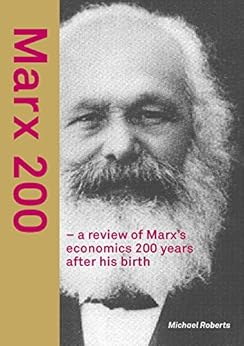
May Day review of "Marx 200" by Michael Roberts

Amazon link

Marx 200 is a punchy, readable and succinct review of Marx’s economics at the 200th anniversary of his birth. A renowned Marxist economist, Roberts rapidly takes us to the core of Marx’s great theoretical innovations, his three ‘laws’, addressing the many arguments of his critics. He then assesses how well Marx’s ‘predictions’ have held up. This short book highlights the current resurgence of Marxist economics; it does, however, also exemplify this tradition’s weaknesses.

Roberts starts with a brief biography of Marx. After reviewing the development of Marx’s thinking he introduces his three ‘laws’: (i) the law of value: only labour creates value ; (ii) the law of accumulation: capitalists are forced to accumulate more and more capital through competition ; and (iii) the law of the tendency of the rate of profit  to decline. On the latter, Roberts presents his usual trenchant and compelling arguments in support.

Non-Marxists are amazed to discover that Marx left us with no fully developed theory of crisis. Such a theory would require the synthesis of all the dynamical tendencies within capitalism - and contemporary Marxists differ in ascribing central causation. For Roberts, the cycle of crises is fundamentally driven by the cycle of profitability. He assembles an impressive amount of data to show graphical correlations and the superposition of short- and long-term economic cycles. He then turns to Marx’s critics: his main targets are the Keynesians and the relatively new school of post-Keynesian ‘heterodox economists’ (he includes a discussion of the ‘transformation problem’).

In his final chapter he addresses Marx’s predictions: how well have they held up?  Marx held that as capitalism developed, inequality would increase (both within and between countries). Roberts has ample data, particular since the inception of neoliberalism in the 1980s, to confirm that. Second is Marx’s point that capitalism is focused exclusively on capital valorisation and cares not a jot for environmental and ecological issues. Roberts see climate change as contemporary evidence for that too, although he underestimates the extent to which capitalist states can successfully cooperate to deal with global ecological issues they find proximately threatening. Finally he addresses the rise of AI and robotics, presenting the orthodox view that machines cannot create value so that total automation is incompatible with capitalist relations of production. Here his presentation is marred by failing to discuss the proximate economic and political effects of overwhelming automation: simply appealing to lack of surplus value leaves the discussion at too high a level of abstraction.

Let us now turn to the weaknesses and lacunae which Roberts’ book shares with other Marxist accounts.

1.  Capitalism is consistently criticised as historically obsolete, irrational and destructive. A socialist replacement is demanded. It’s clear that capitalism’s contradictions drive its dynamics and that its cyclical behaviour creates negative human consequences. Yet where is the credible alternative? How would a socialist state handle the motivational and coordination problems which capitalism, in its tough-minded way, routinely deals with effectively? János Kornai in ‘The Socialist System’ presents a chilling account of the failures of ‘rational planning’ in post-capitalist economies which did not differ qualitatively in development from those in the West today. Simply incanting ‘bottom-up democracy’ as the solution doesn’t do it.

2.  The replacement of capitalism is a serious business, the outcome of a bloody civil war. In the absence of proletarian success retribution has historically been terrible. The working class today in the advanced capitalist countries is about as unprepared as it could possibly be to conduct such a struggle. Yet there is no discussion at all by writers such as Roberts as to the strategy for a successful transition. In the absence of theory and debate, isn’t it obvious that all such calls to ‘abolish capitalism’ are either premature (capitalism not yet ripe for supersession), ritualistic or simply irresponsible?

3. Marxists may be the last community of scholars on earth to cling to the ‘blank slate’ ideology, the idea that humans of all geographies, states and ethnicities exhibit the same social capabilities. In his more extreme formulations, Marx was just wrong about this. Even the impeccably liberal David Reich, in his recent book, ‘Who We Are and How We Got Here’, knows better than that.  La Griffe du Lion wrote on the Internet about ‘smart fractions’ and the bourgeois economist Garett Jones wrote bravely about differential cognitive capital in ‘Hive Mind’ yet no Marxist economist seems to have noticed. The capitalist mode of production may be constituted by social relationships between people, but those people are not global clones. This has consequences for developmental economics - it’s just false to lazily blame a reified ‘imperialism’.

In conclusion, Michael Roberts has written a solid contemporary defence of Marx’s economic and political thinking. I just wish that he and his colleagues would move beyond a defensive posture and absorb new research into human capabilities, then conceptualise more compelling models of socialism and of how the proletariat might accomplish a successful global transition.

Thursday, April 26, 2018

The Law of Accumulation - and competition

PDF link

Michael Roberts' second chapter of his book, Marx 200, is titled "Marx and the three laws of motion under capitalism". The 2nd law is that of accumulation.
"Marx is saying that competition among capitalists forces them to continue to expand their production in order to accumulate more profit or be driven out of business by others. So the law of capitalist accumulation says that competition makes each individual capitalist keep constantly extending capital. The trend is for the proportion of the economy devoted to investment in the means of production (machinery, plant, offices, raw materials) to rise. This has happened pretty much from the point of Marx's birth in all capitalist economies."
I'm going to work through an example from Duncan Foley, "Understanding Capital" to show how this works (p. 56) although in this case we're reducing labour rather than explicitly expanding capital investment.

---

Animals, and people in a hunter-gatherer state, work just hard enough to sustain themselves for the long term. Anything else implies pointless activity, wasting energy. Lions spend time lazing around and grooming each other; hunter-gatherers likewise.

This all changes with the invention of agriculture. Suddenly, if people work harder and longer than required for their own sustenance, they produce a surplus which can be appropriated by a ruling elite of warlords, warriors and priests to sustain themselves. Good for civilisation no doubt: not so pleasant for the overworked and intimidated mass of slaves and peasants.

It was Marx's contribution to understand that capitalism is not different in appropriating surplus labour. The manner of it is obscured: workers are paid for their utility, their ability to labour, not for what they actually produce (essentially they are paid on average sufficient to reproduce themselves at some contestable level of consumption).

Once agreeing to employment, however, they are put to work by their employer who now controls what they do. The value of what they then produce is normally significantly greater than the value of their labour power = wage. Thus emerges profit and those great surpluses which have built our magnificent civilisation (owned by the elites as in all previous post-neolithic modes of production).

This is all in Foley and other places, so I won't continue with Marxism 101. Let's get to the example.

---

Foley considers that an hour of abstract social labour is sufficient to produce 10 bushels of wheat. It's a tradition in Marxist economics textbooks to use Victoriana, copying Marx. Why didn't Foley choose muesli?

An hour of abstract social labour equates to $15 in the example. Suppose the cost of the factory and raw materials comes down also to $15 for 10 bushels of wheat and suppose that the value of the worker's labour-power is $7.50, his wages.

Then the exchange-value of 10 bushels of wheat is, using Marx's standard formula c + v + s is:
c   +    v   +   s

15 + 7.50 + 7.50 = 30
representing an hour's work ($15). The cost is 15 + 7.50 = 22.50, the profit is the surplus value s, 7.50 and the rate of profit is profit/cost = s/(c + v) = 7.50/22.50 = 1/3.

So we imagine lots of little workplaces all producing wheat like this and making a profit of 33%.

---

Now someone develops a new technique which lets those 10 bushels of wheat be produced in 2/3 of an hour, forty minutes instead. This means that in an hour, 50% more wheat can be produced. Productivity has gone up.

So in forty minutes, the value of 10 bushels of wheat looks like this:
15 + 5 + 10 = 30.
Interesting. The production occurred over forty minutes, so the labourer's wage was two thirds of the hourly rate ($7.50) and only incurred a cost of $5. But no-one yet has followed the innovative capitalist's example, so he's a price taker and can sell his 10 bushels of wheat at the existing market price of $30.

He gets a super-surplus of $10 and a super-rate of profit of 10/20 = 1/2 or 50%.

You can see why he was incentivized to innovate.

---

Of course, everyone will now follow him, so assuming the workers consent to the continuing intensity of work (100% rate of surplus value) the price will drop and the new state of affairs for the production of 10 bushels of wheat is:
15 + 5 + 5 = 25.
The profit on 10 bushels of wheat is $5 and the rate of profit is 5/20 = 1/4 = 25%.

Oh dear, due to increased efficiency and less labour being used, the rate of profit has fallen. This is Marx's third law .. although it is more complicated in practice than in this simple example.

---

There is more to say. Notice that the value of 10 bushels of wheat (here equated to its market price) has fallen from $30 to $25, a drop of 1/6 (17%). This is the effect of productivity gains - they drop the price of commodities.

Suppose that, ludicrously, the workers survive only by consuming wheat. Then their costs of self-reproduction have just declined by 17% and thus their equilibrium wage should also tend to drop by the same amount: $7.50 → $6.25 per hour - which equates to $4.17 in forty minutes. So there is a new value composition for 10 bushels of wheat:
15 + 4.17 + 5.83 = 25
and the rate of surplus value (s/v) has gone up due to the cheapening of labour-power, consequent upon the cheapening of the commodity wheat.

This means that the rate of profit is now: 5.83/19.17 = 30%.

It's not as good as the original 33% but it beats 25%.

Will the workers consent to their wages being lowered to their new values (either directly or through devious means such as inflation)? Nothing in the dynamics of capitalism preordains the outcome. It depends on how hard they're prepared to negotiate and fight. This is a zero-sum game, Marx's analysis of class struggle.

Of course if they fight too successfully for wages above the value of their labour power they will indeed cut into profits .. and the capitalist will invest elsewhere.

---

This process of continual accumulation and innovation, driven by competition, is characteristic of capitalism within a sector. For a while I confused it with quite a different issue which is the equalisation of the rate of profit across different sectors.

Here's the problem: profits are defined as s/(c + v) which seems to reward companies with low capital investment and high manning. So hairdressers should be way more profitable than steel companies. But that makes no sense.

Marx figured out pretty early that real market prices in a multi-sector capitalist economy (which is all of them) fluctuate around prices of production, not the simple values we saw in Foley's example. Why is that? Because capital flows between sectors equalising the rate of profit. This causes prices of production to fall below values in labour intensive industries and to rise above values in capital intensive industries.

Michael Roberts has this fairly self-explanatory table on page 84 of Marx 200.


The right hand column has prices of production (Total Price) which equalise the rate of profit p/(c+v) which is 49% in his example - the absolute profit is in the column p.

Notice the redistribution. I'm not going to delve any deeper here - get his book.

Wednesday, April 25, 2018

Michael Roberts on Keynesianism & the modern left

Amazon link

I'm finding Michael Roberts's latest book a lot punchier than "The Long Depression". After a strong and penetratingly-clear review of Marx's 'three laws' (of value, of accumulation and of the tendency of the rate of profit to fall) he moves on to Marx's critics and has this interesting analysis of the continuing popularity of Keynesianism in the ranks of the modern socialist left.
"Marx, Keynes and the labour movement

Keynesian economics dominates on the left in the labour movement. Keynes is the economic hero of those wanting to change the world; to end poverty, inequality and continual losses of incomes and jobs in recurrent crises. In the US, the great gurus of opposition to the neoliberal theories of Chicago school of economics and the policies of Republican politicians are Keynesians.

In the UK, the leftish leaders of the Labour party around Jeremy Corbyn and John McDonnell, self-proclaimed socialists, look to Keynesian economists for their policy ideas and analysis. They bring them onto their advisory councils and seminars.

Those graduate students and lecturers involved in Rethinking Economics, an international attempt to change the teaching and ideas away from neoclassical theory, are led by Keynesian authors like James Kwak or post-Keynesians like Steve Keen, or Victoria Chick or Frances Coppola. Here the idea that inequality is the enemy, not capitalism as such, dominates the media and the labour movement. This is not to deny the ugly importance of rising inequality, but to show that a Marxist view on this does not circulate.

So why do Keynesian ideas continue to dominate? Geoff Mann provides us with an insightful explanation. In a new book, entitled In the Long Run We are all Dead, Mann reckons it is not that Keynesian economics is seen as correct. There have been "powerful Left critiques of Keynesian economics from which to draw; examples include the work of Paul Mattick, Geoff Pilling and Michael Roberts", but Keynesian ideas dominate the labour movement and among those opposed to what Mann calls 'liberal capitalism' for political reasons.

Keynes rules because he offers a third way between socialist revolution, and barbarism, i.e. the end of civilisation as we (actually the bourgeois like Keynes) know it. In the 1920s and 1930s, Keynes feared that the `civilised world' faced Marxist revolution or fascist dictatorship. But socialism as an alternative to the capitalism of the Great Depression could well bring down 'civilisation', delivering instead 'barbarism' - the end of a better world, the collapse of technology and the rule of law, more wars etc. So he aimed to offer the hope that, through some modest fixing of 'liberal capitalism', it would be possible to make capitalism work without the need for socialist revolution. There would be no need to go where the angels of 'civilisation' fear to tread. That was Keynes' narrative.

This appealed (and still appeals) to the leaders of the labour movement and 'liberals' wanting change. Revolution was too risky and we could all go down with it. Mann: "the Left wants democracy without populism, it wants transformational politics without the risks of transformation; wants revolution without revolutionaries". This fear of revolution, Mann reckons, was first exhibited after the French revolution. That great experiment in bourgeois democracy turned into Robespierre and the terror; democracy turned into dictatorship and barbarism — or so the bourgeois myth goes.

Keynesian economics offers a way out of the 1930s depression or the Long Depression now without socialism. It is the third way between the status quo of rapacious markets, austerity, inequality, poverty and crises and the alternative of social revolution that may lead to Stalin, Mao, Castro, Pol Pot and Kim Jong-Un.

It is such an attractive 'third way' that Mann professes that it even appeals to him as an alternative to the risk that revolution will go wrong (see his last chapter, where Marx is portrayed as the Dr Jekyll of Hope and Keynes as the Mr Hyde of Fear).

As Mann puts it, Keynes reckoned that, if civilised experts (like himself) dealt with the short-run problems of economic crisis and slump, then the long-run disaster of the loss of civilisation could be avoided. The famous quote that makes the title of Mann's book, that 'in the long run we are all dead, was about the need to act on the Great Depression with government intervention and not wait for the market to right itself over time, as the neoclassical (`classical' Keynes called it) economists and politicians thought.

For "this long run is a misleading guide to current affairs. In the long run we are all dead. Economists set themselves too easy, too useless a task if in tempestuous seasons they can only tell us that when the storm is long past, the ocean is flat again" (Keynes). You need to act on the short term problem or it will become a long-term disaster. This is the extra meaning of the long run quote: deal with depression and economic crises now or civilisation itself will come under threat from revolution in the long run.

[...]

Like all bourgeois intellectuals, Keynes was an idealist. He knew that ideas only took hold if they conformed to the wishes of the ruling elite. As he put it, "Individualism and laissez-faire could not, in spite of their deep roots in the political and moral philosophies of the late eighteenth and early nineteenth centuries, have secured their lasting hold over the conduct of public affairs, if it had not been for their conformity with the needs and wishes of the business world of the day...These many elements have contributed to the current intellectual bias, the mental make-up, the orthodoxy of the day.". Yet he still really believed that a clever man like him with forceful ideas could change society even it was against the interests of those who controlled it.

The wrongness of that idea was brought home to him in his attempts to get the Roosevelt administration to adopt his ideas on ending the Great Depression and for the political elite to implement his ideas for a new world order after the world war.

He wanted to set up 'civilised' institutions to ensure peace and prosperity globally through international management of economies, currencies and money. But these ideas of a world order to control the excesses of unbridled laissez-faire capitalism were turned into institutions like the IMF, World Bank and the UN Council, used to promote the policies of imperialism, led by America.

Instead of a world of 'civilised' leaders sorting out the problems of the world we got a terrible eagle astride the globe, imposing its will. Material interests decide policies, not clever economists. "
---

Michael Roberts has the strengths and weaknesses of an orthodox Marxist. I lay stress on the word orthodox here. He dismisses Keynes, along with the other critics he considers, because in no case do they propose socialist revolution to deal with the ills of capitalism (as he portrays them).

Roberts's critiques seem wholly compelling: the crises in capitalist reproduction are indeed crises of profitability (and not lack of effective demand, as Keynes claims), yet the brutal methods (devaluation of capital, lowering of wages) required to restore profitability within the framework of capitalism are not at all congenial to well-meaning economists or politicians seeking votes. Yet when executed by the impersonal forces of the crisis itself, they do work.

Roberts would prefer less callous, less cyclical pathways to growth. That's why he's a socialist. Yet he has no model for socialism, no hint as to how the overwhelming motivational and coordination issues of a global economy can be addressed in a manner superior to capitalism. There's just the blind faith that somehow the organised proletariat can do the job.

No political proposition with such a 'manifesto' has a prayer of being taken seriously and in his heart of hearts, Roberts knows it. Hence the ritualistic quality of his denunciations. Yet this selective myopia does neither him nor his book any favours.

And before uncritically lauding the (capitalist-driven) post-1980 successes of China and denouncing the (capitalism-blamed) stagnation of the third world he might try to emulate the bravery of bourgeois economist Garett Jones and absorb this.

But of course I have no serious expectations.

---

I recently wrote about Steve Keen and Corbyn. I plan to work my two posts so far about Marx 200 into an Amazon review over the next few days.

Sunday, April 15, 2018

Michael Roberts: Total Automation under Capitalism

Michael Roberts has a new book out:

Amazon link

Here is what he has to say about the impact of total automation on capitalism (pages 137-141).
"What does this all mean if we enter the extreme (science fiction?) future where robotic technology and AI leads to robots making robots AND robots extracting raw materials and making everything AND carrying out all personal and public services so that human labour is no longer required for ANY task of production at all?

Let's imagine a totally automated process where no human worked in the production process. Surely, value has been added by the conversion of raw materials into goods without humans? Surely, that refutes Marx's claim that only human labour can create value?

In Marx's economic theory, abstract labour is the only source of value and surplus-value. However, in the case of an economy where robots build robots build robots and there is no human labour involved, surely value is still created?

This was the argument of Dmitriev in 1898, in his critique of Marx's value theory. He said that, in a fully automated system, a certain input of machines can create a greater output of machines (or of other commodities). In this case, profit and the rate of profit would be determined exclusively by the technology used (productivity) and not by (abstract) labour. If 10 machines produce 12 machines, the profit is 2 machines and the rate of profit is 2/10, 20%.

Value reduced to use value has nothing to do with Marx's notion of value, which is the monetary expression of abstract labour expended by labourers. If machines could create 'value', this value would be use-value rather than value as the outcome of humans' abstract labour. But, if machines can create 'value', so can an infinity of other factors (animals, the forces of nature, sunspots, etc.) and the determination of value becomes impossible. And if machines supposedly could transfer their use-value to the product, this would immediately crash against the problem of the aggregation of different use-values.

For Marx, machines do not create value. Rather, concrete labour transfers the value of the machines (and, more generally, of the means of production) to the product. They increase human productivity and thus the output per unit of capital invested, while decreasing the quantity of living labour needed for the production of a certain output. Given that only labour creates value, the substitution of the means of production for living labour decreases the quantity of value created per unit of capital invested. ...

The Dmitriev critique confuses the dual nature of value under capitalism: use value and exchange value. There is use value (things and services that people need); and exchange value (the value measured in labour time and appropriated from human labour by the owners of capital and realised by sale on the market). In every commodity under the capitalist mode of production, there is both use value and exchange value. You can't have one without the other under capitalism. But the latter rules the capitalist investment and production process, not the former.

Value (as defined) is specific to capitalism. Sure, living labour can create things and do services (use values). But value is the substance of the capitalist mode of producing things. Capital (the owners) controls the means of production created by labour and will only put them to use in order to appropriate value created by labour. Capital does not create value itself.  So in our hypothetical all-encompassing robot/AI world, productivity (of use values) would tend to infinity while profitability (surplus value to capital value) would tend to zero. ...

This is no longer capitalism. The analogy is more with a slave economy as in ancient Rome. In ancient Rome, over hundreds of years, the formerly predominantly small-holding peasant economy was replaced by slaves in mining, farming and all sorts of other tasks. This happened because the booty of the successful wars that the Roman republic and empire conducted included a mass supply of slave labour.

The cost to the slave owners of these slaves was incredibly cheap (to begin with) compared with employing free labour. The slave owners drove the farmers off their land through a combination of debt demands, requisition in wars and sheer violence. The former peasants and their families were forced into slavery themselves or into the cities, where they scraped a living with menial tasks and skills or begged. The class struggle did not end. The struggle was between the slave-owning aristocrats and the slaves and between the aristocrats and the atomised plebs in the cities.

A fully robot economy means that the owners of the means of production (robots) would have a super-abundant economy of things and services at zero cost (robots making robots making robots). The owners can then just consume. They don't need to make 'profit', just as the aristocrat slave owners in Rome just consumed and did not run businesses to sell commodities to make a profit. So a robotic economy could mean a super-abundant world for all or it could mean a new form of slave society with extreme inequality of wealth and income. It's a social 'choice' or more accurately, it depends of the outcome of the class struggle under capitalism.

The key issue is Marx's law of the tendency of the rate of profit to fall. A rising organic composition of capital leads to a fall in the overall rate of profit engendering recurring crises. If robots and AI do replace human labour at an accelerating rate, that can only intensify that tendency. Well before we get to a robot-all world, capitalism will experience ever-increasing periods of crises and stagnation."
Everything Roberts says here is orthodox Marxist economics and yet there is something missing: the use of the abstract concepts of Marx's theory to reconstruct the concrete phenomena, to discern the details of the actual transition to 'a robot-all world'.

Marx was not a vitalist. He did not think that human protoplasm endowed human labour with some mysterious value-producing quality that mere steel and electronics could never replicate. So what if human workers were everywhere replaced by fabricated androids who also toiled in the factories, were paid wages and consumed ersatz food? Does capitalism still work? [Answer: of course].

If one particular capitalist creates a totally automated factory (or one using purely slave labour which is - in Marxist terms - the same thing) is that incompatible with capitalism? [Answer: of course not].

As more and more capitalists automate their factories, displacing human labour, what is the process which unfolds before them and why? How do they perceive the capitalist economy failing before their eyes?

Or will they rather observe, as Peter Singer writes in his book on Marx: ‘Future capitalists will not find their profits drying up as they dismiss the last workers from their newly-automated factories’ (p. 76).

I outlined some answers here.