Showing posts with label Anwar Shaikh. Show all posts

Wednesday, October 25, 2017

"They dismiss the last workers from their fully automated factories"


A post at Marginal Revolution from 2010: "What is the biggest flaw in the labor theory of value?".

MR is an Internet temple to neoliberalism so a dismissive, patrician putdown of the Labour Theory of Value (LTV) was never in doubt.

In a comment, Chris Hallquist writes (March 30, 2010 at 12:34 pm):
"My favorite comment on the LTV comes from Peter Singer, of all people, in his largely sympathetic book on Marx. I don’t have the exact quote, but it was something like “The capitalists of the future will not see their profits dry up as they dismiss the last workers from their fully automated factories.”
I'm a capitalist. Suppose I have a Magic Box* which, say, costs £100 a day to run and which produces goods on demand to a value of £x. I have in mind something like a science-fictional 'next-generation 3D printer', which could make a case of baked-beans tins or the engine of a car depending on your menu selection and your whim.

Question: what can I charge for the goods produced? What is £x here?

So initially it's just me with the Magic Box -  I can charge what the market will bear. But soon all my competitors will have one too. The last workers are dismissed from their fully automated factories.

But due to competition, eventually I can charge no more than £100 for whatever I produce in a day. If I try to charge more, someone will undercut me and steal my customers. I make no profit.

Plainly before I get to this point I'm going to stop bothering with this investment in Magic Boxes - what's in it for me?

---

What stops this argument applying to capitalism today?

The primitive state of productivity and the consequent scope for further innovation.

As there is no Magic Box today, as a capitalist I have to use workers and machines to produce commodities for sale. Over a cycle of production the workers are paid for their labour-power at the cost of their own social-reproduction (v) and the machines (and raw materials) are paid for at their cost of operation and depreciation (c).  Given both factors (at a cost of c + v), the workforce then produces goods of value (c + v + s) which, by assumption sell at the direct price (Anwar Shaikh). My profit is then s.

Note that (c + v + s) is the actual (LTV) value which, in this model, equals the direct price of the product. There is no cheating here, no selling things above their actual value.

In the simplest historical models, the first capitalists competed with small-scale artisans engaged in simple commodity production - who make no profit as such on their work. But the capitalists innovate, add machines, significantly lower the cost of production per commodity but sell at (or slightly below) prevailing market prices. They increase their own market share and revenues, and thereby accumulate.

Incidentally they also wreck the economy of the simple commodity producers, forcing them out of business and into the ranks of labourers, who produce nothing but their own ability to work (labour-power) for a capitalist. The advent of capitalism was .. messy.

An 'arms race' then develops in which the contribution of more productive machinery increases and labour is shed. A capitalist could in principle always undercut the competition by lowering s, reducing price towards the cost of production and thereby removing profits, but why is that a good use of investment capital? Far better to use the money to invest in some other business which is still making adequate returns. And if there are no such, then we have a crisis, or stagnation.

[A truly perfect competition would drive s to zero and is impossible under capitalism.]

The limit of this process is the Magic Box where the capitalist needs no workers at all. But, as noted above, once everyone has one the price I can charge is forced down to the cost of production - there are no more profits to be had.

And if the Magic Box takes over the whole economy ("They dismiss the last workers from their fully automated factories") there are no other investment opportunities. It is the stagnation from hell; with nowhere to put your money, capitalism simply can't function.

So the story is this: as total automation comes closer, competition forces prices closer to the costs of production as there are declining opportunities to out-innovate competitors. When the last worker leaves, the capitalist simply stands back to observe the robot factories churning out goods which cannot be sold at a profit. He wonders why he bothered to invest (actually he didn't).

But it's worse even than that.

Meanwhile, the displaced workers have no income so they're kind of mad .. and the capitalists, with their profits vanishing, have nothing to skim for their own personal needs (no doubt their hoards will keep them going for a while). Eventually the automated factories all stop working due to no effective demand. The economy finally collapses and everybody starves.

In the real world, the model doesn't get pushed that far.

---

If some people (or a bunch of AIs) take over the reins of managing these automated factories, and if humans, displaced from production, are given money-tokens to purchase commodities, then we've re-invented simple commodity production - as practiced in antiquity using slaves.

Or perhaps people are also given (or purchase or take!) ownership of the Magic Boxes themselves. People use their machines to produce goods for personal consumption and also to trade unwanted goods with other people for commodities they do want (assuming some diversification due to variations in Magic Box design, capabilities or access to raw materials).

It's not capitalism, it's simple commodity production. And what about the centrally-planned economy, the classic model of post-capitalist socialism?

Another day.

---

This is a note: I'm still reading around these issues and revisions are almost certain. For a more detailed, quantitative and 'orthodox' treatment, leveraging the work of Michael Roberts and Peter Cooper, see "Total Automation under Capitalism?". And here is some background reading.

---


* The economic effects of a 'Magic Box' (a cornucopia machine) were humorously imagined by Charles Stross in his SF novel, 'Singularity Sky' (2008).

Saturday, October 07, 2017

A Marxist Economist in Academia

Sam Williams writes about Anwar Shaikh.

Amazon link

"Shaikh has lived and worked in an era dominated by the reaction—the back side so to speak—of the Great Russian Revolution, whose one-hundredth anniversary we celebrate this year (2017). In the United States, where Shaikh works and lives, there has been no socialist organization that was either capable or willing to support the great work that Shaikh has performed. This stands in contrast to the eras of the Second and Third Internationals. As a result, Shaikh has had to earn his living as a professor of economics at the New School. And the New School should be complemented for allowing a man of Shaikh’s stature to perform his work.

This has enabled Shaikh to earn a living and live in relatively comfortable material conditions—at least compared to that of Marx. And he has been free from the kinds of political pressures that existed in the Second and Third Internationals. But the price he has paid for this is that he is subjected to the pressure of “official” economics. Under the “publish or perish” pressure that dominates the academy, he has to show that he is a “real economist”—unlike the writers who produce articles on basic Marxist economics that occasionally appear in the small newspapers published by the small U.S. socialist organizations.

As a result, “Capitalism” is written in such a way that few political activists—even those who specialize in economics—will be able to understand. Instead, “Capitalism” is directed at Shaikh’s fellow economists, who won’t be able to understand it either—though for quite different reasons.

It is also reflected by Shaikh’s definition of “the classical school” of economics, in which he includes Marx, the neo-Ricardians, and his own work. This differs radically from the definition of classical economics as defined by Marx.

In contrast to Shaikh, Marx saw classical economics as something already in the past in his own day as a result of the growing intensity of the class struggle. In contrast to Shaikh, he also put himself outside of all political economy, seeing it as a “bourgeois science” that he was critiquing as an outsider serving the working class.

Modern universities, though they support “free thought” up to a point, cannot but help but be organs in the final analysis of the capitalist ruling class. As such, they are the chief sponsors of “official economics,” which has done and continues to do great harm to the working class and other exploited people. In recent decades, unlike in the past, university economics departments have been willing to hire a few Marxists, but they not surprisingly show a strong preference to those Marxists who concentrate on criticizing aspects of Marx’s work—especially those who have the effect of stripping away all its revolutionary implications.

Neo-Ricardian-inspired critiques of the law of labor value that invalidate Marx’s theory of surplus value, and criticisms of the falling tendency of the rate of profit, which imply that capitalism can last forever, are much appreciated. This is all the more true since the great majority of bourgeois economists are trained only in neo-classical marginalism and are therefore so profoundly ignorant of Marx’s work that they are incapable of criticizing it. Therefore, an economist or two who are familiar enough with Marx’s work that they can critique its most revolutionary conclusions are considered in many university departments a valuable addition to a department otherwise consisting entirely of marginalists—most of whom are allied with the right wing of bourgeois politics.

Almost all professional economists, whether of the right or left, “know” that gold plays no important role in the modern monetary system, though strangely enough operators in the financial markets who are obsessed with every movement of the dollar price of gold have failed to get the message. And the economists also “know”—especially “progressive economists” but not only them—that getting rid of the role gold formerly played in the national and international monetary systems is key to the capitalist state’s alleged “successes” in avoiding “depressions,” which are now defined only as downturns on the scale of the 1930s or greater. Indeed, any attempt to return to a gold standard under current circumstances would have appalling consequences.

While upholding some version of the labor theory of value can be barely tolerated in university economics departments, it generally can’t be Marx’s version but some “MELT” [monetary expression of labor time] or MELT-like version of labor value. The revelation of all the contradictions of accepting Marx’s full theory of value is simply too revolutionary.

Shaikh’s work is all the more remarkable considering the political environment in which he has been obliged to work. However, it cannot in its current form be accepted as a finished product. It is more like a semi-finished product that is almost there but needs a little more work—the most important of which was fortunately done more than a century before the time of Shaikh by Marx himself. Once Shaikh’s MELT-like theory of value is replaced by Marx’s full theory of value, Shaikh’s work will come fully into its own. Correcting and completing Shaikh’s work will be a key task for Marxist economists in the coming years, whose primary job is to wage the now rapidly intensifying class struggle in the field of ideas."
Sam Williams has written an enormously erudite ten part critique of Shaikh's book, starting here. Look to the bottom of his sidebar to find the links to the next nine parts. It's essentially a pamphlet, or a small book.

Anwar Shaikh's video lectures are here.

Friday, September 29, 2017

A Roadmap of Crisis Theories

This post could also be entitled, 'The Gurus of Contemporary Marxist Theory', interpreting 'Marxist' rather broadly.

A year ago, when I started to pay more attention to economics, I was clueless as to where to go for high-quality Marxist analysis (even at the start of my search I was not in any doubt that neoclassical economics - in its denial of the class structure of capitalism - was intellectually bankrupt).

I knew about Ernest Mandel of course, but who else was worth reading, and what were the key issues in contemporary debates?

On the latter question I soon discovered that the most important issue was, of course, the Marxist theory of crisis.

From Michael Roberts
---

On page 15 of Michael Roberts's book, "The Long Depression", he shows a variant of the roadmap below from the San Francisco Bay Area Marxist Study Group (click on image to make larger and more legible).


San Francisco Bay Area Marxist Study Group via Nick Johnson


Incidentally I'm comfortable with Michael Roberts's take on the world because, like him, I'm hard left on the diagram above all the way down 😎.

Roberts is also not that tribal, seeking to understand rather than denounce. This is just as well as he secretly seems as convinced as I am that capitalism has at least another century before the imminence of total automation make production solely for the valorisation of capital essentially impossible.

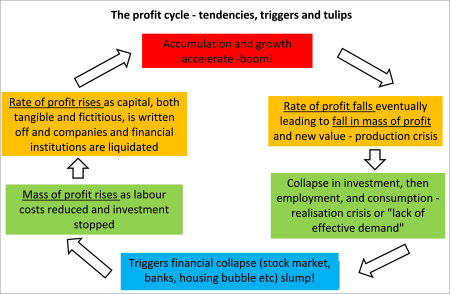
This view of capitalism's likely future rather depends upon Marx's law of the ‘tendency of the rate of profit to fall’ (TRPF) applying over the long-term. I'm good with that as an empirical reality, increasing automation being the causal mechanism.

---

So who are the top gurus of Marxist thinking today? I've already mentioned Michael Roberts who has a prolific blog. I should also mention Sam Williams at "A Critique of Crisis Theory".

Moving now to the superstars, we have Dave Harvey, Michael Heinrich and Anwar Shaikh. I have bought books authored by all three. I'd also mention Andrew Kliman, whose book (below) I've just acquired.

Amazon link

While not a Marxist, radical Keynesian Steve Keen gets an honourable mention for bearing the wrath and fury of the entire neoclassical establishment with courage and fortitude. Roberts writes about him here.

So I'm very much a work-in-progress at the moment, struggling hard to get an intuitive view of the dynamics of capitalist economies at all time scales (Michael Roberts's views on cycles are persuasive).

In the background Marx's own writings, Capital Vols 2, 3 and 4 are still on the stack.

Friday, September 15, 2017

Steve Keen and Anwar Shaikh

In the 1970s the International Marxist Group (IMG) was known as the most intellectual of the far-left organisations. Theory was taken seriously but as a member in my early twenties I never learned much economics - I was not the only one. An abiding memory was of a conference where a senior comrade gave a speech on economic perspectives: a colleague whispered to me that all he had done was take an editorial from The Economist that week and dress it up in Marxist language - I was appalled.

Amazon link

I'm in two minds about Steve Keen's book. I understand that it's dumbed down, written for students contemplating entering university-level economics. The book describes the vast arc of economics history stretching from the classical era of Adam Smith, David Ricardo and Karl Marx (who arguably terminated that tradition by making it politically explosive) through to the rise of the neoclassical tradition, Keynesianism and the confusion we are in today (Sam Williams' analysis is shorter and more definitive).

On the downside, in areas I know something about (quantum mechanics, special relativity) Keen's writing is confused although blusteringly self-confident. Throughout the book he has eschewed equations and diagrams, which is insane - he is reduced to conveying exactly the same concepts in prose which completely obscures his narrative. I was concentrating closely and his verbal arguments elide important steps and don't really hang together.

So I'm thinking Keen is interesting but intellectually underpowered, the kind of tourist guide who you sense isn't really authoritative.

The guy I'm really meant to read, apparently, is Anwar Shaikh.

Amazon link


Sam Williams writes:
"Shaikh’s book is by a modern university-educated economist written for other modern university-educated economists. Economics blogger Michael Roberts in his review says Shaikh’s “Capitalism” is more difficult than Marx’s “Capital.” I agree with Roberts on this point, and I think it is important to examine why this is so.

One reason is that Shaikh’s book demands a thoroughgoing knowledge of Marx’s work, including all three volumes of “Capital.” But it also requires a thoroughgoing knowledge of modern orthodox bourgeois economics—neoclassical marginalism. While parts of the book use Marxist language, the bulk of it is written in both the language of English and mathematics in a way that will be familiar only to those well grounded in orthodox bourgeois economics.

Shaikh provides some “translation” between the terminology employed by Marx and that used by modern economists, but it is hardly sufficient. In addition, where in the many places Shaikh uses the jargon of neo-classcal marginalism in place of basic Marxist concepts, it renders his language imprecise. Marx’s terminology was designed to describe in precise terms his analysis of capitalism. The terminology of neo-classical marginalism was developed for quite different purposes, to say the least, though it’s always possible to see what Shaikh is getting at provided the reader is sufficiently fluent in both “languages.”

Shaikh does provide a useful appendix listing the meaning of symbols he uses in his mathematical equations. The list is a long one.

Marxist political activists, even if they are highly educated Marxists but lack knowledge in today’s bourgeois economic orthodoxy, will have trouble understanding the book. But professional economists thoroughly grounded in modern bourgeois economics will be if anything in even greater trouble. The reason is that trained as they are in present-day bourgeois economics, they will also have a great deal of difficultly with the book unless they also have a thorough grounding in Marx. Though they will feel “more at home” with much of the terminology than will Marxist political activists, the Marxist foundations of the book will escape them.

The professional economists who will have the least difficulty with “Capitalism” are those familiar with the work of the Italian-British economist Piero Sraffa. For those somewhat familiar with Shaikh’s work, this will be no surprise. Much of Shaikh’s work has revolved around the “transformation problem”—the problem of transforming Marx’s values—or direct prices—into prices of production.

Shaikh has spent a considerable part of his career in refuting the suggestion by various critics of Marx that Sraffa’s work has both refuted Marx’s theory of value and surplus value and rendered it unnecessary. Essentially, these critics—also mostly university-educated economists—hold that the capitalist economy can best be described in terms of prices of production. According to them, analyzing capitalism in terms of “value” merely gets in the way.

But even professional economists familiar with Sraffa, unless well grounded in Marx, will not find “Capitalism” an easy read. I would most certainly not recommend Shaikh’s “Capitalism” as an introduction to modern Marxist economic thought.

None of this detracts from the importance of this work, however. Shaikh is undoubtedly one of the most important economic thinkers of our time. What it does mean is that it may take many years—or decades—for the arguments in this book to be assimilated into the understanding of the workers’ movement. I hope to contribute to this process in this extended review and critique."
So this is exciting and daunting! Although Michael Roberts in his review strikes a cautionary note.

Amazon link

Here is my go-forward plan (I have almost completed Capital Vol 1).
  1. Read Capital Vols 2 and 3 and Theories of Surplus Value (Vol 4)
  2. Read David Harvey's "Limits to Capital"
  3. Engage with Shaikh's book (or watch the video lectures).
I would like to complete this plan within my lifetime.