Showing posts with label David Harvey. Show all posts

Sunday, April 22, 2018

"The Limits to Capital" by David Harvey (2007)

Amazon link

Who is David Harvey? Michael Roberts explains on his blog:
"Just in case you are unaware (difficult to believe), Professor Harvey is probably the most eminent Marxist scholar alive today with a host of books, papers and educational videos to his name on Marxist economic theory."
To properly assess this 450 page book, which combines a sophisticated review of Marxist theory together with its detailed application to today's global economy, would be the labour of many hours. Please forgive a much more superficial review here.

First of all, the book is a rather dry read. While not quite a textbook, it demands sustained concentration and one returns to it more out of duty than pleasure. However, once engaged it is full of insights (I had a similar experience with David Reich's book).

This would not be your first choice if you knew nothing about Marxism. For that, you need an introduction. The great thing about Harvey's overview is that he never just regurgitates the sacred texts. You always see a questing intelligence, picking apart Marx's analytic categories and examples, working to understand them from a contemporary perspective. His insights are invariably fresh and thought-provoking.

Harvey is a geographer, a student of spatial and temporal development. As capitalism develops unevenly within regions, countries and globally, one would have thought that Marxists would have explored in depth the interaction between abstract economic categories and geography, but Harvey seems to break new ground towards the end of the book. Yet I sometimes wondered whether his results were that surprising - often pages went by when I thought the new idea could have been better expressed in a single paragraph.

Why do we bother with Marxism? Because we have a healthy skepticism about elite social science. In no mode of production have the elites come clean about the basis of their structural good fortune: capitalism is no different. Only the Marxist tradition 'tells it like it is'.

Yet here Harvey's moralism grates. The idea is to understand the nature and dynamics of the capitalist mode of production, not to ritualistically denounce it in aggrieved tones and lobby emptily for a 'more rational' mode of production based on wishful thinking. Harvey has never convincingly explained how the complex motivational and coordination problems which capitalism addresses pretty successfully could be better handled by a traditionally-conceived socialism - while we have plenty of evidence to the contrary.

And then there are the lacunae. Marx may have said "always doubt" but although Harvey may be the least dogmatic of contemporary Marxist thinkers, he's not prepared to break with blank slate accounts of gender or ethnic differences. Even the impeccably liberal David Reich is ahead of him on this. No wonder he can't seem to see a way towards a Marxist account of the family or, for example, third world underdevelopment.

Despites its selective myopia and unengaging style, there is still a great deal to get out of this book. I was glad to read it, and glad to finish it.

Tuesday, October 03, 2017

Diary: Capital Vol 2 and other stories

Up bright and early this morning. A ten past eight appointment with the dentist to have my new crown fitted. Except that it didn't fit. Apparently this happens one time out of five or six.

The tooth-stub was re-impressed (uncomfortable-to-the-cheek process with a mould) and I have to return in a couple of weeks for the next attempt to fit it.

---

I am working through Capital Vol 2 (£2.99 on Kindle .. slightly easier to read than the free PDF) and what a trial the first four chapters are.

Things they don't tell you. Volume 2 was never written as a book by Marx, instead it was assembled from his voluminous notes by Engels. It's dry, insanely-repetitive .. and a less reverential editor would have cut it down to one tenth the size.

There are occasional nuggests buried under pages of Marx pecking away at the same material, over and over again. Marx was clearly just writing this stuff for himself, trying various thoughts out in an obsessive manner.

I'll grit my teeth and persevere, and then let someone else take over the heavy burden of distilling its real content. David Harvey is meant to be the go-to guy and I have his Limits to Capital.


Unfortunately I have to say I side with Michael Roberts against Harvey in the fundamentals of Marx's dynamical thinking, summed up in the reproduction schemes and Marx’s law of the tendency of the rate of profit to fall (LTRPF).

Update: Vol 2 chapters 5 and 6, where Marx reverts to coherent narrative, are considerably more interesting. I'm learning quite a bit and hoping for a continuing trend here.

---

BBC political editor Laura Kuenssberg has an insightful piece on the BBC website today about the inner decay of the present Tory government.
"The fuss around Boris Johnson is the symptom not the cause. The problem that is increasingly on people's minds at this grisly conference is that the Tories might be only at the start of a decline, which becomes impossible to escape.

"One former minister says, "there is a smell of decay", another, that it is "hopeless, but we are resigned to the nightmare". Cabinet ministers fret that Theresa May simply doesn't have the ideas or imagination to reboot either her leadership or their party. ...

"One of her colleagues says "how did she blow the party up in 12 months?", lamenting how her premiership has paralleled Gordon Brown, who after years of hoping to get to Downing Street arrived there with little to say, bewildered by the sudden challenge of the top job. Another says she looks "bent and broken". ...

"The fear here is not really that Boris Johnson is grabbing all the attention, it's that this party could be dying inside, and it finds itself with a leader who might struggle to stop the downward spiral."
Time to finish up here and go listen to Boris.

---

Comment 

Performance-wise, it was a pretty decent speech and the conference standing ovation looked genuine. The message - economically-globalist, politically-liberal, strategically British-Empire-lite - was tailored to appeal to smaller capitalists operating within the national market, those companies aligned with US and other non-EU markets and the culturally-nationalist fraction of the more traditional working class.

Its tragedy: the Boris vision is not aligned with the interests of the dominant financial and industrial wings of the British ruling class, which heavily value economic integration within the European Union. It also fails for the idealistic middle-class young, those who buy into euro-ideology and fill the ranks of Momentum.

So yet again we've seen the deep fissure within the British elite and in the mass of the population, as refracted through the Tory party. Boris, despite his charisma, does not bridge the divide. No-one can.

Tory party dynamics, going forward, should be fascinating.

Friday, September 29, 2017

A Roadmap of Crisis Theories

This post could also be entitled, 'The Gurus of Contemporary Marxist Theory', interpreting 'Marxist' rather broadly.

A year ago, when I started to pay more attention to economics, I was clueless as to where to go for high-quality Marxist analysis (even at the start of my search I was not in any doubt that neoclassical economics - in its denial of the class structure of capitalism - was intellectually bankrupt).

I knew about Ernest Mandel of course, but who else was worth reading, and what were the key issues in contemporary debates?

On the latter question I soon discovered that the most important issue was, of course, the Marxist theory of crisis.

From Michael Roberts
---

On page 15 of Michael Roberts's book, "The Long Depression", he shows a variant of the roadmap below from the San Francisco Bay Area Marxist Study Group (click on image to make larger and more legible).


San Francisco Bay Area Marxist Study Group via Nick Johnson


Incidentally I'm comfortable with Michael Roberts's take on the world because, like him, I'm hard left on the diagram above all the way down 😎.

Roberts is also not that tribal, seeking to understand rather than denounce. This is just as well as he secretly seems as convinced as I am that capitalism has at least another century before the imminence of total automation make production solely for the valorisation of capital essentially impossible.

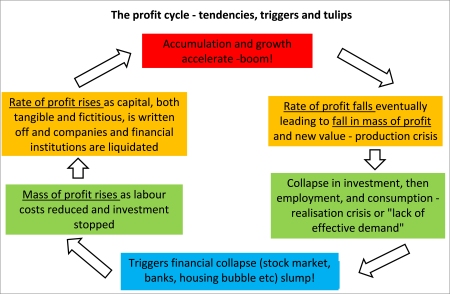
This view of capitalism's likely future rather depends upon Marx's law of the ‘tendency of the rate of profit to fall’ (TRPF) applying over the long-term. I'm good with that as an empirical reality, increasing automation being the causal mechanism.

---

So who are the top gurus of Marxist thinking today? I've already mentioned Michael Roberts who has a prolific blog. I should also mention Sam Williams at "A Critique of Crisis Theory".

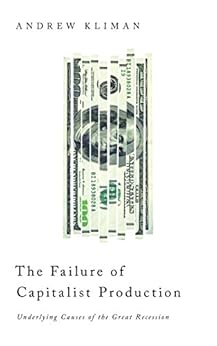
Moving now to the superstars, we have Dave Harvey, Michael Heinrich and Anwar Shaikh. I have bought books authored by all three. I'd also mention Andrew Kliman, whose book (below) I've just acquired.

Amazon link

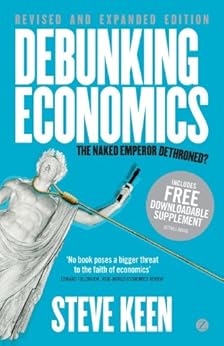
While not a Marxist, radical Keynesian Steve Keen gets an honourable mention for bearing the wrath and fury of the entire neoclassical establishment with courage and fortitude. Roberts writes about him here.

So I'm very much a work-in-progress at the moment, struggling hard to get an intuitive view of the dynamics of capitalist economies at all time scales (Michael Roberts's views on cycles are persuasive).

In the background Marx's own writings, Capital Vols 2, 3 and 4 are still on the stack.

Friday, September 15, 2017

Steve Keen and Anwar Shaikh

In the 1970s the International Marxist Group (IMG) was known as the most intellectual of the far-left organisations. Theory was taken seriously but as a member in my early twenties I never learned much economics - I was not the only one. An abiding memory was of a conference where a senior comrade gave a speech on economic perspectives: a colleague whispered to me that all he had done was take an editorial from The Economist that week and dress it up in Marxist language - I was appalled.

Amazon link

I'm in two minds about Steve Keen's book. I understand that it's dumbed down, written for students contemplating entering university-level economics. The book describes the vast arc of economics history stretching from the classical era of Adam Smith, David Ricardo and Karl Marx (who arguably terminated that tradition by making it politically explosive) through to the rise of the neoclassical tradition, Keynesianism and the confusion we are in today (Sam Williams' analysis is shorter and more definitive).

On the downside, in areas I know something about (quantum mechanics, special relativity) Keen's writing is confused although blusteringly self-confident. Throughout the book he has eschewed equations and diagrams, which is insane - he is reduced to conveying exactly the same concepts in prose which completely obscures his narrative. I was concentrating closely and his verbal arguments elide important steps and don't really hang together.

So I'm thinking Keen is interesting but intellectually underpowered, the kind of tourist guide who you sense isn't really authoritative.

The guy I'm really meant to read, apparently, is Anwar Shaikh.

Amazon link


Sam Williams writes:
"Shaikh’s book is by a modern university-educated economist written for other modern university-educated economists. Economics blogger Michael Roberts in his review says Shaikh’s “Capitalism” is more difficult than Marx’s “Capital.” I agree with Roberts on this point, and I think it is important to examine why this is so.

One reason is that Shaikh’s book demands a thoroughgoing knowledge of Marx’s work, including all three volumes of “Capital.” But it also requires a thoroughgoing knowledge of modern orthodox bourgeois economics—neoclassical marginalism. While parts of the book use Marxist language, the bulk of it is written in both the language of English and mathematics in a way that will be familiar only to those well grounded in orthodox bourgeois economics.

Shaikh provides some “translation” between the terminology employed by Marx and that used by modern economists, but it is hardly sufficient. In addition, where in the many places Shaikh uses the jargon of neo-classcal marginalism in place of basic Marxist concepts, it renders his language imprecise. Marx’s terminology was designed to describe in precise terms his analysis of capitalism. The terminology of neo-classical marginalism was developed for quite different purposes, to say the least, though it’s always possible to see what Shaikh is getting at provided the reader is sufficiently fluent in both “languages.”

Shaikh does provide a useful appendix listing the meaning of symbols he uses in his mathematical equations. The list is a long one.

Marxist political activists, even if they are highly educated Marxists but lack knowledge in today’s bourgeois economic orthodoxy, will have trouble understanding the book. But professional economists thoroughly grounded in modern bourgeois economics will be if anything in even greater trouble. The reason is that trained as they are in present-day bourgeois economics, they will also have a great deal of difficultly with the book unless they also have a thorough grounding in Marx. Though they will feel “more at home” with much of the terminology than will Marxist political activists, the Marxist foundations of the book will escape them.

The professional economists who will have the least difficulty with “Capitalism” are those familiar with the work of the Italian-British economist Piero Sraffa. For those somewhat familiar with Shaikh’s work, this will be no surprise. Much of Shaikh’s work has revolved around the “transformation problem”—the problem of transforming Marx’s values—or direct prices—into prices of production.

Shaikh has spent a considerable part of his career in refuting the suggestion by various critics of Marx that Sraffa’s work has both refuted Marx’s theory of value and surplus value and rendered it unnecessary. Essentially, these critics—also mostly university-educated economists—hold that the capitalist economy can best be described in terms of prices of production. According to them, analyzing capitalism in terms of “value” merely gets in the way.

But even professional economists familiar with Sraffa, unless well grounded in Marx, will not find “Capitalism” an easy read. I would most certainly not recommend Shaikh’s “Capitalism” as an introduction to modern Marxist economic thought.

None of this detracts from the importance of this work, however. Shaikh is undoubtedly one of the most important economic thinkers of our time. What it does mean is that it may take many years—or decades—for the arguments in this book to be assimilated into the understanding of the workers’ movement. I hope to contribute to this process in this extended review and critique."
So this is exciting and daunting! Although Michael Roberts in his review strikes a cautionary note.

Amazon link

Here is my go-forward plan (I have almost completed Capital Vol 1).
  1. Read Capital Vols 2 and 3 and Theories of Surplus Value (Vol 4)
  2. Read David Harvey's "Limits to Capital"
  3. Engage with Shaikh's book (or watch the video lectures).
I would like to complete this plan within my lifetime.