Showing posts with label Michael Heinrich. Show all posts

Friday, April 27, 2018

Socialist Revolution in the 21st Century?

Amazon link .. and a review

"First published in 1928, this is the Comintern’s official manual for insurrection and it has a foreword by Erich Wollenberg giving details of its composite authorship. The introduction by Piatnitsky is generally sensible, which, since he quotes extensively from Lenin on the necessity of a very advanced stage of political decomposition of the capitalist state as a pre-condition for an uprising, is not surprising.

There then follow four case studies, in approved Staff College fashion, of Reval in 1924, Hamburg 1923, Canton 1927 and Shanghai in 1926-27. These are in effect object lessons in how not to do it and disobey practically every one of Lenin’s dictums. ..."              [from Ted Crawford's 1971 review].
---

Amazon link - and no reviews

From 2016/17. So relevant and timely that no-one in the UK or America reviewed it on Amazon ... .

---

In his latest blog post, Marxist economist Michael Roberts concludes:
"Surely, a left government must instead look to replace big capital with democratically-run state enterprises in the ‘commanding heights’ of an economy.  This would lay the proper foundation for innovation and enterprise and thus put use-value before value, price and profit."
Fine words, yet how are we to get there?

Back in the heady days of red-blooded Leninist party building (the 1970s) the revolutionary left was completely educated on what would happen if a left-wing government were to come into office and try to legislate capitalism away. We had seen what happened in Chile.

The media would put up a ferocious ideological onslaught, there would be a massive capital exodus leading to economic depression or collapse while the state apparatus would sabotage socialist initiatives. In extremis, other capitalist powers would restore 'order', perhaps through NATO.

We didn't forget that revolution is civil war. That in an existential clash of two sides, the side with the better programme, the stronger morale, the superior military forces and the more inspired leadership gets to win.

We didn't forget that for capitalists, the socialist revolution looks like the chavish masses violently stealing everything they have, possibly arresting or killing them and their families. No, they surely would not go quietly into that good night.

Of course, the working class today is totally unprepared for such a confrontation. Michael Roberts has argued in his book, Marx 200, that a revival of working class organisation and combativity will not be apparent for some years yet, not until a new capitalist upturn following the end of the current long depression.

And yet we have the prospects of a Corbyn-McDonnell government coming up shortly, which is going to do what exactly?

---

Perry Anderson wrote:
"Yet it is quite clear that without serious exploration and mapping of it [the nature of socialism], any political advance beyond a parliamentary capitalism will continue to be blocked. No working-class or popular bloc in a Western society will ever make a leap in the dark, at this point in history, let alone into the grey on grey of an Eastern society of the type that exists today. A socialism that remains incognito will never be embraced by it."
And this is the problem. With all its cyclical dysfunctions, the monstrously-complex capitalist economy in all its globally interconnected sophistication works. Its valorisation-brutality forces progressive advances where kinder, gentler and less-driven souls would acquiesce to the always-vociferous and inevitable victims .. and preside over stagnation.

It seems unlikely that the working class will take a leap into the 'socialist chaos' that all media commentators will accurately predict without a really compelling narrative.

---

My review and Amazon link


Having read János Kornai's blistering critique of the socialist system, I am deeply skeptical about any transition to socialism which promises a quasi-social-democratic state with mass nationalisation enriched by 'bottom-up democratic forms'. I think we all know that revolutionary fervour dims, the masses demobilise and the activists end up colonising the bureaucracies.

Amazon link

Capitalism, with its separation of politics and economics as so usefully described by Michael Heinrich (PDF link: see chapter 11 p. 203), looks a better guarantor of the development of the productive forces and of personal and political freedoms than any kind of model which Michael Roberts is implicitly proposing.

The best indication of the entirely ritualistic nature of incantations of 'the replacement of capitalism' by contemporary Marxist theoreticians is the complete absence of any discussion of the transition itself.

Speaking personally, I prefer a disappointed honesty to hypocrisy and (self-) deception with the potential to lead to catastrophe.

---

See also; "The Comintern guide to armed insurrection (1928)".

Thursday, November 16, 2017

Q. "How do I get into Marxism?"

Marx is newly fashionable again, but it's a daunting task to take on the four volumes of Capital. And in most fields you don't retrace the founder's tortuous strugglings. In physics, students don't read Newton's or Einstein's original works: they read textbooks.

Marx wrote about what he knew, which was the inner dynamics of capitalism as a mode of production. A good start is "Understanding Capital" by Duncan K. Foley (search "understanding capital foley pdf").

Amazon link


Foley concentrates on the economics, is very clear and writes in a modern paradigm cross-referencing contemporary ideas in economics. The book is thematically-organised across Marx's economic work and is short (170 pages).

Amazon link

As a complement, there's Michael Heinrich's "An Introduction to the Three Volumes of Karl Marx's Capital" - this link is to the online PDF or search "marx capital heinrich pdf". It's similarly short (224 pages), well-written and conceptually clear. Heinrich is more focused on the actual contents of each volume. He also writes about topics Marx intended to address but never got around to, including the theory of crises, the state and communism itself.

Marx wrote very little about post-capitalist social organisation. Without data this would have been no more than speculation. It was down to Lenin, Trotsky, Stalin, Mao and many others to theorise later developments - in ways I would argue were profoundly mistaken.

Tuesday, November 14, 2017

Morbid phenomena of the most varied kind

There's a curious sense of a world marking time. Politics in America, the UK and Europe sounds more than usually confected. Bogus 'outrage' over "Russian intervention in elections", theatrical tub-thumping over North Korea, tedious shadow-boxing over Brexit.

It's all shallow - elite protagonists going through the motions.

Here's an extract from that excellent essay which is Chapter 11 of Michael Heinrich's "An Introduction to the Three Volumes of Karl Marx's Capital":  State and Capital (p. 208).

PDF link

"A decisive shortcoming of the conception of the bourgeois state as an instrument in the hands of the capitalist class is that it presupposes a “ruling” class that is both unified and capable of acting, as well as a clearly defined class interest that simply needs an instrument for its implementation.

Neither assumption is self-evident. The “economic ruling class” in capitalism consists of capitalists with widely varying, even opposing interests. There is a common interest in the maintenance of the capitalist mode of production, but if the system is not threatened by a revolutionary movement, then this interest is far too general to serve as a guideline for “normal” state action. The interests that determine the state’s activity are not just sitting around waiting to be implemented, as is assumed by the instrumentalist conception. Rather, these interests must first be constituted.

All of the state’s measures are contested, whether the issue is the concrete organization of the legal system, the securing of the material conditions of accumulation, or the type and extent of welfare state benefits.

As a rule, every measure brings disadvantages for some capitalists (sometimes even for all capitalists) and advantages for others (or fewer disadvantages than for the rest). Advantages expected - but not certain - over the long term are pitted against immediate disadvantages.

The issue of what the general capitalist interest consists in, which challenges the state should react to and how - all that has to constantly be ascertained. State policies presuppose a constant ascertainment of the general interest and the measures for its implementation."
We're witnessing the terminal decay of the neoliberal ideological project amid the rising resentment of significant strata of society who are 'just not happy with the way things are going' - who yearn for vague, inchoate change.

I see genuine confusion within the elite as to optimal policy going forwards.

This seems very Gramsci:

Amazon link

“The crisis consists precisely in the fact that the old is dying and the new cannot be born; in this interregnum morbid phenomena of the most varied kind come to pass.”
It's hard to see a way out without some kind of multi-year social and economic crisis.

Monday, October 30, 2017

Marx: "Right about capitalism, wrong about socialism"

I've been engaged in an exploration of the Marxian analysis of capitalism as a mode of production, how any successor society might emerge and what it might be like. I've read the first two volumes of Capital (bulky, circuitous and sprawling though they are) and also two excellent introductions from Michael Heinrich and Duncan Foley.

Amazon link .. and PDF

Amazon link .. and PDF

I feel quite sufficiently educated. I also concur with the Russian epigram quoted above: Marx was right about capitalism, but wrong about socialism.

But .. before we get too judgemental .. it's worth bearing in mind that Marx said very little about socialism. As Duncan Foley observes in his "Socialist alternatives to capitalism I: Marx to Hayek",
"In general Marx responded to questions about his views on the organization of socialist society by saying that these questions could be solved only by those who actually confronted them historically, that is, presumably, by the revolutionary movements that would establish socialist institutions. This is a prudent and in some ways sensible stance, but frustrating to a posterity that has made notably little progress on these problems."
Foley continues:
"Really existing socialism

"History, of course, was not waiting for political economy to sort out the issue of socialism. The early decades of the twentieth century also saw the emergence of a Soviet Union dedicated, rhetorically at least, to the building of a socialist economy, out of the wreckage of the Russian Empire.

The Bolsheviks confronted two practical political economic problems in the 1920s. Perhaps the lesser was the organization of day-to-day production and distribution. The greater was what later came to be called the problem of “development”: how to transform the backward, largely traditional agricultural economy of the sprawling Russian empire into a viable industrialized power.

The second task was all the more pressing because the denouement of the First World War on the Eastern Front had revealed the military and political vulnerability of a backward Russian economy in a world increasingly populated by industrialized capitalist powers.

The Soviets, whose leadership contained some remarkably talented and thoughtful figures, such as Nikolai Bukharin, arrived at a practical solution to the problem of organization of day-to-day production fairly soon after consolidating political power through prevailing in the Civil War with the Whites. This took the form of the “New Economic Policy” (NEP), which allowed, and indeed encouraged, capitalist commodity production in many sectors of the economy, including food production.

The NEP structurally created a “mixed” economy in which a large private sector co-existed with state-sponsored industrial enterprises. (The NEP is recognizably a precursor of Deng Xiaoping’s “socialist market economy” which was the framework for Chinese economic growth in recent years.)

The NEP worked well to stabilize the Soviet economy after the Civil War; under this regime output and incomes recovered significantly from the low levels of the Civil War period. Many Bolsheviks, including Lenin, were willing to accept the NEP framework as an indefinitely prolonged phase of building socialism, as long as the state held the “commanding heights” of the economy through control of energy, transportation, heavy industry, and finance.

Two connected and predictable developments undermined the NEP. First, as we would expect, the privatized commodity-producing sector of the economy exemplified some fundamental laws in generating large disparities in income and wealth. The appearance of a wealthy proto-bourgeoisie in the midst of a society governed by a one-party dictatorship committed to socialist goals threatened the narrow political base of Bolshevik power.

Second, the NEP was structurally favorable to the agricultural sector, particularly to the market-oriented strata of the peasants. The NEP thus resulted in a relatively “balanced” path of economic growth between industry and agriculture. Not surprisingly the prices of food and other agricultural products tended to rise relative to industrially produced goods, limiting the degree to which surplus production in agriculture could be mobilized for rapid industrial investment.

Despite Bukharin’s determination to “ride to socialism behind the peasant’s nag”, NEP policies proved explosively unstable politically, and collapsed under efforts to mobilize agricultural surpluses by military force which ultimately led to collectivization, central planning, and the bloody political purges of the nineteen-thirties.

Stalin rather than Bukharin balanced at the top of the “greasy pole” of Communist Party politics apparently more by ruthless and opportunistic manipulation of coalition politics than through consolidating a stable political base of power.

Just how the Soviet economy did operate in the 1930s, and in particular what was the practical mixture of bottom-up and top-down dynamics in this period remains obscure. A relatively small central planning bureaucracy had in theory enormous economic power to implement a policy of extremely rapid industrialization centered on the expansion of heavy industry. It seems unlikely that the fairly coarse-grained plans produced could be the whole story of Soviet economic life under this regime.

The management of new industrial armies recruited to new urban centers involved a great deal of decentralized local improvisation and experimentation. Since the centralized planning bureaucracy did not actually control many resources itself, local managers facing shortages of inputs and surpluses of outputs improvised informal market-like arrangements with each other. Despite the wishful thinking of market-fundamentalists, capitalist economies in periods of extremely rapid industrialization have often strayed significantly from the orthodoxies of profit-maximization given market prices, making it difficult to draw hard analytical lines by which to characterize the Soviet experiment.

While the Soviets were engaged in their furious (if in the very long run curiously futile) attempt to change the world, western European philosophers continued to interpret it. ... "
In his follow-up paper, "Socialist alternatives to capitalism II: Vienna to Santa Fe", Foley contemplates the great complexity of the global capitalist economy and speculates how any subsequent mode of production could do better as regards the difficult issues of economic information retrieval, resource allocation and optimality of outcomes. He contrasts top-down and bottom-up approaches:
"The last half of the twentieth century saw an upsurge in interest in bottom-up self-organized systems, such as ant-hills and bees’ nests, bird flocks, computer networks, unsupervised learning algorithms such as neural nets, the capitalist economy, possibly the human brain and a host of other similar examples.

Several features of these bottom-up systems draw the attention of systems thinkers. For one thing, compared to top-down optimal control systems, bottom-up self-organized systems tend to be more “resilient” or “robust”. Self organized systems often (though not invariably) continue to function (possibly in a degraded mode) despite the disruption or even destruction of important subsystems, and in important cases can recover from such damage spontaneously.

Top-down systems can be built with considerably “redundancy”, but tend to be more vulnerable to disruption of key elements, particularly the feedbacks that implement their optimal control properties.

Another intriguing property of bottom-up self-organized systems is that although they are not designed to achieve optimal performance, they often do perform surprisingly well. Ant-hills, for example, are remarkably efficient in locating and exploiting food sources. Bottom-up self-organized systems also exhibit a high degree of adaptability to new situations. Optimal control systems tend to be optimized for some particular context in which they are designed to operate. Self-organized systems can adapt to a wide range of environmental changes (though there are typically limits to the magnitude of shocks any such system can survive).

Capitalism itself is a good example of all these features of spontaneously organized bottom-up systems: historically capitalist institutions tend to reproduce themselves even after the destruction wrought by wars, revolutions and financial meltdowns; capitalist allocation of resources approximates efficiency to some degree; and capitalism has proven to be highly adaptable in the face of massive environmental changes (many of which, such as world population growth and technical innovations, arise from the dynamics of capital accumulation itself).

The vision of the economy as a complex system gives rise to a “bottom-up” understanding of how commodity production is organized, a la Hayek. It also suggests a parallel bottom-up vision of socialism as arising from the spontaneous organization of production through some framework of institutions different from private appropriation and exchange of products.

This bottom-up vision of social organization resonates with important political currents of the late twentieth century. The “New Left” movements of the nineteen-sixties rebelled against the centralizing and regimenting tendencies of “Old Left” socialism and communism by calling for decentralization, participation, and the political primacy of individual freedom and expression.

The Left, such as it is in the contemporary world of globalized capitalism, is much more attracted to the vision of spontaneous political expression than to the unpleasant chore of organizing political institutions.

This enthusiasm for spontaneity without central coordination or direction has attached different parts of the Left to various economic experiments, plans, philosophies, and models. Some of these, such as micro-credit institutions, amount to very minor modifications of the capitalist commodity system (or could indeed be regarded as systematic extensions of the logic of the commodity system).

One idea which flowers perennially on the Left as an alternative to capitalism is workers’ control. ..."
Foley then looks in detail at the historical experience with workers' control, particularly in the former Yugoslavia, and comes to some very pessimistic conclusions.
"When worker-controlled enterprises become very successful, the resulting hierarchy of workers begins to resemble that of capitalist firms. When the contradictions between the juridical form of organization of the enterprise and the substantive claims of different strata of workers to the surplus revenues become acute, it is common for worker-controlled enterprises to privatize themselves spontaneously, converting into traditional capitalist firms.

A second point is that despite the demonstrated capability of worker-controlled firms to compete successfully with capitalist firms under particular circumstances, there has been no tendency for worker controlled enterprises to grow spontaneously to crowd out capitalist firms in any economy: workers’ control remains a relatively small sector even in societies where tradition and practice favor this form of productive organization."
So no easy answers then. However, Foley's essay would not be complete without at least an attempt to provide an existence proof that a mode of production transcending capitalism is at least possible (- all emphasis in the extract below has been added).
"To bring this talk to an end, I will indulge in the luxury of fantasizing about some alternatives to capitalist-commodity production.

There are some ground rules for this exercise. This is speculation about changing what Marx calls social relations of production. In thinking about alternatives in this (very broad) range of issues I am not required to consider every social problem (foreign policy, religion, education, political institutions, mental illness, drug abuse, culture).

In general, the basic supposition is that life goes on as usual. People get up, go to work or school, form families, reproduce, age, consume, and so forth. There are natural disasters and domestic and foreign conflicts, regional divisions, and the like. But it is not fair for me to wish away critical aspects of the problem of organizing a complex division of labor to sustain the type of technologically sophisticated society post-industrial capitalism has created, with relatively high levels of consumption and economic security.

For example, it would not be very interesting for me to posit a system of universal abundance of use-values created by some imaginary robot workforce, and then to spin a vision of the resulting glittering possibilities for human social life.

It would also not be of much interest for me to ignore the problem of a “transition” by assuming a complete self-contained and self-reproducing alternative system. A socialist fantasy alternative has to include the notion of a “mixed” economy, in which commodity-capitalist social relations continue to prevail in some sectors, or regions. The socialist sector of the economy has to include methods for dealing with a capitalist-commodity other.

Furthermore, I am most interested in ideas that would allow a socialist alternative to co-exist with (and in a larger sense compete with) capitalist-commodity social relations indefinitely. Thus it is not fair for me to assume some “revolutionary” transformation of the whole society (even with the dystopian backdrop of a looming or ongoing ecological crisis) to resolve basic problems of social relations.

It is equally uninteresting for me, however, to ignore the deep hostility of bourgeois ideology to radical alternatives to capitalist-commodity production. I am interested primarily in how ordinary, regular suburban/urban people who by and large have jobs, incomes, and more or less stable lives through the capitalist-commodity system might transform their social relations of production.

It is not going to be hard to criticize the particular fantasy I put forward. The main function of such exercises is to induce dialectic thinking by making concrete assumptions that can be knocked down.

On the other hand, it is not in the spirit of this kind of exercise to invoke “human nature” in one or another of its many incarnations as an objection; or to wish away through assertion the fact that capitalist-commodity production has many parallel unresolved contradictions.

It is not reasonable to insist, for example, that opportunistic behavior would be any less mixed with social and other-regarding behavior in a socialist fantasy than it is in capitalist commodity reality. In fact, it seems reasonable to suppose that a change in social relations could re-balance human behavior towards others at least at the margin.

It also seems reasonable to suppose that people are grown-up enough and aware enough of the facts of economic life to understand that at an aggregate level consumption depends on production, and that they are willing to accept social responsibility to work productively as a condition of consuming."
Don't hold your breath: gaming the system is rather pervasive in human affairs.
"Lifenet 

"So let us imagine an alternative set of social relations, which I will call “Lifenet” which can organize social production to meet at least some part of the spectrum of human needs outside capitalist-commodity institutions.

Lifenet production is organized through peer-production enterprises. People start or join existing peer-production initiatives without any direct material compensation. The output of these enterprises is made available freely to participants in the system through a Lifenet distribution system, just as open-source software is published freely through open source licenses.

One key point here is that users or consumers of Lifenet outputs agree not to re-sell them as commodities for money. The aim is to create an alternative system of production and distribution that can be effectively separated from capitalist-commodity production.

Participants in Lifenet enterprises have a Lifenet account maintained in a central Lifenet database. The Lifenet account records individual contributions to Lifenet enterprises, and also individual withdrawals of Lifenet products. Thus an individual who participated in a food production enterprise would have that participation recorded in her Lifenet account; if she received food or clothing or software from Lifenet distribution centers (perhaps something like food coops or farmers’ markets today) these withdrawals would also be recorded in the Lifenet account. (One can imagine something like a credit card system to maintain these accounts automatically.)

The purpose of the Lifenet account would not be to enforce an exact balance between individual contributions to the production system on the one hand and withdrawals through the distribution system on the other. It would, however, allow the system to monitor the balance of production and distribution as a whole, and to identify and discourage or prevent possible abusive over-drawing on distribution. (If some level of the individual accounts were publicly accessible, peer pressure could play a major role in this respect.)

The premise of the accounts is that Lifenet as a whole is solvent, and has products available for distribution. A Lifenet system is going to work only if the individuals participating and the system itself develop an ethos of thrift, prudence, and waste-aversion. Lifenet must prudently keep large reserves of products to secure its ability to respond to contingencies (natural disasters, local breakdowns of the system) flexibly and reliably. The participants in the system must use its resources sparingly and thriftily, both as producers and consumers. The idea of “enough” has to pervade the system from top to bottom.
He goes on but you can see (as in David Schweickart's account of a possible model for socialism which I wrote about), this is already sinking under its own implausibilities.

It is worth emphasising what derails all these models of socialism: the conflict between the interests of the larger economy vs. the interests of groups comprised of families and friends.

'Communist man' does not exist and  - short of substantial genomic engineering - never will: we are not ants. When this factory has to close and the workers relocate, or that sacrifice has to be made 'for the common good', then under capitalism - in the final analysis - coercion is applied.

Conflicts are intrinsic and unavoidable. Contemporary Marxist intellectuals always leave the room at this point, wringing their hands; the Bolsheviks were never so mealy-mouthed.

So if Professor Foley, a very smart economist, can do no better than this after a lifetime of study, I am more than ever convinced that capitalism will be superseded only when it has created sufficient cognitive-robotic automation to essentially displace the proletariat from production .. and thus end any further possibilities of capital accumulation.

Sunday, October 15, 2017

Readings relating to total automation under capitalism

From the film, "Elysium"

Introduction

Suppose progress in AI and robotics manages to eliminate all human jobs: no more human workers. Would capitalism collapse or just sail serenely on, making the elite ever richer while the masses of the dispossessed watch in apathetic horror from outside the gated communities (Elysium)?

The usual Marxist account is that total automation is incompatible with capitalism, yet the standard response is curiously unconvincing. Marxists say that all automation systems are constant capital, and constant capital eponymously can't create new value. Only variable capital, living human labour, can do that. And it's from variable capital that surplus value - profits - are derived.

No workers, no profits.

This argument uses the abstract model of capitalist production developed in Volume 1 of Capital. But it leaves many things obscure.
  • What is the special status of human labour, was Marx a vitalist?
  • As automation increased, what actually would we see in the economy?
  • If total automation brings about some other mode of production, how did we  switch?
Let's see if we can clarify any of this.

---

1. Why can't robots produce surplus value?

The question was asked particularly clearly in this Reddit post.
"I've often read that Marx firmly asserted that a machine cannot create surplus value. However, since technological capabilities have changed quite a bit since Marx's day, today I decided to do some research into modern interpretations of this theory.

"I couldn't find a good answer as to why a robot can't produce surplus value (sure, it's constant capital, but that doesn't really explain it), but I did find mention that neither slaves or animals (which are both living) can produce surplus value, which indicates that there is something very particular about the type of work done by machines, not the inanimate-ness of the machines themselves, that prohibits them from creating surplus value.

"This leads to a few questions:
  • Why can't robots, slaves, and animals produce surplus value?
  • Does the possibility of robots manufacturing other robots affect this?
  • What about human-like robots created in the future?
"How can a society be both slave-based and capitalist (like the old American South)?

"Thanks!"
And here is the favoured answer - somewhat accurate but ultimately confused and unconvincing.
"Slaves are like tools since they are owned. If they exist alongside capitalism, they, like all other tools, pass their value on to the commodity but do not create new value. This does not mean that slaves are not exploited and don't produce a surplus for their masters. They do, but this surplus does not take the form of surplus value. In this case all the master's profit is surplus value transferred from free laborers. ...

"Surplus-value production requires a certain social organization. The question then is: What social organization differentiates the slave from the wage-laborer such that one doesn't produce surplus value but the other does?

"The answer is a social organization of generalized commodity production requiring an extensive division of labor. This social organization requires what Marx calls the laborer's "freedom in the double sense":
as a free man he can dispose of his labour-power as his own commodity, and that on the other hand he has no other commodity for sale, is short of everything necessary for the realisation of his labour-power.
"So, the slave/animal/robot must be given bourgeois rights; it must no longer be possible to buy and sell them, they must be considered equal as commodity owners and sellers. The slave/animal/robot must also be driven off the land and deprived of any means of production. This forces them to sell their labor-power to survive.

"If the animal/robot had the mental and physical capacity to function this way under these conditions, they would be surplus value producers."
Marx was not a vitalist, the term 'living labour' is an economic category (a producer of new value, an entity which brings labour-power to market as a commodity), not a term of biology.

---

2. Forms of Production

The first step to understanding why the Marxist account is, nevertheless, correct is to carefully distinguish different ways stuff can get produced in a complex economy with a division of labour, requiring trading and exchange. It will become clear that the two critical ideas are the distinction between use-value and exchange-value, and the subtleties of the labour theory of value.

We start by describing three forms of economic organisation: pre-capitalist, capitalist and post-capitalist. Only the second creates surplus value, value appropriated by an economic actor other than the producer.

2a. Simple Commodity Production

Wikipedia has a good account of this pervasive economic mode:
"Simple commodity production (also known as "petty commodity production"; the German original phrase is einfache Warenproduktion) is a term coined by Frederick Engels to describe productive activities under the conditions of what Marx had called the "simple exchange" of commodities, where independent producers trade their own products. The use of the word "simple" does not refer to the nature of the producers or of their production, but to the relatively simple and straightforward exchange processes involved. ...

"Simple exchange of commodities is as old as the history of trade, insofar as it has progressed beyond barter, and occurred for thousands of years before most production became organised in the capitalist way. It begins when producers in a simple division of labour (e.g. farmers and artisans) trade surpluses to their own requirements, with the aim of obtaining other products with an equal value, for their own use. Through the experience of trade, regular exchange values become established for products, which reflect an economy of labour-time. ...

"Simple commodity production is compatible with many different relations of production, ranging from self-employment where the producer owns his means of production, and family labour, to forms of slavery, peonage, indentured labour, and serfdom. The simple commodity producer could aim just to trade his products for others with an equivalent value, or he could aim to realise a profit.

"That is to say, simple commodity production is not specific to any particular mode of production, and might be found in many different modes of production, with various degrees of sophistication. It does not necessarily imply that all inputs or outputs of productive activity are commodities traded in markets. Thus, for example, simple commodity producers could produce some products for their own use on their own land, while trading another part of their products. They might buy or trade some tools and equipment, but also make some themselves. ...

"In Marxian political economy, simple commodity production also refers to a hypothetical economy used to interpret some of Karl Marx's insights about the economic laws governing the development of commodity trade: it refers to a market economy in which all producers own the resources (including the ability to work) that they use in production. No-one is a proletarian, selling his or her labor power to another. Instead, each is self-employed.

"In this imaginary model, there is a direct correspondence between prices and the values of commodities. The model is imaginary, because no such society has ever existed in history; simple commodity production has always combined with some other modes of production, and as soon as a market economy reaches any size, it begins to utilise wage labor in production, and falls under the sway of the laws of capital accumulation."
The take-home point is that in simple commodity production the proprietor is neither a wage labourer nor a capitalist.

Amazon link

In general proprietors trade commodities at their value and do not produce surplus value, as Duncan Foley explains (Understanding Capital, p. 31):
"Consider a system of commodity production in which independent producers buy inputs to production, add their own labor to commodities, and sell the commodities for prices that in the aggregate reflect the labor time expended in the value added to the commodities. We could represent the movement of money and commodities in such a system by the diagram:
C-M-C'
where the producer starts with the commodities he has produced (C) and sells them for money (M) as a way of buying another bundle of commodities (C') that better suit his needs. The commodities purchased (C') have the same value as the commodities sold (C). The motive behind this transformation is not any change in the value owned by the producer but the qualitative change in the use-values he consumes.

When we think of the commodity circulation in this way, we realize that the process comes to an end after one round of exchange. Once the producer has exchanged the commodities he initially owns for the bundle he chooses, there is no reason for any further exchange to take place. If the economic process is to continue, the reason for its continuation must be sought outside the process itself, for example, in the external assumption that the next day the producer will once again find himself with commodities C that are not the ones he wants to consume and will be forced to exchange again.

Furthermore, there could be no social surplus value in this system. An individual trader might cleverly manage to buy some commodities below their real values and sell them at or above their real values and in this way appropriate a surplus value through unequal exchange. But whatever these agents gain in surplus value, some other agents must lose, because of the conservation of value in exchange.

Producers add value to commodities by expending labor on them, but in general they receive in exchange no more than the equivalent of this labor time. Thus there appears to be no way to explain the pervasive appropriation of surplus value as the basis of economic life within this conception.

Notice also that the only conception of accumulation of value in such a system is for an agent to realize more value by selling commodities than he spends in buying them over a period. The difference must take the form of an accumulation of money by the agent. But this accumulated value is simply withdrawn from commodity circulation through the agent's abstinence from consumption.

When the agent finally spends the hoard he has accumulated, he simply returns the money value to circulation and withdraws commodities from circulation of the same value (assuming that the value of money has not changed in the  meantime). There is in this conception no systematic process of accumulation."
2b. Capitalism

Capitalism is a weird mode of production, its strangeness hidden by its historical and geographical ubiquity, as Michael Heinrich explains in his “An Introduction to the Three Volumes of Karl Marx’s Capital” (p. 17):

Amazon link

"In precapitalist societies, the exploitation of the dominated class served primarily the consumption of the ruling class: its members led a luxurious life, used appropriated wealth for their own edification or for that of the public (theater performances in ancient Greece, games in ancient Rome) or to wage war.

Production directly served the fulfillment of wants: the fulfillment of the (forcibly) restricted needs of the dominated class and the extensive luxury and war needs of the ruling class. Only in exceptional cases was the wealth expropriated by the ruling class used to enlarge the basis of exploitation, such as when consumption was set aside to purchase more slaves, to produce a greater amount of wealth.

But under capitalist relations, production for the sake of increasing the capacity to produce is typically the case. The gains of a capitalist enterprise do not serve in the first instance to make a comfortable life for the capitalist possible, but are rather invested anew, in order to generate more gains in the future. Not the satisfaction of wants, but the valorization of capital is the immediate goal of production; the fulfillment of wants and therefore a comfortable life for the capitalist is merely a by product of this process, but not its goal. If the gains are large enough, then a small portion is sufficient to finance the luxurious existence of the capitalist, and the greater portion can be used for the accumulation (enlargement) of capital.

The fact that earnings do not primarily serve the consumption of the capitalist, but rather the continuous valorization of capital, that is, the restless movement of more-and-more accumulation, might sound absurd.

But the issue at hand is not an individual act of insanity. Individual capitalists are forced into this movement of restless profiteering (constant accumulation, expansion of production, the introduction of new technology, etc.) by competition with other capitalists: if accumulation is not carried on, if the apparatus of production is not constantly modernized, then one’s own enterprise is faced with the threat of being steamrolled by competitors who produce more cheaply or who manufacture better products.

A capitalist who attempts to withdraw from this process of constant accumulation and innovation is threatened with bankruptcy. He is therefore forced to participate, whether or not he wants to."

2c. Bureaucratic Socialism

Sam Williams describes the following scenario:
"A single corporation emerges that controls all of production. Let’s call our imaginary corporation the Universal Company Inc.  Its stock is traded on Wall Street and other global stock exchanges. Indeed, it is the only stock traded on the world’s stock exchanges, because it is the only corporation. It is the only business in the world.

Every factory, mill, mine, farm is controlled by Universal’s board of directors. Managers and technical personnel hired by its board of directors determine exactly what kind of goods are produced and the proportions in which each type of good is produced. Under the rule of Universal Company Inc., all workers are employees of the company since there are simply no other corporations to work for. Under the rule of Universal, what is the highest authority that the individual workers face? Why it’s the board of directors of Universal, which is elected by the stockholders of Universal on the principle of one share one vote.

But do the products of the labor of the workers of Universal take the form of commodities? The answer is no. Why not? Remember, Marx defined commodity production as a situation where the producers work for their own private accounts. Producers of commodities exchange the products of their labor and face no higher authority than the mutual pressure they exert on one another. Or what comes to exactly the same thing, the highest authority the producers face is competition among themselves. But this is not the case with the workers of Universal.

Instead of being indirectly social, the labor of the workers of Universal is directly social, as would also be the case under the rule of the associated producers. The board of directors and its subordinate employees such as managers, computer experts, foremen and so on see to it that the workers produce the right products in the right proportions. Since there is no commodity production, there is also no money, since money is simply a form of the commodity. And for the same reason, there is no capital, since capital consists of commodities and money. Where there is no commodities and money, there is no capital. And where there is no capital, there is no accumulation of capital.

The board of directors of the Universal Company Inc. might choose to continue expanded reproduction, but if it does, it will be accumulating use values not capital.

Since I am assuming a class of stockholders, the workers of Universal are indeed exploited. They are forced—just like is the case at the present day—to work some of the time for the boss—the stockholders of Universal—and some of the time for themselves. This allows the stockholders of Universal to live without working.

But the surplus product produced by the surplus, or unpaid, labor of the workers cannot take the form of surplus value, because there is no commodity production and labor does not take the form of value. And where there is no value, there can be no surplus value. And where there is no surplus value, there is no commodity production and no money. The surplus labor of the workers cannot take the form of profit—surplus value realized in the form of money. And where there is no surplus value and no capital, there is no capitalist mode of production.

While some might want to call our imaginary system of exploitation run by the Universal Company “state capitalism” in order to underline its exploitative nature as opposed to the system of cooperative production carried out by the associated producers, they would be forgetting that there have been other systems of exploitation in the history of human production over the last ten thousand years besides capitalism. But our imaginary system would not be a form of capitalism whatever else it might be, because it would lack the essential characteristics that separate capitalist production from other forms of exploitation.

For example, there would be no crises of the general overproduction of commodities, if only because there is no commodity production. In principle, our imaginary system might experience a generalized overproduction of use values, but that is something very different than the crises we experience under capitalism, which combine a generalized overproduction of commodities with a generalized underproduction of use values."
What Sam Williams describes here is an economic description of the "Communist States" emerging from the Russian Revolution and its WW2 aftermath. If you replace bureaucratic domination by workers control, you have a Trotskyist model for the aftermath of a socialist revolution: democratic socialism as the precursor (as the productive forces are developed) of communism. I have critiqued that model elsewhere.

---

3. Discussion

To read further on why total automation is incompatible with capitalism, please continue to:

"They dismiss the last workers from their fully automated factories".

Friday, September 29, 2017

A Roadmap of Crisis Theories

This post could also be entitled, 'The Gurus of Contemporary Marxist Theory', interpreting 'Marxist' rather broadly.

A year ago, when I started to pay more attention to economics, I was clueless as to where to go for high-quality Marxist analysis (even at the start of my search I was not in any doubt that neoclassical economics - in its denial of the class structure of capitalism - was intellectually bankrupt).

I knew about Ernest Mandel of course, but who else was worth reading, and what were the key issues in contemporary debates?

On the latter question I soon discovered that the most important issue was, of course, the Marxist theory of crisis.

From Michael Roberts
---

On page 15 of Michael Roberts's book, "The Long Depression", he shows a variant of the roadmap below from the San Francisco Bay Area Marxist Study Group (click on image to make larger and more legible).


San Francisco Bay Area Marxist Study Group via Nick Johnson


Incidentally I'm comfortable with Michael Roberts's take on the world because, like him, I'm hard left on the diagram above all the way down 😎.

Roberts is also not that tribal, seeking to understand rather than denounce. This is just as well as he secretly seems as convinced as I am that capitalism has at least another century before the imminence of total automation make production solely for the valorisation of capital essentially impossible.

This view of capitalism's likely future rather depends upon Marx's law of the ‘tendency of the rate of profit to fall’ (TRPF) applying over the long-term. I'm good with that as an empirical reality, increasing automation being the causal mechanism.

---

So who are the top gurus of Marxist thinking today? I've already mentioned Michael Roberts who has a prolific blog. I should also mention Sam Williams at "A Critique of Crisis Theory".

Moving now to the superstars, we have Dave Harvey, Michael Heinrich and Anwar Shaikh. I have bought books authored by all three. I'd also mention Andrew Kliman, whose book (below) I've just acquired.

Amazon link

While not a Marxist, radical Keynesian Steve Keen gets an honourable mention for bearing the wrath and fury of the entire neoclassical establishment with courage and fortitude. Roberts writes about him here.

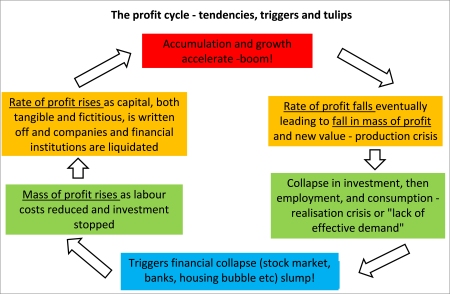
So I'm very much a work-in-progress at the moment, struggling hard to get an intuitive view of the dynamics of capitalist economies at all time scales (Michael Roberts's views on cycles are persuasive).

In the background Marx's own writings, Capital Vols 2, 3 and 4 are still on the stack.

Thursday, May 11, 2017

This ritualisation of Marxism is getting tiresome

Another day and the Labour leadership will be asked once again whether they "agree with Marx". They will reply - again! - that there is a lot to learn from Marx, but that he was wrong about some things.

And they will be right.

I have been reading: "Globalisation: A Systematic Marxian Account" by the excellent Tony Smith,

Amazon link

and I have read no other account of globalisation so sophisticated, profound or analytic (a detailed review here).

---

We all want some kind of roadmap, a clue as to where human civilisation is heading in the twenty first century. Smith reviews four contemporary theories:

  • Traditional social-democracy: capitalism plus a redistributive national state
  • Neoliberalism: emphasising the benign power of global markets
  • The "catalytic state": exemplified by the Chinese activist-state model
  • A putative 'democratic world-state' checking the power of global capital.


All these models assume global capitalism and seek to ameliorate its more perverse or dire effects, those currently creating the popular backlash against the dominant neoliberal ideology - so-called 'populism'.

Smith then cruelly eviscerates each of these models, giving a master-class elaboration of the Marxist approach to economics. It might help to have read Michael Heinrich's "An Introduction to the Three Volumes of Karl Marx's Capital" first.

Amazon link


Such criticism is fine: indeed, a breath of fresh air. Where Marxism fails is not so much in the analysis - who could deny that the 'structures' of society are, in any deep analysis, highly-sophisticated protocols of systematised (but malleable) human behaviour? - but in the remedy.

Describing capitalism for what it is should be ethically-neutral .. in the tradition of scientific analysis.No Marxist analysis has, for example, demonstrated that capitalism would collapse through its own inner nature through some terminal crisis.

But Marxists then add something new and extraneous: an ethical criticism.

They claim that capitalism is inherently unfair, oppressive and - dare I say it? - evil. In opposition, a communitarian solution is proposed (although the Marxist tradition was - and is - understandably sketchy on the details).

The model of future-communism is seldom subject to the level of rigorous criticism correctly bestowed on capitalism, but if it was, it would be understood to be an impossibility. It presupposes a biological human nature which does not exist.

---

There have been precisely zero attempts to integrate Marxism with current understanding of human (evolutionary) psychology, genetics or genomics. Attempts to do so are disavowed as if some category error is being proposed. Marxist blank-slatism reacts with horror to the idea that there could even be such a thing as human nature, detachable from specific and historic relations of production and exchange.

Such a lack of seriousness: the sure hallmarks of an ideology to be taken on faith.

If we learned one thing from Marx, let alone from the Stalinist experience, it's that lack of development of the productive forces is the root of all evil. Conversely, as capitalism increases those forces seemingly without limit, who can predict - yes, who? - as to how future-humanity may be able to organise itself?

In the meantime, let's just crack on and increase those productive forces, while ameliorating the consequences of their current inadequacy.*

---

* Yep, a lot of people think that. And then the arguments start 😟 ..


Thursday, September 01, 2016

Why Marxism refuses to die

Link to PDF

Michael Heinrich starts his book (above) with reasons we should still be interested in studying Marxism.
"“At the beginning of the 1990s, after the collapse of the Soviet Union, it seemed as though capitalism had ultimately and globally triumphed as an economic and social model to which there was no alternative.

“Although there had always been many on the left who did not see a desirable alternative to capitalism in Soviet “really existing socialism,” such distinctions no longer seemed important. To most people, a society beyond the capitalist market economy appeared only as an entirely unrealistic utopia. Instead of protest, accommodation and resignation reigned.

“But it was also - and in particular - the 1990s that showed that capitalism, even after its apparent “final victory,” continued to go hand in hand with processes of crisis and immiseration; and Kosovo, Afghanistan, and the first war in Iraq showed that wars in which the developed capitalist countries were not only indirectly, but indeed very directly involved, were by no means a thing of the past.

“All this was taken up in different forms by the new “counter-globalization” movement and other social movements and made the point of departure for critique. Initially, these critiques were focused on single issues and posed limited demands that remained within the framework of the system. Furthermore, the critiques often rested upon a simple black-and-white moralism.

“However, throughout the course of these conflicts, fundamental questions kept being asked: about contemporary capitalism’s mode of operation; about the connection between capitalism, the state, and war; and also about what kinds of changes are actually possible within capitalism. Leftist theory became important again.

“Every transformative practice assumes a particular understanding of that which exists. If, for example, we demand the introduction of a Tobin tax (that is, the taxation of currency transactions) as a crucial means for the “taming” of a capitalism “unleashed”, then this implies a certain theorization of the importance of financial markets, about tamed or untamed capitalism - whether or not these assumptions are made explicit.

“How contemporary capitalism functions is not an abstract, academic question.”
---

Let me continue the point with an analogy. The practitioners of feudalism conceptualised their society as three Great Estates: clergy (the First Estate), nobility (the Second Estate), and commoners (the Third Estate). A monarch, ruling by divine right, oversaw everything.

One might have observed in the interstices of society small-scale artisans employing a few people, usurers lending money, and merchants importing scarce luxuries. But these would not seem essential to the overarching 'structure' of society.

A feudal 'sociologist' might well assume the future to be like the past. The future king arbitrates between future groups of nobles; the church acts as power-broker and society's ideologist, while the commoners (peasants and artisans) work for a pittance and pay for it all. It's all sanctioned by God and how could it change - even in principle?

In actual history, the commoners lost their lands and became proletarians while the merchants, usurers and lower gentry transformed themselves into capitalists. Revolutions duly followed.

What was wrong with our feudal sociologist's theories? By being 'structuralist' they assumed the feudal order of things as axiomatic. But there are no structures, only people doing essential things in relation to each other in defined ways.

Marx talks about the forces and relations of production (and exchange).

---

Modern (bourgeois) sociologists similarly pre-suppose the forms of social organisation of capitalism. They're baked into the theories - economics being a case in point.

But if you're interested in whether capitalism is the last word on human social organisation, you can't do that. You have to step back and understand capitalism as just another form of human social behaviour. If people systematically behaved differently, capitalism would vanish like mist in the morning, as did 'communism' in the few short years following 1989.

That wouldn't happen, of course, unless there was a powerful, revolutionary fervour to do things differently: capitalism would have to fail the masses big time, and there would have to be a viable alternative to reorganise to.

For more than a century, Marxists have believed that capitalism contains in its mode of reproduction fatal and terminal contradictions, and that the socialist form of society - consciously planned by the masses - was a far superior, non-commodified mode of production.

But the empirical evidence for both these theses is hard to find. Marx may well have had the right kind of analysis (focus on human social relationships, not mythical 'structures') but was his specific analysis and vision correct?

Georg Lukács famously argued that a Marxist was someone who followed Marx's method, not someone who had to agree with all of Marx's historically-bounded results, hypotheses and suggestions.

I don't know if capitalism is 'the end of history', but I am sure it's a profound question for any human being thinking about how to make the future a better place.

Tuesday, August 30, 2016

Simple Reproduction in an Abstract Capitalist Society

Link to online PDF

Capitalism is characterised within the Marxist tradition as generalised commodity production; in Marx’s view, a correct understanding of the commodity encapsulates its fundamentals.

Key is the concept of labour power and surplus value. In the following extract from Michael Heinrich’s “An Introduction to the Three Volumes of Karl Marx’s Capital” (Chapter 5, The Capitalist Process of Production), the term ‘means of production’ relates to machinery and raw materials.
“With regard to the value of the newly produced commodities, the means of production and labour-power play completely different roles.

“The value of the means of production consumed in the creation of a commodity constitutes part of the value of the newly produced commodity. If means of production are completely used up in the process of production, then the value of these means of production is completely transferred to the newly produced mass of commodities.

“But if means of production such as tools or machines are not completely used up, then only a part of their value is transferred. If for example a particular machine has a life span of ten years, then one-tenth of its value is transferred to the mass of commodities produced within a year.  The portion of capital laid out in means of production will, under normal conditions, not change value during the production process, but a portion of its value will constitute a portion of the value of the commodities produced.

“Marx calls this portion of capital constant capital, or c for short.

“Things are different with labour-power. The value of labour-power is not all transferred to the commodities produced. The value newly generated by the “consumption” of labour-power, that is, by labour expenditure, is what is transferred to the value of the newly created commodities.
...
“How much value the worker adds to the product of labour does not depend upon the value of labour-power, but upon the extent to which the labour expended counts as value-creating, abstract labour. The difference between the newly added value and the value of labour-power is the surplus value, or s.

“Or to put it differently, the newly added value is equal to the sum of the value of labour-power and surplus value. Marx calls the portion of capital used to pay wages variable capital, or v for short. This portion of capital changes value during the production process; the workers are paid with v, but produce new value in the amount of v + s.

“The value of a mass of commodities produced within a specific period of time (a day or even a year) can therefore be expressed as:

c + v + s

Here c indicates the value of the constant capital consumed, that is, the value of the raw materials and the proportionate share of the value of tools and machines, insofar as they are used.

“The valorisation of capital results solely from its variable component. The level of valorisation can therefore be measured by relating the surplus value to the variable capital: Marx calls the quantity s/v the rate of surplus value. It is simultaneously also the measure of the exploitation of labour-power.

“The rate of surplus value is usually given as a percentage. For example, if s = 40 and v = 40, then one does not speak of a rate of surplus value of 1, but rather of a rate of surplus value of 100 percent. If s = 20 and v = 40, than the rate of surplus value amounts to 50 percent.”
---

An exercises in Marxist economics is to show how capitalism can reproduce itself. In the most basic case, we look at an idealised steady state situation, where capitalists appropriate surplus value and consume it without re-investment.

Expanded reproduction will be modelled in the next post.

The economy is divided into two departments: Department 1 is the sector which creates means of production (machines and/or raw materials); this department provides and reproduces the ‘c’ in commodity value.

Department 2 produces means of consumption:  food, shelter and all the other necessities for the survival and continuing existence of the workers and capitalists. It underpins the ‘v + s’ in commodity value.

For simple reproduction to occur, the following relation must hold*:

c2 = v1 + s1

This says that the value of the constant capital in Department 2 (means of consumption) must be equal to the variable + surplus value in Department 1.

All other levels of capital may be chosen freely to reflect the size of the economy, the amount of constant capital and labour-power employed and the degree of exploitation**. The economy will turn-over and reproduce itself provided the above relationship holds.

Here is an example spreadsheet, followed through 9 iterations. As you can see, it never changes and equivalent values (Exch) are exchanged between Department 1 and Department 2.


Link to spreadsheet

Department 1 has to buy means of consumption for its own workers and capitalists (v1 + s1) from Department 2 (it makes its own constant capital c1); Department 2 has to buy its constant capital c2 from Department 1, but can produce the necessaries of life for its own workers and capitalists (v2 + c2) itself.
Examine the first row of the spreadsheet above. Department 1 (creator of means of production) creates a value of 12 (in some units) in cycle one. This will purchase the next round of machines and raw materials in the second cycle: 3 units of value available for Department 1 and 9 for Department 2 (the creator of means of consumption).

Department 2 creates 22 units of value which supply workers and capitalists: 9 units required for Department 1 and 13 units for Department 2.

The column 'Exch' indicates the values exchanged between Departments 1 and 2. Department 1 'exports' a value of 9 to Department 2 to maintain/'depreciate' its machinery and raw materials; Department 2 'exports' a value of 9 also to keep the workers and capitalists in Department 1 in shape (5 + 4).

In a certain sense, Department 1 'exports' its surplus machine + raw material value while Department 2 'exports' its surplus necessaries of living value. The two have to match in the market place, where they share the common value of 9.

What counts is that the value created in Department 1 over and above what's needed to reproduce its own constant capital (c1 + v1 + s1 - c1 = v1 + s1) is exactly the same as the constant capital recurrently employed in Department 2 (c2). When that is the case, Department 1 finds a market for its output in Department 2 and can therefore afford to buy its necessaries of life from Department 2 (v1 + s1).

Department 2 will employ sufficient workers, at a cost of v2, to properly employ the means of production (of value c2).

The case for expanded reproduction exploits exactly the same procedure.
This proves that capitalist equilibrium (at least in this ever-so-simple model) is possible in principle; in reality capitalists make independent and non-centralised decisions so coordination cannot be as exact as in the spreadsheet. This will eventually lead us into a theory of crises.

Things get a little more complex and interesting when we consider expanded reproduction, the typical case of a capitalist economy in growth.

The subject of the next post: "Expanded Reproduction in an Abstract Capitalist Society".

---

* See 'Imperialism and the Accumulation of Capital, Bukharin 1925' for more details.

--

** 'Exploitation' is a pejorative word but should be here understood analytically. In any form of society which is economically growing, workers will receive less to spend than the value of their work-production. Otherwise, where is the infrastructure of civilisation to come from?

In the case of capitalism, that 'surplus value' is appropriated privately by the capitalist. In feudalism it was appropriated mainly by the aristocracy, and in slave societies it was directly, coercively owned by the slave's master.

In any society where humans work to society's benefit, there will be a social surplus product .. but it may not take the form of surplus value if labour is not commodified.

Who knows whether that will ever come about?

Monday, August 15, 2016

Paul Mason and PostCapitalism

There are just a few people whose public personas I have rather taken against.

Number one on my current list is Owen Smith. He, you may recall with difficulty, is the insincere and glib little weasel who resembles a mini-me version of François Hollande and who is attempting, for reasons of petty ambition, a doomed campaign to displace Jeremy Corbyn.

---

We move on. Whenever I saw Paul Mason on BBC's Newsnight or Channel 4 news, I observed my twitching hand reach unconsciously for the channel-flip, impelled by some combination of his northern lad with a chip on his shoulder schtick, his self-righteous anger at every policy trying to fix the economy combined with a fanboy gullibility as regards the modish antics of Occupy and every other middle-class angst-fest.

It was Kevin the Teenager reprised at fifty-something.

I understand the type only too well: too smart, idealistic and empathic to fit in with his working class contemporaries; too working class to be accepted into the well-born elite. His perpetual estrangement from power and influence fueling an inchoate rage channelled into left wing rebellion.

Paul Mason was a trotskyist in one of the more cerebral outfits, Workers Power, which has now dissolved/entered into the Corbynista mass to rebuild under the motif of Red Flag.

But Paul Mason noticed that none of the trotskyist predictions of proletarian revolution ever came good. Being of independent mind, he conceptualised an alternative road to communism; at least one reviewer bathetically called him 'the new Marx'.

Amazon link


His book is uneven: historical discussions of subsequent misinterpretations of Marx echo those of Michael Heinrich (blogged about here) who discussed 'worldview Marxism' as a coarsening of Marxist theory. Mason believes, I think correctly, that Lenin and Trotsky fundamentally misunderstood what really happened in Russia in 1917, documenting the reasons for that failure in convincing detail.

It's when he starts to advance his own ideas for post-capitalist transition that wishful thinking and blind hostility come to the fore. Owen Hatherley's review nails it.
"The organised factory proletariat in the US, Europe and Japan never carved out a path to post-capitalism – or socialism as it was then known – but Occupy, Maidan, Tahrir Square, and even the protests against the Workers’ Party government in Brazil, ‘are evidence that a new historical subject exists. It is not just the working class in a different guise; it is networked humanity.’

"The ‘new gravedigger’ produced by capitalism consists of ‘the networked individuals who have camped in the city squares, blockaded the fracking sites, performed punk rock on the roofs of Russian cathedrals, raised defiant cans of beer in the face of Islamism on the grass of Gezi Park’ etc. This is kitsch, but more significant is Mason’s failure to analyse the political content of the movements of the young.

"Not a lot of people in any of them considered ‘capitalism’ their main enemy, probably less so than the average striker in the 1930s or 1970s. They are a disparate bunch, from all manner of class backgrounds, advocating various positions across the political spectrum, but all united apparently by their use of Twitter and their distrust of ‘old elites’ and hierarchies.

"Since they carry no baggage, it isn’t worth investigating why, say, the protests in Brazil so easily passed over into racism, why some in Tahrir Square preferred a new general to an elected Islamist, why both sides in Ukraine’s unrest had a crucial far-right element, or why the descendants of Occupy in London and New York now find themselves campaigning for ageing, old-school leftist social democrats.

"Mason sweeps all this away on a tide of goofy utopianism."
Taking Wikipedia as your model for post-capitalist relations of production is to completely miss the intrinsically parasitic, hobbyist and career-furthering (let alone corporate) nature of so much open-source activity. It's never going to shake its shoulders and sweep aside all those mundane commoditised relations of production which coordinate activities to keep us fed, sheltered, defended, powered-up and online.

---

Mason would have been more acute had he observed that, while Marx gave a very good conceptual account of capitalism in terms of systematised and recurrent patterns of human economic and political activity (process rather than structural models, if you will), he had considerably less to say about why capitalism was either inherently bad news for humanity or precisely why it would necessarily create the conditions for its own supersession.

Due to the inadequate development of the productive forces it inherited, capitalism was truly awful for its human participants (disproportionately for the working class, of course) in Marx's time and as recently as the second world war - but since then it has, by historical standards, not been so bad. Ask the Chinese or the Vietnamese.

And don't blame capitalism for Africa or the Middle-East.

Capitalism still seems pretty efficient at developing the forces of production as Mason, a fan of automation, is happy to concede. So what's going to light the fires of mass revolutionary zeal? Apparently nothing - so we're left with incremental socialism-creep within the interstices of capitalism,

Good luck with that.

Good try, Paul, but we need look elsewhere for possible paths to humanity's future.