Showing posts with label macroeconomics. Show all posts

Wednesday, November 20, 2024

Cheer up! Better times are on the way


From Amazon

Introduction

The theory of long cycles - first identified by Nikolai Kondratiev and later refined by Joseph Schumpeter - proposes that capitalist economies undergo long waves of growth and renewal, spanning 40-60 years. 

These cycles are kicked off by periods of innovation, followed by economic expansion - but eventually stagnation and decline set in, as existing technologies mature and productivity gains dwindle.

The first Kondratiev wave, the Industrial Revolution (circa 1780–1830), introduced mechanised production in textiles, iron, and water power, catalysing industrial growth and urbanisation.

The Age of Steam and Railways (1830–1880) followed, marked by steam power and extensive rail networks, creating national markets and driving economic expansion.

The third wave, the Age of Steel, Electricity, and Heavy Engineering (1880–1930), brought advancements in steel, electricity, chemicals, and the internal combustion engine, fostering new industries like automotive and chemical manufacturing.

The Age of Oil, Automobiles, and Mass Production (1930–1970) then transformed society through petroleum-fueled growth, automobiles, and consumer-oriented mass production, ushering in widespread prosperity post-WWII.

Finally, the Information and Digital Age (1970–present) has redefined economies with computing, the internet, and digital communication, creating an interconnected, information-driven world.

Now, we are entering a sixth wave led by AI, biotech, robotics, and green energy.

Our current period of economic slowdown is, therefore, not an anomaly. We are living through the tail end of the fifth long wave, which began with the information and digital revolution of the 1970s and 1980s. Its initial explosive productivity has long gone, leaving us mired in the ensuing "Long Stagnation".

But that is about to change.

The Cycle of Disruption and Rebirth

Long cycles do not begin smoothly; they are born out of upheaval. 

Schumpeter referred to this as “creative destruction” - a period when old industries, ways of working, and social structures are uprooted to make way for new, more efficient ones. Historically, each new wave brings disruption that manifests as political resistance, temporary labour displacement, social restructuring, and financial volatility.

These challenges are not unique to the coming cycle; they were seen in all the major economic transformations. Steam power in the 19th century led to the mechanisation of labour and the rise of cities. More recently the spread of electricity and assembly lines in the early 20th century saw society adapt to large-scale industrialization - eventually bringing prosperity to unprecedented numbers of people.

Emerging Technologies Drive Growth

Technological advancements in AI, robotics, biotech, and sustainable energy are not merely incremental improvements - they represent transformative shifts:

  • Artificial Intelligence will drive efficiency gains in manufacturing, logistics, healthcare, and finance.
  • Biotechnology will transform personalised medicine, gene editing, and sustainable agriculture.
  • Robotics and Automation will enhance pretty much every industry it touches.
  • Sustainable Energy Technology, (renewables and energy storage) decouples growth from environmental degradation, improving the quality of life.

The Timeline for Prosperity

The initial, disruptive phase of this new cycle will advance to prosperity in roughly a decade as these technologies mature and integrate into the economy, creating dramatic efficiencies and driving growth.

During the early 2030s, expect accelerated adoption as infrastructure, expertise, and regulatory frameworks catch up.

This will culminate in a long period of stable growth in the 2040s, comparable to the post-WWII economic boom.

The Dawn of a New Cycle

The Long Stagnation has seen political volatility as cohorts of university educated young people have failed to achieve the futures their education appeared to promise them. Meanwhile, for most people, personal incomes have not advanced in decades, and the future looks bleak. No wonder they're cynical and angry.

Politically, the veto networks of established interests have conspired to block off hopes of change. Yet these new economic forces will not be forestalled. Through political turmoil new leaders and parties are unjamming the process.

How ironic if the self-styled Progressives are now the reactionary ones, wedded as they are to their static and lifeless equilibrium models which serve only to justify their privileges. Meanwhile the so-called Conservatives, riding the waves of change, are the real revolutionaries, the motors of progress going forward!

Friday, September 01, 2017

Corbyn's economist: Steve Keen

In the days before sat-navs, you could find yourself driving around the English countryside trying to find your destination: a village, say, like Royston Vasey.  Signposts would contain the name and direct you down endless byways, but somehow you never got any closer. You may have had similar experiences in seaside towns with signs to public toilets.

My job as a self-employed telecoms network architect required a passing familiarity with microeconomics (traffic modelling, business cases). Sometimes I would delve into macro, my interest being in crises, recessions and the preconditions for a new wave of expansion. People only build big public networks in a time of exuberant growth.

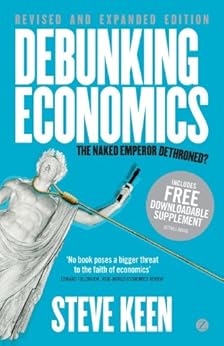
Like Royston Vasey, the search proved elusive. Thanks to Steve Keen, I now know that orthodox macroeconomics simply assumes that crises cannot occur. Those that happen nevertheless cannot be structural, but are due to policy errors or 'outside shocks'.

Keen identifies the bizarre foundations of contemporary macroeconomic models as used by businesses, governments and international agencies: the modelling of all consumers as equivalent atomised individuals (no finance and industrial capitalists, no organised workers); the abstraction away of money, debt and the entire financial sector. A continual return to equilibrium is built in.

Taking these things into account, however, leads to very different models which show strong (and empirically-validated) correlations between excessive private debt and crashes; the economy exhibits chaotic rather than equilibrium-seeking behaviour, something like the weather.

This is all explained rather concisely in his latest book which I've now completed.

Amazon link

I was rather impressed: his arguments seemed plausible and well-corroborated. In the UK he sees an unregulated finance sector (think Margaret Thatcher's 'Big Bang' reforms) as having opened the floodgates of private debt (he has supporting data) and thinks that the chronic UK Government deficit is really a symptom of the long post-crash malaise rather than the prior cause of it.

Reading his Wikipedia bio, I was only slightly surprised to read this:
"In August 2015, Keen endorsed Jeremy Corbyn's campaign in the Labour Party leadership election."
Amazon link

I'll be checking out his main book (above) in the near future. Here's Steve Keen on the BBC's HardTalk.


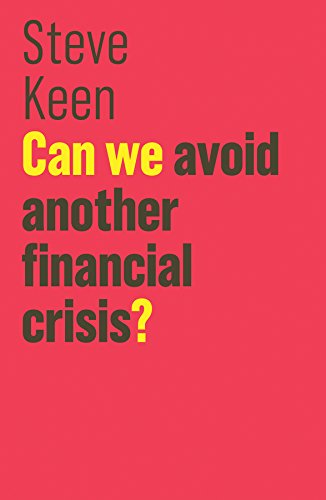
The interviewer is pretty aggressive and it helps to have read Keen's "Can We Avoid Another Financial Crisis? (The Future of Capitalism)" to understand the logic of his responses.

Monday, March 21, 2016

Brexit: surviving the car-crash

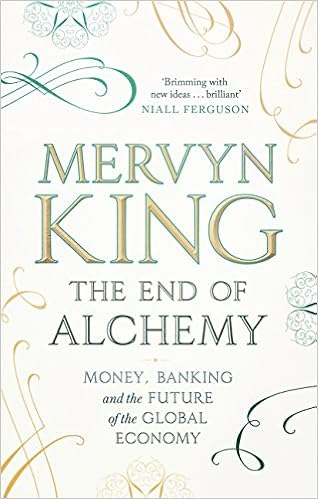
I'm reading Mervyn King's excellent "The End of Alchemy: Money, Banking and the Future of the Global Economy".


Newspaper reviews have been mixed: some commentators clearly wanted the inside story of the crash of 2008. Instead, the former governor of the Bank of England has provided a thoughtful critique of contemporary macroeconomic thinking, both Keynesian and neoclassical.

He gives short shrift to behavioural economics, choosing instead to focus on what he calls radical uncertainty, the unknown unknowns which regularly jeopardise the assumptions built into macroeconomic models. And subvert the policies of politicians.

Here is what he has to say about the prospects for the Euro, the Eurozone and the EU as a whole at the end of chapter 6.
"But in the euro area the fight for survival has become a battle between politicians and arithmetic. Although the future outcome is unknowable, history is on the side of arithmetic. The tragedy of monetary union in Europe is not that it might collapse but that, given the degree of political commitment among the leaders of Europe, it might continue, bringing economic stagnation to the largest currency bloc in the world and holding back recovery of the wider world economy.

"It is at the heart of the disequilibrium in the world today. The French ambition to curtail the economic power of Germany, and especially its central bank the Bundesbank, by drawing it into a monetary union that would be controlled by French civil servants has failed. The French economy is weaker than that of Germany, and monetary union has increased, not reduced, Germany's political dominance.

"Responsibility for the economic conditions in other member states will be laid at the door of Germany. The idea of a federal union was intended to represent the birth of a new Europe, born out of the common experience of defeat and occupation during the Second World War among all the original members of the European Economic Community.

"Attempts to recreate the Holy Roman Empire have often appealed to a European elite, but have foundered on the resistance of its peoples."
In the previous Brexit post I highlighted suggestions that if the European Union survives in any sense it will be led - dominated - by Germany. All other member states, by definition, will then be subordinate. Any path leading to a stable political pecking order in a future EU will be long and complex, and measured in decades, but that's the destination. If it exists at all.

But it seems unlikely that the EU in anything like its current geometry can survive over a period measured in decades. As Mervyn King points out in other chapters of his book, the Greek debt crisis has not gone away and the inevitable Greek default will be hugely unpopular in Germany. And Germany has lent massively to the rest of 'Club Med' in what might be considered belated war reparations.

Historical institutions tend to last longer than anyone thinks possible, and then to collapse faster.

There is a conceivable strategy for the UK in being close to the Northern European axis in the EU, and facilitating the transition to something more sustainable after the EU car crash. But that would demand a political culture in the UK which is communautaire. Such a culture does not exist. The British transactional paradigm for dealing with its EU partners will be worse than useless as the car crash unfolds.

The coming referendum is not the only occasion when the UK's existential relationship with the EU will be confronted - how could a foundational EU crisis not pose it again? - but proponents for staying in should be indicating what tactical advantages the UK gains given the extraordinarily dire outlook in the longer term.

If the UK (England?) decides to abandon ship, or is ejected at some point by a form of constructive dismissal, then it will operate as I imagine Japan will end up in a couple of decades, navigating between powers (the German-dominated EU, America, China) which are so much more powerful than itself.
___

One of the dilemmas facing even the most well-informed voter in the forthcoming referendum is that even when the issue is framed in this way, it's by no means obvious what the optimal answer is. We also have to consider that different sectional groups in the UK (employees of financial institutions and multinationals, the self-employed, trades unionists, blue-collar workers, welfare recipients, the Scots) will have variant interests perhaps best served by voting in different ways.

According to the oddschecker website today, the probability of a 'stay' vote is 69% and of a 'leave' vote is 31%.