Showing posts with label Capital. Show all posts

Wednesday, October 03, 2018

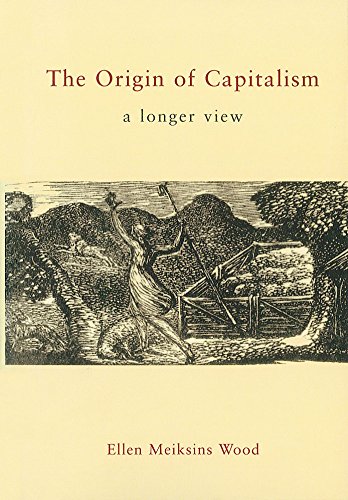
Capitalism is hard to get started

Amazon link

In contemporary thought capitalism, at least in embryo, has always been with us. People have always traded, merchants have always profited and the market has always existed. By some magic England initiated an industrial revolution in the 18th century and thereafter (after a lengthy brutish period) liberal civilisation finally swept the globe - provided the forces of reactionary-populism can be kept at bay.

Such an ideological narrative obscures everything about true causation and real historical dynamics. Ellen Wood's book (above) essentially builds on Marx's arguments in Capital Volume 1, specifically Part 8, Primitive Accumulation, to outline the actual genesis of capitalism.

Classic feudalism exhibited what she terms parcelized sovereignty. A hierarchy of lords and nobles culminated in the monarch. This edifice was supported by explicit expropriation of the social surplus product of the peasantry, forced to work the nobles' land or pay rents in kind or money.

Feudalism of this type is not particularly stable. Power and wealth depend upon the possession of worked estates. It's a zero-sum game in which successful aggression - lord against lord, lord against monarch and monarch against monarch - is well-rewarded.

One route out of this is for the central power to win bringing about the absolutist state (purest example: the French state of Louis 16th who was deposed in the 1789 revolution). The French bourgeois revolutionaries were not capitalists (Wood insists on this distinction); they were urban professionals who used state office as the source of their wealth.

The pre-capitalist absolutist state might have been an end-point for the feudal polity, but it locked feudal relations of production into place - it did not organically produce capitalism.

England took a different route. The state was centralised early, yet was somewhat decoupled from the absolute power of the monarchy. Much of English history can be understood as a conflict between the leading nobles and the monarch for control of the state apparatus, including the means of taxation and repression, through the institutions of parliament.

The early centralisation of the UK market, the centralised, uniform state and the lack of a requirement for local lords to use their own military muscle on their peasants produced a tendency to demand rents in money rather than in kind or by corvée. This led to the phenomenon of agrarian capitalism: large farms (larger than could be cultivated by a family household plus a few hired hands) which relied upon landless workers as paid labourers. The farmer-tenants paid a monetary rent to their aristocratic/noble landlords.

Capitalist tenant-farmers could be turfed off their leases and the rent raised for more productive incomers. This gave the farmers an interest in increasing productivity - such a motive is unknown under the feudal-confiscatory mode of production. Landowners invested in surveying services precisely to ascertain optimal rents.

Where did the capitalist farmers come from? I think they were the most successful yeomen in the first instance, the kulaks of England. Certainly not part of the gentry, as Jane Austen would be the first to point out. This transition occurred in the 16th and 17th centuries primarily (see the Wikipedia article). Enclosures and the move to sheep farming (peaking in the late 18th/early 19th centuries) drove depopulation of the countryside and the mass separation of small-scale peasants from their means of livelihood. Facing starvation, these would flock to the towns where they became the first proletariat.

The first capitalists were those guild-masters who were able to thrown off the egalitarian shackles of guild law and increase the size of their enterprises, hiring tens and hundreds of newly-arrived workers. They were joined by usurers and merchants, looking for new opportunities to increase capital. Through this process, England produced dominant classes of landless workers and capitalists, quite separate from the feudal three estates of the church,  the land-owning aristocracy, and the bourgeoisie and peasantry.

Once capitalism had gained traction, it was both self-sustaining and expansive. In its formative period the workers had no choice but to work hard or die; the capitalists, if defeated by the competition, would be bankrupted and pauperised. Even today, redundancy and bankruptcy are bad news.

Capitalism, unlike every other mode of production, is experienced as a never-ending compulsive treadmill, forced to ceaselessly develop the productive forces.

---

Wood argues that this capitalist lift-off happened just once in history, in England, due to the unique set of circumstances outlined above. She then proposes that under the impact of England's consequent economic and military success, the European absolutist states were forced to introduce their own capitalisms - essentially top-down - as 'modernising' reforms under the threat of obliteration.

I think you could make a similar case for the dynamic of Stalinist Russia .. and for China today.

---

Could the Roman Empire have introduced capitalism? Not an easy question to answer. You have to identify the seeds of both capitalist and proletarian classes and then show how such seeds would have grown rather than being extinguished by stronger and inimical social forces.

Obviously in the actual histories of the great agrarian empires there is not the slightest evidence of incipient capitalist tendencies. The Roman elite's wealth derived from unutterably vast landed estates, mostly worked by slaves. Slavery required a ubiquitous military presence to enforce it. This did not encourage agrarian capitalism, the seed corn for the capitalist transition.

When agrarian/slave empires broke up, they transitioned to feudal structures, not capitalist ones. I suspect that the Roman Empire never had the option for a capitalist future in its structure and dynamics.

---

Incidentally, I was not that impressed by Ellen Wood's book, although the topic she writes about is important and sorely neglected. Her writing is unengaging and repetitive. The book is heavily padded and would have worked better as a long essay.

She spends the first half of the work criticising at length other Marxist authors who, she correctly notes, assume what they are trying to prove, seeing the genesis of capitalism as inherent in trading or petty commodity production (all phenomena of many historical periods, geographies and modes of production which in general never led to capitalism).

Her analysis of the transition to capitalism itself  is largely derivative from Marx (Capital Volume 1 Part 8, et al) and other works on agrarian capitalism (there is an extensive literature).

Finally, she finishes with the usual platitudes about the superiority of a never-explained socialism over capitalism and parochially finds evidence for capitalism's deep flaws in mad-cow disease of all things! So a clever writer but derivative, not too creative, someone who doesn't rise above genre cliche.

---

More posts on Marxist theory.

Thursday, November 16, 2017

Q. "How do I get into Marxism?"

Marx is newly fashionable again, but it's a daunting task to take on the four volumes of Capital. And in most fields you don't retrace the founder's tortuous strugglings. In physics, students don't read Newton's or Einstein's original works: they read textbooks.

Marx wrote about what he knew, which was the inner dynamics of capitalism as a mode of production. A good start is "Understanding Capital" by Duncan K. Foley (search "understanding capital foley pdf").

Amazon link


Foley concentrates on the economics, is very clear and writes in a modern paradigm cross-referencing contemporary ideas in economics. The book is thematically-organised across Marx's economic work and is short (170 pages).

Amazon link

As a complement, there's Michael Heinrich's "An Introduction to the Three Volumes of Karl Marx's Capital" - this link is to the online PDF or search "marx capital heinrich pdf". It's similarly short (224 pages), well-written and conceptually clear. Heinrich is more focused on the actual contents of each volume. He also writes about topics Marx intended to address but never got around to, including the theory of crises, the state and communism itself.

Marx wrote very little about post-capitalist social organisation. Without data this would have been no more than speculation. It was down to Lenin, Trotsky, Stalin, Mao and many others to theorise later developments - in ways I would argue were profoundly mistaken.

Monday, October 30, 2017

Marx: "Right about capitalism, wrong about socialism"

I've been engaged in an exploration of the Marxian analysis of capitalism as a mode of production, how any successor society might emerge and what it might be like. I've read the first two volumes of Capital (bulky, circuitous and sprawling though they are) and also two excellent introductions from Michael Heinrich and Duncan Foley.

Amazon link .. and PDF

Amazon link .. and PDF

I feel quite sufficiently educated. I also concur with the Russian epigram quoted above: Marx was right about capitalism, but wrong about socialism.

But .. before we get too judgemental .. it's worth bearing in mind that Marx said very little about socialism. As Duncan Foley observes in his "Socialist alternatives to capitalism I: Marx to Hayek",
"In general Marx responded to questions about his views on the organization of socialist society by saying that these questions could be solved only by those who actually confronted them historically, that is, presumably, by the revolutionary movements that would establish socialist institutions. This is a prudent and in some ways sensible stance, but frustrating to a posterity that has made notably little progress on these problems."
Foley continues:
"Really existing socialism

"History, of course, was not waiting for political economy to sort out the issue of socialism. The early decades of the twentieth century also saw the emergence of a Soviet Union dedicated, rhetorically at least, to the building of a socialist economy, out of the wreckage of the Russian Empire.

The Bolsheviks confronted two practical political economic problems in the 1920s. Perhaps the lesser was the organization of day-to-day production and distribution. The greater was what later came to be called the problem of “development”: how to transform the backward, largely traditional agricultural economy of the sprawling Russian empire into a viable industrialized power.

The second task was all the more pressing because the denouement of the First World War on the Eastern Front had revealed the military and political vulnerability of a backward Russian economy in a world increasingly populated by industrialized capitalist powers.

The Soviets, whose leadership contained some remarkably talented and thoughtful figures, such as Nikolai Bukharin, arrived at a practical solution to the problem of organization of day-to-day production fairly soon after consolidating political power through prevailing in the Civil War with the Whites. This took the form of the “New Economic Policy” (NEP), which allowed, and indeed encouraged, capitalist commodity production in many sectors of the economy, including food production.

The NEP structurally created a “mixed” economy in which a large private sector co-existed with state-sponsored industrial enterprises. (The NEP is recognizably a precursor of Deng Xiaoping’s “socialist market economy” which was the framework for Chinese economic growth in recent years.)

The NEP worked well to stabilize the Soviet economy after the Civil War; under this regime output and incomes recovered significantly from the low levels of the Civil War period. Many Bolsheviks, including Lenin, were willing to accept the NEP framework as an indefinitely prolonged phase of building socialism, as long as the state held the “commanding heights” of the economy through control of energy, transportation, heavy industry, and finance.

Two connected and predictable developments undermined the NEP. First, as we would expect, the privatized commodity-producing sector of the economy exemplified some fundamental laws in generating large disparities in income and wealth. The appearance of a wealthy proto-bourgeoisie in the midst of a society governed by a one-party dictatorship committed to socialist goals threatened the narrow political base of Bolshevik power.

Second, the NEP was structurally favorable to the agricultural sector, particularly to the market-oriented strata of the peasants. The NEP thus resulted in a relatively “balanced” path of economic growth between industry and agriculture. Not surprisingly the prices of food and other agricultural products tended to rise relative to industrially produced goods, limiting the degree to which surplus production in agriculture could be mobilized for rapid industrial investment.

Despite Bukharin’s determination to “ride to socialism behind the peasant’s nag”, NEP policies proved explosively unstable politically, and collapsed under efforts to mobilize agricultural surpluses by military force which ultimately led to collectivization, central planning, and the bloody political purges of the nineteen-thirties.

Stalin rather than Bukharin balanced at the top of the “greasy pole” of Communist Party politics apparently more by ruthless and opportunistic manipulation of coalition politics than through consolidating a stable political base of power.

Just how the Soviet economy did operate in the 1930s, and in particular what was the practical mixture of bottom-up and top-down dynamics in this period remains obscure. A relatively small central planning bureaucracy had in theory enormous economic power to implement a policy of extremely rapid industrialization centered on the expansion of heavy industry. It seems unlikely that the fairly coarse-grained plans produced could be the whole story of Soviet economic life under this regime.

The management of new industrial armies recruited to new urban centers involved a great deal of decentralized local improvisation and experimentation. Since the centralized planning bureaucracy did not actually control many resources itself, local managers facing shortages of inputs and surpluses of outputs improvised informal market-like arrangements with each other. Despite the wishful thinking of market-fundamentalists, capitalist economies in periods of extremely rapid industrialization have often strayed significantly from the orthodoxies of profit-maximization given market prices, making it difficult to draw hard analytical lines by which to characterize the Soviet experiment.

While the Soviets were engaged in their furious (if in the very long run curiously futile) attempt to change the world, western European philosophers continued to interpret it. ... "
In his follow-up paper, "Socialist alternatives to capitalism II: Vienna to Santa Fe", Foley contemplates the great complexity of the global capitalist economy and speculates how any subsequent mode of production could do better as regards the difficult issues of economic information retrieval, resource allocation and optimality of outcomes. He contrasts top-down and bottom-up approaches:
"The last half of the twentieth century saw an upsurge in interest in bottom-up self-organized systems, such as ant-hills and bees’ nests, bird flocks, computer networks, unsupervised learning algorithms such as neural nets, the capitalist economy, possibly the human brain and a host of other similar examples.

Several features of these bottom-up systems draw the attention of systems thinkers. For one thing, compared to top-down optimal control systems, bottom-up self-organized systems tend to be more “resilient” or “robust”. Self organized systems often (though not invariably) continue to function (possibly in a degraded mode) despite the disruption or even destruction of important subsystems, and in important cases can recover from such damage spontaneously.

Top-down systems can be built with considerably “redundancy”, but tend to be more vulnerable to disruption of key elements, particularly the feedbacks that implement their optimal control properties.

Another intriguing property of bottom-up self-organized systems is that although they are not designed to achieve optimal performance, they often do perform surprisingly well. Ant-hills, for example, are remarkably efficient in locating and exploiting food sources. Bottom-up self-organized systems also exhibit a high degree of adaptability to new situations. Optimal control systems tend to be optimized for some particular context in which they are designed to operate. Self-organized systems can adapt to a wide range of environmental changes (though there are typically limits to the magnitude of shocks any such system can survive).

Capitalism itself is a good example of all these features of spontaneously organized bottom-up systems: historically capitalist institutions tend to reproduce themselves even after the destruction wrought by wars, revolutions and financial meltdowns; capitalist allocation of resources approximates efficiency to some degree; and capitalism has proven to be highly adaptable in the face of massive environmental changes (many of which, such as world population growth and technical innovations, arise from the dynamics of capital accumulation itself).

The vision of the economy as a complex system gives rise to a “bottom-up” understanding of how commodity production is organized, a la Hayek. It also suggests a parallel bottom-up vision of socialism as arising from the spontaneous organization of production through some framework of institutions different from private appropriation and exchange of products.

This bottom-up vision of social organization resonates with important political currents of the late twentieth century. The “New Left” movements of the nineteen-sixties rebelled against the centralizing and regimenting tendencies of “Old Left” socialism and communism by calling for decentralization, participation, and the political primacy of individual freedom and expression.

The Left, such as it is in the contemporary world of globalized capitalism, is much more attracted to the vision of spontaneous political expression than to the unpleasant chore of organizing political institutions.

This enthusiasm for spontaneity without central coordination or direction has attached different parts of the Left to various economic experiments, plans, philosophies, and models. Some of these, such as micro-credit institutions, amount to very minor modifications of the capitalist commodity system (or could indeed be regarded as systematic extensions of the logic of the commodity system).

One idea which flowers perennially on the Left as an alternative to capitalism is workers’ control. ..."
Foley then looks in detail at the historical experience with workers' control, particularly in the former Yugoslavia, and comes to some very pessimistic conclusions.
"When worker-controlled enterprises become very successful, the resulting hierarchy of workers begins to resemble that of capitalist firms. When the contradictions between the juridical form of organization of the enterprise and the substantive claims of different strata of workers to the surplus revenues become acute, it is common for worker-controlled enterprises to privatize themselves spontaneously, converting into traditional capitalist firms.

A second point is that despite the demonstrated capability of worker-controlled firms to compete successfully with capitalist firms under particular circumstances, there has been no tendency for worker controlled enterprises to grow spontaneously to crowd out capitalist firms in any economy: workers’ control remains a relatively small sector even in societies where tradition and practice favor this form of productive organization."
So no easy answers then. However, Foley's essay would not be complete without at least an attempt to provide an existence proof that a mode of production transcending capitalism is at least possible (- all emphasis in the extract below has been added).
"To bring this talk to an end, I will indulge in the luxury of fantasizing about some alternatives to capitalist-commodity production.

There are some ground rules for this exercise. This is speculation about changing what Marx calls social relations of production. In thinking about alternatives in this (very broad) range of issues I am not required to consider every social problem (foreign policy, religion, education, political institutions, mental illness, drug abuse, culture).

In general, the basic supposition is that life goes on as usual. People get up, go to work or school, form families, reproduce, age, consume, and so forth. There are natural disasters and domestic and foreign conflicts, regional divisions, and the like. But it is not fair for me to wish away critical aspects of the problem of organizing a complex division of labor to sustain the type of technologically sophisticated society post-industrial capitalism has created, with relatively high levels of consumption and economic security.

For example, it would not be very interesting for me to posit a system of universal abundance of use-values created by some imaginary robot workforce, and then to spin a vision of the resulting glittering possibilities for human social life.

It would also not be of much interest for me to ignore the problem of a “transition” by assuming a complete self-contained and self-reproducing alternative system. A socialist fantasy alternative has to include the notion of a “mixed” economy, in which commodity-capitalist social relations continue to prevail in some sectors, or regions. The socialist sector of the economy has to include methods for dealing with a capitalist-commodity other.

Furthermore, I am most interested in ideas that would allow a socialist alternative to co-exist with (and in a larger sense compete with) capitalist-commodity social relations indefinitely. Thus it is not fair for me to assume some “revolutionary” transformation of the whole society (even with the dystopian backdrop of a looming or ongoing ecological crisis) to resolve basic problems of social relations.

It is equally uninteresting for me, however, to ignore the deep hostility of bourgeois ideology to radical alternatives to capitalist-commodity production. I am interested primarily in how ordinary, regular suburban/urban people who by and large have jobs, incomes, and more or less stable lives through the capitalist-commodity system might transform their social relations of production.

It is not going to be hard to criticize the particular fantasy I put forward. The main function of such exercises is to induce dialectic thinking by making concrete assumptions that can be knocked down.

On the other hand, it is not in the spirit of this kind of exercise to invoke “human nature” in one or another of its many incarnations as an objection; or to wish away through assertion the fact that capitalist-commodity production has many parallel unresolved contradictions.

It is not reasonable to insist, for example, that opportunistic behavior would be any less mixed with social and other-regarding behavior in a socialist fantasy than it is in capitalist commodity reality. In fact, it seems reasonable to suppose that a change in social relations could re-balance human behavior towards others at least at the margin.

It also seems reasonable to suppose that people are grown-up enough and aware enough of the facts of economic life to understand that at an aggregate level consumption depends on production, and that they are willing to accept social responsibility to work productively as a condition of consuming."
Don't hold your breath: gaming the system is rather pervasive in human affairs.
"Lifenet 

"So let us imagine an alternative set of social relations, which I will call “Lifenet” which can organize social production to meet at least some part of the spectrum of human needs outside capitalist-commodity institutions.

Lifenet production is organized through peer-production enterprises. People start or join existing peer-production initiatives without any direct material compensation. The output of these enterprises is made available freely to participants in the system through a Lifenet distribution system, just as open-source software is published freely through open source licenses.

One key point here is that users or consumers of Lifenet outputs agree not to re-sell them as commodities for money. The aim is to create an alternative system of production and distribution that can be effectively separated from capitalist-commodity production.

Participants in Lifenet enterprises have a Lifenet account maintained in a central Lifenet database. The Lifenet account records individual contributions to Lifenet enterprises, and also individual withdrawals of Lifenet products. Thus an individual who participated in a food production enterprise would have that participation recorded in her Lifenet account; if she received food or clothing or software from Lifenet distribution centers (perhaps something like food coops or farmers’ markets today) these withdrawals would also be recorded in the Lifenet account. (One can imagine something like a credit card system to maintain these accounts automatically.)

The purpose of the Lifenet account would not be to enforce an exact balance between individual contributions to the production system on the one hand and withdrawals through the distribution system on the other. It would, however, allow the system to monitor the balance of production and distribution as a whole, and to identify and discourage or prevent possible abusive over-drawing on distribution. (If some level of the individual accounts were publicly accessible, peer pressure could play a major role in this respect.)

The premise of the accounts is that Lifenet as a whole is solvent, and has products available for distribution. A Lifenet system is going to work only if the individuals participating and the system itself develop an ethos of thrift, prudence, and waste-aversion. Lifenet must prudently keep large reserves of products to secure its ability to respond to contingencies (natural disasters, local breakdowns of the system) flexibly and reliably. The participants in the system must use its resources sparingly and thriftily, both as producers and consumers. The idea of “enough” has to pervade the system from top to bottom.
He goes on but you can see (as in David Schweickart's account of a possible model for socialism which I wrote about), this is already sinking under its own implausibilities.

It is worth emphasising what derails all these models of socialism: the conflict between the interests of the larger economy vs. the interests of groups comprised of families and friends.

'Communist man' does not exist and  - short of substantial genomic engineering - never will: we are not ants. When this factory has to close and the workers relocate, or that sacrifice has to be made 'for the common good', then under capitalism - in the final analysis - coercion is applied.

Conflicts are intrinsic and unavoidable. Contemporary Marxist intellectuals always leave the room at this point, wringing their hands; the Bolsheviks were never so mealy-mouthed.

So if Professor Foley, a very smart economist, can do no better than this after a lifetime of study, I am more than ever convinced that capitalism will be superseded only when it has created sufficient cognitive-robotic automation to essentially displace the proletariat from production .. and thus end any further possibilities of capital accumulation.

Thursday, October 26, 2017

Three links for Thursday

This is a typically lengthy and insightful essay from Scott Alexander posted three years ago:
I CAN TOLERATE ANYTHING EXCEPT THE OUTGROUP.
Somehow it reads as if from yesterday. Scott writes about the American incarnation of his Red/Blue/Gray tribes - but of course they're universal.

---

As a Gray Tribe member, I score utilitarian rather than compassionate. My BS detectors are thus powered up when I read another liberal, hand-wringing diatribe against torture ("It doesn't work!").

Bruce Schneier is paid-up Blue Tribe and uncritically recommends this lengthy article:
"The scientists persuading terrorists to spill their secrets"
which is actually unfailingly fascinating.

But it's The Guardian: the underlying liberal agenda sets up a false interrogation dichotomy: ham-handed brutality vs. sophisticated, empathic 'rapport'. No contest as to which wins there.

The article is forced to concede that it does take two to do rapport:
"Irish paramilitaries were trained to focus their gaze on a spot on the wall and remain utterly silent. Some suspects give only monosyllabic answers, or stick to scripted responses, or simply turn their chair around, presenting the interviewer with the back of their head."
If you're prepared to (competently) torture it can presumably work. Thankfully most bad guys are not sufficiently well-trained or hardcore to resist the highly-effective social-engineering described in the article. There are very good utilitarian reasons not to legitimise torture, whether it works or not.

---

I'm reading Duncan Foley's excellent primer on Capital.

PDF link

Foley is a clear and creative thinker who is prepared to bring some simple mathematics to the table. He's interested in presenting the conceptual apparatus of Marxism in an orderly manner rather than simply providing a slimmed-down exegesis of the books themselves. His approach is very much rooted in applying Marxism to the present day economy, which informs both his appraisal and his examples.

He reconstructs in mathematical form the circulation of capital and Marx's simple and expanded reproduction equations before moving on to the 'transformation problem', crisis theories and Marx's concept of socialism. Here's the table of contents:
Contents

1 On Reading Marx: Method                            1
2 The Commodity: Labor, Value, Money        12
3 The Theory of Capital and Surplus Value    31
4 Production under Capitalism                        49
5 The Reproduction of Capital                         62
6 The Equalization of the Rate of Profit           91
7 The Division of Surplus Value                     105
8 The Falling Rate of Profit                            125
9 The Theory of Capitalist Crisis                    141
10 Socialism                                                   158
Suggested Readings                                      173
References                                                     177
Index                                                              181
In addition as you can see, this introductory book is quite short.

Wednesday, October 18, 2017

Why are cows sacred in the Hindu tradition?


From Marx's Capital, Volume 2, Chapter 12 (1885), (quoting observers).
"While the peasant farmer starves, his cattle thrive. Repeated showers had fallen in the country, and the forage was abundant. The Hindoo peasant will perish by hunger beside a fat bullock.

"The prescriptions of superstition, which appear cruel to the individual, are conservative for the community; and the preservation of the labouring cattle secures the power of cultivation, and the sources of future life and wealth.

"It may sound harsh and sad to say so, but in India it is more easy to replace a man than an ox." ...

"Desertion of life, without reward, for the sake of preserving a priest or a cow . . . may cause the beatitude of those base-born tribes."
One could almost suspect a conscious decision by high-caste Brahmans to create a religious rite protective of cattle, the foundation of an agrarian economy which found them at the apex.

I don't know to what extent these conditions of existence still apply, 130 years later, in rural India. Increasingly, however, the concept of the sacred cow will devolve into a natural experiment in cultural inertia.

Now what's the story on the pig?

Tuesday, October 03, 2017

Diary: Capital Vol 2 and other stories

Up bright and early this morning. A ten past eight appointment with the dentist to have my new crown fitted. Except that it didn't fit. Apparently this happens one time out of five or six.

The tooth-stub was re-impressed (uncomfortable-to-the-cheek process with a mould) and I have to return in a couple of weeks for the next attempt to fit it.

---

I am working through Capital Vol 2 (£2.99 on Kindle .. slightly easier to read than the free PDF) and what a trial the first four chapters are.

Things they don't tell you. Volume 2 was never written as a book by Marx, instead it was assembled from his voluminous notes by Engels. It's dry, insanely-repetitive .. and a less reverential editor would have cut it down to one tenth the size.

There are occasional nuggests buried under pages of Marx pecking away at the same material, over and over again. Marx was clearly just writing this stuff for himself, trying various thoughts out in an obsessive manner.

I'll grit my teeth and persevere, and then let someone else take over the heavy burden of distilling its real content. David Harvey is meant to be the go-to guy and I have his Limits to Capital.


Unfortunately I have to say I side with Michael Roberts against Harvey in the fundamentals of Marx's dynamical thinking, summed up in the reproduction schemes and Marx’s law of the tendency of the rate of profit to fall (LTRPF).

Update: Vol 2 chapters 5 and 6, where Marx reverts to coherent narrative, are considerably more interesting. I'm learning quite a bit and hoping for a continuing trend here.

---

BBC political editor Laura Kuenssberg has an insightful piece on the BBC website today about the inner decay of the present Tory government.
"The fuss around Boris Johnson is the symptom not the cause. The problem that is increasingly on people's minds at this grisly conference is that the Tories might be only at the start of a decline, which becomes impossible to escape.

"One former minister says, "there is a smell of decay", another, that it is "hopeless, but we are resigned to the nightmare". Cabinet ministers fret that Theresa May simply doesn't have the ideas or imagination to reboot either her leadership or their party. ...

"One of her colleagues says "how did she blow the party up in 12 months?", lamenting how her premiership has paralleled Gordon Brown, who after years of hoping to get to Downing Street arrived there with little to say, bewildered by the sudden challenge of the top job. Another says she looks "bent and broken". ...

"The fear here is not really that Boris Johnson is grabbing all the attention, it's that this party could be dying inside, and it finds itself with a leader who might struggle to stop the downward spiral."
Time to finish up here and go listen to Boris.

---

Comment 

Performance-wise, it was a pretty decent speech and the conference standing ovation looked genuine. The message - economically-globalist, politically-liberal, strategically British-Empire-lite - was tailored to appeal to smaller capitalists operating within the national market, those companies aligned with US and other non-EU markets and the culturally-nationalist fraction of the more traditional working class.

Its tragedy: the Boris vision is not aligned with the interests of the dominant financial and industrial wings of the British ruling class, which heavily value economic integration within the European Union. It also fails for the idealistic middle-class young, those who buy into euro-ideology and fill the ranks of Momentum.

So yet again we've seen the deep fissure within the British elite and in the mass of the population, as refracted through the Tory party. Boris, despite his charisma, does not bridge the divide. No-one can.

Tory party dynamics, going forward, should be fascinating.

Friday, September 29, 2017

A Roadmap of Crisis Theories

This post could also be entitled, 'The Gurus of Contemporary Marxist Theory', interpreting 'Marxist' rather broadly.

A year ago, when I started to pay more attention to economics, I was clueless as to where to go for high-quality Marxist analysis (even at the start of my search I was not in any doubt that neoclassical economics - in its denial of the class structure of capitalism - was intellectually bankrupt).

I knew about Ernest Mandel of course, but who else was worth reading, and what were the key issues in contemporary debates?

On the latter question I soon discovered that the most important issue was, of course, the Marxist theory of crisis.

From Michael Roberts
---

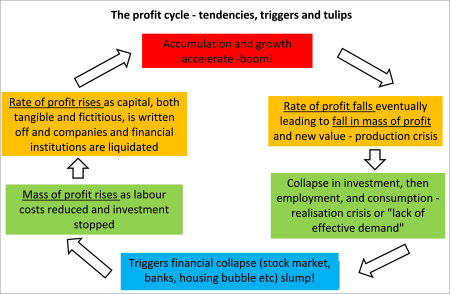
On page 15 of Michael Roberts's book, "The Long Depression", he shows a variant of the roadmap below from the San Francisco Bay Area Marxist Study Group (click on image to make larger and more legible).


San Francisco Bay Area Marxist Study Group via Nick Johnson


Incidentally I'm comfortable with Michael Roberts's take on the world because, like him, I'm hard left on the diagram above all the way down 😎.

Roberts is also not that tribal, seeking to understand rather than denounce. This is just as well as he secretly seems as convinced as I am that capitalism has at least another century before the imminence of total automation make production solely for the valorisation of capital essentially impossible.

This view of capitalism's likely future rather depends upon Marx's law of the ‘tendency of the rate of profit to fall’ (TRPF) applying over the long-term. I'm good with that as an empirical reality, increasing automation being the causal mechanism.

---

So who are the top gurus of Marxist thinking today? I've already mentioned Michael Roberts who has a prolific blog. I should also mention Sam Williams at "A Critique of Crisis Theory".

Moving now to the superstars, we have Dave Harvey, Michael Heinrich and Anwar Shaikh. I have bought books authored by all three. I'd also mention Andrew Kliman, whose book (below) I've just acquired.

Amazon link

While not a Marxist, radical Keynesian Steve Keen gets an honourable mention for bearing the wrath and fury of the entire neoclassical establishment with courage and fortitude. Roberts writes about him here.

So I'm very much a work-in-progress at the moment, struggling hard to get an intuitive view of the dynamics of capitalist economies at all time scales (Michael Roberts's views on cycles are persuasive).

In the background Marx's own writings, Capital Vols 2, 3 and 4 are still on the stack.

Monday, September 18, 2017

Marx and a Universal Basic Income (UBI)

Marx, as far as I know, did not explicitly write about the impact on capitalism of the widespread introduction of a universal basic income.

He did however, (in chapter 33 of Capital, Vol 1) write about an equivalent situation: the economics of the early Australian and American colonies.


Because the land was unowned, it was possible for new, penniless immigrants to rapidly acquire a homestead for themselves and their families, making them effectively self-sufficient.
"Free Americans, who cultivate the soil, follow many other occupations. Some portion of the furniture and tools which they use is commonly made by themselves. They frequently build their own houses, and carry to market, at whatever distance, the produce of their own industry. They are spinners and weavers; they make soap and candles, as well as, in many cases, shoes and clothes for their own use. In America the cultivation of land is often the secondary pursuit of a blacksmith, a miller or a shopkeeper.”
This makes capitalist production difficult.
"The absolute population here increases much more quickly than in the mother-country, because many labourers enter this world as ready-made adults, and yet the labour-market is always understocked. The law of supply and demand of labour falls to pieces.

On the one hand, the old world constantly throws in capital, thirsting after exploitation ...; on the other, the regular reproduction of the wage labourer as wage labourer comes into collision with impediments the most impertinent and in part invincible. ...

The wage-worker of to-day is to-morrow an independent peasant, or artisan, working for himself. He vanishes from the labour-market, but not into the workhouse. This constant transformation of the wage-labourers into independent producers, who work for themselves instead of for capital, and enrich themselves instead of the capitalist gentry, reacts in its turn very perversely on the conditions of the labour-market. ...

It avails him [the capitalist] nothing, if he is so cunning as to import from Europe, with his own capital, his own wage-workers. They soon “cease ... to be labourers for hire; they... become independent landowners, if not competitors with their former masters in the labour-market.” ...

“Our capital,” says one of the characters in the melodrama, "was ready for many operations which require a considerable period of time for their completion; but we could not begin such operations with labour which, we knew, would soon leave us. If we had been sure of retaining the labour of such emigrants, we should have been glad to have engaged it at once, and for a high price: and we should have engaged it, even though we had been sure it would leave us, provided we had been sure of a fresh supply whenever we might need it.”
But sadly not. This little difficulty in kick-starting American capitalism was, however, only temporary.
"On the one hand, the enormous and ceaseless stream of men, year after year driven upon America, leaves behind a stationary sediment in the east of the United States, the wave of immigration from Europe throwing men on the labour-market there more rapidly than the wave of emigration westwards can wash them away.

On the other hand, the American Civil War brought in its train a colossal national debt, and, with it, pressure of taxes, the rise of the vilest financial aristocracy, the squandering of a huge part of the public land on speculative companies for the exploitation of railways, mines, &c., in brief, the most rapid centralisation of capital.

The great republic has, therefore, ceased to be the promised land for emigrant labourers. Capitalistic production advances there with giant strides, even though the lowering of wages and the dependence of the wage-worker are yet far from being brought down to the normal European level."
In Marx's time, the mid-nineteenth century, working class factory life was truly horrendous. This is well-documented in the later chapters of Capital Vol 1.

What lessons can we learn for the twenty first century?

If people can genuinely acquire the necessities of life without labouring for wages then most - given a free choice - won't be signing up as employees. They may do voluntary work or various leisure activities .. but clocking in every day? Forget it .. though work that was interesting and not coercive might still attract a few economically-self-supporting individuals.

I offer you the example of the recently-retired on good pensions.

Taken in the round a UBI set at the level of the average wage would be strongly subversive of the continued operation of a capitalist economy. Pitched at a subsistence level as a variant of welfare, it's a different story.

---

Capital Volume 1, which I've just completed, is an eclectic book. The first four chapters are rather abstract, dry and repetitious although not too intellectually demanding. They are necessary, however, to establish the foundation for the rest of the book.

Subsequent chapters alternate between conceptual analysis (interesting but quite repetitive) and detailed anthropological/statistical studies buttressing and illustrating the economics. Generally they come down to the appalling conditions of the working class of the time, mostly in England.

The last part of the volume is a very interesting account of the process of capitalist rise from the ashes of feudalism. Broadly answering the question: where did the working class and the capitalist class actually come from?

Marx is a very verbal thinker, avoiding mathematics and equations. Everything is explained in words which can help understanding while simultaneously hindering it. If only he had formalised his concepts while retaining the helpfully-tutorial explanations; most modern accounts do that.

I personally found it useful to have Marx's reproduction equations in mind as I read the volume.

Next is Volume 2, where we move from production to exchange.

Friday, September 15, 2017

Steve Keen and Anwar Shaikh

In the 1970s the International Marxist Group (IMG) was known as the most intellectual of the far-left organisations. Theory was taken seriously but as a member in my early twenties I never learned much economics - I was not the only one. An abiding memory was of a conference where a senior comrade gave a speech on economic perspectives: a colleague whispered to me that all he had done was take an editorial from The Economist that week and dress it up in Marxist language - I was appalled.

Amazon link

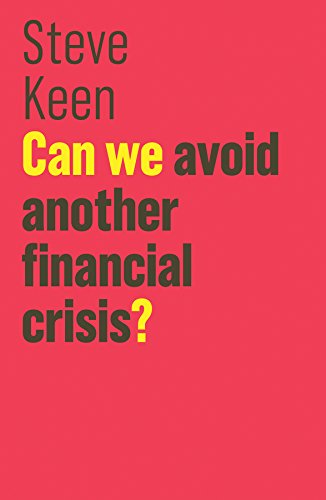
I'm in two minds about Steve Keen's book. I understand that it's dumbed down, written for students contemplating entering university-level economics. The book describes the vast arc of economics history stretching from the classical era of Adam Smith, David Ricardo and Karl Marx (who arguably terminated that tradition by making it politically explosive) through to the rise of the neoclassical tradition, Keynesianism and the confusion we are in today (Sam Williams' analysis is shorter and more definitive).

On the downside, in areas I know something about (quantum mechanics, special relativity) Keen's writing is confused although blusteringly self-confident. Throughout the book he has eschewed equations and diagrams, which is insane - he is reduced to conveying exactly the same concepts in prose which completely obscures his narrative. I was concentrating closely and his verbal arguments elide important steps and don't really hang together.

So I'm thinking Keen is interesting but intellectually underpowered, the kind of tourist guide who you sense isn't really authoritative.

The guy I'm really meant to read, apparently, is Anwar Shaikh.

Amazon link


Sam Williams writes:
"Shaikh’s book is by a modern university-educated economist written for other modern university-educated economists. Economics blogger Michael Roberts in his review says Shaikh’s “Capitalism” is more difficult than Marx’s “Capital.” I agree with Roberts on this point, and I think it is important to examine why this is so.

One reason is that Shaikh’s book demands a thoroughgoing knowledge of Marx’s work, including all three volumes of “Capital.” But it also requires a thoroughgoing knowledge of modern orthodox bourgeois economics—neoclassical marginalism. While parts of the book use Marxist language, the bulk of it is written in both the language of English and mathematics in a way that will be familiar only to those well grounded in orthodox bourgeois economics.

Shaikh provides some “translation” between the terminology employed by Marx and that used by modern economists, but it is hardly sufficient. In addition, where in the many places Shaikh uses the jargon of neo-classcal marginalism in place of basic Marxist concepts, it renders his language imprecise. Marx’s terminology was designed to describe in precise terms his analysis of capitalism. The terminology of neo-classical marginalism was developed for quite different purposes, to say the least, though it’s always possible to see what Shaikh is getting at provided the reader is sufficiently fluent in both “languages.”

Shaikh does provide a useful appendix listing the meaning of symbols he uses in his mathematical equations. The list is a long one.

Marxist political activists, even if they are highly educated Marxists but lack knowledge in today’s bourgeois economic orthodoxy, will have trouble understanding the book. But professional economists thoroughly grounded in modern bourgeois economics will be if anything in even greater trouble. The reason is that trained as they are in present-day bourgeois economics, they will also have a great deal of difficultly with the book unless they also have a thorough grounding in Marx. Though they will feel “more at home” with much of the terminology than will Marxist political activists, the Marxist foundations of the book will escape them.

The professional economists who will have the least difficulty with “Capitalism” are those familiar with the work of the Italian-British economist Piero Sraffa. For those somewhat familiar with Shaikh’s work, this will be no surprise. Much of Shaikh’s work has revolved around the “transformation problem”—the problem of transforming Marx’s values—or direct prices—into prices of production.

Shaikh has spent a considerable part of his career in refuting the suggestion by various critics of Marx that Sraffa’s work has both refuted Marx’s theory of value and surplus value and rendered it unnecessary. Essentially, these critics—also mostly university-educated economists—hold that the capitalist economy can best be described in terms of prices of production. According to them, analyzing capitalism in terms of “value” merely gets in the way.

But even professional economists familiar with Sraffa, unless well grounded in Marx, will not find “Capitalism” an easy read. I would most certainly not recommend Shaikh’s “Capitalism” as an introduction to modern Marxist economic thought.

None of this detracts from the importance of this work, however. Shaikh is undoubtedly one of the most important economic thinkers of our time. What it does mean is that it may take many years—or decades—for the arguments in this book to be assimilated into the understanding of the workers’ movement. I hope to contribute to this process in this extended review and critique."
So this is exciting and daunting! Although Michael Roberts in his review strikes a cautionary note.

Amazon link

Here is my go-forward plan (I have almost completed Capital Vol 1).
  1. Read Capital Vols 2 and 3 and Theories of Surplus Value (Vol 4)
  2. Read David Harvey's "Limits to Capital"
  3. Engage with Shaikh's book (or watch the video lectures).
I would like to complete this plan within my lifetime.

Wednesday, August 30, 2017

Marx on Slavery


Expecting a vitriolic rant on the absolute evils of slavery in the antebellum American South? There are plenty of those, but here Marx is more interesting, more analytic:
"This is one of the circumstances that makes production by slave labour such a costly process. The labourer here is, to use a striking expression of the ancients, distinguishable only as instrumentum vocale, from an animal as instrumentum semi-vocale, and from an implement as instrumentum mutum.

"But he himself [the slave] takes care to let both beast and implement feel that he is none of them, but is a man. He convinces himself with immense satisfaction, that he is a different being, by treating the one unmercifully and damaging the other con amore.

"Hence the principle, universally applied in this method of production, only to employ the rudest and heaviest implements and such as are difficult to damage owing to their sheer clumsiness. In the slave-states bordering on the Gulf of Mexico, down to the date of the civil war, ploughs constructed on old Chinese models, which turned up the soil like a hog or a mole, instead of making furrows, were alone to be found. Conf. J. E. Cairnes. “The Slave Power,” London, 1862, p. 46 sqq.

"In his “Sea Board Slave States,” Olmsted tells us: “I am here shown tools that no man in his senses, with us, would allow a labourer, for whom he was paying wages, to be encumbered with; and the excessive weight and clumsiness of which, I would judge, would make work at least ten per cent greater than with those ordinarily used with us.

"And I am assured that, in the careless and clumsy way they must be used by the slaves, anything lighter or less rude could not be furnished them with good economy, and that such tools as we constantly give our labourers and find our profit in giving them, would not last out a day in a Virginia cornfield – much lighter and more free from stones though it be than ours.

"So, too, when I ask why mules are so universally substituted for horses on the farm, the first reason given, and confessedly the most conclusive one, is that horses cannot bear the treatment that they always must get from negroes; horses are always soon foundered or crippled by them, while mules will bear cudgelling, or lose a meal or two now and then, and not be materially injured, and they do not take cold or get sick, if neglected or overworked.

"But I do not need to go further than to the window of the room in which I am writing, to see at almost any time, treatment of cattle that would ensure the immediate discharge of the driver by almost any farmer owning them in the North.”
From Note 17 of "Chapter 7: The Labour-Process and the Process of Producing Surplus-Value", Capital Volume 1.

In this chapter Marx notes the extreme inefficiency of slavery as compared with the capitalist purchase of labour-power rather than the person of the labourer themselves:
"Then again, the labour-power itself must be of average efficacy. In the trade in which it is being employed, it must possess the average skill, handiness and quickness prevalent in that trade, and our capitalist took good care to buy labour-power of such normal goodness.

"This power must be applied with the average amount of exertion and with the usual degree of intensity; and the capitalist is as careful to see that this is done, as that his workmen are not idle for a single moment. He has bought the use of the labour-power for a definite period, and he insists upon his rights. He has no intention of being robbed.

"Lastly, and for this purpose our friend has a penal code of his own, all wasteful consumption of raw material or instruments of labour is strictly forbidden, because what is so wasted, represents labour superfluously expended, labour that does not count in the product or enter into its value. [note 17]."
Generalised slavery is incompatible with the capitalist mode of production as the use of slaves does not create surplus value - the basis of profits. Classical antiquity was not capitalist.

Putting aside moral issues, slaves replacing workers is a form of total automation. But unlike designed systems, human beings are understandably unenthused by a lifetime role as servitor.

Tuesday, August 29, 2017

Diary: what I'm reading

Amazon link

Peter Turchin recommends this book in his latest, rather blood-curdling post. He writes,
"It is strange to actually live in a society experiencing a structural-demographic crisis, after studying many examples of such crises in the past. Unfortunately the crisis is developing largely according to the classical pattern. The degree of political polarization is at its highest levels since the (First) American Civil War. Intra-elite infighting is tearing the Republic apart. ...

"Steve is one of the “heterodox economists” (meaning that they are pretty much ignored by the mainstream). His starting point is the theory of Hyman Minsky (another economist who was largely ignored by the profession). Minsky’s theory makes a lot of sense to me, however. Let me try explain it in one paragraph.

"The main dynamical driver is the magnitude of private debt (combining what’s owed by both corporations and households) in relation to GDP. Currently this indicator is at 150% of the US GDP. Why is it bad?

"Actually, for a while, as private debt grows, things are just fine because expanding credit drives economic growth (think of new housing construction during building booms). But eventually the cost of servicing accumulated debt starts to depress consumption (the more you pay for your mortgage, the less money you have to buy things). Falling consumption results in overproduction of goods and declining profits for businesses, which makes investment a losing proposition. Credit collapses, businesses go bankrupt, or downsize their labor, less employment means even less consumption, and (absent large-scale increase in government spending) the economy enters a downward-trending “death spiral” of a prolonged depression.

"The precise timing of the turn-around point is very difficult to predict (it’s another example of earthquake-like dynamics). Yet Steve Keen is one of very few economists who predicted the General Financial Crisis (GFC) of 2007–2008.

"If Steve is right in identifying the main cause of the GFC, then we should listen to what he says in the book about the likelihood of another crisis in the next few years. Unfortunately, the news is bad, because we are still at a very high level of private debt in relation to GDP."
Turchin also sees the world economy in the 'winter' phase of the current Kondratiev cycle (I recently wrote about these here).


In any event, I acquired the book and will read it along with this:


They say the first four chapters are tedious, and that after that, things pick up (most readers have abandoned by then). In these early chapters Marx writes at length and repetitiously about the nature of the commodity, use-value and exchange-value, money and the transformation of money into capital.

He's a lively writer, always good for a venomous quip at the expense of an opponent; his knockabout style is far from politically-correct. It helps to be aware of just how important - how foundational - these concepts are for the whole development of Marxist economics.

Still, I'm glad I've got beyond chapter four.