Showing posts with label Sean Carroll. Show all posts

Wednesday, September 25, 2019

"Something Deeply Hidden" - some thoughts

Amazon link

The title is a quote from Einstein, revealed at the end of the book. Carroll is on Einstein's side in the great Einstein-Bohr debates on the meaning and completeness of quantum theory. Sort of.

Carroll writes well, mostly. He's a fluent author and has the surpassing virtue of conceptual clarity. This is a book about concepts: conceptual analysis and what the equations are telling us. This works well at the beginning where he covers the material in a typical undergraduate course, falters later when he discusses quantum field theory, and stutters at the end, where he sketches the research program of deriving spacetime from Hilbert space.

Who is this book for? Not the layperson - it's too unfamiliar, too conceptually abstract and dense. It's for people who know quantum mechanics - the mathematics and the calculations - people who understand the machinery but, like everyone else, struggle to understand what it's telling us about the universe itself. The math he doesn't mention underpins the concepts he's keen to articulate and talk around.

He's persuasive on the many-worlds interpretation, mostly because it seems plausible to start with the wave-function of the universe-as-a-holistic-entity. He's at pains to point out that the MWI is really no more than that: austere quantum theory.

He's excellent on how decoherence works, giving a clear conceptual overview. You have to have covered superpositions and entangled states in your QM course - and to have thought about it - to really grasp what he's saying, though. He writes like it's pretty clear but it isn't.

Should one walk away from this book an Everettian?  Carroll makes a very strong case for this over all the other interpretations - his critiques sometimes feel like shooting fish in a barrel. He's convincing that we should conceptualise QM as if the MWI were true.

But is the universe really a state vector in a high-dimensional Hilbert space? With our familiar classical-looking spacetime something emergent? A reality emergent from entropic-entanglement (hence locality and metric) and then local sampling of that so-structured Hilbert space?

No-one knows. It might be nice .. but the research isn't in.

And then there are the lacunae. The genesis of the standard model is nowhere mentioned. It may all be quantum fields - but how did we get separate quantum fields for all the different fermions and bosons?

My conclusion: every physics undergraduate should read this book. All the questions they have about how quantum theory is put together (the map of the territory in fact) and how it all relates to the universe we experience are honestly discussed here. They won't find those issues addressed in class or in their textbooks.

They will also appreciate how much we still don't understand about the fundamentals of the theory and about reality itself. Quantum gravity is still, most likely, the holy grail. But in the absence of meaningful experiments (the collider plans don't really help) solid progress is likely to remain stalled.

Wednesday, September 18, 2019

“Metaphorical Worlds Interpretation” (Chad Orzel)

Amazon link

I bought this a couple of weeks ago (Kindle) but it still sits in my stack. Soon!

Peter Woit has this post today, however, where he links to a piece by Chad Orzel.

Orzel thinks there is a better way to think about the "Many Worlds Interpretation":
"The problematic aspect here is that the wavefunction of the universe has everything in complicated superposition states, but when we select out a tiny piece of it as our system of interest, we often see that system only in single states, not a superposition of multiple states. The question that’s too often un-asked, though is: What measurement would you do to demonstrate that your system is really in a superposition?

The answer to this doesn’t need to be a procedure specific enough to actually do the experiment; a general outline would be sufficient. And, in fact, we have a couple of centuries of experience at doing exactly this: When we want to show that something has been in two states at the same time, we do an interference experiment. We put our system of interest in a superposition of two states, arrange for those two states to evolve at slightly different rates for some time, and then bring them back together and measure the final state.

If a superposition exists, there will be some oscillation in the probability of a given final state that depends on the differential evolution in the middle. This takes lots of forms– if the two states of the superposition correspond to passing through spatially separated slits, it’ll show up as an interference fringe pattern in space; if they’re two states of a cesium atom in an atomic clock, it’ll show up as a varying probability of ending up in one of those states as you adjust the frequency of your microwave oscillator.

In every case, though, you’re measuring a probability. And not even a Bayesian can accurately measure a probability from a single experiment. To get a good measurement of a probability of some outcome– let alone the variation in probability that is the signature of a superposition state– you need a large number of repeated measurements. And those measurements have to be made under the same conditions every time.

That’s the key feature that lets you carve out some parts of the giant wavefunction of the universe and choose to treat them as systems in definite states, while others need to be treated as full quantum superpositions. The vast majority of the universe that we’re bracketing off as “the environment” affects the measurement conditions, which changes the probabilities you’re measuring.

If the interaction with the environment is small, though, you can ensure that the conditions are close to identical for enough trials to unambiguously see the changing probabilities that show a superposition exists. That subpart of the universal wavefunction needs to be dealt with as a fully quantum system.

If the interaction with the environment is strong and poorly controlled, though, the conditions of your measurement change enough from one repetition to the next that you’re not really doing the same measurement multiple times. If you could know the full state of the environment for a given trial, you would predict one probability, but knowing the full state of the environment for the next trial would lead you to predict a different probability.

In the absence of that knowledge, adding together repeated results just gets you junk– you won’t see a clear dependence on the different evolution of the different states in the superposition, because it’s swamped by the unknown effect of the environment. If you can’t see the interference effect, that system “looks classical,” and you can treat it as having a definite state.

That process of interaction with the changing state of an unknown environment gets the name “decoherence,” and it’s what enables the bookkeeping trick that lets us split off pieces of the wavefunction and consider them in isolation. If the piece you’re interested in is big enough and interacts with the environment strongly enough, there’s no hope of doing the interference measurement that would show it’s in a superposition state. If you can’t do a measurement that would show the existence of the other piece(s) of the superposition, you can safely treat it as being in a single definite state.

It should be emphasized, though, that this is just bookkeeping, not a real separation between “copies of the universe,” or even copies of the system of interest. There’s only one universe, in an indescribably complex superposition, and we’re choosing to carve out a tiny piece of it, and describe it in a simplified way.

It’s not even true, strictly speaking, that the results of a given experiment for a particular object are unaffected by the presence of the other parts of the superposition for that specific object. If you could do the full probability calculation for the whole wavefunction, including all of “the environment,” the probability you would predict for that experiment would include a contribution from all the various states that are superposed. In the absence of that complete knowledge, though, you can get away with ignoring them, because you’ll never be able to repeat the measurements in the way you would need to see the influence.
...
Rather than “Many-Worlds Interpretation,” I’d go with “Metaphorical Worlds Interpretation,” to reflect the fact that all the different ways of cutting up the wavefunction into sub-parts are fundamentally a matter of convenience, a choice to talk about pieces of the wavefunction as if they were separate, because the whole is too vast to comprehend."
Peter Woit likes this story. What do you think?

---

What is decoherence? Read this.

Tuesday, August 07, 2018

Your personality chooses your religion (humour)


The "New Atheists" (Dawkins et al) have a down on religion because -- it isn't true.

Duh! of course no religion can survive the laws of physics .. which explain everything. But religion does more for us than that.
  • It provides a moral framework for our lives as social beings
  • It provides some reassurance in the face of our own mortality
  • Adherence advertises to ourselves and others a commitment to moral behaviour.
These are all things worth having. Yet it's hard to commit to the difficult path of self-discipline and self-denial except under supernatural duress. A candidate religion would be preferable to the extent it was at least somewhat believable.

And then there is the style of the religion. Can one approach it in an intellectually austere way - as an introvert? Or does one have to sway, dance, sing and play the guitar?

Finally  there's not much chance of impressing others with your own commitment to virtue if you advertise your adherence to a faith that no-one has ever heard of, or which is a laughing stock. Church of Scientology, anyone?

So faced with these constraints, I turned to AI and cranked up my Prolog theorem-prover again (last used in car selection).

/* Choosing your religion by the four psychological temperaments (SP, SJ, NF, NT)

Classify religions (faiths) on the following dimensions:
- intensity [ascetic, calm, emotional, shrill]
- plausibility [low, medium]
- recognition amongst the UK public [low, medium]

candidates: evangelical, anglican, wahhabism, sufism, hinduism, buddhism, philosophical_taoism, sjw.
*/

religion(R) :- member(R, [evangelical, anglican, wahhabism, sufism, hinduism, buddhism, philosophical_taoism, sjw]).

intensity(evangelical, emotional).
intensity(anglican, calm).
intensity(wahhabism, emotional).
intensity(sufism, ascetic).
intensity(hinduism, emotional).
intensity(buddhism, calm).
intensity(philosophical_taoism, ascetic).
intensity(sjw, shrill).

plausibility(R, low) :- member(R, [evangelical, anglican, wahhabism, sufism, hinduism]).
plausibility(R, medium) :- member(R, [buddhism, philosophical_taoism, sjw]).

recognition(R, low)     :- member(R, [buddhism, philosophical_taoism, wahhabism, sufism]).
recognition(R, medium)  :- member(R, [evangelical, anglican,  hinduism, sjw]).

choose(Religion, sp) :- intensity(Religion, emotional).
choose(Religion, sj) :- intensity(Religion, calm), recognition(Religion, medium).
choose(Religion, nf) :- intensity(Religion, X), X \= ascetic.
choose(Religion, nt) :- intensity(Religion, ascetic), plausibility(Religion, medium).

?- choose(Religion, sp).
Religion = evangelical ;
Religion = wahhabism ;
Religion = hinduism.
?- choose(Religion, sj).
Religion = anglican ;
?- choose(Religion, nf).
Religion = evangelical ;
Religion = anglican ;
Religion = wahhabism ;
Religion = hinduism ;
Religion = buddhism ;
Religion = sjw.
?- choose(Religion, nt).
Religion = philosophical_taoism ;
---

Notice that I've used the Myers-Briggs/Keirsey temperament classifications: SP-Artisan, SJ-Guardian, NF-Idealist, NT-Rational.

I speak to you as an NT, a Rational. I must say that Taoism is no surprise, but despite my admiration for Lao Tzu and Ursula le Guin, I won't be following the Way any time soon. Too passive, too airy-fairy and how can you take seriously people who call themselves 'cultivators'???

---

Disclaimer: this post is satirical and lays no claim to empirical verisimilitude. It is based on no research and no conclusions should be drawn. If anyone's feelings are hurt, I can only plead for forgiveness. That shouldn't be too difficult.

Saturday, October 14, 2017

MWI, plus entanglement leads to GR, maybe?

In this video Sean Carroll lectures at Kings College on the 'Many-Worlds Interpretation' of quantum theory and his attempts, with collaborators, to conceptualise general relativistic spacetime as an emergent phenomenon due to entanglement.

Apparently the degree of entanglement between distinct vacuum states falls off as the distance between them. But perhaps this can be inverted, so that the concept of distance could be seen as an emergent proxy for the degree of entanglement.


The 50 minute lecture is 'aimed at undergraduates who haven't necessarily yet taken a quantum mechanics course'. If you are such, Carroll's talk will be as compelling as a presentation on Summa Theologica from Thomas Aquinas.

On the other hand, a passable familiarity with Hilbert space, quantum superposition and the Schrödinger equation plus a hand-wavy feel for QFT and Einstein's field equations will allow you to properly appreciate Carroll's approach to physics (and would make you a physics graduate).

In a nutshell, it's believe in the maths. Once you appreciate the ubiquity of superposition (ie, it's everywhere) you're kind of committed to the reality - in some sense - of Hilbert space. The observed phenomena simply can't be explained by theories which restrict themselves to our classical-looking 4D spacetime.

Carroll's talk is not technical in argumentation, he mentions rather than uses the theoretical apparatus of modern physics. That does put the burden of getting his drift wholly on the theoretical preparation of the listener of course.

In the final part of his lecture, he describes the research programme which seeks to obtain geometry from entanglement in quantum field theories via entropy and then, through considerations of energy, to reconstruct the GR field equations as the classical limit.

He seems encouraged, though this is work-in-progress.

Thursday, March 30, 2017

Open systems meet closed automation

Let me start with this rather intriguing story (via Bruce Schneier).


"Prior to World War II, Abraham Wald was a rising mathematician in Europe. Unable to obtain an academic research position in Austria due to his Jewish heritage, Wald eventually made his way to the U.S. to become one of the most important statisticians of the 20th century.

"One of Wald’s most prominent works was produced for the U.S. government’s World War II-era Statistical Resource Group. The project examined aircraft that had returned from their combat missions and the locations of armor on the planes. Placement was, of course, no trivial matter. Misplaced armor would result in a negatively balanced, heavier and less maneuverable plane, not to mention a waste of precious wartime resources.

"Tasked with the overall goal of minimizing Allied aircraft losses by placing additional armor in strategic locations on the plane, Wald challenged the natural instincts of military commanders. Conventional wisdom suggested that the planes’ survival rates might benefit from additional armor placed in the areas that suffered the highest volume of direct hits. But Wald found that was not the case.

"Leveraging data stemming from his examinations of planes returning from combat, Wald made a critical recommendation based on the observation of what was not actually visible: He claimed it was more important to place armor on the areas of the plane without combat damage (e.g., bullet holes) than to place armor on the damaged areas. Any combat damage on returning planes, Wald contended, represented areas of the plane that could withstand damage, since the plane had returned to base.

"Wald reasoned that those planes that were actually hit in the undamaged areas he observed would not have been able to return. Hence, those undamaged areas constituted key areas to protect. A plane damaged in said areas would not have survived and thus would not have even been observed in the sample. Therefore, it would be logical to place armor around the cockpit and engines, areas observed as sustaining less damage than a bullet-riddled fuselage.

"The complex statistical research involved in these and Wald’s related findings led to untold numbers of airplane crews being saved, not only in World War II, but in future conflicts as well."
---

As designers we always have a theory of our proposed artefact in its intended environment. Sometimes we capture the theory in a formal specification, sometimes it's implicit in the examples we feed to some artificial neural net, frequently it's some fuzzy understanding we incorporate into a plain-language requirements document plus some test data.

In any event, the final engineered artefact embodies a theory - the theory of the environment in which it works correctly. That environment is often the real world and here we hit a problem: the real world is not a precisely-specified closed system*. Inevitably the artefact will encounter an event which is out of the envelope of its design - and then it will fail.

A good example of this is driving. Here, you are the artefact. Initially you learn in structured lessons how to control the car and tactics to safely navigate the streets.

As you gain experience, you statistically encounter fewer, rarer anomalous events. If you are lucky, your consequential mistakes will not be too serious. You update your protocol and become a better driver. But you will never be perfect.

Driving is an open system. There are (porous) boundaries around the theory of driving but as all experienced drivers know, that theory incorporates a great deal of real-world social knowledge - it's more than seeing the white lines in the rain. **

---

When we classify a human social role as routine, we're saying that the wider system into which the role is enrolled is effectively closed and can be pre-specified. No real systems are truly closed so we always provide an escalation route to a competent (ie more informed) authority. For truly routine roles, we don't expect that escalation to occur too frequently, or to be problematic when it does.

Bruce Schneier's excellent article is about countering cyber-attacks. This is far from routine. The adversary is using intelligence, novel tools and unfixed vulnerabilities to get you. That's pretty much the definition of an open system. Schneier describes the problem like this:
"You can only automate what you're certain about, and [...] when an uncertain process is automated, the results can be dangerous."
The right answer is to use automated systems within manageably closed subsystems (like antivirus routines) within the broader oversight of a computer-augmented human response team.

Perhaps one day we will have human-socialised AIs which have the intuitions, general knowledge and motivational insights which humans possess, and then we can hand things over to those said AIs, confident they will make no more mistakes than we would in those incredibly challenging not-sufficiently-closed systems.

---

*   Arguably it is from the point of view of modern physics - but that doesn't buy you anything.

** Here's a review about the implications for driverless cars.

Tuesday, February 21, 2017

"From Eternity to Here" - Sean Carroll

Amazon Link

Just finished Sean Carroll's 2011 book, which - after an exhaustive exploration of all other options - locates the origin of 'the arrow of time' in the quantum-fluctuation emergence of super-low-entropy 'baby universes' from a preceding high-entropy de Sitter universe.

Yep, that would be the baby universe in which I'm sitting writing this post.

This may seem extravagant, to explain why eggs produce omelettes but not the reverse, but he refutes all the simpler explanations.

It presently seems unclear, however, whether a de Sitter universe could even make baby universes, absent a better theory of quantum gravity.

Carroll's latest thinking tends in a different direction, suggesting that framing the issue within the spacetime realm may itself be a mistake; the true nature of reality may be Hilbert space with Schrödinger equation dynamics. Spacetime, with its arrow of time, may be emergent.

Strange that the weirdest ideas of modern physics - the MWI, emergent spacetime - seem to be the most plausible.

This is a fine book, and an excellent introduction for the smart non-physicist to general relativity, quantum theory (QM/QFT) and cosmology.

Thursday, January 26, 2017

Diary: books + Clare's health

Not many posts for the next few days as we have a visitor: my 'study' reverts to its ur-status as bedroom.

I ordered Sean Carroll's book (which should be arriving tomorrow or Saturday) ..


.. on account that one reviewer (3 stars) complained it was 'too hard'. I'll try to let you know.

---

Strange how hard it is to predict another's taste in books. I really appreciated Scott Bakker's "The Disciple of the Dog" but all that inline philosophy slowed it down way too much for Clare.

It's been replaced - amazingly - by the famous "The Mote in God's Eye" which she is lapping up as I read it to her.


We haven't even reached the gripping alien lightsail contact event yet; still in the early chapters of Niven's and Pournelle's backstory building, usually condemned as 'boring'.

---

I remain a fan of Scott Bakker and have purchased (Kindle) this: (start of a mega-epic) ..


.. which seems awfully complicated. I have dipped my toe in.

---

My third ordered volume is "The Genome Factor: What the Social Genomics Revolution Reveals About Ourselves, Our History, and the Future" by Dalton Conley and Jason Fletcher.


I'm hyper-wary of the fluffy-bunny pleasantries of the Standard Social Science Model, but it seems well-regarded so I'm taking the risk. Should be out some time in late February.

---

Do you hear that hacking cough from the bedroom? Clare is much recovered today but the sub-zero windchill of our lunchtime shopping trip to Waitrose has sapped her energy .. and she has retired to bed. Still, direction of progress is positive.

---

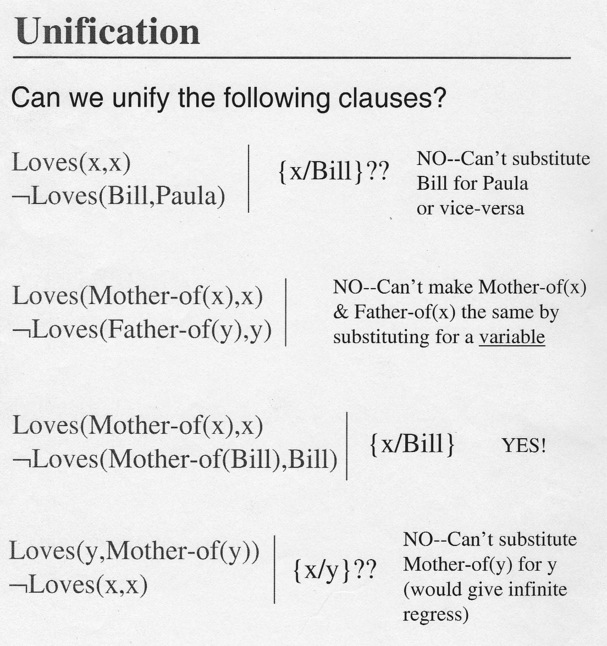
Well, enough time here. I think it's time to re-acquaint myself with J. A Robinson's exemplary treatment of unification with those substitution subtleties ... .


Thursday, January 19, 2017

The quantum-theoretic block universe


Eternalism is not hard to justify.
Yesterday I contemplated my situation and concluded: "This is real, this is now."

Today, when I recollect that scene, I'm inclined to think it was indeed real, and shows the reality of the past (which has not flickered out of existence but is .. elsewhere).

Yesterday, I also thought, "Tomorrow, I will be writing a post."

Today, here I am doing it. For yesterday's me, that shows the reality of the future.
As Frank Sinatra observed, "You can't have one without the other."

---

For greater conviction, we can appeal to special relativity. As I wrote in a piece for sciencefiction.com,
"Brian Greene in ‘The Fabric of the Cosmos’ (page 134) considers an alien in a galaxy ten billion light years away, at the edge of the visible universe. Simply by ambulating towards or away from us at 10 mph, the alien’s view of what is happening ‘right now’ on earth swings from 149 years in the past to 149 years in the future."
Still, the block universe is classical and therefore inaccurate. It's necessary to move to quantum theory where, as usual, one needs to take the red pill.

Theoretical physicist Jeremy Bernstein on 'A Quantum Past'.
"In FAPP (For All Practical Purposes) language we have a quantum mechanical system described by a wave function ψ(t), I am  only interested in the time variable.

The wave function obeys a Schrödinger equation with a Hamiltonian H. The formal solution to this equation is ψ(t) = exp(iHt)ψ(0). Throughout I am setting ћ = 1. Thus to recover Ψ(0) from ψ(t) all we have to do is to multiply by exp(-iHt).

Haven’t we then recovered the past? What is all the fuss about? The problem is that there is more to life than the wave function. There are the “observables” which represent what we really want to know about the system. These observables are described by Hermitian operators A. B. C and so on. We can expand ψ in a sum over the orthonormal eigenfunctions of any of these operators. The coefficients in the expansion are related to the probabilities that in a measurement the system will be found to have one of these eigenvalues. This is “Born’s rule” and in FAPP it must be assumed.

To find which of these eigenvalues the system actually has, we must perform a measurement. Stripped to its essence the apparatus that produces this measurement projects out from the sum of eigenfunctions one of them.

After the measurement the rest of the terms in the sum disappear. Using the term of art, the wave function “collapses”. It is at this point that we lose our capacity to reconstruct the past.

Projection operators are singular. They do not have inverses. All the king’s horses and all the king’s men cannot put the wave function back together again.

It was von Neumann in the early 1930’s who first noted that in FAPP mechanics there were two kinds of processes. There were processes that could be described by a Schrödinger equation and there were measurements which could not. He did not, as far as I know, comment on what this implied for retrodiction.

A case in point is an electron described by a spherically symmetric Schrödinger wave. If this electron strikes a detector is does so at a place - a spot. After this happens all trace of the spherically symmetric wave function vanishes.

I have certainly not made a careful search of the literature but among the founding fathers of FAPP I can come up with only two references that deal with the matter of the quantum past.

One is Heisenberg and the other is a paper by Einstein, Richard Tolman, and Boris Podolsky, “Knowledge of Past and Future in Quantum Mechanics” which they wrote in 1931 when Einstein was spending time at CalTech."
Bernstein talks about these two references, and then discusses where he thinks the problem resides, and what is to be done.
"It seems to me that any interpretation of the quantum theory that addresses this [the problem of wavefunction collapse] must have the feature that measurements are simply just another interaction like the rest.

Von Neumann’s notion that there were two classes of interactions one whose time evolution could be described by a Schrödinger equation and one of which couldn’t, has to be abandoned.

I will discuss two proposals for doing this each of which has its adherents and its detractors. On the one hand I am going to discuss what I will call “Bohmian mechanics” a term which David Bohm, who invented this approach , apparently did not like. As far as he was concerned, he was just doing quantum mechanics but in a different way. However nearly everyone else calls it Bohmian mechanics - so will I.

On the other hand, I am going to discuss the “decoherent history” interpretation which Murray Gell-Mann and Jim Hartle have done the most on. Sometimes this is called the “many worlds” interpretation, but not by them. I think that the term “many worlds” is misleading. As far as we know there is one world, the one we live in."
I'm not a fan of “Bohmian mechanics” and insofar as any quantum ontology works for me, it has to be "Many Worlds" (Sean Carroll explains why).

So I'll skip over Bernstein's description of Bohm's view of the quantum past and quote his take on “decoherent histories”.
"In the "Many Histories Interpretation" what indeed is history?

At first sight this might seem to be obvious. All we have to do is to run the chain backwards.

Yes this gives one history but there are others, possibly very many others. The reason is that if all we know is the present state vector there are many paths by which we could have arrived there depending on which initial state vector we started from. We have no way of knowing this from the data we have at hand.

Let us take an example discussed by Hartle - the Schrödinger cat (I can’t resist noting that when I spent an afternoon with Schrödinger in his apartment in Vienna there was no cat). In any event this unfortunate feline is put in a box that contains a capsule of poison gas and a sample of uranium. The capsule is triggered so that if the uranium has an alpha decay, the alpha sets off the trigger and the unfortunate feline expires.

After a time interval we open the box and happily the cat is alive. It could, according to the many history approach have arrived at this state in two ways. The initial state might have been a cat alive state or it might have been a coherent sum of a cat alive and a cat dead state. From the presence of the living cat we cannot decide.

The vision of the past given by the decoherent history interpretation and the Bohmian seems radically different. In Bohmian mechanics we could in principle follow all the cat molecules backwards in time and arrive at one and only one past.

I don’t know how you feel, but the ambiguity of the past makes me queasy. It might be entertaining to imagine that in an alternate past my grandmother who was born in a Polish stetl could have been Eleanor Roosevelt.

I readily accept that these pasts to not communicate but there seem to be too many of them from the point of view of economy. A trip to a barber wielding Occam’s razor seems warranted.

In any case when it comes to quantum pasts, as Duke Ellington taught us, “Things ain’t what they used to be.”
Perhaps Bernstein wrote this short paper just for that final joke at the end?

To summarise, if you take quantum theory seriously and you take eternalism (the block universe) seriously, then it seems that the past is as indeterminate as the future.

---

How does this relate to the 'low entropy in the past' idea used to explain the 'arrow of time'?

Since quantum theory is consistent with the second law of thermodynamics, a picture emerges of backwards branching towards (superpositions of) Big Bang variants.

My ex-colleague Roy said as much in this comment, on an earlier post devoted to the MWI. See here for more.

Wednesday, January 18, 2017

The Meaning of Life


In the beginning we should all be physicists. As Sean Carroll has repeatedly pointed out, the laws underlying the physics of everyday life are completely understood.
"Many people resist the implication that this theory is good enough to account for the physics underlying phenomena such as life, or consciousness. They could, in principle, be right, of course; but the only way that could happen is if our understanding of quantum field theory is completely wrong.

When deciding between “life and the brain are complicated and I don’t understand them yet, but if we work harder I think we can do it” and “I understand consciousness well enough to conclude that it can’t possibly be explained within known physics,” it’s an easy choice for me."
Carroll summarises our complete theory of the universe in one equation. As he points out, "No experiment ever done here on Earth has contradicted this model."

For the physicist, life is merely a parameter subspace in the evolution of the universal wavefunction. I'm tempted to mention cats. The physicist is professionally a psychopath. So note that the next time a famous physicist expresses an opinion on politics or public policy. They are talking outside their discipline.

---

It's not wrong to start with physics, how could it be? But we seek more enlightenment from biology. At least the subjects we study there are actually living.

The title of this post is the meaning of life. Did you see the word 'human' anywhere?

Consider the plants and animals, the germs and fungi, occupants of this planet for four billion years. Darwin gave us the answer - the meaning of life is to survive and have reproducing progeny. All those ancestral entities which didn't 'get that' were eliminated from reality.

And for most creatures, there is no more meaning than that. If they were to waste their time and energy on doing anything else, they would be outcompeted and removed from the gene pool.

---

On to sociology. It seems unbearable to a cultured person in the twenty first century that the meaning of their life is reduced to the number of child-bearing children they manage to create. This has thrown reductionist biologists into confusion.

I once read that the reason Catholic priests were celibate was some variation of the alleged 'gay uncle' phenomenon. Utterly delusional.

To state the obvious, humans are social creatures and large-scale agrarian societies rapidly outcompeted hunter-gathers. Almost all contemporary humans are the descendants of individuals who successfully adapted to living in large-scale cooperative societies.

Until the recent advent of contraception, reproductive success was strongly linked to social status. Social status in large-scale societies selects for social accomplishment: it helps to be good at something people value, and not to be a muppet.

A desire simply to breed is not really enough: your neighbours can get lethally irritated.

It's surprising how many people delude themselves that being an actor, a rock star, a politician or a top executive or even intellectual is not about getting the girl (or, if a girl, getting a better class of admirer).

What do you think?

---

Social creatures have complex life histories, no longer purely individualistic. We all recall "Haldane famously joking that he would willingly die for two brothers or eight cousins."

Those celibate Catholic priests are using prosocial psychological drives to inhibit their more primal reproductive imperatives. No society could cohere without such inhibitory mechanisms and since the ages of rape and pillage of outgroups, there has been selection for male self-control.

As ever, there is variation in the population and a celibate occupation strongly selects within that.

---

Some conclusions. The biologists are right: for humans the meaning of life is in some extended sense to have offspring. A society which fails to reproduce abolishes itself and vanishes from reality. The extended sense means that we could profitably devote our lives to aiding close kin, or even those whose social-solidarity benefits our kin (the foundation of reciprocal altruism).

We all benefit from the continuing integrity of our societies with their high carrying capacities.

It's OK to be a celibate, rule-abiding priest .. really. Even if you are professionally confused about the meaning of life.

Friday, August 19, 2016

The 10,000 year view

Amazon link

Richard Feynman once wrote:
"From a long view of the history of mankind - seen from, say, ten thousand years from now - there can be little doubt that the most significant event of the 19th century will be judged as Maxwell's discovery of the laws of electrodynamics."
What should we say about the other centuries?

---

The seventeenth century, in 10,000 years time, will be remembered principally for Isaac Newton's laws of dynamics:

  • First law: When viewed in an inertial reference frame, an object either remains at rest or continues to move at a constant velocity, unless acted upon by a net force.

  • Second law: In an inertial reference frame, the vector sum of the forces F on an object is equal to the mass m of that object multiplied by the acceleration vector a of the object: F = ma.

  • Third law: When one body exerts a force on a second body, the second body simultaneously exerts a force equal in magnitude and opposite in direction on the first body.

And universal gravitation:  F = Gm1m2/r2  - plus calculus, co-discovered with Leibnitz.

---

The eighteenth century was not rich in epoch-spanning discoveries, but future historians of science will recall it for Rev. Thomas Bayes, whose profound theorem will power the great AI learning engines down the ages.


---

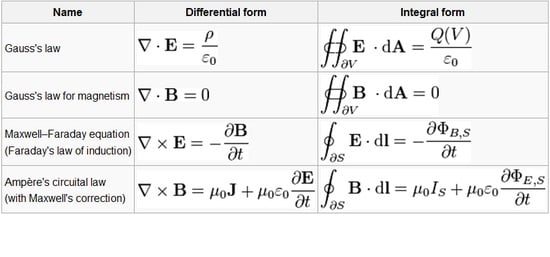
The nineteenth century we've already mentioned. Here are Maxwell's equations in the vector form he would not easily have recognised.


---

The twentieth century is a cornucopia of fundamental science, but I think the most truly foundational, revolutionary and influential discovery has to be the Schrödinger equation, which explains .. well, almost everything around us.


But I doubt the 10,000 year future will have forgotten Einstein - or BohrHeisenbergDirac, ... .

---

Sean Carroll has a related list of his seven favourite equations here.

Saturday, April 04, 2015

Confessions of an eternalist

Confession: I am an eternalist.


Eternalist Sean Carroll has a post up commenting on recent books by Lee Smolin and philosopher Roberto Mangabeira Unger who argue to the contrary. Reading the comments there is depressing  - people either don't understand the issue at all, or don't appreciate how to think about the subjective nature of 'now'. Physicists!

One physicist, Sabine Hossenfelder, has written an excellent and definitive analysis: here's an extract.
"The decisive ability that allows us to experience the present moment as being unlike other moments is that we have a memory. We have a memory of events in the past, an imperfect one, and we do not have memory of events in the future. Memory is not in and by itself tied to consciousness, it is tied to the increase of entropy, or the arrow of time if you wish. Many materials show memory; every system with a path dependence like eg hysteresis does. If you get a perm the molecule chains in your hair remember the bonds, not your brain.

"Memory has nothing to do with consciousness in particular which is good because it makes it much easier to find the flaw in the argument leading to the problem of now.

"If we want to describe systems with memory we need at the very least two time parameters: t to parameterize the location of the particle and Ï„ to parameterize the strength of memory of other times depending on its present location. This means there is a function f(t,Ï„) that encodes how strong is the memory of time Ï„ at moment t. You need, in other words, at the very least a two-point function, a plain particle trajectory will not do.

"That we experience a “now” means that the strength of memory peaks when both time parameters are identical, ie t-Ï„ = 0. That we do not have any memory of the future means that the function vanishes when Ï„ > t. For the past it must decay somehow, but the details don’t matter. This construction is already sufficient to explain why we have the subjective experience of the present moment being special. And it wasn't that difficult, was it?"
I'm not so much into perms as my preferred physical model of subjective temporal experience. If you imagine a robot with an updating model of observed-reality obtained from its internal and external sensors, it's easy to see that examining its own memory store at any instant at all the robot can persuade itself that this instant "now" is special. But all introspective moments are like that. If we saved each database-state where:
"the robot notes that it is aware of itself and its environment now"
to disk, there would be nothing fundamentally distinct about any of them.

That robot is, functionally, me and you and sits easily in the block universe.

Thursday, January 01, 2015

Dreamers and Doers

Sean Carroll has a guest post by Chip Sebens on the Many-Interacting-Worlds Approach to Quantum Mechanics. Here's the first part of it.

---

"In Newtonian physics objects always have definite locations. They are never in two places at once. To determine how an object will move one simply needs to add up the various forces acting on it and from these calculate the object’s acceleration. This framework is generally taken to be inadequate for explaining the quantum behavior of subatomic particles like electrons and protons. We are told that quantum theory requires us to revise this classical picture of the world, but what picture of reality is supposed to take its place is unclear. There is little consensus on many foundational questions: Is quantum randomness fundamental or a result of our ignorance? Do electrons have well-defined properties before measurement? Is the Schrödinger equation always obeyed? Are there parallel universes?

"Some of us feel that the theory is understood well enough to be getting on with. Even though we might not know what electrons are up to when no one is looking, we know how to apply the theory to make predictions for the results of experiments. Much progress has been made―observe the wonder of the standard model―without answering these foundational questions. Perhaps one day with insight gained from new physics we can return to these basic questions. I will call those with such a mindset the doers. Richard Feynman was a doer:
“It will be difficult. But the difficulty really is psychological and exists in the perpetual torment that results from your saying to yourself, ‘But how can it be like that?’ which is a reflection of uncontrolled but utterly vain desire to see it in terms of something familiar. I will not describe it in terms of an analogy with something familiar; I will simply describe it. … I think I can safely say that nobody understands quantum mechanics. … Do not keep saying to yourself, if you can possibly avoid it, ‘But how can it be like that?’ because you will get ‘down the drain’, into a blind alley from which nobody has yet escaped. Nobody knows how it can be like that.”

-Feynman, The Character of Physical Law (chapter 6, pg. 129)
"In contrast to the doers, there are the dreamers. Dreamers, although they may often use the theory without worrying about its foundations, are unsatisfied with standard presentations of quantum mechanics. They want to know “how it can be like that” and have offered a variety of alternative ways of filling in the details. Doers denigrate the dreamers for being unproductive, getting lost “down the drain.” Dreamers criticize the doers for giving up on one of the central goals of physics, understanding nature, to focus exclusively on another, controlling it. But even by the lights of the doer’s primary mission―being able to make accurate predictions for a wide variety of experiments―there are reasons to dream:
“Suppose you have two theories, A and B, which look completely different psychologically, with different ideas in them and so on, but that all consequences that are computed from each are exactly the same, and both agree with experiment. … how are we going to decide which one is right? There is no way by science, because they both agree with experiment to the same extent. … However, for psychological reasons, in order to guess new theories, these two things may be very far from equivalent, because one gives a man different ideas from the other. By putting the theory in a certain kind of framework you get an idea of what to change. … Therefore psychologically we must keep all the theories in our heads, and every theoretical physicist who is any good knows six or seven different theoretical representations for exactly the same physics.”

-Feynman, The Character of Physical Law (chapter 7, pg. 168)
"In the spirit of finding alternative versions of quantum mechanics―whether they agree exactly or only approximately on experimental consequences―let me describe an exciting new option which has recently been proposed by Hall, Deckert, and Wiseman (in Physical Review X) and myself (forthcoming in Philosophy of Science), receiving media attention in: Nature, New Scientist, Cosmos, Huffington Post, Huffington Post Blog, FQXi podcast… Somewhat similar ideas have been put forward by Böstrom, Schiff and Poirier, and Tipler.

"The new approach seeks to take seriously quantum theory’s hydrodynamic formulation which was developed by Erwin Madelung in the 1920s. Although the proposal is distinct from the many-worlds interpretation, it also involves the postulation of parallel universes. The proposed multiverse picture is not the quantum mechanics of college textbooks, but just because the theory looks so “completely different psychologically” it might aid the development of new physics or new calculational techniques (even if this radical picture of reality ultimately turns out to be incorrect)."

Click here for the rest of it.

***

The essential mystery of quantum mechanics is that the theory is built around the dynamics of a thing called the wave function (hence wave mechanics), conventionally labelled ψ. The value of the wave function at each point in space and time is given by the solution to the Schrödinger equation (with appropriate boundary conditions): you imagine the ψ wave flowing around obstacles, through slits, and interfering with itself. The trouble is, the wave function is (apparently) not a 'real entity'. For one thing its values are complex, not real (all observables are real numbers); for another, in its multi-particle mode, the wave function lives in an arbitrarily high-dimension space called configuration space, not our conventional 3 + 1 dimensional space-time.

The wave function, as mentioned, is not itself observable. But if you square the value of the wave function (e.g. in a region of space at a point in time) you get the probability of observing the attribute-value of your interest (e.g. the probability of finding the particle in that region at that time).

The theory is incredibly accurate in giving you the correct probabilities; but it does not tell you what reality is actually doing. About that, quantum mechanics is not just silent - it informs you that your prior beliefs about the world consisting of well-defined particles with defined positions and momenta cannot be true (Bell's theorem).

Gulp!

The doers get on and calculate .. and design the modern technological world; the dreamers wonder whether there is completely non-obvious way to reconstruct the world of appearances ('reality') such that (relativistic) quantum mechanics turns out to be true in that structure of reality.

To date, no-one ever quite succeeded. Maybe Chip Sebens is onto something; maybe the Everett many-worlds formulation of quantum mechanics (still a work-in-progress) can be made to work.

It is my birthday tomorrow (I've reached binary one million) and I expect a present which will shed further light on these perplexing issues.

Sunday, January 13, 2013

The Meaning of Life


Sean Carroll's blog today features Owen Flanagan's thoughts on how a materialist can introduce meaning into their life. His book is called "The Really Hard Problem: Meaning in a Material World" and Carroll includes in his discussion the following quotation:

"Believe none of the theology or metaphysics. But be a cultural or ethnic Catholic (the way many Jewish atheists are). Go to Mass, meditate and pray in a Catholic way if you wish, consult the right saints depending on your needs, have fun, etc. 

"This is a reasonable way of affirming your identity, you can find wise moral guidance in places, and you can drop all the hocus-pocus stuff. That stuff is silly, unbecoming to thoughtful souls, and can be dangerous."

I was sufficiently interested to download a sample of Flanagan's text to my Kindle but I was soon disheartened by his philosopher-ese. After the usual statements of adherence to science and specifically Darwinism, Flanagan is soon fishing in the murkier waters of religions ancient and modern.

All these guys write in a very repetitive and meandering fashion: they have one idea and take hundreds of pages to drip it out.

If you are a Darwinian, then the purpose of life is to facilitate reproducing kin (children or extended family):  textbook stuff of course. For a smart, self-aware, social mammal, this central biological purpose throws up a more sophisticated issue: the significance of one's life - its meaning.

In the West, we live in comfortable societies with few natural predators, where food and shelter are in good supply. To create this rather high-quality environment requires the efforts of a global civilisation, the coordinated labour of millions of people. By contributing to this civilisation and its greater capability we improve the environment for our kin at many degrees of relationship. Our efforts to do so give meaning to our lives. (Different people may draw the circle of what counts as kin at different radii: for some people it's the whole of mankind; for others, merely their extended family: civilisation only works when most people incline more towards the former view).

Given that Darwinism provides the only framework for addressing this issue, it's pleasing that the stories of religion can be readily understood as historically and ethnically-constrained efforts to convey exactly the same point.

By the way, a better post on these topics is here.