Showing posts with label quantum mechanics. Show all posts

Monday, January 20, 2025

Key Stage 1 quantum mechanics


The hydrogen atom 2s orbital (from the textbook)

The 2s orbital of a hydrogen atom is a spherical region of space around the nucleus where an electron is likely to be found. It is part of the second energy level of the atom.


Sketch of the hydrogen atom 2s orbital from my granddaughter.

She was just five when she drew this - quite unprompted. She may have been using the WKB approximation though.


Thursday, October 25, 2018

A second review of "Beyond Weird" by Philip Ball

Amazon link

Roy Simpson has written his own review of the above book which I'm pleased to guest-post here. He previously guest-reviewed "The Order of Time" by Carlo Rovelli.

---

Review of Philip Ball: Beyond Weird (2018)

By Dr. Roy Simpson, October 2018

This review was requested by Nigel Seel and could be read in conjunction with his review of this book.

In reviewing a book such as this it is tempting to first review the style and content of the book, then secondly to add comments concerning one's own view and approach to these matters.

Having been familiar with the basic equations of quantum mechanics for a long time I am not able to say for sure whether the book actually requires the prior familiarity with quantum mechanics suggested in the Seel review. Certainly one has to be interested in physics and its foundations. The book contains a good introduction to the structure and key components of quantum mechanics and eventually leads us towards the questions of interpretation and meaning.

The unusual nature of the formulation of the subject is neatly captured in a chapter comparing the axioms of quantum mechanics with other physics theories. For example we have Newton's Laws:

1. Every moving object keeps moving at the same speed if no force is applied to it. If it is still to begin with, it stays still.

2. If a force is applied to an object it accelerates it in direct proportion to that force .. .

3. For every force that one body exerts on another, the other body exerts an equal force back in the opposite direction.

Special Relativity can be presented with similar physically comprehensible (and experimentally checkable) axioms. By contrast for quantum mechanics we have:

1. For every system, there is a complex Hilbert Space H.

2. States of the system correspond to projection operators onto H.

3. Those things that are observable somehow correspond to eigenprojectors of Hermitian operators.

4. Isolated systems evolve according to the Schrödinger equation.

Now all physics theories have a mathematical content and even Newtonian mechanics can be presented using mathematical structures such as symplectic manifolds, Noetherian moments and differential forms. However Newtonian theory has a basic physical form as stated above. The issue is: what is the Quantum equivalent?

Without an answer to that question it can be difficult to be convinced that the theory has been fully understood, despite the success of the mathematical formulation. So this situation is deemed philosophically unsatisfactory and also impedes progress towards reconciling quantum theory with General Relativity (which also has a physical explanation as well as a successful mathematical form).

The book takes a long look at the most basic interpretation (as these attempts to connect the mathematics with any physical reality are called) of quantum mechanics, called the Copenhagen interpretation.

The book then follows with a more cursory and dismissive view of the Bohm-de Broglie interpretation as an example of a key distinction between such interpretations: are they Ontic (the mathematical entities represent real physical structures in the usual physics sense); or are they Epistemic (the mathematical entities describe the observer's knowledge of the – perhaps unknowable – physical system).

The Copenhagen leans towards the Epistemic, whereas the Bohm is Ontic. Other interpretations are also discussed by the book such as the very Epistemic Qbism interpretation and the Ontic GRW and Penrose-Diosi models. These latter are not just interpretations but are modifications of some of the mathematics (making a physics explanation easier, in the latter case by invoking gravity).

There is also a long and useful discussion of “decoherence”. However this book does not include any mathematics and although that makes the book easier for some audiences, it does detract from some clarity and rigour in the arguments the author wishes to make.

Another interpretation dismissively discussed in the book is the Many Worlds Interpretation. A recent summary of this section is available in an online article by the author here.

There are over one dozen interpretations of quantum mechanics and they are not all discussed in the book. New interpretations appear regularly with an example “The Montevideo Interpretation” (which this reviewer has not yet studied). So the book is not comprehensive in its account of interpretations.

The book gives a long account of the Bell Theorem, which is an experimentally checked theorem implying the non-locality and non-contextuality of quantum mechanics. The discussion here is interesting, but this reviewer has uncovered a recent examination of the Bell Theorem which is more precise about the nature of the “superluminal effects” involved in the statement of the theorem.

Apparently there were two forms of Bell's Theorem: a “coarser” form, and 10 years later a more precise form, which makes clearer what is and is not prohibited by the theorem. However the book does not discuss this level of distinction, and the possible consequences.

The book eventually focuses on the idea of an information-based interpretation of Quantum Mechanics, and recent work related to this. This area of work is largely stimulated by the subject of Quantum Computation, and the intriguing question as to whether all of the “engineering” problems in that area are purely engineering problems and not also some scientific (i.e. quantum interpretational).

Of particular interest is the idea of “quantum reconstruction” and “information causality”. Here the attempt is to address the lack of a physics basis by trying to find one in axioms - often based on “information” based ideas. From the present reviewer's perspective this work is encouraging in the sense that the results may be converging on a class of invariant mathematical objects that are being studied in 21st century mathematics.

So overall the book is a good comprehensive account of quantum interpretation and meaning from an early 21st century perspective, especially as viewed by a physical-chemist who has a “user” view of quantum mechanics.

Sunday, October 07, 2018

"Beyond Weird" - Philip Ball

Amazon link

I mentioned Peter Woit's generally favourable review of this book in a previous post.

"Beyond Weird", despite its cheesy title, makes a good impression from the very start. Ball is an engaging writer who knows his stuff and doesn't patronise the reader. It's like he's talking to a curious colleague who uses quantum theory (a chemist or applied physicist, for example) but doesn't research it. The tone would work well for a recent physics graduate or someone in the final stages of their QM course.

The problem with quantum mechanics is that the mathematics makes plenty of sense in itself (Schrödinger's equation and its many solutions in concrete circumstances such as the structure and behaviour of the hydrogen atom, for example)  but the many constructs of the theoretical apparatus don't align with any compelling concept of 'reality'. To properly engage with the 'interpretation problem' you have to understand the maths, which means taking a course first.

Before I studied quantum mechanics (with the Open University - SM358) I thought I had a grasp - as an educated person with a technical background - of quantum theory, at least at a conceptual level. I knew, or thought I knew, about the uncertainty principle, the wave function and its collapse, the double slit experiment and its paradoxical interpretation and so on.

I spent the first third of my QM course learning a lot of details about Schrödinger's equation in its time dependent and stationary forms, about spin spaces, kets, operators, expansions in terms of eigenfunctions, Hilbert spaces and so on. I was internalising this complex apparatus and making it work and I couldn't anchor any of it into the real world. I was confused, baffled, a sufferer from extreme cognitive dissonance. It was not pleasant.

Eventually I managed to organise all this stuff into something which kind of made internal sense, and kept reminding myself that in the end its only function was to produce a number between zero and one as regards observable outcomes. I had become acculturated, but I still didn't know what any of it really told me about reality.

And I think that only after this 'preparation' is a reader really able to engage profitably with Philip Ball's book.

Ball is good on superpositions and what it would mean if they were observable. He's as good as you could expect on decoherence and einselection, although it would have been useful to have had a more explanatory appendix given its centrality in accounting for 'collapse' (but perhaps that's more a signifier for my own lack of clarity). He is also good at debunking some of the more ontological-realist views of the wavefunction. There are also clear accounts of Bell's theorem and quantum computing.

And then it starts to unravel. Ball clearly has a thing about the many-worlds interpretation (which has a stronghold at his alma mater, Oxford). His customary cool deserts him for visceral distaste. His debunking is anticlimactic, however, depending on philosophical sophistry about identity-continuity before and after 'splitting' of worlds. The MWI does not hang on such arguments.

In the final chapters things get worse. Ball's enthusiasm for 'it from bit', an information-centric approach to the interpretation problem, gets the better of him. Unfortunately the ideas swirling around in this currently active area of investigation are even more formless and confusing than the more conventional ideas he's been debunking all along. We finish the book shaking our heads and asking, 'What was that about?'.

If you read one book on the interpretation of quantum mechanics, and you have studied QM as an undergraduate, this may well be the book for you. It will confirm that you were right to be concerned that the Copenhagen stuff you were taught does not put an end to the discussion, and it will straighten out and firm up many of your questions and half-formed, tentative conclusions.

Just don't think it will give you any final answers: there are none.

---

See also Roy Simpson's review: "A second review of "Beyond Weird" by Philip Ball".

Tuesday, July 24, 2018

Quantum Gravity and the double-slit experiment

The backlog of books I wish I had already read continues to grow.

Amazon link

"Fields of Color explains Quantum Field Theory to a lay audience without equations. It shows how this overlooked and misunderstood theory resolves the weirdness of Quantum Mechanics and the paradoxes of Relativity. The third edition contains a new and simple solution to "the most controversial problem in physics today": the measurement problem." .. from the Amazon page.

Note (updated Friday 27th July 18): having now read this book I don't endorse it. It's simplistic, misleading and dumbed-down to the max. The author, who is an experimentalist, seems to believe that fundamental physics is best understood through a bluff, no-nonsense, concrete interpretation which in no important sense violates our everyday intuitions. Hard to reconcile with the maths (Hilbert space vs spacetime) .. the problematic ontology of operator-valued fields .. and so on. I accept that he believes what he says and that his intentions are good.

---

This post is about quantum gravity. Marginal Revolution  provided a link to this article: "a good explanation of why a theory of quantum gravity in particular is needed". The points made are not unfamiliar (see this superior post from Backreaction*) but the issue is at least somewhat clear.


 " ...you put a (preferably uncharged) test particle in the middle between the slits to see where the gravitational pull goes. If the gravitational field is quantized, then in half of the cases when the electron goes through the slit, the test particle will move left, in the other half of cases it would move right (it would also destroy the interference pattern). If the gravitational field is classical however, the test particle won’t move because it’s pulled equally to both sides. " (Backreaction).

Note that in the former case there's a measurement leading to a 'collapse of the electron wavefunction'.

Take the seemingly-related question: what is the electric field at a point 'at the screen' of an electron in a state of spatial superposition transiting the two slits? (Of course, we know that the electric field is quantised - the photon is the EM field quantum).

I don't recall this matter ever coming up in the usual QM discussion of the two slit experiment. Those are always concerned solely with the spatial trajectory of the electron itself.

It seems to me that this question can't be addressed within quantum mechanics, which assumes a classical electromagnetic field. Surely one must turn to quantum field theory? (See also this from Physics StackExchange). I don't have any top-level, hand-wavy intuitions about that, though. But the book above by Brooks might help.

Still, in QFT the fields are propagating within a fixed spacetime. When it comes to gravitation we're talking about the dynamic metrical structure of spacetime itself. That theory (quantum gravity) really isn't anchored down at all: the reality underpinning spacetime is utterly unlike the continuum of our naive intuitions.

---

* I had never studied the Schrödinger–Newton equation.

Sunday, February 04, 2018

The Copenhagen ontology

Scott Aaronson has an interesting post on his personal interpretation of quantum mechanics (he's probably a 'none-of-the-above' but with a revealed preference for the MWI).


He is, however, particularly scathing about the so-called 'Copenhagen Interpretation'.
"As for Copenhagen, I’ve described it as “shut-up and calculate except without ever shutting up about it”!  I regard Bohr’s writings on the subject as barely comprehensible, and Copenhagen as less of an interpretation than a self-conscious anti-interpretation: a studied refusal to offer any account of the actual constituents of the world, and—most of all—an insistence that if you insist on such an account, then that just proves that you cling naïvely to a classical worldview, and haven’t grasped the enormity of the quantum revolution."
This seems spot on.

---

'You may not be interested in ontology, but ontology is interested in you.'

What happens when a convinced adherent to the Copenhagen Interpretation is asked straight out:
"... what constitutes the "act of measurement" in a world without sentient beings? In such a world (even in a world with sentient beings) there are just physical systems with atoms and molecules all under the rule of Schrödinger's equation. So when does "collapse" occur?

When can it be decided that a measurement has been made if there are no sentient beings?

If everything is made up of particles, and the particles are under the governance of Schrödinger's equation and unitary evolution, when do "measurement" and "collapse" occur? In a world without sentient beings, what would "when the new data arrives" refer to?"
Luboš Motl answers commentator Ricky's question above (in comment 16 here):
""The conceptually right [way] to describe a world without sentient beings is that an unspecified and unknown initial wave function evolves unitarily according to Schrödinger's equation and never collapses because it's only measurements that may collapse and there are none in your theory. The complete "diffusion" of the wave function (into the linear superposition of dead and alive cats and all objects, small and big, in the most general superpositions of all conceivable states) may be said to be a problem - but another problem is that the initial state is totally unknown, too.

"It makes no sense to say that the initial wave function is a particular thing because one may only say that the wave function is a particular thing [if] something is [a] measurement - if a sentient being becomes aware of the result of some measurement. This is not happening in a universe without sentient beings. So there's no specific science to discuss in a universe without sentient beings at all. The laws may still be the same as they are in our world but they won't be applied in any particular situation because there are no particular situations or particular special wave functions in a world where no one ever measures anything.

"Einstein asked whether there is any Moon over there if no one looks. In practice, classical physics is a good enough approximation, so one may assume that the Moon is pretty much there even before observers look etc. But conceptually, if you care about similar objects for which the quantum effects are strong, the right answer is that the Moon just isn't at any particular location and has no other particular properties if no one looks. The wave function isn't a real object of any type. Its amplitudes can't be measured in a single repetition of the situation. It is only a template storing information allowing to predict probabilities of things that actually can be measured - the observables."
The arch-exponent of Copenhagenism appears to believe that the universe is really some unitary evolution in Hilbert space, presumably with space-time somehow emergent. Because ontology.

Friday, December 09, 2016

The enormous helium dimer - a quantum halo state

From Wikipedia:
"Based on molecular orbital theory, He2 should not exist, and a chemical bond cannot form between the atoms. However, the van der Waals force exists between helium atoms as shown by the existence of liquid helium, and at a certain range of distances between atoms the attraction exceeds the repulsion. So a molecule composed of two helium atoms bound by the van der Waals force can exist. The existence of this molecule was proposed as early as 1930.

He2 is the largest known molecule of two atoms when in its ground state, due to its extremely long bond length. The He2 molecule has a large separation distance between the atoms of about 5,200 picometres. This is the largest for a diatomic molecule without ro-vibronic excitation. The binding energy is only about 1.3 mK, 10−7 eV or 1.1×10⁻⁵ kcal/mol. The bond is 5,000 times weaker than the covalent bond in the hydrogen molecule"
This news release in my Google Now feed intrigued me: the helium molecule is very, very big.
"Helium atoms are loners. Only if they are cooled down to an extremely low temperature do they form a very weakly bound molecule. In so doing, they can keep a tremendous distance from each other thanks to the quantum-mechanical tunnel effect. As atomic physicists in Frankfurt have now been able to confirm, over 75 percent of the time they are so far apart that their bond can be explained only by the quantum-mechanical tunnel effect.

The binding energy in the helium molecule amounts to only about a billionth of the binding energy in everyday molecules such as oxygen or nitrogen. In addition, the molecule is so huge that small viruses or soot particles could fly between the atoms. This is due, physicists explain, to the quantum-mechanical "tunnel effect."

They use a potential well to illustrate the bond in a conventional molecule. The atoms cannot move further away from each other than the "walls" of this well. However, in quantum mechanics the atoms can tunnel into the walls. "It's as if two people each dig a tunnel on their own side with no exit," explains Professor Reinhard Dörner of the Institute of Nuclear Physics at Goethe University Frankfurt."
We covered this in Volume III of my OU Quantum Mechanics course! (Chapter 6, page 162).
"The diatomic helium molecule

The He2 molecule has four electrons, so you might think that the helium nuclei would be held together even more strongly than the protons in H2. However, the He2 molecule is unknown under normal conditions of temperature and pressure: at room temperature, helium gas contains only helium atoms.

We need to consider how the electrons occupy the available molecular orbitals. As with H2, the two orbitals of lowest energy are 1σg and 1σu. In He2, two electrons fill the bonding 1σg orbital, and the other two fill the antibonding 1σu orbital. The two electrons in the antibonding orbital do not help to bind the molecule together; on the contrary, they practically cancel out the effect of the electrons in the bonding orbital. Stable molecules generally have more electrons in bonding orbitals than in antibonding orbitals.

Accurate calculations indicate that there is a very shallow minimum in the energy curve of He2 at a radius of Requilibrium = 3×10⁻¹⁰ metres with a dissociation energy of Dequilibrium = 0 .0009 eV. This very small dissociation energy is close to the energy of the lowest vibrational state, so detection of He2 molecules requires very low temperatures, and has only been achieved for a beam of helium atoms cooled to 10−3 K.

Because the energy curve has a very shallow minimum, the molecule samples a range of interatomic distances that are far from the equilibrium value.

Because the energy curve is asymmetric, the average separation of the two nuclei is much greater than the equilibrium separation, and has been estimated to be about 50×10−10 m."
---

To get us up to speed, consider the hydrogen molecule ion: two protons and one electron. The electron wavefunction is decisive in this molecule. Below are the relevant diagrams for the hydrogen molecule ion using the Born-Oppenheimer approximation and LCAO trial functions for the molecular wave function (p. 148).
"The trial function is taken to be a linear combination of atomic orbitals centred on each of the nuclei that form the molecule. This method is known as the linear combination of atomic orbitals, frequently abbreviated to LCAO. The resulting one-electron eigenfunctions for the molecule are called molecular orbitals. We shall now apply the LCAO method to the electronic ground state of the hydrogen molecule ion."


---


---

So now we're ready to look at the corresponding energy/probability-density vs separation graph for the helium dimer (from here). The weak binding requires that we consider the wave-function of the two helium nuclei.


 The weak helium-helium Van der Waals potential decrease leads to the particle probability density distribution leaking more into the classically forbidden region (i..e, tunneling). This effect allows the wavefunction to extend to sizes of fullerenes, the diameter of DNA and even small viruses, while the classical turning point is located at 13.6 Å, the overall wavefunction extends to more than 200 Å.
 
.
50 Å (Angstrom units) = 5,000 picometres. 

I suspect that R measures the distance from the nucleus-nucleus midpoint (in spherical coordinates), while the numbers quoted in the caption above are the nucleus-nucleus separation distances (2R). Ψ is the two-nuclei wave-function. Given the enormous nucleus-nucleus separation, the electrons will be quite tightly bound to their respective nuclei.

---
Imaging the He2 quantum halo state using a free electron laser (light edit).

"Quantum tunneling is a ubiquitous phenomenon in nature and crucial for many technological applications. It allows quantum particles to reach regions in space which are energetically not accessible according to classical mechanics.

"In this tunneling region the particle density is known to decay exponentially. This behavior is universal across all energy scales from MeV in nuclear physics, to eV in molecules and solids, and to neV in optical lattices. For bound matter the fraction of the probability density distribution in this classically forbidden region is usually small.

"For shallow short range potentials this can change dramatically: upon decreasing the potential depth excited states are expelled one after the other as they become unbound.

"A further decrease of the potential depth effects the ground state as well, as more and more of its wavefunction expands into the tunneling region. Consequently, at the threshold (i.e. in the limit of vanishing binding energy) the size of the quantum system expands to infinity.

"For short range potentials this expansion is accompanied by the fact that the system becomes less classical and more quantum-like. Systems existing near that threshold (and therefore being dominated by the tunneling part of their wave-function) are called quantum halo states.

"One of the most extreme examples of such a quantum halo state can be found in the realm of atomic physics: the helium dimer (He2).

[More]."
---

Tuesday, November 08, 2016

Can Everett worlds ever merge?

This post follows up an issue from my review of "The Many Worlds of Hugh Everett III", by Peter Byrne. From the Everett FAQ site.
"Assuming that we have a reversible machine intelligence to hand then the experiment consists of the machine making three reversible measurements of the spin of an electron (or polarisation of a photon).

(1) First it measures the spin along the z-axis. It records either spin "up" or spin "down" and notes this in its memory. This measurement acts just to prepare the electron in a definite state.

(2) Second it measures the spin along the x-axis and records either spin "left" or spin "right" and notes this in its memory. The machine now reverses the entire x-axis measurement - which must be possible, since physics is effectively reversible, if we can describe the measuring process physically - including reversibly erasing its memory of the second measurement.

(3) Third the machine takes a spin measurement along the z-axis. Again the machine makes a note of the result.

According to the Copenhagen interpretation the original (1) and final (3) z-axis spin measurements have only a 50% chance of agreeing because the intervention of the x-axis measurement by the conscious observer (the machine) caused the collapse of the electron's wavefunction.

According to many-worlds the first and third measurements will always agree, because there was no intermediate wavefunction collapse. The machine was split into two states or different worlds, by the second measurement; one where it observed the electron with spin "left"; one where it observed the electron with spin "right".

Hence when the machine reversed the second measurement these two worlds merged back together, restoring the original state of the electron 100% of the time.

Only by accepting the existence of the other Everett-worlds is this 100% restoration explicable."

Monday, November 07, 2016

'The Many Worlds of Hugh Everett III' - Peter Byrne

Amazon Link

I finally got round to reading Peter Byrne's biography of Hugh Everett III.

It's a good book, weaving between three themes: Everett's thesis on the 'Many Worlds Interpretation'; his career as a cold-war nuclear strategist for the Pentagon; and his curiously unconventional personal life (swinger, incipient alcoholic, heavy smoker, womaniser, cynic, libertarian, genius).

The 'Many-Worlds' work was his proudest achievement, although he never published a word on quantum mechanics after his thesis paper. The physics establishment ignored the concept for two decades, while individuals around Bohr were poisonously hostile.

The historical treatment works well, showing how the controversies reflected ongoing preoccupations and progress in the community. Cosmology, quantum gravity and decoherence were later catalysts for renewed interest, as was quantum computing (David Deutsch a key visionary here).

Everett's ideas were continually misunderstood, often wilfully. His concept of 'splitting universes' whenever a 'measurement' is made is actually a topological statement that the universe (multiverse) is a network (not a tree, which would fail time-reversibility) consisting of a non-denumerable infinity of evolving universes, each like our presently observed one, linked by 'measuring events'.

Three major issues continue to puzzle researchers. Everett believed he had derived the Born probability rule from his topology: many physicists disagree. The dispute seems highly technical.

Then there is the problem of the 'preferred basis', which reflects that the concept of superposition is itself basis-dependent, so that the act of splitting seems both arbitrary and non-consistent from point to point on the multiverse network (Everett thought this a non-issue as the act of measurement itself presupposes a basis).

Finally, and a point not brought out by the book, the state vector evolves (via the Schrödinger equation) in Hilbert space, not our familiar four-dimensional spacetime. Yet the Everettian multiverse seems to be a network of spacetime universes. How do we get from the ontology of Hilbert space to that of ordinary spacetime? This seems to be an active research question.

Peter Byrne's book has the usual problems of pop-sci. It's conceptually too remote for a purely lay reader while too imprecise for someone who knows some quantum mechanics (the failure to differentiate spacetime and configuration space, for example).

There are the odd errors of authorial comprehension - Byrne does not appear to understand computer science and his explanation of the Halting Problem is just wrong.

Finally, it's hard to write about the people doing the math and computer simulations for thermonuclear warfare, optimal counterforce strategies and assured destruction without taking some moral stance - but it's just parochial judging those guys, including Everett, from the 'superior' standpoint of an impeccable pacifistic-liberal. Biting the hand that fed you, methinks.

If you want to get a handle on the strange birth and tortuous development of the MWI, you couldn't do better than read this book. And as a bonus you get a voyeuristic tour of scarily-dysfunctional Everettian family life as well.

---

Sean Carroll has a good defence of the MWI.

---

If you have a graduate level of understanding of quantum mechanics, here is your next step.

Amazon link

The definitive introduction to Everettian quantum mechanics.

---

Update: In the comments you will see a discussion as to whether it is really true that worlds can merge as well as split. Splitting occurs via the thermodynamically-irreversible process of decoherence and thus is overwhelmingly the likely thing to happen. Yet under very special circumstances, distinct worlds can merge. This is highlighted in my follow-up post.


Monday, October 10, 2016

Diary: blockchain + becoming a hipster


As mentioned in my previous post, I started reading the above thinking it would explain about Bitcoin, Ethereum and the blockchain. Sadly, I was mistaken. It's a business book with the same airy hand-waving that you get in popular science books 'explaining' quantum mechanics to the unwashed.

I decided I had to read this first (always O'Reilly!).


Amazon link

So far it's excellent although conceptually deep. You need to know about public key cryptography, digital signatures and hashing as prerequisites; I read with Wikipedia open on my other screen-based device (Base58? Remind me).

When I'm done with Mr Antonopoulos I'll return to Mr Mougayar.

Update: here's my "Mastering Bitcoin" review.

Bitcoin and similar have something else in common with quantum mechanics. Many people have a vague semi-familiarity with both topics (shared ledger, peer-to-peer; probabilities, collapse-of-the-wave-function-whatever-that-is) but to get to a proper understanding takes really significant hard work and the assimilation of a number of difficult intermediary concepts.

Finally, the student does 'get it':

"Finally I understand how [the blockchain; quantum mechanics] really works!"

And then they find they can't explain it to anyone who hasn't shared their arduous journey.

---

A Mummer's Farce

Could someone explain why BBC and ITV news presenters are using their facial expressions, tone of voice and body language to indicate the authorised emotional reaction to news items?
  • "Donald Trump said ..." - the face contorts into refined distaste; 
  • "Refugees in 'The Jungle', Calais ..." - the face beams as if an indulgent relative; 
  • "Britain has just won another Gold medal at ..." - official joy, rejoice!
I'm sick of this manipulative, insinuating nonsense; you?

---

Hipster
"The hipster subculture is composed of affluent or middle class youth who reside primarily in gentrifying neighborhoods. It is broadly associated with indie and alternative music, a varied non-mainstream fashion sensibility, vintage and thrift store-bought clothing, generally progressive political views, organic and artisanal foods, and alternative lifestyles. The subculture typically consists of white millennials living in urban areas."
I'm considering becoming a hipster. I already have the physique I think (do you like the new exercise bike?).

Amazon link

The concept of 'hipster' is an example of what Wittgenstein called a 'language game'. There is no one set of necessary and sufficient defining conditions: you don't need to have your slim jeans rolled up or to wear a plaid shirt - although these things help. Nor do you need a beard (though that certainly helps!) or serve in an artisanal cafe, or be fascinated by all things wood.


Somehow I have to stop being my father: green Gore Tex anorak, beige trousers, dad-trainers (above). I won't get everything right: I can't imagine doing the rounds of the charity shops.

I think my lunge for full hipsterdom may start at a large Bristol department store.

Thursday, August 18, 2016

Reality and the MWI


From "Many Worlds? An Introduction" by Simon Saunders.
“As Popper once said, physics has always been in crisis, but there was a special kind of crisis that set in with quantum mechanics. For despite all its obvious empirical success and fecundity, the theory was based on rules or prescriptions that seemed inherently contradictory. There never was any real agreement on these matters among the founding fathers of the theory.
...
“In what sense are the rules of quantum mechanics contradictory? They break down into two parts. One is the unitary formalism, notably the Schrödinger equation, governing the evolution of the quantum state. It is deterministic and encodes spacetime and dynamical symmetries.

“Whether for a particle system or a system of fields, the Schrödinger equation is linear: the sum of two solutions to the equation is also a solution (the superposition principle). This gives the solution space of the Schrödinger equation the structure of a vector space (Hilbert space).

“However, there are also rules for another kind of dynamical evolution for the state, which is - well, none of the above. These rules govern the collapse of the wavefunction. They are indeterministic and non-linear, respecting none of the spacetime or dynamical symmetries. And unlike the unitary evolution, there is no obvious route to investigating the collapse process empirically.

“Understanding state collapse, and its relationship to the unitary formalism, is the measurement problem of quantum mechanics. There are other conceptual questions in physics, but few if any of them are genuinely paradoxical. None, for their depth, breadth, and longevity, can hold a candle to the measurement problem.

“Why not say that the collapse is simply irreducible, ‘the quantum jump’, something primitive, inevitable in a theory which is fundamentally a theory of chance? Because it isn’t only the collapse process itself that is under-specified: the time of the collapse, within relatively wide limits, is undefined, and the criteria for the kind of collapse, linking the set of possible outcomes of the experiment to the wavefunction, are strange.

“They either refer to another theory entirely - classical mechanics - or worse, they refer to our ‘intentions’, to the ‘purpose’ of the experiment.

“They are the measurement postulates - (‘probability postulates’ would be better, as this is the only place where probabilities enter into quantum mechanics). One is the Born rule, assigning probabilities (as determined by the quantum state) to macroscopic outcomes; the other is the projection postulate, assigning a new microscopic state to the system measured, depending on the macroscopic outcome.

“True, the latter is only needed when the measurement apparatus is functioning as a state-preparation device, but there is no doubt that something happens to the microscopic system on triggering a macroscopic outcome.

“Whether or not the projection postulate is needed in a particular experiment, the Born rule is essential. It provides the link between the possible macroscopic outcomes and the antecedent state of the microscopic system. As such it is usually specified by giving a choice of vector basis - a set of orthogonal unit vectors in the state space - whereupon the state is written as a superposition of these. The modulus square of the amplitude of each term in the superposition, thus defined, is the probability of the associated macroscopic outcome.

“But what dictates the choice of basis? What determines the time at which this outcome happens? How does the measurement apparatus interact with the microscopic system to produce these effects? From the point of view of the realist the answer seems obvious. The apparatus itself should be modelled in quantum mechanics, then its interaction with the microscopic system can be studied dynamically. But if this description is entirely quantum mechanical, if the dynamics is unitary, it is deterministic. Probabilities only enter the conventional theory explicitly with the measurement postulates. The straightforwardly physicalistic strategy seems bound to fail. How are realists to make sense of this?

“The various solutions that have been proposed down the years run into scores, but they fall into two broadly recognizable classes. One concludes that the wavefunction describes not the microscopic system itself, but our knowledge of it, or the information we have available of it (perhaps ‘ideal’ or ‘maximal’ knowledge or information). No wonder modelling the apparatus in the wavefunction is no solution: that only shifts the problem further back, ultimately to ‘the observer’ and to questions about the mind, or consciousness, or information - all ultimately philosophical questions.

“Anti-realists welcome this conclusion; according to them, we neglect our special status as the knowing subject at our peril. But from a realist point of view this just leaves open the question of what the goings-on at the microscopic level, thus revealed, actually are. By all means constrain the spatiotemporal description (by the uncertainty relations or information-theoretic analogues), but still some spatiotemporal description must be found, down to the length-scales of cells and complex molecules at least, even if not all the way to atomic processes.

“That leads to the demand for equations for variables that do not involve the wavefunction, or, if none is to be had in quantum mechanics, to something entirely new, glimpsed hitherto only with regard to its statistical behaviour. This was essentially Einstein’s settled view on the matter.

“The only other serious alternative (to realists) is quantum state realism, the view that the quantum state is physically real, changing in time according to the unitary equations and, somehow, also in accordance with the measurement postulates.

“How so? Here differences in views set in. Some advocate that the Schrödinger equation itself must be changed (so as to give, in the right circumstances, collapse as a fundamental process). They are for a collapse theory.

“Others argue that the Schrödinger equation can be left alone if only it is supplemented by additional equations, governing ‘hidden’ variables. These, despite their name, constitute the real ontology, the stuff of tables and chairs and so forth, but their behaviour is governed by the wavefunction. This is the pilot-wave theory.

“Collapse in a theory like this is only ‘effective’, as reflecting the sudden irrelevance (in the right circumstances) of some part of the wavefunction in its influence on these variables. And once irrelevant in this way, always irrelevant: such parts of the wavefunction can simply be discarded. This explains the appearance of collapse.

“But for others again, no such additional variables are needed. The collapse is indeed only ‘effective’, but that reflects, not a change in the influence of one part of the quantum state on some hidden or ‘real’ ontology, but rather the change in dynamical influence of one part of the wavefunction over another - the decoherence of one part from the other.

“The result is a branching structure to the wavefunction, and again, collapse only in a phenomenological, effective sense. But then, if our world is just one of these branches, all these branches must be worlds. Thus the many worlds theory - worlds not spatially, but dynamically separated.”
Saunders' introductory chapter from the book, "Many Worlds?" underlines the central puzzle of quantum mechanics. What would reality have to be like to make the theory of quantum mechanics so incredibly accurate?

Realists driven to the 'Many Worlds Interpretation' can still make no sense of it (Sean Carroll is a consistent defender, though). As Saunders observes on page 20,

“How does talk of macroscopic objects so much as get off the ground? What is the deep-down ontology in the Everett interpretation? It can’t just be wavefunction [...]; it is simply unintelligible to hold that a function on a high-dimensional space represents something physically real, unless and until we are told what it is a function of  - of what inhabits that space, what the elements of the function’s domain are.

“If they are particle configurations, then there had better be particle configurations, in which case not only the wavefunction is real.”


And so I have bought "The Many Worlds of Hugh Everett III: Multiple Universes, Mutual Assured Destruction, and the Meltdown of a Nuclear Family" by Peter Byrne.

Thursday, January 28, 2016

Notebook


A year ago I promised myself that I would continue chipping away at decoherence. During the last couple of days I reviewed "Demystifying decoherence and the master equation of quantum Brownian motion" by John King Gamble and John F. Lindner .. and I finally get the drift. My February resolution is to take up pen and paper and work through the details seriously rather than just superficially reading around it.

This is how Gamble and Lindner introduce their paper:
"The details of decoherence theory are sufficiently complicated to discourage students and physicists from other fields to pursue a basic understanding of decoherence. The available literature is aimed at an advanced audience and contains significant gaps for most physicists.

"In this paper we attempt to rectify this situation by making the underlying concepts associated with decoherence accessible to a more general audience. We begin in Sec. II by introducing the concept of a state operator, an object of central importance to quantum decoherence theory, through a simple example first developed by Bernstein. We consider a rudimentary universe consisting of quantum particles and an “environment” randomized by a roulette wheel, and show that this randomization leads to diagonalization of the state operator and the emergence of classical behavior."
Now that I have immersed myself in outer products, projection operators, density matrices and expected values, the wood is finally emerging from the trees.

---

My other resolution for February is to revisit "The Vital Question: Why is life the way it is?" by Nick Lane. Universally acclaimed as groundbreaking and brilliant (which it is), this book is not an easy read and has defied concise summarization.


Nick Lane explains how the first cell might have got going from inorganic precursors. This involves a detailed review of the most elementary mechanisms of cellular operation: membrane metabolism, protein synthesis, bioenergetics and cell-replication. In computer terms, it's like microprocessor analysis at the sub-gate level.

I am determined to internalise it sufficiently to write a proper review.

---


Clare and myself walked to Wookey Hole this morning under bright sunshine and a pure blue sky, accompanied by a chilly wind. On arrival at an empty Wookey Hole Inn we asked for hot chocolate. In my case this is always more in hope than expectation: the drink almost invariably arrives lukewarm.

And so it was to be. The young woman who made the drinks was interesting: Barbie looks - very slim; tight trousers with tucked-in top; an over-made-up, rather pinched face. She made an art form of failing to meet my eye, studiously talking in a peremptory fashion to points adjacent to my head. I said to Clare afterwards, "I doubt she'll last."

---

The Amazon elves have done their work and a big parcel arrived this morning. After the Xylitol chewing gum, perhaps the smallest entity in the box was this.


Julian Barnes' new novel recounts how Shostakovich survived Stalin (review). The book is for Clare, who studied the composer during her OU arts unit.


By far the heaviest constituent was the package of six large jars of sauerkraut you see above. I had watched one of those cute medical programmes featuring that doctor who is a twin and who has that beard and who tries stuff out .. and sauerkraut is apparently a superfood for your gut biome. Well, we here just love our gut biomes and so I decided they needed a treat.

I am waiting for Clare's smile of delight once she gets in from the garden and has had a chance to absorb (sic) this addition to our already rather over-stuffed pantry. A side-dish of sauerkraut, anybody?

---

This Zika virus never used to be so bad; it might have mutated. I was all doom and gloom over Ebola and yet, thankfully, the epidemic burned itself out before it hit Europe. Let's hope we get lucky again.

Thursday, December 03, 2015

Some really good-bad books

Fay Weldon writes one of my favourite classifications:
"In the nineties, moved by the new GOO (‘GOOd read’) classification in Camden public libraries, I devised my own classification scheme as follows.

Good-good books – the best of contemporary literary novels, plus classics which were best-sellers in their day and have withstood the passage of time: all engaging with the intellect, if ‘difficult’.

Bad-good books – pretentious and dreadfully boring, yet taken seriously by the occasional reviewer (usually a friend of the author) and funded by the Arts Council.

Good-bad books – intensely readable, unpretentious and seldom reviewed.

Bad-bad books – worthy only to be hurled into the corner or dropped in the bath."
Sometimes you just need to switch off your intellect and enjoy a piece of page-turning escapism. If you are a science-fiction fan, you could do considerably worse than turn to B. V. Larson, for example his Undying Mercenaries series of exceedingly good-bad books.

The first volume ...


Larson also writes insightfully about the craft of successful, self-published writing ("Advice Concerning the Self-Publishing Game ").

---

Steve Hsu has an interesting post on the interpretation of quantum mechanics (PDF here). Basically he does a good job of explaining where the many worlds interpretation comes from, and how decoherence plays a critical role in 'separating branches'. He then sheds a really clear light on the issue of 'where do the Born Rule probabilities come from?' concluding this is still an unresolved problem.

As a bonus, the comments feature the infamous Luboš Motl who is coaxed to clearly explain his own views on quantum reality. As a hard-line 'Copenhagenist', Motl appears to believe that reality is both ill-defined and lacks objective (classical-ish) reality in the absence of sentient observers - a highly counter-intuitive view for sure! Here is how he explains things:
"The conceptually right to describe a world without sentient beings is that an unspecified and unknown initial wave function evolves unitarily according to Schrödinger's equation and never collapses because it's only measurements that may collapse and there are none in your theory. The complete "diffusion" of the wave function (into the linear superposition of dead and alive cats and all objects, small and big, in the most general superpositions of all conceivable states) may be said to be a problem - but another problem is that the initial state is totally unknown, too.

"It makes no sense to say that the initial wave function is a particular thing because one may only say that the wave function is a particular thing [if] something is [a] measurement - if a sentient being becomes aware of the result of some measurement. This is not happening in a universe without sentient beings. So there's no specific science to discuss in a universe without sentient beings at all. The laws may still be the same as they are in our world but they won't be applied in any particular situation because there are no particular situations or particular special wave functions in a world where no one ever measures anything.

"Einstein asked whether there is any Moon over there if no one looks. In practice, classical physics is a good enough approximation, so one may assume that the Moon is pretty much there even before observers look etc. But conceptually, if you care about similar objects for which the quantum effects are strong, the right answer is that the Moon just isn't at any particular location and has no other particular properties if no one looks. The wave function isn't a real object of any type. Its amplitudes can't be measured in a single repetition of the situation. It is only a template storing information allowing to predict probabilities of things that actually can be measured - the observables."
This is all accessible to anyone who has taken and understood QM at an undergraduate level.

Thursday, June 11, 2015

Is quantum suicide allowed?

So here is my dilemma. I'm still reading "The Hollow Man" by Dan Simmons to Clare. The story starts with hero Jeremy losing his beloved wife Gail to the agonies of cancer. The hero and his wife are telepathic. (We are prepared thus far to suspend disbelief).

In one thread of the story, Jeremy falls apart in grief and descends into a hobo-existence (this is set in America) - there is a purposeful analogy to Dante. In the other thread, we get flashbacks to Jeremy's research as a mathematician, full of gobbledegook about personality/consciousness as hologram, the Schrödinger equation and populist quantum theory. It's the data dump from hell, riddled with spurious guff. This I don't read to Clare.

In the end, you sort of know that Jeremy and Gail are going to get reunited, but how can this be? The answer is a variant of quantum suicide. My question: do I dare read this to Clare; does it pass the suspension of disbelief test?

I can get away with the idea of a quantum superposition. Most people know that, for example, a particle's position can't be definitely localised - we say its wave function is spread out. This is equivalent to saying that it's in a superposition of location states. It's basic quantum mechanics, experimentally observed and not the least bit speculative.

We can also have discrete rather than continuous superpositions: the best known is Schrödinger's famous cat. This is also legitimate science though the fine details remain unresolved.

Now to quantum suicide (Wikipedia article). It's like you replace the cat and the radiation-triggered cyanide is replaced by a gun. You decide to shoot yourself. Now, there is some probability that the gun will misfire due to some unlikely outcome of events down at the quantum level. So the time-evolution of you with the gun evolves into a superposition like this:

|You and gun not fired>  =>  a|you-alive and gun-misfired> + b|you-dead and gun-fired>

a and b are coefficients expressing the relative amplitudes of these two states, with |b| expected to be enormously larger than |a| for a reasonably reliable gun.

In the standard interpretation of quantum mechanics, this simply means that you'll most likely end up dead: end of story. The superposition quantum state 'collapses' to the
 |you-dead and gun-fired>
state with probability |b|2 (or maybe you got lucky with probability |a|2) once somebody notices (these days we invoke decoherence).

But in the many-worlds interpretation there are no collapses. All states of a superposition are realised in separate versions of the universe. Since you have no consciousness when you're dead, your continuing sense of self will continue to exist in the universe with this state:
|you-alive and gun-misfired>
Immortality!

Quite a lot of physicists believe in the many-worlds interpretation: it seems the only way to make objective sense of quantum mechanics and to remove the subjective role of a 'collapse-inducing' observer. But would Clare, my proxy for 'the person in the street', believe it for the purposes of a plot denouement?

I don't think so. And that's why Dan Simmons novel just doesn't work and I continue with the challenging work of real-time editing!

Tuesday, April 21, 2015

"Quirky Quantum Concepts" by Eric L. Michelsen

You've taken a first course in quantum mechanics. You know your way round Schrödinger’s equation, eigenstates and eigenvalues, and you've thoroughly explored the hydrogen atom. But deep down you’re confused.

You read about Schrödinger’s Cat and that you don’t see superpositions ‘in real life’ because of ‘decoherence’, but what’s that? Populist accounts talk airily about the 'leakage of phase information into the environment', but that sort of hand-waving hardly adds clarity. The technical literature discusses the exponential decay of off-diagonal terms in the density matrix ... but what’s physically going on?

You read about the various interpretations. Is the wave function part of reality? Is it just a subjective statement of the experimenter’s state of knowledge? So much ink discussing the significance of Schrödinger’s equation: and of course, that eponymous equation isn't even correct. The road to the truth about quantum mechanics must run through its relativistic cousin, quantum field theory. But what a chasm separates you, the student, from that towering intellectual achievement. No-one can explain in accessible terms what QFT is, the map of the territory. Saying baldly that 'at each point in space and time there are an infinite number of simple harmonic oscillator modes (with creation and annihilation operators) for each type of fundamental particle'  ... doesn't really do it for most people.

What you need is a book in which these concepts are discussed via simple models, mathematically clear but at a level accessible to people who've completed a first course in quantum mechanics at undergraduate level (and understood it). Eric Michelsen has admirably succeeded in this book, which is a natural successor to Gary Bowman’s Essential Quantum Mechanics. In both cases the texts are meant to be read alongside a traditional textbook, but focus on conceptual clarity – what is the maths really saying? – and a careful linkage with what’s observed in reality.

Quirky Quantum Concepts covers many other topics.  There are fine reviews of wave mechanics itself; scattering (barely touched on in most elementary classes); matrix mechanics and density matrices; angular momentum; and the QM treatment of multi-electron atoms. But for me the clear treatment of loss of coherence and the very introductory but rigorous and comprehensible guide to QED/QFT were the high points of this excellent book.

(Note: as a bonus, the PDF is available on the Internet. I bought the book not just through guilt – it’s easier to flip to and fro in hard copy).

Tuesday, March 03, 2015

A long read

Clare and Nigel in Greece: 2007
A pointless holiday snap: we were travelling with the Andante archaeological travel company visiting Athens, Delphi, Corinth, Sparta and the site of the ancient Olympics at Olympia.

Terry Pratchett's humour doesn't really agree with me, although I respect his evident intelligence, wisdom and all-round national treasure status blah, blah, blah. I had therefore avoided "The Long X" sequence, X ∈ {Earth, War, Mars, ..., ...} on the grounds of anticipated boredom. Co-authorship with Stephen Baxter, big science and poor characterisation, did nothing to mitigate my fears.

A visit to the library and I weakened, bringing home {Earth, Mars}. The critics are right: nothing much happens for hundreds of pages. I quite like the idea of a countable (possibly countably-infinite) number of parallel universes accessible by 'stepping' -  a Euclidean fifth large dimension. That seems to have been where their joint imagination ran out.

But could the universe be even stranger? It would be soooo cool if the spacetime of our common-sense reality were an emergent property of some high-dimensional Hilbert space. Now wouldn't that be something!*

---

* I don't pretend to understand this paper, but I like the authors' aim:

" ... a new approach to the problem of unification of quantum theory with general relativity theory. Its key idea is to “general relativise quantum theory” instead of “quantising general relativity” ...".

Monday, February 16, 2015

Two unenviable choices


More quirky writing from Dr Michelsen, describing the two main options for understanding what quantum mechanics really means. This surely answers the question; "How would Jesus have explained it?"
"Dr. Xavier E. Rox believes in predictability. There can be no collapse, no random events. Physics is deterministic, just like the old classical physicist, Dr. Diehard, says. Dr. Rox observes, “Diehard’s only problem is that his math is wrong. Physics follows the Schrödinger equation.”

Of course, to be consistent with experiment, Dr. Rox must assume that at every instant, the quantum state of the entire universe, including himself(!), splits into a new superposition of all possible results. “Better complexity and confusion than uncertainty,” he declares, much to the dismay of Werner Heisenberg.

On Sunday, Dr. Rox goes to the Church of Duplicity, and worships a rapidly growing list of very similar gods.

***

Dr. Ophelia C. Cam retorts, “Stuff and nonsense! I can only ever perceive one world, so it is unscientific to talk about others. They are, by definition, outside the possibility of observation, and therefore, also by definition, outside the realm of science.” She believes that each observer, with each observation, collapses her own wave-function of the universe. That is, to be consistent with experiment, she must assume that each observer has her own wave-function for the universe, which collapses only when its owner makes an observation. This means the quantum state of the universe is different for different observers.

How can a wave-function collapse? How can a wave-function be subjective, and not absolute? “I don’t know, and I don’t care,” says Dr. Cam. “Like it or not, it is what it is. The measured results provide a single reality for all observers, so there is no physical consequence of personalized wavefunctions.”

On Wednesdays, Dr. Cam goes to the Church of One Mind, where she prays to a very lonely God.

Who is right, then, Dr. Rox or Dr. Cam? This is not a scientific question, since both professors make the same experimental predictions. Whom you believe depends on which church you attend."
You see what he did there? With the names?

Satire aside, it's interesting that this is the best that the greatest minds on the planet have been able to come up with, in a century of trying. We're missing something important.

Wednesday, February 11, 2015

Many Worlds: the "loss of coherence" and decoherence

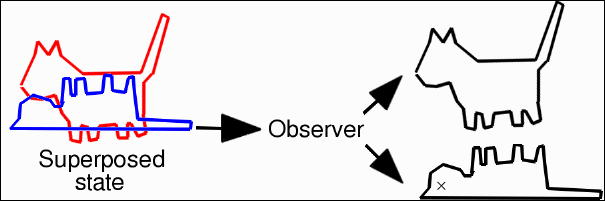
What problem does the "many worlds interpretation" try to solve? The core idea is captured by the infamous Schrödinger's cat thought-experiment. The cat ends up in a superposition:

α |cat-alive> + β |cat-dead>           (where α, β are complex amplitudes)

but in reality we never observe such a superposition. What we see is either that the Geiger counter has triggered, releasing the poison and the cat is dead or there was no particle-emission and the cat remains alive. Making the act of measurement explicit, the observer becomes entangled with the cat-box on observation and joins the superposition thus (with updated amplitudes α' and β') :

α'∣Live cat> ⊗ ∣Observer sees live cat> + β'∣Dead cat>  ⊗ ∣Observer sees dead cat>.

The overall situation is still a superposition, but an Everettian would say that since the observer has 'split',  each 'copy' doesn't see a superposition but just one outcome. If world-splitting is not your thing, then you have to postulate (as an extra axiom) that 'measurement' somehow causes the superposition to collapse to one or the other outcome according to the probabilities |α'|2 and |β'|2.

We now focus more precisely on how the process of 'measurement' destroys superpositions - a topic called 'decoherence'. The formal treatment of decoherence involves graduate-level concepts and is formidably inaccessible, while analogies such as 'phase information leaking into the environment' are unhelpful at best. I will say more about a 'simplest possible model' another day.

However, something can be said even at undergraduate level, and for this we are indebted to non-Everettian Eric L. Michelsen and his excellent "Quirky Quantum Concepts: Physical, Conceptual, Geometric, and Pictorial Physics that Didn't Fit in Your Textbook (Undergraduate Lecture Notes in Physics)". This is available as a PDF but in a fit of guilt I bought it. An extract, [somewhat annotated] follows (page 51 and following).

---

"In theoretical QM, we usually focus on perfect systems, and pure states. We frequently say that a measurement “collapses” the quantum state vector to one agreeing with the measurement, and this is often a useful simplification of the measurement process. However, in practice, the measurement process is more complicated than that, because most measuring equipment, and all observers, are macroscopic. The “decohered” state is the norm; you must work hard to achieve even an approximately pure entangled state.

We show here that elementary QM can explain some of the features of real measurements, however, the full explanation of decoherence is beyond our scope. (The term “decoherence” has a specific meaning: the process of a system becoming entangled with its environment in irreversible ways, resulting in the loss of a consistent phase relationship between components of the system state. We therefore use the more general term “loss of coherence” for both decoherence and other processes.)

Most macroscopic measurements do not show quantum interference [as in the two-slit experiment]. Why not? One reason is that macroscopic bodies suffer unknowable, and unrepeatable energy interactions, i.e. they gain or lose an unknowable amount of energy due to uncontrollable interactions with their environments. In other words, they are subject to simple “noise.” This results in the loss of a consistent phase relationship between components of a superposition state. We discuss below how such a loss of consistent phase leads to classical probabilities.

Let us walk through a plausible measurement, and consider the elementary quantum mechanics involved. [The system pictured below shows the famous Stern-Gerlach experiment, which first demonstrated the quantization of angular momentum.]


Suppose we start with a particle which can be in either of two states, |s1> or |s2>, such as polarization (horizontal or vertical), or spin (up or down). A general particle state is then:

|ψ> = a|s1> + b|s2>     where a,b are complex coefficients and |s1>,  |s2>  are basis states.


This is called a coherent superposition, because a and b have definite phases. (This is in contrast to a mixed state or incoherent mixture, where a and b have unknown phases.) All that is required for loss of coherence is for the relative phases of a and b to become unknown. For simplicity, we take |s1> and |s2> to be energy eigenstates, and the particle is spread throughout our measurement system [i.e. it is in a spatial superposition].

According to the Schrödinger equation, every state time-evolves with a complex phase determined by its energy, then our 2-state system time evolves according to:

|ψ(t)> = ae-iE1t/|s1> + be-iE2t/|s2>.

Since the energies E1 and E2 are quantized, the complex phases multiplying |s1> and |s2> maintain a precise (aka coherent) relationship, though the relative phase varies with time.

When we measure the particle state, the state of the measuring device becomes entangled with the measured particle. Let |M1> and |M2> be states of the whole measuring system in which either detector 1 detected the particle, or detector 2. If we look directly at the indicator lights, we will observe only state 1 or state 2, but never both. This means |M1> and |M2> are orthogonal. As the measuring system first detects the particle, the combined state of the particle/measuring-device starts out as a coherent superposition: [this is the same as the Schrödinger's cat case above]

|Ψ> = c|M1>|s1> + d|M2>|s2>       where c, d are complex coefficients.

The combined system time evolves according to its new energies:

|Ψ(t)> = ce-i(E1 + EM1)t/|M1>|s1> + de-i(E2 + EM2)t/|M2>|s2>

If the energies of the two measuring device states fluctuate even a tiny bit, the two components of the superposition will rapidly wander into an unknown phase relation. They will lose coherence.

Every macroscopic system suffers unrepeatable and unknowable energy fluctuations due to its environment.

We estimate a typical coherence loss rate shortly.

[So what does this loss of phase coherence mean in practice?]. Let us examine the effects of various kinds of energy transfers between a system and its environment. In our two-path experiment, [I think he means that this is a variant experiment where we don't 'look at' (i.e. measure) the indicator lights 1 and 2 so allowing the interference pattern to emerge on the screen in the figure to the right] the interference pattern is built up over many trials, by recording detections on film. Now suppose one path suffers an energy transfer to/from its environment before recombining and interfering. There are four possibilities:

  1. The energy transfer is knowable and repeatable. Then one can predict and see an interference pattern in the usual way.
  2. The energy transfer is unknowable, but repeatable. Then we can record an interference pattern, and from it, determine the relative phases of the two paths (mod 2π), and therefore the relative energies (mod 2πħ/t) from (ΔE/)t.
  3. The energy transfer is knowable for each trial, but not repeatable. Essentially, each trial has its own position for the interference pattern. One can then divide the detection region into intervals of probability calculated for each trial, and then show consistency with QM predictions, but contrary to classical probability.
  4. The energy transfer is unknowable and unrepeatable. Then there will be no interference pattern, and repeated trials do not allow us to measure any quantum effects, since the phase is unknown on each trial. Therefore, the measurements are equivalent to classical probabilities: it is as if a single path was chosen randomly, and we simply don’t know which path it was.

This fourth condition, of unknowable and unrepeatable energy transfer, causes loss of coherence, the randomization of phase of components of a superposition. Loss of coherence makes measurements look like the system behaves according to classical probabilities, with no “wave” effects. Loss of coherence destroys the interference pattern when we try to measure through “which slit” a particle passes. Full loss of coherence leads to classical probabilities.

Our example process leading to loss of coherence follows directly from the Schrödinger equation and unknown energy transfers. There is no need to invoke any “spooky” quantum effects.

Note that even accounting for loss of coherence, quantum theory still requires the axiom of collapse of the wave-function upon observation. When a particle’s wave splits, then passes through both detector 1 and detector 2, and then loses coherence because of entanglement with a macroscopic measuring device, the system is still left in a superposition of both slits:

|Ψ(tafter)> = f|M1>|s1> + g|M2>|s2>

we just don’t know f or g. We can’t generate an interference pattern from multiple trials, because each trial has a different phase relation between f and g, putting the peaks and valleys of any hoped-for interference pattern in a random place on each trial. These shifts average over many trials to a uniform distribution. Nonetheless, each trial evolves in time by the Schrödinger equation, which still leaves the system in a superposition. Once we “see” the result, however, the unobserved component of the wave-function disappears, i.e. the wave-function collapses.

Collapse of the wave-function is outside the scope of the Schrödinger equation, but within the scope of QM, because collapse is a part of QM theory. It is one of our axioms. Some references confuse this issue: they try to avoid assuming such a collapse as an axiom, but cannot derive it from other axioms. From this, they conclude that QM is “incomplete.” In fact, what they have shown is that the axiom of collapse completes QM.

Note that once the measuring system fully loses coherence, we could just as well say that the wavefunction has then collapsed, because from then on the system follows classical probabilities (equivalent to a collapsed, but unknown, wave-function). However, we now show that a binary model of “collapse or not” cannot explain partial coherence.

Partial coherence: What if we start with a microscopic system but replace our microscopic atoms with mesoscopic things: bigger than microscopic, but smaller than macroscopic? Mesoscopic things might be a few hundred atoms. These are big enough to lose coherence much faster than single atoms, but still slowly enough that some amount of interference is observed. However, the interference pattern is weaker: the troughs are not as low, and the peaks are not as high. A superposition leading to a weak interference pattern is called partially coherent. We describe partial coherence in more detail in section 8.4. The simple model that the wave-function either collapsed or didn’t cannot describe the phenomenon of partial coherence.

The larger the mesoscopic system, the more uncontrollable interactions it has with its environment, the faster it loses coherence, and the less visible is any resulting interference pattern. We can estimate the time-scale of coherence loss from our example energy fluctuations as follows: a single 10 μm infrared photon is often radiated at room temperature. It has an energy of ~0.1 eV = 1.6 x 10⁻²⁰ J. This corresponds to ω = E/ħ ~ 2 x 10¹⁴ rad/s. When the phase of the resulting system has shifted by an unknowable amount > ~2π, we can say the system has completely lost coherence. At this ω, that takes ~ 4 x 10–14 s. In other words, thermal radiation of a single IR photon causes complete loss of coherence in about 40 femtoseconds. In practice, other effects cause macroscopic systems to lose coherence in dramatically shorter times.

Summary: A measurement entangles a measuring device with the measured system. The entangled state of device and system time-evolves according to the Schrödinger equation. Macroscopic devices lose coherence, due to interactions with the environment. Lack of coherence prevents any interference pattern within the system. Therefore, measurement by a macroscopic device produces subsequent results that are classical, as if the system collapsed into a definite state upon measurement, but observers only “see” which state when they look at the measuring device. Any observation by a person is necessarily macroscopic, because people are big. Such an observation collapses the (incoherent) device/system/world state to that observed. Quantum interference can only be seen if it occurs before any entanglement with a macroscopic system (and therefore before any loss of coherence in the system).

The model of “collapse of the wave-function” is a binary concept: either the wave-function collapses or it doesn't. Such a model cannot account for the phenomenon of partial coherence. Loss of coherence is a continuous process, taking a fully coherent state through less and less partially coherent states and eventually to incoherent (aka “mixed”) states. Continuous loss of coherence fully explains partial coherence and the varying visibility of interference patterns.

Some quantum effects, such as the spectrum of atoms, do not rely on interference, and are therefore macroscopically observable. In fact, measurement of such effects led to the development of QM."