Showing posts with label Hugh Everett III. Show all posts

Saturday, October 14, 2017

MWI, plus entanglement leads to GR, maybe?

In this video Sean Carroll lectures at Kings College on the 'Many-Worlds Interpretation' of quantum theory and his attempts, with collaborators, to conceptualise general relativistic spacetime as an emergent phenomenon due to entanglement.

Apparently the degree of entanglement between distinct vacuum states falls off as the distance between them. But perhaps this can be inverted, so that the concept of distance could be seen as an emergent proxy for the degree of entanglement.


The 50 minute lecture is 'aimed at undergraduates who haven't necessarily yet taken a quantum mechanics course'. If you are such, Carroll's talk will be as compelling as a presentation on Summa Theologica from Thomas Aquinas.

On the other hand, a passable familiarity with Hilbert space, quantum superposition and the Schrödinger equation plus a hand-wavy feel for QFT and Einstein's field equations will allow you to properly appreciate Carroll's approach to physics (and would make you a physics graduate).

In a nutshell, it's believe in the maths. Once you appreciate the ubiquity of superposition (ie, it's everywhere) you're kind of committed to the reality - in some sense - of Hilbert space. The observed phenomena simply can't be explained by theories which restrict themselves to our classical-looking 4D spacetime.

Carroll's talk is not technical in argumentation, he mentions rather than uses the theoretical apparatus of modern physics. That does put the burden of getting his drift wholly on the theoretical preparation of the listener of course.

In the final part of his lecture, he describes the research programme which seeks to obtain geometry from entanglement in quantum field theories via entropy and then, through considerations of energy, to reconstruct the GR field equations as the classical limit.

He seems encouraged, though this is work-in-progress.

Thursday, January 19, 2017

The quantum-theoretic block universe


Eternalism is not hard to justify.
Yesterday I contemplated my situation and concluded: "This is real, this is now."

Today, when I recollect that scene, I'm inclined to think it was indeed real, and shows the reality of the past (which has not flickered out of existence but is .. elsewhere).

Yesterday, I also thought, "Tomorrow, I will be writing a post."

Today, here I am doing it. For yesterday's me, that shows the reality of the future.
As Frank Sinatra observed, "You can't have one without the other."

---

For greater conviction, we can appeal to special relativity. As I wrote in a piece for sciencefiction.com,
"Brian Greene in ‘The Fabric of the Cosmos’ (page 134) considers an alien in a galaxy ten billion light years away, at the edge of the visible universe. Simply by ambulating towards or away from us at 10 mph, the alien’s view of what is happening ‘right now’ on earth swings from 149 years in the past to 149 years in the future."
Still, the block universe is classical and therefore inaccurate. It's necessary to move to quantum theory where, as usual, one needs to take the red pill.

Theoretical physicist Jeremy Bernstein on 'A Quantum Past'.
"In FAPP (For All Practical Purposes) language we have a quantum mechanical system described by a wave function ψ(t), I am  only interested in the time variable.

The wave function obeys a Schrödinger equation with a Hamiltonian H. The formal solution to this equation is ψ(t) = exp(iHt)ψ(0). Throughout I am setting ћ = 1. Thus to recover Ψ(0) from ψ(t) all we have to do is to multiply by exp(-iHt).

Haven’t we then recovered the past? What is all the fuss about? The problem is that there is more to life than the wave function. There are the “observables” which represent what we really want to know about the system. These observables are described by Hermitian operators A. B. C and so on. We can expand ψ in a sum over the orthonormal eigenfunctions of any of these operators. The coefficients in the expansion are related to the probabilities that in a measurement the system will be found to have one of these eigenvalues. This is “Born’s rule” and in FAPP it must be assumed.

To find which of these eigenvalues the system actually has, we must perform a measurement. Stripped to its essence the apparatus that produces this measurement projects out from the sum of eigenfunctions one of them.

After the measurement the rest of the terms in the sum disappear. Using the term of art, the wave function “collapses”. It is at this point that we lose our capacity to reconstruct the past.

Projection operators are singular. They do not have inverses. All the king’s horses and all the king’s men cannot put the wave function back together again.

It was von Neumann in the early 1930’s who first noted that in FAPP mechanics there were two kinds of processes. There were processes that could be described by a Schrödinger equation and there were measurements which could not. He did not, as far as I know, comment on what this implied for retrodiction.

A case in point is an electron described by a spherically symmetric Schrödinger wave. If this electron strikes a detector is does so at a place - a spot. After this happens all trace of the spherically symmetric wave function vanishes.

I have certainly not made a careful search of the literature but among the founding fathers of FAPP I can come up with only two references that deal with the matter of the quantum past.

One is Heisenberg and the other is a paper by Einstein, Richard Tolman, and Boris Podolsky, “Knowledge of Past and Future in Quantum Mechanics” which they wrote in 1931 when Einstein was spending time at CalTech."
Bernstein talks about these two references, and then discusses where he thinks the problem resides, and what is to be done.
"It seems to me that any interpretation of the quantum theory that addresses this [the problem of wavefunction collapse] must have the feature that measurements are simply just another interaction like the rest.

Von Neumann’s notion that there were two classes of interactions one whose time evolution could be described by a Schrödinger equation and one of which couldn’t, has to be abandoned.

I will discuss two proposals for doing this each of which has its adherents and its detractors. On the one hand I am going to discuss what I will call “Bohmian mechanics” a term which David Bohm, who invented this approach , apparently did not like. As far as he was concerned, he was just doing quantum mechanics but in a different way. However nearly everyone else calls it Bohmian mechanics - so will I.

On the other hand, I am going to discuss the “decoherent history” interpretation which Murray Gell-Mann and Jim Hartle have done the most on. Sometimes this is called the “many worlds” interpretation, but not by them. I think that the term “many worlds” is misleading. As far as we know there is one world, the one we live in."
I'm not a fan of “Bohmian mechanics” and insofar as any quantum ontology works for me, it has to be "Many Worlds" (Sean Carroll explains why).

So I'll skip over Bernstein's description of Bohm's view of the quantum past and quote his take on “decoherent histories”.
"In the "Many Histories Interpretation" what indeed is history?

At first sight this might seem to be obvious. All we have to do is to run the chain backwards.

Yes this gives one history but there are others, possibly very many others. The reason is that if all we know is the present state vector there are many paths by which we could have arrived there depending on which initial state vector we started from. We have no way of knowing this from the data we have at hand.

Let us take an example discussed by Hartle - the Schrödinger cat (I can’t resist noting that when I spent an afternoon with Schrödinger in his apartment in Vienna there was no cat). In any event this unfortunate feline is put in a box that contains a capsule of poison gas and a sample of uranium. The capsule is triggered so that if the uranium has an alpha decay, the alpha sets off the trigger and the unfortunate feline expires.

After a time interval we open the box and happily the cat is alive. It could, according to the many history approach have arrived at this state in two ways. The initial state might have been a cat alive state or it might have been a coherent sum of a cat alive and a cat dead state. From the presence of the living cat we cannot decide.

The vision of the past given by the decoherent history interpretation and the Bohmian seems radically different. In Bohmian mechanics we could in principle follow all the cat molecules backwards in time and arrive at one and only one past.

I don’t know how you feel, but the ambiguity of the past makes me queasy. It might be entertaining to imagine that in an alternate past my grandmother who was born in a Polish stetl could have been Eleanor Roosevelt.

I readily accept that these pasts to not communicate but there seem to be too many of them from the point of view of economy. A trip to a barber wielding Occam’s razor seems warranted.

In any case when it comes to quantum pasts, as Duke Ellington taught us, “Things ain’t what they used to be.”
Perhaps Bernstein wrote this short paper just for that final joke at the end?

To summarise, if you take quantum theory seriously and you take eternalism (the block universe) seriously, then it seems that the past is as indeterminate as the future.

---

How does this relate to the 'low entropy in the past' idea used to explain the 'arrow of time'?

Since quantum theory is consistent with the second law of thermodynamics, a picture emerges of backwards branching towards (superpositions of) Big Bang variants.

My ex-colleague Roy said as much in this comment, on an earlier post devoted to the MWI. See here for more.

Monday, November 07, 2016

'The Many Worlds of Hugh Everett III' - Peter Byrne

Amazon Link

I finally got round to reading Peter Byrne's biography of Hugh Everett III.

It's a good book, weaving between three themes: Everett's thesis on the 'Many Worlds Interpretation'; his career as a cold-war nuclear strategist for the Pentagon; and his curiously unconventional personal life (swinger, incipient alcoholic, heavy smoker, womaniser, cynic, libertarian, genius).

The 'Many-Worlds' work was his proudest achievement, although he never published a word on quantum mechanics after his thesis paper. The physics establishment ignored the concept for two decades, while individuals around Bohr were poisonously hostile.

The historical treatment works well, showing how the controversies reflected ongoing preoccupations and progress in the community. Cosmology, quantum gravity and decoherence were later catalysts for renewed interest, as was quantum computing (David Deutsch a key visionary here).

Everett's ideas were continually misunderstood, often wilfully. His concept of 'splitting universes' whenever a 'measurement' is made is actually a topological statement that the universe (multiverse) is a network (not a tree, which would fail time-reversibility) consisting of a non-denumerable infinity of evolving universes, each like our presently observed one, linked by 'measuring events'.

Three major issues continue to puzzle researchers. Everett believed he had derived the Born probability rule from his topology: many physicists disagree. The dispute seems highly technical.

Then there is the problem of the 'preferred basis', which reflects that the concept of superposition is itself basis-dependent, so that the act of splitting seems both arbitrary and non-consistent from point to point on the multiverse network (Everett thought this a non-issue as the act of measurement itself presupposes a basis).

Finally, and a point not brought out by the book, the state vector evolves (via the Schrödinger equation) in Hilbert space, not our familiar four-dimensional spacetime. Yet the Everettian multiverse seems to be a network of spacetime universes. How do we get from the ontology of Hilbert space to that of ordinary spacetime? This seems to be an active research question.

Peter Byrne's book has the usual problems of pop-sci. It's conceptually too remote for a purely lay reader while too imprecise for someone who knows some quantum mechanics (the failure to differentiate spacetime and configuration space, for example).

There are the odd errors of authorial comprehension - Byrne does not appear to understand computer science and his explanation of the Halting Problem is just wrong.

Finally, it's hard to write about the people doing the math and computer simulations for thermonuclear warfare, optimal counterforce strategies and assured destruction without taking some moral stance - but it's just parochial judging those guys, including Everett, from the 'superior' standpoint of an impeccable pacifistic-liberal. Biting the hand that fed you, methinks.

If you want to get a handle on the strange birth and tortuous development of the MWI, you couldn't do better than read this book. And as a bonus you get a voyeuristic tour of scarily-dysfunctional Everettian family life as well.

---

Sean Carroll has a good defence of the MWI.

---

If you have a graduate level of understanding of quantum mechanics, here is your next step.

Amazon link

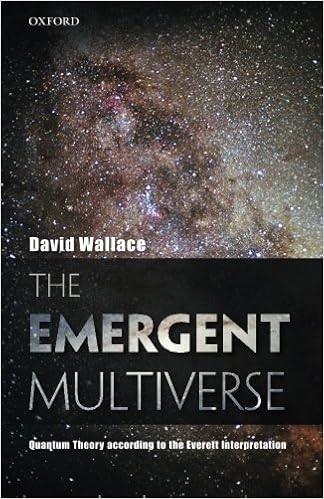
The definitive introduction to Everettian quantum mechanics.

---

Update: In the comments you will see a discussion as to whether it is really true that worlds can merge as well as split. Splitting occurs via the thermodynamically-irreversible process of decoherence and thus is overwhelmingly the likely thing to happen. Yet under very special circumstances, distinct worlds can merge. This is highlighted in my follow-up post.


Thursday, August 18, 2016

Reality and the MWI


From "Many Worlds? An Introduction" by Simon Saunders.
“As Popper once said, physics has always been in crisis, but there was a special kind of crisis that set in with quantum mechanics. For despite all its obvious empirical success and fecundity, the theory was based on rules or prescriptions that seemed inherently contradictory. There never was any real agreement on these matters among the founding fathers of the theory.
...
“In what sense are the rules of quantum mechanics contradictory? They break down into two parts. One is the unitary formalism, notably the Schrödinger equation, governing the evolution of the quantum state. It is deterministic and encodes spacetime and dynamical symmetries.

“Whether for a particle system or a system of fields, the Schrödinger equation is linear: the sum of two solutions to the equation is also a solution (the superposition principle). This gives the solution space of the Schrödinger equation the structure of a vector space (Hilbert space).

“However, there are also rules for another kind of dynamical evolution for the state, which is - well, none of the above. These rules govern the collapse of the wavefunction. They are indeterministic and non-linear, respecting none of the spacetime or dynamical symmetries. And unlike the unitary evolution, there is no obvious route to investigating the collapse process empirically.

“Understanding state collapse, and its relationship to the unitary formalism, is the measurement problem of quantum mechanics. There are other conceptual questions in physics, but few if any of them are genuinely paradoxical. None, for their depth, breadth, and longevity, can hold a candle to the measurement problem.

“Why not say that the collapse is simply irreducible, ‘the quantum jump’, something primitive, inevitable in a theory which is fundamentally a theory of chance? Because it isn’t only the collapse process itself that is under-specified: the time of the collapse, within relatively wide limits, is undefined, and the criteria for the kind of collapse, linking the set of possible outcomes of the experiment to the wavefunction, are strange.

“They either refer to another theory entirely - classical mechanics - or worse, they refer to our ‘intentions’, to the ‘purpose’ of the experiment.

“They are the measurement postulates - (‘probability postulates’ would be better, as this is the only place where probabilities enter into quantum mechanics). One is the Born rule, assigning probabilities (as determined by the quantum state) to macroscopic outcomes; the other is the projection postulate, assigning a new microscopic state to the system measured, depending on the macroscopic outcome.

“True, the latter is only needed when the measurement apparatus is functioning as a state-preparation device, but there is no doubt that something happens to the microscopic system on triggering a macroscopic outcome.

“Whether or not the projection postulate is needed in a particular experiment, the Born rule is essential. It provides the link between the possible macroscopic outcomes and the antecedent state of the microscopic system. As such it is usually specified by giving a choice of vector basis - a set of orthogonal unit vectors in the state space - whereupon the state is written as a superposition of these. The modulus square of the amplitude of each term in the superposition, thus defined, is the probability of the associated macroscopic outcome.

“But what dictates the choice of basis? What determines the time at which this outcome happens? How does the measurement apparatus interact with the microscopic system to produce these effects? From the point of view of the realist the answer seems obvious. The apparatus itself should be modelled in quantum mechanics, then its interaction with the microscopic system can be studied dynamically. But if this description is entirely quantum mechanical, if the dynamics is unitary, it is deterministic. Probabilities only enter the conventional theory explicitly with the measurement postulates. The straightforwardly physicalistic strategy seems bound to fail. How are realists to make sense of this?

“The various solutions that have been proposed down the years run into scores, but they fall into two broadly recognizable classes. One concludes that the wavefunction describes not the microscopic system itself, but our knowledge of it, or the information we have available of it (perhaps ‘ideal’ or ‘maximal’ knowledge or information). No wonder modelling the apparatus in the wavefunction is no solution: that only shifts the problem further back, ultimately to ‘the observer’ and to questions about the mind, or consciousness, or information - all ultimately philosophical questions.

“Anti-realists welcome this conclusion; according to them, we neglect our special status as the knowing subject at our peril. But from a realist point of view this just leaves open the question of what the goings-on at the microscopic level, thus revealed, actually are. By all means constrain the spatiotemporal description (by the uncertainty relations or information-theoretic analogues), but still some spatiotemporal description must be found, down to the length-scales of cells and complex molecules at least, even if not all the way to atomic processes.

“That leads to the demand for equations for variables that do not involve the wavefunction, or, if none is to be had in quantum mechanics, to something entirely new, glimpsed hitherto only with regard to its statistical behaviour. This was essentially Einstein’s settled view on the matter.

“The only other serious alternative (to realists) is quantum state realism, the view that the quantum state is physically real, changing in time according to the unitary equations and, somehow, also in accordance with the measurement postulates.

“How so? Here differences in views set in. Some advocate that the Schrödinger equation itself must be changed (so as to give, in the right circumstances, collapse as a fundamental process). They are for a collapse theory.

“Others argue that the Schrödinger equation can be left alone if only it is supplemented by additional equations, governing ‘hidden’ variables. These, despite their name, constitute the real ontology, the stuff of tables and chairs and so forth, but their behaviour is governed by the wavefunction. This is the pilot-wave theory.

“Collapse in a theory like this is only ‘effective’, as reflecting the sudden irrelevance (in the right circumstances) of some part of the wavefunction in its influence on these variables. And once irrelevant in this way, always irrelevant: such parts of the wavefunction can simply be discarded. This explains the appearance of collapse.

“But for others again, no such additional variables are needed. The collapse is indeed only ‘effective’, but that reflects, not a change in the influence of one part of the quantum state on some hidden or ‘real’ ontology, but rather the change in dynamical influence of one part of the wavefunction over another - the decoherence of one part from the other.

“The result is a branching structure to the wavefunction, and again, collapse only in a phenomenological, effective sense. But then, if our world is just one of these branches, all these branches must be worlds. Thus the many worlds theory - worlds not spatially, but dynamically separated.”
Saunders' introductory chapter from the book, "Many Worlds?" underlines the central puzzle of quantum mechanics. What would reality have to be like to make the theory of quantum mechanics so incredibly accurate?

Realists driven to the 'Many Worlds Interpretation' can still make no sense of it (Sean Carroll is a consistent defender, though). As Saunders observes on page 20,

“How does talk of macroscopic objects so much as get off the ground? What is the deep-down ontology in the Everett interpretation? It can’t just be wavefunction [...]; it is simply unintelligible to hold that a function on a high-dimensional space represents something physically real, unless and until we are told what it is a function of  - of what inhabits that space, what the elements of the function’s domain are.

“If they are particle configurations, then there had better be particle configurations, in which case not only the wavefunction is real.”


And so I have bought "The Many Worlds of Hugh Everett III: Multiple Universes, Mutual Assured Destruction, and the Meltdown of a Nuclear Family" by Peter Byrne.