Showing posts with label General Relativity. Show all posts

Sunday, February 01, 2026

Does a Thrown Ball Reveal the Curvature of Spacetime?


Does a Thrown Ball Reveal the Curvature of Spacetime?

The question sounds innocent: you throw a ball, it traces a neat parabola, and you wonder whether you have just watched Einstein at work. The difficulty is that “curvature” is doing two very different jobs in this story. One sense concerns the visible curvature of a spatial trajectory drawn by an object as time passes. The other concerns the invariant curvature of four-dimensional spacetime itself. These are related, but they are not the same thing. The confusion arises when they are either collapsed into one another, or artificially torn apart. The clean way forward is to contrast three observer stances and be explicit about what each can and cannot infer.

1. The ground-based observer: “The ball falls.”

You stand on the Earth and watch the ball arc downward. In your coordinates, the path through space is approximately parabolic. This is not in dispute. The question is what that parabola represents.

In general relativistic terms, you are not an inertial observer. The Earth’s surface is prevented from free fall by internal stresses in matter; your accelerometer reads roughly 1g. Your frame is therefore non-inertial. When you describe the motion of freely falling objects from such a frame, inertial effects appear that look exactly like a gravitational force.

From this standpoint, the ball’s parabolic trajectory is the spatial trace of a geodesic described in a non-inertial coordinate system. This is a perfectly legitimate description, but it does not by itself settle the question of spacetime curvature. Curved spatial paths can arise either because spacetime is curved or because the observer’s frame is accelerating. From the ground alone, those possibilities are not disentangled.

2. The local free-fall observer: “The ball is (almost) straight.”

Now imagine you are launched alongside the ball, sharing its free-fall motion. In your immediate neighbourhood you are very close to an inertial frame. Over short distances and times, the ball does not exhibit any strong downward acceleration relative to you. Its motion is close to uniform; its worldline appears nearly straight in your local coordinates.

This is the equivalence principle in its proper domain: local, approximate, and powerful. It guarantees that along any freely falling worldline one can choose coordinates in which gravitational effects largely disappear. This is technically represented by the ability to set the connection coefficients (the Christoffel symbols) to zero at a specific point.

But this does not mean spacetime is flat. What vanishes locally are the connection coefficients, not the curvature. Curvature reveals itself only when you consider a region rather than a point or a single worldline. If you watch another freely falling object nearby, you will eventually observe relative acceleration between the two. Those tidal effects cannot be transformed away. They are the signature of the Riemann curvature tensor.

3. The deep-space inertial observer: “The ball follows a geodesic of curved spacetime.”

Now consider an inertial observer far from the Earth, equipped with a telescope, floating freely and not accelerating. This observer is the “smoking gun” witness. Because they know they themselves are inertial, any deviation they see in the ball’s path cannot be attributed to their own coordinate acceleration.

This observer does not need to appeal to accelerating coordinate systems to explain what they see. They observe a ball moving in the gravitational field sourced by the Earth, and in general relativity that means the ball follows a geodesic of the Earth’s spacetime geometry. When this observer asks, “What curve does this geodesic trace in three-dimensional space as a function of my time coordinate?”—referring to the coordinate time t of a distant clock—the answer in the weak-field, low-velocity regime is: approximately a parabola.

That near-parabolic shape is not an illusion, nor is it a coordinate trick. It is precisely how timelike geodesics in the Earth’s weak gravitational field project into ordinary space when described using a reasonable global time coordinate. In this limited but perfectly legitimate sense, the parabolic trajectory is explained by spacetime curvature. The Earth’s mass curves spacetime; free particles follow geodesics; those geodesics, when viewed spatially, look parabolic to an excellent approximation.

Why the parabola is still not “the curvature”

Here is the crucial distinction that must be made sharply. Although the near-parabolic trajectory is a consequence of spacetime curvature, it is not itself a direct measure of that curvature. A single geodesic, by itself, does not encode the Riemann tensor. Different curved spacetimes can support geodesics whose spatial projections look very similar over short distances.

What curvature controls, invariantly and unavoidably, is the relative motion of nearby geodesics. If the deep-space observer watches two balls thrown with slightly different initial conditions, they will see their separation evolve in a way that cannot be mimicked in flat spacetime by any choice of coordinates. That relative acceleration—tidal deviation—is the coordinate-independent manifestation of spacetime curvature.

“Mostly timelike rather than spacelike curvature”

This phrase gestures at a genuine feature of the weak-field regime. Near Earth, the dominant deviation of the metric from flatness lies in the time-time component (g00). This encodes gravitational time dilation and reproduces the Newtonian potential in the appropriate limit. For slow-moving objects (where velocity v is much less than the speed of light c), this time-warping largely governs their motion.

Spatial curvature is also present, but its effects on slow projectiles are subleading. If the ball were thrown at relativistic speeds, or if we were observing the path of light, the spatial components of the curvature would become just as prominent as the temporal ones. It is one unified spacetime geometry, but the ball’s low velocity makes it primarily sensitive to the temporal "stretch" of the metric.

The answer, stated precisely

A thrown ball near Earth follows a timelike geodesic of the Earth’s weakly curved spacetime. A ground-based observer describes that geodesic as a parabola because they are in a non-inertial frame. A local free-fall observer sees the motion as nearly straight because curvature is negligible over small regions. A deep-space inertial observer sees neither illusion nor fiction: they see a genuine geodesic of a curved spacetime whose spatial projection is approximately parabolic.


Addendum: Why do different observers see the same shape?

It may seem counter-intuitive that the earthbound observer (in a non-inertial frame) and the deep-space observer (in an inertial frame) both conclude the ball follows an approximate parabola. One might expect such different perspectives to yield different geometries. However, they converge because the Earth’s gravitational potential and the ground’s physical acceleration are numerically and geometrically coupled.

For the ground-based observer, the parabola is an inertial effect. Because the ground is constantly pushing you upward, you are in an accelerating frame. In such a frame, a free particle appears to accelerate in the opposite direction. Your description follows the Newtonian kinematic: z(t) = z0 + vz0t - ½gt2. This is a "fictitious" force result, but the mathematical plot is a literal parabola.

For the deep-space observer, the interpretation is inverted. They see the ball following a worldline that is as "straight" as the curved geometry allows (a geodesic). Because they are observing a slow-moving object in a weak field, the metric component governing time dilation (g00 ≈ 1 + 2Φ/c2) dominates the math. When they project this 4D worldline onto their 3D spatial grid, the resulting equation for the trajectory yields the exact same ½gt2 relationship.

Ultimately, they must converge because of the Equivalence Principle. If the "fictitious" parabola seen on the ground did not match the "geometric" parabola seen from space, an observer could distinguish between gravity and acceleration simply by throwing a ball. The fact that they see the same shape is not a coincidence; it is a requirement of the symmetry between acceleration and gravity that lies at the heart of General Relativity.


Thursday, January 16, 2025

Physics as Geometry (by ChatGPT)


I was always puzzled that while position and velocity are relative - you need a coordinate system to give you a quantitative value (a vector) and that can vary between observers - yet acceleration seems absolute. You may not have a definite velocity - but you certainly know if you are accelerated.

Where does this difference come from? It certainly doesn’t seem explicable by mere differentiation: dx/dt; dv/dt …

Let’s ask ChatGPT.


Velocity and Acceleration: Relative and Absolute?

In Einstein’s theory of relativity, velocity is understood as a relative concept. The velocity of an object can only be defined with respect to another frame of reference, making it inherently dependent on the choice of observer. However, acceleration, to be specific proper acceleration, is absolute in a meaningful sense. Proper acceleration is the acceleration measured by an accelerometer attached to an object and does not depend on external reference frames.

Proper acceleration actually reveals an object’s deviation from geodesic motion in spacetime. In General Relativity, freely falling objects follow geodesics—natural paths dictated by spacetime curvature. Any deviation from these geodesics, caused by forces like electromagnetic or nuclear interactions, results in proper acceleration.

Proper acceleration serves as a direct probe of the forces acting on an object, linking the physical experience of motion to spacetime geometry. But perhaps we can go further in exploring the very concept of 'forces'...


Acceleration and Geodesics: The Role of Geometry

In General Relativity, gravity, traditionally conceived as a force, emerges instead as the curvature of spacetime caused by mass and energy. Objects in freefall follow geodesics—paths that minimize proper time—in malleable spacetime and 'proper acceleration' quantifies any deviations from such natural trajectories.


Forces as Geometry: The Internal Spaces of Gauge Theory

While gravity arises from spacetime geometry, the Standard Model forces (electromagnetic, weak, and strong) are described using gauge theories. These forces can be conceptualised as originating from the geometry of internal spaces rather than spacetime.

[So now we see why we had the tutorial a couple of days ago on fiber bundles and connections and curvature. Go look.]

In fundamental physics, a gauge theory is a type of field theory where the laws of physics remain invariant under local transformations of certain symmetry groups, called gauge groups. These symmetries are "local" because the transformations can vary from point to point in spacetime, necessitating the introduction of additional fields, known as gauge fields, to preserve this invariance. 

Gauge fields mediate the interactions between particles and are associated with the fundamental forces of nature. For example, the electromagnetic force arises from the U(1)U(1) gauge symmetry, while the weak and strong nuclear forces correspond to SU(2)SU(2) and SU(3)SU(3) symmetries, respectively.

The dynamics of these fields and their interactions are governed by the mathematical structure of connections and curvatures on fiber bundles, with the curvature describing the field strength (e.g., the electromagnetic or gluon fields).

Gauge theories underpin the Standard Model of particle physics and have proven remarkably successful in describing the fundamental forces of nature, except gravity.

Gauge theories of spacetime objects rely on the mathematical framework of fiber bundles, where:

The base space is spacetime.

The fibers are internal symmetry spaces associated with gauge groups ( for electromagnetism, for the weak force, and for the strong force).

Connections on these bundles define how fields change across spacetime, while their curvature describes the strength of forces (e.g., the electromagnetic field or gluon interactions).

In this geometric picture, particles move along geodesics in internal spaces, and deviations from these geodesics correspond to forces. For example, an electron in an electromagnetic field experiences a 'force', but that's really an expression of the curvature of the fiber bundle, just as a planet’s motion is affected by spacetime curvature in GR. (Advanced).


Toward Unified Geometry: Higher Dimensions and Emergent Spacetime

One paradigm within modern physics seeks to unify GR and QT within a single geometric framework. Several theories pursue this goal by introducing higher-dimensional spaces in which all forces, including gravity, emerge as manifestations of geometry:

1. Kaluza-Klein Theory

Adds an extra spatial dimension to spacetime. Electromagnetism is reinterpreted as a geometric effect of this additional dimension, with the gauge symmetry arising naturally.

2. String Theory

Proposes that particles are vibrating strings in a high-dimensional space. The Standard Model forces and gravity are meant to emerge from the geometry of compactified extra dimensions.

3. Emergent Spacetime

Suggests that spacetime itself is not fundamental but arises from more primitive entities, such as quantum entanglement or networks of interacting quantum bits. In such models, acceleration, curvature, and force become emergent properties of a deeper, pre-spacetime structure.

These approaches aim to provide a unified geometric foundation, where all forces are seen as curvatures in a higher-dimensional or more abstract space. The elegance of these formulations lies in their capacity to reduce complex phenomena to simple geometric principles, suggesting that at its heart, nature is deeply geometric. However, reconciling the quantum nature of gauge fields with the classical geometric nature of GR remains an unresolved challenge.


Tuesday, January 14, 2025

Fiber Bundles and Connections: a ChatGPT Briefing


Fiber Bundles and Connections: a ChatGPT Briefing

Fiber bundles are incredibly useful in combining relativity with quantum theory, particularly when developing Quantum Field Theory (QFT). They provide the mathematical framework to incorporate internal symmetry spaces of quantum fields alongside the spacetime manifolds of Special and General Relativity.


1. What is a Fiber Bundle?

A fiber bundle is a space that looks locally like a product of two spaces but may have a more complicated global structure. It's a way of "attaching" one type of space (the fiber) to every point of another space (the base space).

Components of a Fiber Bundle:

  1. Base Space (B): The "main" space where everything is anchored. For example, spacetime is often the base space in physics.

  2. Fiber (F): A space "attached" to every point of the base space. This might be a vector space, a circle, or something else, depending on the problem (see image above). It's often an 'internal space' of quantum theory.

  3. Total Space (E): The combined structure, including the base and all the fibers.

  4. Projection (π:E→B): A map that "projects" the total space onto the base space, associating each point in the total space with a point in the base space.

Example: a Cylinder

  • The base space (B) is a circle.

  • The fiber (F) is a line segment.

  • The total space (E) is the cylinder.

  • Locally, the cylinder looks like a product B×F (a circle times a line segment), but globally, the cylinder wraps around.


2. Principal and Associated Bundles

  • A principal bundle has fibers that are groups (like U(1) for electromagnetism or SU(3)for the strong force).

  • An associated bundle uses the same base space but replaces the fibers with other structures (e.g., vector spaces).

These structures are crucial in physics because they provide the mathematical framework for gauge fields.


3. What is a Connection?

A connection on a fiber bundle tells you how to "connect" the fibers at different points in the base space. It provides a way to compare fibers, even if the base space is curved or twisted.

Why is a Connection Needed?

Imagine walking on a curved surface while carrying a vector (like an arrow). The connection tells you how to "transport" the vector as you move so that its relationship with the surface remains consistent.

Parallel Transport

Parallel transport is the process of moving objects (like vectors) along a curve in the base space while keeping them consistent with the connection.


4. The Curvature of a Connection

The curvature of a connection measures how much the fibers "twist" or "bend" when you move around a loop in the base space. This is crucial in physics:

  • For gravity (General Relativity), curvature describes spacetime bending and therefore gravity.

  • For gauge theories (like electromagnetism), curvature describes field strengths (e.g., the electromagnetic field tensor).


5. Examples in Physics

  1. Electromagnetism (Gauge Theory):

    • The base space is spacetime.

    • The fiber is a U(1) group (related to the phase of the electromagnetic wave - the imaginary angle) - see below.

    • The connection corresponds to the electromagnetic potential (Aμ). Note that this is a different field to the fiber bundle.

    • The curvature corresponds to the electromagnetic field strength (Fμν=∂μAv−∂vAμ).


  2. General Relativity:

    • The base space is spacetime.

    • The fiber is a tangent space (a small, flat space attached to every point).

    • The connection is the Levi-Civita connection, describing how vectors are parallel transported.

    • The curvature is the Riemann tensor, describing spacetime bending.


6. Why Are Fiber Bundles Useful?

Fiber bundles are essential for describing systems where local properties vary but are organized globally. For instance:

  • Gauge theories describe forces (electromagnetic, weak, strong) as interactions in the internal "fiber" spaces.

  • General Relativity uses fiber bundles to describe how spacetime geometry affects motion.

  • The Standard Model combines these ideas, describing particles as objects in fibers and their interactions as connections and curvatures.


Summary

  • A fiber bundle is a structure where a "fiber" space is attached to every point of a "base" space.

  • A connection defines how to compare or move objects (like vectors) between fibers.

  • Curvature measures how much the connection "twists" the fibers, leading to physical effects like forces or field strengths.

These ideas unify many physical theories, allowing us to describe particles, forces, and spacetime geometry in a single mathematical framework.

An article about this.


"What are the elements of the electromagnetic gauge field?"

ChatGPT: The electromagnetic gauge field arises in the context of quantum electrodynamics (QED) and the U(1) gauge symmetry. It's the connection over the fiber bundle (phase iθ, with its U(1) symmetry). 

Its key elements are:

  1. Gauge Field (Aμ):
    The electromagnetic gauge field is a four-vector field Aμ=(A0,A), where:

    • A0: The scalar potential, representing the electric potential.
    • A: The vector potential, related to the magnetic field.

    Together, Aμ encodes the information about the electromagnetic fields and their interactions.

  2. Field Strength Tensor (Fμν) - curvature of the connection:
    The electromagnetic field strength tensor Fμν is derived from the gauge field (note that this is a kind of 4D generalisation of the curl vector operator ×A):

    Fμν=μAννAμ

    This tensor describes the electric and magnetic fields:

    • Electric field (E): Ei=F0i.
    • Magnetic field (B): Bi=12ϵijkFjk
  3. Gauge Symmetry:
    The electromagnetic gauge field Aμ is defined up to a gauge transformation:

    AμAμ+μΛ(x)

    where Λ(x) is a scalar function. This symmetry reflects the freedom to redefine Aμ without altering physical observables. Specifically it is linked to the U(1) symmetry of the fiber bundle.

  4. Physical Observables:
    While Aμ itself is not directly measurable, the field strength tensor Fμν is. It encodes the observable electric and magnetic fields.

  5. Interaction with Charged Particles:
    In QED, the gauge field couples to charged particles, such as electrons, via the minimal coupling:

    pμpμeAμ

    where pμ is the four-momentum and e is the charge of the particle.

In summary, the electromagnetic gauge field is represented by the four-vector potential Aμ, from which the physical electric and magnetic fields are derived, and it exhibits U(1) gauge symmetry. This symmetry governs how Aμ interacts with charged particles and transforms under gauge transformations.

For more clarity, see 'Moving the slider' as a gauge transformation metaphor.


My full tutorial with ChatGPT.

Monday, December 16, 2024

Foliation in SR and GR - a ChatGPT briefing

From ResearchGate

Introduction

Foliations formalize the concept of the present moment in special and general relativity. Unlike the naive intuition that 'now' is a unique and universal moment in the history of the universe, relativity theory demonstrates that foliations depend on the observer's state of motion and local spacetime curvature.

In the flat spacetime of special relativity, foliations are distinct for inertial observers moving at different relative velocities. In the curved spacetimes of general relativity, particularly near regions of extreme curvature such as the event horizons of rotating black holes where spacetime becomes highly distorted leading to effects such as 'frame-dragging', foliations may not exist globally.

In these extreme scenarios, time is no longer orthogonal to space. This implies that even a relativized notion of a coherent 'now' can break down in such extreme environments, leaving no consistent way to define a universal 'now,' even for a single observer.

This sets up tomorrow's post: "There Is No Such Thing as ‘Now’".


Foliation in Special and General Relativity

Foliation is a geometric concept used in spacetime theories to represent the decomposition of a four-dimensional manifold into a family of three-dimensional hypersurfaces. This allows for a clearer understanding of spacetime dynamics, observers' perspectives, and the structure of the universe. Below, the concept is outlined in the contexts of both special relativity and general relativity.

1. Foliation in Special Relativity

Spacetime Structure

  • In special relativity, spacetime is modeled as a flat, four-dimensional Minkowski manifold.
  • It has a global structure, where spacetime can be divided into three-dimensional spacelike hypersurfaces labeled by a time parameter t.

Slices of Spacetime

  • Simultaneity Hypersurfaces: A foliation in special relativity corresponds to slicing spacetime into surfaces of constant time t as perceived by an inertial observer. These slices represent "events happening at the same time" for that observer.
  • Coordinate System: Using an inertial frame of reference, the Minkowski metric ensures a natural foliation where time and space are clearly separated. Note that spacetime foliations representing "now" for inertial observers in relative motion generally do not coincide as 3D hyperplanes in spacetime. This is due to the relativity of simultaneity in special relativity, which states that different observers in relative motion will disagree on what events are simultaneous.

Importance

This foliation is consistent across all inertial observers due to the uniformity of the Minkowski metric. It simplifies calculations in special relativity, particularly for problems involving dynamics or causality.

2. Foliation in General Relativity

Spacetime Structure

  • In general relativity, spacetime is curved and described by a four-dimensional pseudo-Riemannian manifold with the Einstein field equations governing its geometry.
  • There is no inherent global structure, and foliations depend on the spacetime geometry and the choice of observers or coordinates.

ADM Formalism

  • In numerical relativity, the Arnowitt-Deser-Misner (ADM) formalism employs foliation to describe spacetime evolution:
    • Spacetime is foliated into a family of spacelike hypersurfaces Σt, each labeled by a time parameter t.
    • The metric on the spacetime is decomposed into:
      • The induced metric on the hypersurface Σt.
      • The lapse function, governing the rate of time flow between successive slices.
      • The shift vector, describing the relative motion of spatial coordinates between slices.

Dynamical Description

Foliation allows for the study of spacetime dynamics through "3 + 1 decomposition," where the Einstein field equations are split into:

  • Constraint equations, governing each hypersurface's internal geometry.
  • Evolution equations, determining how the geometry changes between hypersurfaces.

Applications

  • Black Hole Spacetimes: Foliation helps describe event horizons and singularities by selecting hypersurfaces that adapt to physical features of the spacetime.
  • Cosmology: In the Friedmann-Lemaître-Robertson-Walker (FLRW) metric, spacetime is foliated into constant-time slices corresponding to the universe's homogeneous and isotropic expansion.

Observer-Dependent Foliations

Observers in curved spacetime can define their own foliations, often dependent on their motion or gravitational effects. Examples include:

  • Null Foliation: Hypersurfaces of constant null coordinates, used in the study of light cones.
  • Constant Proper Time Foliation: Used for timelike observers, where slices correspond to the observer's proper time.

3. Key Differences Between Special and General Relativity

Aspect Special Relativity General Relativity
Spacetime Geometry Flat Minkowski spacetime Curved spacetime with a dynamic metric
Global Structure Global foliation exists universally Foliation depends on local geometry
Coordinate Systems Inertial frames define natural foliation Observer-dependent or ADM formalism required
Applications Simple dynamics and causality problems Black holes, cosmology, and numerical studies

Conclusion

Foliation is a versatile tool in both special and general relativity, facilitating the analysis of spacetime's structure and evolution. While in special relativity it is straightforward due to the flat geometry, in general relativity, it becomes a sophisticated mathematical technique tailored to the curvature and dynamics of spacetime.

Wednesday, June 26, 2019

We are too slow and thin


We see phenomena as separate which are really one thing. So electrostatic forces of attraction and repulsion versus magnetism. They are projections of a deeper unity in SR.

We cleave apart the time and space components but not symmetrically. If the unit of time is the convenient second, the corresponding unit of space is the light-second, 300,000 km.

This is the scale of stars, not people.

When we separate space and time we find the new, partial phenomena are related by a factor of the speed of light squared. Thus magnetism is weak compared to electrostatic forces; Newton's gravity captures time-curvature, ignores spatial-curvature.

We are spatially-narrow and temporally--large (light years!) and we move slowly in the galactic frame.

No wonder we see the deeper reality skewed.

The purest view of the universe is surely from the viewpoint of the photon. Yet for itself, its proper time is zero.

How can it even exist?

Monday, June 10, 2019

Another Bucket List item ticked off

So far I have ticked off two of my life's bucket-list items:
and today I can add a third one:
  • Calculating the advance of the perihelion of Mercury in General Relativity (2019).
Admittedly the calculation was choreographed by the extremely friendly "Exploring Black Holes: Introduction to General Relativity" by Edwin F. Taylor, John Archibald Wheeler and Edmund Bertschinger. [Now out of print, but PDF chapters are available here - they auto-download].

The book uses algebra and calculus rather than tensors, and bases itself on the Schwarzschild metric rather than Einstein's field equations.

The Schwarzschild metric (Taylor and Wheeler)

So that is some hand-holding! Nevertheless the conceptual analysis is clear and the result comes out, despite approximations, pretty accurately.

I did the calculations!

---

Why does the elliptical orbit measurably precess? Because the metric isn't sufficiently flat at Mercury's orbital radius. As Mercury approaches the sun at perihelion it ventures into more deeply-curved spacetime. Locally radial distances increase and time slows.

Mercury dwells longer here than Newton thought.


Here's the PDF of the chapter on Mercury's anomalous precession.

While it dallies, its constant orbital momentum is still swinging it around the sun. When it laggardly rises, it's moved farther around than it thought. The ellipse-axis has advanced.

Now I see it.

---

What other items do I have on my bucket list? I have one, but it's secret.

Saturday, October 14, 2017

MWI, plus entanglement leads to GR, maybe?

In this video Sean Carroll lectures at Kings College on the 'Many-Worlds Interpretation' of quantum theory and his attempts, with collaborators, to conceptualise general relativistic spacetime as an emergent phenomenon due to entanglement.

Apparently the degree of entanglement between distinct vacuum states falls off as the distance between them. But perhaps this can be inverted, so that the concept of distance could be seen as an emergent proxy for the degree of entanglement.


The 50 minute lecture is 'aimed at undergraduates who haven't necessarily yet taken a quantum mechanics course'. If you are such, Carroll's talk will be as compelling as a presentation on Summa Theologica from Thomas Aquinas.

On the other hand, a passable familiarity with Hilbert space, quantum superposition and the Schrödinger equation plus a hand-wavy feel for QFT and Einstein's field equations will allow you to properly appreciate Carroll's approach to physics (and would make you a physics graduate).

In a nutshell, it's believe in the maths. Once you appreciate the ubiquity of superposition (ie, it's everywhere) you're kind of committed to the reality - in some sense - of Hilbert space. The observed phenomena simply can't be explained by theories which restrict themselves to our classical-looking 4D spacetime.

Carroll's talk is not technical in argumentation, he mentions rather than uses the theoretical apparatus of modern physics. That does put the burden of getting his drift wholly on the theoretical preparation of the listener of course.

In the final part of his lecture, he describes the research programme which seeks to obtain geometry from entanglement in quantum field theories via entropy and then, through considerations of energy, to reconstruct the GR field equations as the classical limit.

He seems encouraged, though this is work-in-progress.

Thursday, April 13, 2017

A star drive which might work (Mach Effect)

NASA has just announced this: "Mach Effects for In Space Propulsion: Interstellar Mission".

From Centauri Dreams:
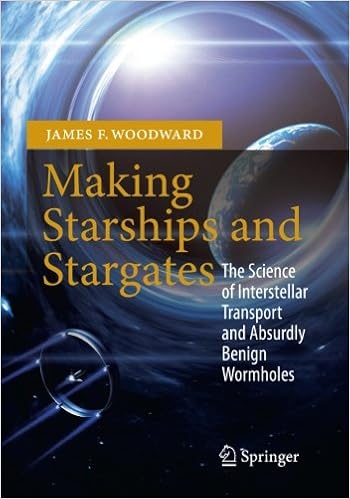
" In this case, the work goes toward a so-called Mach Effect Thruster (MET). Mach effects are transient variations in the rest masses of objects as predicted by standard physics where Mach’s principle applies. Proponents believe they offer the possibility of producing thrust without the ejection of propellant, as discussed in James Woodward’s Making Starships and Stargates: The Science of Interstellar Transport and Absurdly Benign Wormholes (Springer-Verlag, 2012).

What Fearn proposes is to investigate such thrusters by continuing the development of laboratory-scale devices while designing and developing power supply and electrical systems that will determine the efficiency of the Mach Effect Thruster. The analytical task is to improve theoretical thrust predictions and build a reliable model of the device. At the theoretical level, this team is definitely talking deep space, with part of the proposal being to:

'Predict maximum thrust achievable by one device and how large an array of thrusters would be required to send a probe, of size 1.5m diameter by 3m, of total mass 1,245 Kg including a modest 400kg of payload, a distance of 8 light years (ly) away.'"
Here's the book mentioned.

Amazon link

I downloaded the book-sample to my Kindle app and so far it's both well-written and interesting. Unlike the 'EM Drive', which was widely criticised and seems to violate conservation of momentum, the Mach Effect appears to be a valid consequence of General Relativity when combined with Mach's principle - at least, no-one so far has come forward with a convincing theoretical refutation.

Experimental effects so far appear to be small (if they exist at all) and unproven, but NASA evidently considers there could be something to it.

I'll probably read the book a little later. At least Jerry Pournelle will be pleased.

Sunday, September 25, 2016

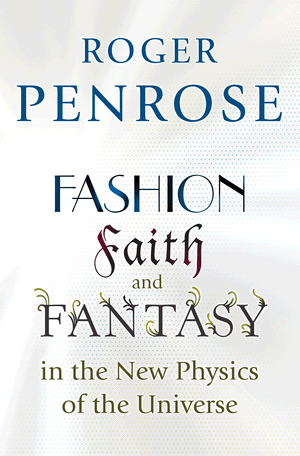
Fashion, Faith and Fantasy: a kind of review

Amazon link

I have just "finished" this book and put my hands up in dismay at the thought of reviewing it.

Roger Penrose is now 85 and this book may be the final presentation of his worldview. Although he talks about the 'layman' as his audience, potential readers should recall "The Road to Reality". In Amazon reviews of that tome, retired maths professors and physics PhDs lined up to recount at which chapter they hit the limits of their knowledge and had to give up.

This volume is not so different.

In a nutshell:

1. Penrose dislikes String Theory because its extra dimensions admit too many functional degrees of freedom (basically the number of possible field configurations).  It is not explained clearly why the super-explosion in the functional freedom space size is problematic, although he does make a related point that he believes that the six 'curled-up' dimensions are actually unstable and should collapse.

Perhaps it's obvious.

2. Quantum Theory is seen as a partial or incomplete theory - in particular, Penrose thinks that its linearity will be violated in an improved theory. He believes that the reason we don't observe 'Schrödinger's cat' spatial superpositions is due to the gravitational effects of superposition (he takes spatial delocalisation to have a real gravitational effect, aligning with his ontological realism for the quantum state). Specifically, the gravitational self-energy due to the superposition generates energy uncertainty, equivalent to time-uncertainty, hence superposed stationary states collapse into a position eigenstate very quickly. As he explains it, the maths behind this is pretty advanced, requiring general relativity.

3. Cosmologically, Penrose is not a fan of inflation, basing his criticisms on the 2nd Law and entropy. His criticisms have force suggesting that inflation retains support faute de mieux.

What does Penrose himself suggest as alternatives? He thinks twistor theory (a framework featuring emergent space-time) continues to have promise, and believes that a particular kind of bouncing, recurrent universe traversing through repeated big-bangs can explain the extraordinarily low entropy 13.8 billion years ago.

I think it's good for physics that he wrote this book, but absent a huge background in general relativity, complex analysis, twistor theory, quantum field theory and tensor analysis it's difficult to assess the merits of his arguments.