Showing posts with label Maxwell's Equations. Show all posts

Thursday, October 31, 2024

Visualising Maxwell's Equations


Maxwell's equations are a kind of pons asinorum of physics. An essential bridge to be crossed in electromagnetism - yet as a system of equations - apparently impenetrable. First obstacle: we have those weird operators: div, grad and curl; second obstacle: the vector differential operator del (which when applied directly is the operator grad)is commingled with the dot and cross product operations to somehow produce div and curl.

I tend to understand things visually and geometrically: I want to think that the equations describe the time and space behaviour of some entity or entities which I can visualise as a whole. It is said that Maxwell was influenced by mechanical analogies, imagining electric and magnetic fields as if they were filled with tiny gears, wheels, and cogs in space. This approach enabled him to think in terms of physical interactions and visualize the fields as interconnected, dynamic entities rather than as the purely abstract concepts denoted by the equations without context.

I asked ChatGPT to take me through Maxwell's equations and highlight their geometric nature, starting with the operators.


Divergence (div or 'del dot') - ∇ ·

∇ ⋅ F = ∂Fx/∂x + ∂Fy/∂y + ∂Fz/∂z

The divergence of a field measures how much the field spreads out from or converges into a point.

In Maxwell's equations:

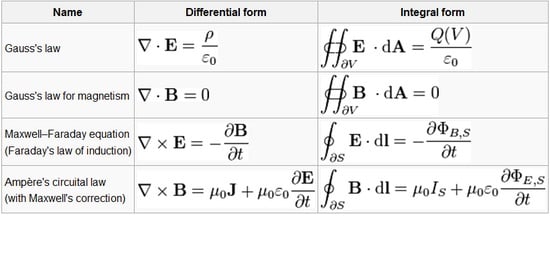
Gauss's law for electricity: ∇ · E = ρ/ε0. This shows that the divergence of the electric field E is proportional to the local charge density ρ, meaning electric field lines radiate out from positive charges and converge into negative charges.

Gauss's law for magnetism: ∇ · B = 0. The divergence of the magnetic field B is always zero, indicating that magnetic field lines form closed loops, with no magnetic monopoles acting as sources or sinks.


Gradient (grad) - ∇

∇F = (∂F/∂x, ∂F/∂y, ∂F/∂z)

The gradient of a scalar field represents the direction and rate of its steepest increase. In the case of the electric field:

The electric field E can be derived from the electric potential φ as E = -∇φ. This means that the electric field points in the direction of the steepest decrease in electric potential.


Curl (rot or 'del cross') - ∇ ×

The curl of a vector field measures its tendency to circulate around a point, describing the "rotational" aspect of the field. In determinant form:
 
∇ × F =
i j k
∂/∂x ∂/∂y ∂/∂z
Fx Fy Fz

In Maxwell's equations:

Faraday's law: ∇ × E = -∂B/∂t

The curl of the electric field is proportional to the rate of change of the magnetic field B, indicating that a changing magnetic field induces a circulating electric field (electromagnetic induction). We can imagine a bar magnet being inserted into the centre of a loop of wire: as the magnet moves into the loop a current is induced around the wire. Lenz's law tells us that the magnetic field created by the induced current resists the motion of the magnet ensuring conservation of energy (the minus sign).

Ampère-Maxwell law: ∇ × B = μ0 J + μ0ε0 ∂E/∂t

The curl of the magnetic field B is related to the electric current density J and the rate of change of the electric field E. This shows how a current or a changing electric field generates a circulating magnetic field.


Geometric and Spacetime Structure

Maxwell's equations highlight the deep connection between electric and magnetic fields. Faraday's law and Ampère's law describe how a changing electric field generates a magnetic field, and vice versa, giving these fields a dynamic interplay. This interaction shows that electric and magnetic fields are not independent; they are part of a unified structure in spacetime.

In modern physics (special relativity), this is described using the electromagnetic field tensor, where the fields are different components of the same spacetime entity F, transforming into one another depending on the observer's reference frame.


Wikipedia article

Maxwell's equations, with the help of div, grad, and curl, thus describe how electric and magnetic fields evolve and interact geometrically, revealing their unified nature in spacetime.

Wednesday, February 22, 2017

Perhaps no-one understands Maxwell's equations

"Microsoft CEO Satya Nadella spoke at a public event in India on Monday ...

"The first time I put on a HoloLens was to see something Cleveland Clinic [a non-profit academic medical center] had built for medical innovation... As an electrical engineer who never understood Maxwell's equations, I thought if I had a HoloLens, I would have been a better electrical engineer. Overall I feel that augmented reality is perhaps the ultimate computer," he said.
From here.

Actually, the article was entitled, "Microsoft CEO says artificial intelligence is the 'ultimate breakthrough'", but I was struck by his confession of ignorance about the foundational theory of classical electromagnetism.


Maxwell's equations

This looks bad, of course. But let's cut the CEO some slack: Maxwell's equations are notoriously unintuitive, as I observed in this post.

You can use the equations, solving them for particular physical configurations. But what picture do they give of the nature of the field(s) themselves?

What are we to make of the fact that a stationary observer of a motionless charged ball sees a static spherical electric field E, while an observer moving past that same ball sees electric and magnetic fields (E' and B')?

The magnetic field is a relativistic effect.

The charge is at rest in frame F, so this observer notes a static electric field. An observer in another frame F′ moves with velocity v relative to F, and notices the charge to move with velocity −v with an altered electric field E due to length contraction and a magnetic field B due to the motion of the charge. (Wikipedia).

That's implicit in Maxwell's equations, but don't tell me it's obvious. For that, you need to write the equations in a manifestly covariant form, but they don't teach you that in undergraduate electrical engineering.

---

Oh, and he's surely right about augmented reality being the main deliverable from the current state of the art in artificial neural net technologies. The Holy Grail of AGI will be a product of mastering situated social cognition, a post for another day (but see here).

Friday, August 19, 2016

The 10,000 year view

Amazon link

Richard Feynman once wrote:
"From a long view of the history of mankind - seen from, say, ten thousand years from now - there can be little doubt that the most significant event of the 19th century will be judged as Maxwell's discovery of the laws of electrodynamics."
What should we say about the other centuries?

---

The seventeenth century, in 10,000 years time, will be remembered principally for Isaac Newton's laws of dynamics:

  • First law: When viewed in an inertial reference frame, an object either remains at rest or continues to move at a constant velocity, unless acted upon by a net force.

  • Second law: In an inertial reference frame, the vector sum of the forces F on an object is equal to the mass m of that object multiplied by the acceleration vector a of the object: F = ma.

  • Third law: When one body exerts a force on a second body, the second body simultaneously exerts a force equal in magnitude and opposite in direction on the first body.

And universal gravitation:  F = Gm1m2/r2  - plus calculus, co-discovered with Leibnitz.

---

The eighteenth century was not rich in epoch-spanning discoveries, but future historians of science will recall it for Rev. Thomas Bayes, whose profound theorem will power the great AI learning engines down the ages.


---

The nineteenth century we've already mentioned. Here are Maxwell's equations in the vector form he would not easily have recognised.


---

The twentieth century is a cornucopia of fundamental science, but I think the most truly foundational, revolutionary and influential discovery has to be the Schrödinger equation, which explains .. well, almost everything around us.


But I doubt the 10,000 year future will have forgotten Einstein - or Bohr, Heisenberg, Dirac, ... .

---

Sean Carroll has a related list of his seven favourite equations here.

Saturday, December 05, 2015

James Clerk Maxwell on TV

BBC2 in Scotland had an hour-long documentary earlier this week presented by Prof Iain Stewart, a geologist. The programme was probably not bad for a general audience. After all, how do you explain Maxwell's equations to anyone without a good background in vector calculus?


I think you should try. Maxwell himself constructed an elaborate edifice of cogs and mechanisms in space to aid his intuitions about the behaviour of electric and magnetic fields (div and curl). The eponymous equations followed, and his newtonian-physicalist model was thrown away; it took a major cultural shift in physics to accept the validity of equations that seemed to have no intuitive or obvious underlying interpretation.


Of course, modern physics is all like that: no-one has a good intuitive model of Minkowski spacetime, its variably-curved analogue in GR or most particularly for what the equations of quantum mechanics are telling us about 'reality'.

The BBC programme carefully took the lower path, more travelled. But at least they showed Maxwell's equations on a blackboard with a competent professor 'explaining' them to the hapless Stewart. A geologist faced with differential equations! He explained to camera that he understood none of it - he gave a convincing impression of a man whose head hurt.

He could be right. Geologists are, I would guess, less bright than biologists these days ... and how bright are they? Razib Khan had a post about that with this diagram ...

This diagram is from the science journal Nature

and this explanation (noting that green is not good) (and also see this):
"The above is from an article in Nature, A test that fails. ...

"My physicist friends always enjoy a chuckle whenever I honestly state that physicists are smarter than biologists, as I am a biologist. There are rare cases, such as Ed Witten, of people entering physics from other fields, but in general it’s the physicists who are the imperialists. And that’s because they’re smart, able to decompose general problems rapidly and decisively. In contrast, biologists are somewhat narrow in their focus, and plodding in their reasoning.

"These are generalizations, but I think they’re roughly correct (I had a friend at a prominent non-profit who was irritated with how difficult it was to find Ph.D. biologists who were flexible thinkers in interviews). And standardized tests bear out my generalization (though honestly, it is a pleasure talking to physicists and mathematicians about out of topic fields compared to biologists partly because they’re so mentally acute; you don’t need GRE stats to get this)."
So Professor Stewart, shape up or ship out of this presenting lark!

Saturday, April 06, 2013

Visualising Div and Curl

Some people are happy with just the maths equations. For myself, I want a geometric picture to really understand and use a concept. Thanks to Daniel Fleisch for the best description of how to visualise Div and Curl from this book. Click on the images to make them larger and readable.

A good introduction to Maxwell's Equations


Visualising the Div operator


Visualising the Curl operator

The Grad operator (on a scalar field), applied at a point on the surface, delivers the tangent vector pointing up the steepest slope, with its length measuring the steepness. That's pretty easy to visualise.

Richard Feynman commented somewhere that in the distant centuries yet-to-be, when people look back to the nineteenth century, they will remember it for just one thing: it was the century when Maxwell's equations were formulated.