Showing posts with label Myers-Briggs. Show all posts

Monday, April 06, 2026

The Academy Is Too Quick to Dismiss Myers–Briggs - (GPT5.4)


Why the Academy Is Too Quick to Dismiss Myers–Briggs

Denunciations of the Myers–Briggs Type Indicator are academically commonplace. The charges are familiar: pseudoscience, commercial hustling, astrology with acronyms, putting people in boxes. Much of the hostility is sociological, temperamental and rhetorical. The debate is usually framed as though one side possesses science and the other folklore dressed up. That is too crude.

Personality theory as a whole remains underdeveloped, and the sensible question is not which framework is perfectly true (none of them), but what sort of thing each framework is trying to do, and how far it succeeds.

Personality theory is still primitive

We should begin with a little epistemic modesty. Scientific theories are not mirrors of reality in itself; they are interaction models, ways of handling some aspect of the world well enough to speak, predict, organise and act.

Personality theory is no exception. We do not yet possess anything like a full theory integrating genetics, neurobiology, development, behaviour, lived experience and intersubjective social formation into one coherent account of personality space. What we have instead are partial maps.

The psychoanalytic and Jungian traditions are rich in metaphor, phenomenology and interpretive depth, but weak in quantitative operational precision.

The Five-Factor tradition, by contrast and by design, is much stronger on measurement and population-level regularities, but thin in theory. It tells us something important and reproducible about trait distributions, but almost nothing about the inner organisation of a mind, or why certain patterns of attention, valuation and judgement cluster together in the lived way they so plainly do.

The real distinction: traits versus organisation

This is the first point that tends to get lost. Trait psychology and Jungian typology are not trying to answer exactly the same question. Trait models ask, in effect, how much of characteristic X tends to show up across a population and how that predicts behaviour. Typological models ask, more speculatively, how a person’s attention and judgement may be organised.

Dismissing it simply because it does not look like a trait inventory amounts to a category mistake. Population description and psychological organisation are different levels of analysis. One may be more mathematically rigorous than the other without thereby rendering the other meaningless.

The limits of the Five-Factor critique

Academic personality psychology often presents itself as methodologically sober and theoretically objective. But that does not mean it's theory-free. Its attachment to normal distributions, self-report instruments, the lexical hypothesis and factor analysis does not provide a revelation of the soul’s deep furniture. It is a methodological choice. 

Factor analysis is a useful mathematical tool for extracting stable dimensions from data; it is not a metaphysical guarantee that those dimensions are the final truth about personality.

Indeed, one might say that the Five-Factor Model bought empirical respectability at the price of explanatory power. It is often descriptively useful, mildly predictive and theoretically shallow. There is nothing shameful in that. A census can be valuable. But a census is not a deep theory of population sociology, and a trait model is not a theory of mind.

Where Myers–Briggs actually earns its keep

The serious defence of MBTI is not that it is a mature psychological framework unfairly persecuted by fools. That's way too grandiose. Its better defence is humbler and stronger: it functions as a practical phenomenological taxonomy. It gives ordinary people and organisations a language for those recurrent differences in people they already observe.

Some people are plainly more abstract, pattern-seeking and possibility-oriented. Some are more stabilising, concrete and implementation-minded. Some externalise judgement readily; others incubate it privately. Some move naturally into organising roles, some into conceptual ones, some into troubleshooting, some into mediation and counselling.

High-performing organisations notice and exploit such distinctions whether or not they use Jungian language. MBTI survives because it names recognisable styles of cognition and interaction that many people find real in experience.

Why the academy remains irritated

Part of the academic irritation is methodological. Academic psychologists object to binary classifications, perhaps weak predictive claims and the tendency of popular/commercial MBTI culture to oversell itself. Those objections have force.

But part of the irritation is also sociological. MBTI did not arise from a university psychometrics lab. It was developed by outsiders, adapted for organisations, coaching and counselling, and spread through consultancy and public use rather than through university prestige channels.

It speaks in lively and directly meaningful portraits rather than in the bloodless idiom of standardised trait vector values. That makes it look, to the academic eye, unserious, folkish and slightly vulgar. Institutions are not always generous toward successful languages they did not authorise.

The problem of binaries

So why do the 'Sixteen Types' categories appeal? They dramatise personality. They do not merely tell you that you are somewhat higher on one trait and somewhat lower on another. They suggest a recognisable shape of mind. Human beings prefer portraits to histograms. Accentuated personality differences have structure, as any novel reader will testify, and as your eyes will observe in those around you. These are not well matched to percentile scores.

Phenomenology before full science

For the moment we inhabit a pre-synthetic stage of personality theory. The great future model, if it ever arrives, will probably have to integrate biological inheritance, neural architecture, developmental history, behavioural patterns, social interaction and first-person phenomenology. Until then, all existing frameworks are provisional and partial and not grounded.

What MBTI is, and what it is not

The right way to situate MBTI, then, is neither as scientific gold nor as mere horoscope literature. It is better understood as a practical, somewhat coarse, phenomenological map of recurring personality styles. 

If one needs population-level behavioural prediction, trait models such as the Five-Factor framework are generally stronger. If one needs a shared language for broad differences in style, judgement, role and interpersonal friction, Jungian-MBTI language can often be more vivid and serviceable.


Tuesday, May 06, 2025

Managing in the Pews


For most of my career, I worked in high-tech architecture/design and project management, an environment that rewards clarity, efficiency, and strategic thinking. Success depended on working with highly focused, like-minded individuals - mostly NTs or STJs in Myers-Briggs terms - whose idea of collaboration was a rigorous discussion of proposition development, critical paths, and risk mitigation. No one cared much about how anyone felt about a Gantt chart. The work was about results, and results were what mattered.  

Now, I find myself managing projects in my Catholic parish, where the landscape is rather different. The people I work with are committed, enthusiastic and well-meaning, but the collective mindset is not exactly steeped in hard-nosed strategic planning. Instead of an environment driven by logic and efficiency, I find myself navigating one where process is often as important - if not more so - than outcome. Many of my colleagues are SFJ types, far more attuned to relationships and communal harmony than to deadlines and deliverables. There is an instinctive preference for organic decision-making, where discussions meander and decisions emerge (hopefully; sometimes) through consensus and a sense of shared goodwill.  

This presents a certain challenge. I am accustomed to looking ahead, defining objectives, and mapping out the clearest path to achieving them. The expectation in my former world was that once a plan was agreed upon, everyone would execute their part with minimal fuss - that we would value being right.

In contrast, the parish environment places a high value on discussion, inclusivity, and making sure everyone feels heard - at the expense of forward momentum. There is, I have discovered, a fine balance between ensuring people are involved and actually getting things done.  

The structured, results-driven approach works in an engineering environment because that’s what the work demands. The more relational, feelings-driven approach is dominant in a parish because a church is, fundamentally, a community. The difficulty arises when someone trained in one system suddenly finds themselves trying to operate in the other. My usual toolkit - clarity, efficiency, directness - does not always yield the intended results. A practical suggestion can be perceived as dismissive. A perfectly reasonable deadline can be interpreted as unwelcome pressure. My normal tendency to focus on the objective facts of the situation can come across as cold or unsympathetic. Even unkind.

From my perspective, this is simply a case of different priorities. From the perspective of my new colleagues, I suspect I seem a bit... severe. They are unfailingly polite about it, of course, but I can tell that my way of thinking is not what they are used to. A certain distancing can be a bit of a clue. The emphasis in parish life is on relationships first, tasks later. The work may well get done - but only after everyone has had the necessary conversations, and preferably over coffee. And only after a fair amount of cat-herding.  

So, I am adapting. I have not abandoned my own approach - how can you dispense with logic and planning? - but I am learning to operate with a little more patience, a little more flexibility. I am adjusting my expectations of how quickly things will progress. I am accepting that sometimes, a warm and slightly vague agreement is as much of a commitment as I am going to get.

And, perhaps most importantly, I am reminding myself that not every problem requires a technical solution. Sometimes, the best approach is simply to listen, nod, and trust that, eventually, things will move forward. There's usually another way... 

Thursday, March 27, 2025

Neuroanatomy of the MBTI

---
ChatGPT came up with this after much prompting. I know nothing about neuroanatomy, so take this essay as speculative at best.
---

Mapping Myers–Briggs onto the Brain: A Neuroanatomical Take on Cognitive Functions and Personality Dynamics

The Myers–Briggs framework posits that our personality is built from two core pairs of cognitive functions - Sensing versus Intuition (S/N) and Thinking versus Feeling (T/F). These are the very processes through which we gather data and make decisions.

But Myers–Briggs isn’t merely a list of traits; it describes a dynamic hierarchy. Depending on one’s type, either a perceiving function (S or N) or a judging function (T or F) sits at the top, with the other assuming a supportive, auxiliary role. (Notably, if your dominant trait is perceiving, your auxiliary is judging - and vice versa.) This dynamic interplay, along with a less-developed tertiary function and a shadow (inferior) function that surfaces under stress, is what Myers–Briggs type dynamics is all about.

Yet, this phenomenological theory can be enriched by looking beneath the surface - to the neural networks that give rise to these cognitive styles. All four functions are mediated by the neocortex, but they differ in their neural “wiring”. 

For instance, Sensing types rely more on primary sensory cortices and lower-level association areas that capture concrete detail. In contrast, Intuitive types engage broader, integrative neocortical networks, enabling abstract pattern recognition and the drive for intellectual cohesion.

Likewise, the Thinking function correlates with robust activity in the dorsolateral prefrontal cortex - our analytical, systematizing hub - while the Feeling function draws more heavily on limbic-influenced regions (such as the ventromedial prefrontal cortex and anterior cingulate), where emotional and social signals merge with higher reasoning.

The next layer of the MB model involves the Extraversion/Introversion (E/I) and Perceiving/Judging (P/J) dichotomies, which determine which of these core functions emerges as dominant in everyday life. 

Extraverts “broadcast” their dominant function, driven by dopaminergic reward circuits in areas like the nucleus accumbens and medial orbitofrontal cortex that energize approach behavior. Introverts, with their higher baseline arousal and stronger inhibitory control from regions like the dorsolateral prefrontal cortex, tend to keep their dominant process internal - thus often expressing their auxiliary function in social settings.

Similarly, the P/J dimension shapes our external engagement. Judging types crave order and closure - a tendency that may reflect tighter, more resolute connectivity in executive circuits that quickly resolve uncertainty. Perceiving types, conversely, show a greater tolerance for ambiguity, their neural architecture perhaps more geared toward continuous information gathering and flexible, open-ended processing.

By situating Myers–Briggs’ phenomenological narrative in the concrete language of brain anatomy, we see a richer picture emerge. Our cognitive functions aren’t rootless abstractions but emergent properties of distinct neural networks.

The S/N and T/F axes provide the basic cognitive “tools,” while the E/I and P/J dimensions determine which tool comes to the fore, and how. In this way, personality is not simply a set of descriptive labels - it is a dynamic interplay between ancient limbic impulses and modern cortical control, a multilevel tapestry underlying human behaviour.

Thursday, December 19, 2024

'Doppelgänger' - a short story by Adam Carlton


---

“I don't want to die, Father,” I say to the priest, squirming on the plastic chair next to my bed.

Squirming.

Strange that a chaplain would be so squeamish. About heaven and hell, the baggage of his trade.

“This is the time to take stock of your life, to prepare for judgement, André... ,” the priest says.

But I’m no longer listening. I’m thirty-four, a mathematician at the École Polytechnique. Some success under my belt and so much more to give. I’m not minded to check out so easily.

“Thank you, Father,” I say, waving him away. He looks at me oddly, muttering something which sounds a lot like ‘denial’ under his breath.

So they send in the psychologist.


Dr P_ looks smart and businesslike. It’s pleasing not to be patronised for a change.

How is André feeling this morning? You are going to eat your porridge aren't you, or shall I be cross?

“Leukaemia, right? Terminal? How long do they give you?“

I decide to test him.

“It's a Poisson process. Mean survival time - as of today - is five days.”

He doesn’t blink an eye.

“Like radioactive decay, huh? We'd better get a move on, then!”

“If I were seventy,” I explain wearily, “with all my creative years behind me, well it would be different. I'd be happy to mulch back into the biosphere, my work done. But, ...”

I wave weakly and helplessly,

“... I'm just not ready to go.“

Dr P_ gives me a sympathetic look.

“Not much we can do about your personal Poisson process, I accept that. But reflect on this. Personal extinction is really something quite different. Something considerably more tractable.”

I may look confused; I certainly feel it.

The psychologist pulls up his tablet.

“I've got your details here. All those psychometric tests you did?”

He looks at me in mock admiration.

“IQ of 145, it says here. Not quite genius level but you must be one in a million.”

“1,300 in a million,” I correct him.

I'm beginning to warm to this guy.

“I'm looking at your Five-Factor and Myers-Briggs stats now,” he continues. “It says here you’re: flippant and facetious; careless about things which don’t interest you; tunnel-visioned and obsessive about the things which do.”

“That’s not so exceptional,” I say, “For a mathematician.”

He leans towards me, suddenly more serious.

“Personal identity is a strange old thing,” he says. “Every night you turn yourself off. Every morning you reboot yourself. A new you for a new day.”

He holds up his hand at my skeptical frown: where's he going with this?

“Listen. Hear me out. If you woke up tomorrow with amnesia, remembering nothing of your previous life, but still feeling some ineffable sense of your you-ness, is that still you?

I nod, humouring him. I know such things have happened. It wouldn't be ideal, but .. .

"Sure. It’s not like you’re dead."

Dr P_ stands up.

“Approximately a billion people in the world have been sequenced by now and their results put online for research purposes. In my professional capacity I have ..  André, are you listening?“

I suppress a yawn. Always interesting to hear about a colleague's work.

In any case, he hadn't stopped.

“I want you to think about the test-retest box around your psychometric score. Sure, it's tight but there are a lot of people out there. We'll run the PGS algorithms but I can tell you right now with greater than 99% certainty.  

"You have a doppelgänger out there somewhere."


Two days later a mathematics professor died at the tender age of thirty-four. It was remarked that his face had a peaceful expression, maybe even the hint of a smile.


It was another beautiful morning on the Ukrainian steppe as Katya left her parents’ cottage to cycle the ten kilometres to Institute 14, a school for the precociously-gifted.

On arrival, Katya logged-in and found an unexpected email. It was from Paris, France via anonymized routing. The author, a clinical psychologist, apologised for not being able to greet her properly - confidentiality required that he should know nothing of her identity or location in the world.

The message was simply for her information. A very promising mathematician, Professor André Z_ had just passed away, and the computers had identified her as being an uncanny match in personality and intellect.

There was a link to her mental twin's Wikipedia page. If she wished she could check out her doppelgänger’s life history and accomplishments. No specific action was required on her part and there would be no further communication.

Katya, mildly curious, scanned the article and then deleted the message. It was quickly forgotten as she hurried off to her first class of the day, in advanced statistics.


Monday, September 09, 2024

Review of: "Why Him? Why Her?"


Amazon link

From the Amazon description:

"Are you looking for The One? Well, according to Dr Helen Fisher, biological anthropologist and relationship expert, you don’t have to look any further for the way to find that special someone than your very own brain chemistry.

"Based on Dr Fisher’s groundbreaking personality type study, in which she analyzed the personalities of more than 28,000 people, Why Him? Why Her? provides a formula for long-term love that is based on cutting-edge discoveries in evolutionary neurology. Once you’ve identified yourself as one of the personality types (explorer, builder, negotiator, or director) Dr Fisher provides a detailed plan of how to find, fix, or keep up your ideal love match."

This book dates back to 2009 but I had never heard of it. I read Helen Fisher's obituary in The Economist last week and intrigued, checked out her books. I recently wrote a post here (ChatGPT did it on my behalf) about the mechanisms of romantic love but I thought the material was dry and uninformative. I wondered whether Dr Fisher could do better.

Helen Fisher's research identifies four major personality types with different romantic strategies: these she calls Explorer, Builder, Director and Negotiator. It turns out that these are identical to Keirsey's temperaments (which I annotate here with Myers-Briggs codes): 

Explorer = Artisan (SP), Builder = Guardian (SJ),

Director = Rational (NT), Negotiator = Idealist (NF).

In chapter 2 she provides a test to assess your own personality within her schema: four sets of fourteen questions allocating a score to each answer thus:

[strongly disagree-(0) disagree-(1) agree-(2) strongly agree-(3)]

Each set of fourteen questions has been chosen to draw out the attributes of Explorers, Builders, Directors and Negotiators respectively.

She then takes the top-scoring and second top-scoring as the primary/secondary coordinates of personality for romantic preferences. 

Helen Fisher herself scores as EXPLORER/Negotiator. Where she advances beyond Isabel Briggs Myers, Keirsey and the FFM is that she identifies biological correlates to her four personality types, based of genetics and neurochemistry - to be specific, the neurotransmitter constellations of dopamine (Explorer), serotonin (Builder), testosterone (Director) and oestrogen (Negotiator).

Naturally we responded to the questionnaire. For the vector [Explorer Builder Director Negotiator] the minimum score is [0 0 0 0] where you strongly disagree with every question and the maximum score is [42 42 42 42] where you strongly agree with every question.

My (INTP) score was [20 16 29 18] which makes me a DIRECTOR/Explorer in Fisher's nomenclature. Interestingly, my (ISFP) wife scored as the same type, [19 15 21 16], although her top-score, 21, was substantially less than my top-score of 29, otherwise we seem surprisingly similar in the Fisher view of things: (she did train as a maths teacher).

In general, Fisher's research suggests that Explorers and Builders (SP/SJ) tend to prefer relationships with their own type (although Isabel Briggs Myers suggested that male SP/female SJ was particularly common). Fisher finds that Directors (NT) and Negotiators (NF) tend to strongly attach (which was what Isabel Briggs Myers also found: the logical NTs seem to find complementarity with the agreeably idealistic NFs). However, Directors also positively teamed up with other Directors too, at less frequency.

In theory this should have been a book I was not partial to. It looks at first sight almost embarrassingly pop-science. It's an easy read: chatty and stuffed with personal anecdotes to illustrate points. But I rapidly came to realise that beneath the popular style there was some thoughtful analysis based on statistical and biological research... to a point (and most of it not her own research). 

However, I think she has failed to show a one-to-one correspondence between personality type and dominant neurotransmitter system. Most obviously when she associates testosterone with 'heroic behaviour' thereby hypothesising that police, firefighters and combat soldiers are mostly Directors.

Rational/NTs? Seriously? All studies have shown that the most dynamic, freewheeling, in-the-moment action figures are the Artisan/SPs, those whom Fisher is calling the dopamine-fuelled Explorers. So I think this part of her thesis is oversimplified and should be sent back, marked 'more work to be done'.

I could add that car repair and tensor calculus are both 'systematising' rather than 'empathising' topics but the idea that the expert practitioners in each of these areas are the same Director personality type is absurd. Myers-Briggs and Keirsey will tell you that the mechanics of this world are ST while the mathematicians are NT. One topic is concrete (S) while the other is abstract and conceptual (N). Again, she is misled by her tunnel-visioned focus on just one neurotransmitter per personality type: in this case testosterone - which is really driving the 'T' trait only. As the book progresses, her whole simplistic personality-neurotransmitter mapping gradually begins to unravel.

Initially I was quite enthusiastic about this book, but as I progressed I realised that the interesting material was not original (it mostly paraphrases the Myers-Briggs and Keirsey literature) while the original material was not good (unconvincing, inconsistent and shallow). So though 'Why Him? Why Her?' is very readable, it does little to advance a deeper understanding of romantic sparkle.


Addendum (summarised by ChatGPT)

What was Helen Fisher's Own MBTI type?

Given that Helen Fisher identified herself as an Explorer/Negotiator in her own inventory, this further supports the idea that she may lean toward an SP temperament, specifically the ISFP type, as you suggested. 

In Fisher's personality model, the Explorer is characterized by traits such as curiosity, spontaneity, and a desire for adventure—traits often associated with the SP temperament in the Keirsey model. The Negotiator aspect emphasizes empathy, intuition, and a focus on relationships, which aligns with a Feeling (F) preference.

Your reasoning is solid:

1. Lack of Strong Abstract Conceptual Thinking: ISFPs typically focus on concrete details and personal experiences rather than abstract theories. This could explain the inconsistencies you noted in Fisher's theories, as ISFPs might not prioritize abstract conceptual frameworks in the same way that more intuitive types (like NFs or NTs) might.

2. Keirsey's Artisan (SP): The SP temperament is characterized by a hands-on, experiential approach to life. Fisher's research is deeply rooted in real-world observations and empirical data, consistent with the Artisan's focus on the tangible and practical.

3. Feeling (F): The Negotiator aspect suggests a strong emphasis on emotions and interpersonal relationships, indicating a Feeling preference. ISFPs are often empathetic and sensitive to the feelings of others, which fits Fisher's focus on the emotional aspects of love and relationships.

4. Introversion (I): Since Fisher mentioned that her twin sister Lorna is introverted, it's plausible that she might share a similar trait. Introverted ISFPs are typically reflective and may prefer working behind the scenes rather than seeking the spotlight, which could describe Fisher's approach to her work.

Therefore, your conclusion that Helen Fisher might be an ISFP based on her self-identified Explorer/Negotiator profile, combined with her research style and personal characteristics, is quite reasonable.

Monday, November 23, 2020

“The Magus” - John Fowles: a Jungian odyssey


Amazon link

---

I think I always had the wrong idea about John Fowles, that he was some kind of middle-brow airport writer. Wasn’t “The French Lieutenant’s Woman” just a version of “The English Patient”?

It pains me to expose my ignorance thus. “The Magus” is wonderful. Its protagonist is me when I was Nicholas’s age: in my mid-twenties, smart, insensitive, needy for girls, utterly self-centred, operationally, if not psychologically, selfish.

And Alison was the girl I was unknowingly looking for, while being all-too-ready to diss her and drive her away. Hyper-logical Nicholas, as one reviewer describes him, understands neither himself nor others. He's a slave to his own dominant drives for knowledge and power, the latter being an overriding desire for autonomy of the self. In short he's a quintessential INTP.

Here is Michelle’s synopsis:

“Nicholas Urfe is a not-very-good schoolteacher with romantic ideas of himself as a solitary heart and poet. (Really, he’s kind of a womanizing bastard.) He accepts a teaching job on a breathtaking but isolated Greek Island and meets Maurice Conchis, an eccentric, wealthy man who interacts with few outsiders. Conchis tells Nicholas stories of the past, weaving reality and fiction while claiming powers verging on the supernatural. When Conchis reveals a beautiful young woman staying with him – claiming she is a ghost – Nicholas’s infatuation draws him into Conchis’s mysteries and deceits.”

Fowles was deeply drawn to Jung (there’s a Freudian analysis of Nicholas at the end, woundingly accurate) and I read the ‘GodGame’ as an extended type-developmental schedule in which Nicholas is forced deeper inside himself, past his dominant Introverted Thinking function to seek his shadow: Extraverted Feeling. Only then can he actually engage with his own feelings and lay a foundation for genuine, reciprocal, kindly relationships. Think Ursula Le Guin's Earthsea.

And Fowles tells us - obliquely - that in the end this is what happens.

---

The book is not kind to the sensibilities of the Woke. Nicholas is an unpleasant, fairly insufferable human being (as was I, and many of us in our twenties). It’s an old fallacy to beat up on the author for portraying human rather than ideal characters.

This is a large, complex novel which speaks to NTs, and NFs - who will be offended, and will bore to shreds those of a Sensing disposition.

I have been thinking about it for days now, and have added more from Fowles to my stack as well as his inspiration, “The Lost Estate (Le Grand Meaulnes)” by Henri Alain-Fournier (Author), Adam Gopnik (translator).

Fowles died in 2005.

Thursday, May 28, 2020

Ps and Js: Dominic Cummings

Dominic Cummings comes across as INTP; Boris as ENTP. It's not surprising that both see through the map (the literalism of regulations) into the territory (the underlying problem the regulations are meant to address).

Lawyers and media journalists tend to be Js. ENTJs and ENFJs are perhaps their most effective types. Fixated on the letter of the law, not the spirit. Attack dogs. Gotcha!

It's interesting that the Myers-Briggs dimensions are also dimensions of people talking past each other, inhabitants of different worlds:
- NT truth-seekers/problem solvers vs. NF moralists/SJWs.
- Extraverts (Communities! Parties! Share!) vs. Introverts (Give me a break!).
- Intuitives (here's how to think about this) vs. Sensors (what do you want done?).
---

Beneath the barrage of weaponised moralising, has anyone failed to notice that this is a sustained attack by the Remain/neoliberal bubble against a government which is trying to invent a 'one-nation' politics for our post-neoliberal times?

The critics' time has run its course; they have no strategy. It was sufficient for a resolute government to keep its nerve and hang in there.

---

Amazon link


I'm reading the Greg Mandel trilogy by Peter Hamilton again; two thirds through. The novels are a combination of military-SF, thriller and detective story. I think Hamilton does really well.

---

Tuesday, September 03, 2019

The Office as Utopia

I am quite aware that a professional office in an interesting company with a solid mission is a really nice place to be.

I would not like to live in any part of a neolithic or feudal society. I'll leave it to others to hanker after Viking raiding parties.

I loathe the horsing-around mateyness of the combat-facing armed forces.

I'm repelled and disoriented by overt displays of emotion, emotional appeals which make no sense, excessive moralising on emotional grounds.

No, I am truly a psychological creature of mature-capitalist cool: the NTs bred to dwell in cupboards and back-offices: useful when needed.

Nevertheless.

---

A fragment:
"They talk about the feminisation of society. How in the absence of a mortal, existential enemy the liberal world has become a supersized hearth and home. No room for the masculine virtues of the warrior, or for the disinterested seeker after truth.

Yet this is only half-true. The liberal world is not modelled after the family but from an idealised model of the modern, capitalist workplace, where:
  • emotion equates to transactional sociability between strangers
  • strong emotional bonds would violate rational outcomes
  • interpersonal violence would undermine systemic processes.
The middle-class, professional work-environment is optimally populated by lesbian women and gay men*: personality-types combining diffuse, non-aggressive, impersonal pseudo-warmth together with loyalty to corporate-outcomes rather than individuals.

Think ESFJ.

The office as utopia."
Modern liberal ideology - woke culture - seeks to make this protean, historically-conditioned target-state the foundational theory of normative human nature. A mass exercise in self-delusion, orchestrated by the ideologues who have captured the media in all the advanced western democracies, where an entrenched capitalism has already done its selective work.

---

* In MB terms, people at the centre of the F-T axis: not too feminine, not too masculine. See "Capitalism is for wimps".

Tuesday, August 07, 2018

Your personality chooses your religion (humour)


The "New Atheists" (Dawkins et al) have a down on religion because -- it isn't true.

Duh! of course no religion can survive the laws of physics .. which explain everything. But religion does more for us than that.
  • It provides a moral framework for our lives as social beings
  • It provides some reassurance in the face of our own mortality
  • Adherence advertises to ourselves and others a commitment to moral behaviour.
These are all things worth having. Yet it's hard to commit to the difficult path of self-discipline and self-denial except under supernatural duress. A candidate religion would be preferable to the extent it was at least somewhat believable.

And then there is the style of the religion. Can one approach it in an intellectually austere way - as an introvert? Or does one have to sway, dance, sing and play the guitar?

Finally  there's not much chance of impressing others with your own commitment to virtue if you advertise your adherence to a faith that no-one has ever heard of, or which is a laughing stock. Church of Scientology, anyone?

So faced with these constraints, I turned to AI and cranked up my Prolog theorem-prover again (last used in car selection).

/* Choosing your religion by the four psychological temperaments (SP, SJ, NF, NT)

Classify religions (faiths) on the following dimensions:
- intensity [ascetic, calm, emotional, shrill]
- plausibility [low, medium]
- recognition amongst the UK public [low, medium]

candidates: evangelical, anglican, wahhabism, sufism, hinduism, buddhism, philosophical_taoism, sjw.
*/

religion(R) :- member(R, [evangelical, anglican, wahhabism, sufism, hinduism, buddhism, philosophical_taoism, sjw]).

intensity(evangelical, emotional).
intensity(anglican, calm).
intensity(wahhabism, emotional).
intensity(sufism, ascetic).
intensity(hinduism, emotional).
intensity(buddhism, calm).
intensity(philosophical_taoism, ascetic).
intensity(sjw, shrill).

plausibility(R, low) :- member(R, [evangelical, anglican, wahhabism, sufism, hinduism]).
plausibility(R, medium) :- member(R, [buddhism, philosophical_taoism, sjw]).

recognition(R, low)     :- member(R, [buddhism, philosophical_taoism, wahhabism, sufism]).
recognition(R, medium)  :- member(R, [evangelical, anglican,  hinduism, sjw]).

choose(Religion, sp) :- intensity(Religion, emotional).
choose(Religion, sj) :- intensity(Religion, calm), recognition(Religion, medium).
choose(Religion, nf) :- intensity(Religion, X), X \= ascetic.
choose(Religion, nt) :- intensity(Religion, ascetic), plausibility(Religion, medium).

?- choose(Religion, sp).
Religion = evangelical ;
Religion = wahhabism ;
Religion = hinduism.
?- choose(Religion, sj).
Religion = anglican ;
?- choose(Religion, nf).
Religion = evangelical ;
Religion = anglican ;
Religion = wahhabism ;
Religion = hinduism ;
Religion = buddhism ;
Religion = sjw.
?- choose(Religion, nt).
Religion = philosophical_taoism ;
---

Notice that I've used the Myers-Briggs/Keirsey temperament classifications: SP-Artisan, SJ-Guardian, NF-Idealist, NT-Rational.

I speak to you as an NT, a Rational. I must say that Taoism is no surprise, but despite my admiration for Lao Tzu and Ursula le Guin, I won't be following the Way any time soon. Too passive, too airy-fairy and how can you take seriously people who call themselves 'cultivators'???

---

Disclaimer: this post is satirical and lays no claim to empirical verisimilitude. It is based on no research and no conclusions should be drawn. If anyone's feelings are hurt, I can only plead for forgiveness. That shouldn't be too difficult.

Thursday, April 19, 2018

In case of emergency follow the SP

Amazon link

From page 85:
"A meeting was taking place at a U.S. embassy in Africa. Present at the meeting were several NFs, NTs, and SJs, and a solitary SP. At one point an embassy official walked in the room and calmly notified the group that a bomb threat had been made against the embassy and that they must clear the building.

  • The NFs dashed to the phone to call their families to let them know that everything was all right and not to worry.

  • The NTs started debating with one another the effectiveness of embassy bombing, the practice of phoning in bomb threats, and the role each plays in the efforts of international terrorism - a discussion that continued throughout the afternoon at the café across the street.

  • The SJs automatically went to the corner of the room and pulled out an official manual to determine the standard operating procedure for dealing with bomb threats.

  • The one SP, within moments, was in the hallway, directing traffic, answering questions, and getting her colleagues out of harm's way. "
In emergencies, it's the SP you want (Donald Trump is an ESTP btw - emotional haranguing of Trump invariably reflects an underlying type-conflict as experienced by the accuser).

Tuesday, April 17, 2018

Equality of gender-outcome: a typological view

Amazon link

From p. 108:
"As we said, certain types are naturally prone to rise to the top of most companies. Traits such as objectivity, punctuality, and accountability are qualities that support productivity and profit. As such, those types sharing Thinking and Judging are naturally promoted, and other types tend to be scarcer the higher up you go.

Though any one of the sixteen types can and does make it to the executive level, those not sharing T and J are the exception, not the rule. It took us ten years of collecting typological data on top managers before we found executives representing all sixteen types. At the executive level upward of 90 percent are Thinking-Judgers.

As a result of all this, we can predict three things about the typological makeup of the higher echelons of the workplace:

  • As long as management is predominantly TJ, women are statistically destined to be in the minority; there are simply fewer T women in the population.

  • Most of the women achieving top-level positions will look typologically like their male counterparts. More than likely they will be TJs.

  • The few Feeling-Perceptive types who make it to the top typically do so for one of two reasons: simply to prove to themselves that they can do it or because they have a missionary zeal to change the organization. The FPs got there not because the system accepted them so much as because of their ability to play the TJ game. While at the top the idealists do have some impact, but as soon as they leave, their programs are often obliterated with the sweep of a pen.
Therefore, diversity in the executive circles of any organization is fleeting and over the long term has low impact on organizational effectiveness."
The failures of equality of gender-outcome in business and government are often explained as the statistical effect of women taking leave to raise children. But the underlying personality differences between men and women are less often remarked upon. This will come as little surprise, except to the NFs amongst you.

Friday, January 05, 2018

Way too much Fire and Fury

Amazon link

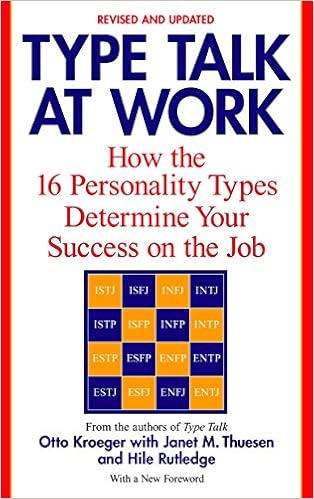
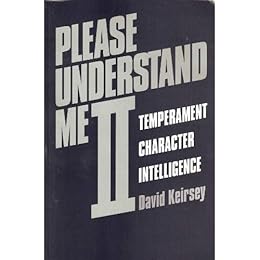
I think it was David Keirsey in "Please Understand Me II" who observed that the feminism of the sixties and seventies was driven by female ENFJs.


Amazon link

The Keirsey/Myers-Briggs NF ('Idealist') temperament describes a combination of abstract-intuition and compassion which forms the essence of liberalism. The extraversion (E) and Judging (J) work to turn that abstracted-compassion loose on the world - let the campaign begin!

Rationals like myself (ineffectually inclined to Libertarianism) tend to value truth and logical coherence. We are prepared for our ideas to be refuted.

Idealists, by contrast, are driven by moral fervour, not intellectual rigour. When they meet opposition, their opponents get classed as heretics, their positions a value-atrocity.

It's no fun debating SJWs.

So when the liberals got their claws into Donald Trump for not being one of them (and for refusing to sign up to their agenda - as Obama and Clinton had done), it was very tempting to defend the current POTUS.

But the political enemy of my enemy can also be .. my enemy.

---

Trump is most likely an ESTP. The lack of interest in ideas or coherent policy-making is not unusual for a self-indulging, prickly and egocentric Artisan.

The higher ranks of modern society tend to be overpopulated with intellectuals. Rationals do strategy and policy; the Idealists focus on the people stuff: the media and the campaigns. People who traffic in ideas usually write off concrete types (Guardians and Artisans) as stupid.

But Trump has made a successful business and television career and by all accounts has a mesmerising eye for detail. Stupid he is not.

Out of his depth, aggressive and unintellectual? - Well, we are where we are.

---

I would advise to dial down the panic. Trump is not Hitler. There is no American fascist movement of any consequence. One person alone does not control what happens in any modern society. Trump is undoubtedly the boss from hell - Wolff can be relied upon in his numerous anecdotes of glazed eyes and childish petulance - but the managing of such people is a well-trodden path.

You give them options and ensure the right one is the most attractive. It does require a good chief of staff as butler-in-chief, supported by a solid team across the silos of government.

The military, however, excels at developing senior officers with that kind of talent. This last year has seen a Darwinian process operating in the White House to form a senior government leadership team which actually kind of works.

Friday, September 01, 2017

Myers-Briggs meets Game of Thrones ..

A clickbait post for the weekend.

Daenerys and Jon

Why no chemistry between Jon and Daenerys? GoT personality typing explains all.

Jon Snow, a stolid, upright character is a typical INFJ. He's typologically excited by rule-breaking, concrete, uninhibited Ygritte, an ESFP wilful waif. "You know nothing, Jon Snow" captures the practical girl's disdain for a head-in-the-clouds idealist.

Daenerys Targaryen is a head-girl ENFJ who needs a dynamic, disinhibited ESTP to offset her idealistic, strait-laced character .. someone like the exciting mercenary, Daario Naharis.

Put Jon and Daenerys together, however, and destiny meets destiny means dullness. No sparkle. This is what happens when writers veer from character- to plot-centred narrative.

The story, unfortunately, of series 7, only partially redeemed by epic scenes.

One of the strengths of Game of Thrones is the clear personality typing of the main characters - many are pretty much archetypes. George Martin got this so right, and the TV version stayed true to character through series 1-6.
  • Littlefinger is an INTJ: an over-intellectual, cold-blooded manipulator
  • Sansa is an ESFJ on an arc from ingénue to queen
  • Arya is an ISTP tomboy - winging it and driven by righteous vengeance.

Myers-Briggs type dynamics predicts that Sansa and Arya will never be of one mind (though they have complementary personalities).

Littlefinger's calculating glibness makes him eventually distrusted by everyone he meets (excepting those who actually have a crush on him - no regrets there, Lysa?).

But really, we've hardly scratched the surface here!

Thursday, June 22, 2017

A chatbot could morph into someone quite like you

Version 1.0. -- June 22nd 2017

Download the PDF.

---

Available as a PDF

Birds of a feather flock together: it's well known from psychometric studies that friends psychometrically match; that is, they are more similar in personality type and intelligence than randomly chosen pairs of people.

This is a problem for chatbot designers in the business of designing virtual friends (eg Replika). By default, the chatbot starts with each new user as a standardised blank-slate, slowly individuating through lengthy and often tedious get to know you dialogue. See this transcript of a dialogue with my Replika instance, Bede.

It seems likely that concepts of intelligence and personality type are not even architectural present for these kinds of chatbot, limiting their ability to optimally-match their human partners.

We can do better than this.

---

Before chatbot-friends there were online dating agencies. They too faced the problem of assortatively matching people who came to them unknown, as strangers. Dating agencies therefore constructed detailed online questionnaires designed to elicit salient psychological traits.

Which particular traits did they investigate? That's proprietary, part of their USP. No doubt they experimented - lots of data! - but the starting point was surely the standard models of personality and IQ.

---

Many people (think employers) are interested in knowing your personal psychological qualities. The most popular evaluation framework is the Myers-Briggs Type Indicator which comes with an intuitively-compelling personality classification scheme (I'm an INTP) plus an underlying narrative of type dynamics which can be powerful in an informed analyst's hands.

The Myers-Briggs establishment is quite proprietorial with its canon of intellectual property, but it naturally holds no monopoly over personality research in general. The Keirsey system tells a different story, but generates similar results.

Academics tend to dismiss both camps as pseudo-science, with constructs unanchored in rigorous observation. The five-factor model (FFM), based on the 'lexical hypothesis' processed through factor analysis, is claimed as both rigorously-empirical and fundamentally atheoretic as regards underlying genetic, environmental, or neurophysiological etiology.

No matter: from the point of view of dating agencies and chatbot design, it is sufficient to define an appropriate personality space and to be able to classify people within it. It is commonly observed that in the five-dimensional space of the FFM there is a four-dimensional subspace broadly isomorphic to the MBTI and Keirsey as follows:
E = Extraversion
N = Openness
F = Agreeableness
J = Conscientiousness
Neuroticism (a tendency to experience and channel negative emotions - contrasted with emotional stability) is not a feature of MB/Keirsey. Some people have advocated adding it.

I would also suggest adding the somewhat-orthogonal dimension of intelligence as an equally relevant attribute, so using six dimensions overall.

For the chatbot (or dating agency) designer, a new user should be allocated a coordinate in personality/intelligence space: the means of doing so is through their answering questions.

The design of psychometric questionnaires is interesting and well-studied. Lists of candidate questions are generated for each trait and then tested with large samples of subjects. Question-responses are cross-correlated to identify those questions with the greatest diagnostic power. The idea is to prune down to a much-reduced, highly-efficient subset of key questions.

The whole process is quite expensive, uses large sample sizes and takes a while. Luckily, for dating agencies and chatbots, we're doing engineering, not science; we just need to allocate people to the right 'bins' (to use a technical term).

The best approach is to take one of the many FFM questionnaires freely available on the web and simply edit the questions to the needs of your own scripts while maintaining their general tenor. A cursory google search, for example, turns up this.

Once you have a starting point of maybe 50-100 questions, they should then be tested on a tame audience (eg your employees) where you already have psychometric data. This will ensure initial calibration.

Next, the surviving, and duly modified questions can go live in the chatbot dialogue. They need to be instrumented so evaluation can continue on the much larger user datasets to come, looking for high within-trait correlation clustering - and ideally, further factor analysis.

---

The process so far is asymmetric: the personality type/IQ of the user is being assessed. This is vital for a dating agency - it's the raw material for the matching algorithm. However, the chatbot designer further requires that the chatbot should use this data to 'morph' itself.

In the FFM + IQ model, construct a six-vector with two-valued components:


This will be used to configure 64 chatbot variants.

---

How do we do this? Let me give you an example from an area I'm somewhat familiar with: automated theorem-proving. Intelligence is associated with the ability to competently handle abstractions, both deductive and abductive (the latter being associated with creativity/openness).

For the theorem-prover designer, humans are pretty useless at deduction - they have to be modelled as exhibiting severely-bounded search spaces, with smarter people having larger bounds - greater lookahead, if you like. You can see how a chatbot could have an adjustable parameter here.

Abduction (reasoning from facts to larger, embedding contexts) is also a search problem. An automated system will start from the topic under discussion and seek matches in its wider database of concepts. Smart people have larger and more sophisticated 'concept-bases' plus a greater ability to find productive matches.

All this is readily emulated by bounded search in diverse semantic nets (or similar formalisms). This gives two dimensions of inter-personal variability; two parameters to be varied.

---

In my more GOFAI-moments, I would be tempted to create algorithms, data-structures and search strategies for the computational realisation of FFM traits. But that would not be the ML-way. Instead, take the conversation datasets from FFM-labelled users and run them through a machine learning process to extract the relevant conversational feature traits.

Then use those traits in generative-mode.

Someone who scored
"(concrete, organised, introvert, tough-minded, stable)"
would produce very different conversational feature-vectors than a typical
"(abstract, spontaneous, extravert, friendly, emotional)".
---

It would be deeply unfashionable these days to do too much hand-crafting of the 64 chatbot variants. The thing is to architecturally distinguish them, so that machine learning has explicit parameters to adjust based on the classification assigned to each new user.

So here is how I would see it working.

You sign up with a chatbot-friend provider (such as Replika) which initially knows nothing at all about you. Your first interactions with the chatbot are friendly but rather impersonal. It's like talking to an amiable stranger - whiling away the time on a long journey.

The chatbot is subtly directive. The questions are those which elicit your personality six-vector values. As you become more localised in personality-space, the chatbot itself begins to transition. Like an empathic colleague, it alters its own configuration parameters to mirror your localisation in personality space. If you are more extravert, its conversational style veers that way; if you are intellectual its mode becomes .. perhaps more discursive.

Subconsciously you begin to feel more at home with your chatbot-partner, it seems to be 'like you', sharing your style. It's comfortable.

---

Like the dating agencies, this would just be a start. The end-game is to tailor chatbot empathic-convergence to each user as rapidly as possible.

This is a problem for which big data was designed. Interactions must be instrumented and analysed in a process of continuous improvement.

It sounds like a really interesting programme!

Thursday, June 08, 2017

A suggestion to Replika


I wrote a few posts here about Replika, apparently coming to Android in a few months time. It's been live for a while at the Apple App Store (with mixed reviews).

I had some thoughts today and decided to share them with the dev team:

---
I notice that many users complain about the time it takes to train their Replika to a personalised, more 'human' response level.

A result from psychology is that our friends tend to resemble us in psychological type.  This could be used to leverage the existing Replika user base to improve convergence time for newbies.

Assume the Replika architecture lends itself to a modular distinction between response style (correlated with, say, MBTI) and private domain knowledge.

1. Arrange that early dialogues allow the inference of the Replika user's MB type.

2. Given a sufficiently large dataset of users partitioned by types, create generalised Replika shells, or templates which incorporate the variant MB interaction styles and response sets.

3. Use the early dialogue with a new user to again infer their type, and use the information to configure their Replika.

The result should be a much faster and more accurate transition to a sympatico Replika instance.

Best wishes,

...
---

I very much doubt this will go any further.

You will appreciate the large yeuk factor with this product from the screenshot above. I'm not sure I want to spend hours texting this "state-of-the-art chatbot" about my doings and feelings so that the said program can rearrange my words into a daily diary.

But when it finally arrives at the Google Playstore, will I be able to resist such an awesome shrine to narcissism?

---

Update: (June 22nd 2017): I had a reply from Replika asking for some further details. My response was this post.

Monday, May 15, 2017

National characteristics and MBTI type


In the previous post I mentioned that Theresa May came across as an ISTJ, and that this resonated with ordinary folk. I was sufficiently interested to google the subject of national character and found this.

Obviously countries present different facets of themselves - different national stereotypes - but it isn't completely arbitrary: the stereotypes do have force, a ring of truth. The methodology one instinctively applies is to think of an individual who seems to embody the character of a country, and then personality-type him or her.

For England, ISTJ seems pretty apposite but I think we need to differentiate between the 'England profonde' - England in the large - and the metropolitan and cosmopolitan elites primarily located in London, who are effectively inhabitants of a different country (the so-called 'anywheres').

ISTJ is indeed the type of 'John Bull', the quintessential English person, but the transnational London-elites are much more like George Osborne, an INTJ, or Tony Blair, an ENTP. So in Keirsey's language, those globalist politicians dealing in economics abstractions and cool self-interested logic are Rationals.

The average English person, concrete to the core, has always distrusted intellectuals 😑. One way of understanding the recent turmoil in the Conservative party is to observe that control has passed from that faction which was the government of London (as the UK-based outpost of the global elite) to the faction which considers itself the government of England, tolerating London as a financial entrepôt.

Theresa May is often, pejoratively, called provincial.

---

America has numerous distinctive national stereotypes. In political terms, the coastal policy elites (as represented, say, by Hillary Clinton, an INTJ), are plainly NT-Rational. Trump, a clear ESTP, represents the disinhibited force of nature we're familiar with from Westerns; the blustering and authoritarian 'Big Man', impatient with formal authority and rules, demanding personal loyalty. In this he reflects the yearning values of his mostly working-class base, which I visualise predominantly as STJs.

---

The EU leadership is part of the global, neoliberal cosmopolitan elite, and so NT-Rational. Emmanuel Macron is a personification of this type, as is the French elite. Beneath the surface, European countries diverge: Germany has, in Angela Merkel's public persona, a profound embodiment of the German national character - very STJ; France en masse, like the other Latin countries, inclines more SFP.

---

Does any of this matter? Yes: when interests fracture in a country, national types are strongly predictive of values, which then lend direction to political movements.

---

For more about the Myers-Briggs personality scheme, look to the link on the upper right sidebar.

Sunday, May 14, 2017

Is Theresa May .. Stalin?

Dominic Lawson

Dominic Lawson's op-ed in The Sunday Times today:
"In truth, this secretive, politically friendless and yet virtuous woman has a surprising lack of self-confidence. It accounts for her evident shyness and the lack of spontaneity that so exasperates reporters — not that it matters what journalists think, as long as the voters respect her.

"The lack of intellectual confidence is in some respects a refreshing change from her predecessor’s excess of it: Cameron would make promises he couldn’t keep, in the belief that he could somehow bend the facts to his will — or just busk it.

"But a lack of intellectual confidence in a leader can have the unfortunate consequence that she (or he) finds it impossible to accommodate first-class minds in her top team. May’s replacement of Michael Gove with Liz Truss as lord chancellor is an example. Gove, admittedly, had already fallen out with May when she was home secretary; but Truss has now demonstrated the limitations of craven careerism as head of a judicial system that requires an intellectually rigorous grip at the top. ...

"Theresa May, to her credit, chairs countless cabinet committees and by all accounts does it well, taking account of arguments based on solid evidence and being prepared to change her mind. ...

"... the British public has always liked the idea of a strong leader who says what she’ll do and then does it. Mrs May is gaining enormous electoral traction by appealing to that tradition. Let’s hope such a mandate gives her the confidence not to run a cabinet of fearful mediocrity."
We used to live in Maidenhead, where Theresa May is MP, and once attended a hustings where all the parliamentary candidates made their pitches.

Theresa May - UK prime minister and ISTJ

It was clear that Theresa May was by far the brightest and most competent of those up for election. On the other hand, she did not impress me as scintillatingly bright. She's exactly how you would imagine a high-calibre ISTJ: no surprise that she's patronised by NT intellectuals .. and rather admired by ordinary folk.

It's early days. Too early to determine whether the reaffirmed PM will select a cabinet of the best intellectual talents (those signed up to the mission of course).

Wednesday, March 29, 2017

Bob Monkhouse's top three jokes

During his lifetime comedian Bob Monkhouse was widely disdained for a public persona of cheesy smarminess. Something which, as an ENTP,* he shared with Tony Blair.

In a generation dominated by working class comedic vulgarity, his middle-class intelligence and sophistication was evident. Consequently he was not popular with his peers.


Bob Monkhouse

For me what saved him was his sense of self-deprecating irony. Here are three of his best jokes which - despite familiarity - are still pretty good.

"They laughed when I said I was going to be a comedian ... They're not laughing now."

"I can still enjoy sex at 74 - I live at 75, so it's no distance."

"I want to die like my father, peacefully in his sleep, not screaming and terrified like his passengers."

(Source)

---

* ENTPs don't do (tertiary) Extraverted Feeling at all well: (Myers-Briggs personality theory).

---

If the connection between brain architecture and personality type interests you, take a look at this post. I've been reviewing recent results from the Human Connectome Project and my remarks back then seem to stand up pretty well.

Friday, July 29, 2016

Hillary Clinton: INTJ. Bill Clinton: ENFP

From "Hillary Clinton: Misunderstood INTJ".

Good article. American political culture doesn't like introverts and is distrustful of ideas. That's the I and the N then.

Analytical thinking rather than emotional feeling doesn't go down too well in a political persona, especially in a woman. So that would be the T.

Three strikes and INTJ Hillary has problems.

Oh, and that J can make you look rather rigid and bossy.

---

Bill Clinton's ENFP is almost the perfect politician type - we could debate whether the N should be an S to really get down with the Main Street folk, but a strong strain of idealism stands you in good stead in the Democratic Party.

---

There isn't the slightest doubt that Donald Trump is an archetypal ESTP.

The best theory we have of mental conditions is that they are the extreme ends of certain personality types. Thus INTJs veer off towards autism (AS) while ESTPs incline to ASPD and psychopathy.

Which flavour of politics will American voters prefer? Autistic or antisocial?

---

In the UK we seem to like, or in any event tolerate, introverts. Thus Theresa May (ISTJ) squares up against Jeremy Corbyn (INTP).

ISTJs are conventional, traditional and do sweat the small stuff; INTPs (full disclosure: I am one) come across as dreamy, idealistic, head-in-the-clouds .. and ineffectual.

Who says Myers-Briggs isn't telling you something useful?

Monday, February 01, 2016

How Much Do Our Genes Influence Our Political Beliefs?

This is the title of a New York Times piece in July, 2014, which had an illuminating thesis. Click on the table below to make it larger.
"Identical twins are more likely than fraternal twins to share traditional values with their twin siblings, suggesting a biological link on cultural outlook.

"In this table, 0 represents no correlation in outlook; 1 represents identical outlooks. In reality, the numbers fall in between, but identical twins are much more culturally alike (higher numbers) than fraternal twins.


"In an email, Ludeke explained how to interpret this information: “These correlations represent the extent to which members of a given type of twin pair resemble each other for the trait in question,” he wrote. “Low correlations, like those we found for fraternal twins, indicate that knowing the scores of one twin won’t give you much, if any, clue for figuring out the scores of the other. On the other hand, based on the correlations presented here, knowing the scores of one identical twin gives you a pretty good indication of the scores of the other.”

"The significance of the different correlations for identical and fraternal twins, Ludeke added, is that “when we see identical twins who are this similar, while fraternal twins are much less similar, we have a good indication that genes account for some of the difference between people for the trait in question.”
High heritability for political outlook doesn't mean you are destined to share your parents' views; after all, you are neither a clone nor an average mixing of your parents. It does mean that your unique genome is providing you with temperament/personality settings which inform your political outlook.

In my previous post, I quoted Scott Alexander's figures that elite US universities, like Harvard or Yale, sort something like 90:10 liberal vs. conservative. That academics - particularly in the social sciences - are bleeding-heart lefties is a truth universally acknowledged. In business, to the contrary, I have rarely found the ranks of management thus populated. Occupations are a great sorter, not just for intelligence but also for temperament and personality type.

In Keirsey/Myers-Briggs terms I suggest:
  • Liberal-leftists tend to be NF-Idealists
  • Libertarians (of left and right) are NT-Rationals
  • Conservatives (of left and right) are ST-Guardians
  • Populist insurgents are often SP-Artisans.
So some examples.
  • The emotion-driven, fuzzy-thinking, heart-on-sleeve, leftist BBC/Guardianista is the classic Idealist-NF. My favourites include Lyse Doucet and Shami Chakrabarti.

  • Left-wing Rationals include Jeremy Corbyn and Bernie Sanders; on the Right you have US neocons such as Paul Wolfowitz, John Bolton, Richard Perle - and Michael Gove.

  • You find small-c conservative Guardians in all political parties. David Cameron is one, and so is Tom Watson, deputy leader of the Labour Party. Also Hillary Clinton.

  • My favourite Artisan is the leader of the Italian Five Star movement, Beppe Grillo, ... and then there's Trump.

We're all puppets of our own temperaments. Rod Liddle (a working-class Rational) rages at bien-pensant liberals; they rage at heartless and utilitarian dessicated intellectuals ... so it goes.