"Microsoft CEO Satya Nadella spoke at a public event in India on Monday ...From here.
"The first time I put on a HoloLens was to see something Cleveland Clinic [a non-profit academic medical center] had built for medical innovation... As an electrical engineer who never understood Maxwell's equations, I thought if I had a HoloLens, I would have been a better electrical engineer. Overall I feel that augmented reality is perhaps the ultimate computer," he said.
Actually, the article was entitled, "Microsoft CEO says artificial intelligence is the 'ultimate breakthrough'", but I was struck by his confession of ignorance about the foundational theory of classical electromagnetism.
 |
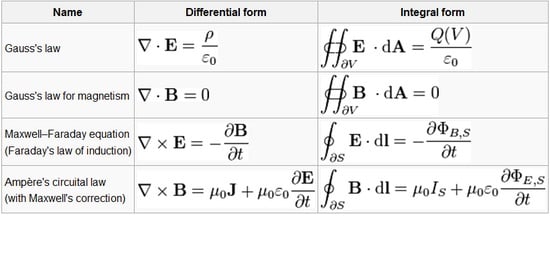
Maxwell's equations |
This looks bad, of course. But let's cut the CEO some slack: Maxwell's equations are notoriously unintuitive, as I observed in this post.
You can use the equations, solving them for particular physical configurations. But what picture do they give of the nature of the field(s) themselves?
What are we to make of the fact that a stationary observer of a motionless charged ball sees a static spherical electric field E, while an observer moving past that same ball sees electric and magnetic fields (E' and B')?
The magnetic field is a relativistic effect.
 |
| The charge is at rest in frame F, so this observer notes a static electric field. An observer in another frame F′ moves with velocity v relative to F, and notices the charge to move with velocity −v with an altered electric field E due to length contraction and a magnetic field B due to the motion of the charge. (Wikipedia). |
That's implicit in Maxwell's equations, but don't tell me it's obvious. For that, you need to write the equations in a manifestly covariant form, but they don't teach you that in undergraduate electrical engineering.
---
Oh, and he's surely right about augmented reality being the main deliverable from the current state of the art in artificial neural net technologies. The Holy Grail of AGI will be a product of mastering situated social cognition, a post for another day (but see here).