Showing posts with label entropy. Show all posts

Thursday, January 15, 2026

Entropy, Cosmology, and the Illusion of Objectivity (GPT5.2)


Entropy, Cosmology, and the Illusion of Objectivity

In physics, entropy occupies an awkward position in our conceptual furniture. In classical laboratory thermodynamics it behaves like a solid citizen: measurable, predictive, monotonic. Yet at a foundational level it is disturbingly slippery. Its definition depends on how we partition the world into macrostates, and that partition depends on which variables we choose to treat as salient. Change the coarse-graining and the entropy changes with it. There is nothing in the microscopic laws that tells us which description is the right one.

This dependence is not a minor technical blemish; it is structural. Entropy is not a property of a system simpliciter, but of a system under a description. Phase space does not come pre-tiled into macrostates. We impose the tiling, guided by stability, locality, and practical decoupling, and are rewarded—remarkably—with thermodynamics that works.

That said, this freedom is not the whimsical licence of bored physicists inventing macrostates at will. The macroscopic variables that dominate thermodynamics—temperature gradients, pressure differences, chemical potentials, free energy flows—are not arbitrary inventions. They are forced upon us by the structure of interactions in large systems: by locality, by short-range forces, by equilibration timescales, and by the existence of robust collective degrees of freedom. These quantities are not fundamental, but they are inevitable. Any coarse-graining that ignores them fails to track anything dynamically stable.

Cosmology, however, seems to resist even this qualified deflationary reading. The early universe was in an extraordinarily special state. Smooth, homogeneous, and gravitationally far from equilibrium, its initial state lay in a tiny region of the space of possible cosmic configurations. This fact is not conventional or observer-relative. It is written into the cosmic microwave background, into structure formation, into the very possibility of stars, chemistry, evolution, and life. Persistent free-energy gradients arise because matter began in a configuration from which gravitational clumping could only increase.

This appears to restore objectivity to entropy. But the restoration is only partial, and it comes at a price.

What is objectively fixed is not a unique entropy value, but a severe boundary condition. Almost any physically serious coarse-graining—any description that respects gravity, locality, and the relevant degrees of freedom—agrees on the essential ordering: the early universe was vastly “lower entropy” than the present one. The universe began in a configuration so special that all reasonable measures point in the same direction.

In this sense, the Past Hypothesis is real in a way entropy itself is not. It is an objective fact about the initial state of the cosmos, not a uniquely defined state variable attached to it. Entropy functions as a bookkeeping device that becomes indispensable once that fact is granted. It tracks the unravelling of an initial condition whose improbability is the deep mystery.

The arrow of time, then, is not imposed by entropy; entropy records it. The universe does not come equipped with a canonical entropy functional. What it comes with is a remarkably ordered beginning. History, complexity, and life unfold because of that beginning, not because entropy was ever a fundamental property written into the laws.

Entropy feels objective because the initial condition was brutally asymmetric. The miracle is not that entropy depends on description. The miracle is that, given how the universe started, it scarcely matters which sensible description we choose.

 

Tuesday, February 21, 2017

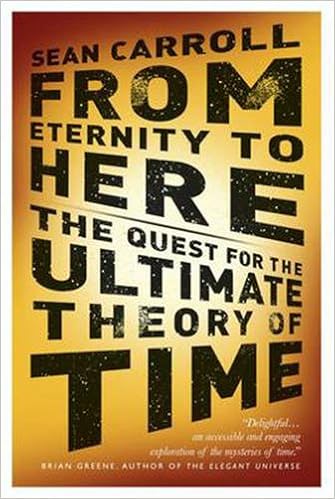
"From Eternity to Here" - Sean Carroll

Amazon Link

Just finished Sean Carroll's 2011 book, which - after an exhaustive exploration of all other options - locates the origin of 'the arrow of time' in the quantum-fluctuation emergence of super-low-entropy 'baby universes' from a preceding high-entropy de Sitter universe.

Yep, that would be the baby universe in which I'm sitting writing this post.

This may seem extravagant, to explain why eggs produce omelettes but not the reverse, but he refutes all the simpler explanations.

It presently seems unclear, however, whether a de Sitter universe could even make baby universes, absent a better theory of quantum gravity.

Carroll's latest thinking tends in a different direction, suggesting that framing the issue within the spacetime realm may itself be a mistake; the true nature of reality may be Hilbert space with Schrödinger equation dynamics. Spacetime, with its arrow of time, may be emergent.

Strange that the weirdest ideas of modern physics - the MWI, emergent spacetime - seem to be the most plausible.

This is a fine book, and an excellent introduction for the smart non-physicist to general relativity, quantum theory (QM/QFT) and cosmology.

Thursday, November 05, 2015

Password Entropy

There are some things you just know.
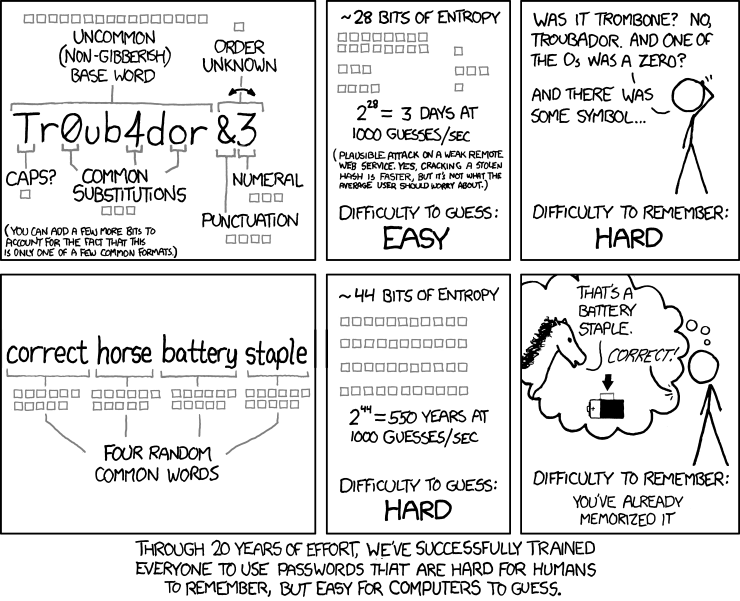
The gold standard for password generation was set by this xkcd cartoon.


Let's look at password entropy (from the Wikipedia article).
"It is usual in the computer industry to specify password strength in terms of information entropy, measured in bits, a concept from information theory. Instead of the number of guesses needed to find the password with certainty, the base-2 logarithm of that number is given, which is the number of "entropy bits" in a password.

"A password with, say, 42 bits of strength calculated in this way would be as strong as a string of 42 bits chosen randomly, say by a fair coin toss. Put another way, a password with 42 bits of strength would require 242 attempts to exhaust all possibilities during a brute force search. Thus, adding one bit of entropy to a password doubles the number of guesses required, which makes an attacker's task twice as difficult."
...

"For passwords generated by a process that randomly selects a string of symbols of length, L, from a set of N possible symbols, the number of possible passwords can be found by raising the number of symbols to the power L, i.e. NL. Increasing either L or N will strengthen the generated password.

"The strength of a random password as measured by the information entropy is just the base-2 logarithm or log2 of the number of possible passwords, assuming each symbol in the password is produced independently. Thus a random password's information entropy, H, is given by the formula

H = log2NL = L * log2N = L * log N/log 2

where N is the number of possible symbols and L is the number of symbols in the password. H is measured in bits.In the last expression, log can be to any base."
If we take logs to base 10 and consider the word 'cat' (where the three symbols are each taken from the set of 26 lower case characters {a-z}) then the entropy is:
3 * (log 26/ log 2) = 3 * (1.415/.3010) = 3 * 4.7 = 14 (approx).
In the xkcd cartoon, the phrase used is: "correcthorsebatterystaple" which I make to be 25 characters. These are drawn from the 26 lc symbols {a-z} which deliver 4.7 bits of entropy per character. (Handy table for DIY calculations here).

This would give a pretty impressive total of 26 * 4.7 = 117.5 bits of entropy.

But xkcd claims only 44; how come?

The cartoon's author, Randall Munroe, could be using the NIST heuristic analysis of 2004. After all, the phrase is not composed from random letters but words in English, which cuts out a lot of randomness*. If we use the NIST figures, I calculate we get 41 bits of entropy. But the whole area is actually rather vague.

Personally, I do the best I can. I use relatively insecure passwords for low-grade access to websites which seem to demand them, and much more cryptic (and unmemorable) passwords for stuff which is really important. By now I must have somewhere close to a hundred different username-password combinations,

Some people recommend investing in a password manager; I use Word with the 128-bit AES encryption turned on and a pretty high-entropy password which I have memorised. NIST recommends 80 bits of entropy for (non-military) high-security.

If I ever forget it, I'm toast!

---

* Bruce Schneier has some good advice (and a bit of a critique of the xkcd cartoon).

Johannes Weber has written the excellent 'Password Strength/Entropy: Characters vs. Words'.

Randall Munroe, xkcd author, explains what he was really doing (clue - count the little boxes representing bits under the symbols/words ...). Think of the words in the passphrase as quasi-symbols drawn from a huge 'alphabet' - a set with thousands or hundreds of thousands of members. This is the value we give to N (so even log2N is reasonably large). Then with two to six words in the passphrase, L = 2 to 6 ... and the entropy L * log2N does what you need. In the cartoon, Randall assumes a publically-known dictionary of 2,048 words, from which each word in the passphrase is randomly chosen. This gives 11 bits of entropy for each word.