Showing posts with label Richard Feynman. Show all posts

Friday, March 07, 2025

Engineering consciousness?

---

Richard Feynman once remarked that "unless you can build something, you don’t really understand it." This simple observation underpins the very nature of scientific inquiry and technological progress. If you cannot replicate a phenomenon through engineering, then your understanding of it is at best incomplete.

But when we apply this insight to consciousness we are confronted with an unnerving reality: despite our increasing competence in building systems that outperform anything in the natural world: aircraft that outmatch birds in flight, tanks that could defeat any armoured reptile, and computer systems that easily outthink humans, we still cannot engage with consciousness itself.

This profound inability suggests a paradigmatic gap in our understanding. It seems that we are missing something fundamental about what consciousness truly is and how it might have emerged.

Modern AI systems converse, navigate, play games at superhuman levels. Yet they are not conscious. They might simulate understanding but they do not feel. They lack subjective experience.

To date, no engineering specification has required, or led to the emergence of, consciousness. While we have designed systems to meet every requirement we could imagine - intelligence, adaptability, problem-solving - none of these systems exhibit the subjective what-it’s-like quality of conscious experience. Have we overlooked some crucial aspect of what makes human beings not just intelligent, but conscious?

We turn to introspection. Take the example of driving a familiar route. Once the skill is mastered, the brain processes the task automatically, our conscious mind is elsewhere. However, when something goes wrong - say, an unexpected obstacle appears - we "wake up" to the problem. Our conscious mind kicks in, calling upon a broader model of the world, seeking a solution.

This shift from automatic processing to conscious thought hints at a key feature of cognition: consciousness arises when the system is confronted with a situation that can’t be resolved by routine processes. When the 'closed world' assumed by instinct expands to the 'open world' of coupled reality.The brain reaches out to a wider pool of knowledge, seeking to integrate more complex information, a 'bigger picture' to formulate a solution.

In these moments of cognitive consciousness, the brain is not simply processing more information, but is actively integrating a more expansive model of the world. This expansion of awareness feels like a conscious step - an intervention from the "bigger world" outside the confines of the immediate task.

The crucial question, however, is why this transition is accompanied by a conscious experience. Why does the mind 'wake up into self-awareness' when faced with complexity?

And this is not even the full explanation of consciousness. It only touches on the functional aspects - the cognitive process of integrating new information. It does little to explain the affective experience of consciousness - the "hard problem" that David Chalmers famously identified. Why does any system, biological or otherwise, experience the intense pain of a stubbed toe, or the exquisite joy of a Led Zeppelin riff? This is the domain of qualia - the raw, subjective feel of experience that, as far as we can guess, seems to arise from the interplay of lower and higher brain systems.

It seems plausible that emotions play a critical role in harmonizing the conflict between primal drives and higher-level cognitive goals. But this does not, in itself, explain why pain feels so profoundly bad, or why joy is so intensely pleasurable. The rawness of these sensations seems to arise from the tension between lower-level survival instincts and the more abstract, deliberate planning processes of the cortex.

Emotions, in this sense, act as a bridge between these competing systems. But why should these conflicts - between the brainstem’s imperative to action and the cortex’s more detached planning - be felt at all? Robot designers have been designing such multilevel 'subsumption architectures' for decades without anyone ever thinking that consciousness was involved.

This is (one of) the unexplained mysteries at the heart of consciousness.

The failure of materialism to account for consciousness appears absolute. AI systems get better and better but they're all p-zombies. ChatGPT? Superhuman competences, human-level dialogue; no consciousness.

Consciousness seems to be a solution in search of a problem. Is this sending us the message that we’re simply operating within the wrong paradigm?

The reductionist, materialist model of consciousness posits that the mind will eventually be explained through an understanding of brain processes. As a hypothesis, this is appealing in its simplicity: no magic. But also no success.

In despair, panpsychism offers a radically different approach, positing that consciousness is a fundamental property of the universe - something intrinsic to all matter. Consciousness is not an emergent property but an inherent aspect of reality. Atoms and the void - and consciousness.

Panpsychism offers no predictive or explanatory capabilities. It sells itself as a metaphysical framework, but without any practical means to explore the concept of consciousness. A comforting idea, perhaps, but one that presently leads nowhere.

We remain at an impasse. Materialism fails to explain consciousness, and panpsychism fails to provide any productive means of exploring it. Feynman might say: if we can’t yet build consciousness, it simply means we don’t understand it well enough (or indeed, at all).

So consciousness joins the other great questions: why is there something rather than nothing? What is the true nature of reality? And Camus' question.


Tuesday, November 20, 2018

The Banach–Tarski paradox


According to Wikipedia:
"Given a solid ball in 3‑dimensional space, there exists a decomposition of the ball into a finite number of disjoint subsets, which can then be put back together in a different way to yield two identical copies of the original ball. Indeed, the reassembly process involves only moving the pieces around and rotating them without changing their shape.

However, the pieces themselves are not "solids" in the usual sense, but infinite scatterings of points. The reconstruction can work with as few as five pieces.

A stronger form of the theorem implies that given any two "reasonable" solid objects (such as a small ball and a huge ball), the cut pieces of either one can be reassembled into the other. This is often stated informally as "a pea can be chopped up and reassembled into the Sun" and called the "pea and the Sun paradox".
I remember reading Richard Feynman's reaction to this in his memoir "Surely You're Joking Mr Feynman!",
"Then I [Feynman] got an idea. I challenged them [the mathematicians]: “I bet there isn’t a single theorem that you can tell me – what the assumptions are and what the theorem is in terms I can understand – where I can’t tell you right away whether it’s true or false.”

It often went like this: They would explain to me, “You’ve got an orange, OK? Now you cut the orange into a finite number of pieces, put it back together, and it’s as big as the sun. True or false?”

“No holes.”

“Impossible!

“Ha! Everybody gather around! It’s So-and-so’s theorem of immeasurable measure!”

Just when they think they’ve got me, I remind them, “But you said an orange! You can’t cut the orange peel any thinner than the atoms.”

“But we have the condition of continuity: We can keep on cutting!”

“No, you said an orange, so I assumed that you meant a real orange.”

So I always won. If I guessed it right, great. If I guessed it wrong, there was always something I could find in their simplification that they left out."

There are no infinities in reality.

Friday, December 01, 2017

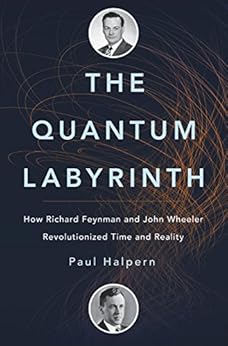
"The Quantum Labyrinth" - Paul Halpern

Amazon link

Paul Halpern, a physicist and historian of science, has written here a combined biography of John Wheeler and Richard Feynman covering the fifty years of their interlinked careers in physics (c. 1940-1990). Feynman started out as a student of Wheeler's, working on the deep problems of Dirac's early formulation of quantum electrodynamics, specifically 'the infinities'. Wheeler and Feynman resurrected the old Newtonian idea of 'action at a distance', combining advanced and retarded solutions of Maxwell's equations to model radiation resistance. This led to Feynman's development of the path integral formalism.

The war diverted both of them to the Manhattan project - Feynman's war in particular has been amply covered in many other books, together with his doomed marriage to Arline.

Post-war we see the full-on assault on QED where Feynman diagrams make their appearance, we accompany Wheeler as he makes General Relativity relevant again, and we encounter topics as diverse as cosmology, the Everett interpretation of quantum mechanics, time travel, nanotechnology and quantum computing.

To read this book is to journey with the protagonists. It's strong on places and times, on personalities and issues and debates. There are no equations or diagrams, although Halpern has a talent for verbal description (he makes a reasonable job of describing delayed-choice experiments, for example).

If you're a physics graduate who has absorbed the abstractions as a logical edifice, you will find this book an ideal complement as you watch the builders debating models and shooting each other down, while racing for priority. They say you should never watch sausages being made, but in physics it adds that vital human dimension of context and motivation.

Wednesday, November 29, 2017

Ed Witten speaks ...

Ed Witten is the foremost theoretical physicist alive today, although his introspective nature does not make great TV: consequently he's largely unknown to the general public.

Ed Witten (from Quanta magazine)

Peter Woit's recent post points towards an interview of Witten by Natalie Wolchover of Quanta magazine. Here is some of what Witten had to say:
"I tend to think that there isn’t a precise quantum description of space-time — except in the types of situations where we know that there is, such as in AdS space. I tend to think, otherwise, things are a little bit murkier than an exact quantum description. But I can’t say anything useful.

The other night I was reading an old essay by the 20th-century Princeton physicist John Wheeler. He was a visionary, certainly. If you take what he says literally, it’s hopelessly vague. And therefore, if I had read this essay when it came out 30 years ago, which I may have done, I would have rejected it as being so vague that you couldn’t work on it, even if he was on the right track."
By synchronicity, I'm currently reading this (which I have also reviewed):

Amazon link

which is a biographical account of the tangled lives of John Wheeler and Richard Feynman. Wheeler was the visionary, the 'big picture' guy, while Feynman was the 'let's get down to the basics and do the calculations' artisan-theorist.

Somehow the whole was greater than the parts: birds and frogs.

Witten continues:
"I tend to assume that space-time and everything in it are in some sense emergent. By the way, you’ll certainly find that that’s what Wheeler expected in his essay. As you’ll read, he thought the continuum was wrong in both physics and math. He did not think one’s microscopic description of space-time should use a continuum of any kind — neither a continuum of space nor a continuum of time, nor even a continuum of real numbers.

On the space and time, I’m sympathetic to that. On the real numbers, I’ve got to plead ignorance or agnosticism."
The whole interview is Witten playing the role of Feynman to the shade of Wheeler.

---

Other posts on emergent spacetime: and here's Wheeler's essay (pdf) which Witten referenced - it is infuriatingly vague, written in Wheeler's characteristic mangled-syntax english.

Friday, August 19, 2016

The 10,000 year view

Amazon link

Richard Feynman once wrote:
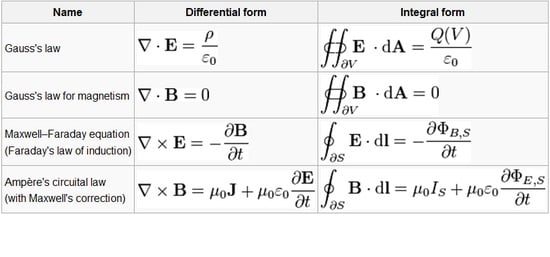
"From a long view of the history of mankind - seen from, say, ten thousand years from now - there can be little doubt that the most significant event of the 19th century will be judged as Maxwell's discovery of the laws of electrodynamics."
What should we say about the other centuries?

---

The seventeenth century, in 10,000 years time, will be remembered principally for Isaac Newton's laws of dynamics:

  • First law: When viewed in an inertial reference frame, an object either remains at rest or continues to move at a constant velocity, unless acted upon by a net force.

  • Second law: In an inertial reference frame, the vector sum of the forces F on an object is equal to the mass m of that object multiplied by the acceleration vector a of the object: F = ma.

  • Third law: When one body exerts a force on a second body, the second body simultaneously exerts a force equal in magnitude and opposite in direction on the first body.

And universal gravitation:  F = Gm1m2/r2  - plus calculus, co-discovered with Leibnitz.

---

The eighteenth century was not rich in epoch-spanning discoveries, but future historians of science will recall it for Rev. Thomas Bayes, whose profound theorem will power the great AI learning engines down the ages.


---

The nineteenth century we've already mentioned. Here are Maxwell's equations in the vector form he would not easily have recognised.


---

The twentieth century is a cornucopia of fundamental science, but I think the most truly foundational, revolutionary and influential discovery has to be the Schrödinger equation, which explains .. well, almost everything around us.


But I doubt the 10,000 year future will have forgotten Einstein - or BohrHeisenbergDirac, ... .

---

Sean Carroll has a related list of his seven favourite equations here.