Showing posts with label Emergent Spacetime. Show all posts

Friday, January 16, 2026

Is Spacetime Fundamental? Or Does It Emerge from Quantum Configuration Space?


Most attempts at quantum gravity treat spacetime as somehow fundamental—albeit quantised, discretised, or reimagined—rather than exploring the more radical idea that configuration space, or some deeper pre-geometric structure, is ontologically prior. Canonical quantisation, loop quantum gravity, spin foams—all these frameworks tend to smuggle spacetime in through the back door: manifolds, coordinate charts, causal orderings. The stage may wobble, shrink, or pixelate, but it remains recognisably a stage.

There is, however, a less-travelled but more conceptually daring road: theories in which configuration space comes first. These approaches ask the unthinkable: If space and time are emergent, then from what exactly are they emerging?

The situation today is not unlike physics in the 1890s. Maxwell’s electrodynamics stood tall, yet the atom remained an enigma, and the aether was taken for granted. A great theoretical edifice loomed, but its foundations were about to be washed away by the incoming tide of Planck and Einstein. We may now be in the same liminal moment—admiring the view from a scaffold that future physicists will dismantle.

In today’s pre-paradigmatic landscape, we face a conceptual standoff. Quantum field theory presumes a smooth, fixed background spacetime. General relativity, by contrast, treats spacetime itself as dynamic—but without the faintest hint of quantum entanglement or superposition. 

Attempts to resolve the tension tend either to bolt quantum mechanics onto classical geometry (as in loop quantum gravity), or to embed spacetime in a higher-dimensional scaffolding (as in string theory). Or, more radically, they dissolve spacetime entirely into something else: a tangle of configurations, causal sets, or entropic gradients.

The real difficulty is not merely technical—it’s philosophical. We lack not just the right equations, but the right questions. What is a “quantum” of geometry? What does a “probability amplitude” mean when there is no background spacetime in which anything can happen? These are not peripheral puzzles. They are ontological wrecking balls.

And unlike past scientific revolutions, we have no empirical anomaly to light the way. There is no ultraviolet catastrophe, no perihelion of Mercury. Quantum gravity has become theoretical physics’ Everest: people attempt the climb not because there is a storm coming, but because the peak is there, mocking us with its silence.

Still, for all their eccentricity and scarcity, these configuration-first approaches may be carving the path toward a Copernican reversal. What if spacetime is not the fundamental canvas, but a dramatis persona—an emergent illusion conjured from a deeper script written in the language of entanglement, topology, and relational structure?

Several research programs are already groping toward such a script. 

  • Tensor-network methods in AdS/CFT suggest that spatial geometry may be nothing more than a map of entanglement patterns.
  • The “it from qubit” program frames spacetime as the holographic bookkeeping of quantum information.
  • Causal set theory posits that causal order, not geometry, is the true primitive, with spacetime volume arising from the density of discrete events.
  • Even more abstract approaches - group field theory, amplituhedra, twistor theory - hint that the familiar continuum may be only a projection from higher-dimensional combinatorial or algebraic structures.

Whether any of these daring starts will crystallise into a paradigm is unknown. But the fact that multiple routes converge on the same suspicion - that spacetime is not fundamental at all - may itself be the signal. In the long arc of physics, such convergences often precede a revolution.

Whether that script will ever be legible to physicists in the 21st century is still an open question. But perhaps it’s the right one.

Tuesday, July 24, 2018

Quantum Gravity and the double-slit experiment

The backlog of books I wish I had already read continues to grow.

Amazon link

"Fields of Color explains Quantum Field Theory to a lay audience without equations. It shows how this overlooked and misunderstood theory resolves the weirdness of Quantum Mechanics and the paradoxes of Relativity. The third edition contains a new and simple solution to "the most controversial problem in physics today": the measurement problem." .. from the Amazon page.

Note (updated Friday 27th July 18): having now read this book I don't endorse it. It's simplistic, misleading and dumbed-down to the max. The author, who is an experimentalist, seems to believe that fundamental physics is best understood through a bluff, no-nonsense, concrete interpretation which in no important sense violates our everyday intuitions. Hard to reconcile with the maths (Hilbert space vs spacetime) .. the problematic ontology of operator-valued fields .. and so on. I accept that he believes what he says and that his intentions are good.

---

This post is about quantum gravity. Marginal Revolution  provided a link to this article: "a good explanation of why a theory of quantum gravity in particular is needed". The points made are not unfamiliar (see this superior post from Backreaction*) but the issue is at least somewhat clear.


 " ...you put a (preferably uncharged) test particle in the middle between the slits to see where the gravitational pull goes. If the gravitational field is quantized, then in half of the cases when the electron goes through the slit, the test particle will move left, in the other half of cases it would move right (it would also destroy the interference pattern). If the gravitational field is classical however, the test particle won’t move because it’s pulled equally to both sides. " (Backreaction).

Note that in the former case there's a measurement leading to a 'collapse of the electron wavefunction'.

Take the seemingly-related question: what is the electric field at a point 'at the screen' of an electron in a state of spatial superposition transiting the two slits? (Of course, we know that the electric field is quantised - the photon is the EM field quantum).

I don't recall this matter ever coming up in the usual QM discussion of the two slit experiment. Those are always concerned solely with the spatial trajectory of the electron itself.

It seems to me that this question can't be addressed within quantum mechanics, which assumes a classical electromagnetic field. Surely one must turn to quantum field theory? (See also this from Physics StackExchange). I don't have any top-level, hand-wavy intuitions about that, though. But the book above by Brooks might help.

Still, in QFT the fields are propagating within a fixed spacetime. When it comes to gravitation we're talking about the dynamic metrical structure of spacetime itself. That theory (quantum gravity) really isn't anchored down at all: the reality underpinning spacetime is utterly unlike the continuum of our naive intuitions.

---

* I had never studied the Schrödinger–Newton equation.

Wednesday, November 29, 2017

Ed Witten speaks ...

Ed Witten is the foremost theoretical physicist alive today, although his introspective nature does not make great TV: consequently he's largely unknown to the general public.

Ed Witten (from Quanta magazine)

Peter Woit's recent post points towards an interview of Witten by Natalie Wolchover of Quanta magazine. Here is some of what Witten had to say:
"I tend to think that there isn’t a precise quantum description of space-time — except in the types of situations where we know that there is, such as in AdS space. I tend to think, otherwise, things are a little bit murkier than an exact quantum description. But I can’t say anything useful.

The other night I was reading an old essay by the 20th-century Princeton physicist John Wheeler. He was a visionary, certainly. If you take what he says literally, it’s hopelessly vague. And therefore, if I had read this essay when it came out 30 years ago, which I may have done, I would have rejected it as being so vague that you couldn’t work on it, even if he was on the right track."
By synchronicity, I'm currently reading this (which I have also reviewed):

Amazon link

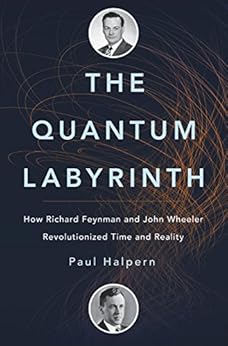
which is a biographical account of the tangled lives of John Wheeler and Richard Feynman. Wheeler was the visionary, the 'big picture' guy, while Feynman was the 'let's get down to the basics and do the calculations' artisan-theorist.

Somehow the whole was greater than the parts: birds and frogs.

Witten continues:
"I tend to assume that space-time and everything in it are in some sense emergent. By the way, you’ll certainly find that that’s what Wheeler expected in his essay. As you’ll read, he thought the continuum was wrong in both physics and math. He did not think one’s microscopic description of space-time should use a continuum of any kind — neither a continuum of space nor a continuum of time, nor even a continuum of real numbers.

On the space and time, I’m sympathetic to that. On the real numbers, I’ve got to plead ignorance or agnosticism."
The whole interview is Witten playing the role of Feynman to the shade of Wheeler.

---

Other posts on emergent spacetime: and here's Wheeler's essay (pdf) which Witten referenced - it is infuriatingly vague, written in Wheeler's characteristic mangled-syntax english.

Saturday, October 14, 2017

MWI, plus entanglement leads to GR, maybe?

In this video Sean Carroll lectures at Kings College on the 'Many-Worlds Interpretation' of quantum theory and his attempts, with collaborators, to conceptualise general relativistic spacetime as an emergent phenomenon due to entanglement.

Apparently the degree of entanglement between distinct vacuum states falls off as the distance between them. But perhaps this can be inverted, so that the concept of distance could be seen as an emergent proxy for the degree of entanglement.


The 50 minute lecture is 'aimed at undergraduates who haven't necessarily yet taken a quantum mechanics course'. If you are such, Carroll's talk will be as compelling as a presentation on Summa Theologica from Thomas Aquinas.

On the other hand, a passable familiarity with Hilbert space, quantum superposition and the Schrödinger equation plus a hand-wavy feel for QFT and Einstein's field equations will allow you to properly appreciate Carroll's approach to physics (and would make you a physics graduate).

In a nutshell, it's believe in the maths. Once you appreciate the ubiquity of superposition (ie, it's everywhere) you're kind of committed to the reality - in some sense - of Hilbert space. The observed phenomena simply can't be explained by theories which restrict themselves to our classical-looking 4D spacetime.

Carroll's talk is not technical in argumentation, he mentions rather than uses the theoretical apparatus of modern physics. That does put the burden of getting his drift wholly on the theoretical preparation of the listener of course.

In the final part of his lecture, he describes the research programme which seeks to obtain geometry from entanglement in quantum field theories via entropy and then, through considerations of energy, to reconstruct the GR field equations as the classical limit.

He seems encouraged, though this is work-in-progress.

Thursday, July 06, 2017

What would amaze Newton? Not much

"I've seen things you people wouldn't believe: attack ships on fire off the shoulder of Orion. I've watched C-beams glitter in the dark near the Tannhauser Gate. All those... moments... will be lost... in time, like... tears... in rain." (ref).
Did I mention that I am already bored with the future?


As an experiment, I mentally bring Sir Isaac Newton (1642-1727) back to life as a fully-formed adult, and ask what surprises him about three hundred and fifty years of progress. I don't mean surprised in any obvious sense, I mean stuff he'd discover that he genuinely could not have anticipated.

Our present-day culture and technology? I think that was all imaginable in the 17th century. I hesitated a bit at computers - the whole concept of hardware-software seems to depend on a post-Newton paradigm - but then I remembered Leibnitz.

So I think the only things which would truly amaze the brought-forward Newton are:
  1. Relativity
  2. Quantum Theory
  3. The neurobiological basis of mind.
The first two violate his Galilean worldview; the third his strong religious beliefs.

---

Today we know the universe - spatially and temporally - pretty well: from 10-32 seconds at startup out to about 100 billion years ahead.

We also know what the universe is macroscopically made of: galaxies, black holes, stars, planets, space-boulders, dust & gas clouds. The known laws of physics apply to virtually all of the phenomenology of these objects - we can predict with high accuracy what it would be like to visit.

No real surprises there.

---

Life is bounded by physics, chemistry and thermodynamics. We have a reasonable theory of biogenesis ('The Vital Question') and the transition to eukaryotic and multicellular life.

I wouldn't be surprised to find we are the only technological society in this galaxy (evidence) and I think we have a reasonable idea about the kinds of aliens that might exist - once we peel off those rose-coloured spectacles.

If I were to achieve an unwanted immortality, I just don't see where future history could differ much surprise-wise from that space which science-fiction has already massively, redundantly charted.

I would be interested - but I don't see myself massively amazed.

---

Note: there really isn't that much room for reality to out-weird our imagination when a leading paradigm to understand the spacetime in which we live is described thus:
"The zeroth order phenomena [in quantum gravity] is locality itself. This must be the case if, as is sometimes hypothesized, locality is emergent in the classical or continuum limit of a fundamental quantum theory of gravity, whose states are networks living in no space, perhaps spin networks or records of entanglement.

The first order departures from locality are quantum phenomena, especially entanglement. Indeed one version of this proposal is that spatial relations are emergent from entanglement. ... "
From Lee Smolin's paper, "What are we missing in our search for quantum gravity?".

Monday, April 03, 2017

"Where is heaven, Father?"

Some seven or eight years ago I attended a Catholic event with Clare at the church in Andover. I think it was a lecture on some theological issue or other, or maybe a talk on the Missions. In any event it was a dark night and the church was packed.

At some stage in the evening the priest, an elderly, kindly man with a poor public speaking style, took questions from the audience: a kind of 'ask me anything'.

A quavering voice - evidently an elderly Irish woman - piped up from behind us: "Father, where is heaven?"

My jaw dropped: in this day and age?

The priest was, however, up to the job. He explained that previous orthodoxy had held that heaven was beyond the sky. However, NASA had sent a great many rockets and heaven was nowhere to be seen up there. However, modern physics was very strange with quantum effects between the atoms which no-one understood. Possibly it was here that heaven was located.

There was no follow-up question.

---

It made me think though. If heaven is nowhere to be found in this spacetime universe, could it really be found in Hilbert space? Perhaps in the primordial substance before spacetime geometry had ever congealed?

Let's ask Carlo Trugenberger: "Emergent 4D Quantum Geometry from Critical Space-Time Graphs".
"After a brief introduction to the problem of quantum gravity and the main solution approaches on the market I will focus on my new proposal of a quantum gravity model in which the fundamental degrees of freedom are information bits for both discrete space-time points and links connecting them.

"The Hamiltonian is a very simple network model consisting of a ferromagnetic Ising model for space-time vertices and an antiferromagnetic Ising model for the links. As a result of the frustration between these two terms, the ground state self-organizes as a new type of low-clustering graph.

"I will provide ample evidence that this simple network model has two critical points, an ultraviolet fixed point corresponding to fluctuating information bits and an infrared fixed point corresponding to an emergent geometric phase with space-time dimension 4.

"The model predicts that, at small scales, the space-time dimension decreases until space-time itself completely dissolves into a disordered soup of information bits.  The large-scale dimension 4 of the universe is related to the upper critical dimension 4 of the Ising model and to illustrate the dimension decoupling mechanism I will solve a toy version of the model in the mean field approximation.

"At finite temperatures the universe graph emerges without big bang and without singularities from a ferromagnetic phase transition in which space-time itself forms out of a hot soup of information bits."

So heaven might be 'a hot soup of information bits' (but perhaps that's the other place). Perhaps we could link this idea with Eternal Inflation to get a contemporaneous theological ontology.

---

How do we know that our current universe has three spatial dimensions? Because Clare needed a minimum of three strings to deploy her self-made bird feeder (two pie dishes from Poundland).

Three strings = three spatial dimensions

The designer shows her grasp of string theory

As I carefully explained to her, the argument works best in polar coordinates.

Tuesday, February 21, 2017

"From Eternity to Here" - Sean Carroll

Amazon Link

Just finished Sean Carroll's 2011 book, which - after an exhaustive exploration of all other options - locates the origin of 'the arrow of time' in the quantum-fluctuation emergence of super-low-entropy 'baby universes' from a preceding high-entropy de Sitter universe.

Yep, that would be the baby universe in which I'm sitting writing this post.

This may seem extravagant, to explain why eggs produce omelettes but not the reverse, but he refutes all the simpler explanations.

It presently seems unclear, however, whether a de Sitter universe could even make baby universes, absent a better theory of quantum gravity.

Carroll's latest thinking tends in a different direction, suggesting that framing the issue within the spacetime realm may itself be a mistake; the true nature of reality may be Hilbert space with Schrödinger equation dynamics. Spacetime, with its arrow of time, may be emergent.

Strange that the weirdest ideas of modern physics - the MWI, emergent spacetime - seem to be the most plausible.

This is a fine book, and an excellent introduction for the smart non-physicist to general relativity, quantum theory (QM/QFT) and cosmology.

Monday, December 28, 2015

Emergent spacetime: a review of George Musser's book


George Musser is profoundly disserved by his book’s cover. Featuring garish colours, a clichéd title and fatuous sub-title, it is easy to assume that this is a sensationalist popularisation for dummies. You could not be further from the truth. George Musser is a contributing editor for Scientific American and the author of ‘The Complete Idiot’s Guide to String Theory’ – he has interviewed the world’s leading physicists and produced a wonderfully clear account of how our familiar spacetime might be emergent (Amazon link).

He starts with the classic experiment: produce two photons in correlated polarisation states. Set them going in opposite directions. If the polarisation of one photon is measured, its value instantly determines the polarisation state of the other, no matter how far away it has flown. This is quantum non-locality and it tells us that something is wrong with our understanding of spacetime as a smooth continuum with light cones determining cause and effect.

Physicists tend to hate this kind of observation. Given that quantum theory itself defies any straightforward interpretation as a theory of ‘reality’ it seems that non-locality is just one more piece of ontological weirdness. Better to shut up and calculate: we know the theory works incredibly well and we know how to interpret the answers (as probabilities).

The sense that ‘reality’ is real and should make sense in its own terms is a powerful intuition. It has frequently been use to highlight conceptual weaknesses in otherwise successful theories. Musser recounts just how much trouble Newton’s contemporaries (and Newton himself) had with the apparently infinite speed of gravity in his theory – this is also a kind of non-locality. It was nineteenth century field theories (Faraday, Maxwell) followed by General Relativity which (briefly) restored locality to physics.

Quantum non-locality is something else. Musser writes (p. 125), “Instead of thinking of quantum non-locality as an effect which operates within space, I think we need to take it as a sign that space itself is a doomed concept.”  What would a theory of emergent spacetime look like? There are a number of ideas; naturally none are fully worked out.

Fay Dowker talks about causal sets - space is built out of discrete units, ordered in a complex network whose structure creates space. Fotini Markopoulou has a similar networked theory of ‘atomic grains of space’ in an approach punningly-termed quantum graphity; the link density is determined by the available energy, from which emerges space as we know it. String theory has a model of emergent-space based on matrix models: the matrices catalogue the web of interactions between D0-branes, dimension zero building blocks of space. Leonard Susskind is associated with this line of research.

Musser explains these various theories in some detail, as best he can, describing their applications to black hole modelling and the early universe. AdS/CFT makes its obligatory appearance with yet another brave attempt to explain the holographic principle. But these diverse approaches deal mainly in space, treating time asymmetrically.

The book finishes with the Amplituhedron. Built on the foundations of S-matrix theory and twisters with a dash of string theory, the amplituhedron is a geometric structure used for calculating transition probabilities for particle interactions. Each particle contributes a polyhedron vertex with its momentum setting the size of the corresponding polyhedral face. The interior volume gives the resulting amplitude.
‘“There are no fields, no particles, no interactions,” Trnka says. The locality we observe in daily life is a consequence of the way the faces fit together – specifically that they form a closed shape, as opposed to disconnected planes.’
I don’t think the reader is expected to fully grasp this.

The idea that the 13.8 billion light year observable universe is an emergent artefact of an underlying non-spatial non-temporal quantum reality is surely the most mind-blowing concept of modern physics. Yet there are excellent reasons for taking it seriously. George Musser has written a clear, accessible and intelligent review of how this might be possible – it’s as near as most of us are ever going to get to understanding it – and he is to be congratulated.

Thursday, December 10, 2015

Emergent Spacetime


An extract from this book - (publisher, you have no idea how naff that front cover is).
"“Spacetime can’t be fundamental,” says the theorist Nima Arkani-Hamed. “It has to come out of something more basic.”

This thinking completely inverts physics. Nonlocality is no longer the mystery; it’s the way things really are, and locality becomes the puzzle. When we can no longer take space for granted, we have to explain what it is and how it arises, either on its own or in union with time.

Clearly, constructing space isn’t going to be as straightforward as melding molecules into a fluid. What could its building blocks possibly be? Normally we assume that building blocks must be smaller than the things you build out of them. A friend of mine and his daughter once erected a detailed model of the Eiffel Tower out of popsicle sticks; they hardly needed to explain that the sticks were smaller than the tower.

When it comes to space, though, there can be no “smaller,” because size itself is a spatial concept. The building blocks cannot presume space if they are to explain it. They must have neither size nor location; they are everywhere, spanning the entire universe, and nowhere, impossible to point to. What would it mean for things not to have positions? Where would they be? “When we talk about emergent space-time, it must come out of some framework that is very far from what we’re familiar with,” Arkani-Hamed says."
Emergent spacetime is a hot topic. Relativity assumes spacetime as a prior manifold and imposes geometry upon it. Quantum theory knows nothing - ab initio - about spacetime; its setting is a high/infinite dimensional complex vector space known as Hilbert space.

How are the two reconciled? Physical observables such as spatial position (momentum, energy, spin state are others) define coordinate systems (sets of basis vectors) within Hilbert space. It seems that Hilbert space is more fundamental than the spacetime we find ourselves in, but how do we get our perceived universe out of quantum theory? A unified theory needs to tell us but no compelling narrative has yet emerged.

I'm hoping this book can bring me up to date (in a sort of, a bit like, resembling kind of way).

---

A review from Backreaction (which de-risked this purchase for me).