Not many posts for the next few days as we have a visitor: my 'study' reverts to its ur-status as bedroom.
I ordered Sean Carroll's book (which should be arriving tomorrow or Saturday) ..
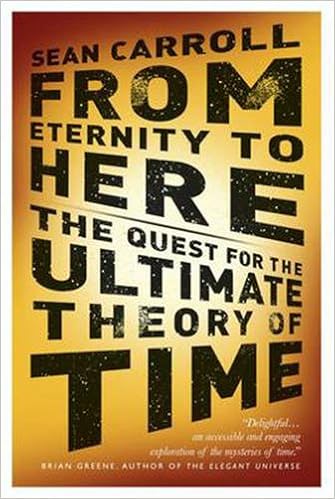
.. on account that one reviewer (3 stars) complained it was 'too hard'. I'll try to let you know.
---
Strange how hard it is to predict another's taste in books. I really appreciated Scott Bakker's "The Disciple of the Dog" but all that inline philosophy slowed it down way too much for Clare.
It's been replaced - amazingly - by the famous "The Mote in God's Eye" which she is lapping up as I read it to her.
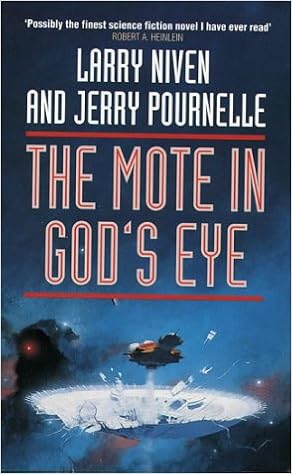
We haven't even reached the gripping alien lightsail contact event yet; still in the early chapters of Niven's and Pournelle's backstory building, usually condemned as 'boring'.
---
I remain a fan of Scott Bakker and have purchased (Kindle) this: (start of a mega-epic) ..
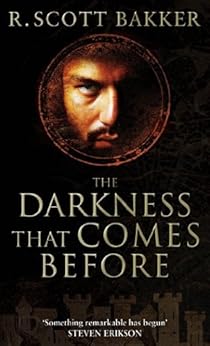
.. which seems awfully complicated. I have dipped my toe in.
---
My third ordered volume is "The Genome Factor: What the Social Genomics Revolution Reveals About Ourselves, Our History, and the Future" by Dalton Conley and Jason Fletcher.
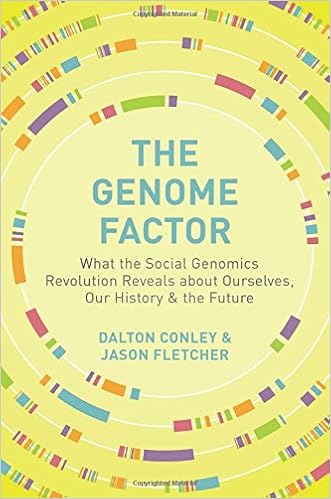
I'm hyper-wary of the fluffy-bunny pleasantries of the Standard Social Science Model, but it seems well-regarded so I'm taking the risk. Should be out some time in late February.
---
Do you hear that hacking cough from the bedroom? Clare is much recovered today but the sub-zero windchill of our lunchtime shopping trip to Waitrose has sapped her energy .. and she has retired to bed. Still, direction of progress is positive.
---
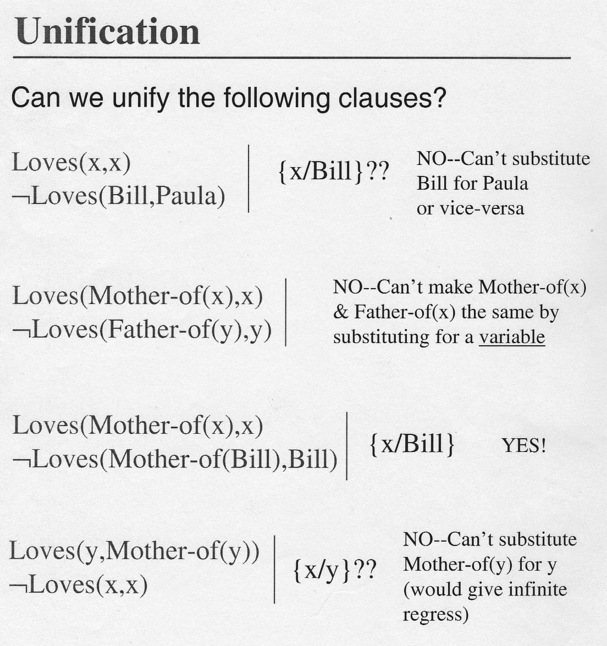
Well, enough time here. I think it's time to re-acquaint myself with J. A Robinson's exemplary treatment of unification with those substitution subtleties ... .
Showing posts with label Logic Form and Function. Show all posts
Thursday, January 26, 2017
Diary: books + Clare's health
Labels:
Book,
Dalton Conley,
J. A. Robinson,
Jason Fletcher,
Jerry Pournelle,
Larry Niven,
Logic Form and Function,
Scott Bakker,
Sean Carroll,
The Genome Fac tor,
The Mote in God's Eye,
Unification
Thursday, December 22, 2016
J. A. Robinson's Lisp code for his resolution theorem prover
Here are the pages - from Chapter 13 of "Logic: Form and Function" - where J. A. Robinson documents and describes his hyper-resolution theorem prover in Lisp. You will find the Lisp interestingly archaic.
My apologies for the poor quality - it was done in a rush. Nevertheless, the material is quite readable. It's published as the PDF link below.
PDF
My apologies for the poor quality - it was done in a rush. Nevertheless, the material is quite readable. It's published as the PDF link below.
Wednesday, December 21, 2016
"Logic: Form and Function" contents
J. A Robinson's book has arrived, and here's the contents list.
I may post the Chapter 13 code of his Hyper-Resolution Theorem Prover (written in the most delightfully archaic Lisp) but there's so much, it will take a while.
[Update (Dec 22nd): Here it is (PDF)].
My really cool New Year Resolution: re-implement it in Common Lisp, in the modern style.
I may post the Chapter 13 code of his Hyper-Resolution Theorem Prover (written in the most delightfully archaic Lisp) but there's so much, it will take a while.
[Update (Dec 22nd): Here it is (PDF)].
My really cool New Year Resolution: re-implement it in Common Lisp, in the modern style.
Thursday, December 15, 2016
"Logic: Form and Function": J. A. Robinson
John Alan Robinson is a semi-forgotten hero of artificial intelligence (he died four months ago). He discovered the resolution rule (and rediscovered Herbrand's concept of unification) which made automated theorem-proving a computational reality. And he wrote a book which was a classic on how to implement a resolution theorem prover.
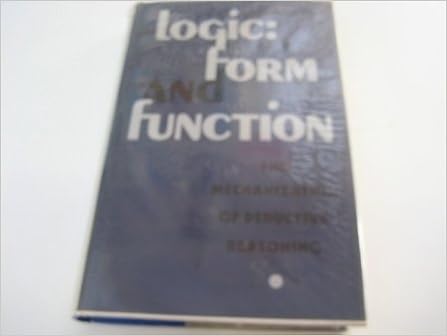
His 1979 book, Logic: Form and Function, is out of print and now only available second-hand. It's sunk into obscurity, as you can see from Amazon's terrible image above.
After some efforts, I have managed to order a copy and will do my best to write a review (Google reports no accessible reviews on the Internet). Here is some background on Robinson (Wikipedia).
Automated theorem proving (ATP) is the engine of classical AI in the way that neural nets are the engine of contemporary AI.
Deep Learning, which makes everything into a classification problem, has superseded brittle, classical AI not least because high-level features emerge from the weight-training process under some optimisation criteria, rather than being hand-crafted by the programmer.
Check this brilliant article from the NYT (via Steve Hsu).
But if your ambitions are somewhat modest, ATP takes you a long way .. and you can do it at home, kids.
---
Here is the table of contents from "Logic: Form and Function".
And finally, here is the text from Chapter 13 where Robinson documents his (very old-fashioned) Lisp code for the hyper-resolution theorem prover (PDF).
My apologies for the poor quality, but it is readable. To make sense out of how it works, I suspect you need to buy the book and to read the preceding chapters.
![]() |
| Amazon Link |
His 1979 book, Logic: Form and Function, is out of print and now only available second-hand. It's sunk into obscurity, as you can see from Amazon's terrible image above.
After some efforts, I have managed to order a copy and will do my best to write a review (Google reports no accessible reviews on the Internet). Here is some background on Robinson (Wikipedia).
"Robinson was born in Halifax, Yorkshire, England in 1930 and left for the United States in 1952 with a classics degree from Cambridge University. He studied philosophy at the University of Oregon before moving to Princeton University where he received his PhD in philosophy in 1956. He then worked at Du Pont as an operations research analyst, where he learned programming and taught himself mathematics.---
He moved to Rice University in 1961, spending his summers as a visiting researcher at the Argonne National Laboratory's Applied Mathematics Division. He moved to Syracuse University as Distinguished Professor of Logic and Computer Science in 1967 and became professor emeritus in 1993.
It was at Argonne that Robinson became interested in automated theorem proving and developed unification and the resolution principle. Resolution and unification have since been incorporated in many automated theorem-proving systems and are the basis for the inference mechanisms used in logic programming and the programming language Prolog.
Automated theorem proving (ATP) is the engine of classical AI in the way that neural nets are the engine of contemporary AI.
Deep Learning, which makes everything into a classification problem, has superseded brittle, classical AI not least because high-level features emerge from the weight-training process under some optimisation criteria, rather than being hand-crafted by the programmer.
Check this brilliant article from the NYT (via Steve Hsu).
But if your ambitions are somewhat modest, ATP takes you a long way .. and you can do it at home, kids.
---
Here is the table of contents from "Logic: Form and Function".
And finally, here is the text from Chapter 13 where Robinson documents his (very old-fashioned) Lisp code for the hyper-resolution theorem prover (PDF).
My apologies for the poor quality, but it is readable. To make sense out of how it works, I suspect you need to buy the book and to read the preceding chapters.
Subscribe to:
Posts (Atom)