Showing posts with label quantum entanglement. Show all posts

Saturday, October 14, 2017

MWI, plus entanglement leads to GR, maybe?

In this video Sean Carroll lectures at Kings College on the 'Many-Worlds Interpretation' of quantum theory and his attempts, with collaborators, to conceptualise general relativistic spacetime as an emergent phenomenon due to entanglement.

Apparently the degree of entanglement between distinct vacuum states falls off as the distance between them. But perhaps this can be inverted, so that the concept of distance could be seen as an emergent proxy for the degree of entanglement.


The 50 minute lecture is 'aimed at undergraduates who haven't necessarily yet taken a quantum mechanics course'. If you are such, Carroll's talk will be as compelling as a presentation on Summa Theologica from Thomas Aquinas.

On the other hand, a passable familiarity with Hilbert space, quantum superposition and the Schrödinger equation plus a hand-wavy feel for QFT and Einstein's field equations will allow you to properly appreciate Carroll's approach to physics (and would make you a physics graduate).

In a nutshell, it's believe in the maths. Once you appreciate the ubiquity of superposition (ie, it's everywhere) you're kind of committed to the reality - in some sense - of Hilbert space. The observed phenomena simply can't be explained by theories which restrict themselves to our classical-looking 4D spacetime.

Carroll's talk is not technical in argumentation, he mentions rather than uses the theoretical apparatus of modern physics. That does put the burden of getting his drift wholly on the theoretical preparation of the listener of course.

In the final part of his lecture, he describes the research programme which seeks to obtain geometry from entanglement in quantum field theories via entropy and then, through considerations of energy, to reconstruct the GR field equations as the classical limit.

He seems encouraged, though this is work-in-progress.

Monday, December 28, 2015

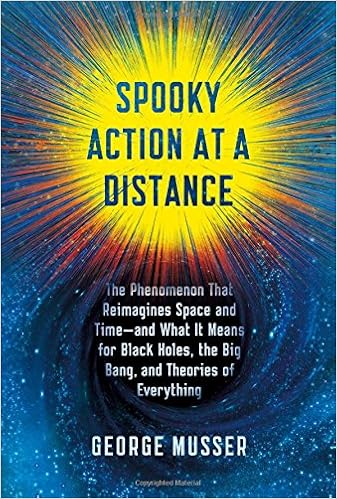
Emergent spacetime: a review of George Musser's book


George Musser is profoundly disserved by his book’s cover. Featuring garish colours, a clichéd title and fatuous sub-title, it is easy to assume that this is a sensationalist popularisation for dummies. You could not be further from the truth. George Musser is a contributing editor for Scientific American and the author of ‘The Complete Idiot’s Guide to String Theory’ – he has interviewed the world’s leading physicists and produced a wonderfully clear account of how our familiar spacetime might be emergent (Amazon link).

He starts with the classic experiment: produce two photons in correlated polarisation states. Set them going in opposite directions. If the polarisation of one photon is measured, its value instantly determines the polarisation state of the other, no matter how far away it has flown. This is quantum non-locality and it tells us that something is wrong with our understanding of spacetime as a smooth continuum with light cones determining cause and effect.

Physicists tend to hate this kind of observation. Given that quantum theory itself defies any straightforward interpretation as a theory of ‘reality’ it seems that non-locality is just one more piece of ontological weirdness. Better to shut up and calculate: we know the theory works incredibly well and we know how to interpret the answers (as probabilities).

The sense that ‘reality’ is real and should make sense in its own terms is a powerful intuition. It has frequently been use to highlight conceptual weaknesses in otherwise successful theories. Musser recounts just how much trouble Newton’s contemporaries (and Newton himself) had with the apparently infinite speed of gravity in his theory – this is also a kind of non-locality. It was nineteenth century field theories (Faraday, Maxwell) followed by General Relativity which (briefly) restored locality to physics.

Quantum non-locality is something else. Musser writes (p. 125), “Instead of thinking of quantum non-locality as an effect which operates within space, I think we need to take it as a sign that space itself is a doomed concept.”  What would a theory of emergent spacetime look like? There are a number of ideas; naturally none are fully worked out.

Fay Dowker talks about causal sets - space is built out of discrete units, ordered in a complex network whose structure creates space. Fotini Markopoulou has a similar networked theory of ‘atomic grains of space’ in an approach punningly-termed quantum graphity; the link density is determined by the available energy, from which emerges space as we know it. String theory has a model of emergent-space based on matrix models: the matrices catalogue the web of interactions between D0-branes, dimension zero building blocks of space. Leonard Susskind is associated with this line of research.

Musser explains these various theories in some detail, as best he can, describing their applications to black hole modelling and the early universe. AdS/CFT makes its obligatory appearance with yet another brave attempt to explain the holographic principle. But these diverse approaches deal mainly in space, treating time asymmetrically.

The book finishes with the Amplituhedron. Built on the foundations of S-matrix theory and twisters with a dash of string theory, the amplituhedron is a geometric structure used for calculating transition probabilities for particle interactions. Each particle contributes a polyhedron vertex with its momentum setting the size of the corresponding polyhedral face. The interior volume gives the resulting amplitude.
‘“There are no fields, no particles, no interactions,” Trnka says. The locality we observe in daily life is a consequence of the way the faces fit together – specifically that they form a closed shape, as opposed to disconnected planes.’
I don’t think the reader is expected to fully grasp this.

The idea that the 13.8 billion light year observable universe is an emergent artefact of an underlying non-spatial non-temporal quantum reality is surely the most mind-blowing concept of modern physics. Yet there are excellent reasons for taking it seriously. George Musser has written a clear, accessible and intelligent review of how this might be possible – it’s as near as most of us are ever going to get to understanding it – and he is to be congratulated.

Friday, April 03, 2015

All is geometry

Here's a little puzzle. Suppose you pick a number randomly between 0 and 1: call it x. Now pick a second one, also between 0 and 1: call it y. What's the average distance between x and y?

Hands up those who called out zero! Well, you clever, but you bad! I mean the distance you could measure with a ruler, no negative distances.

Not so trivial now, is it.

So here's a picture of us choosing x and y (figure 1). Let's agree that the order makes no difference to the gap between them, so we'll just arrange things so that x is the bigger one (don't care, if x = y).

Figure 1
We'll let z be the distance measured by our mathematical ruler between the two numbers - we want to know the average value of z over many trials. We can plot x and y as separate choices in the X-Y plane (figure 2).

Figure 2

The space of possible choices for x and y is the shaded triangle above. The area of the triangle is one half - we'll need this later.

Now, we add the Z-axis where we can plot the distance between them, z = x-y.

Figure 3

The volume z = x-y is a right-angled triangular pyramid. As you can see, when y is zero, z is just equal to x so z slopes upwards on the X-axis. When y = x, z is zero - that's where the pyramid meets the X-Y plane. The volume of the pyramid is a third the base-area times the height so that's (1/3) * (1/2) * 1 = 1/6; we'll need that in a moment.

I hope you'll agree that this three-dimensional volume showing the variation in distance between two randomly chosen points in the [0, 1] interval is not exactly obvious. To work out the average value of the distance z, we consider a shape which "sits" on the shaded area of figure 2 above, which has the same volume as figure 3 but is of uniform z-height.

Here's the picture (figure 4).

Figure 4

As you can see, z here is a constant 1/3, because (1/3) * (1/2) = (1/6), the same volume as before.

So that's the answer: the average distance between two randomly-chosen points is one third. Did you guess that correctly?

[Note: you might be surprised by how hard this problem is in general].

---

Here's another puzzle. You throw an ordinary six-faced die twice (example: getting 5 and 2). Call the difference between the two scores z (example: z = 5-2 = 3).

What's the average value of z? Fancy a guess?

Suppose the faces of the die were labelled (1/6), (2/6), ..., (6/6). Then these six points are uniformly distributed along the interval [0, 1] so we could use the result we already showed above and estimate that the average distance between them should be one third.

Of course the actual values on the die are six times bigger, so we would expect the value of z here also to be six times bigger, so 6 * (1/3) = 2.

Rough, obviously. We're talking a continuous approximation to a discrete distribution. We can get the right answer by simply listing cases.

6-1 = 5, 6-2 = 4, 6-3 = 3, 6-4 = 2, 6-5=1, 6-6 = 0
5-1 = 4, 5-2 = 3, 5-3 = 2, 5-4 = 1, 5-5 = 0
4-1 = 3, 4-2 = 2, 4-3 = 1, 4-4 = 0
3-1 = 2, 3-2 = 1, 3-3 = 0
2-1 = 1, 2-2 = 0
1-1 = 0

Total of differences = 35; total number of cases = 21 so average difference = 35/21 = 5/3 = 1.67 .. or, as we say, two to the nearest whole number :-).

(Do you see how you could draw pictures of these cases paralleling figures 2-4 above? You'd get a lumpy three-dimensional histogram rather than the smooth pyramid.)

---

There is a point to this amateur theorising. Mathematics sometimes seems very abstract and textual: axioms and long strings of deduction. This is to take a very lexical-syntactic view; to reduce ourselves to automated theorem-provers. The language of mathematics is about something, and that something is structure, geometry. The entities of mathematics are structural objects, often of high-complexity, of infinite size and inhabiting many dimensions. Our axioms and theorems describe properties of these structures; our proofs are like a blind man feeling his way around an elephant, encountering its aspects deduction by deduction.

When you truly understand a mathematical object in its full "shape", its nature is obvious. But it's hard for mortals to encompass the infinite - mere glimpses are sometimes as good as it gets.

Since physics is finding mathematical structures which can be brought into correspondence with measured reality, it is equally true - in some sense - that physics is geometry. There is a programme in physics, Geometrodynamics, which takes this rather literally.

You might also like to take a look at the hottest of new physics ideas: ER = EPR (wormholes in general relativity = quantum entanglement).
"I’ve mentioned before that John Wheeler was one of my heros during my formative years. Back in the 1950s, Wheeler held a passionate belief that “everything is geometry,” and one particularly intriguing idea he called “charge without charge.” There are no pointlike electric charges, Wheeler proclaimed; rather, electric field lines can thread the mouth of a wormhole. What looks to you like an electron is actually a tiny wormhole mouth. If you were small enough, you could dive inside the electron and emerge from a positron far away."
---

"Where did all this come from?" you ask wonderingly. Amazingly, I was working this out in bed this morning at 6.30 am. I have no idea why.