 |
| Amazon link |
Richard Feynman once wrote:
"From a long view of the history of mankind - seen from, say, ten thousand years from now - there can be little doubt that the most significant event of the 19th century will be judged as Maxwell's discovery of the laws of electrodynamics."What should we say about the other centuries?
---
The seventeenth century, in 10,000 years time, will be remembered principally for Isaac Newton's laws of dynamics:
- First law: When viewed in an inertial reference frame, an object either remains at rest or continues to move at a constant velocity, unless acted upon by a net force.
- Second law: In an inertial reference frame, the vector sum of the forces F on an object is equal to the mass m of that object multiplied by the acceleration vector a of the object: F = ma.
- Third law: When one body exerts a force on a second body, the second body simultaneously exerts a force equal in magnitude and opposite in direction on the first body.
And universal gravitation: F = Gm1m2/r2 - plus calculus, co-discovered with Leibnitz.
---
The eighteenth century was not rich in epoch-spanning discoveries, but future historians of science will recall it for Rev. Thomas Bayes, whose profound theorem will power the great AI learning engines down the ages.

---
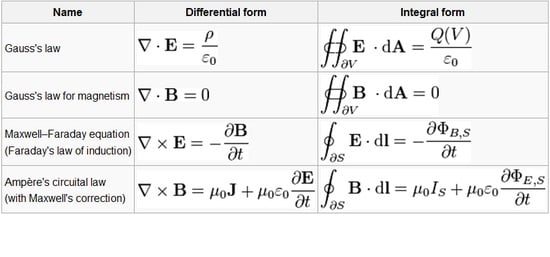
The nineteenth century we've already mentioned. Here are Maxwell's equations in the vector form he would not easily have recognised.
The twentieth century is a cornucopia of fundamental science, but I think the most truly foundational, revolutionary and influential discovery has to be the Schrödinger equation, which explains .. well, almost everything around us.

But I doubt the 10,000 year future will have forgotten Einstein - or Bohr, Heisenberg, Dirac, ... .
---
Sean Carroll has a related list of his seven favourite equations here.
