Showing posts with label Western Marxism. Show all posts

Thursday, August 23, 2018

"Postmodernism, or, The Cultural Logic of Late Capitalism" - Fredric Jameson

Amazon link

I've just begun reading Fredric Jameson's masterpiece and was struck by this excerpt (page 4):
"As for the postmodern revolt against all that [i.e. modernism], however, it must equally be stressed that its own offensive features from obscurity and sexually explicit material to psychological squalor and overt expressions of social and political defiance, which transcend anything that might have been imagined at the most extreme moments of high modernism—no longer scandalize anyone and are not only received with the greatest complacency but have themselves become institutionalized and are at one with the official or public culture of Western society.

What has happened is that aesthetic production today has become integrated into commodity production generally: the frantic economic urgency of producing fresh waves of ever more novel-seeming goods (from clothing to airplanes), at ever greater rates of turnover, now assigns an increasingly essential structural function and position to aesthetic innovation and experimentation.

Such economic necessities then find recognition in the varied kinds of institutional support available for the newer art, from foundations and grants to museums and other forms of patronage. Of all the arts, architecture is the closest constitutively to the economic, with which, in the form of commissions and land values, it has a virtually unmediated relationship.

It will therefore not be surprising to find the extraordinary flowering of the new postmodern architecture grounded in the patronage of multinational business, whose expansion and development is strictly contemporaneous with it. Later I will suggest that these two new phenomena have an even deeper dialectical interrelationship than the simple one-to-one financing of this or that individual project.

Yet this is the point at which I must remind the reader of the obvious; namely, that this whole global, yet American, postmodern culture is the internal and superstructural expression of a whole new wave of American military and economic domination throughout the world: in this sense, as throughout class history, the underside of culture is blood, torture, death, and terror. "
Postmodernism is surely a liberal project. Jonathan Haidt (Moral Foundations Theory) has highlighted liberal blindness to the moral dimensions of sanctity, respect for due authority and sexual/social propriety. Pussy Riot are rightly postmodernist icons.

Jameson here nails the moral selectiveness of fashionable liberal opinion.

---

Jameson is undeniably brilliant - his work suffused in the culture of Western Marxism and the Frankfurt School. I'm debating whether to get his later (2005) review, "Archaeologies of the Future: The Desire Called Utopia and Other Science Fictions".
Amazon link

"This is a brilliant study of utopia and science fiction, from Thomas More to Philip K. Dick, by the master literary critic. "Archaeologies of the Future", Jameson's most substantial work since "Postmodernism", investigates the development of the Utopian form since Thomas More, and interrogates the functions of Utopian thinking in a post-Communist age.

The relationship between utopia and science fiction is explored through the representations of otherness...alien life and alien worlds...and a study of the works of Philip K. Dick, Ursula LeGuin, William Gibson, Brian Aldiss, Kim Stanley Robinson and more."      [From the Amazon page].

Wednesday, March 07, 2018

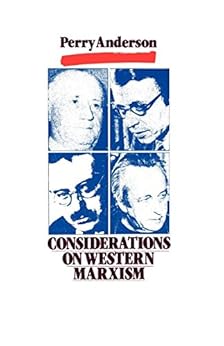
Perry Anderson on Western Marxism and Hegemony

Amazon link

"In The German Ideology, Marx wrote that the development of the forces of production is an absolutely necessary practical premise because without it scarcity is merely generalized (nur der Mangel verallgemeinert), and with destitution (Notdurft) the struggle for necessities would begin again and all the old filth would necessarily be reproduced'. See Werke, Vol. 3, pp. 34-5.

This passage was to be recalled by Trotsky in his analysis of the reasons for the rise of Stalinism in Russia, which made scarcity (nuzhda) a central category of its explanation: see The Revolution Betrayed, New York 1965,pp. 56-60."
This from the notes for Chapter 4 of "Considerations on Western Marxism" by Perry Anderson. It's a quote I've had in mind a long time, but was unable to track down. Very critical for the analysis of the failures of bureaucratic-socialism in the twentieth century, and perhaps in the twenty-first.

Anderson is a visionary, synthetic writer: (a bird or a seer in the classic distinction). His account of Western Marxism after the Russian revolution is crammed full of insights. Anderson reviews the works of Lukács, Korsch and Gramsci; Adorno, Marcuse and Benjamin; Sartre and Althusser; and Della Volpe and Colletti, together with other figures within Western Marxism from 1920 to 1975.

Here's a brief summary from a generally hostile review.
"Anderson argues that despite their diversity all these thinkers represent a common response to the failure of the Russian revolution to spread to the West after the First World War, and the consequent suffocation of Marxism by Stalinists, fascism, and social-democracy.

The ‘Western Marxists’ reacted by flying from active involvement in the class struggle to a preoccupation with philosophy, and indeed with idealist philosophy divorced from practice in a way that the classical Marxists, from Marx himself to Lenin, Luxemburg and Trotsky, would have violently rejected.

Only today, Anderson concludes, with the revival of workers’ struggles and of the revolutionary movement in the advanced capitalist countries, can Marxist theory be integrated into the class struggle again."
Anderson was writing in 1974, when the événements of May '68 in Paris were still fresh in mind and the Trotskyist movement had been revitalised (it was not to last). In his afterword written a decade later, Anderson was less starry-eyed and more conscious of the many gaps at the core of Marxist thinking: what would the socialist state look like, once we reject the naive vision of the permanently mobilised working class organised in councils? Where is the genesis of revolution to be found in a prosperous bourgeois democracy?

Our theoretical difficulties here relate to our very distance from the phenomenon in question: the practical transcendence of capitalism.

Anderson has come to see the concept of hegemony (as pioneered in the works of Gramsci) as a powerful and under-theorised foundation of capitalist stability: the privileging of consent over repression. His latest books ( The H-Word: The Peripeteia of Hegemony and the reissued The Antinomies of Antonio Gramsci: With a New Preface) are his attempt to address these issues.

---

Next: Perry Anderson's Marxism.

Tuesday, July 26, 2016

"What Is Orthodox Marxism?"

Amazon link

I first wrestled with "History and Class Consciousness" in my early twenties; it remains my favourite book of Marxist theory.

Georg Lukács was
"... a Hungarian Marxist philosopher, aesthetician, literary historian, and critic. He was one of the founders of Western Marxism, an interpretive tradition that departed from the Marxist ideological orthodoxy of the USSR. He developed the theory of reification, and contributed to Marxist theory with developments of Karl Marx's theory of class consciousness. He was also the philosopher of Leninism. He ideologically developed and organised Lenin's pragmatic revolutionary practices into the formal philosophy of vanguard-party revolution.

"As a literary critic Lukács was especially influential, because of his theoretical developments of realism and of the novel as a literary genre. In 1919, he was the Hungarian Minister of Culture of the government of the short-lived Hungarian Soviet Republic (March–August 1919).

"Lukács has been described as the preeminent Marxist intellectual of the Stalinist era, though assessing his legacy can be difficult as Lukács seemed to both support Stalinism as the embodiment of Marxist thought, and yet also champion a return to pre-Stalinist Marxism."
This morning I re-read "What Is Orthodox Marxism?", the first essay in the collection - and marvelled at the abstraction, erudition and sophistication of Lukács's thought.

It's slightly jolting to be reminded of just how conceptually deep Marxist theory actually is - not that you would know it from most professed 'Marxists'.

I considered writing a summary but found Phil Burton-Cartledge had done the job already- and much more diligently.

One feels that criticising Lukács without having immersed oneself in decades of study of the Western Marxism tradition would be like an arts journalist debating General Relativity and Quantum Field Theory with Stephen Hawking as a self-presumed equal (although that's happened).

Look, I buy into all this totality stuff, I like dialectical materialism and can accept that 'the proletariat is at one and the same time the subject and object of its own knowledge'. But once we've done all that, destroyed capitalism and removed capitalist reification and alienation, what next? Lukács sees the full liberation of mankind.

For me, on a bad day, it's dramatically relaxed selection.