 |
| Amazon link |
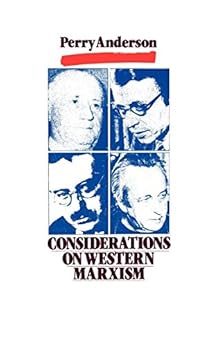
"In The German Ideology, Marx wrote that the development of the forces of production is an absolutely necessary practical premise because without it scarcity is merely generalized (nur der Mangel verallgemeinert), and with destitution (Notdurft) the struggle for necessities would begin again and all the old filth would necessarily be reproduced'. See Werke, Vol. 3, pp. 34-5.This from the notes for Chapter 4 of "Considerations on Western Marxism" by Perry Anderson. It's a quote I've had in mind a long time, but was unable to track down. Very critical for the analysis of the failures of bureaucratic-socialism in the twentieth century, and perhaps in the twenty-first.
This passage was to be recalled by Trotsky in his analysis of the reasons for the rise of Stalinism in Russia, which made scarcity (nuzhda) a central category of its explanation: see The Revolution Betrayed, New York 1965,pp. 56-60."
Anderson is a visionary, synthetic writer: (a bird or a seer in the classic distinction). His account of Western Marxism after the Russian revolution is crammed full of insights. Anderson reviews the works of Lukács, Korsch and Gramsci; Adorno, Marcuse and Benjamin; Sartre and Althusser; and Della Volpe and Colletti, together with other figures within Western Marxism from 1920 to 1975.
Here's a brief summary from a generally hostile review.
"Anderson argues that despite their diversity all these thinkers represent a common response to the failure of the Russian revolution to spread to the West after the First World War, and the consequent suffocation of Marxism by Stalinists, fascism, and social-democracy.Anderson was writing in 1974, when the événements of May '68 in Paris were still fresh in mind and the Trotskyist movement had been revitalised (it was not to last). In his afterword written a decade later, Anderson was less starry-eyed and more conscious of the many gaps at the core of Marxist thinking: what would the socialist state look like, once we reject the naive vision of the permanently mobilised working class organised in councils? Where is the genesis of revolution to be found in a prosperous bourgeois democracy?
The ‘Western Marxists’ reacted by flying from active involvement in the class struggle to a preoccupation with philosophy, and indeed with idealist philosophy divorced from practice in a way that the classical Marxists, from Marx himself to Lenin, Luxemburg and Trotsky, would have violently rejected.
Only today, Anderson concludes, with the revival of workers’ struggles and of the revolutionary movement in the advanced capitalist countries, can Marxist theory be integrated into the class struggle again."
Our theoretical difficulties here relate to our very distance from the phenomenon in question: the practical transcendence of capitalism.
Anderson has come to see the concept of hegemony (as pioneered in the works of Gramsci) as a powerful and under-theorised foundation of capitalist stability: the privileging of consent over repression. His latest books ( The H-Word: The Peripeteia of Hegemony and the reissued The Antinomies of Antonio Gramsci: With a New Preface) are his attempt to address these issues.
---
Next: Perry Anderson's Marxism.