 |
| Amazon link |
In contemporary thought capitalism, at least in embryo, has always been with us. People have always traded, merchants have always profited and the market has always existed. By some magic England initiated an industrial revolution in the 18th century and thereafter (after a lengthy brutish period) liberal civilisation finally swept the globe - provided the forces of reactionary-populism can be kept at bay.
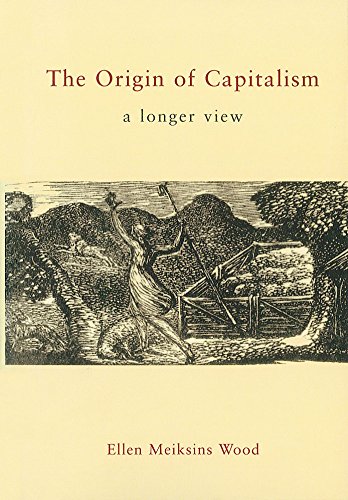
Such an ideological narrative obscures everything about true causation and real historical dynamics. Ellen Wood's book (above) essentially builds on Marx's arguments in Capital Volume 1, specifically Part 8, Primitive Accumulation, to outline the actual genesis of capitalism.
Classic feudalism exhibited what she terms parcelized sovereignty. A hierarchy of lords and nobles culminated in the monarch. This edifice was supported by explicit expropriation of the social surplus product of the peasantry, forced to work the nobles' land or pay rents in kind or money.
Feudalism of this type is not particularly stable. Power and wealth depend upon the possession of worked estates. It's a zero-sum game in which successful aggression - lord against lord, lord against monarch and monarch against monarch - is well-rewarded.
One route out of this is for the central power to win bringing about the absolutist state (purest example: the French state of Louis 16th who was deposed in the 1789 revolution). The French bourgeois revolutionaries were not capitalists (Wood insists on this distinction); they were urban professionals who used state office as the source of their wealth.
The pre-capitalist absolutist state might have been an end-point for the feudal polity, but it locked feudal relations of production into place - it did not organically produce capitalism.
England took a different route. The state was centralised early, yet was somewhat decoupled from the absolute power of the monarchy. Much of English history can be understood as a conflict between the leading nobles and the monarch for control of the state apparatus, including the means of taxation and repression, through the institutions of parliament.
The early centralisation of the UK market, the centralised, uniform state and the lack of a requirement for local lords to use their own military muscle on their peasants produced a tendency to demand rents in money rather than in kind or by corvée. This led to the phenomenon of agrarian capitalism: large farms (larger than could be cultivated by a family household plus a few hired hands) which relied upon landless workers as paid labourers. The farmer-tenants paid a monetary rent to their aristocratic/noble landlords.
Capitalist tenant-farmers could be turfed off their leases and the rent raised for more productive incomers. This gave the farmers an interest in increasing productivity - such a motive is unknown under the feudal-confiscatory mode of production. Landowners invested in surveying services precisely to ascertain optimal rents.
Where did the capitalist farmers come from? I think they were the most successful yeomen in the first instance, the kulaks of England. Certainly not part of the gentry, as Jane Austen would be the first to point out. This transition occurred in the 16th and 17th centuries primarily (see the Wikipedia article). Enclosures and the move to sheep farming (peaking in the late 18th/early 19th centuries) drove depopulation of the countryside and the mass separation of small-scale peasants from their means of livelihood. Facing starvation, these would flock to the towns where they became the first proletariat.
The first capitalists were those guild-masters who were able to thrown off the egalitarian shackles of guild law and increase the size of their enterprises, hiring tens and hundreds of newly-arrived workers. They were joined by usurers and merchants, looking for new opportunities to increase capital. Through this process, England produced dominant classes of landless workers and capitalists, quite separate from the feudal three estates of the church, the land-owning aristocracy, and the bourgeoisie and peasantry.
Once capitalism had gained traction, it was both self-sustaining and expansive. In its formative period the workers had no choice but to work hard or die; the capitalists, if defeated by the competition, would be bankrupted and pauperised. Even today, redundancy and bankruptcy are bad news.
Capitalism, unlike every other mode of production, is experienced as a never-ending compulsive treadmill, forced to ceaselessly develop the productive forces.
---
Wood argues that this capitalist lift-off happened just once in history, in England, due to the unique set of circumstances outlined above. She then proposes that under the impact of England's consequent economic and military success, the European absolutist states were forced to introduce their own capitalisms - essentially top-down - as 'modernising' reforms under the threat of obliteration.
I think you could make a similar case for the dynamic of Stalinist Russia .. and for China today.
---
Could the Roman Empire have introduced capitalism? Not an easy question to answer. You have to identify the seeds of both capitalist and proletarian classes and then show how such seeds would have grown rather than being extinguished by stronger and inimical social forces.
Obviously in the actual histories of the great agrarian empires there is not the slightest evidence of incipient capitalist tendencies. The Roman elite's wealth derived from unutterably vast landed estates, mostly worked by slaves. Slavery required a ubiquitous military presence to enforce it. This did not encourage agrarian capitalism, the seed corn for the capitalist transition.
When agrarian/slave empires broke up, they transitioned to feudal structures, not capitalist ones. I suspect that the Roman Empire never had the option for a capitalist future in its structure and dynamics.
---
Incidentally, I was not that impressed by Ellen Wood's book, although the topic she writes about is important and sorely neglected. Her writing is unengaging and repetitive. The book is heavily padded and would have worked better as a long essay.
She spends the first half of the work criticising at length other Marxist authors who, she correctly notes, assume what they are trying to prove, seeing the genesis of capitalism as inherent in trading or petty commodity production (all phenomena of many historical periods, geographies and modes of production which in general never led to capitalism).
Her analysis of the transition to capitalism itself is largely derivative from Marx (Capital Volume 1 Part 8, et al) and other works on agrarian capitalism (there is an extensive literature).
Finally, she finishes with the usual platitudes about the superiority of a never-explained socialism over capitalism and parochially finds evidence for capitalism's deep flaws in mad-cow disease of all things! So a clever writer but derivative, not too creative, someone who doesn't rise above genre cliche.
---
More posts on Marxist theory.
