Showing posts with label Perry Anderson. Show all posts

Friday, April 27, 2018

Socialist Revolution in the 21st Century?

Amazon link .. and a review

"First published in 1928, this is the Comintern’s official manual for insurrection and it has a foreword by Erich Wollenberg giving details of its composite authorship. The introduction by Piatnitsky is generally sensible, which, since he quotes extensively from Lenin on the necessity of a very advanced stage of political decomposition of the capitalist state as a pre-condition for an uprising, is not surprising.

There then follow four case studies, in approved Staff College fashion, of Reval in 1924, Hamburg 1923, Canton 1927 and Shanghai in 1926-27. These are in effect object lessons in how not to do it and disobey practically every one of Lenin’s dictums. ..."              [from Ted Crawford's 1971 review].
---

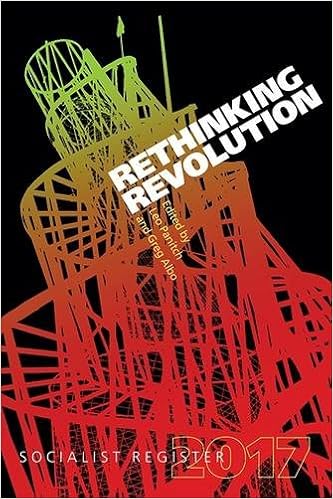
Amazon link - and no reviews

From 2016/17. So relevant and timely that no-one in the UK or America reviewed it on Amazon ... .

---

In his latest blog post, Marxist economist Michael Roberts concludes:
"Surely, a left government must instead look to replace big capital with democratically-run state enterprises in the ‘commanding heights’ of an economy.  This would lay the proper foundation for innovation and enterprise and thus put use-value before value, price and profit."
Fine words, yet how are we to get there?

Back in the heady days of red-blooded Leninist party building (the 1970s) the revolutionary left was completely educated on what would happen if a left-wing government were to come into office and try to legislate capitalism away. We had seen what happened in Chile.

The media would put up a ferocious ideological onslaught, there would be a massive capital exodus leading to economic depression or collapse while the state apparatus would sabotage socialist initiatives. In extremis, other capitalist powers would restore 'order', perhaps through NATO.

We didn't forget that revolution is civil war. That in an existential clash of two sides, the side with the better programme, the stronger morale, the superior military forces and the more inspired leadership gets to win.

We didn't forget that for capitalists, the socialist revolution looks like the chavish masses violently stealing everything they have, possibly arresting or killing them and their families. No, they surely would not go quietly into that good night.

Of course, the working class today is totally unprepared for such a confrontation. Michael Roberts has argued in his book, Marx 200, that a revival of working class organisation and combativity will not be apparent for some years yet, not until a new capitalist upturn following the end of the current long depression.

And yet we have the prospects of a Corbyn-McDonnell government coming up shortly, which is going to do what exactly?

---

Perry Anderson wrote:
"Yet it is quite clear that without serious exploration and mapping of it [the nature of socialism], any political advance beyond a parliamentary capitalism will continue to be blocked. No working-class or popular bloc in a Western society will ever make a leap in the dark, at this point in history, let alone into the grey on grey of an Eastern society of the type that exists today. A socialism that remains incognito will never be embraced by it."
And this is the problem. With all its cyclical dysfunctions, the monstrously-complex capitalist economy in all its globally interconnected sophistication works. Its valorisation-brutality forces progressive advances where kinder, gentler and less-driven souls would acquiesce to the always-vociferous and inevitable victims .. and preside over stagnation.

It seems unlikely that the working class will take a leap into the 'socialist chaos' that all media commentators will accurately predict without a really compelling narrative.

---

My review and Amazon link


Having read János Kornai's blistering critique of the socialist system, I am deeply skeptical about any transition to socialism which promises a quasi-social-democratic state with mass nationalisation enriched by 'bottom-up democratic forms'. I think we all know that revolutionary fervour dims, the masses demobilise and the activists end up colonising the bureaucracies.
Amazon link

Capitalism, with its separation of politics and economics as so usefully described by Michael Heinrich (PDF link: see chapter 11 p. 203), looks a better guarantor of the development of the productive forces and of personal and political freedoms than any kind of model which Michael Roberts is implicitly proposing.

The best indication of the entirely ritualistic nature of incantations of 'the replacement of capitalism' by contemporary Marxist theoreticians is the complete absence of any discussion of the transition itself.

Speaking personally, I prefer a disappointed honesty to hypocrisy and (self-) deception with the potential to lead to catastrophe.

---

See also; "The Comintern guide to armed insurrection (1928)".

Monday, March 19, 2018

No communism without abundance

PDF link

This is the exact quote I was looking for (page 11 of the text above).
"this development of productive forces ... is an absolutely necessary practical premise because without it want is merely made general, and with destitution the struggle for necessities and all the old filthy business would necessarily be reproduced"
Marx, The German Ideology, Part I, Feuerbach, Opposition of the Materialist and Idealist Outlook.

This remark seems commonplace, but its cold-eyed assessment of human nature contradicts the voluntarism which underlay Stalinism - and other over-enthusiastic projects to build the socialist utopia based on good intentions.

Thursday, March 08, 2018

Perry Anderson's Marxism

Amazon link


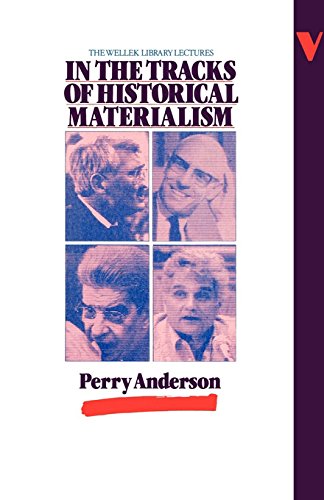
In this work (based on a lecture series in 1983) Anderson addresses (amongst other things) the legacy of Critical Theory and structuralism: the work of Levi-Strauss, Lacan, Foucault and Derrida. You will not encounter a clearer overview or critique of their school.

The author's preferred style is olympian abstraction but he is also a bit of a magpie, selecting authors and works here and there which have struck his interest. He is extremely open-minded and non-dogmatic. But he doesn't want to be a reformist or a renegade - so many of those in the history of Marxian thinking! - so when he encounters a dogma he has internalised, and which is thereby uncritiqueable, he's forced to a fanciful or fantastic conclusion. I won't discuss it further here, but his views on why the feminist agenda is unachievable under capitalism (but will be delivered by socialism) defy belief.

---

Let's look at his postscript for "In the Tracks of Historical Materialism" via selected extracts. He starts with the lack of any serious examination within the Marxist tradition of what socialism would actually be like. As he correctly observes:
"Yet it is quite clear that without serious exploration and mapping of it, any political advance beyond a parliamentary capitalism will continue to be blocked. No working-class or popular bloc in a Western society will ever make a leap in the dark, at this point in history, let alone into the grey on grey of an Eastern society of the type that exists today. A socialism that remains incognito will never be embraced by it.

To bring the two closer together, there are four great areas where practical research and proposal are above all now needed.

(i) The first of these is this the political structure of a socialist democracy. What would be the precise forms of mandate, periodicity, franchise and constituency in a `neo-soviet' system articulating workplace and residential principles within a producers' democracy covering polity and economy alike?
  • How far would a professional administrative apparatus subsist? 
  • What division of powers would be codified? 
  • How would jurisdiction be allocated between national and local instances of authority? 
  • Would there exist a new 'technology of delegation'? 
  • What would be the optimal ways of disaggregating control over the means of communication? 
(ii) The second central area for debate is obviously the pattern of an advanced socialist economy. Assuming a full producers' democracy and popular determination of alternative plans, all the most difficult and intricate problems remain.
  • What would be the range of forms of social ownership?
  • How large, or small, a role should the market play?
  • Could planning ever pre-adjust to new needs, with their inherent dynamism?
  • What devices would exist to resolve conflicts between central and regional interests?
  • What would be the appropriate combination of price mechanisms?
  • How should consumer rights be articulated with those of producers, in major services?
  • Should the volume of product choices be increased, or diminished?
  • Which patterns of technology, and what distribution of labour-times, would be desirable?
  • How should different jobs be remunerated?
(iii) A third area where careful reflection is long overdue is what might be called the socio-cultural pattern of a 'libertarian levelling' - that is, means for abolishing class and gender inequalities beyond the reappropriation of the means of production by the direct producers.

What kinds of detailed transformation of the educational system, and mutations of the division of labour, would most effectively tend to overcome any inherited or imposed ladder of life-chances - while at the same time multiplying rather than restricting individual differentiation and development of talent?

(iv) The final and most formidable area of all concerns the international relations between - inevitably - unevenly developed socialist countries themselves. Ultimately, this involves the problem of the relationship between the producing classes in the rich nations and those of the poor nations, as well as the question of the relationship between the world peasantry and the world working-class within the poorer countries themselves.
  • What would be any protectable pattern of equitable flows of trade and investment between North and South, were both liberated from the sway of capital?
  • How could revenues and resources be progressively best shared? 
  • What kinds of technological exchange and diffusion would most depolarize the economic geography left by capitalism? 
  • Is 'evened development' historically imaginable - if so, what would it mean? 
Merely to enumerate such questions is to register how little most of them have been directly confronted within the Marxist tradition in the West."
---

Anderson then considers "The Economics of Feasible Socialism" by Alec Nove.

Amazon link

I have not read this book but reviewers point to its rather pedestrian vision of municipal quasi-social-democracy, a mixed economy with nationalisation of the commanding heights .. and strict egalitarian salaries .. and parliament.

Anderson is extremely polite, and in his own dismissal through faint praise simply notes that Nove present no roadmap for transition to such a state, which in any event is unlikely to inspire proletarians to die in a ditch. He continues:
"If capital could visit such destruction on even so poor and small an outlying province of its empire as Vietnam, to prevent its loss, is it likely that it would suffer its extinction meekly in its own homelands?

The lessons of the past sixty-five years or so are in this respect without ambiguity or exception: there is no case, from Russia to China, from Vietnam to Cuba, from Chile to Nicaragua, where the existence of capitalism has been challenged, and the furies of intervention, blockade and civil strife have not descended in response.

Any viable transition to socialism in the West must seek to curtail that pattern: but to shrink from or to ignore it is to depart from the world of the possible altogether. In the same way, to construct an economic model of socialism in one advanced country is a legitimate exercise: but to extract it from any computable relationship with a surrounding, and necessarily opposing, capitalist environment - as this work does - is to locate it in thin air. "
The step Anderson is not prepared to take is this: accept that capitalism is not weak, that its superficial contradictions are not life-threatening and that Bolshevik-style revolutions will never happen in advanced capitalist states.

Capitalist states have seen great dislocations and have tolerated left-wing governments (which absorbed and defused popular discontent). Their subsequent policies tended to wreck the economy which then ushered in a period of political counter-revolution (the Allende-Pinochet transition in Chile is an extreme case in point). Finally capitalism (with its vast reserves) stabilised and resumed (Chile today is quite successful).

The one thing capitalism can't handle is abundance, which undermines market relations. That's the area Anderson should be looking at but it's beyond his intellectual paradigm.

---

Related: "Perry Anderson on Western Marxism and Hegemony".

Wednesday, March 07, 2018

Perry Anderson on Western Marxism and Hegemony

Amazon link

"In The German Ideology, Marx wrote that the development of the forces of production is an absolutely necessary practical premise because without it scarcity is merely generalized (nur der Mangel verallgemeinert), and with destitution (Notdurft) the struggle for necessities would begin again and all the old filth would necessarily be reproduced'. See Werke, Vol. 3, pp. 34-5.

This passage was to be recalled by Trotsky in his analysis of the reasons for the rise of Stalinism in Russia, which made scarcity (nuzhda) a central category of its explanation: see The Revolution Betrayed, New York 1965,pp. 56-60."
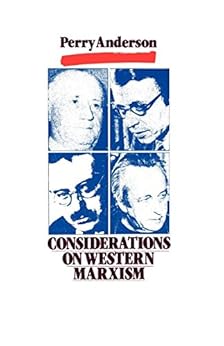
This from the notes for Chapter 4 of "Considerations on Western Marxism" by Perry Anderson. It's a quote I've had in mind a long time, but was unable to track down. Very critical for the analysis of the failures of bureaucratic-socialism in the twentieth century, and perhaps in the twenty-first.

Anderson is a visionary, synthetic writer: (a bird or a seer in the classic distinction). His account of Western Marxism after the Russian revolution is crammed full of insights. Anderson reviews the works of Lukács, Korsch and Gramsci; Adorno, Marcuse and Benjamin; Sartre and Althusser; and Della Volpe and Colletti, together with other figures within Western Marxism from 1920 to 1975.

Here's a brief summary from a generally hostile review.
"Anderson argues that despite their diversity all these thinkers represent a common response to the failure of the Russian revolution to spread to the West after the First World War, and the consequent suffocation of Marxism by Stalinists, fascism, and social-democracy.

The ‘Western Marxists’ reacted by flying from active involvement in the class struggle to a preoccupation with philosophy, and indeed with idealist philosophy divorced from practice in a way that the classical Marxists, from Marx himself to Lenin, Luxemburg and Trotsky, would have violently rejected.

Only today, Anderson concludes, with the revival of workers’ struggles and of the revolutionary movement in the advanced capitalist countries, can Marxist theory be integrated into the class struggle again."
Anderson was writing in 1974, when the événements of May '68 in Paris were still fresh in mind and the Trotskyist movement had been revitalised (it was not to last). In his afterword written a decade later, Anderson was less starry-eyed and more conscious of the many gaps at the core of Marxist thinking: what would the socialist state look like, once we reject the naive vision of the permanently mobilised working class organised in councils? Where is the genesis of revolution to be found in a prosperous bourgeois democracy?

Our theoretical difficulties here relate to our very distance from the phenomenon in question: the practical transcendence of capitalism.

Anderson has come to see the concept of hegemony (as pioneered in the works of Gramsci) as a powerful and under-theorised foundation of capitalist stability: the privileging of consent over repression. His latest books ( The H-Word: The Peripeteia of Hegemony and the reissued The Antinomies of Antonio Gramsci: With a New Preface) are his attempt to address these issues.

---

Next: Perry Anderson's Marxism.

Tuesday, February 27, 2018

"The Class Struggle in the Ancient Greek World"

Amazon link

Well, I wanted to like this book. How many Marxist analyses are there of Antiquity anyhow (apart from Perry Anderson's)?

But G.E.M. de Ste. Croix lost his credibility for me when he defined women as a class in the Marxist sense - because of their role in the reproduction of human beings and their subordination to men in this regard. He admits that he is 'correcting' Marx and Engels in taking this foolish step.

The author was a classics magpie. He had spent a lifetime reading the Greek and Latin source texts and had a beyond-encyclopedic knowledge of even the most obscure manuscripts. The material is overwhelming in its fine-grained detail - and consequently unreadable unless you are a specialist-scholar. In the latter case, you are likely to be as unimpressed by the superficiality of his repetitive analysis as you are overwhelmed by his dense, fine-grained historical accounts and endless quotations

I think it would be wiser to stick to Perry Anderson's far superior "Passages from Antiquity to Feudalism" and "Lineages of the Absolutist State".