Showing posts with label Duncan Foley. Show all posts

Monday, February 18, 2019

The next 25 years

Razib Khan has an interesting and well-written piece peering into the future: "The end of America as the world as we know it", a free teaser for his "Premium Posts" where he's seeking to monetize his stuff. Good luck!

Anyway, here are some highlights. Bold shows my emphasis.
"The American elites have always been defined by wealth, but there also remained an element of patriotism and pride in the nation-state. The idea that we are a light unto the nations with our example of robust democratic republicanism. The rise of global capital means that many of the economic oligarchs have weak attachments to specific nations. They are citizens of an archipelago of super-cities inhabited by the financial elite. They involve themselves with the politics of multiple nations but fundamentally are not of any nation in anything more than a bureaucratic sense. Rupert Murdoch is a case in point."
There has been a recurrent sense that the high-bourgeoisie has been 'unpatriotic' since the dawn of 'Monopoly Capitalism' back at the start of the twentieth century. Plenty of observers noted the pro-German appeasement policies of the British elites in the nineteen thirties.

Globalisation has massively amplified the social weight of this class fraction - no-one ever took the concept or vision of a 'borderless world' seriously before; they do now.
"To use Peter Turchin’s framework, the West is a society with declining social cohesion and riven by elite factions due to overproduction in the administrative classes. The “post-World War II consensus” was boring, but it also presented a vision of emulation. A robust middle-class was supported by an economy which was productive and had a use for semi-skilled labor. We are entering a period where old certitudes are fading away. Economic and cultural.

But they are not being replaced by a new system or a new ideology in the West. The neoliberal framework is better than its rivals, but its cold and rational operations are always going to result in only a cult following. The resurgence of classical socialism among young Westerners and the appeal of political Islam elsewhere indicate a genuine lack of new ideas. While “Communist” China turns back toward its own traditions, in India Rightist movements are creating a new understanding of their society that rejects the Nehruvian project that descends from British Fabian socialism."
Good insights here.The masses increasingly perceive neoliberal ideology as pedalled by the mainstream media and public intellectuals as an alien narrative that they don't sign up for. It's also full of bare-faced affronts to the truth of course which irritate the engaged mind.

Yet what is the alternative? All the old ideas of resistance are being dusted off, but none seems to cohere with new realities.
"The end of the unipolar age will affect the ideological tribes differently. The cosmopolitan and broadly liberal upper middle and upper classes will welcome a post-national and global age, but some elements will not acclimate itself well to the reality that this age is not dominated by particular and contingent Anglo-liberal values. That is because of this class’ adherence to a form of economic determinism, where modern technological productive societies go hand and hand with liberalism. History ends, and it ends in their way. Despite the fact that organized “liberal” parties are generally a “Third Force” to the parties of the Left and the Right where they have any power at all (arguably in the United States this “liberalism” was the ascendant ideology in both the Republican and Democratic parties for the 20th century).

We are aware of how the populist Right will react. The call will go out to roll back the clock to the decades after World War II when white Christian America was self-confident and a superpower unparalleled. To a time when the USA could dictate terms and shape the course of the world through its own singular fiat. Its very will. The problem with this vision is American power was always conditioned on exogenous circumstances. The rise of Communism and state and regulatory socialism crippled the long-term trajectory of many nations. World War II reduced the European nation-states and Japan to client states. None of these contingent events can be replicated.

Parts of the cultural Left aim to create a more egalitarian world by deconstructing and tearing down the edifice of the hierarchical Western order that arose over the past few centuries. But this is like organisms adapted toward a niche that no longer exists. The world of the 1950s, 1960s, and 1970s, no longer exists. Inverting the moral message of The Rising Tide of Color Against White World-supremacy will continue in the 2020s, but substantively it is a message grounded in the realities of the 1920s. Like the Indian elites’ anger and resentment toward British imperialism, the intersectional critical race theory that is common in the United States is a reflex and toolkit designed for a fundamentally different world. Why continue to muster the armies of the West after the death of Sauron? For glory and position within the administrative state, and the few sinecures available to culture producers.

Finally, the banner of the old Red Flag is now rising once again, like a phoenix from the ashes. Instead of a redistributive economy in a market context, some of these radicals want to reconceptualize economic relations in a Marxist sense. Seize the means of production. They will tell us that “this time it will be different.” I am skeptical that most people will buy into this message. Like the attempt to mobilized racial and sexual minorities against white males, a classical Left economic policy was always optimized for the industrial economy of the late 19th and early 20th centuries. A message it is, but for a time long gone.

I come bringing news of the death of our old gods. Not news of the birth of the new."
Oh dear, Razib unerringly puts his fingers here on the central weakness of the Marxist left. In my view the analysis of capitalism as a mode of production is as smart and compelling as ever (I am currently being re-impressed by Duncan Foley's "Understanding Capital") but the Marxist judgement of the faults of capitalism is as faddy and derivative, as theatrical and formulaic as ever, while the conceptualisation of transition is so implausible and under-theorised that it resembles the transcendental crisis we see in fundamental physics.  

No-one knows anything.

Thursday, April 26, 2018

The Law of Accumulation - and competition

PDF link

Michael Roberts' second chapter of his book, Marx 200, is titled "Marx and the three laws of motion under capitalism". The 2nd law is that of accumulation.
"Marx is saying that competition among capitalists forces them to continue to expand their production in order to accumulate more profit or be driven out of business by others. So the law of capitalist accumulation says that competition makes each individual capitalist keep constantly extending capital. The trend is for the proportion of the economy devoted to investment in the means of production (machinery, plant, offices, raw materials) to rise. This has happened pretty much from the point of Marx's birth in all capitalist economies."
I'm going to work through an example from Duncan Foley, "Understanding Capital" to show how this works (p. 56) although in this case we're reducing labour rather than explicitly expanding capital investment.

---

Animals, and people in a hunter-gatherer state, work just hard enough to sustain themselves for the long term. Anything else implies pointless activity, wasting energy. Lions spend time lazing around and grooming each other; hunter-gatherers likewise.

This all changes with the invention of agriculture. Suddenly, if people work harder and longer than required for their own sustenance, they produce a surplus which can be appropriated by a ruling elite of warlords, warriors and priests to sustain themselves. Good for civilisation no doubt: not so pleasant for the overworked and intimidated mass of slaves and peasants.

It was Marx's contribution to understand that capitalism is not different in appropriating surplus labour. The manner of it is obscured: workers are paid for their utility, their ability to labour, not for what they actually produce (essentially they are paid on average sufficient to reproduce themselves at some contestable level of consumption).

Once agreeing to employment, however, they are put to work by their employer who now controls what they do. The value of what they then produce is normally significantly greater than the value of their labour power = wage. Thus emerges profit and those great surpluses which have built our magnificent civilisation (owned by the elites as in all previous post-neolithic modes of production).

This is all in Foley and other places, so I won't continue with Marxism 101. Let's get to the example.

---

Foley considers that an hour of abstract social labour is sufficient to produce 10 bushels of wheat. It's a tradition in Marxist economics textbooks to use Victoriana, copying Marx. Why didn't Foley choose muesli?

An hour of abstract social labour equates to $15 in the example. Suppose the cost of the factory and raw materials comes down also to $15 for 10 bushels of wheat and suppose that the value of the worker's labour-power is $7.50, his wages.

Then the exchange-value of 10 bushels of wheat is, using Marx's standard formula c + v + s is:
c   +    v   +   s

15 + 7.50 + 7.50 = 30
representing an hour's work ($15). The cost is 15 + 7.50 = 22.50, the profit is the surplus value s, 7.50 and the rate of profit is profit/cost = s/(c + v) = 7.50/22.50 = 1/3.

So we imagine lots of little workplaces all producing wheat like this and making a profit of 33%.

---

Now someone develops a new technique which lets those 10 bushels of wheat be produced in 2/3 of an hour, forty minutes instead. This means that in an hour, 50% more wheat can be produced. Productivity has gone up.

So in forty minutes, the value of 10 bushels of wheat looks like this:
15 + 5 + 10 = 30.
Interesting. The production occurred over forty minutes, so the labourer's wage was two thirds of the hourly rate ($7.50) and only incurred a cost of $5. But no-one yet has followed the innovative capitalist's example, so he's a price taker and can sell his 10 bushels of wheat at the existing market price of $30.

He gets a super-surplus of $10 and a super-rate of profit of 10/20 = 1/2 or 50%.

You can see why he was incentivized to innovate.

---

Of course, everyone will now follow him, so assuming the workers consent to the continuing intensity of work (100% rate of surplus value) the price will drop and the new state of affairs for the production of 10 bushels of wheat is:
15 + 5 + 5 = 25.
The profit on 10 bushels of wheat is $5 and the rate of profit is 5/20 = 1/4 = 25%.

Oh dear, due to increased efficiency and less labour being used, the rate of profit has fallen. This is Marx's third law .. although it is more complicated in practice than in this simple example.

---

There is more to say. Notice that the value of 10 bushels of wheat (here equated to its market price) has fallen from $30 to $25, a drop of 1/6 (17%). This is the effect of productivity gains - they drop the price of commodities.

Suppose that, ludicrously, the workers survive only by consuming wheat. Then their costs of self-reproduction have just declined by 17% and thus their equilibrium wage should also tend to drop by the same amount: $7.50 → $6.25 per hour - which equates to $4.17 in forty minutes. So there is a new value composition for 10 bushels of wheat:
15 + 4.17 + 5.83 = 25
and the rate of surplus value (s/v) has gone up due to the cheapening of labour-power, consequent upon the cheapening of the commodity wheat.

This means that the rate of profit is now: 5.83/19.17 = 30%.

It's not as good as the original 33% but it beats 25%.

Will the workers consent to their wages being lowered to their new values (either directly or through devious means such as inflation)? Nothing in the dynamics of capitalism preordains the outcome. It depends on how hard they're prepared to negotiate and fight. This is a zero-sum game, Marx's analysis of class struggle.

Of course if they fight too successfully for wages above the value of their labour power they will indeed cut into profits .. and the capitalist will invest elsewhere.

---

This process of continual accumulation and innovation, driven by competition, is characteristic of capitalism within a sector. For a while I confused it with quite a different issue which is the equalisation of the rate of profit across different sectors.

Here's the problem: profits are defined as s/(c + v) which seems to reward companies with low capital investment and high manning. So hairdressers should be way more profitable than steel companies. But that makes no sense.

Marx figured out pretty early that real market prices in a multi-sector capitalist economy (which is all of them) fluctuate around prices of production, not the simple values we saw in Foley's example. Why is that? Because capital flows between sectors equalising the rate of profit. This causes prices of production to fall below values in labour intensive industries and to rise above values in capital intensive industries.

Michael Roberts has this fairly self-explanatory table on page 84 of Marx 200.


The right hand column has prices of production (Total Price) which equalise the rate of profit p/(c+v) which is 49% in his example - the absolute profit is in the column p.

Notice the redistribution. I'm not going to delve any deeper here - get his book.

Thursday, November 16, 2017

Q. "How do I get into Marxism?"

Marx is newly fashionable again, but it's a daunting task to take on the four volumes of Capital. And in most fields you don't retrace the founder's tortuous strugglings. In physics, students don't read Newton's or Einstein's original works: they read textbooks.

Marx wrote about what he knew, which was the inner dynamics of capitalism as a mode of production. A good start is "Understanding Capital" by Duncan K. Foley (search "understanding capital foley pdf").

Amazon link


Foley concentrates on the economics, is very clear and writes in a modern paradigm cross-referencing contemporary ideas in economics. The book is thematically-organised across Marx's economic work and is short (170 pages).

Amazon link

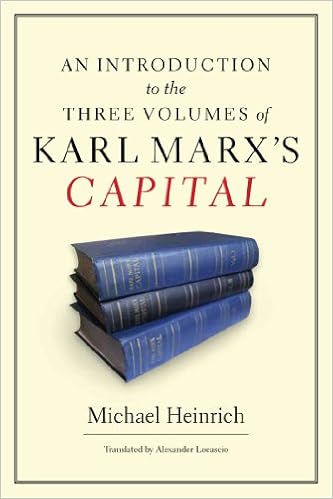
As a complement, there's Michael Heinrich's "An Introduction to the Three Volumes of Karl Marx's Capital" - this link is to the online PDF or search "marx capital heinrich pdf". It's similarly short (224 pages), well-written and conceptually clear. Heinrich is more focused on the actual contents of each volume. He also writes about topics Marx intended to address but never got around to, including the theory of crises, the state and communism itself.

Marx wrote very little about post-capitalist social organisation. Without data this would have been no more than speculation. It was down to Lenin, Trotsky, Stalin, Mao and many others to theorise later developments - in ways I would argue were profoundly mistaken.

Monday, October 30, 2017

Marx: "Right about capitalism, wrong about socialism"

I've been engaged in an exploration of the Marxian analysis of capitalism as a mode of production, how any successor society might emerge and what it might be like. I've read the first two volumes of Capital (bulky, circuitous and sprawling though they are) and also two excellent introductions from Michael Heinrich and Duncan Foley.

Amazon link .. and PDF

Amazon link .. and PDF

I feel quite sufficiently educated. I also concur with the Russian epigram quoted above: Marx was right about capitalism, but wrong about socialism.

But .. before we get too judgemental .. it's worth bearing in mind that Marx said very little about socialism. As Duncan Foley observes in his "Socialist alternatives to capitalism I: Marx to Hayek",
"In general Marx responded to questions about his views on the organization of socialist society by saying that these questions could be solved only by those who actually confronted them historically, that is, presumably, by the revolutionary movements that would establish socialist institutions. This is a prudent and in some ways sensible stance, but frustrating to a posterity that has made notably little progress on these problems."
Foley continues:
"Really existing socialism

"History, of course, was not waiting for political economy to sort out the issue of socialism. The early decades of the twentieth century also saw the emergence of a Soviet Union dedicated, rhetorically at least, to the building of a socialist economy, out of the wreckage of the Russian Empire.

The Bolsheviks confronted two practical political economic problems in the 1920s. Perhaps the lesser was the organization of day-to-day production and distribution. The greater was what later came to be called the problem of “development”: how to transform the backward, largely traditional agricultural economy of the sprawling Russian empire into a viable industrialized power.

The second task was all the more pressing because the denouement of the First World War on the Eastern Front had revealed the military and political vulnerability of a backward Russian economy in a world increasingly populated by industrialized capitalist powers.

The Soviets, whose leadership contained some remarkably talented and thoughtful figures, such as Nikolai Bukharin, arrived at a practical solution to the problem of organization of day-to-day production fairly soon after consolidating political power through prevailing in the Civil War with the Whites. This took the form of the “New Economic Policy” (NEP), which allowed, and indeed encouraged, capitalist commodity production in many sectors of the economy, including food production.

The NEP structurally created a “mixed” economy in which a large private sector co-existed with state-sponsored industrial enterprises. (The NEP is recognizably a precursor of Deng Xiaoping’s “socialist market economy” which was the framework for Chinese economic growth in recent years.)

The NEP worked well to stabilize the Soviet economy after the Civil War; under this regime output and incomes recovered significantly from the low levels of the Civil War period. Many Bolsheviks, including Lenin, were willing to accept the NEP framework as an indefinitely prolonged phase of building socialism, as long as the state held the “commanding heights” of the economy through control of energy, transportation, heavy industry, and finance.

Two connected and predictable developments undermined the NEP. First, as we would expect, the privatized commodity-producing sector of the economy exemplified some fundamental laws in generating large disparities in income and wealth. The appearance of a wealthy proto-bourgeoisie in the midst of a society governed by a one-party dictatorship committed to socialist goals threatened the narrow political base of Bolshevik power.

Second, the NEP was structurally favorable to the agricultural sector, particularly to the market-oriented strata of the peasants. The NEP thus resulted in a relatively “balanced” path of economic growth between industry and agriculture. Not surprisingly the prices of food and other agricultural products tended to rise relative to industrially produced goods, limiting the degree to which surplus production in agriculture could be mobilized for rapid industrial investment.

Despite Bukharin’s determination to “ride to socialism behind the peasant’s nag”, NEP policies proved explosively unstable politically, and collapsed under efforts to mobilize agricultural surpluses by military force which ultimately led to collectivization, central planning, and the bloody political purges of the nineteen-thirties.

Stalin rather than Bukharin balanced at the top of the “greasy pole” of Communist Party politics apparently more by ruthless and opportunistic manipulation of coalition politics than through consolidating a stable political base of power.

Just how the Soviet economy did operate in the 1930s, and in particular what was the practical mixture of bottom-up and top-down dynamics in this period remains obscure. A relatively small central planning bureaucracy had in theory enormous economic power to implement a policy of extremely rapid industrialization centered on the expansion of heavy industry. It seems unlikely that the fairly coarse-grained plans produced could be the whole story of Soviet economic life under this regime.

The management of new industrial armies recruited to new urban centers involved a great deal of decentralized local improvisation and experimentation. Since the centralized planning bureaucracy did not actually control many resources itself, local managers facing shortages of inputs and surpluses of outputs improvised informal market-like arrangements with each other. Despite the wishful thinking of market-fundamentalists, capitalist economies in periods of extremely rapid industrialization have often strayed significantly from the orthodoxies of profit-maximization given market prices, making it difficult to draw hard analytical lines by which to characterize the Soviet experiment.

While the Soviets were engaged in their furious (if in the very long run curiously futile) attempt to change the world, western European philosophers continued to interpret it. ... "
In his follow-up paper, "Socialist alternatives to capitalism II: Vienna to Santa Fe", Foley contemplates the great complexity of the global capitalist economy and speculates how any subsequent mode of production could do better as regards the difficult issues of economic information retrieval, resource allocation and optimality of outcomes. He contrasts top-down and bottom-up approaches:
"The last half of the twentieth century saw an upsurge in interest in bottom-up self-organized systems, such as ant-hills and bees’ nests, bird flocks, computer networks, unsupervised learning algorithms such as neural nets, the capitalist economy, possibly the human brain and a host of other similar examples.

Several features of these bottom-up systems draw the attention of systems thinkers. For one thing, compared to top-down optimal control systems, bottom-up self-organized systems tend to be more “resilient” or “robust”. Self organized systems often (though not invariably) continue to function (possibly in a degraded mode) despite the disruption or even destruction of important subsystems, and in important cases can recover from such damage spontaneously.

Top-down systems can be built with considerably “redundancy”, but tend to be more vulnerable to disruption of key elements, particularly the feedbacks that implement their optimal control properties.

Another intriguing property of bottom-up self-organized systems is that although they are not designed to achieve optimal performance, they often do perform surprisingly well. Ant-hills, for example, are remarkably efficient in locating and exploiting food sources. Bottom-up self-organized systems also exhibit a high degree of adaptability to new situations. Optimal control systems tend to be optimized for some particular context in which they are designed to operate. Self-organized systems can adapt to a wide range of environmental changes (though there are typically limits to the magnitude of shocks any such system can survive).

Capitalism itself is a good example of all these features of spontaneously organized bottom-up systems: historically capitalist institutions tend to reproduce themselves even after the destruction wrought by wars, revolutions and financial meltdowns; capitalist allocation of resources approximates efficiency to some degree; and capitalism has proven to be highly adaptable in the face of massive environmental changes (many of which, such as world population growth and technical innovations, arise from the dynamics of capital accumulation itself).

The vision of the economy as a complex system gives rise to a “bottom-up” understanding of how commodity production is organized, a la Hayek. It also suggests a parallel bottom-up vision of socialism as arising from the spontaneous organization of production through some framework of institutions different from private appropriation and exchange of products.

This bottom-up vision of social organization resonates with important political currents of the late twentieth century. The “New Left” movements of the nineteen-sixties rebelled against the centralizing and regimenting tendencies of “Old Left” socialism and communism by calling for decentralization, participation, and the political primacy of individual freedom and expression.

The Left, such as it is in the contemporary world of globalized capitalism, is much more attracted to the vision of spontaneous political expression than to the unpleasant chore of organizing political institutions.

This enthusiasm for spontaneity without central coordination or direction has attached different parts of the Left to various economic experiments, plans, philosophies, and models. Some of these, such as micro-credit institutions, amount to very minor modifications of the capitalist commodity system (or could indeed be regarded as systematic extensions of the logic of the commodity system).

One idea which flowers perennially on the Left as an alternative to capitalism is workers’ control. ..."
Foley then looks in detail at the historical experience with workers' control, particularly in the former Yugoslavia, and comes to some very pessimistic conclusions.
"When worker-controlled enterprises become very successful, the resulting hierarchy of workers begins to resemble that of capitalist firms. When the contradictions between the juridical form of organization of the enterprise and the substantive claims of different strata of workers to the surplus revenues become acute, it is common for worker-controlled enterprises to privatize themselves spontaneously, converting into traditional capitalist firms.

A second point is that despite the demonstrated capability of worker-controlled firms to compete successfully with capitalist firms under particular circumstances, there has been no tendency for worker controlled enterprises to grow spontaneously to crowd out capitalist firms in any economy: workers’ control remains a relatively small sector even in societies where tradition and practice favor this form of productive organization."
So no easy answers then. However, Foley's essay would not be complete without at least an attempt to provide an existence proof that a mode of production transcending capitalism is at least possible (- all emphasis in the extract below has been added).
"To bring this talk to an end, I will indulge in the luxury of fantasizing about some alternatives to capitalist-commodity production.

There are some ground rules for this exercise. This is speculation about changing what Marx calls social relations of production. In thinking about alternatives in this (very broad) range of issues I am not required to consider every social problem (foreign policy, religion, education, political institutions, mental illness, drug abuse, culture).

In general, the basic supposition is that life goes on as usual. People get up, go to work or school, form families, reproduce, age, consume, and so forth. There are natural disasters and domestic and foreign conflicts, regional divisions, and the like. But it is not fair for me to wish away critical aspects of the problem of organizing a complex division of labor to sustain the type of technologically sophisticated society post-industrial capitalism has created, with relatively high levels of consumption and economic security.

For example, it would not be very interesting for me to posit a system of universal abundance of use-values created by some imaginary robot workforce, and then to spin a vision of the resulting glittering possibilities for human social life.

It would also not be of much interest for me to ignore the problem of a “transition” by assuming a complete self-contained and self-reproducing alternative system. A socialist fantasy alternative has to include the notion of a “mixed” economy, in which commodity-capitalist social relations continue to prevail in some sectors, or regions. The socialist sector of the economy has to include methods for dealing with a capitalist-commodity other.

Furthermore, I am most interested in ideas that would allow a socialist alternative to co-exist with (and in a larger sense compete with) capitalist-commodity social relations indefinitely. Thus it is not fair for me to assume some “revolutionary” transformation of the whole society (even with the dystopian backdrop of a looming or ongoing ecological crisis) to resolve basic problems of social relations.

It is equally uninteresting for me, however, to ignore the deep hostility of bourgeois ideology to radical alternatives to capitalist-commodity production. I am interested primarily in how ordinary, regular suburban/urban people who by and large have jobs, incomes, and more or less stable lives through the capitalist-commodity system might transform their social relations of production.

It is not going to be hard to criticize the particular fantasy I put forward. The main function of such exercises is to induce dialectic thinking by making concrete assumptions that can be knocked down.

On the other hand, it is not in the spirit of this kind of exercise to invoke “human nature” in one or another of its many incarnations as an objection; or to wish away through assertion the fact that capitalist-commodity production has many parallel unresolved contradictions.

It is not reasonable to insist, for example, that opportunistic behavior would be any less mixed with social and other-regarding behavior in a socialist fantasy than it is in capitalist commodity reality. In fact, it seems reasonable to suppose that a change in social relations could re-balance human behavior towards others at least at the margin.

It also seems reasonable to suppose that people are grown-up enough and aware enough of the facts of economic life to understand that at an aggregate level consumption depends on production, and that they are willing to accept social responsibility to work productively as a condition of consuming."
Don't hold your breath: gaming the system is rather pervasive in human affairs.
"Lifenet 

"So let us imagine an alternative set of social relations, which I will call “Lifenet” which can organize social production to meet at least some part of the spectrum of human needs outside capitalist-commodity institutions.

Lifenet production is organized through peer-production enterprises. People start or join existing peer-production initiatives without any direct material compensation. The output of these enterprises is made available freely to participants in the system through a Lifenet distribution system, just as open-source software is published freely through open source licenses.

One key point here is that users or consumers of Lifenet outputs agree not to re-sell them as commodities for money. The aim is to create an alternative system of production and distribution that can be effectively separated from capitalist-commodity production.

Participants in Lifenet enterprises have a Lifenet account maintained in a central Lifenet database. The Lifenet account records individual contributions to Lifenet enterprises, and also individual withdrawals of Lifenet products. Thus an individual who participated in a food production enterprise would have that participation recorded in her Lifenet account; if she received food or clothing or software from Lifenet distribution centers (perhaps something like food coops or farmers’ markets today) these withdrawals would also be recorded in the Lifenet account. (One can imagine something like a credit card system to maintain these accounts automatically.)

The purpose of the Lifenet account would not be to enforce an exact balance between individual contributions to the production system on the one hand and withdrawals through the distribution system on the other. It would, however, allow the system to monitor the balance of production and distribution as a whole, and to identify and discourage or prevent possible abusive over-drawing on distribution. (If some level of the individual accounts were publicly accessible, peer pressure could play a major role in this respect.)

The premise of the accounts is that Lifenet as a whole is solvent, and has products available for distribution. A Lifenet system is going to work only if the individuals participating and the system itself develop an ethos of thrift, prudence, and waste-aversion. Lifenet must prudently keep large reserves of products to secure its ability to respond to contingencies (natural disasters, local breakdowns of the system) flexibly and reliably. The participants in the system must use its resources sparingly and thriftily, both as producers and consumers. The idea of “enough” has to pervade the system from top to bottom.
He goes on but you can see (as in David Schweickart's account of a possible model for socialism which I wrote about), this is already sinking under its own implausibilities.

It is worth emphasising what derails all these models of socialism: the conflict between the interests of the larger economy vs. the interests of groups comprised of families and friends.

'Communist man' does not exist and  - short of substantial genomic engineering - never will: we are not ants. When this factory has to close and the workers relocate, or that sacrifice has to be made 'for the common good', then under capitalism - in the final analysis - coercion is applied.

Conflicts are intrinsic and unavoidable. Contemporary Marxist intellectuals always leave the room at this point, wringing their hands; the Bolsheviks were never so mealy-mouthed.

So if Professor Foley, a very smart economist, can do no better than this after a lifetime of study, I am more than ever convinced that capitalism will be superseded only when it has created sufficient cognitive-robotic automation to essentially displace the proletariat from production .. and thus end any further possibilities of capital accumulation.

Thursday, October 26, 2017

Three links for Thursday

This is a typically lengthy and insightful essay from Scott Alexander posted three years ago:
I CAN TOLERATE ANYTHING EXCEPT THE OUTGROUP.
Somehow it reads as if from yesterday. Scott writes about the American incarnation of his Red/Blue/Gray tribes - but of course they're universal.

---

As a Gray Tribe member, I score utilitarian rather than compassionate. My BS detectors are thus powered up when I read another liberal, hand-wringing diatribe against torture ("It doesn't work!").

Bruce Schneier is paid-up Blue Tribe and uncritically recommends this lengthy article:
"The scientists persuading terrorists to spill their secrets"
which is actually unfailingly fascinating.

But it's The Guardian: the underlying liberal agenda sets up a false interrogation dichotomy: ham-handed brutality vs. sophisticated, empathic 'rapport'. No contest as to which wins there.

The article is forced to concede that it does take two to do rapport:
"Irish paramilitaries were trained to focus their gaze on a spot on the wall and remain utterly silent. Some suspects give only monosyllabic answers, or stick to scripted responses, or simply turn their chair around, presenting the interviewer with the back of their head."
If you're prepared to (competently) torture it can presumably work. Thankfully most bad guys are not sufficiently well-trained or hardcore to resist the highly-effective social-engineering described in the article. There are very good utilitarian reasons not to legitimise torture, whether it works or not.

---

I'm reading Duncan Foley's excellent primer on Capital.

PDF link

Foley is a clear and creative thinker who is prepared to bring some simple mathematics to the table. He's interested in presenting the conceptual apparatus of Marxism in an orderly manner rather than simply providing a slimmed-down exegesis of the books themselves. His approach is very much rooted in applying Marxism to the present day economy, which informs both his appraisal and his examples.

He reconstructs in mathematical form the circulation of capital and Marx's simple and expanded reproduction equations before moving on to the 'transformation problem', crisis theories and Marx's concept of socialism. Here's the table of contents:
Contents

1 On Reading Marx: Method                            1
2 The Commodity: Labor, Value, Money        12
3 The Theory of Capital and Surplus Value    31
4 Production under Capitalism                        49
5 The Reproduction of Capital                         62
6 The Equalization of the Rate of Profit           91
7 The Division of Surplus Value                     105
8 The Falling Rate of Profit                            125
9 The Theory of Capitalist Crisis                    141
10 Socialism                                                   158
Suggested Readings                                      173
References                                                     177
Index                                                              181
In addition as you can see, this introductory book is quite short.

Sunday, October 15, 2017

Readings relating to total automation under capitalism

From the film, "Elysium"

Introduction

Suppose progress in AI and robotics manages to eliminate all human jobs: no more human workers. Would capitalism collapse or just sail serenely on, making the elite ever richer while the masses of the dispossessed watch in apathetic horror from outside the gated communities (Elysium)?

The usual Marxist account is that total automation is incompatible with capitalism, yet the standard response is curiously unconvincing. Marxists say that all automation systems are constant capital, and constant capital eponymously can't create new value. Only variable capital, living human labour, can do that. And it's from variable capital that surplus value - profits - are derived.

No workers, no profits.

This argument uses the abstract model of capitalist production developed in Volume 1 of Capital. But it leaves many things obscure.
  • What is the special status of human labour, was Marx a vitalist?
  • As automation increased, what actually would we see in the economy?
  • If total automation brings about some other mode of production, how did we  switch?
Let's see if we can clarify any of this.

---

1. Why can't robots produce surplus value?

The question was asked particularly clearly in this Reddit post.
"I've often read that Marx firmly asserted that a machine cannot create surplus value. However, since technological capabilities have changed quite a bit since Marx's day, today I decided to do some research into modern interpretations of this theory.

"I couldn't find a good answer as to why a robot can't produce surplus value (sure, it's constant capital, but that doesn't really explain it), but I did find mention that neither slaves or animals (which are both living) can produce surplus value, which indicates that there is something very particular about the type of work done by machines, not the inanimate-ness of the machines themselves, that prohibits them from creating surplus value.

"This leads to a few questions:
  • Why can't robots, slaves, and animals produce surplus value?
  • Does the possibility of robots manufacturing other robots affect this?
  • What about human-like robots created in the future?
"How can a society be both slave-based and capitalist (like the old American South)?

"Thanks!"
And here is the favoured answer - somewhat accurate but ultimately confused and unconvincing.
"Slaves are like tools since they are owned. If they exist alongside capitalism, they, like all other tools, pass their value on to the commodity but do not create new value. This does not mean that slaves are not exploited and don't produce a surplus for their masters. They do, but this surplus does not take the form of surplus value. In this case all the master's profit is surplus value transferred from free laborers. ...

"Surplus-value production requires a certain social organization. The question then is: What social organization differentiates the slave from the wage-laborer such that one doesn't produce surplus value but the other does?

"The answer is a social organization of generalized commodity production requiring an extensive division of labor. This social organization requires what Marx calls the laborer's "freedom in the double sense":
as a free man he can dispose of his labour-power as his own commodity, and that on the other hand he has no other commodity for sale, is short of everything necessary for the realisation of his labour-power.
"So, the slave/animal/robot must be given bourgeois rights; it must no longer be possible to buy and sell them, they must be considered equal as commodity owners and sellers. The slave/animal/robot must also be driven off the land and deprived of any means of production. This forces them to sell their labor-power to survive.

"If the animal/robot had the mental and physical capacity to function this way under these conditions, they would be surplus value producers."
Marx was not a vitalist, the term 'living labour' is an economic category (a producer of new value, an entity which brings labour-power to market as a commodity), not a term of biology.

---

2. Forms of Production

The first step to understanding why the Marxist account is, nevertheless, correct is to carefully distinguish different ways stuff can get produced in a complex economy with a division of labour, requiring trading and exchange. It will become clear that the two critical ideas are the distinction between use-value and exchange-value, and the subtleties of the labour theory of value.

We start by describing three forms of economic organisation: pre-capitalist, capitalist and post-capitalist. Only the second creates surplus value, value appropriated by an economic actor other than the producer.

2a. Simple Commodity Production

Wikipedia has a good account of this pervasive economic mode:
"Simple commodity production (also known as "petty commodity production"; the German original phrase is einfache Warenproduktion) is a term coined by Frederick Engels to describe productive activities under the conditions of what Marx had called the "simple exchange" of commodities, where independent producers trade their own products. The use of the word "simple" does not refer to the nature of the producers or of their production, but to the relatively simple and straightforward exchange processes involved. ...

"Simple exchange of commodities is as old as the history of trade, insofar as it has progressed beyond barter, and occurred for thousands of years before most production became organised in the capitalist way. It begins when producers in a simple division of labour (e.g. farmers and artisans) trade surpluses to their own requirements, with the aim of obtaining other products with an equal value, for their own use. Through the experience of trade, regular exchange values become established for products, which reflect an economy of labour-time. ...

"Simple commodity production is compatible with many different relations of production, ranging from self-employment where the producer owns his means of production, and family labour, to forms of slavery, peonage, indentured labour, and serfdom. The simple commodity producer could aim just to trade his products for others with an equivalent value, or he could aim to realise a profit.

"That is to say, simple commodity production is not specific to any particular mode of production, and might be found in many different modes of production, with various degrees of sophistication. It does not necessarily imply that all inputs or outputs of productive activity are commodities traded in markets. Thus, for example, simple commodity producers could produce some products for their own use on their own land, while trading another part of their products. They might buy or trade some tools and equipment, but also make some themselves. ...

"In Marxian political economy, simple commodity production also refers to a hypothetical economy used to interpret some of Karl Marx's insights about the economic laws governing the development of commodity trade: it refers to a market economy in which all producers own the resources (including the ability to work) that they use in production. No-one is a proletarian, selling his or her labor power to another. Instead, each is self-employed.

"In this imaginary model, there is a direct correspondence between prices and the values of commodities. The model is imaginary, because no such society has ever existed in history; simple commodity production has always combined with some other modes of production, and as soon as a market economy reaches any size, it begins to utilise wage labor in production, and falls under the sway of the laws of capital accumulation."
The take-home point is that in simple commodity production the proprietor is neither a wage labourer nor a capitalist.

Amazon link

In general proprietors trade commodities at their value and do not produce surplus value, as Duncan Foley explains (Understanding Capital, p. 31):
"Consider a system of commodity production in which independent producers buy inputs to production, add their own labor to commodities, and sell the commodities for prices that in the aggregate reflect the labor time expended in the value added to the commodities. We could represent the movement of money and commodities in such a system by the diagram:
C-M-C'
where the producer starts with the commodities he has produced (C) and sells them for money (M) as a way of buying another bundle of commodities (C') that better suit his needs. The commodities purchased (C') have the same value as the commodities sold (C). The motive behind this transformation is not any change in the value owned by the producer but the qualitative change in the use-values he consumes.

When we think of the commodity circulation in this way, we realize that the process comes to an end after one round of exchange. Once the producer has exchanged the commodities he initially owns for the bundle he chooses, there is no reason for any further exchange to take place. If the economic process is to continue, the reason for its continuation must be sought outside the process itself, for example, in the external assumption that the next day the producer will once again find himself with commodities C that are not the ones he wants to consume and will be forced to exchange again.

Furthermore, there could be no social surplus value in this system. An individual trader might cleverly manage to buy some commodities below their real values and sell them at or above their real values and in this way appropriate a surplus value through unequal exchange. But whatever these agents gain in surplus value, some other agents must lose, because of the conservation of value in exchange.

Producers add value to commodities by expending labor on them, but in general they receive in exchange no more than the equivalent of this labor time. Thus there appears to be no way to explain the pervasive appropriation of surplus value as the basis of economic life within this conception.

Notice also that the only conception of accumulation of value in such a system is for an agent to realize more value by selling commodities than he spends in buying them over a period. The difference must take the form of an accumulation of money by the agent. But this accumulated value is simply withdrawn from commodity circulation through the agent's abstinence from consumption.

When the agent finally spends the hoard he has accumulated, he simply returns the money value to circulation and withdraws commodities from circulation of the same value (assuming that the value of money has not changed in the  meantime). There is in this conception no systematic process of accumulation."
2b. Capitalism

Capitalism is a weird mode of production, its strangeness hidden by its historical and geographical ubiquity, as Michael Heinrich explains in his “An Introduction to the Three Volumes of Karl Marx’s Capital” (p. 17):

Amazon link

"In precapitalist societies, the exploitation of the dominated class served primarily the consumption of the ruling class: its members led a luxurious life, used appropriated wealth for their own edification or for that of the public (theater performances in ancient Greece, games in ancient Rome) or to wage war.

Production directly served the fulfillment of wants: the fulfillment of the (forcibly) restricted needs of the dominated class and the extensive luxury and war needs of the ruling class. Only in exceptional cases was the wealth expropriated by the ruling class used to enlarge the basis of exploitation, such as when consumption was set aside to purchase more slaves, to produce a greater amount of wealth.

But under capitalist relations, production for the sake of increasing the capacity to produce is typically the case. The gains of a capitalist enterprise do not serve in the first instance to make a comfortable life for the capitalist possible, but are rather invested anew, in order to generate more gains in the future. Not the satisfaction of wants, but the valorization of capital is the immediate goal of production; the fulfillment of wants and therefore a comfortable life for the capitalist is merely a by product of this process, but not its goal. If the gains are large enough, then a small portion is sufficient to finance the luxurious existence of the capitalist, and the greater portion can be used for the accumulation (enlargement) of capital.

The fact that earnings do not primarily serve the consumption of the capitalist, but rather the continuous valorization of capital, that is, the restless movement of more-and-more accumulation, might sound absurd.

But the issue at hand is not an individual act of insanity. Individual capitalists are forced into this movement of restless profiteering (constant accumulation, expansion of production, the introduction of new technology, etc.) by competition with other capitalists: if accumulation is not carried on, if the apparatus of production is not constantly modernized, then one’s own enterprise is faced with the threat of being steamrolled by competitors who produce more cheaply or who manufacture better products.

A capitalist who attempts to withdraw from this process of constant accumulation and innovation is threatened with bankruptcy. He is therefore forced to participate, whether or not he wants to."

2c. Bureaucratic Socialism

Sam Williams describes the following scenario:
"A single corporation emerges that controls all of production. Let’s call our imaginary corporation the Universal Company Inc.  Its stock is traded on Wall Street and other global stock exchanges. Indeed, it is the only stock traded on the world’s stock exchanges, because it is the only corporation. It is the only business in the world.

Every factory, mill, mine, farm is controlled by Universal’s board of directors. Managers and technical personnel hired by its board of directors determine exactly what kind of goods are produced and the proportions in which each type of good is produced. Under the rule of Universal Company Inc., all workers are employees of the company since there are simply no other corporations to work for. Under the rule of Universal, what is the highest authority that the individual workers face? Why it’s the board of directors of Universal, which is elected by the stockholders of Universal on the principle of one share one vote.

But do the products of the labor of the workers of Universal take the form of commodities? The answer is no. Why not? Remember, Marx defined commodity production as a situation where the producers work for their own private accounts. Producers of commodities exchange the products of their labor and face no higher authority than the mutual pressure they exert on one another. Or what comes to exactly the same thing, the highest authority the producers face is competition among themselves. But this is not the case with the workers of Universal.

Instead of being indirectly social, the labor of the workers of Universal is directly social, as would also be the case under the rule of the associated producers. The board of directors and its subordinate employees such as managers, computer experts, foremen and so on see to it that the workers produce the right products in the right proportions. Since there is no commodity production, there is also no money, since money is simply a form of the commodity. And for the same reason, there is no capital, since capital consists of commodities and money. Where there is no commodities and money, there is no capital. And where there is no capital, there is no accumulation of capital.

The board of directors of the Universal Company Inc. might choose to continue expanded reproduction, but if it does, it will be accumulating use values not capital.

Since I am assuming a class of stockholders, the workers of Universal are indeed exploited. They are forced—just like is the case at the present day—to work some of the time for the boss—the stockholders of Universal—and some of the time for themselves. This allows the stockholders of Universal to live without working.

But the surplus product produced by the surplus, or unpaid, labor of the workers cannot take the form of surplus value, because there is no commodity production and labor does not take the form of value. And where there is no value, there can be no surplus value. And where there is no surplus value, there is no commodity production and no money. The surplus labor of the workers cannot take the form of profit—surplus value realized in the form of money. And where there is no surplus value and no capital, there is no capitalist mode of production.

While some might want to call our imaginary system of exploitation run by the Universal Company “state capitalism” in order to underline its exploitative nature as opposed to the system of cooperative production carried out by the associated producers, they would be forgetting that there have been other systems of exploitation in the history of human production over the last ten thousand years besides capitalism. But our imaginary system would not be a form of capitalism whatever else it might be, because it would lack the essential characteristics that separate capitalist production from other forms of exploitation.

For example, there would be no crises of the general overproduction of commodities, if only because there is no commodity production. In principle, our imaginary system might experience a generalized overproduction of use values, but that is something very different than the crises we experience under capitalism, which combine a generalized overproduction of commodities with a generalized underproduction of use values."
What Sam Williams describes here is an economic description of the "Communist States" emerging from the Russian Revolution and its WW2 aftermath. If you replace bureaucratic domination by workers control, you have a Trotskyist model for the aftermath of a socialist revolution: democratic socialism as the precursor (as the productive forces are developed) of communism. I have critiqued that model elsewhere.

---

3. Discussion

To read further on why total automation is incompatible with capitalism, please continue to:

"They dismiss the last workers from their fully automated factories".