Showing posts with label IQ. Show all posts

Sunday, July 13, 2025

Identical Twins are more Similar in IQ than Personality


Identical, but Not Quite: Why IQ Marches in Step while Personality Wanders Off

It is a familiar observation: identical twins often present with astonishing similarities, not only in appearance but also in mannerism and speech. Friends and even parents may struggle to tell them apart in the early years.

Yet as they mature, the illusion of interchangeability fades. One twin excels in mathematics, the other in literature; one becomes a public speaker, the other prefers a solitary vocation. What begins in near-perfect alignment gently diverges. But how far does the divergence go, and why?

The Data

Behavioural genetics offers an empirical framework to think about these questions. Here are the observed correlations for identical (monozygotic, MZ) twins reared together:

TraitMZ Twin Correlation (r)
Height0.90 – 0.95
IQ (Full-Scale)0.85 – 0.88
Big Five Personality Traits0.40 – 0.60

The conclusion is immediate: intelligence is more tightly correlated between identical twins than personality traits. Height, as a proxy for straightforward genetic architecture, sits at the top. Personality, despite its deep integration with brain function, reveals a lower correspondence. This is not liberal ideology, merely observation.

1. Measurement Reliability

IQ tests are among the most robust tools in psychometrics. Instruments such as the WAIS-IV report test–retest reliabilities upwards of 0.95. In contrast, personality inventories, while well-validated, typically hover around 0.80–0.85 for domain scores. This psychometric limitation alone reduces the maximum possible observable correlation.

2. Neurobiological Substrates

General intelligence is strongly associated with the fronto-parietal control network. A broadly connected and globally efficient set of hubs in the brain supports reasoning, problem-solving, and learning. Minor improvements in network integrity can shift the overall performance upwards across all subdomains of IQ.

Personality traits, in contrast, arise from a mosaic of partially independent systems. Dopaminergic tone influences Extraversion and Openness; serotonergic regulation is linked to Neuroticism and Agreeableness. The anatomical correlates are more diffuse and variable. A tweak in one circuit may have little bearing on others. The architecture is simply less centralised.

3. Genetic Additivity versus Interaction

IQ is highly additive in its genetic structure. Genome-wide association studies identify thousands of single nucleotide polymorphisms (SNPs) that contribute small, independent effects. The result is a stable, predictable transmission across generations and high resemblance in MZ twins.

Personality is less cooperative. Dominance effects, epistasis, and gene–environment interactions dominate the landscape. These introduce a degree of stochasticity—twins may inherit the same genes, but the way those genes interact during development can vary.

4. Developmental Contingency and Environmental Divergence

Identical twins share a genome but not a placenta. Even intrauterine environments can differ subtly in nutrient distribution or hormonal exposure. Postnatal environments are even more idiosyncratic: peer groups, teachers, illnesses, and accidents all impose small but cumulative effects on the formation of personality. The “non-shared environment” typically explains 40–50% of variance in personality traits, compared to perhaps 20% in intelligence.

5. The Surface Illusion

In early childhood, identical twins are often treated as interchangeable. The clothing, names, routines—sometimes even the expectations—are aligned. This creates an illusion of profound sameness. However, deeper measurement reveals divergence beneath the symmetry.

Conclusion

From a neurobiological and psychometric perspective, it is no surprise that IQ shows greater concordance between identical twins than personality. Intelligence reflects centralised brain infrastructure and a dominantly additive genetic script. Personality, by contrast, emerges from a web of interacting systems, developmental contingencies, and environmental nuance.

The genome loads the dice for both, but it throws more heavily in the case of IQ. Personality is the shadow cast by chance, history and context over a shared biological template.

Thursday, December 19, 2024

'Doppelgänger' - a short story by Adam Carlton


---

“I don't want to die, Father,” I say to the priest, squirming on the plastic chair next to my bed.

Squirming.

Strange that a chaplain would be so squeamish. About heaven and hell, the baggage of his trade.

“This is the time to take stock of your life, to prepare for judgement, André... ,” the priest says.

But I’m no longer listening. I’m thirty-four, a mathematician at the École Polytechnique. Some success under my belt and so much more to give. I’m not minded to check out so easily.

“Thank you, Father,” I say, waving him away. He looks at me oddly, muttering something which sounds a lot like ‘denial’ under his breath.

So they send in the psychologist.


Dr P_ looks smart and businesslike. It’s pleasing not to be patronised for a change.

How is André feeling this morning? You are going to eat your porridge aren't you, or shall I be cross?

“Leukaemia, right? Terminal? How long do they give you?“

I decide to test him.

“It's a Poisson process. Mean survival time - as of today - is five days.”

He doesn’t blink an eye.

“Like radioactive decay, huh? We'd better get a move on, then!”

“If I were seventy,” I explain wearily, “with all my creative years behind me, well it would be different. I'd be happy to mulch back into the biosphere, my work done. But, ...”

I wave weakly and helplessly,

“... I'm just not ready to go.“

Dr P_ gives me a sympathetic look.

“Not much we can do about your personal Poisson process, I accept that. But reflect on this. Personal extinction is really something quite different. Something considerably more tractable.”

I may look confused; I certainly feel it.

The psychologist pulls up his tablet.

“I've got your details here. All those psychometric tests you did?”

He looks at me in mock admiration.

“IQ of 145, it says here. Not quite genius level but you must be one in a million.”

“1,300 in a million,” I correct him.

I'm beginning to warm to this guy.

“I'm looking at your Five-Factor and Myers-Briggs stats now,” he continues. “It says here you’re: flippant and facetious; careless about things which don’t interest you; tunnel-visioned and obsessive about the things which do.”

“That’s not so exceptional,” I say, “For a mathematician.”

He leans towards me, suddenly more serious.

“Personal identity is a strange old thing,” he says. “Every night you turn yourself off. Every morning you reboot yourself. A new you for a new day.”

He holds up his hand at my skeptical frown: where's he going with this?

“Listen. Hear me out. If you woke up tomorrow with amnesia, remembering nothing of your previous life, but still feeling some ineffable sense of your you-ness, is that still you?

I nod, humouring him. I know such things have happened. It wouldn't be ideal, but .. .

"Sure. It’s not like you’re dead."

Dr P_ stands up.

“Approximately a billion people in the world have been sequenced by now and their results put online for research purposes. In my professional capacity I have ..  André, are you listening?“

I suppress a yawn. Always interesting to hear about a colleague's work.

In any case, he hadn't stopped.

“I want you to think about the test-retest box around your psychometric score. Sure, it's tight but there are a lot of people out there. We'll run the PGS algorithms but I can tell you right now with greater than 99% certainty.  

"You have a doppelgänger out there somewhere."


Two days later a mathematics professor died at the tender age of thirty-four. It was remarked that his face had a peaceful expression, maybe even the hint of a smile.


It was another beautiful morning on the Ukrainian steppe as Katya left her parents’ cottage to cycle the ten kilometres to Institute 14, a school for the precociously-gifted.

On arrival, Katya logged-in and found an unexpected email. It was from Paris, France via anonymized routing. The author, a clinical psychologist, apologised for not being able to greet her properly - confidentiality required that he should know nothing of her identity or location in the world.

The message was simply for her information. A very promising mathematician, Professor André Z_ had just passed away, and the computers had identified her as being an uncanny match in personality and intellect.

There was a link to her mental twin's Wikipedia page. If she wished she could check out her doppelgänger’s life history and accomplishments. No specific action was required on her part and there would be no further communication.

Katya, mildly curious, scanned the article and then deleted the message. It was quickly forgotten as she hurried off to her first class of the day, in advanced statistics.


Monday, July 08, 2024

Elites are not like us


A young member of the British elite - by OpenArt

When I was a teen, commuting to grammar school from my working class housing estate, I thought people like my teachers and the parents of my school-friends were a separate species from my working class community.

  • Middle-class people were polite, pleasant, organised and thoughtful. They could follow a train of thought with interest and contribute with sophistication.
  • By contrast the working-class people of my acquaintance seemed loud and boisterous, crass in their humour, impulsive and easily distracted. No conversations about ideas.

Gemini tells me that there are correlations between socioeconomic status (SES) and the Big Five personality traits.

“Here's a summary of the findings:

    • Conscientiousness and Agreeableness: Individuals from higher SES backgrounds tend to score higher on conscientiousness (organized, disciplined) and agreeableness (cooperative, helpful).
    • Extraversion and Openness: Studies suggest a positive association between SES and extraversion (outgoing, sociable) and openness to experience (intellectual, curious).
    • Neuroticism: Lower SES is linked with higher scores on neuroticism (anxious, tense).”

This class-sorting by personality type is accompanied by an IQ gradient (of almost 2 SD). With assortative mating - recall that personality traits and IQ have heritability greater than 50% - this inexorably leads in the direction of a persistent caste system. Indeed, as Gregory Clark has shown ('The Son Also Rises'), social mobility in modern societies is already far less than most people imagine.

Another reason why populism, the revolt of the dispossessed, can never win, merely providing shock troops for cynical, shameless, but aspirational elite members jockeying for their own place at the summit.

Thursday, April 12, 2018

Life in a genetic meritocracy

Note: you may find the text below rather boring, but due to continuing migration and population movements on a global scale the situation described is becoming more prevalent, not less.

---

Expulsion of the Uganda Asians (Indians)

From the BBC (an interview with Toby Young).
"According to the political scientist Charles Murray, meritocracy inevitably leads to a genetically-based caste system. Why? Because the traits selected for by the meritocratic sorting principle are genetically-based and, as such, likely to be passed on from parents to their children.

Genetic variation means some highly able children will be born to people of average and below average intelligence, but the children of the meritocratic elite will, in aggregate, always have a competitive advantage and over several generations that leads to social ossification."
Capitalism, unlike previous more traditionalist modes of production, is strongly meritocratic. Those able to function at senior levels in industry, finance, the military, government and academia are inevitably highly educated and comfortable with abstractions. Charles Murray was worried about assortative mating amongst elites, which has been facilitated by the expansion in university places. But the situation, globally, is more complex than that.

---

Refer to Garett Jones's table of National IQs, mentioned in my previous post. Whether through colonialism, general population movements or targeted immigration, it's perfectly possible for people from a cognitively-advantaged country to find themselves a minority in a country where the majority fare markedly less well. Chinese minorities in Southeast Asia and the 'Ugandan Asians' (who were from India) are cases in point.

Such talented minorities, culturally distinct from the majority, tend meritocratically to rise.* While this does work its meritocratic magic when things are going well, it has downsides when the country runs into trouble, as economies invariably do.

---

How does it feel to be a member of a genetic elite? I can only imagine. There must be the sense of social solidarity with your cultural fellows, plus a vague sense of disquiet directed towards the non-elite majority. Some of that majority will be as accomplished as your group, but few. Most will be less able (although you will want to affirm their capabilities).

How does it feel to be a member of the somewhat-disadvantaged majority? Again, I can only speculate. Most of the time it won't be much on your mind. In any event, such reflections will not be a welcome feature of the zeitgeist.

Normally.

Now is a time when the interests of elites and the masses are perceived to be diverging across the world. It's when class conflict becomes enmeshed with ethnic identifications that we should start getting a little concerned. In Uganda things did not go well:
Before the expulsion, Asians owned many large businesses in Uganda but the purge of Asians from Uganda's economy was virtually total. In total, some 5,655 firms, ranches, farms, and agricultural estates were reallocated, along with cars, homes and other household goods.

For political reasons, most (5,443) were reallocated to individuals, with 176 going to government bodies, 33 being reallocated to semi-state organisations and 2 going to charities. Possibly the biggest winner was the state-owned Uganda Development Corporation, which gained control over some of the largest enterprises, though both the rapid nature of the growth and the sudden lack of experienced technicians and managers proved a challenge for the corporation, resulting in a restructuring in 1974-5.

"The Ugandan economy fell deep into a crisis under the strain of civil wars, the nationalization of certain industries and the expulsion of the Asians.. . By 1987, President Yoweri Museveni had inherited an economy that suffered the poorest growth rate in Africa."
Meritocracy normally works well, despite its critics. When times get hard, not so much.

---

* A worked example

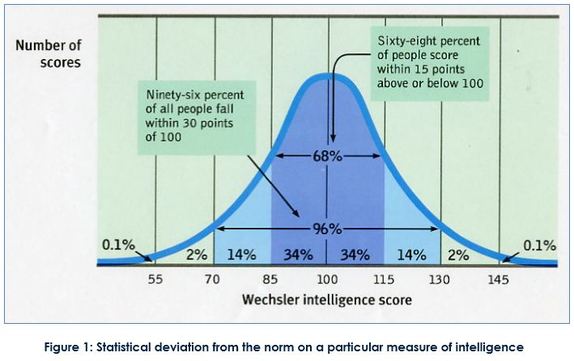
From the standardised normal distribution, the percentage of a population more than 1 standard deviation above the mean is 16%, more than 2σ is 2.3% and more than 3σ is 0.13%.

Take a hypothetical population A with the European norm of 100 (standard deviation 15) and a distinct group B representing 0.5% of the population who have a mean IQ one standard deviation up, ie 115.

Assume that elite IQ is three standard deviations above majority-average: a member of the top elite will have an IQ in excess of 145. What is the expected ratio of people from A and B in the elite?

Suppose the population size of A is 20 million so that the population size of B is (at 0.5%) 100,000.

We know that 0.13% of population A (3σ) will make it into the elite (assuming pure meritocracy) contributing 26,000 people.

Population B will have 2.3% (2σ) of its members in the elite; this is 2,300 people.

So the elite ratio A:B is 11:1, a fair distance from the 200:1 overall population ratio.

Stratification will be more intense if population B clusters in certain sectors where they historically specialise, as the Ugandan Asians did in commerce.

---

Addendum

Consider four standard deviations above majority-average, an IQ of 160+.  The area under the normal curve above 4σ is 0.003%.

Population A contributes 600 people with this elevated score; population B provides 130 people. The A:B ratio is now around 5:1. Perhaps the really top elite does consist of under a thousand people in a medium-sized country, so the expected ratio is perhaps not too unrealistic.

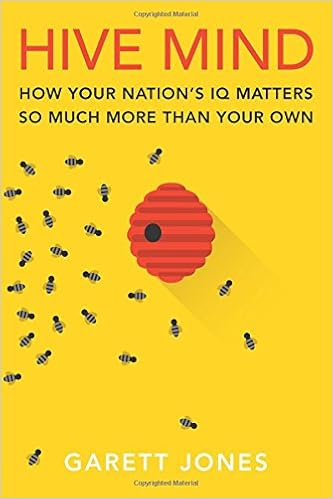
National IQs - from "Hive Mind"

Amazon link

This is a reference post. The data below is taken from the "Data Appendix" in "Hive Mind" by Garett Jones, which I reviewed here. Click on the images below to make larger.


"Notes: The middle column reports the Rindermann, Sailer, Thompson cognitive ability (CA) scores estimated from the international tests the PISA, the TIMSS, and the PIRLS. The right-hand column reports national average IQ as estimated by Lynn and Meisenberg.

The table only reports data for countries where both estimates are available. Both estimates include data of varying quality; in particular, developing country estimates may be based on small samples or limited numbers of tests and should be treated with caution.

This is a problem that also arises when measuring GDP per person in developing countries, as Morten Jerven's book Poor Numbers documents. Sources: Rindermann, Sailer, and Thompson, "The Impact of Smart Fractions" and Lynn and Meisenberg, "National IQs Calculated." See also Jervens, Poor Numbers. "
The main take-home lesson is that countries differ quite markedly in their average IQ, pretty much as you would expect given their economic and political success or lack of it. Not forgetting that countries are people, not inert geography.

The scores are misleading for countries which are highly stratified ethnically such as Israel, many countries in Latin America and the USA (to some extent). India (not shown) with its castes and jatis is problematic - the concept of national IQ doesn't really apply there at all.

China's average national IQ is generally estimated to be 105, aligned with Taiwan and Japan above.

Wednesday, January 17, 2018

The dream of 'designer babies'

Some things in the media are so mind-numbingly stupid that I feel frozen into dumbness: 'Where would I start?'

Where is the politician or pundit who simply states - in exasperation:
"Why wouldn't we want designer babies? Is random better? And when you choose your partner with care, aren't you trying - in  part - to optimise your children? Listen people, we already do designer babies! And that's good and indeed evolutionarily obvious."
OK, I never heard that. Ever.

But we will soon be able to make more informed choices about the genomes of our offspring. Three obstacles:
  1. We need to understand the phenotypical effects of alleles (existing or even new)
  2. We need certainty about the effects of genetic engineering - no mistakes
  3. We need to make it easy and convenient to access and then implant the modified cell.
So, once fixed, my question is: what do we want to do?

---

Issues

Firstly, there seems to be a biological recognition of kin-similarity. Babies swapped unknowingly at birth who grow up with unrelated 'parents' do seem to feel that something is wrong. I don't think we understand causally-genomically what is going on here and changing too many alleles, increasing the genomic distance between parents and child, may start to impact the relationship.

Secondly, you can't optimise everything. It may be true - as Steve Hsu has insisted - that high IQ tends to correlate with general health and superior performance in most areas. And if it's a question of minimising genetic load you can see why.

But beyond a certain point, high IQ seems to require that more of the brain is devoted to the processing of abstractions leaving less for other things. This is probably part of the underlying etiology for different personality types.

There seem to be few highly-intellectual axe-wielding warriors.

Thirdly, there is a feeling that although some parents might want their children to be great athletes or painters or musicians or novelists or priests or therapists or .. parents, there is something special about IQ.

Without intelligence we are sunk, none of the rest is going to work as our civilization will collapse. And that has been true up to now: all that smart fraction stuff - that you need a lot of folks with IQ 105+ just to run a complex society. And that the real innovation comes from those world-class people with IQs in excess of 160.

But .. I have not the slightest doubt that by the time we are able to routinely engineer the genomes of our offspring, we will have AI systems which are conceptually-competent way beyond the smartest humans that we can envisage.

We know what really smart people do: they internalise and extend a vast set of abstractions and manipulate them in interesting and complex ways to engage with problems. The lower foothills of this space are already colonised by deep-learning systems: their future seems pretty scalable.

It's not at all clear that the destiny or destination of the human race is or should be unbounded smartness, once we correct the errors of mutational load.

---

I've just finished reading "The Strangest Man: The hidden Life of Paul Dirac, Quantum Genius" by Graham Farmelo.

Amazon link

Dirac was plainly one of the smartest people who have ever lived. He is also generally assessed as autistic (Asperger's syndrome). In Farmelo's account, although not chronically unhappy, he hardly seems to have led a fulfilled life. His total, obsessive focus on developing theory seems to have led to a final disillusionment with the state of physics when he died (1984) - and with his own life's work.

I suspect that the first epoch of empowered genomic engineering will not be a mad rush for ever higher IQ, with the target of the ubiquitous production of von Neumann equivalents. Instead, I suspect we will edit out the obvious errors and reinforce the talents already latent in the specific underlying genome.

Let a thousand flowers bloom.

---

I suspect the second epoch of genomic engineering will be entirely different.

Tuesday, January 09, 2018

Autism & IQ, Deep Learning, Quantum Computing

Three papers (PDF) for you today.

---

1. Autism As a Disorder of High Intelligence - Bernard J. Crespi

Alterations of function in the autistic brain

Crespi's paper attempts to synthesise what is know phenotypically about mental pathologies such as autism with the genetics of intelligence. His thesis is:
"... alleles for autism overlap broadly with alleles for high intelligence, which appears paradoxical given that autism is characterized, overall, by below-average IQ.

This paradox can be resolved under the hypothesis that autism etiology commonly involves enhanced, but imbalanced, components of intelligence. This hypothesis is supported by convergent evidence showing that autism and high IQ share a diverse set of convergent correlates, including large brain size, fast brain growth, increased sensory and visual-spatial abilities, enhanced synaptic functions, increased attentional focus, high socioeconomic status,more deliberative decision-making, professional and occupational interests in engineering and physical sciences, and high levels of positive assortative mating."
and
".. autism represents most broadly a disorder of high intelligence (and low imagination), and schizophrenia a disorder of high imagination (and low intelligence) .. ."
I think his argument works best at the Asperger-end of the spectrum, where brain architecture imbalances have not yet led to major social dysfunction.

---

2. Deep Learning: A Critical Appraisal by Gary Marcus


Gary Marcus says "I present ten concerns for deep learning, and suggest that deep learning must be supplemented by other techniques if we are to reach artificial general intelligence."

He begins by observing starkly that "Deep learning, as it is primarily used, is essentially a statistical technique for classifying patterns, based on sample data, using neural networks with multiple layers."

Deep learning typically "knows" no more than can be inferred from regularities in the offered datasets (images, sounds, texts). With such limited data it's generally going to be impossible to infer background theories such as folk physics and folk psychology, let alone the physical and social properties of objects, people and behaviours which condition our everyday lives.

He then examines in detail just how consequentially-brittle deep learning systems are at generalising correctly outside of their training sets. This does not augur well for applications in open domains (such as self-driving cars, Internet censorship and the construction of competent social companions such as chatbots).

I completely agree with this paper, together with its conclusions that some serious new thinking is desperately required.

[Via "The Wild Week in AI"].

---

3. "Quantum Computing in the NISQ era and beyond" by John Preskill

From the abstract.
"Noisy Intermediate-Scale Quantum (NISQ) technology will be available in the near
future. Quantum computers with 50-100 qubits may be able to perform tasks which
surpass the capabilities of today’s classical digital computers, but noise in quantum
gates will limit the size of quantum circuits that can be executed reliably."
This is a useful review of the field of quantum computing, aimed at (technically-minded) venture capitalists. It's accessible and describes what quantum computing is, the various ways it can be implemented and what a quantum computer can - and cannot - do.

Almost the ideal introduction.

[Via Scott Aaronson].

Wednesday, December 13, 2017

"Are British people stupider than the Chinese?"

Via Marginal Revolution, an amusingly-dry memoir from Puzhong Yao. Here's an extract:


"It was the summer of 2000. I was 15, and I had just finished my high school entrance exam in China. I had made considerable improvements from where I started in first grade, when I had the second- worst grades in the class and had to sit at a desk perpendicular to the blackboard so that the teacher could keep a close eye on me. I had managed to become an average student in an average school.

My parents by then had reached the conclusion that I was not going anywhere promising in China and were ready to send me abroad for high school. Contrary to all expectations, however, I got the best mark in my class and my school. The exam scores were so good that I ranked within the top ten among more than 100,000 students in the whole city. My teacher and I both assumed the score was wrong when we first heard it.

As a consequence, I got into the best class in the best school in my city, and thus began the most painful year of my life. My newfound confidence was quickly crushed when I saw how talented my new classmates were. In the first class, our math teacher announced that she would start from chapter four of the textbook, as she assumed, correctly, that most of us were familiar with the first three chapters and would find it boring to go through them again.

Most of the class had been participating in various competitions in middle school and had become familiar with a large part of the high school syllabus already. Furthermore, they had also grown to know each other from those years of competitions together. And here I was, someone who didn’t know anything or anyone, surrounded by people who knew more to begin with, who were much smarter, and who worked just as hard as I did. What chance did I have?

During that year, I tried very hard to catch up: I gave up everything else and even moved somewhere close to the school to save time on the commute, but to no avail. Over time, going to school and competing while knowing I was sure to lose became torture. Yet I had to do it every day. At the end-of-year exam, I scored second from the bottom of the class—the same place where I began in first grade.

But this time it was much harder to accept, after the glory I had enjoyed just one year earlier and the huge amount of effort I had put into studying this year. Finally, I threw in the towel, and asked my parents to send me abroad. Anywhere else on this earth would surely be better.

So I came to the UK in 2001, when I was 16 years old. Much to my surprise, I found the UK’s exam-focused educational system very similar to the one in China. What is more, in both countries, going to the “right schools” and getting the “right job” are seen as very important by a large group of eager parents. As a result, scoring well on exams and doing well in school interviews—or even the play session for the nursery or pre-prep school—become the most important things in the world. Even at the university level, the undergraduate degree from the University of Cambridge depends on nothing else but an exam at the end of the last year.

On the other hand, although the UK’s university system is considered superior to China’s, with a population that is only one-twentieth the size of my native country, competition, while tough, is less intimidating. For example, about one in ten applicants gets into Oxbridge in the UK, and Stanford and Harvard accept about one in twenty-five applicants. But in Hebei province in China, where I am from, only one in fifteen hundred applicants gets into Peking or Qinghua University.

Still, I found it hard to believe how much easier everything became. I scored first nationwide in the GCSE (high school) math exam, and my photo was printed in a national newspaper. I was admitted into Trinity College, University of Cambridge, once the home of Sir Isaac Newton, Francis Bacon, and Prince Charles.

I studied economics at Cambridge, a field which has become more and more mathematical since the 1970s. The goal is always to use a mathematical model to find a closed-form solution to a real-world problem. Looking back, I’m not sure why my professors were so focused on these models. I have since found that the mistake of blindly relying on models is quite widespread in both trading and investing—often with disastrous results, such as the infamous collapse of the hedge fund Long-Term Capital Management. Years later, I discovered the teaching of Warren Buffett: it is better to be approximately right than precisely wrong. But our professors taught us to think of the real world as a math problem.

The culture of Cambridge followed the dogmas of the classroom: a fervent adherence to rules and models established by tradition.  For example, at Cambridge, students are forbidden to walk on grass. This right is reserved for professors only. The only exception is for those who achieve first class honors in exams; they are allowed to walk on one area of grass on one day of the year.

The behavior of my British classmates demonstrated an even greater herd mentality than what is often mocked in American MBAs. For example, out of the thirteen economists in my year at Trinity, twelve would go on to join investment banks, and five of us went to work for Goldman Sachs.

Three years later, I graduated with first class honors and got a job offer from Goldman’s Fixed Income, Currency and Commodity division, the division founded by my hero Rubin. It seemed like whatever I wished would simply come true. But inside, I feared that one day these glories would pass. After all, not long ago, I was at the bottom of my class in China. And if I could not even catch up with my classmates in a city few people have even heard of, how am I now qualified to go to Cambridge University or Goldman? Have I gotten smarter?

Or is it just that British people are stupider than the Chinese?"
So, words of wisdom here from Puzhong Yao. But is his final assertion plausible?

He states, "I ranked within the top ten among more than 100,000 students in the whole city". In a normal distribution this represents 1/10,000 of the whole area, on the extreme right hand side.

How many standard deviations is that?   3.72.

If we assume the mean north-east asian IQ to be around 106, then with standard deviation 15, this makes our author's IQ 160+.

This would not be an elite IQ in China*, but since the IQ threshold for Oxbridge is reckoned to be 145 (3 standard deviations above the lower British norm), he's plainly going to excel there!

---

* If Puzhong Yao is in the intellectual top 0.01%, then in a Chinese population of one billion he's in the top 100,000.

But the really top elite, say the top thousand people in the country, would be more than 4.75 standard deviations out, with IQs around 180.

Saturday, November 04, 2017

Elite UK universities and their threshold IQ


From Bruce Charlton:
"My suggestion is that the current elite UK undergraduate universities are: Oxford, Cambridge, LSE, Imperial, Warwick, St Andrew's, UCL, York, Bristol, Edinburgh, Bath and Durham. ...

"I will define elite universities as those recruiting mostly from the top 10 percent of the population in terms of IQ. Since IQ in the UK has an average of 100 with a standard deviation of 15, the top 10 percent of the UK population have an IQ of about 120 plus. ...

"... relatively few ‘high-IQ’ professions have an average entry standard of 120 plus and absorb about half the cognitive elite.

"These professions include accountants, architects, scientists, computer scientists, social scientists, university teachers, mathematicians, engineers, lawyers, dentists and physicians. Leading Chief Executives and senior managers make up the other main high-IQ group."
As many people have observed, if you send half of the population to university, the admittance threshold will be IQ = 100 and you will have to make sure that the subjects they study are not that difficult .. nor the exams.

It's getting harder to select the people who'll actually be able to do the tougher jobs. *

---

* Very, very hand-wavy.

Tuesday, August 08, 2017

'Accelerando' and the architecture of superintelligence


After four years I've just re-read Charles Stross's Accelerando and was again blown away. Here are my summer of 2013 thoughts. But in a nutshell, as the solar system transitions through the Singularity, posthumans of superintelligence transcend even augmented versions of ourselves.

Can we say more?

---

Intelligence is a reified concept. It presents as a trait of performance but is frequently conceived of as a mechanistic 'thing'. It's as if we took athletes such as Usain Bolt and Mo Farah and claimed they had a high 'quickness-quotient'. We would discuss the heritability of QQ and perhaps derive a scale. We would discuss biological correlates - is there a QQ module somewhere in the body?

IQ is clearly telling us something about performance, but to a greater extent than admitted it's collapsing several different things into one measure.
  • Reaction time (where we're defeated by houseflies).
  • Logical inference - where we're easily beaten by simple AI systems.
  • Pattern induction (eg Raven's Progressive Matrices):  AI programs do well.
But perhaps the best definition of intelligence is the 'ability to learn or understand or to deal with new or trying situations'.

---

Back in March I wrote a piece about the architecture of intelligence, 'Roger Atkins: Mind Design notebook'.  I proposed that we should think of the intelligent mind as operating over a semantic network defined by nodes, links and overall processing speed.

-- Each node is a minitheory: some facts, rules and cached deductions + relevant inference rules. For example, you have a small minitheory about your pet and a much larger one about yourself.

-- Each link represents a kind of relation between theories (there are many). The classic 'ISA' relation familiar from object-oriented languages and ontologies would be an example. Also similarity relations for analogical reasoning.

-- Processing operations over a semantic net include:
  • Take a node (minitheory) and deepen it with new facts, deductions or rules. Or create a new node on encountering or constructing some new entity.

  • Create a new connection or relationship between nodes via an insight as to how they relate. A more richly-connected semantic net is potentially more powerful.

  • Given a problem, navigate around the semantic net to form a solution (then add it).
---

With this architecture, a more intelligent entity has:
  • a larger and more densely-connected link-set
  • more and more-elaborated nodes
  • faster link-traversal, new-link-creation and node-processing.
Links between different, and perhaps remote nodes will likely be rather abstract and removed from direct experience. For example, a notion of symmetry underlies both natural beauty and artificial design. A sophisticated semantic net requires the handling of complex abstraction.

---

This architectural model gives us a handle both on superior human intelligence and on posthuman superintelligence.

Firstly, why can't we just go and build an AGI today? Because the root set of competences in every human's semantic net are nodes and links which encode the experienced physical and social world, a net which requires a degree of innervated embodiment we have as yet no clue as to how we might build. Only when 'they walk amongst us' will designers be in with a chance.

Secondly, how would a superintelligence differ from today's humanity? A superintelligence would possess a semantic net with improved performance along all three dimensions. Observe however that no matter how complex a network of abstract nodes, at the base is the set of nodes which must connect to the complexity of the world. Even the brightest genius condemned to a sensory-deprivation cell wouldn't be that performative. Nothing there to work on.

I suspect that the sum total of new social experiences is parameterised by the possibilities of new physical environments, whether occasioned by exploration and/or technologies. And even these are ultimately bounded by the free energy available, as Accelerando reminded us with such gusto.

I think the take-home message is broadly as Stross imagined it. A superintelligence which walked amongst us (Hi Aineko!) would be bounded by the limitations of purely human technology + culture. But a society of superintelligences able to drive forward  their own physical, technological and cultural environment?

Well, let's just say there would be plenty of headroom.

---

Note: in this view, artificial neural nets are an engineering implementation of the semantic net architecture described above. We know from human neural nets (aka 'brains') that a 'compiled' semantic network runs real fast in the subconscious (maybe it is the subconscious) while trying to 'consciously' work on your own semantic network to address novel, complex problems is really hard work and a real test of IQ.

Friday, July 28, 2017

Smart pets? An *obvious* spinoff ...

From Steve Hsu today at Information Processing:
"Work on cognitive enhancement will probably be done first in monkeys, proving Planet of the Apes prophetic within the next decade or so :-)"
Many (most?) of the alleles implicated in superior cognitive functioning will doubtless have other physiological effects. This 'multiple and diverse impact' of genes is called Pleiotropy.

For this reason - when we have a list of the relevant IQ alleles - we would be ill-advised to shift into genome-editing mode and just flip all those genes to their 'enhancement' variants.

Naturally, there'll be loads of research first on mice, monkeys (expensive) and .. cats.


Link

Contra Wittgenstein, I may yet share my life with a truly biologica Aineko before I die.

---

(Nothing worse than being incessantly nagged by an entitled creature which believes itself master or mistress of the universe and which additionally possesses claws).

Wednesday, July 19, 2017

Super-intelligence: A. E. Van Vogt - "Asylum"


Another SF short story which made an impression on me as a young teen. I was fascinated by this graphic description of what reality would be like to someone of immense intelligence.

The observer here, apparently a reporter named Bill Leigh, suddenly discovers he is actually the personality overlay of a covert 'Great Galactic' operative .. with an IQ of 1,200!

---
"The room and the girl in it changed, not physically, but subjectively, in what he saw, in the details.

Details burned at him; furniture and design that a moment before had seemed a flowing, artistic whole, abruptly showed flaws, hideous errors in taste and arrangement and structure.

His gaze flashed out to the garden, and in instants tore it to mental shreds.Never in all his existence had he seen or felt criticism on such a high,devastating scale.

Only - Only it wasn't criticism. Actually. The mind was indifferent. It saw things. Automatically, it saw some of the possibilities; and by comparison the reality suffered.

It was not a matter of anything being hopelessly bad. The wrongness was frequently a subtle thing. Birds not suited, for a dozen reasons, to their environment. Shrubs that added infinitesimal discord not harmony to the superb garden.

The mind flashed back from the garden; and this time, for the first time, studied the girl. On all Earth, no woman had ever been so piercingly examined. The structure of her body and her face, to Leigh so finely, proudly shaped, so gloriously patrician - found low grade now.

An excellent example of low-grade development in isolation.That was the thought, not contemptuous, not derogatory, simply an impression by an appallingly direct mind that saw - overtones, realities behind realities,a thousand facts where one showed. There followed crystal-clear awareness of the girl's psychology, objective admiration for the system of isolated upbringing that made Klugg girls such fine breeders; and then - Purpose!"
---

Here's a summary of 'Asylum'.
" two fugitive Dreeghs – energy vampires that suck blood and use energy – land on Earth. They are in dire need of blood and attack two humans right away to restore themselves. They then bury their spaceship under a New York restaurant where they dwell.

The murders shock the people on earth because murder is almost unheard of since Dr. Ungarn – currently residing on an asteroid near the Jupiter moon of Europa – devised serum to rid most of mankind of its murderous impulses. The story is investigated and reported by one of the world’s most recognized reporters – Bill Leigh. Soon after the publication of his article, he is invited by a stranger to his favorite New York restaurant to dine in a private room.

Leigh arrives and soon is joined by a young woman who hastily takes him through a secret door to a subterranean chamber where the Dreeghs are living. The young woman confronts them and warns the Dreegh that Earth is to be left alone. As a lower, fugitive race, the Dreegh will be dealt with most harshly.

Leigh is stunned and isn’t sure how to report this story and make it believable. But before he can, he is kidnapped by the Dreegh who use their mental powers to convince him to travel to the asteroid where Dr. Ungarn lives to destroy him and his daughter. The Dreegh suspect that the Ungarns are agents of the Great Galactics who will prevent them from settling and taking over Earth.

Leigh manages to hitch a ride on the freighter that routinely transports supplies to Dr. Ungard’s laboratory near Jupiter with no idea what his real intentions are, other than to find the girl who he met on Earth that he is sure is Patricia Ungard. They arrive on the asteroid and just as they are meeting with the Ungards, the two Dreegh arrive and capture them. They inform the group that more Dreegh are on the way and that this vanguard against their invasion of this solar system will be destroyed.

As the Dreegh prepare to draw the life force out of their three victims, a powerful mental force awakens in Leigh and he is able to slay the Dreegh before they can harm Patricia or her father. He is then contacted by a higher intelligence that informs him that he has never really been Bill Leigh, reporter. He learns that it is he who is one of the supreme beings of the Great Galactics. Leigh, unable to comprehend all this, jumps into a small space shuttle and flees to earth."
"Asylum" is better known as the first part of A. E. Van Vogt's "fix-up" novel "Supermind", which postulated  "... on an IQ curve that would include humans, Kluggs, Lennels and Dreeghs, the respective averages would be 100, 220, 380, and 450 ... ".

Sadly not available on Kindle.

Sunday, July 02, 2017

A Scanner Darkly

Your problem for today: to find the right linkage between the following two items.


---

1. Robin Hanson wrote this, including an almost throwaway comment on feminism:
"Yes one sex may have a worse deal overall. But most of the ways in which we’ve had sex-asymmetric official rules and widely held expectations did not result from a conspiracy by one sex to repress the other. They were mostly reasonable responses to sex differences relevant in ancient societies.

"We may have failed to adapt them quickly enough to our new modern context. But many of them are still complex and difficult issues. We’d do better to roll up our sleeves and deal with each one, than to obsess over which sex has the worse overall deal."
This seems a more reasonable line to take than the moralising we frequently get. It could also conceivably generalise to other groups who once got a raw deal within one set of social relations, which they later saw a way of overcoming, once those social relations had moved on.

---

2. From The Sunday Times today (Jonathan Leake, Science Editor):
"Research into human IQ — long one of the most controversial areas of science — has produced a new set of suitably awkward results.

Men’s average IQ is four points above women’s because they typically have bigger brains.

Scientists used the latest scanning techniques to measure the brain volumes of 896 people, who were also subjected to a battery of intelligence tests.

“We found that the average IQ of men was about four points above that of women,” said Professor Dimitri van der Linden, of Erasmus University in Rotterdam.

“So if men had an average score of 100, women would score 96.”
This would mean that 40% of women would be smarter than the average man. The Sunday Times 'balances' this two month old research result with some recent moral absolutism:
"The research coincides with a new book, Inferior: How Science Got Women Wrong — and the New Research That’s Rewriting the Story, whose author, Angela Saini, is sharply critical of it.

She said: “It is scientifically well established that there is no difference on average in general intelligence between women and men. It’s also well known that women have, on average, slightly smaller brains than men because they are, on average, slightly smaller in size. This paper does not disprove these facts.

“For more than 100 years, male anatomists and neuroscientists have sought to find evidence of women’s intellectual inferiority by comparing their brains to those of men. It’s surprising that in the 21st century those efforts haven’t ended.”
It obviously never occurred to Professor Dimitri van der Linden, of Erasmus University in Rotterdam and his team to correct for that, except:
"Men’s brains are bigger than women’s, even when controlling for bigger body size, which means they should have higher intelligence, though the evidence for that is conflicting. Most researchers find no notable differences overall, saying that different strengths and weaknesses balance each other out, but Lynn and Irwing (2002, 2004) argued that adult males are almost 4 IQ points brighter than adult females.

"The authors of the present paper have found one of the largest MRI samples available, each scanned person having done 10 cognitive tests, which is what makes this study particularly interesting."
Yes, this is not a new story: Dr James Thompson discussed it back in April.

Friday, March 03, 2017

Diary: programming is hard!

I remember a post by James Thompson (can't find it - sorry) describing the joy of giving IQ tests to bright students. Their smug condescension as they breeze through the early items; their horror as they hit their cognitive limits and start to sweat: "Wait a mo, .., just can't seem to see it ... ."

In artificial intelligence textbooks it's standard to cover the coding of theorem provers for propositional-calculus. Hidden away in the advanced exercises is the suggestion to extend the program to cover the full predicate-calculus. Inevitably, this is flagged as hard.

Tell me about it. Today I got basic binary resolution to work. Great! I can do inference. And yet this is not the central mystery of a predicate-calculus resolution theorem prover (RTP).

The conceptual problems arise from the layers of abstraction around the proof procedure. At the risk of boring you even further, binary resolution is driven by the unification of complementary literals (basic formulae). These two literals occur in the two clauses offered to the resolution function (hence binary resolution).

A  problem addressed by an RTP comprises: assumptions  = the axioms, a set of clauses, plus the problem itself, a goal clause.

Here's my working example. First come the axiom clauses:
(defvar *c3*   (mk-fact-clause '(likes rod horvath)))
(defvar *c4*   (mk-fact-clause '(likes sally renner)))
(defvar *c5*   (mk-fact-clause '(likes sally rod)))
(defvar *c6*   (mk-fact-clause '(likes hardy renner)))
(defvar *c7*   (mk-fact-clause '(likes hardy rod)))
(defvar *c8*   (mk-fact-clause '(amusing hardy)))
(defvar *c9*   (mk-fact-clause '(likes horvath moties)))
(defvar *c10* (mk-rule-clause '(likes sally ?x) '((likes ?x moties)) ) )
(defvar *c11* (mk-rule-clause '(likes rod ?x) '((likes ?x renner) (likes ?x rod)) ) )
(defvar *c12* (mk-rule-clause '(likes ?x ?y) '((amusing ?y) (likes rod ?y)) ) )
(defvar *c13* (mk-fact-clause '(likes ?x ?x)))

(defvar *g1* (mk-goal-clause '((likes sally ?who)) ) )  ; this is the problem clause
You may notice a "Mote in God's Eye" theme here.

Despite the simplicity of these facts and rules, you'll struggle a bit to figure out the complete list of who, exactly, Sally Fowler likes.

I expect better from my program - once completed.

---

So a clause might look like this (which you will recognise as a Prolog-style Horn-clause):
'( (likes sally ?x) ← ((likes ?x ?y) (likes ?y moties)) )   ; a rule clause
which is already a bit complicated.

Then we have to set up structures for the knowledge-base (facts and rules), the goals which emerge from the resolution process, and the pointers and bindings which allow a reconstruction of proofs.

---

In telling you this, my intention is not to document the program, my point is more psychological.

You need to keep a very great deal of abstract structure in your head simultaneously if you hope to put this not-entirely-trivial program together. Plus lots of functions.

It's very g-loaded, much like doing mathematics.
"It's quite hard getting figures but ... it appears that the average IQ of students applying for PhD programmes at good universities in computer science is around 128.

"That sounds right to me. Most software development companies don't take people without good first degrees or a higher degree in a STEM subject - and that's just the pool we're talking about here."
---

Parenthetically, thank God for Lisp, a gift from the deity for clear, conceptual, exploratory thinking.

---

I read endless texts in the media from innumerate journalists about how unemployed or newly-redundant workers are going to retrain as software developers. Those writers couldn't hack it themselves and sadly, neither will most of those no-longer-required workers.
"Wait a mo, ..., just can't seem to see it ... ."
At an IQ threshold of 128, we're talking about 2.5% of a population normed at 100.

A caveat. It's intellectually hard writing machine learning programs or configuring recalcitrant artificial neural nets on novel problem-domains .. or programming RTPs. Yet for everyone doing those things, there are ten people paid to use graphical web design tools or load databases, or do a bit of scripting. Things which are not that hard.

Like many occupations, there has been mission-creep in the definition of software developer.

---

And why am I making such heavy weather of this wretched theorem-prover? This.

Sunday, January 22, 2017

How smart are software developers?


It's quite hard getting figures but based on this raw data, it appears that the average IQ of students applying for PhD programmes at good universities in computer science is around 128.

That sounds right to me. Most software development companies don't take people without good first degrees or a higher degree in a STEM subject - and that's just the pool we're talking about here.

Tuesday, June 07, 2016

Robert Heinlein on Democracy

Robert Heinlein from "The Notebooks of Lazarus Long, Time Enough for Love".
"Democracy is based on the assumption that a million men are wiser than one man. How's that again? I missed something. Autocracy is based on the assumption that one man is wiser than a million men. Let's play that over again too. Who decides?"
In Robert Harris's novel "Archangel", I recall a scene after the death of Stalin where the secret police chief, Beria, tries to manipulate his colleagues to ensure his own succession. He has a cunning plan but it does not end well.

A politburo colleague observes that Beria, like many very smart people, assumes that more average people will never figure out what he's up to. But that's to mistake the nature of average folk: it's not that they can't get there - they can; it just takes them a little longer.

That's why I'm not that worried by the left-hand side of the bell-curve getting the vote.


The not-so-super-smart are usually not au fait with the niceties of public policy options, but they tend to be pretty expert on whether things are working out well for themselves. And in the end, that's a recipe for a stable and productive society: keep the punters reasonably content.

If you disenfranchise swathes of the population, you reserve political power to the vested interests of those who retain the vote. Naturally public policy will be captured (in the economics sense of regulatory capture) by such vested interests.

In the long run, this is seldom a good thing.

Sentimental, moralistic platitudes about the 'ethical superiority of democracy' don't do it for me.

No, I'm strictly functionalist. Democracy should be supported because it's the only system which provides a regular and universal protocol to "kick the bastards out".

---

Note: if you want Robert Heinlein's considered view as to how to make democracy work, you should read "Starship Troopers".


Tl; dr - voting should be restricted to those prepared to defend society, so no votes for parasites. Basically you do your military service, indicate your willingness to put your life on the line for your country .. and then you get to vote.

Tuesday, May 17, 2016

How unfair is access to university education?

The Times today has a leader, "First-Degree Burn", where they state:
"With notable exceptions, Britain’s universities are still not doing enough to attract poor students. English 18-year-olds from the most advantaged 20 per cent of backgrounds are still more than six times more likely to attend a top university than those from the least advantaged 20 per cent.

"Jo Johnson, the universities’ minister, calls this unacceptable and he is right."
In fact he is quite wrong.

---

Suppose 'advantage' is normally distributed in the UK population (it is not - more later) and suppose it correlates pretty well with IQ (which seems more reasonable).

Then the top 20% would have a mean IQ of 121 and their children (regressing to the mean) an average IQ of 117. *

The bottom 20% would be a symmetrical story, the left side of the bell curve. Their mean IQ would be 79 and their children's an improving 84 (83.2 but let's round up).

---

The Times mentions 'a top university', by which they most likely mean the Russell Group. The IQ needed to get into a Russell Group university is estimated to be 120.
 - Given a population with average IQ of 117, you would expect 42% to be eligible to meet the 120 cut-off.

 - Given a population with an average IQ of 84, you would expect 0.8% to be smart enough to meet the IQ 120 cut-off for the Russell Group.
That's a ratio of 42/0.8 = 52.5 - far worse than the lamentable six to one quoted by The Times.

The problem is with the financial-advantage model. The disadvantage-advantage distribution is far from normal; a small minority are very well off while a very large minority share a lowish level of income which is conventionally described as 'disadvantaged'.

What IQ amongst the 'disadvantaged' would replicate The Times' statistic of six to one?

A 'disadvantaged ' IQ of 98.

A population with an average child's IQ of 98 would have around 7% with an IQ at or above 120 - and thus be eligible to attend a 'top university'.

Since 98 is pretty much the average IQ of the mass of people in the UK, The Times' figures do not surprise me at all - they're exactly what we should expect.

And for that reason, despite any confected outrage or exciting new policies, I don't expect them to alter at all, short of crashing admission standards. **

---

* If you're wondering where all these figures came from, we're applying truncation selection ideas which were explained in detail here.


The first part of the calculation goes like this:

Talking about the top 20% of the population for IQ (mean = 100, std. dev. = 15) we have p = 20% = 0.2. This is the area we are 'breeding from', the top 20%.

The mean IQ of this group S = 100 + std. dev. * i(p) = 100 + 15 * 1.4 = 121,

... where we look up i = i(p) = i(0.2) = 1.4  in the table.

Using an IQ heritability of 0.8, the mean children's IQ = R = 100 + 0.8 * 21 = 116.8 = 117,

... reversion to the mean.

A symmetrical calculation give us the story for the bottom 20%

The rest is just putting numbers into the normal distribution.

---

** If pushed I'd say that the above analysis makes both the affluent and disadvantaged children too smart. As a reality check, what if we made the mean IQ of the advantaged kids 115 (1 sigma up) and the disadvantaged kids 95 (one third of a sigma down)? That sounds more like it.

Then 40% of the 'rich' kids could get into a Russell Group university, and 5% of the 'poor' kids. That's a ratio of eight to one. And The Times did hint that the ratio was worse than 6:1 ...

---

More bad science from The Times.

Friday, May 06, 2016

Thoughts on an IKEA visit

Never let it be said that quantum mechanics is not risqué.

In Book 3 of the Open University course you learn about molecular orbitals: crudely, the probability distribution of electrons around the nuclei of atoms bound together as molecules. The simplest case is two protons sharing one electron - H2+, the hydrogen molecule ion.

Lowest energy orbital for the hydrogen molecule ion

A pleasing shape, wouldn't you say?

The distribution of body weight on our double bed has a similar density function. This is not simply because we naturally prefer to sleep on our own sides, it's more that our mattress is in fact two single mattresses zipped together. The central hard ridge repels each of us off to the side.

To solve this problem, Clare and myself visited IKEA Bristol yesterday to purchase a super kingsize mattress. We both lay on the store bed, exploring mattress possibilities, to the general hilarity - some verbally expressed - of passing fellow-shoppers.

It should be delivered next Thursday, after which our bedtime molecular orbital may look more like the additive combination below:


---

We also bought a small flat-pack chest of drawers which took me almost three hours to assemble. I am astonishingly inept at manipulating physical reality and therefore had to work extra hard at being systematic, laying everything out in the right orientation, and checking every diagram three times.

Success!

It's an IQ test, and I googled "minimum IQ to assemble IKEA flat-pack" but there were no relevant hits. I recommend this as a research project.

But upon reflection, I figured that anyone who could afford IKEA prices would either have a high-enough IQ to do the assembly correctly already or would be rich enough to hire a handyman, so I doubt it's a problem IKEA lose any sleep over.

Monday, April 11, 2016

Truncation Selection by 50% (half the population)

This post uses the results of: "Boosting IQ by 15 points (truncation selection)". We now look at another example.

Suppose we had a country whose population originally shared the Caucasian average IQ,
(mean = 100; std dev = σ = 15).
And suppose a catastrophe occurred which led to half the population emigrating - such things have been known to happen in European history.

And suppose the brightest were the ones who emigrated.

What would be the average IQ of those who remained?

  • The proportion who remain, p, is 50%.
  • From the table at the bottom of the post above, the intensity of selection, i(p) = 0.8
  • Then use this equation, S = σ * i(p).

The average IQ of those left behind is S = 15 * 0.8 = 12 points below the mean; i.e. the non-emigrating have an average IQ of 88. However, due to regression to the mean, subsequent generations will do better than this.

Their descendants will have an IQ of R = h2S, where h2 = 0.6 (say) is the additive heritability of IQ.
So R = 0.6 *12 = 7 IQ points below the original population mean.
Their descendants will have an average IQ of 93.

Here's a list of country IQs.

---

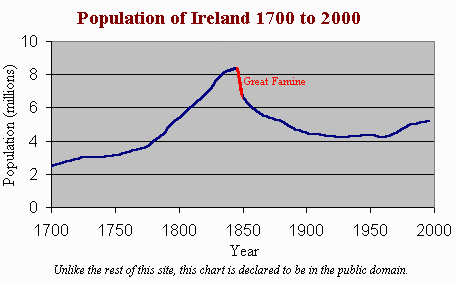
The power of population genetics ...

Diagram from here

The mean IQ of Ireland was documented in the country list above as 92.

---

You have to be careful with country IQs. If the country is not ethnically homogeneous you tend to get a stratified society where the average IQ hides more than it illuminates. For example, in Israel the Ashkenazim are smart and tend to dominate at the top of society - but non-Ashkenazim have a more typical Middle-Eastern IQ and numerically dominate - the resulting averaged IQ is documented as 95. Many Latin-American countries are ethnically stratified so one number is not that useful.

If the country has had a dysfunctional economic system and/or history (China is a case in point, Vietnam another), then deprivation will depress IQ scores.

Saturday, April 02, 2016

Heritability, correlation and prediction

We're told that intelligence is 60-80% heritable, and that personality is 40-60% heritable. In some hand-wavy way, we know that heritability captures the nature side of the nature-nurture contribution to traits.

But what does heritability really mean? It's a rather slippery concept. We'll get there by stages.

1. The contribution of genes to a phenotype

Let's take height as our running example (pretty much the same heritability as intelligence). Let's take a person with height P (P stands for phenotype - the measured trait). P is measured in inches away from the population mean height.

How did a person get to be that height? Nature and nurture, right?

We assume that the alleles the person got from their father contributes Xfather inches of height, Xmother counts the inches they received from their mother's alleles they inherited, and then there is a nurture - or environmental - term E inches. So their total height,
P = Xfather + Xmother + E.
Note these are genetic additive effects: each additional allele is plausibly assumed to make its independent contribution into raising or lowering X a fraction. Dominance and epistatic effects are neglected in this simplified conceptual model (in a polygenic trait, they tend not to be large).

Since we're measuring deviations from the mean, the average values across the population of Xfather, Xmother and E must all be zero. And so, therefore, must be the average value of P.

So without loss of generality, we assume Xfather, Xmother and E are normally distributed random variables with mean zero and variances as follows:
Var(Xfather) = Vadditive/2    -- each parent provides half the additive genetic 'input'

Var(Xmother) = Vadditive/2   -- each parent provides half the additive genetic 'input'

Var(E) = Venvironment.
So what is Var(P), the variance of height as we observe it in the population?
Var(P) = Var(Xfather) + Var(Xmother) + Var(E) +

        2Cov(Xfather, Xmother) + 2Cov(Xfather, E) + 2Cov(Xmother, E).
Messy, but if we assume Xfather, Xmother and E are independent, their covariances are zero, so
Var(P) = Var(Xfather) + Var(Xmother) + Var(E),

Vphenotype  = Vadditive + Venvironment
The fraction of the population phenotypic variation due to genetic, additive effects is then simply
h2 = Vadditive/Vphenotype = Vadditive/(Vadditive + Venvironment).
This is the definition of heritability, h2.

So if h2 is 0.5, then 50% of the variance in the phenotype is genetic in origin (additive-genetic, that is) and 50% is environmental (everything else).

Note that the more you reduce environmental variance, for example making sure that everyone's well-fed, properly educated and not knocked about, the more genetic differences predominate .. and heritability goes up. Not what the SJWs really want to hear!

---

2. Correlations

What is the correlation, ρ, between a parent and child for height?

If we have two random variables, A and B, the correlation between them is defined as follows:
ρ =  Cov(A,B)/√(Var(A) * Var(B)).
This is the standard definition.

In the case of one parent and their offspring, under some simplifying assumptions,
Cov(parent,offspring) = Vadditive/2
- this takes a few lines to work out, setting most of the Xfather, Xmother and E cross-terms to zero. It reflects the 50% of genetic material they have in common.

More obviously,
Var(parent) = Var(offspring) = Vphenotype,
So using the formula for ρ above,
ρ = (Vadditive/2) / Vphenotype = h2/2.
This shows that heritability is not the same as the correlation between a child and one of its parents.

In general, the correlation, ρ, on a trait between relatives is equal to the coefficient of relatedness times the heritability, ie ρ = rh2.

---

3. Predictions

If we know the height of both the parents, what's our best prediction of the height of their offspring? In our mind, we draw the best-fit regression line on the scatter-plot of parental-midpoint and offspring heights measured across the population.

If we centre the graph-axes at the mean values of the two populations (parental mid-point heights and offspring heights) then the regression line goes through the origin, with slope β. Then the equation of the regression line takes this simple form:
predicted-offspring-height = β * parental-midpoint-height
with both heights measured as inches in deviation from the respective means.

How do we compute β?

In this special case it turns out that β equals the heritability, so β  = h2. *

This should remind you of the Breeder's Equation.

---

Example: suppose the heritability of height is 0.673 and we know that one parent is 3 inches above the population mean while the other parent is 1 inch above the mean, what's the predicted (expected) height deviation from the mean for their child?
Answer: predicted-offspring-height = β * (3 + 1)/2 = 2h2 = 1.35 inches.
Yes, the child has regressed towards the mean.

---

This is problem 6.3 (p. 149) from 'Population Genetics: a concise guide' by John H. Gillespie, from which all the material above has been summarised.

---

* In general, β = ρ * (σyx) where x is the independent variable.