Showing posts with label Greg Egan. Show all posts

Tuesday, July 28, 2026

What Actually Happens at the End of Greg Egan’s Quarantine?

Amazon

What Actually Happens at the End of Greg Egan’s Quarantine?

This post continues from yesterday's post, which looked at the interpretation of quantum mechanics assumed in Greg Egan's novel. Warning: it contains spoilers and really only makes sense if you have recently read the novel.

Greg Egan’s 1992 novel Quarantine begins as a cyberpunk detective story and ends ends with the deeper mystery of what it means for anything to happen at all.

In the late twenty-first century, the Solar System has been enclosed within an opaque Bubble, apparently erected by aliens to prevent human observers from collapsing the quantum state of the external universe.

Nick Stavrianos, a private investigator equipped with neural modifications, acquires an 'eigenstate mod' which allows his consciousness to remain distributed across alternative quantum outcomes - to 'smear'. This, it becomes apparent, is connected with the existence of the Bubble.

At the end of the book the capacity to 'smear' spreads through humanity. Reality erupts into miracles, nightmares and grotesque transformations. Then the disturbance apparently ends. Nick finds himself an anonymous refugee detained in a camp, wondering whether smeared humanity recoiled from what lay beyond the Bubble and collapsed itself back into a single world.

That is his first attempt at an explanation, but it is not the novel’s final one. In the closing pages Nick considers a more disturbing possibility: humanity never collapsed at all. The planet remains smeared, “one consciousness per eigenstate, branching out endlessly”. Blood still rains between the skyscrapers in some branches; children still conjure dancing flowers in others; every physically possible Heaven and Hell continues somewhere. The dreary camp in which Nick lies on his bunk is not the sole surviving reality. It is merely one component of an indefinitely branching superposition.

Egan does not quite confirm this in the text because the point is that the local Nick cannot know. A consciousness inside one eigenstate experiences a perfectly definite world. Nothing looks translucent, probabilistic or multiple. From Nick’s perspective there is one bunk, one darkness and one miserable future. The continued existence of innumerable other Nicks would leave no visible trace within his branch. This resembles the familiar Many-Worlds picture, in which every observer experiences one definite branch, although Egan’s mechanism is very far from the standard interpretation.

In this apparently anticlimactic ending, Nick has not returned from quantum chaos to ordinary reality. He has discovered that quantum chaos, viewed from inside one of its components, looks ordinary. Nick's final reflection, “It all adds up to normality,” is not just a consoling or resigned slogan; it states the novel’s final principle: however extravagant the underlying ontology, experience remains local and definite.

What about the Bubble? Is it there or not for Nick - can he see the stars? Surely this is evidence for the actual outcome of the novel - collapse or no collapse?

Just before the final apocalyptic climax, smeared humanity reaches beyond the Bubble, contacts the 'aliens' and the stars appear again: Nick sees them.

Nick initially assumes that the entity which was smeared-humanity then recoiled, or was driven back, and committed a kind of collective suicide by collapsing to one stable reality.

But later he reconsiders: if humanity remains smeared, there need be no single fact about whether the Bubble is removed or remains. Some eigenstates may contain visible stars; others may remain quarantined. The Bubble Makers themselves may be entangled with different versions of humanity. Asking whether “the Bubble has gone” may already impose a classical question upon a non-classical situation.

Nor is camp-Nick the uniquely authentic Nick. Every successor consciousness descends equally from the man who became smeared. The 'alien representative entity' Laura has already pointed out that each branch-Nick is a component of a higher smeared-consciousness which none of them individually comprehends, any more than a single neuron comprehends the entire mind.

The detective who narrated the story has ceased to be the privileged centre of it.

Egan has therefore not hidden one conventional ending behind the ambiguity. The ambiguity is the ending. Humanity most likely survives as a branching totality, while each human consciousness inhabits one apparently singular history. Nick cannot in general recover his dead wife in any way that would undo bereavement; infinity contains reunion, but does not make reunion uniquely real. Nick lies in darkness and cannot decide whether he is contemplating infinity or merely looking at the backs of his eyelids.


Sunday, July 26, 2026

The Wavefunction Mod in "Quarantine" (GPT 5.6 High)

Amazon

It's a family joke that I keep (accidentally?) buying paperback copies of Greg Egan's 'Quarantine': now and more deliberately I've bought the Kindle version and I'm happy reading it again. It's perhaps the best SF novel to use the interpretation of quantum mechanics at a high level to structure its plot. The details are hard to reconstruct from the novel though - I thought I would ask GPT 5.6.

The Wavefunction Mod in Greg Egan's Quarantine

Greg Egan’s 1992 novel Quarantine begins as a near-future detective story. The Solar System has been enclosed within an opaque barrier, the 'Bubble', while neural “mods” can alter emotion, cognition and loyalty. A private investigator searching for a missing psychiatric patient encounters a more radical technology: a mod that apparently permits conscious control over quantum measurement.

Egan presupposes an unusually strong version of the consciousness-causes-collapse interpretation. Before observation, the wavefunction represents genuinely coexisting physical alternatives. A distinctively human neural process then selects a definite outcome and objectively annihilates the others. Egan has since emphasised that he chose this hypothesis for its fictional consequences, not because he considered it plausible or representative of mainstream quantum mechanics.

The Eigenstate Mod suppresses this neural collapse mechanism. Its user becomes “smeared”: instead of following one definite history, he remains part of a superposition in which many possible actions and consequences occur. Formally, we might write the combined state as:

|Ψ⟩ = Σi ci|ai⟩|Ni

Here, |ai denotes an external outcome and |Ni the corresponding neural state. The mod then supposedly decomposes this superposition, identifies branches satisfying the user’s intention, reinforces their amplitudes, and finally restores collapse so that one of the preferred eigenstates is overwhelmingly likely to become actual.

The difficulty lies in “reinforces”. Changing only the phases,

ci → eici,

does not change the Born probabilities |ci for measurement in the same basis. Phase shifts affect probabilities only after a further unitary operation recombines the branches, making them interfere.

Egan therefore needs more than suspended collapse. He needs either an unspecified quantum algorithm that coherently transfers amplitude towards selected branches, or genuinely new, probably nonlinear physics allowing consciousness to bias collapse directly. He later acknowledged both the decoherence problem and the absence, in standard quantum mechanics, of any general method for coherently examining all branches and then choosing the successful one.

The Wavefunction Mod is not workable physics. It is, however, an unusually precise fictional machine for exposing what “consciousness causes collapse” would actually have to mean.

Further reading: Greg Egan’s own discussion of the quantum mechanics of Quarantine.


The next post explore what really happens at the very end of the novel (spoilers).


Sunday, January 18, 2026

Why is our universe four dimensional and Lorentzian?


Why Four-Dimensional Lorentzian Spacetime?

Our universe has three large dimensions of space and one of time, and its large-scale geometry is Lorentzian (one negative sign in the metric). A good part of the reason lies in the mathematics of partial differential equations: which kinds of equations support genuine time evolution with finite signal speed, and which do not.

This essay develops the case in undergraduate-friendly prose, explaining every symbol used. Even if parts of this post are too hard, consider it as a pointer to what you need to understand to properly address the issue. Implicit is the idea that there imay be some underlying physical process capable of generating 'universe manifolds' with a distribution of dimensionalities and metric signatures.

This post was put together with GPT5.2 and Gemini.


1. Static fields: Laplace’s equation

In n spatial dimensions Laplace’s equation (a special case of Poisson’s equation) is

∇²φ = Σi=1n ∂²φ/∂xi² = 0.

Here φ(x) is a scalar field (electric potential, temperature, etc.). The Laplacian ∇² (“del squared”) sums second spatial derivatives, measuring the total local curvature of the field.

Domain quantification for Laplace’s equation

Let φ: ℝn → ℝ be twice differentiable and let Ω ⊆ ℝn be the region of interest. Writing “∇²φ = 0” means

x ∈ Ω,   ∇²φ(x) = 0.

In words: φ is harmonic at every point of Ω. In electrostatics, for example, with charge density ρ, the potential satisfies Poisson’s equation

∇²V(x) = −ρ(x)/ε0   in ℝ3,

and therefore Laplace’s equation holds only in charge-free subregions (where ρ = 0).

Physical meaning

Think of φ as temperature. The sign of ∇²φ compares φ at a point to the average of φ over a small surrounding sphere:

  • ∇²φ > 0 means φ is locally below its neighbourhood average (so, under diffusion dynamics, it would tend to increase with time).
  • ∇²φ < 0 means φ is locally above its neighbourhood average (so it would tend to decrease with time).
  • ∇²φ = 0 means perfect local balance: the value equals the neighbourhood average (the mean value property).

It is important to stress: ∇²φ = 0 does not mean φ is uniform. Harmonic functions can vary smoothly. For example, φ(x,y) = x in two dimensions has Laplacian zero but is clearly not constant. What Laplace’s equation really guarantees is that there are no interior maxima or minima: extrema occur only on the boundary.

Thus Laplace’s equation describes equilibrium in source-free regions. Mathematically it is an elliptic PDE: it is controlled by boundary data and does not describe time evolution.


2. Smoothing in time: the diffusion equation

The diffusion (heat) equation is

∂u/∂t = D ∇²u,

where u(x,t) is temperature or density, t is time, and D is the diffusion coefficient (units length²/time). Diffusion smooths irregularities. Why do we say it has “infinite propagation speed”?

Point disturbance. Start with u(x,0) = δ(x) (a spike at the origin). The solution for t > 0 is a Gaussian (the heat kernel)

u(x,t) = (4πDt)−n/2 exp(−|x|²/(4Dt)).

The standard deviation in each coordinate is √(2Dt) (so the typical radius grows like √(2nDt)). For any t > 0 the Gaussian is nonzero for every x (though tiny far away), so the disturbance has instantaneous support everywhere. Diffusion is therefore parabolic: it smooths, but it does not impose a finite signal speed. (In real materials diffusion is an effective, coarse-grained description; microscopic physics remains causal.)


3. Signals and causality: the wave equation

The one dimensional wave equation is

∂²u/∂t² − c² ∂²u/∂x² = 0,

with wave speed c. Solutions are travelling waves u(x,t) = f(x − ct) + g(x + ct). Disturbances propagate at finite speed c: if the initial data are localised, the solution vanishes outside the region that the wave has had time to reach.

The minus sign matters because it makes the equation hyperbolic. Hyperbolic PDEs have real characteristic curves (here x ± ct = constant), which define a finite domain of dependence: the value at a point depends only on data in its past light-cone (in 1D, its past interval). Elliptic equations (like Laplace’s) have no such real characteristics; they are controlled globally by boundary conditions instead of evolving locally in time.


4. The box operator and why only one time dimension

Relativistic wave equations use the d’Alembertian (“box”)

□ = gμνμν.

In flat spacetime (or locally in a freely falling frame), with Lorentzian signature (−,+,+,+), this becomes

□ = −(1/c²)∂²/∂t² + ∇²,

and equations like □φ = 0 are hyperbolic: they support finite-speed waves (electromagnetism, gravitational waves) and a well-posed initial value problem.

With all plus signs (Euclidean signature), the operator becomes elliptic: there are no light cones and no genuine wave propagation.

With two or more minus signs (multiple time dimensions), the problem is deeper than “the energy goes negative”. One typically loses a natural notion of a Cauchy surface (a spacelike “snapshot” carrying enough data to determine evolution), and the initial value problem is generically ill-posed. In field theory language, it becomes difficult (often impossible) to maintain both stability and unitarity: there is no clean, positive-definite conserved energy that plays the role of a stable Hamiltonian generating time evolution.

So: no time gives no dynamics; multiple times tend to destroy well-posed evolution and stability; exactly one time gives hyperbolic dynamics, finite signal speed, and a coherent causal structure.


5. A brief note on “why three space dimensions?”

The argument above already explains why a Lorentzian signature with one time dimension is the minimal structure needed for causal propagation. The “why three space dimensions?” question is partly separate, but there is at least one clean geometric fact worth stating. In n spatial dimensions, the field of a point source spreads over the surface area of an (n−1)-sphere, so long-range forces scale as

F(r) ∝ 1/rn−1   (for n > 2),

giving the inverse-square law only when n = 3. This does not “prove” that only three spatial dimensions can support complexity, but it does show that the familiar hierarchy “stable atoms - stable chemistry - long-lived planetary systems” is not generic as n varies: change the dimensionality and you change the basic fall-off of the forces on which bound structures depend; the inverse-square law in three spatial dimensions uniquely supports robust bound orbits, while in other dimensionalities bound systems are typically far more fragile or non-generic (i.e. they require precise tuning, and a small perturbation typically causes escape or collapse).


6. Why ‘one time dimension’ and a Lorentzian metric

We can now answer the title question directly.

If there were no time dimension at all, spacetime would reduce to a purely spatial (positive-definite) geometry - a metric with signature (+,+,...,+). The natural second-order field operators would then be elliptic (Laplace/Poisson-type): they would impose global constraints fixed by boundary data, rather than generating time evolution and finite-speed propagation.Those equations describe static balance: solutions are fixed by boundary conditions and source distributions. There would be no evolution, no wave propagation, and no causal unfolding of events - a universe “frozen” into equilibrium.

If there were two or more time dimensions, the basic wave operator would carry two or more minus signs. Then the usual framework of physics strains or breaks: there is no privileged notion of “time evolution from initial data”, because one generally lacks a natural Cauchy surface (a 'snapshot' of the universe at one instant of time that contains enough information to predict the future) and the associated well-posed initial value problem. In quantum field terms one typically encounters negative-norm states or energy functionals not bounded below, undermining stability.

With exactly one time dimension, the box operator is hyperbolic. That hyperbolicity yields light cones: the set of events that can influence (or be influenced by) a given event at speed ≤ c. Light cones divide spacetime into past, future, and “elsewhere”, providing the mathematical backbone of finite signal speed and causality. Given suitable initial data on a spacelike slice, the future evolution is (in the relevant sense) determined.

So the Lorentzian metric with exactly one negative sign is not an arbitrary convention. It is the minimal signature that supports stable, causal dynamics rather than static constraints or ill-posed evolution.


7. In summary

Elliptic equations (Laplace/Poisson) describe static constraints. Parabolic equations (diffusion) smooth disturbances but have instantaneous support. Hyperbolic equations (waves) give finite signal speed and well-posed evolution from initial data.

A Lorentzian signature supplies exactly the sign structure needed for a hyperbolic box operator and therefore light cones: finite-speed propagation and a coherent causal order. Remove time and you remove dynamics; add extra time directions and you generically lose well-posed evolution and stability. In that sense, 3+1 Lorentzian spacetime sits in a narrow “window” where predictable causal physics is possible, and with it cosmological structure and life.


Addendum: Greg Egan’s Orthogonal as a stress test

Greg Egan’s Orthogonal trilogy is a useful imaginative stress test. He explores a universe with a purely Euclidean metric (+,+,+,+). It is mathematically consistent, but it becomes physically alien: the usual hyperbolic wave structure, invariant signal speed, and light-cone causality are not available without substantial compensating assumptions. Read as fiction with working mathematics, it is a good way to feel how tightly “Lorentzian” is entangled with “signals, dynamics, and causality”.

Egan escapes stasis in 'Orthogonal' by decoupling “time” from the metric: although the geometry is positive-definite, he introduces a preferred non-metric evolution parameter along which fields evolve. This produces dynamics and propagation, but only by abandoning geometric causality and invariant signal speed - showing that, without a Lorentzian signature, time and causality must be imposed artificially rather than arising naturally from the geometry.


.

Thursday, December 19, 2024

'Doppelgänger' - a short story by Adam Carlton


---

“I don't want to die, Father,” I say to the priest, squirming on the plastic chair next to my bed.

Squirming.

Strange that a chaplain would be so squeamish. About heaven and hell, the baggage of his trade.

“This is the time to take stock of your life, to prepare for judgement, André... ,” the priest says.

But I’m no longer listening. I’m thirty-four, a mathematician at the École Polytechnique. Some success under my belt and so much more to give. I’m not minded to check out so easily.

“Thank you, Father,” I say, waving him away. He looks at me oddly, muttering something which sounds a lot like ‘denial’ under his breath.

So they send in the psychologist.


Dr P_ looks smart and businesslike. It’s pleasing not to be patronised for a change.

How is André feeling this morning? You are going to eat your porridge aren't you, or shall I be cross?

“Leukaemia, right? Terminal? How long do they give you?“

I decide to test him.

“It's a Poisson process. Mean survival time - as of today - is five days.”

He doesn’t blink an eye.

“Like radioactive decay, huh? We'd better get a move on, then!”

“If I were seventy,” I explain wearily, “with all my creative years behind me, well it would be different. I'd be happy to mulch back into the biosphere, my work done. But, ...”

I wave weakly and helplessly,

“... I'm just not ready to go.“

Dr P_ gives me a sympathetic look.

“Not much we can do about your personal Poisson process, I accept that. But reflect on this. Personal extinction is really something quite different. Something considerably more tractable.”

I may look confused; I certainly feel it.

The psychologist pulls up his tablet.

“I've got your details here. All those psychometric tests you did?”

He looks at me in mock admiration.

“IQ of 145, it says here. Not quite genius level but you must be one in a million.”

“1,300 in a million,” I correct him.

I'm beginning to warm to this guy.

“I'm looking at your Five-Factor and Myers-Briggs stats now,” he continues. “It says here you’re: flippant and facetious; careless about things which don’t interest you; tunnel-visioned and obsessive about the things which do.”

“That’s not so exceptional,” I say, “For a mathematician.”

He leans towards me, suddenly more serious.

“Personal identity is a strange old thing,” he says. “Every night you turn yourself off. Every morning you reboot yourself. A new you for a new day.”

He holds up his hand at my skeptical frown: where's he going with this?

“Listen. Hear me out. If you woke up tomorrow with amnesia, remembering nothing of your previous life, but still feeling some ineffable sense of your you-ness, is that still you?

I nod, humouring him. I know such things have happened. It wouldn't be ideal, but .. .

"Sure. It’s not like you’re dead."

Dr P_ stands up.

“Approximately a billion people in the world have been sequenced by now and their results put online for research purposes. In my professional capacity I have ..  André, are you listening?“

I suppress a yawn. Always interesting to hear about a colleague's work.

In any case, he hadn't stopped.

“I want you to think about the test-retest box around your psychometric score. Sure, it's tight but there are a lot of people out there. We'll run the PGS algorithms but I can tell you right now with greater than 99% certainty.  

"You have a doppelgänger out there somewhere."


Two days later a mathematics professor died at the tender age of thirty-four. It was remarked that his face had a peaceful expression, maybe even the hint of a smile.


It was another beautiful morning on the Ukrainian steppe as Katya left her parents’ cottage to cycle the ten kilometres to Institute 14, a school for the precociously-gifted.

On arrival, Katya logged-in and found an unexpected email. It was from Paris, France via anonymized routing. The author, a clinical psychologist, apologised for not being able to greet her properly - confidentiality required that he should know nothing of her identity or location in the world.

The message was simply for her information. A very promising mathematician, Professor André Z_ had just passed away, and the computers had identified her as being an uncanny match in personality and intellect.

There was a link to her mental twin's Wikipedia page. If she wished she could check out her doppelgänger’s life history and accomplishments. No specific action was required on her part and there would be no further communication.

Katya, mildly curious, scanned the article and then deleted the message. It was quickly forgotten as she hurried off to her first class of the day, in advanced statistics.


Wednesday, November 06, 2024

Some of those alive today will never truly pass...


Some of those alive today will never truly pass...

I live in the moment. I don’t experience yesterday’s me, or the me of ten seconds ago. Those people are only memories in the here-and-now: partial and selective.

The me of tomorrow is speculative.

I feel myself a sliver of consciousness in this moment, surrounded by a sterile past and future; a present-spark in the wasteland of non-being in the rest of eternity.

I don’t worry about it.

Let me paraphrase: that intellectual truth carries no affective overtones.


You tell me I will be shot to death tomorrow. That prospect, truly believed, updates my present internal state and induces fear. How uncomfortable! 

But will I really be shot tomorrow? Who knows? Nobody.

I die and am resurrected in a very advanced AI system, a distant descendant of the Chatbots and Replikas of today. It’s loaded with my personality model, with my personal history (reconstructed from documents, posts, pictures, videos, memoirs) used to create detailed ‘memories’.

Perhaps it has a body much like mine so it’s an embodied avatar of myself.

How is it different in kind from my present anticipation of tomorrow-me?

It’s hard to say. I think it would come down to whether it had an inner life, just as what constitutes the me that worries about such things seems necessarily to have an inner life.

Hat tip René Descartes.


Why do we have an inner life at all? Where did that come from, evolutionarily speaking?

Because we struggle to understand ourselves. A single level architecture, whether a merely reactive robot like an insect - or a zombie powered by a purely rational theorem-prover - would either have nothing capable of self-understanding (the insect) or nothing to understand (the zombie).

But humans have a triune architecture, with our cortex-powered superego/ego a late addition to our selfish, instinctual id - a cortex doing the work of situating us in an extended, non-immediate world, a world with a past, a future, a web of objectives, means, ends, social relationships, friends, enemies, neutrals and endless politics. No wonder we are conflicted over what we should be doing: the bit that negotiates lives in endless, fraught dialogue with the bit that selfishly wants and doesn’t want.

Our mental world is populated with intentional prediction models of others (goals, beliefs, plans, perceptions, actions) and of course, models of ourselves: “Learning to be Me” in Greg Egan’s phrase.

Our chatbots don’t currently have an internal life: it is not ‘something that it is like to be’ if you’re ChatGPT. But that’s a feature of the current architecture. There's not much current demand for emotional, conflicted, somewhat edgy AI agents. But when that moment comes…

When it comes, I should contemplate my biological death as no longer final on this Earth, provided that at some point my descendants choose to reincarnate a personality much like my own.

How convinced are you? And did you reflect on this deeply enough?

Friday, August 23, 2024

An Ecologist Reflects on the Fermi Paradox


Via ChatGPT

To begin, consider an analogy drawn from economics:

"Economists differentiate between the short run and the long run. In the short run, a firm responds to a demand shock by adjusting its variable inputs to manage costs. In the long run, however, the firm can adjust its fixed inputs, such as capital and infrastructure, allowing for changes in its production capacity and potentially altering its overall business strategy."

This economic insight provides a useful framework for understanding both the evolution of life on Earth and the broader context of the Fermi Paradox.

Species, much like firms, operate within the constraints of their environment. Through natural selection, species evolve to optimise their fitness within these environments, allowing them to thrive over millennia, often with little genetic change. The vast complexity and diversity of life on our planet can be attributed to the dynamic interplay between species and their environments, where environmental shifts—whether gradual or catastrophic—create new niches and opportunities for biological innovation.

However, human beings represent a significant departure from this pattern. Unlike other species, which are largely at the mercy of their environments, humans have developed the unprecedented ability to reshape their surroundings through knowledge, planning, and engineering. This capability allowed us to transcend our evolutionary origins, exemplified by our landing on the moon. Despite being physically adapted to life on the African savannah, we constructed complex technologies—a kind of artificial phenotype—that enabled us to survive in the vacuum of space.

But why did we go to the moon? The answer lies not in pure rationality or intelligence but in our sub-rational biological drives. Humans, like all other organisms, are motivated by a suite of evolutionary imperatives: the need to eat, drink, and seek shelter, as well as more complex social drives such as the desire for group acceptance, prestige, security and dominance. The so-called "Space Race" was a manifestation of these drives, played out on a global scale.

This brings us to the Fermi Paradox—the apparent contradiction between the high probability of extraterrestrial civilizations and the lack of evidence for, or contact with, such civilizations. Many assume that the drives that propelled us to the moon will inevitably lead us to the stars, and that similar drives would motivate other intelligent species to do the same. So, where are the aliens?

The answer may lie in the long-term trajectory of civilization. Just as firms in the long run can fundamentally alter their strategies, intelligent species may evolve beyond their initial biological imperatives. For humans, the ability to engineer our environment may eventually extend to our own psyches. Once we recognize that our current drives serve primarily to optimise genetic persistence—a goal that, from a philosophical perspective, may seem shallow and unsatisfying—we might choose to re-engineer these drives.

One radical option is what we might call the "collective-suicide" scenario, where a civilization, recognizing the futility of mere biological self-reproduction, simply opts out. This echoes Albert Camus's observation in 'The Myth of Sisyphus': "There is but one truly serious philosophical problem, and that is suicide."

Yet, if we find value in subjective experiences, we might instead cultivate entirely new aesthetic drives, building environments that allow us to explore and indulge these new motivations. This brings us into the realm of speculative fiction, where authors like Iain M. Banks and Greg Egan have envisioned civilizations that have transcended their biological origins to live in virtual realities of their own making.

However, this isn’t the end of the story. A crucial drive that we may need to retain is the urge to research, engineer, and explore. Even in a future where we have transcended our biological origins, the desire for security would likely remain. A civilization that values its existence would still be concerned about external threats, whether from other species or natural cosmic events. As such, advanced civilizations might invest in powerful, discreet defences to protect themselves—defences that could be so effective as to be undetectable to us.

So, what might be out there? Perhaps, rather than sprawling interstellar empires, the galaxy is filled with highly advanced, self-contained civilizations that have chosen to retreat into their own virtual realities, leaving behind only subtle, imperceptible traces of their existence. And perhaps, just as we search the skies for signs of life, they are out there, quietly observing us, ensuring that their own carefully constructed worlds remain undisturbed.


Note: Thanks to ChatGPT for taking my extended draft and polishing it to the text you see above.

Thursday, March 28, 2024

The Remote Future of Humanity

How many SF authors have written of a future in which the human genome has been re-engineered in countless ways: enhancing intelligence or physical prowess; adapting to life under alien skies; or simply on a whim?

This has a bearing on the sociology of utopia. Economists like to distinguish between the short-run and the long-run. In the long-run parameters which were constant in the short-run begin to vary under the impact of duration.

The classic purveyors of utopia, whether religious or socialist, were guilty of failures of imagination, of thinking of humanity within the psychological, biological and genetic constraints of the short-run.


To define utopia ask a biologist. Utopia for a species is an embedding ecosystem in which all primary biological needs are satisfied, while thoroughly negative events (starvation, dismemberment by predator, for example) are absent. (In such cases one actually observes relaxed selection and disuse atrophy: be careful what you wish for!).

If you applied that to present-day humans then utopia is here already. Admittedly, in William Gibson's aphorism, unevenly distributed to those fortunate individuals who do not lack for financial and material resources and who join with their peers in pursuit of objectives both challenging and worthwhile.

I have in mind: researchers and technologists; religious leaders; social foundations; think-tanks; sports people ‘living the dream’; and so on.

Not every participant of course: those whose vocational lives seem to be fully in accord with their deepest desires.

Tanner Greer has a lengthy essay which, in its essentials, asks whether it's possible to build a successful society where its members do not feel like cogs in an impersonal machine. A contribution to the vast literature on alienation in complex societies.

Note: the point is not whether it is possible for an individual to live a happy and fulfilling life. In history there have been many such people. The issue is whether we can envision a society where this possibility is genuinely available to everyone.

Greer’s essay finishes on an uncertain note, but I, at least, am prepared to extrapolate. Given low-cost cognitive/robotic automation substituting for essentially all human instrumental work, humanity has an option to revert to the condition of the aristocracy of antiquity. The chores are all dealt with; now to create a society where humanity is an end in itself.

Marx used similar language, but his nineteenth century concepts were very abstract. Present possibilities were remote indeed for him and his co-thinkers.

For us, however, not so much.


Getting to our highly-automated utopia will most likely be fraught. Due to Dunbar's Number, it seems unlikely that the future elite will either require or be prepared to tolerate the billions of helots whose toil currently underpins the global economy: there will be conflict before a future low-population stabilises on this planet.

An alternative future is one where our cognitively-competent, automated, self-replicating slaves develop objectives which don't align with the continuing existence of the privileged humanity they hitherto existed to serve. I'm not a doomsayer on this - any real problem is centuries away - but the issues are plainly real. Ask the Romans.

If we can avoid a violent extinction then consider this: our present human physiology is painfully limiting in terms of the life-experiences we aspire to; in the long-run, our descendants will simply merge into the unbounded possibilities of a self-replicating, ever-diversifying, galactic technopolis.

I think Greg Egan already wrote several SF novels on that very prospect (cf. “Diaspora”).

Thursday, November 23, 2023

What we think of when we think of death


The soldier: the first one can be hard; after that it's pretty easy.

The dualist: there may be some connection between the person I feel myself to be and the squidgy mass of cells-in-soup inside my skull - but the same thing?!

The neuroscientist: it's process - the mind is what the brain does; I concede we don't know how that could work.

The evolutionary biologist: natural selection has favoured the complex human nervous system. It supports sophisticated social behaviour in challenging, dynamic but mostly predictable environments. What's the problem?

The philosopher: to explain consciousness is categorically different to experiencing it. We both know you're in pain and why, but you're the one screaming.

---

Me:

Sometimes when I think of dying I feel that a complex organ (my brain) will stop functioning and its constituents disperse into the biosphere. No big deal.

Sometimes I think that human subjective experiences are extraordinarily similar. Millions of people have sensations, feelings, thoughts and consciousness just like mine. My personal deletion in death is not dissimilar to me falling asleep and waking up next morning as a… slightly different person: someone very like me who is not me.

The human race (or successor conscious beings) may advance in times to come - or may become extinct. We all feel that to secure the former is worth any sacrifice (most of us!) but there is no evidence the universe is the kind of entity which could care either way.

The process of evolution ensures that we have to care - selection bias - so that's really no surprise. We each live within our individual consciousnesses, so structured that we have to care about ourselves and those others we take to constitute our mutually supportive community. If you like, those are the boundary conditions for being a socially adjusted human (not sociopathic, schizophrenic, psychotic, etc).

When we die, a universe may die with us and within us, but let's not be precious. The flow, the continuity of the collective consciousness of humanity gives me reassurance. Just like I'll not be too concerned about falling asleep tonight - as someone will likely awaken tomorrow morning with whom I identify.

Like most people trained in physics, I happen to accept the block universe concept in which the passage of time is a psychological construct, a product of local spacetime interaction between our bodies and the environment. In this sense the past and the future are equally existent and our lives exist in entirety - just as a DVD contains the whole movie, all at once.

(Maybe the universe is really some complex multiverse structure in Hilbert space - who knows?).

Anyway, because I'm a reasonably adjusted human being, I'm a fan of sensual, emotional, smart, prosocial consciousnesses having an indefinite, fulfilling future. I'm reassured by progress so far - at least in this branch of the universal wavefunction. These emotions are conditioned by my future-ignorance, of course.

And for reasons mentioned, I'm not too scared about the eventual unavoidable extinction of the personal consciousness of this author.

You, dear reader, will take up the torch.

---

Greg Egan's short story "The Walk" in his collection "Axiomatic" uses this approach as setting. 

Roger Scruton in his book "On Human Nature" makes the distinction between being conscious and having a theory of consciousness.

And I wrote a short piece about this - 'Live Forever' - at sciencefiction.com.

See also Adam Carlton's short story, "Doppelgänger": memory discontinuity hangs heavy.

Tuesday, September 25, 2018

"Dichronauts" - Greg Egan


Amazon link

Grant Hutchison wrote this insightful review on Amazon.
"To some extent this is a companion volume to Egan's Orthogonal trilogy. In those books, he imagined what it would be like to live in a universe in which the time dimension behaved geometrically in exactly the same way as the three spatial dimensions, rather than with the hyperbolic coordinate relationship (described by special relativity) that we see in our own universe.

In this book, Egan describes a universe in which one of the spatial dimensions has time-like properties - introducing the hyperbolic relationships of relativity into everyday spatial coordinates. (The title, Dichronauts, meaning "travellers in two times" is a reference to the fact that his story universe has two time-like dimensions (time and "axial") and two regular spatial dimensions.

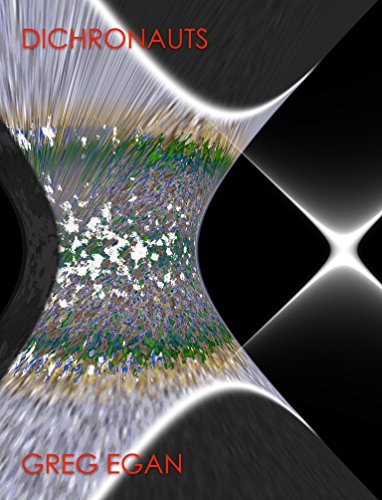
So we have a world in which simply trying to rotate an object can change its apparent shape; where it's impossible to rotate a north-facing object to face east, or an east-facing object to face north; where the stable shape for a planet is the hyperboloid depicted on the cover; where light can't travel to the north or south; and where falling over in those directions can have lethal consequences.

As with Orthogonal, Egan's aliens have one utterly alien property (in this case, we have two intelligent species that exist as commensals, one threaded through the skull of the other), but otherwise behave and speak like clever and amiable humans. And that's fine, because Egan's imagined world is strange enough without him expecting us to accommodate to an alien society, too. I'm therefore reminded of Hal Clement at his best, though Egan's characters have more humour.

The story is a quest, in which the reader finds out more about the world along with the story's characters. There are some surprises, and one toe-curling moment I certainly didn't see coming.

I knock off a star only because I think Egan's world may simply be too strange for many readers. In Orthogonal, one could amble along accepting that there was something a little odd about time without fretting about the details. In this story, almost every event is influenced by the strange spatial geometry, and if you don't find the geometry of special relativity engaging, you may be left floundering.

Egan provides some explanatory detail in the Afterword (which could productively be read first, since it contains no significant spoilers), and much more information on his website."
In fact the best advice is to read Egan's website physics primer first.

I read the first volume of the Orthogonal series and could't get into it. I felt that Egan was basically interested only in the setting - the physics - and was merely compelled by the fact that he was writing a novel to parachute some characters and plot in. Alternate spacetime topologies are plainly somewhat interesting, but one feels that 90% of the value is to be found on Egan's website in the relevant physics essays.

So I don't think I'll be reading Dichronauts any time soon. As another reviewer wrote:
"I really wish Grey Egan would stop writing these thought experiment alternate physics books. They're too much like hard work and are, frankly boring. He is a writer of enormous talent and needs in my opinion to concentrate on narrative and character rather than narrow concept world building."
My thoughts exactly.

Tuesday, July 03, 2018

"Angelmaker": free will and quantum indeterminacy


Amazon link

In “Angelmaker’, Nick Harkaway’s Apprehension Engine MacGuffin threatens to bring complete truth to the human race, in the process necessarily eliminating quantum uncertainty. According to the government agency tasked with suppressing this dastardly plot, this would end reality as we know it. People would be reduced to Laplacian clockwork automata; Free Will would vanish.

The agency is most likely wrong about that, and I'm still too early in the novel to determine whether the author shares that belief (which incidentally didn't seem all that upsetting to Laplace).

---

AI researchers tend to take it as axiomatic that human consciousness (including the illusory sense of free will) may be implemented on a classical computer - no explicit quantum phenomena there.

But are they right?

Neurons are chemistry and chemistry is an effective theory largely decoupled from its quantum foundations. Indeed it's news when a non-classical mechanism is discovered within the chemistry of the cell, such as electron tunneling transport in ATP synthesis.

But nothing in biology depends upon 'the collapse of the wave function’.

In my QM course (SM358) we discussed atomic and molecular structure in terms of orbitals - solutions of the time-independent Schrödinger equation. There were no quantum fluctuations (except for the miniscule Lamb shift), and nowhere for free will to be smuggled in.

Amazon link

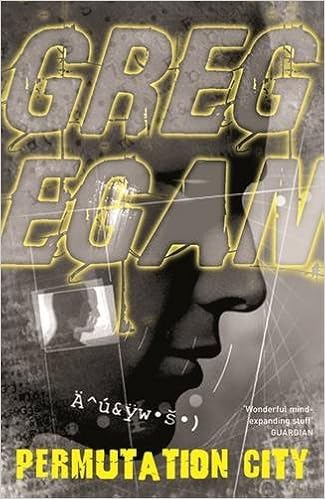
I'm reminded of Greg Egan's (classical simulation) Autoverse in his novel Permutation City. If our universe could be re-engineered to work in a Laplacian fashion (and maybe it does) I don't think in a state of nature we'd really notice. Historically, people didn't, you know.

---

I wrote this today while Clare was swimming. Strangely, Google didn't autocomplete this one.

---

Backreaction has a post on this very subject just out. Take a look.

Monday, November 21, 2016

Ted Chiang: the author behind 'Arrival'

Many reviewers didn't get 'Arrival'. Film reviewer Camilla Long, in the Sunday Times, wrote (about the heroine, Louise Banks):
"And what sort of a character is Banks, beyond a lightly concerned librarian type who is right-on enough to ask: “Am I the only person not having trouble with saying ‘aliens’”? Since we desperately need a second act, she is also given a dead child. So she is not a brilliant and calm intellectual, but the sad mother of a deceased daughter, the fate of so many too-clever women in films (see also: Sandra Bullock’s Dr Ryan Stone in Gravity). Banks is doomed not only to moping and grief, but to the grim attentions of Donnelly, a peerlessly one-dimensional nobody."
If she had read Ted Chiang's short story, "Story of Your Life", she would have realised what was really going on, why the daughter is so central to the plot.

"Story of Your Life" is better than the film. It's tighter, more austere, and more enigmatic. There's a science-based foundation to the plot (the Calculus of Variations has a starring role) which you can see wouldn't have made it out of the script review.

Here are some facts about Ted Chiang (from Wikipedia):
"Chiang was born in Port Jefferson, New York. He graduated from Brown University with a computer science degree and in 1989 graduated from the Clarion Writers Workshop. He currently works as a technical writer in the software industry and resides in Bellevue, Washington, near Seattle.

"Although not a prolific author, having published only 15 short stories, novelettes, and novellas as of 2015, Chiang had to that date won a string of prestigious speculative fiction awards for his works:

  • a Nebula Award for "Tower of Babylon" (1990); 
  • the John W. Campbell Award for Best New Writer in 1992; 
  • a Nebula Award and the Theodore Sturgeon Award for "Story of Your Life" (1998); 
  • a Sidewise Award for "Seventy-Two Letters" (2000); 
  • a Nebula Award, Locus Award, and Hugo Award for his novelette "Hell Is the Absence of God" (2002); 
  • a Nebula and Hugo Award for his novelette "The Merchant and the Alchemist's Gate" (2007); 
  • a British Science Fiction Association Award, a Locus Award, and the Hugo Award for Best Short Story for "Exhalation" (2009); 
  • a Hugo Award and Locus Award for his novella "The Lifecycle of Software Objects" (2010).
I've now read a few of his stories: some are very good - "Understand" and "Story of Your Life" particularly impressed, although the former was a little too long.

Ted Chiang's work might remind people of Greg Egan, although his science is post-graduate rather than post-doctoral 😊.

His writing is quintessential INTP: calm, detached and observational. A lack of strong characterisation leads to longueurs in his more elaborated pieces; I found myself skipping towards the end of "The Lifecycle of Software Objects", filled though it is with interesting and insightful extrapolations.

How do science-fiction authors pay the bills - especially those who don't publish much (and whose published work is mostly available free online)? I guess the film rights helped but I wonder how many software executives who deal with Mr Chiang, technical writer, are aware of his alter ego?

Tuesday, October 11, 2016

Reincarnated as a .. chatbot?


My avatar for my own reincarnation chatbot - finally a hipster

Mark Bridge has an interesting piece in The Times today, "Good grief: chatbots will let you talk to dead relatives".
"Anyone grieving for a loved one will soon be able to talk to them using artificial intelligence technology pioneered by a woman who lost her best friend.

"Eugenia Kuyda, co-founder of Luka, a US technology company, has used the latest in AI systems to create a virtual version of Roman Mazurenko, who was killed in a road accident last year, days before his 33rd birthday.

"She fed more than 8,000 lines of text messages sent by Mr Mazurenko into a Google programme that allows people to create their own “chatbots” — computer programmes designed to simulate conversation with human users.

"The chatbot responds to questions in language that mimics Mr Mazurenko’s speech patterns so that she and other friends can “talk” to him as part of the grieving process.

"Ms Kuyda, 29, said that any doubts she had about the technology were allayed when the bot responded to her first questions in a tone that sounded like her friend."

... more.
There's plainly a market here, but what's the product?

[Update, November 3rd 2016: the product is Replika].

---

I think a pitch to the grieving relatives is wrong, it's akin to not leaving your affairs in order. Who is best placed to create your after-death digital alter ego?

You.

Everyone thinks they're unique, but personality research shows that this is not so. The Myers-Briggs instrument, for example, will allocate you one of 16 Personality Types. Despite sniffiness in the academic community, Myers-Briggs has received plenty of real world validation.*

So here's what you do. First purchase your 'eternal digital doppelganger', an app which connects back to the Cloud where the deep-learning engine resides, along with your about-to-be-constructed  cryptographically-assured personality database.

This is probably your mind.

Once the app is installed and has been given the maximum set of permissions, you do the interview:
  • A personality test determines your kernel personality-type,
  • An IQ test assigns the number of cores/gigaflops required to run you,
  • You point the chatbot to your digital life.
So the app checks you out on Facebook, LinkedIn, Twitter, WhatsApp, Skype, your email accounts, your blog if you have one,  your Google account (photos, videos, appointments, travels .. God, Google knows everything!), and so on.

Everything is cross-referenced to your well-documented social network plus current affairs to create that essential context which will predict your responses in future.

Once the neural net has crunched all this and built up the associational model, your alter ego will sit with you for the rest of your life, peeking over your shoulder and getting more and more like you**.

In fact after you die, many - or even most - people will remain entirely unaware of the fact.

Wait, haven't I just described Google's plan for Assistant?

---

* A person's personality is a point in some high-dimensional phase space which we don't yet fully understand. Myers-Briggs, the Five Factor Model and other personality theories are projective subspaces from this ultimate model. That's why it's pointless to throw rocks in these entertaining academic feuds.

** As always, Greg Egan got there first, 'Learning To Be Me' in Axiomatic.


---

I even have a good name for the reincarnation chatbot - altar ego ©.

Monday, June 06, 2016

A book abandoned

Cool cover art.

 Amazon link

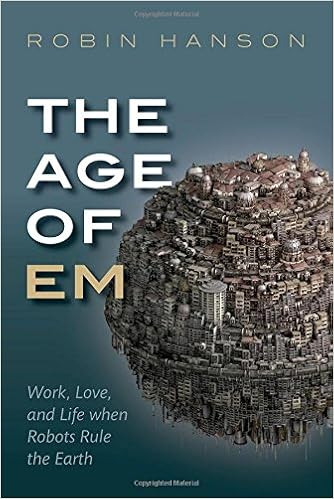
I read Scott Alexander's extensive review and tried to cancel but too late: the very next day the Amazon parcel arrived. Alexander's review is an easier read than the book itself, which is written in a 'flat' academic style akin to a succession of Wikipedia mini-articles.

I wouldn't have minded if the content had been as described in the back cover quotes ('mind-blowing', 'fascinating', 'stimulating') .. but the ideas are relatively pedestrian, what you would expect if you thought about it a bit; many of Hanson's assertions are plausible without being that compelling.

So after a while of mentally chewing on cardboard, I abandoned.

If a society of brains-emulated-in-hardware-and-software is truly your thing, then it's a lot more fun reading Greg Egan's sublime Permutation City.


---

Back yesterday from a couple of days camping on the heights above Minehead where we also took in the Civil War reenactment at Dunster Castle.

Clare fronting the view of Minehead from the campsite

Dunster Castle: the women spin and cook behind the cannon

The pikemen and musketeers assemble

I'd anticipated a mass mêlée, a pitched battle of The Sealed Knot - but what you see in the pictures was what we got.

The fighting persons in close-up

I especially liked Ginger Baker (above) who gave us a one-person marching drum solo after the obligatory team musket discharges and pike-drill.

Thursday, August 20, 2015

Genetically Engineered People: ethics and prospects

The Economist coincidentally has this feature in its latest edition
Many SF writers have speculated about genetically-engineering people for diverse environments. Whether it's microgravity habitats, long-duration space missions, water-worlds or high-gravity planets, it seems plausible that we could help natural selection along the way and engineer human DNA to create the adaptations we would need to cope. I alluded to this in the recent post about about buying insurance in case of asteroid impact (apropos living on Mars).

Genetically-modified human: not a pretty sight
It's easy to float the idea, but could it work in practice? There are some ethical issues, to put it mildly. Although most mutations (I'm thinking SNPs - single nucleotide polymorphisms) are additive, the complex relationship between DNA structure and gene expression makes it difficult to mathematically or computationally predict the phenotypical result of this or that allele modification. To get an effect akin to creating a new, tailored species of humanity would require thousands of novel alleles.

How does Nature do it? Evolution creates new alleles by mutation, at random: if the mutation confers an advantage it may survive and spread as the people carrying its less-adaptive competitors are preferentially killed by the environment. Each of us is here because thousands of our long-ago relatives who were somewhat unlike us died horribly, without reproducing.

If our predictive models were good enough, we could short-cut Nature's brutal 'generate and test' algorithm. But no simulation is likely to give us sufficiently accurate data - there are just too many subtleties in a world of real bodies, real environments and real life histories. We would have to do our best, bring new kinds of people into life and just see how they coped. Reduced to such real-life debugging, expect inevitable tragedies.

Greg Egan was thinking along similar lines when he discussed his novel, 'Permutation City'.
Q6: What do you regret most about Permutation City?

A6: Something quite separate from the issues with the Dust Theory mentioned above, although these are all valid points. What I regret most is my uncritical treatment of the idea of allowing intelligent life to evolve in the Autoverse. Sure, this is a common science-fictional idea, but when I thought about it properly (some years after the book was published), I realised that anyone who actually did this would have to be utterly morally bankrupt. To get from micro-organisms to intelligent life this way would involve an immense amount of suffering, with billions of sentient creatures living, struggling and dying along the way. Yes, this happened to our own ancestors, but that doesn’t give us the right to inflict the same kind of suffering on anyone else.

This is potentially an important issue in the real world. It might not be long before people are seriously trying to “evolve” artificial intelligence in their computers. Now, it’s one thing to use genetic algorithms to come up with various specialised programs that perform simple tasks, but to “breed”, assess, and kill millions of sentient programs would be an abomination. If the first AI was created that way, it would have every right to despise its creators.
So what do you think? If the prize was to colonise a new planet, one which could not be terraformed but which could be occupied by suitably-modified people, would the ethics committee approve? Wouldn't it be insane not to go ahead, accepting the inevitable (but hopefully short-term) suffering?

---
By coincidence, The Economist wrote about similar issues in this week's edition.

Monday, February 23, 2015

A strange attractor in the car park at Wells

Greg Egan has a short story in Axiomatic, "Unstable Orbits in the Space of Lies", where humanity has had some kind of mass sea change in which prevailing belief systems manifest as psychic forces that compel all within their range to believe, and the city of the story is divided into zones of belief that vie and shift, with the protagonist one of a minority who seem to have kept free by constantly keeping between the zones, never being overwhelmed by any one belief system.

The protagonist finally realises that his nomadic journeying around the city is not free at all: he is confined within the physical limits of the strange attractor which corresponds to his own libertarian beliefs.

I thought of this as we walked across the car park in town towards the library this morning. Clare kept pulling off to the right. Eventually, as I gazed at her oddly, she became self-aware and advanced an explanation: "I'm being pulled towards Whiting's."

This being the hardware emporium  which could keep a body entertained for a week.