Showing posts with label eugenics. Show all posts

Wednesday, January 17, 2018

The dream of 'designer babies'

Some things in the media are so mind-numbingly stupid that I feel frozen into dumbness: 'Where would I start?'

Where is the politician or pundit who simply states - in exasperation:
"Why wouldn't we want designer babies? Is random better? And when you choose your partner with care, aren't you trying - in  part - to optimise your children? Listen people, we already do designer babies! And that's good and indeed evolutionarily obvious."
OK, I never heard that. Ever.

But we will soon be able to make more informed choices about the genomes of our offspring. Three obstacles:
  1. We need to understand the phenotypical effects of alleles (existing or even new)
  2. We need certainty about the effects of genetic engineering - no mistakes
  3. We need to make it easy and convenient to access and then implant the modified cell.
So, once fixed, my question is: what do we want to do?

---

Issues

Firstly, there seems to be a biological recognition of kin-similarity. Babies swapped unknowingly at birth who grow up with unrelated 'parents' do seem to feel that something is wrong. I don't think we understand causally-genomically what is going on here and changing too many alleles, increasing the genomic distance between parents and child, may start to impact the relationship.

Secondly, you can't optimise everything. It may be true - as Steve Hsu has insisted - that high IQ tends to correlate with general health and superior performance in most areas. And if it's a question of minimising genetic load you can see why.

But beyond a certain point, high IQ seems to require that more of the brain is devoted to the processing of abstractions leaving less for other things. This is probably part of the underlying etiology for different personality types.

There seem to be few highly-intellectual axe-wielding warriors.

Thirdly, there is a feeling that although some parents might want their children to be great athletes or painters or musicians or novelists or priests or therapists or .. parents, there is something special about IQ.

Without intelligence we are sunk, none of the rest is going to work as our civilization will collapse. And that has been true up to now: all that smart fraction stuff - that you need a lot of folks with IQ 105+ just to run a complex society. And that the real innovation comes from those world-class people with IQs in excess of 160.

But .. I have not the slightest doubt that by the time we are able to routinely engineer the genomes of our offspring, we will have AI systems which are conceptually-competent way beyond the smartest humans that we can envisage.

We know what really smart people do: they internalise and extend a vast set of abstractions and manipulate them in interesting and complex ways to engage with problems. The lower foothills of this space are already colonised by deep-learning systems: their future seems pretty scalable.

It's not at all clear that the destiny or destination of the human race is or should be unbounded smartness, once we correct the errors of mutational load.

---

I've just finished reading "The Strangest Man: The hidden Life of Paul Dirac, Quantum Genius" by Graham Farmelo.

Amazon link

Dirac was plainly one of the smartest people who have ever lived. He is also generally assessed as autistic (Asperger's syndrome). In Farmelo's account, although not chronically unhappy, he hardly seems to have led a fulfilled life. His total, obsessive focus on developing theory seems to have led to a final disillusionment with the state of physics when he died (1984) - and with his own life's work.

I suspect that the first epoch of empowered genomic engineering will not be a mad rush for ever higher IQ, with the target of the ubiquitous production of von Neumann equivalents. Instead, I suspect we will edit out the obvious errors and reinforce the talents already latent in the specific underlying genome.

Let a thousand flowers bloom.

---

I suspect the second epoch of genomic engineering will be entirely different.

Sunday, December 24, 2017

A Christmas message from the Bubble


From stratospheric heights we survey our globe. The tendrils of capital lace effortlessly through America, surge eastwards across the Atlantic to pan-Europa; offshoots jut into Russia. Westward they leap trans-Pacific into Japan and Australasia, penetrating India and China like growing roots.

Africa remains dark.

This weave of intangible finance and investment is shadowed by the stately global flow of commodities .. and the migration of workers of all skills and hues to wherever they are best needed.

This is how capitalism was always meant to work!

A frictionless, flexible, adaptable global-scale economy. And we run it, benefit from it. We make it happen, and it makes our culture: rationalistic, individualistic, transactional, civilised, urbane, liberal, secular - truly homo economicus.

Wait: there are irritants. What is that Trump creature doing, railing against us in his absurd bombast? A clown tweeting banal stupidities to his redneck base - who ordered that?

And where did those ghastly Brexiteers crawl from, ruining the future with their atavistic anxieties? They, and their less-potent counterparts in other European 'countries'.

We shall be busy the next twenty years. Our progressive enclave must extend itself: geographically to Russia and China, and also downward, absorbing more and more of those troublesome little people.

(Africa? We move rapidly on.)

Setting the world politically to rights is the tiresome chore of the age but with the media, students and young professionals on our case, we're cooking with gas .. or should I say renewables (heh heh).

No real issues in finishing this up (barring presentation) - there are some great advances in genetic engineering coming down the road.

Friday, February 24, 2017

Domestic servants: a modest proposal

I have fond memories of our Roomba, spinning mindlessly around our previous house, unable to empty itself and needing help to escape from under the bed. Didn't work in our current home - carpets too thick.

We're as far as ever from artificial general intelligence (AGI). But why try to solve a thousand problems of mental and physical agility when biology has already done the work for us over 400 million years?

"Wait!", I hear you say. Domestic servitude died out with the Edwardians. Besides, the idea of all those servants observing and judging your every move. It's so creepy. No privacy. It's like your home isn't your own.

But that was before CRISPR ...
"She paused. "Just out of curiosity, what's planned fo' the serfs along these lines?"

He relaxed. "Oh, much less. That was debated at the highest levels of authority, an' they decided to do very little beyond selectin' within the normal human range.

"Same sort of cleanup on things like hereditary diseases. Average height about 50 millimeters lower than ours. No IQs below 90, which'll bring the average up to 110. No improvements or increase in lifespan so they'll be closer to the original norm than the Race.

"Some selection within the personality spectrum: toward gentle, emotional, nonaggressive types. About what you'd expect."
If they like serving you, can it really be slavery?

---


More about the Draka.

Monday, May 16, 2016

When well-intentioned people write bad things

It's not that Matt Ridley hasn't got form. There's a veneer of political correctness which seems to stick to public-intellectual science-writers; they persist in writing cosy, comforting pieces they must know to be misleading, even untrue.

Today, Ridley has an op-ed piece in The Times. "Gene editing isn’t a slippery slope to eugenics", trying to rehabilitate the notion of eugenics.  This is opportune given the dysgenic features of advanced Western countries (relaxed selection leading to mutational load, & the idiocracy stuff), combined with the ameliorating possibilities of genetic engineering.

Ridley starts with the correct statement that eugenics is bad when coercive. State-controlled reproduction is oppressive whether it's China's one-child policy, India's compulsory sterilization or - that old favourite - the disreputable practices of Nazi Germany.

So few problems with his first point:
"First, the essence of eugenics was compulsion: it was the state deciding who should be allowed to breed, or to survive, for the supposed good of the race. As long as we prevent coercion, we will not have eugenics. Our politics would have to change far more drastically than our science."
His second point is more dubious - reassuring cant, some might call it. Artificial insemination with the eggs or sperm of strangers is not what most couples want - they made their own eugenic selection when they chose their partner.
"The second reason we need not fear a return of eugenics is that we now know from 40 years of experience that without coercion there is little or no demand for genetic enhancement. People generally don’t want paragon babies; they want healthy ones that are like them. At the time test-tube babies were first conceived in the 1970s, many people feared in-vitro fertilisation would lead to people buying sperm and eggs off celebrities, geniuses, models and athletes. In fact, the demand for such things is negligible; people wanted to use the new technology to cure infertility — to have their own babies, not other people’s. It is a persistent misconception shared among clever people to assume that everybody wants clever children."
But what if their own child-to-be could be tweaked a little? Or there could be a little bit of selection amongst all their possible children? This is already pretty popular for genetic disease screening; and rightly so.

And then we descend to the plain wrong.
"The more recent discovery that traits such as intelligence are caused by the complicated interaction of multiple genes of small effect means that it is anyway going to be virtually impossible to decide what genetic recipe to recommend to somebody who wants a clever child, or a good-looking one, or an athletic one. By contrast, the genetic changes that cause terrible afflictions such as Huntingdon’s disease or cystic fibrosis are singular and obvious. Selecting embryos that lack such traits, or editing the genes of people so that they are born without carrying such traits, will always be much easier than selecting genetic combinations that might, in the right circumstances and with the right upbringing, lead to slightly higher IQ. Cure will always be easier than enhancement."
We know that embryo selection on as few as ten fertilised eggs could span an IQ gap of ~11 IQ points. That would boost Caucasian populations to the level of the Ashkenazim in one generation. And not a CRISPR in sight.

There is little reason to believe that genetic engineering of many hundreds of SNPs wouldn't be possible within two generations, resulting in significant trait alterations on any reasonably-heritable trait - which is most of them.

We're talking height, health, athletic ability, musicality, personality .. and of course IQ here.

So, Matt, it's not going to be so hard and, trust me, they'll all be jumping at it once it's safe and cheap.

And you must know this. So what's with the 'reassuring' lies?

Monday, April 11, 2016

Truncation Selection by 50% (half the population)

This post uses the results of: "Boosting IQ by 15 points (truncation selection)". We now look at another example.

Suppose we had a country whose population originally shared the Caucasian average IQ,
(mean = 100; std dev = σ = 15).
And suppose a catastrophe occurred which led to half the population emigrating - such things have been known to happen in European history.

And suppose the brightest were the ones who emigrated.

What would be the average IQ of those who remained?

  • The proportion who remain, p, is 50%.
  • From the table at the bottom of the post above, the intensity of selection, i(p) = 0.8
  • Then use this equation, S = σ * i(p).

The average IQ of those left behind is S = 15 * 0.8 = 12 points below the mean; i.e. the non-emigrating have an average IQ of 88. However, due to regression to the mean, subsequent generations will do better than this.

Their descendants will have an IQ of R = h2S, where h2 = 0.6 (say) is the additive heritability of IQ.
So R = 0.6 *12 = 7 IQ points below the original population mean.
Their descendants will have an average IQ of 93.

Here's a list of country IQs.

---

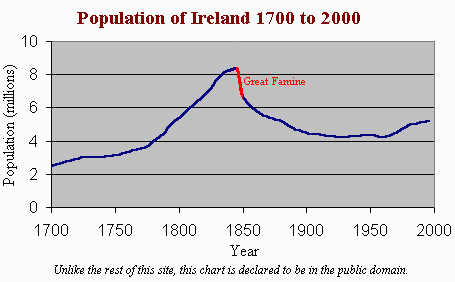
The power of population genetics ...

Diagram from here

The mean IQ of Ireland was documented in the country list above as 92.

---

You have to be careful with country IQs. If the country is not ethnically homogeneous you tend to get a stratified society where the average IQ hides more than it illuminates. For example, in Israel the Ashkenazim are smart and tend to dominate at the top of society - but non-Ashkenazim have a more typical Middle-Eastern IQ and numerically dominate - the resulting averaged IQ is documented as 95. Many Latin-American countries are ethnically stratified so one number is not that useful.

If the country has had a dysfunctional economic system and/or history (China is a case in point, Vietnam another), then deprivation will depress IQ scores.

Thursday, February 18, 2016

Boosting IQ by 15 points (truncation selection)

It's 2025 and England, having left the EU, has to fend for itself in competitive battle against China. It's not easy: the Chinese are very smart and out-innovate us in key sectors - financial services and high technology.

Something has to be done.

A secret Government task force reports. The problem is our human capital: we're just not smart enough; we can't hack the highly abstract, interconnected and complex realities of the new economy. We have to give our population an IQ boost.

Farmers have known for centuries what to do; animal breeding and genetics professionals have worked out all the details. You identify the traits you want and select that proportion of the population which - if bred together - will deliver offspring with the desired characteristics.

Evolution in action.

'What do we need?' asks the Minister.

Nothing less than a boost in our average population IQ of 15 points, the report suggests, which would bring us up to the level of the the Ashkenazim or India's Brahmin - and better than the Chinese average IQ of 106.

'OK,' says the Minister, 'and how would we get there?'

The report has done the calculations. We'd have to restrict breeding to those people with an IQ greater than 109. Basically, middle-class professionals and up.

The Minister ponders: 'We're doomed.'

---

The report had an easy-to-read annex which is reproduced below.

State-enforced eugenics has had a deservedly poor press. But voluntary, on-demand child improvement - without coercion - is an easier sell. Putting breeding restrictions to one side, the report also talked about making gene-editing and embryo-selection options widely available, perhaps free on the NHS for the poor.

Perhaps England can hack the 21st century after all.

---

Truncation selection

As a running example, we take a population of potential parents with mean IQ 100 and standard deviation 15 IQ points; this is broadly the Caucasian English population. We wish to identify a proportion of high-IQ individuals (p%) to breed from, so that their offspring will have an average IQ one standard deviation, σ = 15 IQ points, greater than the current overall parent population.

The related questions of interest:
  1. What is the IQ cut-off threshold, above which we permit high-IQ parents to breed?
  2. What proportion of the overall population parents do we allow to breed?
  3. What is the average IQ of the selected parent-breeders?
We know that the parent-breeder IQ has to be higher than the target IQ in the offspring, because of regression to the mean. This reflects that some of the parents' higher intelligence is due to "luck" - what we euphemistically call 'environmental influences'. In the offspring, this luck goes away and only that portion of intelligence due to (additive) genetics contributes. This is captured by the heritability being less than one.


S is the mean of the selected population minus the population mean, (example: 118.75 - 100 = 18.75, as we shall see).

h2 is the heritability of the trait (example: for IQ we'll assume h2 = 0.8 - estimates vary)

R is the mean of the offspring of those selected minus the population mean, (example: 115 - 100 = 15).

We can now define the relationship between the mean incremental-IQ in the selected parent-breeders and the mean incremental-IQ of their offspring. It's the breeder's equation.
R = h2S.
Knowing R and h2 we can easily work out S. For our running example, we want a future breeding population with mean IQ of 115 (ie R is 15) and the heritability, h2, is 0.8.
So S = 15/0.8 = 18.75.
The mean IQ of our selected parents has to be 118.75.

Connecting proportion allowed to breed (p) with their mean trait-value (S)

This doesn't tell us what proportion of the population is going to be allowed to breed. We need another equation relating S and p, the proportion of the population (on the right-hand side of the bell curve) allowed to breed.

Note that p is the area under the curve on the right of the distribution (see picture above), and S is the mean value of that selected area (in units of σ).

This equation is:
S = σi(p)
where σ is the population standard deviation (15 IQ points) and i(p) is a function we look up in tables, called the 'intensity of selection'. Once we know i(p), we can work backwards in the table to look-up p.

Let's do it.
i(p) = S/σ = 18.75/15 = 1.25. *
Looking up in the tables, p = 26%.

Looking at the selection intensity table below, if we select 26% of parents from the top of the existing intelligence distribution and allow them to breed, the average IQ if their children will be 115, one standard deviation greater than at present.

Note that the average IQ of these parents will be, as we already saw, 118.75.

The IQ cut-off (below which we don't allow anyone to breed) is the truncation point x0. From the table below, it's 0.643 (standard deviations) which equates to an IQ of approximately 110.

The result of all this hard work? Our selected offspring will have an average IQ of 115 - that puts them on a par with the Ashkenazim or Brahmin, and better than the Chinese average of 106.

Job done in one generation!

---

* We can combine the two equations to eliminate S, so that
R = h2σi(p), or

i(p) = R/(h2σ)   -   (example: i(p) = 15/(0.8 * 15) = 1.25 as above).
---

Here is the table for i(p).


Further Reading
  1. A slide overview (PDF).
  2. A useful handbook, 'Selection and Genetic Change' (PDF), by Erling Strandberg and Birgitta Malmfors . 
  3. The appendices to the above (PDF) with the maths for the intensity of selection function.

Monday, February 08, 2016

Choose the best of your virtual children

I wrote critically of Nick Bostrom in my review of his "Superintelligence" book. But when he's not writing in a philosophical straightjacket, his intelligence and creativity produce rather better results, as here with Carl Shulman.

Suppose you have nine brothers/sisters. Your nine siblings will, of course vary in height, weight ... and intelligence. We know how to think about the relationship between the IQ of parents and their offspring (Steve Hsu explains here).

  • We take the average of the parents' IQ, and that is the mean IQ of their children.

  • The children do not of course have identical IQs, they're not clones; instead they populate the usual Gaussian distribution with standard deviation in the 7-11 IQ point range (rather than the usual population IQ SD of 15). The authors were conservative and used 7.5 in their simulation below.

So Carl and Nick have this table in their paper, from which you can see that the maximum IQ gap within ten children (dimmest to smartest) might be as much as 23 IQ points. Yes, I find that surprising too.

The table is based on a large scale simulation (10 million couples) and what I take it to be saying is this: if you use ten embryos and decide to implant the smartest, then you'll get an average 11.5 IQ point gain over just selecting a random embryo with no pre-screening for intelligence at all.

Is that important? It's the difference between a clerical and a professional job.


If you come from a large family, consider your siblings and consider whether any of this makes any sense.

We already do embryo selection for single-mutation diseases. A fertilised egg (in vitro) is allowed to divide until you have, say, an eight-cell clump - at this stage there is no functional differentiation. One cell is then extracted and its genome sequenced looking for the faulty gene. If the genome is fine, the seven remaining cells are implanted and the embryo grows to term with no ill effects; otherwise, discard and repeat. (It is more complex than this).

For IQ-based embryo selection to catch on we need a predictive model which can take a sequenced genome and predict with tight accuracy the resulting IQ (assuming decent nutrition, no abuse etc). We can't do this now as the relevant genes haven't yet been identified. But that should change within five to ten years. And we need to get the cost right down: doing 10 whole-genome sequences could be pricey.

Apart from the hassle of IVF and any legalistic hurdles, the way would then be open. What might be the consequences? Carl and Nick have a table - click on it to make it bigger.


---

Just a note about IES on the right-hand side.
"The effectiveness of embryo selection would be vastly increased if multiple generations of selection could be compressed into less than a human maturation period. This could be enabled by advances in an important complementary technology: the derivation of viable sperm and eggs from human embryonic stem cells. Such stem cell derived gametes would enable iterated embryo selection (henceforth, IES):

1. Genotype and select a number of embryos that are higher in desired genetic characteristics;

2. Extract stem cells from those embryos and convert them to sperm and ova, maturing within 6 months or less;

3. Cross the new sperm and ova to produce embryos;

4. Repeat until large genetic changes have been accumulated."
...
"Using IES could deliver much more extreme results, and the fixed costs of using IES to produce enhanced embryos could be spread across large numbers of enhanced children. On the other hand, IES would compromise the typical genetic relationship between parents and children. To avoid negative effects of inbreeding, IES would require either a large starting supply of donors, or the expenditure of substantial selective power to reduce harmful recessive alleles. These factors would tend to push towards IES offspring being less genetically related to their parents (though more related to one another), and could reduce the appeal of IES."
All this and we haven't even mentioned genetic engineering, or CRISPR-Cas9.

I blogged that Toby Young had a piece about this back in September last year.

Wednesday, September 23, 2015

The little people - the Draka solution


Did I mention that the Draka are a master race who have conquered half the world and subjugated everyone else as slave-serfs with the utmost cruelty?

Naturally the Draka have some plans for their always-dangerous subjects ... (from "The Domination": Book 3, The Stone Dogs, p. 632).
She paused. "Just out of curiosity, what's planned fo' the serfs along these lines?"

He relaxed. "Oh, much less. That was debated at the highest levels of authority, an' they decided to do very little beyond selectin' within the normal human range. Same sort of cleanup on things like hereditary diseases. Average the height about 50 millimeters lower than ours.

"No IQs below 90, which'll bring the average up to 110. No improvements or increase in lifespan so they'll be closer to the original norm than the Race. Some selection within the personality spectrum: toward gentle, emotional, nonaggressive types. About what you'd expect."

He laughed.

"An' a chromosome change, so that they're not interfertile with us any mo'; the boys can run rampant among the wenches as always without messin' up our plans."

"Yes," she said again, interest drifting elsewhere. "When can we do it?"

"Tomorrow would be fine, Tetrarch. The process of modifyin' the ova is mostly automatic. Viral an' enzymic, actually . . . Tomorrow at 1000 hours?"
Naturally a wench-serf will be the surrogate mother.

Monday, September 14, 2015

Stephen Michael Stirling and the Draka

I first learned about the Draka from Razib Khan's blog post.


The three volume omnibus is called "The Domination" by S. M. Stirling - the link is to the extensive Wikipedia article. And here's the blurb from Amazon - £5.99 on your Kindle app.
"In this omnibus of Marching Through Georgia, Under the Yoke and The Stone Dogs, S.M. Stirling traces the rise of the Domination of the Draka and its long struggle with the United States and the American-led Alliance for Democracy. In this alternate history, the Americans who rejected the Revolution did not scatter to the four winds and Canada; a slight change in the course of events brought them to the new Crown Colony of Drakia instead, starting with the Cape of Good Hope and soon encompassing the whole of the right subcontinent of Southern Africa. Burning resentment and limitless ambition spurred the expansion of the people who called themselves the Draka.

There they built the Domination, an empire of inconceivable wealth and savagery, founded on conquest and slavery. It grew until it spanned the African continent, and then in the Great War of the early twentieth century, to include much of Asia as well. In the Eurasian War, Germany and the Soviet Union exhausted each other and the Draka stepped in, leaving the Domination triumphant from the English Channel to the China Sea. Only the United States and its allies stood between the Draka and their dream of an enslaved humanity.

By the 1990s, the Draka commanded the stuff of life itself, mastering biotechnology until they could create new species at will... and transform themselves into the Master Race of their savage dreams. The Alliance for Democracy traveled another path, into the mysteries of the physical universe and the technology based on such knowledge. The final confrontation would settle which was more powerful... or leave the earth a lifeless rock where nothing human remained but bones."
The story is told from the point of view of an elite Draka plantation family. It's unsettling but there's something rather admirable about their Spartan-inspired culture and special-forces style 'can-do' attitude; you do find yourself rooting for them as they take on the Nazis. Good people trapped in an evil system.

In Stirling's Wikipedia article, it is observed:
'Stirling frequently uses the Draka and other villains as point-of-view characters, leading to complaints that he has some sympathy with them. He is known to be dismayed by this analysis of his work. He describes the Draka series as dystopias based on "suppos[ing that] everything had turned out as badly as possible, these last few centuries". Stirling responded to these accusations in his novel Conquistador, which contained the quotation (variously attributed to Larry Niven or Robert A. Heinlein) "There is a technical term for someone who confuses the opinions of a character in a book with those of the author. That term is idiot."'
Anyway, book one, Marching Through Georgia where we accompany the liberal-minded Draka Eric von Shrakenberg in the Caucasus, is a great read and I'm enjoying it.

---

Update (Sept 19th 2015): the second volume, Under the Yoke, is incomparably darker.

Wednesday, September 09, 2015

A Modest Proposal

Success in life strongly correlates with intelligence. Mass university education for both sexes has led to mass assortative mating, the smart hitching up with the smart. They transition into cognitively demanding jobs such as higher management, finance, accountancy, the law, architecture, IT, science and engineering where pay and prospects are good. Smart couples have smart offspring (the heritability of intelligence is high). In consequence, we are in danger of breeding a stable, stratified society with an intellectually-gifted upper class and a rather dim, under-employed lower class.

Some people don't care about this. Others do care, but don't see how we can avoid it. But Toby Young has a rather bizarre idea as to how to fix it. You should read the whole of his rather long article (here, via Steve Hsu who is name-checked) but the essential proposition is this:
"I’m thinking in particular of the work being done by Stephen Hsu, Vice-President for Research and Professor of Theoretical Physics at Michigan State University. He is a founder of BGI’s Cognitive Genomics Lab. BGI, China’s top bio-tech institute, is working to discover the genetic basis for IQ. Hsu and his collaborators are studying the genomes of thousands of highly intelligent people in pursuit of some of the perhaps 10,000 genetic variants affecting IQ. Hsu believes that within ten years machine learning applied to large genomic datasets will make it possible for parents to screen embryos in vitro and select the most intelligent one to implant. Geoffrey Miller, an evolutionary psychologist at New York University, describes how the process would work:

Any given couple could potentially have several eggs fertilized in the lab with the dad’s sperm and the mom’s eggs. Then you can test multiple embryos and analyze which one’s going to be the smartest. That kid would belong to that couple as if they had it naturally, but it would be the smartest a couple would be able to produce if they had 100 kids. It’s not genetic engineering or adding new genes, it’s the genes that couples already have.

It’s worth repeating this last point, because it deals with one of the main reservations people will have about this procedure: these couples wouldn’t be creating a super-human in a laboratory, but choosing the smartest child from the range of all the possible children they could have. Nevertheless, this could have a decisive impact. “This might mean the difference between a child who struggles in school, and one who is able to complete a good university degree,” says Hsu.

My proposal is this: once this technology becomes available, why not offer it free of charge to parents on low incomes with below-average IQs? Provided there is sufficient take-up, it could help to address the problem of flat-lining inter-generational social mobility and serve as a counterweight to the tendency for the meritocratic elite to become a hereditary elite. It might make all the difference when it comes to the long-term sustainability of advanced meritocratic societies.

At first glance, this sounds like something Jonathan Swift might suggest and, of course, there are lots of ethical issues connected with “designer babies”. But is it so different from screening embryos in vitro so parents with hereditary diseases can avoid having a child with the same condition? (This is known as a pre-implantation genetic diagnosis.) I don’t mean that a low IQ is comparable to a genetic disorder like Huntington’s, but if you allow parents to choose which embryo to take to term, whatever the reason, you’ve already crossed the Rubicon. And screening out embryos with certain undesirable genes is legal in plenty of countries, including Britain.

In an article for Nautilus, Stephen Hsu argues that making this new technology widely available will be essential to prevent it being exploited by the privileged few, thereby exacerbating inequality:

Almost certainly, some countries will allow genetic engineering, thereby opening the door for global elites who can afford to travel for access to reproductive technology. As with most technologies, the rich and powerful will be the first beneficiaries. Eventually, though, I believe many countries will not only legalize human genetic engineering, but even make it a (voluntary) part of their national healthcare systems. The alternative would be inequality of a kind never before experienced in human history.

Hsu isn’t being paranoid. Some rich people, like the movie star Jodie Foster, have already used artificial insemination to try and maximise their children’s IQs utilising the sperm of Nobel Prize-winners. If high-achieving couples in London, Paris and New York are prepared to make their children listen to Mozart in the hope of boosting their intelligence, even though there’s no evidence it has any effect, they wouldn’t hesitate to make use of a technology that actually worked.

Hsu’s solution is to make it freely available to everyone, but that would only help to prevent it making existing inequalities even worse. After all, if people from all classes used it in exactly the same proportions, all you’d succeed in doing would be to increase the average IQ of each class, thereby preserving the gap between them. Wouldn’t it be better to limit its use to disadvantaged parents with low IQs? That way, it could be used as a tool to reduce inequality.

This technology might actually be more effective than anything else we’ve tried when it comes to tackling the issue of entrenched poverty, with the same old problems—teenage pregnancy, criminality, drug abuse, ill health—being passed down from one generation to the next like so many poisonous heirlooms. In due course, why not conduct a trial in a city like Detroit and see if it works? It has become a cliché to point out that the disadvantages of being brought up in a low-income family are apparent when a child is as young as eighteen months, so it shouldn’t take long to see if increasing the IQs of children from deprived backgrounds makes an impact. It would be inexpensive, too, so wouldn’t involve a massive hike in taxation. “The cost of these procedures would be less than tuition at many private kindergartens,” says Hsu.

In a sense, what I’m suggesting is a form of redistribution, except the commodity being redistributed is above-average intelligence rather than wealth. This is a way of significantly reducing end-state inequality that should be acceptable to conservatives (at least, non-religious conservatives) because it doesn’t involve the use of coercive state power. Participation would be entirely voluntary. Let’s call this policy “g-galitarianism”. (For those unfamiliar with the jargon, “g” is commonly used by psychologists and geneticists to stand for “general factor of cognitive ability” and is often used as a synonym for “IQ”. It was first given this designation by Charles Spearman, a British army officer, at the turn of the last century.)

A lot of the resistance to this idea will come from a visceral dislike of anything that smacks of eugenics, for understandable historical reasons. But the main objection to eugenics, at least in the form it usually takes, is that it involves discriminating against disadvantaged groups, whether minorities or people with disabilities. What I’m proposing is a form of eugenics that would discriminate in favour of the disadvantaged. I’m not suggesting we improve the genetic stock of an entire race, just the least well off. This is a kind of eugenics that should appeal to liberals - progressive eugenics."
Young concludes:
"Liberals who deny that there’s any genetic basis to intelligence shouldn’t have a problem with this trial since, according to their logic, the in vitro procedure I’m proposing won’t have any effect on IQ. That doesn’t mean they won’t object, of course. Herrnstein points out this inconsistency in the Appendix to IQ in the Meritocracy: “Thus, the very same people one day abhor the idea of tampering with people’s genes may, the next day, vigorously deny the conclusion that human society involves genetic factors.”
I suspect that Young has his tongue firmly in cheek here. A technique which is guaranteed to give you the smartest kids you can feasibly produce? The middle and upper classes will be all over it!